Bloomberg

Bitcoin Dips Below $20,000 for a Sixth Session as ‘Fear’ Sets In

(Bloomberg) — Bitcoin fell below $20,000 for a sixth consecutive trading session, the longest stretch of days that it has dipped under that closely-watch level since the crypto market was rocked by turmoil in July. 

The largest cryptocurrency by market value declined as much as 3.1% to $19,577 on Thursday. Most other digital tokens were also lower, with Ether dropping 1%, Avalanche off 3.9% and Solana down 4.3% as of 1:58 p.m. in New York. 

“If you look at the charts, Bitcoin does look weak,” said Garry Krugljakow, founder of GOGO Protocol, an open-source DeFi protocol for asset management and savings. “The sentiment indicators are pointing to maximum fear.”

The crypto sector has contracted to less than $1 trillion, or about a third of its all-time market value reached in November. After coming of the highs amid a general increase in risk aversion, coin prices were rocked midyear by the collapse of the Terra ecosystem, the demise of the Three Arrows Capital and the bankruptcy of broker Voyager and lender Celsius. 

“There is a lot of fear that if we make new lows on BTC (as a proxy for the market), there will be another wave of crypto company defaults,” said Stephane Ouellette, chief executive of FRNT Financial Inc.

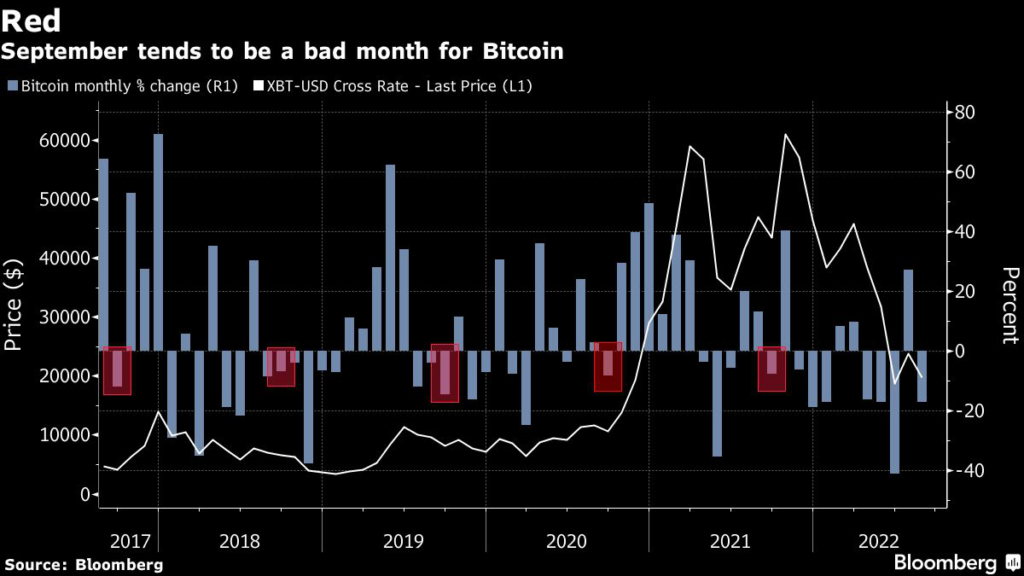
The decline on the first day of September doesn’t bode well for the bellwether coin. The ninth month of the year has historically been one of the worst for Bitcoin, which has fallen every September since 2017. Bitcoin has averaged an 8.5% drop for the month over the past five years, according to Bespoke Investment Group.  

Bullish market participants say the price decline is already being viewed as a buying opportunity for some investors. 

“Under the hood, moreover, I think you’re seeing institutions gobble up coins when BTC drops below $20,000,” said Krugljakow.

More stories like this are available on bloomberg.com

©2022 Bloomberg L.P.

Instacart Buys AI Pricing Platform Eversight in Enterprise Push

(Bloomberg) — Instacart Inc. is acquiring Eversight Inc., a platform that helps retailers and packaged-goods brands determine pricing and set promotions, as it seeks to expand its technology offerings to grocers.

Terms of the deal weren’t disclosed in a statement on Thursday. 

“When it comes to grocery shopping, we know that every dollar matters. With higher inflation and the average cost of groceries up, we’re taking even more steps to make food and daily essentials more affordable,” Chief Executive Officer Fidji Simo said in the statement. 

Combining Eversight’s technology, which automates processes that have traditionally been manual and time-consuming, with Instacart will help offer more value for brand and retail partners and help maximize savings for customers, Instacart said. Palo Alto, California-based Eversight was valued at $54 million in 2019 and had raised a total of $27.7 million in funding, according to PitchBook.

Instacart, a pioneer in grocery delivery, has been looking for ways to tap revenue streams outside of its consumer-facing marketplace app, which boomed during Covid but has since seen the pace of sales moderate. 

In March, Simo, a former Facebook veteran, said she sees advertising eventually accounting for the majority of Instacart’s revenue with the grocery delivery business breaking even. Simo said the company’s advertising business grew “close to triple digits” last year and will be “very important” to Instacart’s future financial model.

Simo has honed Instacart’s focus on being a technology supplier for supermarkets since taking the helm last year and has said its enterprise business, Instacart Platform, will play a key role in the company’s next chapter. 

The San Francisco-based company is preparing for an initial public offering, which could happen as soon as this year Bloomberg has reported, despite a slow year for IPOs and volatile public markets. Earlier this year, Instacart slashed its valuation by almost 40% to about $24 billion. 

Instacart, which relies on an army of more than 600,000 gig workers for its core-grocery delivery app, has sought ways to make its operations more efficient. The company has also been expanding into the retail sector. This month, Instacart launched a new service that allows customers to order same-day delivery for large items, including furniture and electronics from certain stores.

More stories like this are available on bloomberg.com

©2022 Bloomberg L.P.

Bed Bath & Beyond Pushes Fragile Market With Share Sale Plan

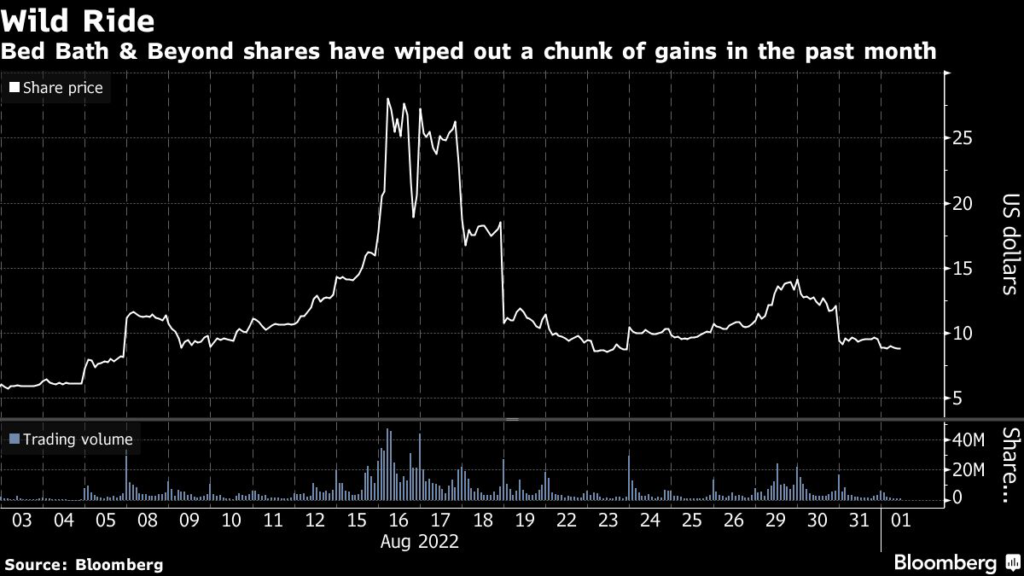
(Bloomberg) — Bed Bath & Beyond Inc. is testing the loyalty of its most ardent retail investors with plans to sell new shares as the roller coaster that is its stock price lurches downhill.

The home-goods retailer on Wednesday filed to sell up to 12 million common shares as part of a move to enhance liquidity as it fights to survive. The plan comes after the stock plunged 70% from an August high when activist investor Ryan Cohen dumped his investment and made off with millions.

The new offering was part of a financing overhaul praised by analysts as an effort to buy the struggling company a bit of time while it seeks to revamp its offerings amid plummeting sales. Still, the retailer’s flailing revenues are likely to make traders more than a little cautious about piling into the stock. Shares have fallen 27% in the two days since the announcement.

“Bed Bath & Beyond has enhanced its liquidity position and is making more aggressive cuts to align its cost structure with the lower sales level,” Telsey Advisory Group analyst Cristina Fernández wrote in a note. “But there has been no positive change in direction in its sales trend in recent months.”

Now, Bed Bath & Beyond faces a crucial holiday season with the overwhelming majority of analysts recommending investors sell the stock. The average 12-month price target implies additional downside of 46% from Thursday’s $8.82 level. 

The company “may have saved itself from a restructuring scenario,” said Joseph Acosta, partner in the bankruptcy practice at law firm Dorsey & Whitney. “But if the holiday season does not go well or their capital raise does not produce the anticipated results, we might be talking about reorganization again in the late fall or early spring.”

It’s a playbook that’s been replicated often over the past two years as the speculative mania born from no-fee brokers and social-media chatrooms offered life to struggling firms. However, when other retail-trader favorites pushed shares onto investors, global markets were in a much more stable place.

GameStop Corp. raised more than $1 billion by selling shares in an at-the-market offering offering program last summer when the S&P 500 Index was at a record high. AMC Entertainment Holdings Inc. sold more than 200 million shares from the end of 2020 through the first half of last year as retail traders flocked to the struggling movie-theater operator. Beleaguered retail company Express Inc., which was caught up in the meme stock craze, tapped the historically unusual strategy of selling shares directly into the open market last summer.

The difference for Bed Bath & Beyond is that it’s selling into a renewed slump in its stock price in the past two weeks. 

Still, the company is likely to find support from retail investors. Despite the wild ride in so-called meme stocks, a recent MLIV Pulse survey showed the phenomenon is here to stay. 

Read more: Meme Stock Mania Will Live On Despite Wild Swings: MLIV Pulse

Retail traders snapped up a record $337 million of Bed Bath & Beyond shares in August, data from Vanda Research show, with touts on internet forums spiking.

More stories like this are available on bloomberg.com

©2022 Bloomberg L.P.

Bed Bath & Beyond’s Share Sale Tests Boundaries of Retail Frenzy

(Bloomberg) — Bed Bath & Beyond Inc. is testing the loyalty of its most ardent retail investors with plans to sell new shares as the roller coaster that is its stock price lurches downhill.

The home-goods retailer on Wednesday filed to sell up to 12 million common shares as part of a move to enhance liquidity as it fights to survive. The plan comes after the stock plunged 70% from an August high when activist investor Ryan Cohen dumped his investment and made off with millions.

The new offering was part of a financing overhaul praised by analysts as an effort to buy the struggling company a bit of time while it seeks to revamp its offerings amid plummeting sales. Still, the retailer’s flailing revenues are likely to make traders more than a little cautious about piling into the stock. Shares have fallen 27% in the two days since the announcement.

“Bed Bath & Beyond has enhanced its liquidity position and is making more aggressive cuts to align its cost structure with the lower sales level,” Telsey Advisory Group analyst Cristina Fernández wrote in a note. “But there has been no positive change in direction in its sales trend in recent months.”

Now, Bed Bath & Beyond faces a crucial holiday season with the overwhelming majority of analysts recommending investors sell the stock. The average 12-month price target implies additional downside of 46% from Thursday’s $8.82 level. 

The company “may have saved itself from a restructuring scenario,” said Joseph Acosta, partner in the bankruptcy practice at law firm Dorsey & Whitney. “But if the holiday season does not go well or their capital raise does not produce the anticipated results, we might be talking about reorganization again in the late fall or early spring.”

It’s a playbook that’s been replicated often over the past two years as the speculative mania born from no-fee brokers and social-media chatrooms offered life to struggling firms. However, when other retail-trader favorites pushed shares onto investors, global markets were in a much more stable place.

GameStop Corp. raised more than $1 billion by selling shares in an at-the-market offering offering program last summer when the S&P 500 Index was at a record high. AMC Entertainment Holdings Inc. sold more than 200 million shares from the end of 2020 through the first half of last year as retail traders flocked to the struggling movie-theater operator. Beleaguered retail company Express Inc., which was caught up in the meme stock craze, tapped the historically unusual strategy of selling shares directly into the open market last summer.

The difference for Bed Bath & Beyond is that it’s selling into a renewed slump in its stock price in the past two weeks. 

Still, the company is likely to find support from retail investors. Despite the wild ride in so-called meme stocks, a recent MLIV Pulse survey showed the phenomenon is here to stay. 

Read more: Meme Stock Mania Will Live On Despite Wild Swings: MLIV Pulse

Retail traders snapped up a record $337 million of Bed Bath & Beyond shares in August, data from Vanda Research show, with touts on internet forums spiking.

More stories like this are available on bloomberg.com

©2022 Bloomberg L.P.

EU Wants Telecom Companies to Prove Netflix, YouTube Should Pay for Traffic

(Bloomberg) — The European Commission wants telecom companies to provide evidence that streaming sites such as Netflix Inc. and Alphabet Inc.’s YouTube should pay for the additional traffic sent over their networks, according to a document seen by Bloomberg. 

The commission plans to ask telecommunications companies how much traffic has increased in the past three years, where it’s coming from and what the higher demand is costing them, according to a draft of the questionnaire from early April. 

A commission spokesperson declined to comment.

Some European Union officials have been gearing up to propose a “fair share” remuneration policy that would require companies that produce streaming videos and other data-heavy applications to pay telecom operators for the amount of traffic they send over networks. Telecom companies would then re-invest that money to upgrade their infrastructure. 

Read More: Vestager’s Idea for Tech to Pay Telecom Costs Gets More Pushback

The idea has sparked a fierce debate in Europe, with parliamentarians and open internet campaigners raising concerns alongside the tech giants that these rules could hurt net neutrality, creating a two-tiered internet. 

EU countries including Germany and the Netherlands urged the commission this summer to wait for a final analysis from the EU’s telecom regulating body, as well as open consultations with the bloc’s members and the public, before moving ahead with a proposal, according to another document previously reported by Bloomberg. 

Other countries like France and Italy increased pressure on the commission to move ahead with a remuneration proposal, according to a Reuters report last month.

The questionnaire will also ask the tech companies how much their own costs have increased and to describe their relationships with telecom operators and whether there are any signs of “market failure” in how content is delivered on networks. 

The commission has yet to send the list of questions to companies, a person familiar with the plans said. The EU’s largest telecom companies include Telefonica SA, Vodafone Group Plc, Deutsche Telekom AG and Orange SA.

A final proposal will be ready at the end of this year or beginning of 2023 at the earliest, and the commission plans to finalize the questionnaire in the coming weeks, the person said, asking not to be identified because the plans are still private.  

More stories like this are available on bloomberg.com

©2022 Bloomberg L.P.

GM’s Cruise Recalls 80 Self-Driving Cars Due to Risk of Crash

(Bloomberg) — General Motors Co.’s Cruise self-driving car unit has recalled an older version of software used by its robotaxis at the time of a crash in San Francisco in June, according to federal transportation regulators. 

Cruise has updated the automated driving system, or ADS, software and all affected vehicles were repaired in July, the National High Traffic Safety Administration said in a report posted early Thursday on its website. The issue centered on situations in which the driverless cars turned left at traffic signals without a green arrow light.

“The software may, in certain circumstances when making an unprotected left, cause the ADS to incorrectly predict another vehicle’s path or be insufficiently reactive to the sudden path change of a road user,” the report said. 

Cruise won permission from the California Public Utilities Commission on June 2 to charge fares late at night for its robotaxi service. The next day, one of its cars collided with a Toyota Prius while trying to make an unprotected left turn. The Prius driver was driving 40 miles an hour in a 25 mph zone. 

Read more: GM’s Cruise Plots Quick Expansion After Debuting Robotaxi Fares

The incident prompted both NHTSA and Cruise’s board to start asking questions, resulting in the recall filing. Cruise no longer uses that version of software, which was in use in 80 of its cars at the time of the accident.

“We submitted this voluntary filing in the interest of transparency to the public,” Cruise spokeswoman Hannah Lindow said in an email. “It pertains to a prior version of software and does not impact or change our current on-road operations.”

Separately, Cruise also has had to make fixes to its self-driving system after about a dozen cars all stopped in the same intersection in San Francisco, hemming other motorists in while the company sent employees to retrieve the cars.

Related: GM Wants to Test Self-Driving Car With No Steering Wheel, Pedals

More stories like this are available on bloomberg.com

©2022 Bloomberg L.P.

Nvidia Tumbles After New US Rule Threatens Chip Exports to China

(Bloomberg) — Nvidia Corp. fell the most in more than two years on Thursday after warning that new rules governing the export of artificial-intelligence chips to China may affect hundreds of millions of dollars in revenue.

The stock dropped as much as 12% to a low of $132.76 following the disclosure Wednesday that Nvidia’s A100 and forthcoming H100 products will require approval from the US government before they can be sold to Chinese customers. It was the biggest intraday decline since March 2020, around the start of the pandemic.

In a separate filing on Thursday, Nvidia said the US government has authorized it to “perform exports needed to provide support for US customers of A100 through March 1, 2023.” Nvidia has also been granted permission to transfer necessary technology to China for the development of its upcoming H100 products. These exports are authorized to be conducted through the US chipmaker’s Hong Kong facility through Sept. 1, 2023, according to the filing. 

That statement did little to assuage investors, who fear a big chunk of Nvidia’s sales are at risk. The company warned in its initial statement that the restrictions may cost it $400 million in revenue this quarter. The time limitations laid out in Thursday’s filing — as well as the fact there was no mention of any license for Chinese customers — suggested the US government is determined to clamp down on access to technology it deems could be misused for military purposes. 

Nvidia relies on the Asian country for about a quarter of its revenue, and the temporary easing likely doesn’t allow it to sell the chips to some of the biggest buyers of that type of technology — Chinese hyperscalers, companies that operate giant data centers full of server chips. 

What the easing does do is crucially allow Nvidia to use Chinese engineers and operations to complete development of its H100 chip, its latest piece of technology for the market.  

“If Nvidia is unable to complete H100 development, the knock-on effects would likely be much larger than the direct revenue exposure in the current quarter,” Matt Ramsay, an analyst at Cowen & Co., wrote in a report. 

Read more: Nvidia gives weak forecast, adding to concerns of chip slump

“We are working with our customers in China to satisfy their planned or future purchases with alternative products and may seek licenses where replacements aren’t sufficient,” the company said on Wednesday. “The only current products that the new licensing requirement applies to are A100, H100 and systems such as DGX that include them.”

US companies are under increasing government scrutiny over their dealings with China, the largest market for semiconductors, amid a growing rivalry between the world’s two largest economies. The US is trying to limit China’s access to technology, arguing that the country represents a security risk. China, in turn, is trying to build its own domestic capabilities to make itself less dependent on the US, which still dominates the design and development of the crucial technology.

Advanced Micro Devices Inc. said Wednesday that it received a similar notice from the government, though it doesn’t expect a significant impact. “At this time, we do not believe that shipments of MI100 integrated circuits are impacted by the new requirements,” the company said in a separate statement.

According to Nvidia’s Wednesday filing, the government’s new rules specify chips with certain performance capabilities.

The rules apply to both China and Russia, though Nvidia and AMD no longer sell to Russia.

More stories like this are available on bloomberg.com

©2022 Bloomberg L.P.

Sunny Hostin of The View Shares How to Plan the Perfect Vacation

(Bloomberg) — At Bloomberg Pursuits, we love to travel. And we always want to make sure we’re doing it right. So we’re talking to globe-trotters in all of our luxury fields—food, wine, fashion, cars, real estate—to learn about their high-end hacks, tips, and off-the-wall experiences. These are the Distinguished Travel Hackers.

Sunny Hostin, 53, has spent the last six years sparring with everyone from Meghan McCain to Whoopi Goldberg as a regular panelist on ABC’s The View, which returns for Season 26 on Sept. 6. The New York City-born lawyer and former federal prosecutor started her broadcasting career on Court TV and Fox News before being poached by CNN to be one of its resident legal eagles. She jumped to Disney-owned ABC and became a co-host of The View in 2016, and has since become a staple of daytime TV.

When she’s not on TV or in Westchester, N.Y., with her husband Emmanuel and their two children, Hostin travels some 250,000 miles per year. Her airline of choice? JetBlue—especially its business class, Mint. “When I’m flying to the West Coast, which is kind of often, I only fly Mint because you get that little—it’s almost like your own pod,” Hostin says. “The last time I was on it, John Kerry was on with me.”

When you book a trip, check whether the arrivals airport offers this paid-for service.

Starting your vacation and leaving your vacation, these are two really important times: You’re looking forward to having a wonderful time, or you know you have to get back to reality. You don’t want to spoil it, so try to have a greeter that meets you at the airplane door. They take you through customs, and everything’s sort of fast-tracked. It’s a concierge-level service that means your vacation starts right there and then. We just did it in the Turks and Caicos and again in Cabo, Mexico—and we were on to our vacation, Champagne in hand, within 10 minutes of getting off the plane. It’s a time saver, but it’s also a peace-of-mind saver. I don’t want to travel any other way now; it’s such a treat.

Related:  Flight Cancelled? You May Be Eligible for Meal, Hotel Options

Extend  your wardrobe with  this easy-to-use device.

I refuse to go anywhere without my True & Tidy steamer. You must have one. A lot of hotels certainly don’t have them, and even if they have a steaming service, I like to do it myself. It means I don’t have to check any luggage, and I can still wear fabulous things. I can wear linen. It lets you refresh clothes, so all you need is a carry-on.

Planning a major group getaway? This is how to  guarantee it won’t go awry.

I take a trip with a group of women in media every year, Black women in media, like Angela Rye and Tiffany Cross. This year, they chose Turks and Caicos. And they know how to do it well: They basically send someone in advance to check things out. They do this huge reconnaissance. So if you’re going with a group and want nothing to go wrong, do that. The meals can be pre-planned—everyone’s food allergies and beverage of choice. It makes it such a wonderful trip.

Why you should feel good snagging that aisle seat.

You’re doing God’s work in the aisle seat. I didn’t like to interrupt people when I was in the window seat. I was told there were some studies done by psychologists that it’s actually the least-selfish seat on the plane.

If you want to meet locals, follow Hostin’s schedule …

I’m naturally a night owl, but I have to get up really early for my show. So if I can stay up until 3 a.m. when I’m traveling, I’m in my happy place. (Have plenty of cocktails.) Bali and Vietnam were both great really late at night, and so was Hong Kong. At first, the bar there was filled with expats, but around 1 or 2 a.m., it became packed with folks from Discovery Bay, I guess—people who lived on houseboats. It was the best time ever. No question: The later it gets somewhere, the more local it is, which is why it’s worth staying up. The locals are waiting for the visitors to leave.

… and also this attitude.

I love meeting new people, which I think is a requirement to really get the full experience of travel, not just seeing new places. My son has that wanderlust as well. I can’t keep him home. He just came back from a gap year in South Africa; I doubt he will live in the States permanently. And my daughter is the opposite. She’s like a homing pigeon. She just likes to be here. But it’s easier as a woman to meet locals. My husband says I smile a lot, and that’s why I’m so approachable—I mean, yeah, I have very big teeth, a big smile. I remember we went to Spain to visit my husband’s family (he’s originally from there) and we went to a little medieval town, Medinaceli, that’s like, stuck in time. And I met this older Spanish woman, and we spoke for probably two hours.

Related:   As Global Entry Delays Hit 18 Months, Travelers Are Steered to TSA PreCheck

Even such an inveterate traveler as her has places she’s missed out on—and for unusual reasons.

Japan is top of my list of places to go that I’ve never been. I got into a program in college, and a scholarship to study in Japan for a year. And then I met a guy who was a little dumb and couldn’t get into that program. And I decided not to go, so I could spend the summer basically with him—it’s one of my life’s big regrets. So I’ve promised myself I would go there, but I haven’t had the time. I’d really like to go for a month.

The best sense-memory souvenir to bring back home.

I love hot sauce! So when I go to different countries, if there’s a hot sauce that’s just made there and you’re not going to be able to get on Amazon or whatever, I generally bring that back, so I get a little taste of where I was—like this incredible oil. It only requires a drizzle, but it changes the flavor of any bit of food. [Editor’s note: Just remember to pack it in your luggage; most hot sauce bottles exceed the carry-on allowance for liquids.]

Hostin starts glowing when she talks about Puerto Rico.  

Puerto Rico is fully recovered from Hurricane Maria now. I was there in April. You feel like you’re in a different country, but it’s still part of the United States. And there’s a way to do it luxuriously: Stay at the Ritz-Carlton Reserve on Dorado Beach, with a butler, a bartender, and a chauffeur, in one of the villas that are owned and rented out. Then go to Luquillo beach, which has the phosphorescent bay. Go very late at night for a tour on a beautiful boat, and have a lobster dinner. Then they give you these crystal glasses to put into the water, and when you pour it out? It looks like liquid fire.

Related:  Where You Can Travel Now Without a Covid Vaccine or Test

How the British capital stoked a lifelong love of adventure—and a hearty skepticism to common wisdom.

The first trip I took without my parents was when I went to London to study. I learned about myself that I’m quite an adventurer and I like traveling alone. I have never minded sitting at a restaurant alone with a book. And I’m quite the barfly as well. I enjoy my own company. I’m there as a Puerto Rican, African American woman, and I’m living on Albemarle Street in Mayfair. It was fine, but I see all these Black folks kind of walking around and wondered: Where are they hanging out? People were explaining to me that Black people have been part of the UK, and of London, forever. I heard you couldn’t go to Brixton, because it was so dangerous, but as someone that grew up in the Bronx, I was like, it can’t be more dangerous than that. And it wasn’t at all—it was great: the reggae clubs, the food. My night owl self loved every second of it.

More stories like this are available on bloomberg.com

©2022 Bloomberg L.P.

Stocks Drop as Robust Data to Keep Fed Aggressive : Markets Wrap

(Bloomberg) — US stocks sank for a fifth day and a measure of the dollar surged to a record after data showed the American economy remained robust last month even as the Federal Reserve stepped up its inflation battle.

The S&P 500 dropped more than 1% to start September, the two-year Treasury yield topped 3.5% and the dollar rallied on speculation the latest data will force the Fed to raise rates by three-quarters of a percentage point at its meeting later this month. Risk assets had been under pressure over night after China put the megacity of Chengdu under lockdown, delivering a blow to economic growth.

US manufacturing growth steadied in August, while jobless claims came in lower than estimated, adding to a flurry of data this week that show the American economy can likely withstand additional harsh central bank tightening. Investors on Friday will receive the last reading on unemployment before the Fed’s next meeting. August inflation data is due Sept. 13.

“The market got ahead of itself thinking that the Fed was going to be able to cut interest rates next year because of some of the softening in inflation data,” said Megan Horneman, chief investment officer at Verdence Capital Advisors. Central bank officials quashing hopes of a dovish pivot drove a “pretty big shift in expectations for interest rates, not this year, per se, but really next year,” she said.

Stocks are also entering a month that is often poor for returns, following losses in August. The S&P 500 has averaged declines of 0.6% and 0.7% for August and September, respectively, over the past 25 years.

“Right now you have to be patient,” Horneman said. “I wouldn’t try and get in the middle of this kind of reset and re-pricing we’ve seen. The markets can move pretty violently.”


Chengdu’s lockdown continues to ripple through the economy. Factory slowdowns in Europe and Asia also reflect dwindling demand.

Investors are also assessing political risks as Russia’s invasion of Ukraine continues and tensions in Taiwan mount, with the latter shooting down a civilian drone after weeks of complaints about incursions by unmanned aerial vehicles from China.

Russia is considering a plan to buy as much as $70 billion in yuan and other “friendly” currencies this year to slow the ruble’s surge, before shifting to a longer-term strategy of selling its holdings of the Chinese currency to fund investment. 

“The Fed effect is now melding with other global factors such as China’s growth slowdown and Europe’s stagflation to create a more fraught global macro environment with higher rates and lower growth,” said Alvin Tan, strategist at RBC Capital Markets in Singapore. “It is this combination of hawkish central banks led by the Fed, China’s slowdown and Europe’s stagflation that is now driving volatility across global markets.”

Here are some key events to watch this week:

  • ECB Governing Council members due to speak at event Tuesday through Sept. 2
  • US nonfarm payrolls, Friday
  • UK leadership ballot closes Friday. Winner announced Sept. 5

Will Chinese sovereign bonds outperform Treasuries? China is the theme of this week’s MLIV Pulse survey. Click here to participate anonymously.

Some of the main moves in markets:

Stocks

  • The S&P 500 fell 1.1% as of 11:29 a.m. New York time
  • The Nasdaq 100 fell 2%
  • The Dow Jones Industrial Average fell 0.5%
  • The Stoxx Europe 600 fell 1.7%
  • The MSCI World index fell 0.6%

Currencies

  • The Bloomberg Dollar Spot Index rose 0.7%
  • The euro fell 1.2% to $0.9937
  • The British pound fell 0.8% to $1.1532
  • The Japanese yen fell 0.7% to 139.95 per dollar

Bonds

  • The yield on 10-year Treasuries advanced seven basis points to 3.26%
  • Germany’s 10-year yield advanced three basis points to 1.57%
  • Britain’s 10-year yield advanced nine basis points to 2.89%

Commodities

  • West Texas Intermediate crude fell 2.8% to $87.02 a barrel
  • Gold futures fell 1.1% to $1,707.70 an ounce

More stories like this are available on bloomberg.com

©2022 Bloomberg L.P.
Bankrupt Celsius Seeks to Return $50 Million of Locked Crypto

(Bloomberg) — Celsius Network Ltd., the bankrupt cryptocurrency lender, is seeking to give coins back to a sliver of users who are locked out of their accounts. 

The company asked for a US bankruptcy judge’s permission to release about $50 million worth of cryptocurrency stuck on the platform in so-called custody accounts, which were designed to store digital assets rather than generate returns. A full hearing on the request is set for October 6, according to court papers. 

The move highlights a split among the many thousands of users burned by the company’s bankruptcy. Those who deposited crypto with the goal of earning interest on their holdings signed over their ownership of the coins to Celsius, according to the company, while those who only stored their assets on the platform technically retained title to the coins. 

  • Read more: Celsius Network’s Mess Gets Even Messier

The roughly $50 million Celsius is seeking to return now is just a fraction of the more than $200 million trapped in custody accounts on the platform. That’s because many users shifted their holdings from interest-bearing accounts into custody arrangements shortly before the bankruptcy, which may allow Celsius to assert ownership over the coins, a lawyer for Celsius told US Bankruptcy Judge Martin Glenn in a Thursday hearing. 

The custody accounts are also just a tiny slice of the crypto users haven’t recovered from Celsius. The market value of assets in so-called earn accounts totaled about $4.2 billion as of July 10, according to court papers. 

The bankruptcy case is Celsius Network LLC, 22-10964, US Bankruptcy Court for the Southern District of New York (Manhattan).

  • Read more: Quebec’s Caisse Writes Off Celsius, Saying Bet Was ‘Too Soon’

More stories like this are available on bloomberg.com

©2022 Bloomberg L.P.

Close Bitnami banner
Bitnami