Bloomberg

Ransomware Attack Sends Montenegro Reaching Out to NATO Partners

(Bloomberg) — Montenegro is getting support from US and other allies in fending off cyberattacks against its information systems and electronic services at a time of political turmoil.

Hackers targeted websites and databases of the smallest former Yugoslav republic with the “Cuba” ransomware and a new virus named “Zero Date,” Montenegro’s Public Administration Minister Marash Dukaj said in Facebook video. Montenegro joined the North Atlantic Treaty Organization in 2017 after ending close ties with Russia.

Most government websites have been temporarily disabled as a precaution, he said. 

FBI’s rapid-response Cyber Action Team is expected in Montenegro to help deal with the attacks, in “another proof of excellent cooperation between the United States of America and Montenegro,” Interior Ministry Filip Adzic said on a Facebook page, after meeting FBI officials in the US.

“Montenegro is not alone in this situation, our NATO partners are with us,” Dukaj said.

Officials are focused on stopping “criminal groups” from conducting such hacks, he said. 

Dusan Polovic, Montenegro’s cybersecurity chief, told news outlets that citizens’ personal data hadn’t been compromised. 

He didn’t name Russia as the culprit, but state broadcaster RTCG cited sources at the Balkan nation’s security agency, ANB, as saying that Russia was behind the attack, prompting the government to ask US and other NATO allies for protection.

The US Embassy in Montenegro on Aug. 26 warned of a “persistent and ongoing” hack affecting the country.

The European Union also pledged expert support to the country that has for years sought to join the bloc.

“EU wants to see Montenegro protected from cybersecurity threats,” EU ambassador to Montenegro, Oana Kristina Popa said in a tweet.

The EU is also backing a “multicountry project aimed at strengthening cyber resilience in Montenegro” that includes sending experts to help protect its critical infrastructure.

More stories like this are available on bloomberg.com

©2022 Bloomberg L.P.

Flutterwave Obtains Key License in Nigeria Ahead of Planned IPO

(Bloomberg) — Flutterwave Inc., an Africa-focused financial technology firm, obtained a switching and processing license for electronic payments in the continent’s biggest market Nigeria as it seeks to expand across the region. 

The permit from Nigeria’s central bank enables Flutterwave to process fund transfers between banks and fintechs, handle card transactions, participate in agency banking and engage in other payment services without an intermediary, it said in emailed statement on Thursday. 

The license comes at at time when the Lagos and San Francisco-based firm is planning an initial public offering on the Nasdaq while battling allegations of financial misconduct, including claims of money laundering in Kenya and irregularities related to stock options and bullying of staff in Nigeria, its biggest market. 

Flutterwave, valued at more than $3 billion and backed by B Capital Group and Tiger Global Management LLC, plans to use the funds raised during the IPO to expand operations in its existing markets and enter new ones in Africa. 

Read: Africa Unicorn Maps Nasdaq IPO Unfazed by Regulatory Hurdles

This is “an important milestone in our growth story,” Oluwabankole Falade, Flutterwave’s chief regulatory and government affairs officer, said in the statement. “As a switch, we have more responsibilities and will continue to work with regulators to ensure we meet and exceed their expectations.”

More stories like this are available on bloomberg.com

©2022 Bloomberg L.P.

Unnamed Public CEO Was the Victim of Catfishing Scheme, Federal Prosecutors Say

(Bloomberg) — The chief executive officer of a publicly traded company was the victim of an extortion and catfishing scheme that targeted wealthy, high-profile men, according to federal prosecutors in New York.

Neither the CEO nor his company was identified in a statement Thursday by the US Attorney’s Office announcing the arrest of a New York woman on extortion and cyberstalking charges. 

“No one should have to fear public humiliation and financial loss from the release of personal, private information,” US Attorney Damian Williams said in the statement. 

A 34-year-old Bronx woman, who was arrested Wednesday, made numerous intimidating messages to the CEO and threatened to release photos and explicit communications in an attempt to get payouts, according to the indictment. 

The woman had targeted others as part of an alleged blackmail and extortion scheme, FBI Assistant Director Michael Driscoll said in the statement. 

She faces as much as 20 years in prison if convicted of extortion, and as much as five years on the other counts. 

The case is US v Blackwood, 22-cr-460, US District Court, Southern District of New York (Manhattan.)

More stories like this are available on bloomberg.com

©2022 Bloomberg L.P.

Zuckerberg Targeted by House GOP Eager to Probe Hunter Biden

(Bloomberg) — House Republicans are demanding that Meta Platforms Inc. Chief Executive Officer Mark Zuckerberg hand over FBI warnings and communications that led Facebook to suppress stories about President Joe Biden’s son weeks before the 2020 election.

More than 30 Republicans told Zuckerberg in a letter Thursday that it “is highly troubling” that the technology giant limited distribution of a 2020 New York Post article about Hunter Biden, his laptop “and allegations of Biden family corruption.”

Zuckerberg mentioned the incident in an interview last week with podcaster Joe Rogan.

The letter, signed by Representatives Jim Jordan of Ohio, the top Judiciary Committee Republican, James Comer of Kentucky, the top Oversight and Reform Committee Republican, and 33 colleagues provides another indication that the GOP will focus heavily on Hunter Biden if the party gains control of the House — and with it committee subpoena power.

That also presents a risk for US tech companies that are reviled by conservatives who accuse them of limiting the reach of some right-wing users. Republicans are expecting to win the House majority in November’s midterm elections, which means GOP-led committees could compel executives to testify in public hearings and demand internal documents beginning next year.

During the 2020 presidential campaign, President Donald Trump’s personal lawyer, Rudy Giuliani, released materials to some news outlets purportedly from a laptop that Hunter Biden had left at a Wilmington, Delaware, repair shop. Trump’s campaign alleged the materials, the origin of which wasn’t verified by Bloomberg News, undercut Joe Biden’s claims that he and his son never discussed overseas business dealings.

The GOP letter comes as some of Trump’s most ardent supporters in Congress have leveled sharp criticism at the FBI, or even called for its funding to be cut, after the search of Trump’s Mar-Lago-Estate in Florida as part of an ongoing effort to recover classified documents removed from the White House. 

It also follows on the heels of a letter from two Senate Republicans — Chuck Grassley of Iowa and Ron Johnson of Wisconsin — seeking records relating to the FBI’s contact with Meta’s Facebook, Twitter Inc. and other social media companies relating to the Biden family, Hunter Biden’s laptop and Russian disinformation around the time of the election. 

The House Republicans, who do not currently have any authority to subpoena or otherwise compel Zuckerberg to take any action, instruct him in the letter to preserve all documents, communications, metadata and emails relating to “Facebook’s actions to interfere in free and fair election-related public disclosure.”

Zuckerberg last week told Rogan that the FBI advised his company before the 2020 election to be vigilant for polarizing Russian propaganda or misinformation content.

In his interview, Zuckerberg didn’t say that the FBI specifically pointed to the Post article that alleged Hunter Biden’s laptop contained emails that indicated Joe Biden used his influence when he was vice president to help his son’s business dealings.

But Zuckerberg said it fit the “pattern” of the FBI’s warnings. As a result, Facebook decreased distribution of the news for five or six days, though people could still share it. 

“Basically the ranking and news feed was a little bit less, so fewer people saw it than would have otherwise,” Zuckerberg said. 

Meta spokesperson Andy Stone pointed to the company’s tweets after Zuckerberg spoke with Rogan, reiterating that the FBI’s warning was general in nature — and already public. Zuckerberg made similar comments when he testified before Congress in 2020. 

In their letter to Zuckerberg, the Republicans demand all documents since Oct. 1, 2020, between any Facebook employees and the FBI referring or tied to the Post’s reporting on the Biden family. In addition, they want any such documentation of Facebook contact with the Biden presidential campaign or Democratic National Committee regarding the Post’s reporting.

The FBI was led then — as it is now — by Christopher Wray, who was appointed by Trump in 2017. Trump and Wray, however, sparred over the agency’s inquiries into Russia and other matters.

In their letter, the House Republicans also demand any material on the FBI’s more-general warnings to Facebook employees about anticipated 2020 election misinformation, and Facebook’s internal responses when warned to be “on high alert” for that.

Republicans have long complained that the technology giants have censored conservative viewpoints, something the companies deny, and they will pursue that theme if they win in November. The Democrats who now control Congress also have the big technology companies in their sights, with Judiciary Chairman Jerrold Nadler considering antitrust legislation. 

(Updates with Meta comment beginning in the 14th paragraph)

More stories like this are available on bloomberg.com

©2022 Bloomberg L.P.

US Manufacturing Growth Holds Steady, Inflation Pressures Ease

(Bloomberg) — US manufacturing growth steadied in August at the slowest pace in over two years, while a measure of materials costs declined for a fifth-straight month in a welcome sign inflationary pressures are abating.

The Institute for Supply Management’s gauge of factory activity held at 52.8, matching the lowest level since June 2020, according to data released Thursday. Readings above 50 indicate expansion, and the latest figure compared with a median projection of 51.9 in a Bloomberg survey of economists.

“Sentiment remained optimistic regarding demand, with five positive growth comments for every cautious comment,” said Timothy Fiore, chair of ISM’s Manufacturing Business Survey Committee. Still, “Panelists continue to express unease about a softening economy.”

Ten manufacturing industries reported growth for the month, led by mineral products, petroleum and transportation equipment.

The figures suggest sustained yet moderate growth in manufacturing and some additional easing in supply constraints. The industry is so far faring better than its counterparts in Europe and Asia, where the war in Ukraine and economic slowdown in China are leading to shrinking factory activity.

A weaker global economy and recession concerns have led to pullbacks in prices for oil, metals and other commodities. As a result, the ISM’s US measure of prices paid for materials used in the production process fell 7.5 points to the lowest level since June 2020. The gauge plunged 18.5 points in the prior month. 

Select ISM Industry Comments

“Demand from customers is still strong, but much of that is because there is still fear of not getting product due to constraints. They are stocking up.” – Computer & Electronics Products

“Sales in target business softening month-over-month, down 12 percent by revenue. Inventory days are increasing.” – Chemicals Products

“Strong sales continue. The impact of the chip shortage is slowing.” – Transportation Equipment

“Supply in most groups is slowly increasing, but demand appears to be outpacing — causing pricing to either stabilize or increase.” – Petroleum & Coal Products

“Overall, I have seen much improvement in the availability of raw materials. However, trucking issues continued, and production capacity within some industries remains tight.” – Nonmetallic Minerals Products

“Demand is softening; however, we are continuing to produce to replenish inventory.” – Primary Metals

“Orders are still strong through the end of the year, but there is a feeling that customers may start pulling back on orders, either cancelling them or pushing them into 2023.” – Plastics & Rubber Products

The ISM results follow regional reports painting a somewhat mixed picture of the sector. A measure of New York state factory activity plunged in August by the second-most in data back to 2001. However, gauges of manufacturing in the Philadelphia and Chicago areas improved or held up.

Supplier delivery times lengthened slightly, the ISM figures showed, yet at the slowest pace since before the pandemic. And a measure of factory inventories fell 4.2 points to a four-month low of 53.1, showing stockpiles were being rebuilt at a slower pace.

The ISM’s employment gauge, meantime, rose to a five-month-high of 54.2, suggesting more manufacturers were adding to payrolls in August.

(Adds ISM industry comments)

More stories like this are available on bloomberg.com

©2022 Bloomberg L.P.

Starbucks Workers Are Winning the Union Fight on TikTok

(Bloomberg) — The union battle at Starbucks has spread to TikTok. And the baristas are winning.

A TikTok account run by Starbucks Workers United, the group of employees aiming to unionize the world’s largest coffee chain, has taken off this month with several viral posts. One video showing employees staging a walkout after the firing of a coworker has more than 28 million views. In recent weeks, the account’s followers have ballooned from about 50,000 to more than 260,000.

Meanwhile, Starbucks has tried to counter with its own account, starting Starbucks Partners TikTok not long after the union debuted its feed late in 2021. The handle has 4,000 followers and its best-performing post generated 114,000 views.

Starbucks Workers United launched its TikTok in December, on the heels of its  first victory in Buffalo, New York. But only recently have members posted more consistently on the social media platform that has surged in popularity in recent years, especially among teens and young adults. It has paid off with nine videos surpassing a million views and comments like “no contract, no coffee” — the movement’s rallying cry — flooding the official TikTok account of Starbucks.

“At first we were kind of like: ‘No, that’s more for jokes,’” said Casey Moore, a 25-year-old Starbucks barista in Buffalo who helps run the account. “Eventually, we were like: ‘Well, why not? Starbucks is huge on TikTok.’”

The TikTok account reflects the dynamism that’s brought this campaign a level of success not seen in the history of the US labor movement, according to John Logan, a professor of labor history at San Francisco State University. Restaurant and retail chains have thwarted organized labor for decades as overall US union membership plummeted. But Starbucks workers are helping create a new template to challenge one of America’s biggest employers.

Read More: The Bitter Fight For Unions at Starbucks, One Year Later

“You can dismiss it as silly little videos, but this is the new world of organizing,” Logan said. “They’re doing things I wish the unions had been doing, frankly, for the longest period of time.”

The approval rating of unions in the US has hit 71%, the highest in nearly 60 years, with people under 40 being the biggest supporters. So-called Generation Z, whose oldest members are in their mid-20s, make up TikTok’s core audience and are increasingly turning to social media and away from traditional news sources to learn about current events.

Gen Z is important to Starbucks, too. Howard Schultz, the coffee chain’s founder who returned as chief executive officer on an interim basis in April, recently told analysts that cohort’s love of iced beverages, which they share with their followers on social media, helped drive quarterly revenue to a record $8.2 billion.

The company continues to work closely with its employees in “reimagining” the Starbucks experience, the company said in an emailed statement. “Through our collaboration sessions, direct engagement with partners and their direct feedback, we are building the future together.”

Moore and her colleagues are betting that the popularity of customers talking about their Starbucks experiences on TikTok — the #starbucks hashtag has almost 28 billion views — will help their posts. The platform’s algorithm is often considered the most adept at serving up related content that holds attention spans. What starts as seeing posts about the chain’s pumpkin spice lattes may now lead a user to videos of picket lines.

TikTok has also boosted outreach from current Starbucks workers who want to learn how to organize their stores, according to Moore. Through July, employees at 326 Starbucks locations have filed union election petitions with the National Labor Relations Board. The company has more than 15,000 US shops.

“It’s just going to be an incredibly powerful tool to raise awareness about our campaign,” Moore said. “Just like strikes are a tool, TikTok is a tool that we can use in this fight.”

(Updates follower count in deck headline and second paragraph.)

More stories like this are available on bloomberg.com

©2022 Bloomberg L.P.

Turkey’s Drone Powerhouse to Double Capacity on Foreign Demand

(Bloomberg) —

Baykar, the Turkish drone maker whose armed aircraft have been used in conflicts from Ukraine to Azerbaijan and Ethiopia, is planning to make more drones next year than in all previous years combined.

The company plans 500 of its signature TB2 unmanned aerial vehicles and 40 newer Akinci models in 2023, Chief Executive Officer Haluk Bayraktar told the state-run Anadolu Agency, citing surging foreign demand.

Both targets, which require more than double current capacity, would top the total 400 TB2s and 20 Akincis that Bayraktar said he’s made to date. The first TB2 was delivered in 2014, according to the company website.

The plans will accelerate the spread of a technology that was previously the reserve of more established arms producers like the US and Israel to countries with smaller defense budgets, and boost Turkey’s export figures.

Baykar has export deals with 24 countries, Bayraktar said without identifying them, up from 22 in August. Recent potential buyers include Malaysia and Romania. Ukraine has used Baykar drones against Russian forces, with the company donating several to its war effort.

More stories like this are available on bloomberg.com

©2022 Bloomberg L.P.

A Dozen Crypto ETFs That All Act the Same: An Industry Identity Crisis

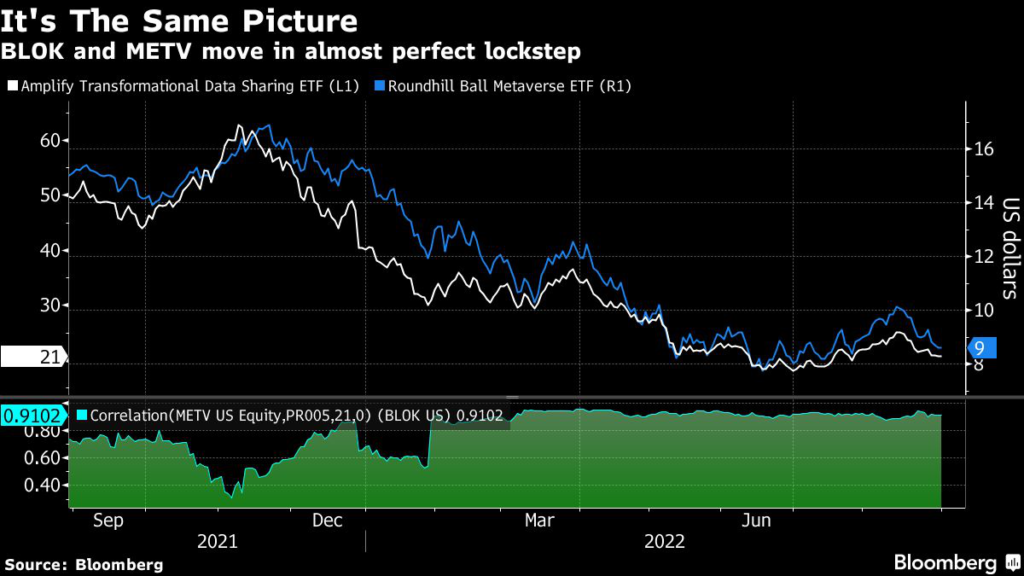
(Bloomberg) — More than a dozen crypto-linked ETFs have launched over the past two years, attempting to track everything from the metaverse to Bitcoin miners to various blockchains. However, near-perfect correlations show those attempts at differentiation have largely been futile. 

The $572 million Amplify Transformational Data Sharing ETF (ticker BLOK), the largest such fund, has a correlation of 0.9 or greater with 14 of 18 other US-listed crypto-themed ETFs, with a reading of 1 indicating perfect harmony, data compiled by Bloomberg show. The 21-day correlation coefficient between BLOK — which holds blockchain-focused companies, — and the $489 million Roundhill Ball Metaverse ETF (METV), which seeks exposure to the nascent digital world, currently stands at 0.91. 

The tight link between the crypto-flavored ETFs exposes a problem for issuers and investors alike: at the moment, trying to target specific aspects of the cryptocurrency universe largely produces a portfolio of extremely similar stocks. The issue is rooted in the fact that with so few public companies involved in digital assets, according to Bloomberg Intelligence, to the point that the holdings of an Bitcoin miners ETF ends up looking very similar to a fund ostensibly tracking firms building out the digital economy.

“There’s only so many public companies with true concentrated exposure to the crypto market that there is only so much you can do with these funds to make them differentiated,” said Bloomberg Intelligence ETF analyst James Seyffart. “It’s likely that as the industry matures and new companies enter, we will see correlations decrease.”

A slew of crypto-adjacent equity funds have set sail in the past few years as US regulators continue to reject physically backed Bitcoin ETF applications. Schwab Asset Management launched the Schwab Crypto Thematic ETF (STCE) last month after BlackRock unveiled the iShares Blockchain and Tech ETF (IBLC) in April. 

Part of the reason correlations are so high at the moment is a function of the enormous plunge in crypto, Seyffart said. Bitcoin is more than 70% below November’s all-time high. The drop coincides with a fall in the stock market as decades-high inflation and an aggressive Federal Reserve weigh on risk appetite.

As a result, the top eight worst-performing, non-leveraged equity ETFs are all crypto-linked equity funds — all of which have under $100 million in assets, according to Bloomberg data. That kind of drawdown could prompt ETF issuers to reevaluate their offerings, said VettaFi’s Lara Crigger.

“If it’s going to happen, it’s going to happen now,” Crigger said on Bloomberg Television’s “ETF IQ” program. “We’re right in the middle of the crypto winter, this is the appropriate time for some of those ETFs that may have been struggling to gain assets, maybe their issuers are taking a second look.”

More stories like this are available on bloomberg.com

©2022 Bloomberg L.P.

Almost No Stock Spared as Semiconductor Rout Spreads

(Bloomberg) — Computer sales are faltering, short sellers are ramping up bets against semiconductor stocks and the US is tightening export restrictions. For investors in the chip sector, the outlook just keeps getting darker.  

After rallying in July with the rest of tech, the shares of companies involved in the production of semiconductors are tumbling again amid a steady stream of warnings about slumping demand. The Philadelphia semiconductor index slumped almost 10% in August, about twice the loss for the tech-heavy Nasdaq 100 Index. And high flyers like Nvidia Corp. are back to flirting with lows reached two months ago.

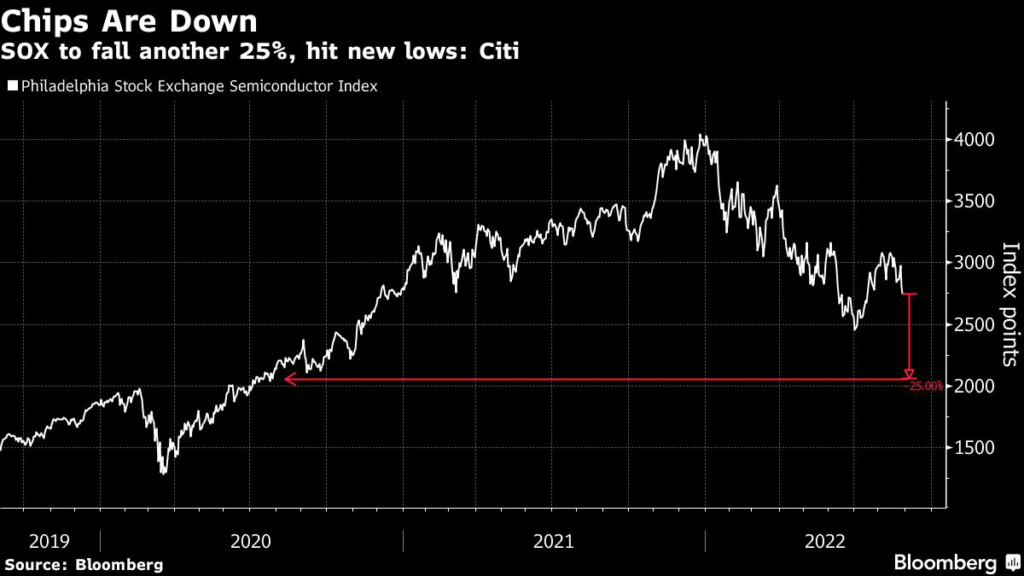
With the Federal Reserve showing few signs of letting up on interest rate hikes, some on Wall Street are predicting the pain is just getting started as chipmakers are forced to rein in production following years of boom times. Citigroup Inc. analysts said this week they expect another 25% decline for the semiconductor index, with slowing demand spreading from personal computers and handsets to cars and industrial products. 

“I think we’ll continue to see headwinds across the board through the fall,” said Michael Matousek, head trader at US Global Investors. “We may not see a turn in the cycle until the Fed starts reducing rates or at least keeping them steady.”

The chip index is down 34% from its record close on Dec. 27, with 29 of the benchmark’s 30 stocks falling in that time. Nvidia is the worst performer, losing more than half its value. Wolfspeed Inc., a maker of automotive and industrial chips, is the sole gainer, holding on to an advance of a fraction of 1%.

Seagate Technology Holdings Plc became the latest to sound the alarm on Wednesday. The biggest maker of computer hard drives cut its revenue forecast for the current quarter, citing deteriorating economic trends and “cautious buying behavior” from businesses around the world and cloud customers in the US. Dell Technologies Inc. last week gave a pessimistic outlook on the second half, warning of “more cautious customer behavior.”

Meanwhile, Nvidia pared some premarket losses on Thursday after saying it obtained licenses to provide support to US customers in China for its artificial intelligence chips, one day after disclosing it needs Washington’s approval to sell certain products to Chinese-based customers.

The pain should come as no surprise to Wall Street analysts, who have been slashing profit estimates in the sector for most of the year. Projections for 2023 earnings growth for semiconductor-related companies in the S&P 500 Index have fallen 10 percentage points since January, compared with a roughly 6-point decline for the broader tech sector, according to data compiled by Bloomberg Intelligence.

The gloom is welcome news for short sellers, who have added to bets against semiconductor stocks in recent months. Since the start of the third quarter, short interest in the US information technology sector is up $3.4 billion and about 80% of that increase is concentrated within chipmakers and equipment companies, according to data from S3 Partners.

Of course, there’s a case to be made that a lot of the bad news is already priced in to semiconductor stocks, which are approaching levels that have historically represented good buying opportunities. Priced at 15 times projected profits, the semiconductor index is below the average valuation over the past decade, according to data compiled by Bloomberg. Micron Technology Inc. and Qualcomm Inc. are among the cheapest, trading at about 10 times.

Those multiples may not be as cheap as they look, given that earnings estimates are still falling. The Citigroup analysts, Christopher Danely and Kelsey Chia, see the industry “entering the worst semiconductor downturn in a decade given the recession and inventory build.”

“We maintain our belief that every company/end market will correct and we expect the SOX index to hit new lows,” they wrote in a research note.  


Tech Chart of the Day

The Citi analysts noted that estimates fell during the second-quarter earnings season for the first time since the pandemic. A 25% decline in the semiconductor index would wipe out all the gains made during the pandemic. The SOX has fallen 32% this year through Wednesday’s close, its biggest annual decline since 2008.

Top Tech Stories

  • Arm Ltd. sued Qualcomm for breach of contract and trademark infringement, setting up a legal showdown between the SoftBank Group Corp.-owned chip company and one of its biggest customers.
  • Nvidia fell in premarket trading after warning that new rules governing the export of artificial-intelligence chips to China may affect hundreds of millions of dollars in revenue.
  • Tencent Holdings Ltd. has set a soft target of divesting about 100 billion yuan ($14.5 billion) of its $88 billion listed equity portfolio this year as it shifts strategy, the Financial Times reported, citing two unidentified people familiar with the matter.
  • Rogers Communications Inc. succeeded in extending a deadline to buy back $9.33 billion of bonds, overcoming objections from some investors about terms of the deal.
  • Alibaba Group Holding Ltd.’s Lazada Group is preparing to make its maiden foray into Europe, building on its success in Southeast Asia to take on rivals such as Amazon.com Inc. and Zalando SE in one of the biggest online shopping markets.
  • The founder of Taiwanese chipmaker United Microelectronics Corp. outlined plans to fund military training for millions of “civilian warriors” in Taiwan to fight against any potential Chinese invasion.
  • Carro, one of Southeast Asia’s biggest online marketplaces for used cars, raised close to S$200 million ($143 million) in debt financing this year, as startups worldwide vie for increasingly scarce venture capital.
  • Uber Technologies Inc. will partner with a financial technology startup to boost the number of electric vehicles in London by an additional 10,000 over the next few years, according to a statement.


(Updates with Nvidia annoucement in paragraph seven.)

More stories like this are available on bloomberg.com

©2022 Bloomberg L.P.

Twitter Launches an Edit Button for Paying Subscribers

(Bloomberg) — Twitter Inc. is launching an edit button for the first time, after years of debate both internally and externally as to whether such a feature was a good idea for a product known for making posts go viral. 

The edit feature will soon be available to users who pay $4.99 per month for a subscription to Twitter Blue. Edit Tweet, as the feature will be called, will let users make changes to their tweet for up to 30 minutes after it’s originally published. Tweets that are edited will carry a label, and others on Twitter will be able to click on the label to see prior versions of the post. 

The company  is specifically testing the edit button with a small group of users in hopes of quickly resolving possible issues, the company wrote in a blog post. The edit button will then roll out to Twitter Blue users in the coming weeks. 

Twitter has debated the pros and cons of an edit button for years, with some worried that it will be abused by people hoping to go viral, only to change the content of a message after it’s been retweeted. Former CEO Jack Dorsey said as recently as January 2020 that an edit button was highly unlikely, but it was so widely requested that the company never made a definitive call on whether it would launch something.

That debate snowballed earlier this year when Tesla Inc. CEO Elon Musk took a large ownership stake in the company, then polled his followers on whether they wanted an edit button. The majority of those who voted said yes. Twitter quickly confirmed it was already testing the feature internally, and in an apparent effort to distance the project from Musk’s influence, clarified that it started work on an edit button before Musk’s poll. 

More stories like this are available on bloomberg.com

©2022 Bloomberg L.P.

Close Bitnami banner
Bitnami