Bloomberg

China iPhone Assembler Accused of Secretly Acquiring Taiwan Tech

(Bloomberg) — Taiwanese prosecutors have indicted the head of Luxshare Precision Industry Co. for using a shell company to surreptitiously take over a key local company, ratcheting up accusations of technology theft directed at mainland Chinese companies.

Prosecutors alleged in a court filing that Luxshare Chairwoman Grace Wang used a Hong Kong firm to mask her company’s identity and buy shares in Speed Tech Corp. in 2012, according to a copy of the document seen by Bloomberg News. Taiwanese law forbids mainland Chinese companies from conducting business on the island without approval from the local authorities.

American agencies including the FBI have accused Beijing of encouraging people to steal technology that advances its own interests. Taipei sees the outflow of silicon engineers and technology to mainland companies as a key national security issue, and this year began to enforce regulations prohibiting Chinese firms from hiring away top-flight talent in sensitive sectors such as chips.

Luxshare joined the exclusive club of global iPhone assemblers in recent years, marking a seismic shift to a decade-old production model just as Washington-Beijing tensions escalated. It struck a deal to acquire Wistron Corp.’s iPhone unit and become the first mainland company to assemble Apple Inc.’s marquee device. 

Luxshare is among the largest of a crop of fast-rising Chinese electronics houses increasingly snatching Apple orders away from established firms like Hon Hai Precision Industry Co. It’s become the world’s biggest maker of AirPods — one of the fastest-selling consumer accessories in the market before Covid and a global economic downturn hammered demand for electronics.

Representatives for the company didn’t respond to requests for comment.

Read more: Engineer Charged With Stealing Chip Technology Thriving in China

More stories like this are available on bloomberg.com

©2022 Bloomberg L.P.

White House Wants NASA to Slow Hunt for Killer Asteroids in ‘Baffling’ Move

(Bloomberg Government) — Thousands of asteroids as big as the Washington Monument zip around our solar system at 40,000 miles per hour, hunks of metal or rock that could strike with 10 times the force of the most powerful nuclear weapon and kill millions of people.

Congress wants NASA to find them. The Biden administration says it can wait.

The space agency estimates there are about 25,000 asteroids of at least 140 meters in diameter near Earth’s orbit. While the odds of them crashing into our planet at any given time are minuscule, Congress directed NASA to find 90% of them by 2020. Scientists have found fewer than half.

But for reasons it has not publicly explained, the administration has proposed delaying by two years, until 2028, the launch of an infrared space telescope meant to find those threatening asteroids and sharply cutting its budget for next year. One space policy advocate called the move “baffling.”

Lawmakers have pushed back, inserting measures into key bills and calling for a faster timeline for the telescope’s funding and launch. The fight could flare up as the federal government’s Sept. 30 shutdown deadline approaches.

It also comes as NASA focuses on higher-profile missions. Artemis 1, an uncrewed Moon-orbiting mission, is slated to launch Saturday, while a separate mission to collect rock and dust samples from Mars is looming.

On Sept. 26, NASA also plans to direct a spacecraft the size of a small car to slam into an asteroid at 14,760 mph in a bid to shift its trajectory. That asteroid isn’t a threat to Earth, but the mission is the first time NASA has practiced bumping one to change its course.

Asteroid-ramming techniques won’t matter if scientists can’t find the potential threats, advocates say.

“You can’t mitigate anything unless you know it’s there,” said Amy Mainzer, a University of Arizona professor and mission director for the Near Earth Object Surveyor, the telescope being put on hold. “And we know from experience that it takes time to build and launch spacecraft. So every year that we wait—that we don’t have a good understanding of what is out there—is a year that basically makes it less likely for us to go mitigate something if we did find something.”

About 500 times a year, researchers identify asteroids of at least 140 meters in diameter near Earth’s orbit. At that size—the width of one-and-a-half football fields—they pass a semi-apocalyptic Goldilocks test.

They’re not quite as big as the 10- to 15-kilometer asteroid that led to the extinction of the dinosaurs, but there’s more of them and they’re harder to find. And they’re much more destructive than the asteroids of 20 meters or less that more frequently hit Earth.

A study published in 2019 by the National Academies of Sciences, Engineering, and Medicine concluded a 140-meter asteroid could release the equivalent of 500 megatons of TNT upon impact. That’s more than 30,000 times as powerful as the atom bomb the U.S. dropped on Hiroshima.

Such asteroid strikes happen rarely: The same report put the average interval between them at 20,000 years.

Much more frequently, Earth gets the smaller variety space objects that leave their own trail of destruction. In 2013, a roughly 20-meter asteroid broke apart about 25 kilometers above the town of Chelyabinsk, Russia, shattering windows and injuring more than 1,600 people.

Russia also was the site of the most destructive asteroid in recorded human history. In 1908, a 50- to 80-meter asteroid struck near the Podkamennaya Tunguska River and flattened more than 800 square miles of uninhabited forest.

For now, NASA is still mostly reliant on ground-based observations to spot objects of 140 meters or more. Officials also repurposed a space telescope, called NEOWISE, that was originally meant to find planets—but it’s only discovered five large asteroids this year.

The Surveyor telescope is projected to have a wider field of vision, allowing scientists to get a broader landscape of nearby asteroids, Casey Dreier, chief advocate and senior space policy adviser at the Planetary Society, said in a phone interview. And its infrared sensors will spot dark asteroids invisible to the naked eye.

“They’re like these dark, charcoal, potato-like things that are tiny, and you know generally where they could be but don’t know where they are,” Dreier said. “And if they’re moving fast, it’s hard to find them at the right time.”

‘Baffling’ Cuts

NASA spokesman Joshua Handal told Bloomberg Government the agency “will launch NEO Surveyor as early as possible,” but did not answer questions about why the administration proposed the delay.

In its annual budget justification, NASA cited its need to “support other high priority missions,” pointing to “cost growth” for its missions collecting surface samples on Mars and surveying one of Jupiter’s moons.

Mainzer said she hasn’t gotten an explanation from the administration for the proposed cuts and delay.

In conversations with congressional staff, NASA has cited the narrow launch windows for the Mars mission as one reason for changing the Surveyor’s budget and timetable, a House Republican aide said. If officials miss their deadline to launch the Mars spacecraft, they’ll have to wait another 26 months. The Surveyor doesn’t face similar constraints.

Dreier described the budget request to Congress — $39.9 million, rather than the $170 million that constitutes full funding — as “baffling.” There’s no apparent reason NASA couldn’t have simply asked for more money, rather than pitting missions against each other, he said.

By comparison, Congress allocated more than $170 million in 2022 for the National Gallery of Art, the National Agricultural Statistics Service, and the maintenance of House office buildings.

“It’s really a tiny drop in the bucket,” Leroy Chiao, a retired NASA astronaut and commander of the International Space Station, said in a Bloomberg Radio interview. “Any time you’re cutting programs, and satellite programs—whether it’s satellite programs or human spaceflight programs—it’s kind of a shame.”

There’s been a limited lobbying effort. The University of Arizona’s in-house lobbyist reported working on the issue earlier this year. CapGov, LLC, reported lobbying on behalf of Space Dynamics Laboratory. The Planetary Society and the National Space Society also sent a letter to appropriators asking them to reject proposed cuts to the program’s funding.

Philip Christensen, co-chair of a steering group that produced the decadal planetary science report for the National Academy of Sciences, Engineering, and Medicine, told lawmakers that the NEO Surveyor had been a significant focus for the panel.

“We spent a lot of time discussing it and the consensus was very much that this is an important mission,” Christensen said at a congressional hearing in May. “It’s crucial to the people here on the Earth; we need to understand and identify these objects.”

Congress Pushes Back

At the same May hearing, Rep. Brian Babin (R-Texas) questioned the proposed delay, saying the NEO Surveyor “will advance science, maintain global leadership, and protect our precious planet.”

The House and Senate Commerce-Justice-Science appropriations bills both include more money than the administration requested, but less than $170 million. They also both include language urging NASA to launch the telescope before 2028.

The recently enacted CHIPS bill on semiconductor research included language directing the NASA administrator to continue the mission “on a schedule to achieve a launch-readiness date not later than March 30, 2026, or the earliest practicable date.” But that measure includes only authorizing language rather than actual funding.

Arizona lawmakers had a hand in supporting the language. In a statement, Sen. Kyrsten Sinema (D-Ariz.) praised the program’s work “protecting our planet from dangerous asteroids and comets, boosting Arizona’s space innovation, and helping create good paying jobs.”

Despite the efforts on the Hill, the mission may have to start preparing for a two-year delay as soon as October.

Lawmakers have acknowledged they’ll rely on a stopgap funding measure to avoid a government shutdown after the Sept. 30 deadline, instead aiming for a full spending deal in November or December.

NASA and the White House Office of Management and Budget declined to say what kind of directions the NEO Surveyor mission would receive under a continuing resolution.

But if the government is funded under a continuing resolution, NASA may choose to start winding down work. Mainzer knows the project would “lose big chunks of our subcontractors” and slow to a trickle. Job cuts are possible, including at the University of Arizona, she said.

For her, the last few months have been proof that life imitates art. The professor served as a science consultant on the Netflix blockbuster “Don’t Look Up,” in which astronomers struggle to alert a distracted public to a massive comet headed toward Earth.

The most likely outcome for the Surveyor project, she said, is that her researchers do their work and don’t identify a giant asteroid that could someday hit the planet. But they won’t know until they try.

“Hopefully, there isn’t something,” Mainzer said. “And then we’ll do some nice solar system science and go on our merry way and worry about other things. Hopefully that’s the case. But hope is not a management strategy. It’s better to just go do the experiment and see what’s there.”

To contact the reporter on this story: Jack Fitzpatrick in Washington at jfitzpatrick@bgov.com

To contact the editors responsible for this story: John Martin at jmartin@bloombergindustry.com; Giuseppe Macri at gmacri@bgov.com

More stories like this are available on bloomberg.com

©2022 Bloomberg L.P.

All Eyes Are on the BlackRock-Coinbase Partnership

  • Listen to Bloomberg Crypto on the iHeartRadio App
  • Listen to Bloomberg Crypto on Apple Podcasts
  • Listen to Bloomberg Crypto on Spotify  

(Bloomberg) — BlackRock, the world’s largest asset manager, teamed up with crypto exchange Coinbase in August in a move that both Wall Street and the crypto industry are watching closely. BlackRock says the partnership will help clients more easily manage and trade their Bitcoin.  For Coinbase, it’s a validation of sorts after it suffered a record $1.1 billion dollar loss for the second quarter as crypto markets slumped. The company’s shares have fallen more than 70% this year, and it is facing regulatory scrutiny on multiple fronts.Bloomberg reporters Yueqi Yang and Silla Brush join this episode to discuss the implications of Wall Street’s latest foray into crypto.

Follow us on Twitter @crypto, and subscribe to the Bloomberg Crypto Newsletter at https://bloom.bg/cryptonewsletter  

More stories like this are available on bloomberg.com

©2022 Bloomberg L.P.

StanChart Joins Tech Giants With Singapore Digital Bank

(Bloomberg) — Standard Chartered Plc’s joint venture with an arm of Singapore’s biggest trade union group started digital banking services in the city-state, adding to rivalry in the space where tech giants are also seeking to make their mark.

Trust Bank, in which the UK firm holds 60%, is offering savings accounts, credit cards and insurance products, targeting workers and their families with benefits aimed at cushioning the pain of rising inflation, according to a statement by the firms on Thursday. Fairprice Group, which runs supermarkets and food courts across the island, holds the remaining stake in the venture along with NTUC Enterprise.

Singapore is set to see intensifying competition in financial services as the likes of Jack Ma’s Ant Group Co. and Grab Holdings Ltd. challenge the area traditionally controlled by lenders led by DBS Group Holdings Ltd., the country’s largest. For Standard Chartered, backed by state investor Temasek Holdings Pte., this will be its second digital bank in Asia, following the launch of Mox in Hong Kong in 2020. 

The Fairprice Group engages with some one million clients everyday through its various outlets, according to Trust Bank’s Chief Executive Officer Dwaipayan Sadhu. “We should be able to tap into that ecosystem,” Sadhu said at a briefing. The supermarket group has a network of close to 570 touchpoints including groceries and meal offerings.

The new digital bank will also offer automatic teller machine services primarily via Standard Chartered’s local network, he added.

Potential

The Trust Bank launch follows close on the heels of Grab and Singapore Telecommunications Ltd., which earlier said their banking app will roll out next week. That group obtained one of two full digital banking licenses in 2020 that allow deposit taking and serve both retail and corporate customers. The other license holder is Sea Ltd., which has not disclosed much details of its plans yet. Unlike the tech firms, Standard Chartered does not need such a permit because of its banking status.

The Covid-19 pandemic has prompted people to use more digital services, Deputy Prime Minister Lawrence Wong said at the Trust Bank event. “With greater digital adoption in financial services, there is much potential for the banking sector to relook how to do things differently and serve customers better,” Wong said.

Singapore joins the UK and Hong Kong in opening up to digital-only financial services, seeking to cement its position as a regional center for fintech and wealth management. 

(Adds Fairprice Group’s network in fourth paragraph)

More stories like this are available on bloomberg.com

©2022 Bloomberg L.P.

Indika Turns to Gold, Electric Bikes in Shift Away From Coal

(Bloomberg) — PT Indika Energy is scaling up investment in electric vehicle, logistics and gold mining in a gradual shift away from coal after making a fortune from surging prices of the fossil fuel.

The Indonesian miner, which posted a 1500% jump in net income in the first half, will stop investing in coal and is spending $600 million to have non-coal businesses account for half of its revenue in three years, from less than 20% currently, Group CEO Aziz Armand said in an interview Wednesday. 

Indika joins other miners in Indonesia, the world’s biggest thermal coal exporter, in expanding into clean energy amid a global push to end the use of the dirtiest fuel. PT Adaro Energy said in April it was shifting to renewable energy using the windfall profits generated from surging coal prices.

“The world’s challenge is not about economy and geopolitics but also about climate change,” Armand said. “With the global energy crisis, coal prices are good now, but will that persist for the next five or 10 years?”

Indika Liquidity Risks Evaporate on Hot Coal Prices, Asset Sales

Shares of Indika Energy have risen nearly 90% this year, in line with other Indonesian coal miners.

More detail from the interview:

  • Indika has spent $300 million to expand non-coal businesses including gold mining, logistics, solar power and electric vehicle development
  • Company is developing a mine in South Sulawesi to sell 120,000 ounces of gold each year in 2025
  • Company started selling electric motorcycles in August
  • Shift away from coal would help the company tap global financing easier, Armand said

More stories like this are available on bloomberg.com

©2022 Bloomberg L.P.
Thailand Tightens Crypto Advertisement Rules After Zipmex Freeze

(Bloomberg) — Thailand tightened rules on advertising by crypto companies, joining countries like Singapore in seeking to protect retail investors in the wake of a $2 trillion selloff in digital asset markets.  

Ads for virtual tokens must include clear and visible warnings about the risks of investing in cryptocurrencies, the nation’s Securities & Exchange Commission said in emailed statement on Thursday.  

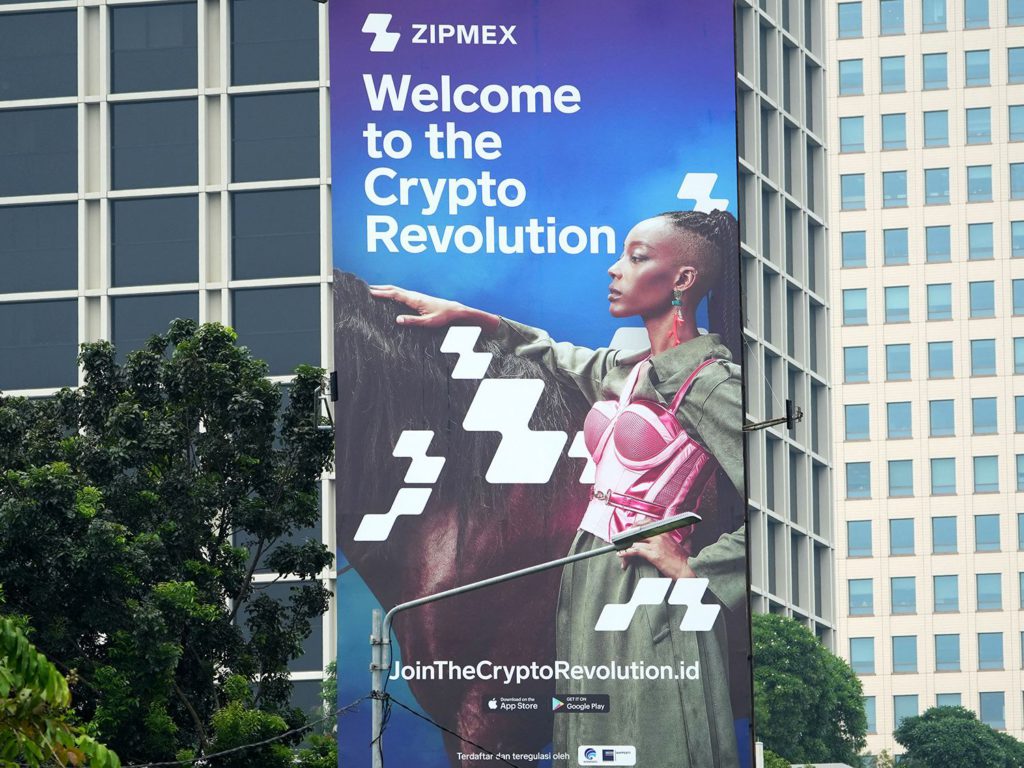
Authorities had already telegraphed their intent to put in place more protections for small investors. The new advertising rules come after Zipmex (Thailand), a locally licensed cryptocurrency exchange, and its regional parent last month halted some withdrawals. The parent, Zipmex Pte, was granted three months of protection from creditors by a Singapore court on Aug. 15. 

The SEC tightened rules after discovering that some ads contained no warnings about cryptocurrency risks, while other promotions featured only positive information, according to the statement. 

Details of the tighter crypto advertising regulations include:

  • Advertisements must not feature false, misleading or exaggerated claims
  • Warnings of risks must be clear and easy to notice
  • The ads must feature balanced views, mentioning both positive and negative factors
  • Crypto firms must limit advertising to official channels like their websites

More stories like this are available on bloomberg.com

©2022 Bloomberg L.P.
Thailand Tightens Crypto Advertising Rules After Market Rout

(Bloomberg) — Thailand tightened rules on advertising by crypto companies, joining countries like Singapore in seeking to protect retail investors in the wake of a $2 trillion selloff in digital asset markets.  

Ads for virtual tokens must include clear and visible warnings about the risks of investing in cryptocurrencies, the nation’s Securities & Exchange Commission said in emailed statement on Thursday.  

Authorities had already telegraphed their intent to put in place more protections for small investors. The new advertising rules take effect after Zipmex (Thailand), a locally licensed cryptocurrency exchange, and its regional parent last month halted some withdrawals. The parent, Zipmex Pte, was granted three months of protection from creditors by a Singapore court on Aug. 15. 

The SEC tightened rules after discovering that some ads contained no warnings about cryptocurrency risks, while other promotions featured only positive information, according to the statement. 

Details of the tighter crypto advertising regulations include:

  • Advertisements must not feature false, misleading or exaggerated claims
  • Warnings of risks must be clear and easy to notice
  • The ads must feature balanced views, mentioning both positive and negative factors
  • Crypto firms must limit advertising to official channels like their websites

More stories like this are available on bloomberg.com

©2022 Bloomberg L.P.
Factory Slowdown in Europe and Asia Is Warning for Global Trade

(Bloomberg) — Closely watched gauges of manufacturing in Europe and Asia fell amid intensifying fallout from the war in Ukraine and an economic slowdown in China.

The purchasing managers index for the 19-nation euro zone slipped to 49.6 in August from 49.8 in July, according to S&P Global — a reflection of dwindling demand as consumers face surging costs for energy and a broadening range of goods and services.

Germany and Italy both saw the worst readings in 26 months.

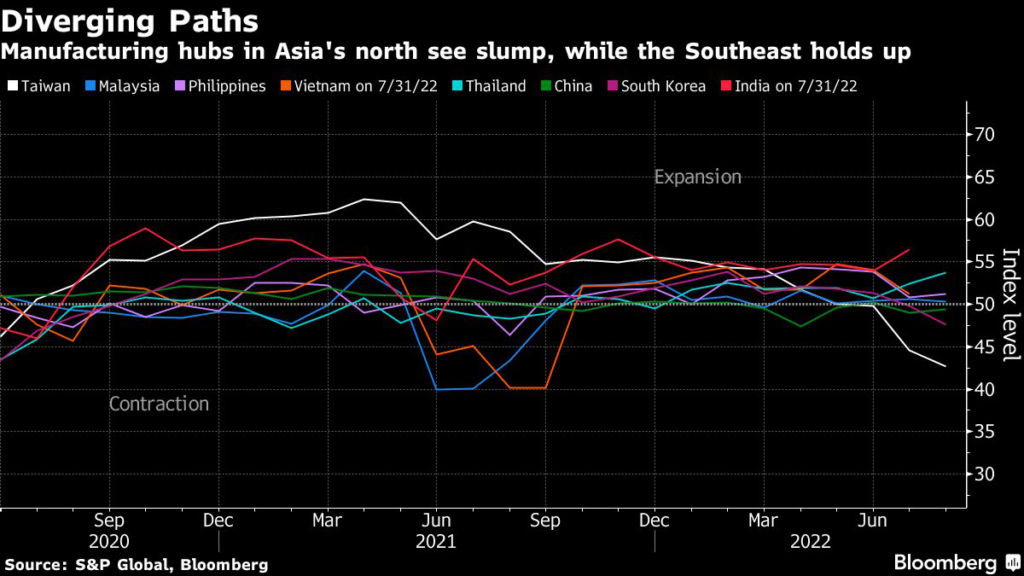
In Asia, Taiwan’s PMI fell to 42.7 — its lowest since May 2020 — while South Korea’s declined to 47.6 — the worst since July 2020. Japan weakened too, though remained above the level of 50 that separates contraction from expansion.

A drop in new orders to Taiwanese firms indicates the decline seen in export orders in July is continuing. A series of chipmakers have warned recently of slowing demand for semiconductors, which are a key export from both Taiwan and South Korea. 

The data add to a highly uncertain global environment as the world’s two biggest economies move in different directions and most central bankers push interest rates higher to fight soaring prices. The hit to factory output from some of the world’s biggest trading hubs is a key warning for demand as inflation weighs on households. 

For the euro area, the chances of a recession are increasing by the day as Russia curtails energy shipments, stoking steep gains in prices for natural gas and power. Despite the gloomy outlook, the European Central Bank is expected to keep raising rates to contain the hottest inflation since the creation of the common currency.

“Forward-looking indicators suggest that the downturn is likely to intensify — potentially markedly — in coming months, meaning recession risks have risen,” S&P Global economist Chris Williamson said.

Over in Asia, firms in South Korea — a bellwether for global trade — “often commented on concerns that the economy would continue to perform poorly amid weak demand and challenging global economic conditions,” S&P Global Market Intelligence economist Usamah Bhatti said.

Shipments of Korean semiconductors fell for the first time in more than two years last month, dropping 7.8% from a year ago, according to official data released Thursday. Chips comprise about 20% of South Korea’s exports by value, but the drop was compensated for by other goods, with total exports rising 6.6%.  

“Concern that the economic slowdown would deepen grew among manufacturers, while businesses also noted the lingering impact of inflation and the war in Ukraine,” pushing the level of positive sentiment down to the lowest since last October, Bhatti said.

There was also more evidence of weakness in Chinese manufacturing. Factory activity shrank in August, a private survey showed, suggesting fallout from power shortages and Covid outbreaks is hitting smaller firms alongside large and state-owned ones.

The Caixin Manufacturing PMI fell to 49.5 last month from 50.4 in July, according to a statement Thursday from Caixin and S&P Global. That reading matched official data released Wednesday that showed activity contracted for a second month in August. The official manufacturing PMI inched up to 49.4 from 49.

JOIN: This week’s MLIV Pulse survey on investing in China

A boost to Asia exports from China’s initial reopening from bruising lockdowns is now fading, with shipments likely to weaken further, according to Alex Holmes, a senior economist at Oxford Economics Ltd.

“This adds weight to our view that Asian export growth will return to its broad decelerating trend in the second half, as the external sector cools due to faltering global demand,” he said in a report.

More stories like this are available on bloomberg.com

©2022 Bloomberg L.P.
Chip Tycoon Vows to Fund Taiwan’s ‘Civilian Army’ Against China

(Bloomberg) — The founder of Taiwanese chipmaker United Microelectronics Corp. outlined plans to fund military training for millions of “civilian warriors” in Taiwan to fight against any potential Chinese invasion.

Robert Tsao, who stepped down as chairman of UMC in 2006, said at a Thursday briefing in Taipei that he will donate NT$1 billion ($32.8 million) to help train 3 million civilian soldiers in collaboration with the military and an additional 300,000 expert marksmen. The funds are part of a NT$3 billion pledge he made in August to aid Taiwan in protecting itself from an increasingly belligerent China. 

“Given the Chinese Communist Party’s record of atrocities against its own people and its brutal domination of those like the Uyghurs who are not even Chinese, the CCP’s threats have only ignited among the Taiwanese people a bitter hatred against this threatening enemy, and a shared determination to resist,” Tsao said in a prepared statement.

Wearing a bullet-proof vest throughout the briefing, the 75-year-old also announced he was renouncing his Singaporean passport and reverting back to Taiwanese citizenship, which he had given up in 2011.

“I am back in Taiwan, and I will die in Taiwan. I will not watch the CCP turn Taiwan into another Hong Kong,” he told reporters in Taipei.

Tsao’s move comes at the most fraught time in decades for relations across the Taiwan Strait.

After US House Speaker Nancy Pelosi landed in Taipei in early August, China launched a series of military and economic countermeasures to signal its displeasure. The People’s Liberation Army conducted drills encircling much of Taiwan and fired missiles directly over the main island in the days following Pelosi’s visit. 

While China claims Taiwan as part of its territory and vehemently opposes any implication of independent statehood from other countries, the government of President Tsai Ing-wen views the island as a de facto sovereign nation awaiting broader international recognition. 

More than 87% of the Taiwanese public wants the island to remain independently governed outside of the control of Beijing, according to the latest results of a long-running survey of political beliefs released in July by the Election Study Center of National Chengchi University.

More stories like this are available on bloomberg.com

©2022 Bloomberg L.P.
Coinbase-Backed Crypto Firm Rain Financial Cuts Jobs

(Bloomberg) —

Rain Financial Inc., one of the Middle East’s largest crypto exchanges, reduced staff amid a recent downturn in digital assets.

The staff cuts were made to reflect the “operational needs and market conditions,” the company said in a statement. It didn’t provide the number of people made redundant.

“As a business we have had to adapt our future plans given these difficult market conditions to ensure we can navigate through this downturn,” Rain Financial said.

Cryptocurrency prices have declined this year from the highs reached in early November. Rain’s backers include Silicon Valley venture capital firm Kleiner Perkins and Coinbase Ventures. It last raised funds at a $500 million valuation, pledging to use the money to expand in the Middle East and Africa and double its workforce to 800 this year. 

More stories like this are available on bloomberg.com

©2022 Bloomberg L.P.
Close Bitnami banner
Bitnami

