
Bloomberg

Korea Trade Deficit Swells to Record on Weak Won, Strong Energy

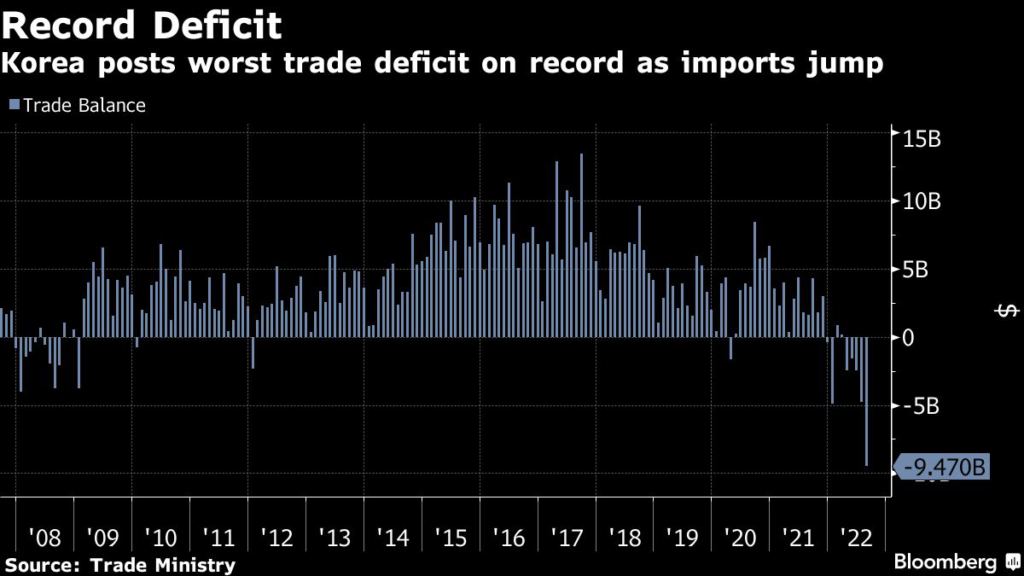
(Bloomberg) — South Korea posted a record trade deficit in August as the currency hovered around a 13-year-low and energy prices remained elevated, swelling the cost of imports and amplifying pressure on exporters.

The shortfall almost doubled to $9.5 billion, the biggest in data going back to at least 2000, the trade ministry said Thursday. While a 6.6% gain in exports exceeded economists’ expectations, it was dwarfed by imports soaring 28.2%.

Semiconductor shipments, the biggest driver of South Korean income, fell 7.8% last month. That was the first decline in more than two years, a time when the global economy bore the brunt of the pandemic.

Korea is headed for its first annual trade deficit since 2008 as elevated energy and commodity prices drive up import prices, underpinned by Russia’s ongoing war on Ukraine. Global demand is also at risk of faltering as central banks raise interest rates to try to rein in inflation.

“We expect a trade deficit lasting at least into early next year given that imports are unlikely to decline as much as exports do,” said Kim Hyo-jin, an economist at KB Securities. “The key is energy prices, whether it’s oil or natural gas. There’s so much uncertainty around it.”

Supply chain disruptions, partly worsened by Covid lockdowns in China, have also contributed to inflationary pressure. A series of rate hikes by the Federal Reserve to rein in US inflation has weighed on other currencies, including the won, making imported goods more expensive for their economies.

The won weakened as much as 0.76% following today’s trade data. Shares of Samsung Electronics Co. , the world’s biggest memory-chip maker, fell as much as 2.2% in the local stock market.

Korea’s trade performance is viewed as an important barometer of international demand as the country manufactures key items such as chips, displays and refined oil for the world economy.

Resilient export growth has been a major factor underpinning the Bank of Korea’s confidence in raising rates. Governor Rhee Chang-yong joined global central bank chiefs at Jackson Hole over the weekend in reaffirming a willingness to keep tightening monetary policy until inflation eases meaningfully.

Adding to export woes is a gradual decline in global demand for semiconductors, the biggest cash cow for Korea. Meantime, the nation’s automakers are facing headwinds as the US “Inflation Reduction Act” excludes them from tax breaks aimed at shoring up American electric-vehicle makers.

While the outlook for exports remains clouded, consumption has been a key support for the Korean economy as Covid regulations are loosened.

A separate update from the Bank of Korea on gross domestic product showed the economy expanded 0.7% last quarter from the previous three months and 2.9% from a year earlier, unchanged compared with an earlier estimate.

Today’s report also showed:

  • Exports adjusted for working-day differences rose 2.2% in August from a year earlier.
  • Total automobile shipments advanced 35.9%, while exports of rechargeable batteries climbed 35.7%.
  • Imports reached a record amount as the purchases of energy and commodities jumped, the ministry said.

(Adds economist comment, chart, market move.)

More stories like this are available on bloomberg.com

©2022 Bloomberg L.P.

California Moves to Shield Election Worker Privacy Amid Threats

(Bloomberg Government) — California election workers would be able to block their addresses from public view under a proposed expansion of a program set up to protect abortion providers from harassment and intimidation.

The state Senate on Wednesday voted 30-3 to pass the measure (S.B. 1131), which is now ready for consideration by Gov. Gavin Newsom (D). The Assembly had passed it on a vote of 62-0.

“As the midterm elections quickly approach, this legislation is urgently needed to protect the Californians who do the largely thankless but very essential work of ensuring that our elections are free, fair, and effectively administered,” Sen. Josh Newman (D), the bill’s author, said in a statement. If the measure becomes law, election workers and other public employees who face threats of violence could immediately sign up for a two-year enrollment in the Safe at Home program, with the option to re-enroll. The program redirects participants’ mail to a post-office box so that their residential addresses don’t appear in public records requests.

Election workers also could enroll in a county-level program to remove their home addresses, phone numbers, and email addresses from the voter rolls.

The Safe at Home Program was formed in 1999 for survivors of domestic violence, and has been expanded to include stalking and trafficking victims, health care providers, and public health officials.

The bill is backed by the New York-based Brennan Center for Justice, which published a report last year detailing a wave of threats against election workers after the 2020 general election. One in three election officials surveyed in the report said they felt unsafe doing their job, and one in six said they had been threatened. Close to one-third said they knew someone who quit their election job due to safety concerns.

The Legislature also has sent to Newsom bills that would:

  • Extend to Jan. 1, 2027 the end date for a law that prohibits election “deepfakes”— digitally manipulated audio or visual media intended to damage a candidate’s reputation (A.B. 972);
  • Require California’s Citizens Redistricting Commission to count incarcerated individuals as living at their last known place of residence, not the correctional facility (A.B. 1848);
  • Update campaign transparency requirements to make television and digital advertising disclosure statements more visible (S.B. 1360);
  • Change local recall election protocols (A.B. 2582; A.B. 2584); and
  • Prohibit automatically recurring campaign contributions unless a donor consents to it (A.B. 775).

Newsom has until Sept. 30 to sign or veto the bills.

To contact the reporter on this story: Tiffany Stecker in Sacramento, Calif. at tstecker@bgov.com

To contact the editor responsible for this story: Katherine Rizzo at krizzo@bgov.com

More stories like this are available on bloomberg.com

©2022 Bloomberg L.P.

UN Report Accuses China of ‘Serious’ Rights Abuses in Xinjiang

(Bloomberg) — China committed “serious human rights abuses” against ethnic Muslims in the Xinjiang region and may be guilty of crimes against humanity, the top United Nations rights official said in a report that the government in Beijing had tried to block.

The report from UN High Commissioner for Human Rights Michelle Bachelet cited testimony alleging “patterns of torture or other forms of cruel, inhuman or degrading treatment or punishment” as part of a campaign that China said is aimed at clamping down on extremism and terrorism. It said holy places such as the Imam Asim Shrine in southern Xinjiang had been demolished.


Detentions of Uyghurs and other Muslim groups, along with a broader campaign of restrictions and rights violations “may constitute international crimes, in particular crimes against humanity,” Bachelet said.

“The report gives credence to the widespread deprivation of liberty in re-education centers, the torture and sexual violence found there, the likelihood of forced labor, the assault on religious and cultural rights,” said William Nee, research and advocacy coordinator at Chinese Human Rights Defenders. 

The US and other nations have labeled China’s treatment of the Uyghurs “genocide,” though that word did not appear in the Bachelet report.

Smears and Slanders

In its response, included with the report’s publication, China said the assessment ignores rights achievements made by the Chinese government, goes against the mandate of Bachelet’s office and “wantonly smears and slanders China.”

“The Chinese government, pursuing a people-centered approach, upholds that living a happy life is the primary human right and has embarked on a human rights development path which conforms to the trend of the times,” the government said.

Bachelet, a former president of Chile, became the first UN human rights chief since 2005 to visit China, in a trip that rights groups criticized because they said China wouldn’t let her take an accurate measure of the government’s rights record in Xinjiang. She later acknowledged she’d faced “limitations” and hadn’t been able to meet detained Uyghurs.

Her report comes less than a month after a UN slavery expert found claims of forced labor in Xinjiang to be “reasonable.” Wednesday’s report urged China to grant UN agencies and officials “unrestricted” visits to Xinjiang.

Releases Urged

The UN document said the Chinese government should promptly release “all individuals arbitrarily deprived of their liberty” in Xinjiang, and to “urgently” put families in contact with those caught up in the region’s system of internment camps and prisons. It also recommended that the global business community, amid allegations of forced labor, take “all possible measures” to protect workers in the region.

China regularly denies all such allegations, dismissing them as efforts to smear the country and delay its economic rise. China’s Foreign Ministry spokesman Zhao Lijian told reporters at a press briefing on Wednesday before the report came out that China “rejects” its publication.” 

In an interview with German broadcaster DW News earlier this week, Bachelet dismissed criticism that her long-awaited report had been delayed. “I want outcomes,” she said. “Because just to speak out and have no change, for me is not enough.”

Bachelet’s assessment is consistent with findings from several western governments. In one of its final acts in office, the Trump administration designated China’s crackdown on Uyghurs and other minorities in the Xinjiang region as genocide. The Biden administration later affirmed that finding.

(Updates with response, further details, beginning in third paragraph.)

More stories like this are available on bloomberg.com

©2022 Bloomberg L.P.

SoftBank’s Arm Is Suing Qualcomm for Licensing and Trademark Violations

(Bloomberg) — Arm Ltd. sued Qualcomm Inc. for breach of contract and trademark infringement, setting up a legal showdown between the SoftBank Group Corp.-owned chip company and one of its biggest customers.

The conflict centers on Qualcomm’s acquisition of chip startup Nuvia Inc. last year. That business developed chip designs using Arm licenses and they can’t be transferred to Qualcomm without permission, according to the suit filed in the US District Court in Delaware. Nuvia’s licenses were terminated in February after negotiations failed to reach a resolution, Arm said.

Qualcomm and Arm are two of the world’s most influential chip companies, and their standoff is bound to be closely watched in the industry. San Diego-based Qualcomm is the biggest maker of the processors and modems used in smartphones. But like many others in the chip industry, it relies on an instruction set from UK-based Arm, a company that has created much of the underlying technology for mobile electronics. An instruction set is the basic computer code that chips use to run software such as operating systems.

“Because Qualcomm attempted to transfer Nuvia licenses without Arm’s consent, which is a standard restriction under Arm’s license agreements, Nuvia’s licenses terminated in March 2022,” Arm said in a statement. “Before and after that date, Arm made multiple good faith efforts to seek a resolution.”

Qualcomm said its licenses with Arm cover custom-designed processors, something that the complaint ignores. 

“Arm’s lawsuit marks an unfortunate departure from its longstanding, successful relationship with Qualcomm,” the company said in a statement. “Arm has no right, contractual or otherwise, to attempt to interfere with Qualcomm’s or Nuvia’s innovations.”

Qualcomm acquired Nuvia to beef up its technology and allow it to field more powerful chips. It’s part of a broader strategy by Qualcomm Chief Executive Officer Cristiano Amon to decrease his company’s reliance on the smartphone industry and grab a share of the laptop chip market and — eventually — the lucrative server processor business. But the suit threatens to hamper those efforts.

The Nuvia acquisition took place while Arm was itself the subject of a takeover attempt by Nvidia Corp., which planned to buy it from SoftBank for $40 billion. Qualcomm’s CEO was vocal in opposing that deal, saying it would compromise Arm’s independence in the chip industry. Nvidia abandoned the purchase in February after the US Federal Trade Commission sued to block it.

Qualcomm shares fell 1.6% to $132.27 on Wednesday in New York. They’ve lost 28% of their value this year, in line with a broader rout for chip stocks. 

Arm was acquired in 2016 by SoftBank, which is now preparing to spin it off in an initial public offering. Arm’s customer list already includes the biggest names in technology, which have embraced its designs because they’re relatively inexpensive to use and require less power. After gaining a foundation in mobile devices, Arm’s innovations are now increasingly part of computers.

Companies such as Amazon.com Inc.’s AWS are using Arm’s technology as the basis for in-house chip designs, allowing them to break Intel Corp.’s hold on the market for data-center server processors. Such chips can sell for more than $10,000 each. 

Arm has two types of customers: companies that use its designs as the basis for their chips and ones that create their own semiconductors and only license the Arm instruction set. Qualcomm has had both kinds of arrangements with Arm over the years, but the Nuvia deal is part of a push to design more of its chips itself. Arm is arguing that the Nuvia products still rely on technology that Qualcomm hasn’t negotiated the right to.

Arm acts a traffic cop on the use of technology by verifying each new processor’s compatibility. That gives it a unique window into what companies are doing across the industry. It should also allow it to see whether Qualcomm chips include work done by Nuvia ahead of its acquisition. According to Arm, anything created under those canceled licenses should have been destroyed.

In May, Qualcomm asked Arm for verification of a new processor core.

“Based on the timing and circumstances surrounding Qualcomm’s request, discovery is likely to show that Qualcomm’s processor core design is based on or in part the processor core design developed under the prior Nuvia licenses,” the suit said. 

Qualcomm is no stranger to licensing disputes. The company gets a large chunk of its profit from selling the rights to its own technology — a key part of mobile wireless communications. Its customers include Samsung Electronics Co. and Apple Inc., the two biggest smartphone makers.

Qualcomm emerged victorious in 2019 from a wide-ranging legal fight with Apple. It also won a court decision on appeal against the US Federal Trade Commission, which alleged that the company was using predatory licensing activities.

(Updates Qualcomm response in sixth paragraph.)

More stories like this are available on bloomberg.com

©2022 Bloomberg L.P.

Google Defends Meta Deal, Ad Tech Empire From Antitrust Threat

(Bloomberg) — A 2018 advertising pact between Alphabet Inc.’s Google and Meta Platforms Inc. doesn’t violate antitrust law because it doesn’t restrict Facebook from using rival ad exchanges, Google’s attorney told a federal judge.

Texas and a group of other states sued Google over the agreement, nicknamed Jedi Blue, as well as other anticompetitive conduct they allege allowed the search giant to monopolize the market for the technology to buy, sell and service online advertising. Both Google and Meta, which is not a defendant in the case, have defended the agreement and denied any wrongdoing.

“The written agreement itself has nothing unlawful in it,” Eric Mahr, an attorney for Google, said Wednesday at a hearing in Manhattan federal court. He argued the deal expanded competition because it allowed Facebook to bid on ads being sold through Google’s ad exchange on behalf of websites or mobile apps within its Facebook Audience Network.

But Ashley Keller, a lawyer representing Texas, said Google entered into the deal to give Meta advantages on the exchange it runs to buy and sell advertising. In exchange, the social media company abandoned plans to adopt a new type of technology that would have undercut Google’s online advertising monopoly, he said.

“They were smart enough not to write down their agreement that could result in criminal sanctions,” Keller said. “Nobody wants to go to jail and wear an orange jumpsuit.”

Google has asked Judge P. Kevin Castel to dismiss the antitrust suit, arguing that all of the conduct that the states target is legal.

“Google does not have to design any of its products to take into account the interests of rivals,” Mahr told Castel Wednesday. The states “want to turn Google into an ad tech utility.”

But Texas’s Keller argued that Google has consistently taken steps to make it harder for rivals to compete, such as manipulating the auctions for online advertising to ensure Google’s products end up winning. When those efforts didn’t succeed, Google would buy off the competition, as it did with Meta, he said. The Google-Meta pact, first made public in the states’ suit, is now also under investigation by regulators in Europe and the UK.

“There are privileges that Google gives to its own buying tools,” Keller said. “It’s just naked anticompetitive behavior to make sure others can’t disrupt the monopoly.”

Castel, who asked dozens of questions about Google’s ad tech tools and the online advertising market during the two-hour hearing, said the arguments were “helpful” but didn’t indicate how he might rule, or when.

Lawyers for the Justice Department — which sued Google in 2020 for allegedly monopolizing the search market and is separately probing the company’s ad tech business — attended Wednesday’s hearing. The agency could file its own antitrust suit against Google for monopolizing the ad tech market as soon as next month.

The case is In re Google Digital Advertising Antitrust Litigation, 21-md-03010, U.S. District Court, Southern District of New York (Manhattan).

More stories like this are available on bloomberg.com

©2022 Bloomberg L.P.

Uber Plans to Supply 10,000 More Electric Cars in London

(Bloomberg) — Uber Technologies Inc. will partner with a financial technology startup to boost the number of electric vehicles in London by an additional 10,000 over the next few years, according to a statement. 

Mobility fintech Moove is expanding its vehicle financing business to the UK after previously launching in countries such as India and Nigeria. Moove is already Uber’s largest vehicle supply partner across Europe, the Mideast and Africa.

Launched in 2020 by entrepreneurs Ladi Delano and Jide Odunsi, Amsterdam-based Moove has raised more than $200 million and is backed by investors that include the UK government’s British International Investment arm. The company aims to make it easier for ride-hailing and food delivery gig workers to get a vehicle with no deposit or credit check, relying instead on an alternative underwriting model. 

Amid skyrocketing energy prices, Moove is also seeing a rise in demand for its electric vehicles, Co-Chief Executive Officer Delano said in an interview. He said the most popular car model financed by Moove is Tesla Inc.’s Model 3.

“A lot of our customers are already in fuel-guzzling vehicles and we’re now moving them into EV vehicles at a very low cost of switching,” he said. “The result of rising prices has actually led to a very high demand for our product.”

Uber currently has more than 6,000 electric vehicles on its app in London, the most of any city and equal to 13% of all its cars there.

More stories like this are available on bloomberg.com

©2022 Bloomberg L.P.

WorldRemit Parent Names Lenhard, Ex-Bill.com Executive, as CEO

(Bloomberg) — Zepz Group, the UK financial technology startup, has named Mark Lenhard as its new chief executive officer, replacing Breon Corcoran.

Lenhard, 44, joins the payments company, which owns the WorldRemit and Sendwave brands, after previously serving as Bill.com Holdings Inc.’s chief operating officer, Zepz said in a statement on Thursday, confirming an earlier Bloomberg News report. 

Zepz is working to stem its losses and announced cost-cutting measures earlier this year including plans to eliminate about 5% of the workforce, freeze pay and slash the marketing budget. Lenhard joins after a series of executive departures, including the chief technology officer and chief financial officer, who left since December. 

Read More: UK’s $5 Billion Fintech Zepz Struggled With Accounting, Churn

Lenhard said the company achieved profitability this year, though he declined to elaborate, and said he sees an opportunity to continue building out the money-transfer business. 

“The important thing is one, we’re profitable, but two, we’re really focused on growth within the organization,” he said. “We’ve barely scratched the surface of this industry.”

Zepz was valued at $5 billion in a fundraising round last year. The company had been planning for a potential initial public offering as soon as the second quarter of this year, Bloomberg reported in February. However Lenhard said that the company doesn’t immediately need financing and isn’t preoccupied by an IPO.

Prior to Bill.com, Lenhard held positions at JPMorgan Chase & Co. and PayPal Holdings Inc. 

More stories like this are available on bloomberg.com

©2022 Bloomberg L.P.

Nvidia Declines on Warning That China Restriction May Hurt Sales

(Bloomberg) — Nvidia Corp. fell in late trading after warning that new rules governing the export of artificial-intelligence chips to China may affect hundreds of millions of dollars in revenue.

The stock dropped as much as 5.1% in extended trading following the disclosure that Nvidia’s A100 and forthcoming H100 products will require approval from the US government before they can be sold to Chinese customers. The US is concerned that these processors might be used by the military, Nvidia said in a regulatory filing Wednesday. The company received the notification on Aug. 26.

Nvidia is already facing a sales slump, triggered by lower demand for personal computers. On the day before it got the notice, the company gave a disappointing forecast, saying it needed to cut shipments to reduce an excess of inventory. Now it has a new headache. If the company doesn’t get permission to sell the chips into China, $400 million in sales may be hurt, Nivida said. That represents about 6.8% of revenue in the fiscal third quarter.

“We are working with our customers in China to satisfy their planned or future purchases with alternative products and may seek licenses where replacements aren’t sufficient,” the company said in an emailed statement. “The only current products that the new licensing requirement applies to are A100, H100 and systems such as DGX that include them.”

US companies are under increasing government scrutiny over their dealings with China, the largest market for semiconductors, amid a growing rivalry between the world’s two largest economies. The US is trying to limit China’s access to technology, arguing that the country represents a security risk. China, in turn, is trying to build its own domestic capabilities to make itself less dependent on the US, which still dominates the design and development of the crucial technology.

Advanced Micro Devices Inc. said Wednesday that it received a similar notice from the government, though it doesn’t expect the effect to be material. “At this time, we do not believe that shipments of MI100 integrated circuits are impacted by the new requirements,” the company said in a separate statement.

According to Nvidia’s filing, the government’s new rules specify chips with certain performance capabilities.

The rules apply to both China and Russia, though Nvidia and AMD no longer sell to the latter country.

More stories like this are available on bloomberg.com

©2022 Bloomberg L.P.

An $8 Billion Cartoon Bear Leads Push for Japan Tourism Revival

(Bloomberg) — A region in southwestern Japan is pinning its hopes for a post-pandemic recovery in tourism on a wide-eyed black bear called Kumamon.

The cuddly character has gained worldwide fame since he debuted as a promotional mascot for Kumamoto prefecture in 2010. Now authorities are developing bear-themed attractions across the region, betting they will spur an influx of overseas visitors when some of the world’s strictest border restrictions ease.

“We need to focus on the long-term strategy,” Shunya Waki, who heads the Kumamon Group in the regional governor’s office, said in an interview. “Now that so many people already know about the character, we want to attract them here with Kumamon and make them explore.”

The plump, red-cheeked bear has become Japan’s most successful regional mascot since he was launched to mark the opening of a new high-speed rail line for the southwestern island of Kyushu. Kumamon-themed merchandise, ranging from clothing to tote bags, stationary and face masks, has generated more than 1.1 trillion yen ($7.9 billion) in sales over the past decade — with authorities largely allowing his image to be used for free.

This approach to intellectual property rights has helped spread his popularity around the world. Kumamoto collaborated with Alibaba Group Holding Ltd.’s online travel site Fliggy, with Kumamon hosting a live stream that showcased attractions. He’s been used in a hygiene-awareness campaign launched by Japan’s aid agency to help teach Indian children to wash their hands. 

The bear was even tasked with promoting a new chip plant that Taiwan Semiconductor Manufacturing Co. will build in Japan, with production expected to start by the end of 2024. 


Like the rest of Japan, Kumamoto’s tourism industry has been smashed by the pandemic, with most overseas visitors banned for about two years. International visitors who stayed in the prefecture, renowned for its 17th century castle, hot springs, and active volcano Mount Aso, plunged 97% in April, compared with the same month in 2019 before the pandemic hit, according to the Japan Tourism Agency.

Japan to Scrap Covid-Test Requirement for Vaccinated Travelers

Japan has been gradually easing virus curbs to bring back tourism. The government last week announced plans to scrap a requirement to show a negative Covid-19 result to enter the country for travelers who have received three vaccine doses. The cap on daily arrivals will rise to 50,000 from the current 20,000 from Sept. 7. Still, the country remains among the slowest in the developed world to open up again.

Kumamoto hopes Kumamon will ensure visitor numbers quickly bounce back. Inbound tourism consumption in the prefecture’s capital city reached 82.6 billion yen in 2019, with the largest number coming from China at 67,356, followed by 63,895 from Taiwan and 50,622 from Hong Kong. That’s the biggest spending since at least 2011, according to the city’s 2020 report.

Bloomberg Intelligence analyst Angela Hanlee said that while the popular mascot may increase the length of time visitors stay in the prefecture and help boost spending, better transport links would be essential to lure first-time overseas tourists from major destinations.

“It is difficult to expect first-time Japan visitors to plan their trip to destinations other than Tokyo, Osaka and Kyoto,” she said. “The key for regions to draw foreign tourists is to improve air connectivity.”

Nevertheless, Kumamon-themed attractions have sprung up across the prefecture including a park next to an international cruise ship terminal with dozens of bear statues. The prefecture will subsidize the cost of developing other projects. In the capital city, events will be held frequently at the central train station, airport and other locations to give visitors the chance to interact with the mascot.

The chance to snap a selfie with the affable bear and share it on social media is likely to lure in Kumamon aficionados like Marx Didong Zhao, a 23-year-old student in Changsha, China.

“We have this culture in Chinese social media, in which people go somewhere just to take fancy pictures and share them,” said Zhao. “So if you can see Kumamon around the town, that might be a good attraction for Chinese tourists.”


More stories like this are available on bloomberg.com

©2022 Bloomberg L.P.

California Crypto Oversight Bill Moves Closer to Becoming Law

(Bloomberg) — A California bill that would require crypto financial-service businesses to get a special license is now closer to becoming law, with the Assembly voting to approve it Tuesday after the Senate gave it the nod a day earlier. It now heads to the desk of Governor Gavin Newsom, who has until Sept. 30 to sign or veto the bill.

If signed into law, the legislation — called the  Digital Financial Assets Law — would introduce tighter crypto regulations and more oversight for the industry in California. The bill, which would go into effect January 2025, would require companies like digital-asset exchanges to get licensed with the state’s Department of Financial Protection and Innovation.

Assembly member Timothy Grayson, a Democrat who introduced the legislation, said in a statement that the bill’s passage shows “the Legislature’s understanding that a healthy cryptocurrency market can only exist if simple guardrails are established.”

Some industry advocates have opposed the bill. The Blockchain Association, a crypto lobbying group, tweeted Monday that the proposed legislation “creates shortsighted and unhelpful restrictions that would impede crypto innovators’ ability to operate and push many out of the state.” 

New York similarly requires crypto businesses to get a “BitLicense” in order to conduct digital-asset activities in the state and issued the first of these license in 2015. However, the practice has been heavily criticized by some crypto enthusiasts, including New York City Mayor Eric Adams, a Democrat who has ambitions of making New York a digital-asset hub.

More stories like this are available on bloomberg.com

©2022 Bloomberg L.P.

Close Bitnami banner
Bitnami
