
Bloomberg

Shanghai’s Two-Month Lockdown Is Still Rippling Through Economy

(Bloomberg) — Three months after Shanghai lifted an unprecedented Covid lockdown that lasted more than 60 days, businesses in China’s richest and biggest consumer market are still struggling with a sluggish recovery as lingering restrictions continue to deter people from going about their normal lives.

Though city-wide curbs on movement were scrapped on June 1, the ordeal hasn’t ended altogether for Shanghai’s 25 million residents. China’s Covid-Zero policy still requires localized lockdowns of neighborhoods and apartment blocks whenever cases emerge, making that quick trip to a shop or a mall challenging. Then there’s the need for regular testing to use public transportation or to enter indoor spaces such as office buildings and restaurants, not to mention quarantine for as long as 14 days at a government facility in some instances.

As a result, demand for everything from dining out to movies and tourism are still far below pre-lockdown levels, while some indicators show Shanghai is taking longer to recover than Hong Kong and Singapore after rules were eased in those cities. Retail sales in the city dropped 4.3% in June from a year earlier and rose a meager 0.3% in July, following an average 35% slump in the preceding three months starting March, when the outbreak began. 

Wang Yihan, owner of two role-playing game venues in the city, is praying for “no more Covid comeback.” “It’s just so difficult to get enough cash flow,” she said, adding about 60% of peers she knows have shut their businesses in recent months. “Even if we survive now, we can’t make it through if another lockdown comes.”

These five charts show how Shanghai is reeling from the aftermath of the lockdown:

1. Impact on Retail

Unlike Singapore or Hong Kong — even though these cities also placed strict social distancing rules — Shanghai’s recovery hasn’t been as swift when it comes to post-easing retail sales. For instance, Hong Kong experienced a wave of outbreaks earlier this year, but started to gradually ease restrictions from late March by lifting flight bans, cutting quarantine days and allowing dine-in services. Monthly retail sales returned to growth in April right after. In Singapore, where curbs also caused frustration among residents and businesses last year, growth barely stalled and accelerated immediately after the island-nation announced significant easing in March.

2. Mall Vacancies

Shopping malls in Shanghai are seeing a surge in vacancies that climbed to 7% in the second quarter, above a “warning line” of 5%, after Covid Zero lockdowns hammered consumer demand, China Real Estate Information Corp. said late August, citing research of 20 major malls. Worst-hit Super Brand Mall, which sits at the heart of Shanghai’s Lujiazui financial district, saw 34% of its shops shuttered, CRIC said. The 2.7-million-square-feet mall, just a few minutes away from the world’s second-tallest office tower, had been one of the most popular shopping centers since it opened more than two decades ago.

3. Consumer Spending

While people are starting to go out to have some fun, data still show Shanghai consumer spending — which usually centers around products linked to socializing, like cosmetics and apparel — still has a long way to return to normal.

Food and daily necessities remain the key driver of the post-lockdown recovery in Shanghai. Consumer staples including household care products such as tissue paper and laundry detergents, and in-home food and drinks are the most popular shopping categories, according to monthly consumer surveys compiled by consultancy Mintel by interviewing 100 Shanghai residents. 

Tourism is another sector that still suffers from weak consumer sentiment in China, as recent Covid outbreaks in some of the top domestic travel destinations such as Hainan and Xinjiang further scare visitors from making travel plans. 

China’s Covid-Hit Tourism Season Deals Fresh Blow to the Economy

Summer holiday travel bookings to Shanghai, which has usually been the top destination for Chinese visitors during the holiday period, fell 70% this year, according to a Ctrip survey done in July, though the city’s popularity picked up in the third quarter. Among Shanghai consumers, only half of interviewees in Mintel surveys said they spent on tourism in August, compared with February. 

4. Hotels and Restaurants

The willingness to increase spending on dining out and entertainment such as cinemas and exhibitions, has started to pick up, though they were still below pre-lockdown levels in August. 

The city’s hospitality and restaurant sales still posted 37% and 21% drop in June and July, after slumping more than 60% during the lockdown in April and May. Box-office revenue for Shanghai in July just reached less than half of last year’s level, according to ticketing platform Maoyan Entertainment. August sales returned to about the same level from a year ago. 

“The lockdown hit the restaurant sector very hard in recent months,” said Cao Zhehui, general manager of Shanghai-based Haisu Foods, which supplies meals to both international and local hotels, restaurants and airports. “The recovery is still gradual,” he said, adding he’s positive over the long term, as about 70% of his business was back as of late August.

5. Traffic and Flights

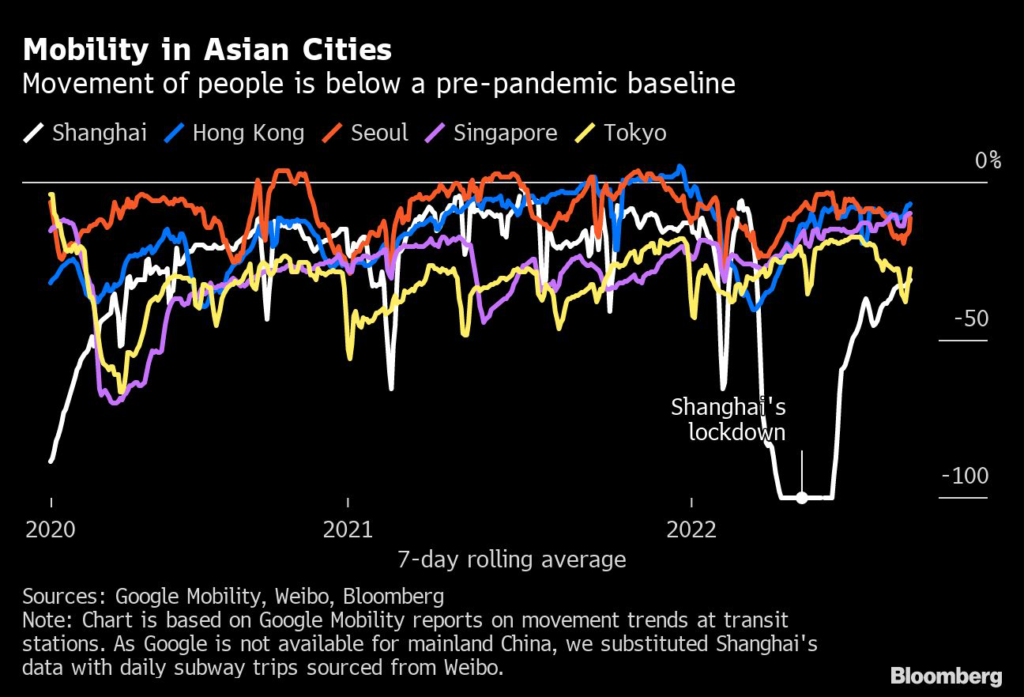
The city’s traffic data point to the first positive sign that Shanghai is returning to normal, but that has also taken almost 3 months. Median metro traffic and daily flights in August both reached over 80% of the number for the first two months this year. That indicates most residents have been going to work as usual, likely due to limited adoption of work-from-home protocols by Chinese companies, although they are still reluctant to spend. But Shanghai’s metro mobility, which in 2021 almost returned to pre-pandemic level just like other major Asian cities such as Hong Kong and Seoul, was in late August still down nearly 30% from that baseline. 

More stories like this are available on bloomberg.com

©2022 Bloomberg L.P.

MicroStrategy’s Michael Saylor Sued by DC for Not Paying Income Taxes

(Bloomberg) — Washington, D.C., is suing MicroStrategy Inc. co-founder and Executive Chairman Michael Saylor — probably best known as the largest corporate buyer of Bitcoin — for tax fraud, claiming that he skipped out on paying more than $25 million in income taxes despite living in the district for more than a decade.

According to the lawsuit, which was filed with the D.C. Superior Court’s civil division, Saylor knowingly avoided paying taxes he owed since 2005 by fraudulently claiming to be a resident of other, lower-taxes jurisdictions, including Virginia and Florida. It claims that Saylor lived in a luxury penthouse on the Georgetown waterfront and docked multiple yachts on the district’s Potomac riverfront. 

D.C. Attorney General Karl Racine announced the lawsuit on Twitter Wednesday. 

“I respectfully disagree with the position of the District of Columbia, and look forward to a fair resolution in the courts,” Saylor said in a statement provided to Bloomberg News. He said he moved to Miami Beach from Virginia a decade ago after purchasing a historic house there. 

“Although MicroStrategy is based in Virginia, Florida is where I live, vote, and have reported for jury duty, and it is at the center of my personal and family life,” he said. 

MicroStrategy, a Tysons Corner, Virginia-based software company, is also being sued by D.C. for allegedly conspiring to help him evade taxes. Saylor was the CEO of MicroStrategy until earlier this month. 

“The District of Columbia’s claims against the company are false and we will defend aggressively against this overreach,” MicroStrategy said in a statement.

The lawsuit claims that MicroStrategy was aware that Saylor lived in D.C. for more than half of the year, which under the district’s laws would make him a legal resident. Regardless, the company allegedly filed inaccurate tax forms using his Florida address and failed to withhold and remit D.C. taxes, according to the lawsuit. 

The district’s case originated with a whistleblower, who filed a complaint under seal in April 2021 under D.C.’s False Claims Act.

“Demonstrating his disdain for the rules that everyone else has to live by, Saylor publicly flaunted his billionaire lifestyle while bragging to his friends and associates about how he was evading District taxes,” according to the whistleblower complaint. 

Shares of MicroStrategy fell 3.6% to $231.56 on Wednesday. The stock has dropped about 57% this year, mirroring the decline in Bitcoin. 

  • Listen: The Highs and Lows of Being a Bitcoin Maximalist (Podcast)

(Updates with comment from MicroStrategy in the seventh paragraph.)

More stories like this are available on bloomberg.com

©2022 Bloomberg L.P.
US Stocks End a Turbulent Month on a Down Note: Markets Wrap

(Bloomberg) — US stocks and bonds ended a turbulent August lower as traders recalibrated rate-hike expectations after central banks across the globe vowed to step up their fights against inflation.

All major US indexes had their worst month since June. Treasuries in August faced their biggest monthly loss since April as the Federal Reserve resolved to stay hawkish. Oil posted a third monthly drop — the longest losing streak in more than two years — hampered by the likelihood of slower global growth.

Read More: Bulls Starved in August Amid Worst Cross-Asset Selloff Since ‘81

Federal Reserve officials in recent days quashed hopes of a dovish pivot, a view that had helped fuel bets that this year’s bear market is over. Since then, investors have been sifting through sometimes-conflicting economic data for further policy clues. While job openings data on Tuesday underscored tightness in the labor market, revamped ADP data on Wednesday showed US companies increased headcount at a relatively sluggish pace in August. All eyes will be on the job report on Friday for further hints about the central bank’s path.

“Now that the Jackson Hole dust is settling, markets have gained clarity on today’s investment question,” said Florian Ielpo, head of macro research at Lombard Odier Asset Management. “Yesterday’s question was ‘will inflation level down’ when today’s is ‘how big will the needed slowdown be.’ For now, markets are pricing a marked slowdown, not a fully-fledged recession.”

The Fed has ditched its soft-landing goal and is instead aiming for a “growth recession,” which would mean a protracted period of meager growth and rising unemployment. 

Euro-area inflation accelerated to another all-time high, strengthening the case for the European Central Bank to consider a jumbo interest-rate hike when it meets next week. ECB Governing Council member Joachim Nagel urged a “strong” reaction. Money markets have now priced in 125 basis points of tightening from the ECB by October, which implies a half-point hike and a three-quarter point increase spread over its next two policy decisions.

Investors are also contending with mounting friction between Beijing and Taipei after Taiwanese soldiers fired shots to ward off civilian drones and evaluating the latest Chinese data, which indicated factory activity shrank for a second month. Power shortages, a property sector crisis and Covid outbreaks all took a toll.

Here are some key events to watch this week:

  • ECB Governing Council members due to speak at event Tuesday through Sept. 2
  • China Caixin manufacturing PMI, Thursday
  • US nonfarm payrolls, Friday
  • UK leadership ballot closes Friday. Winner announced Sept. 5

Will Chinese sovereign bonds outperform Treasuries? China is the theme of this week’s MLIV Pulse survey. Click here to participate anonymously.

Some of the main moves in markets:

Stocks

  • The S&P 500 fell 0.8% as of 4 p.m. New York time
  • The Nasdaq 100 fell 0.6%
  • The Dow Jones Industrial Average fell 0.9%
  • The MSCI World index fell 0.8%

Currencies

  • The Bloomberg Dollar Spot Index was little changed
  • The euro rose 0.3% to $1.0049
  • The British pound fell 0.3% to $1.1616
  • The Japanese yen was little changed at 138.91 per dollar

Bonds

  • The yield on 10-year Treasuries advanced six basis points to 3.16%
  • Germany’s 10-year yield advanced three basis points to 1.54%
  • Britain’s 10-year yield advanced 10 basis points to 2.80%

Commodities

  • West Texas Intermediate crude fell 2.8% to $89.09 a barrel
  • Gold futures fell 0.9% to $1,721.40 an ounce

More stories like this are available on bloomberg.com

©2022 Bloomberg L.P.

Stanford Pulled Into Dropout Musk’s Legal Fight With Twitter

(Bloomberg) — Stanford University was subpoenaed by famous dropout Elon Musk as part of his legal fight with Twitter Inc. over his plan to walk away from a $44 billion takeover offer.

Lawyers for Musk want all records of all “conversations, conferences, discussions, interviews, meetings, negotiations and agreements” between Twitter and Stanford as well as anyone related to the university about the proposed deal, according to a subpoena issued Wednesday in Delaware.  

At the age of 24, Musk started a doctoral program in physics at Stanford in 1995 but dropped out after two days. Earlier this month, the Tesla Inc. founder tweeted about a letter he received from a Stanford professor telling him about the cutting-edge research he missed out on. 

It’s not clear what connection Musk thinks Stanford has to the deal, but the university has links to much of what goes on in Silicon Valley. Twitter CEO Parag Agrawal has a Stanford Ph.D. in computer science, and Fei Fei Li, a computer science professor at the university, serves on the company’s board. Google co-founders Sergey Brin and Larry Page were also Stanford computer science grad students. 

Both sides have issued a spate of subpoenas to banks, investors and lawyers involved in the deal as they seek ammunition for an Oct. 17 trial before Delaware Chancery Court Judge Kathaleen St. J. McCormick. Musk cancelled the buyout citing Twitter’s failure to hand over information about spam and robot accounts embedded in their customer base. Twitter counters it made robust disclosures about the bots issue and Musk’s concerns are a flawed pretext for nixing the deal.

Bloomberg News reported earlier Wednesday Musk will seek to push the trial back to December after the emergence of a Twitter whistle-blower, who says his concerns about bot accounts were ignored. Former Twitter security head Peiter Zatko also raised concerns about user privacy in a complaint sent to regulators and Congress last week.

The case is Twitter v. Musk, 22-0613, Delaware Chancery Court (Wilmington). 

(Updates with Stanford professor serving on Twitter’s board. An earlier version of the story was corrected to say Musk sent out subpoena.)

More stories like this are available on bloomberg.com

©2022 Bloomberg L.P.

Google Workers Protest $1.2 Billion Israeli Contract

(Bloomberg) — Google employees are ratcheting up pressure on the internet-search giant to abandon its artificial intelligence work with the Israeli government, planning public demonstrations to draw greater attention to the controversial cloud-computing contract.

A handful of current and former workers spoke on Wednesday alongside Palestinian rights activists in San Francisco to call for the Alphabet Inc.-owned company to end Project Nimbus, a $1.2 billion contract through which Google and Amazon.com Inc. provide the Israeli government and military with AI and cloud services. The seven-year contract went into effect in July 2021. A petition protesting the agreement has received 800 signatures from Google employees, according to one of the organizers.

Speaking outside Google’s San Francisco offices, employee Gabriel Schubiner said workers went public after their concerns were met with silence internally.

“Google claims that cloud technology is neutral, but technology is powerful, and giving that power to an army that kills without consequences is not a neutral act,” Schubiner said. “Given the history of apartheid and violence enacted by Israel, I am horrified by the prospect of what my work as an AI researcher for this company could enable.”

Additional demonstrations are planned on Sept. 8 in New York, the San Francisco Bay Area and Seattle, according to a statement from the Alphabet Workers Union, which represents some of the employees involved.

Google hasn’t provided specific details of the cloud services it has committed to providing Israel through Project Nimbus, but training materials reviewed by The Intercept showed that the company had touted the capabilities of its image analysis tools to detect faces, facial landmarks and emotions, and to track objects in videos.

“We are proud that Google Cloud has been selected by the Israeli government to provide public cloud services to help digitally transform the country,” said Shannon Newberry, a Google spokesperson. “The project includes making Google Cloud Platform available to government agencies for everyday workloads such as finance, health care, transportation and education, but it is not directed to highly sensitive or classified workloads.”

Newberry said the company doesn’t make general purpose facial recognition commercially available and Google remains committed to responsible AI innovation.

But 15 Google employees who posted testimonials online said the company’s unwillingness to listen to their protestations of opaque military contracts with state actors was disappointing. “We need to ask ourselves: Do we want to give the nationalist armies of the world our technology?” Schubiner said earlier. 

The public demonstrations follow the resignation on Tuesday of Ariel Koren, a Google staffer who had publicly criticized Google’s work with the Israeli government. Koren said the company relocated her role overseas shortly after she went public with her objections, effectively forcing her to resign.

“Unfortunately, right now we are at a place where the only real accountability that big tech has to the public comes from workers speaking out,” Koren said in an interview. “Google needs to affirm that workers have that right.”

Google says it prohibits retaliation against employees who speak out against wrongdoing in the workplace, and publicly shares its conduct policies. “We thoroughly investigated this employee’s claim, as we do when any concerns are raised,” said Newberry, the Google spokesperson. “Our investigation found there was no retaliation here.” She added that the National Labor Relations Board also investigated Koren’s complaint and dismissed it.

In recent years, Google has faced a wave of activism by workers challenging the company’s treatment of contract workers, handling of sexual harassment claims and work with governments, among other issues. In 2019, Google fired five employees who had been involved in organizing at the company, and the NLRB ruled that two of those firings were illegal, while others had faced unlawful surveillance and retaliation.

The backlash to Google’s involvement in Project Nimbus has stretched beyond its employee base. Earlier this year, Alphabet shareholders proposed that the company’s board issue a report reassessing its role in the Israeli contract. In June, the proposal was overwhelmingly voted down, in line with the Alphabet board’s recommendation to oppose it.

(Updates with employee comment in the fourth paragraph)

More stories like this are available on bloomberg.com

©2022 Bloomberg L.P.

Canoo’s Manufacturing Head Is Out as EV Maker Plans Outsourcing

(Bloomberg) — Canoo Inc. is parting ways with its head of manufacturing just a few weeks after announcing plans to outsource production of its upcoming electric vehicle for Walmart Inc.

John Mocny, a longtime employee of General Motors Inc. who joined the startup in early 2022 from Harley-Davidson Inc., is leaving the startup, according to people familiar with the matter. 

Mocny declined to comment. A spokesperson for Canoo had no immediate comment.

The exit after less than a year on the job is the latest sign of executive tumult at the fledgling EV company, which has struggled to bring a production vehicle to market since going public in a December 2020 merger with a blank-check company. Its shares have tumbled about 59% this year.

Other recent departures include Canoo’s former chief human resources officer and multiple employees in the talent acquisition department earlier this month, according to the people familiar. Rich Schmidt, a former Tesla Inc. executive who was brought on as a senior vice president of manufacturing in December, left the company in May.

Read more: Canoo Loses More Executives as EV Startup Suffers Talent Drain

The startup said last month that Walmart had placed an order for at least 4,500 battery-powered vans, with the option to purchase up to 10,000. To meet that demand, Canoo, which has said it will move its headquarters to Walmart’s hometown of Bentonville, Arkansas, plans to use a third party for initial production.

Canoo had previously explored outsourcing, tapping Dutch outfit VDL Nedcar last year to build its vehicles, but ultimately walked away from that plan.

More stories like this are available on bloomberg.com

©2022 Bloomberg L.P.

California Probes Race Bias in Hospitals’ Patient Care Software

(Bloomberg) — California is investigating whether software that helps hospitals carry out tasks such as patient diagnostics discriminates against racial and ethnic minorities, according to the state’s top legal official.

Attorney General Rob Bonta’s office sent a letter to 30 unidentified hospitals in the state on Wednesday asking them for data on “decision-making tools, products, software systems, or algorithmic methodologies” used in operations including triage, billing and operating room scheduling.

The information request marks the “first step” in a state inquiry into whether commercial algorithms used by providers to make decisions regarding patients’ health-care access results in impartial treatment, according to a statement from Bonta’s office.

“It’s critical that we work together to address these disparities and bring equity to our health-care system,” Bonta said in the statement. 

Read More: Racial Bias in Clinical Medicine Algorithms Targeted by HHS

More stories like this are available on bloomberg.com

©2022 Bloomberg L.P.
US Commerce Chief’s Agenda Reveals Amazon, Apple CEO Meetings

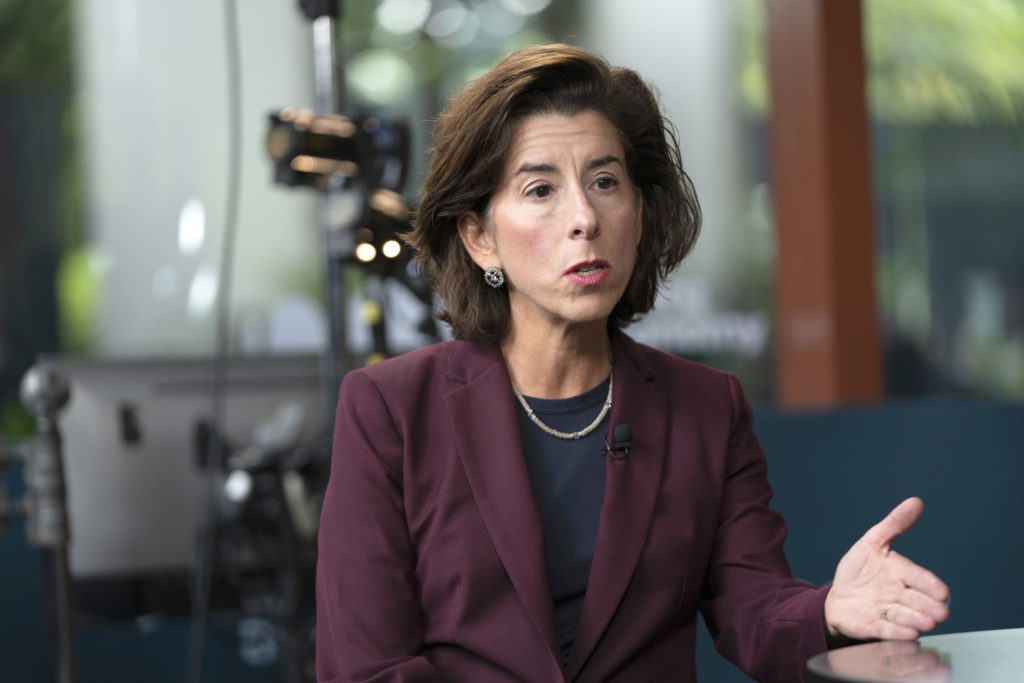
(Bloomberg) — US Commerce Secretary Gina Raimondo met with chief executive officers including Amazon.com Inc.’s Andy Jassy and Apple Inc.’s Tim Cook early in her tenure, according to a copy of her April 2021 calendar obtained by Bloomberg News Wednesday.

The calendar shows that Raimondo, who has faced criticism from progressives over her ties to the biggest tech companies, requested the April 5 meeting with Jassy, while the meeting with Cook, which was sought by Apple, took place on April 21. The meetings don’t specify what was discussed, but the Commerce Department oversees key trade issues for US business and officials routinely meet with company executives. 

Raimondo also held meetings with a slew of CEOs in other industries, including General Motors Co.’s Mary Barra, AT&T Inc.’s John Stankey, Verizon Communication Inc.’s Hans Vestberg, Visa Inc.’s Al Kelly, Walt Disney Co.’s Bob Chapek and Suzanne Clark, president and CEO of the US Chamber of Commerce. 

The Commerce Department has started to release Raimondo’s calendars in recent months in response to public records requests by activists. 

Left-leaning groups have accused Raimondo of acting as the Biden administration’s mouthpiece for big businesses, pushing for policies that would benefit corporate America. Raimondo rankled the groups last year when she publicly opposed legislation in Europe that would rein in the power of the biggest US tech companies. Since then, Raimondo has voiced support for similar antitrust legislation in the US, and the White House said President Joe Biden and Raimondo were aligned on the need to ensure that tech companies compete fairly in the economy. 

Raimondo has taken stances on numerous issues that the business community opposes, said Commerce Department spokesperson Robyn Patterson. “There isn’t an inch of daylight between Secretary Raimondo’s position on business and Big Tech and President Biden’s position,” she said. 

It’s part of Raimondo’s job “to work with the business community to move the President’s agenda forward,” said Patterson.  Raimondo and Biden “have both fought special interests to protect American workers and consumers, and partnered with American businesses to create good-paying jobs and advance our nation’s strategic interests.” Patterson noted the recent infrastructure law as an example of that partnership.

Jeff Hauser, the founder and director of government ethics group Revolving Door Project, which is among the groups that obtained Raimondo’s calendars, said he’s concerned about the closeness between the Commerce Department and some of the world’s largest corporations. 

“The interests of big tech and the interests of the American people are not correlated,” Hauer said. “The relationships between executive branch leaders and tech moguls should be adversarial, not convivial.” 

Raimondo also met with Josh Bolten, president and CEO of the Business Roundtable, a group that represents corporate chief executives across a range of industries, including tech, telecom, retail and more. 

She received a briefing from the Committee on Foreign Investment in the United States or Cfius, a body that reviews the national-security implications of purchases of US businesses by foreign buyers. That panel is reviewing TikTok, the popular social media app controlled by Chinese-owned ByteDance Ltd. 

More stories like this are available on bloomberg.com

©2022 Bloomberg L.P.
Snap Will Cut 20% of Workforce, Slash Investments, Add COO

(Bloomberg) — Snapchat’s parent company is slashing staff and scaling back investments in straggling businesses, an attempt to rein in costs following a slowdown in ad revenue growth.

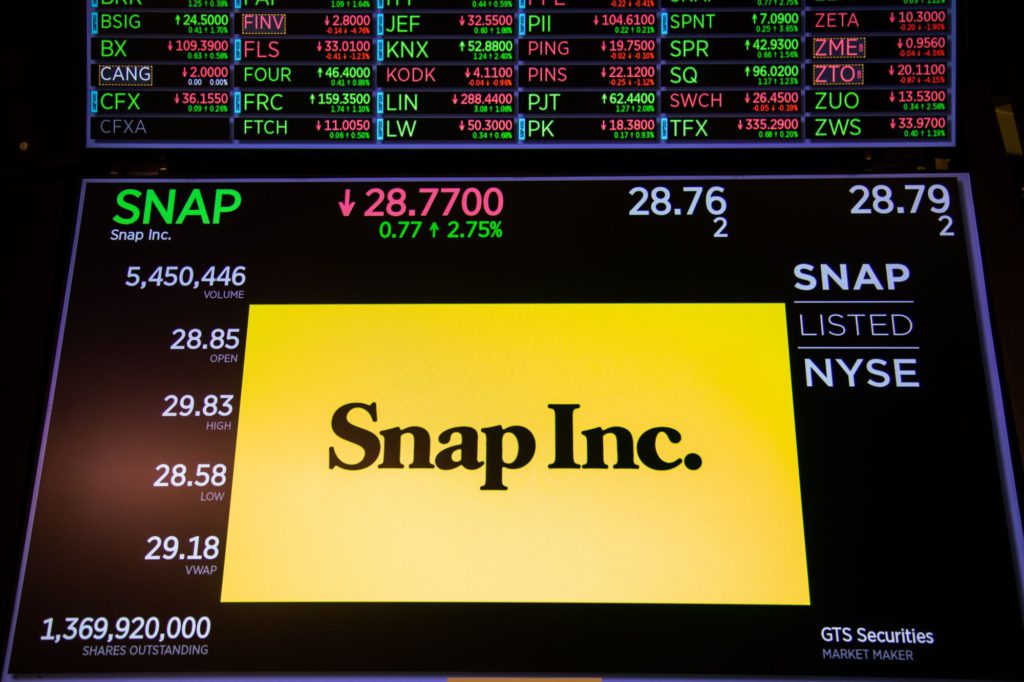
Snap Inc. is cutting about 20% of its 6,400-person workforce, Chief Executive Officer Evan Spiegel said in an internal memo sent to staff Tuesday. The change was necessary because revenue growth of 8% in the current quarter fell short of the company’s initial assumptions. Snap, which makes a social app popular with young people, has never reported single-digit quarterly revenue growth as a public company, according to Bloomberg data.

Any projects that don’t contribute to growing users and sales or the company’s augmented reality offerings will be cut or receive “substantially reduced investment,” Spiegel said in his memo. “While we will continue our work to reaccelerate revenue growth, we must ensure Snap’s long term success in any environment.”

The shares gained 8.9% in New York to $10.90. Snap has fallen 79% this year through Tuesday’s close, on track for the worst year since listing as a public company in 2017.

A pullback in spending from advertisers on its platform has crippled Snap’s sales growth this year. Employees in the struggling advertising sales departments will now report to a newly appointed chief operating officer, Jerry Hunter, who previously held the role of senior vice president of the engineering team. The ad divisions previously reported to Chief Business Officer Jeremi Gorman, who is leaving the company for a role at Netflix, the company said.

With investors losing confidence, the company is tasked with simultaneously growing and controlling costs. The company is culling work to prioritize growing the user base, improving the ad business and finding new sources of revenue.

To help with these efforts, the company is also adding three regional president roles in the Americas, Asia Pacific and Europe, Middle East and Africa regions.

Snap is known for its core social media app Snapchat, which is popular for sending disappearing photo and video messages. The company is reducing or discontinuing investments in the following areas:

  • Snap Originals, shows and series produced by Snap
  • Minis, the pared-down version of third-party services like ticketing apps and meditation apps on Snapchat
  • Games
  • Pixy, the flying camera drone in development since 2017 that launched earlier this year
  • Zenly, a separate social mapping app
  • Voisey, a separate app for writing songs with others

The company will also narrow the scope of development for its Spectacles camera glasses.

Social media companies have reported challenges to ad revenue in recent quarters. Marketers are spending less both due to economic uncertainty and the changes Apple Inc. made to its privacy policy last year that impacted iPhone user ad tracking. 

“As advertising dollars in aggregate grow more slowly, competition for these dollars intensifies,” Snap said in the presentation.

While Spiegel said it’s difficult to project revenue for the year in these conditions, this restructuring will help ensure the company continues generating free cash flow in 2023. The company expects to see a one-time cost of $110 million to $175 million tied to the job cuts, according to an investor presentation. Ultimately, Snap expects to reduce annualized content and operating costs by $500 million, relative to the second quarter.

(Adds number of employees in second paragraph.)

More stories like this are available on bloomberg.com

©2022 Bloomberg L.P.

US Stocks Sink as August Hobbles to Finish Line: Markets Wrap

(Bloomberg) — US stocks dropped on the final day of an August that has seen everything from equities to Treasuries and commodities retreat as central banks around the globe stepped up their fights against inflation. 

The S&P 500 and the Nasdaq 100 fell, after fluctuating between modest gains and losses for most of the session. Treasuries were little changed after paring declines that were led by a selloff in UK and euro-zone bonds.

Investors have been sorting through sometimes-conflicting economic data. Job openings data on Tuesday underscored tightness in the labor market, but revamped ADP data on Wednesday showed US companies increased headcount at a relatively sluggish pace in August. With Federal Reserve officials determined to act to tamp down inflation, all eyes will be on the job report on Friday for further policy clues.

“What’s clear is that predicting this market is not clean cut,” Angeline Newman, a managing director at UBS Global Wealth Management, said on Bloomberg Television. “We are living in a world where conflicting economic signals are making the path of monetary policy very difficult to determine.”

The Fed has now ditched its soft landing goal and is instead aiming for a “growth recession,” which would mean a protracted period of meager growth and rising unemployment. 

Oil is heading for a third monthly drop — the longest losing run in more than two years — hampered by the likelihood of slower global growth. 

Meanwhile, euro-area inflation accelerated to another all-time high, strengthening the case for the European Central Bank to consider a jumbo interest-rate hike when it meets next week. ECB Governing Council member Joachim Nagel urged a “strong” reaction. Money markets have now priced in 125 basis points of tightening from the ECB by October, which implies a half-point hike and a three-quarter point increase spread over its next two policy decisions.

Investors are also contending with mounting friction between Beijing and Taipei after Taiwanese soldiers fired shots to ward off civilian drones and evaluating the latest Chinese data, which indicated factory activity shrank for a second month. Power shortages, a property sector crisis and Covid outbreaks all took a toll.

Here are some key events to watch this week:

  • ECB Governing Council members due to speak at event Tuesday through Sept. 2
  • China Caixin manufacturing PMI, Thursday
  • US nonfarm payrolls, Friday
  • UK leadership ballot closes Friday. Winner announced Sept. 5

Will Chinese sovereign bonds outperform Treasuries? China is the theme of this week’s MLIV Pulse survey. Click here to participate anonymously.

Some of the main moves in markets:

Stocks

  • The S&P 500 fell 0.4% as of 2:01 p.m. New York time
  • The Nasdaq 100 fell 0.3%
  • The Dow Jones Industrial Average fell 0.5%
  • The MSCI World index fell 0.8%

Currencies

  • The Bloomberg Dollar Spot Index fell 0.1%
  • The euro rose 0.4% to $1.0052
  • The British pound fell 0.3% to $1.1620
  • The Japanese yen was little changed at 138.75 per dollar

Bonds

  • The yield on 10-year Treasuries advanced two basis points to 3.12%
  • Germany’s 10-year yield advanced three basis points to 1.54%
  • Britain’s 10-year yield advanced 10 basis points to 2.80%

Commodities

  • West Texas Intermediate crude fell 1.6% to $90.19 a barrel
  • Gold futures fell 0.6% to $1,725.20 an ounce

More stories like this are available on bloomberg.com

©2022 Bloomberg L.P.

Close Bitnami banner
Bitnami