Bloomberg

Genesis’s Acheson Leaves in Latest Departure From Crypto Lender

(Bloomberg) — Noelle Acheson, head of market insights at crypto lender Genesis, said she’s leaving the company two weeks after it announced widespread layoffs.

Acheson has held that role for more than a year and before that spent more than four years with CoinDesk, according to her LinkedIn profile. She holds a degree in applied mathematics and economics from Brown University. Both Genesis and CoinDesk are units of Barry Silbert’s Digital Currency Group. 

“Sad to say goodbye to friends and colleagues — some of the smartest, most dedicated people I’ve ever had the pleasure of working with + learning from,” Acheson tweeted on Wednesday. She hasn’t yet revealed where she’s going next. 

Genesis Chief Executive Officer Michael Moro earlier this month stepped down as part of a leadership shuffle after the crypto brokerage was stung by exposure to bankrupt hedge fund Three Arrows Capital and a broad market downturn. Genesis at the time announced that it was cutting 20% of its 260-person workforce. 

Genesis was the biggest creditor ensnared in the collapse of Three Arrows after the fund failed to meet margin calls. Its parent Digital Currency Group assumed some liabilities and filed a $1.2 billion claim against Three Arrows, which is under liquidation. Genesis officials didn’t immediately respond to a request for comment.

Genesis is one of the largest and best-known lenders in digital assets. The company said recently that second-quarter new-loan origination had declined 9% from the previous period to about $40 billion. Crypto’s market value has plunged 50% this year to about $1 trillion, according to CoinMarketCap.

More stories like this are available on bloomberg.com

©2022 Bloomberg L.P.

Hackers Hit Italian Oil Giant Eni’s Computer Network

(Bloomberg) — The Italian oil giant Eni SpA said Wednesday that its computer networks were hacked in recent days and that the consequences so far appeared to be minor. 

“Eni confirms that the internal protection systems have detected unauthorized access to the company network in recent days,” a company representative said, in response to a query from Bloomberg News. The country’s largest energy company is working with local authorities to assess the consequences of the attack, the representative added.

People familiar with the situation said Eni appeared to be hit by a ransomware attack. Ransomware is a type of malware that locks computers and blocks access to files in lieu of a payment. It’s not clear who was responsible for the breach.

“Ransomware groups are aware that to ensure continuity of services energy companies may be willing to pay large ransom sums in exchange for unlocking the affected systems,” said Mirko Gatto, chief executive officer at the Italian cybersecurity firm Yarix, in a phone interview. 

In addition, state-sponsored hackers may have an interest in carrying out malicious attacks on the energy sector in European countries that are particularly dependent on gas from Russia or sources outside of Europe, he said. 

Earlier this week, Italy’s energy agency Gestore dei Servizi Energetici SpA suffered a breach on Sunday night and Monday morning, according to a statement. Among other functions, GSE is one of the government agencies in charge of the running of Italy’s electricity market.

GSE’s systems and operations are still blocked after the attack, a person familiar with the matter said. Servers were compromised, workers have no access to emails or internal data and some energy market functions carried by GSE are suspended, the source added.

GSE didn’t comment beyond its original statement.

A major risk of breaches of utilities and other critical infrastructure operators is that hacks of their IT systems can lead to disruptions of operational systems that provide electricity, water and other services to end users, even if the hackers never actually touch that sensitive equipment. Last year, Alpharetta, Georgia-based Colonial Pipeline Co. shut the largest fuel pipeline in the US after a ransomware attack crippled its IT systems, and in February, Hamburg, Germany-based oil trader Mabanaft said it was the victim of a cyberattack that disrupted the delivery of fuels across Germany.


(Updates with additional details throughout)

More stories like this are available on bloomberg.com

©2022 Bloomberg L.P.

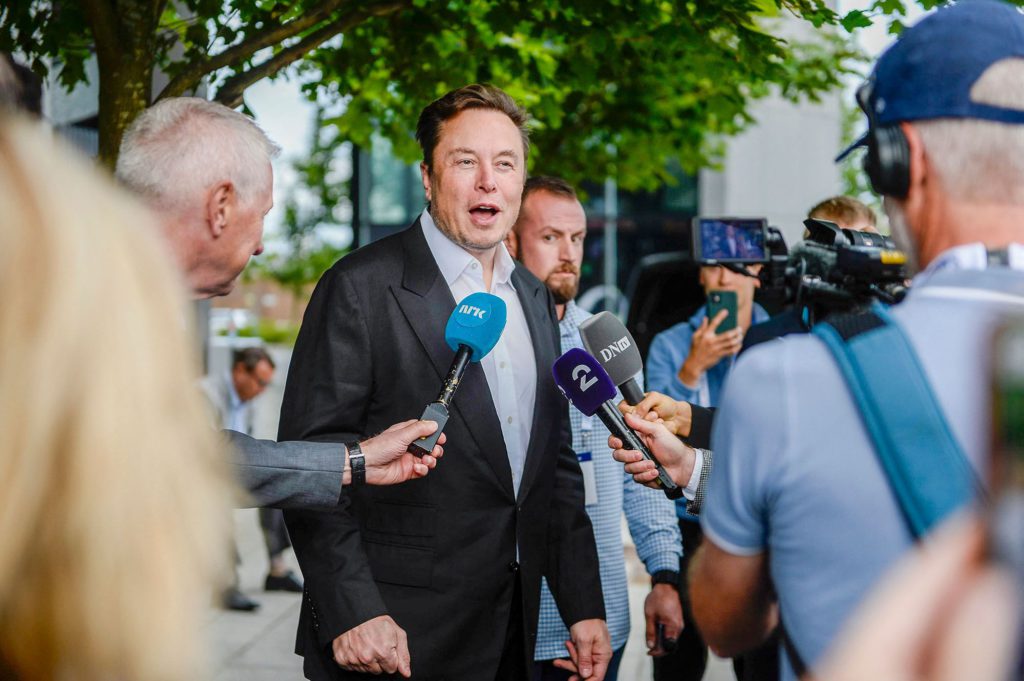
Musk Wants Longer Twitter Trial Delay Over Whistle-Blower Claims

(Bloomberg) — Elon Musk is planning to seek a delay in the trial over his $44 billion proposed buyout of Twitter Inc. until as late as December, amid new whistle-blower revelations about the company’s response to bot accounts, according to people familiar with Musk’s strategy.

In a Tuesday court filing, Musk had proposed the Oct. 17 trial be pushed to some time in November, but the people said he is preparing ask Delaware Chancery Court Judge Kathaleen St. J. McCormick for delay until early December. He wants more time so he can properly assess the claims former Twitter computer security head Peiter Zatko made last week in a whistle-blower complaint to regulators and Congress.

Zatko said that he raised concerns about the numbers of robot and spam accounts but was ignored. Twitter is suing Musk to force him to complete the deal, but the billionaire says the company’s misleading statements about bot accounts give him a valid reason to cancel his $54.20-per-share offer.

A December trial would get Musk closer to the February date he originally suggested shortly after Twitter filed the case in July. McCormack fast-tracked the case over his objection.

Musk proposed a November trial as part of his request to amend his counterclaims, which was filed under seal Tuesday in Delaware Chancery Court. According to the people, Musk wants to add Zatko’s allegation that Twitter had “egregious deficiencies” in protecting users’ accounts from hackers as further justification of his decision to nix the deal. 

He also contends Twitter executives knew about Zatko’s claims but didn’t disclose them when they agreed to the deal in April, the people said. Twitter also allegedly refused to turn over Zatko’s internal files and emails as part of the litigation, saying they weren’t relevant.

A Twitter representative declined to comment but noted that the company’s lawyers said again Tuesday in court and regulatory filings that Musk’s case for terminating the deal is “invalid and wrongful.”

Brian Quinn, a Boston College law professor, said Zatko’s claims will likely result in a trial delay. “I’d be shocked if Judge McCormick doesn’t push this trial back to give both sides more time to weigh this whistle-blower’s stuff,” he said.

Twitter has said spam and robot accounts make up about 5% of its customer base. The billionaire contends his analysis shows a third of Twitter’s more than 230 million users may fall into the bot category.

The case is Twitter v. Musk, 22-0613, Delaware Chancery Court (Wilmington). 

More stories like this are available on bloomberg.com

©2022 Bloomberg L.P.

Cloudflare Hints It Won’t Cut Ties to Site Linked to Harassment

(Bloomberg) — After days of silence, Cloudflare Inc. suggested Wednesday it wouldn’t cede to pressure to terminate internet services for controversial discussion forum Kiwi Farms, issuing a statement about its policies on abuse and saying that it didn’t want to set a precedent for speech on the internet. 

Cloudflare, which provides products from web security services to web hosting and internet technology, has been under pressure to drop Kiwi Farms as a customer after the online forum known for harassment and hate campaigns recently forced a well-known transgender Twitch streamer into hiding. The Anti-Defamation League has referred to Kiwi Farms as “an extremist-friendly forum that has been the breeding ground for countless harassment campaigns.” 

In a blog post Wednesday morning in response to “questions that have arisen,” executives compared Cloudflare to a telephone company and said turning off security services because the content is “despicable” is the wrong policy.  

“Terminating security services for content that our team personally feels is disgusting and immoral would be the popular choice,” according to a joint statement from Chief Executive Officer Matthew Prince and Alissa Starzak, the global head of public policy. “But, in the long term, such choices make it more difficult to protect content that supports oppressed and marginalized voices against attacks.” 

Read about the campaign for Cloudflare to end support for Kiwi Farms

Over the last decade, Kiwi Farms has been tied to multiple doxxing attacks, in which a person’s private, personal information is published online, or “swatting,” where anonymous attackers use that private information to send police or SWAT teams to a targeted person’s home. At least two people who have died by suicide have been targeted by Kiwi Farms users, according to messages from the victims themselves or friends cited in news reports. Kiwi Farms receives 10 million views a month, according to data from web traffic analysis service SimilarWeb.

Clara Sorrenti, 28, whose online name is “Keffals,” has been leading the charge to force Cloudflare to terminate services for Kiwi Farms. The Twitch streamer and political commentator said she was swatted at her home in London, Ontario, earlier this month. She then moved to a different, undisclosed address, but said Kiwi Farms users tracked her every move and continued to target her. “There are countless people actively, every day, being harassed by this site — most neurodivergent or transgender,” Sorrenti said in an interview on Tuesday. “It would help a lot of people if Cloudflare no longer provided their services to Kiwi Farms.”

Her cause has garnered widespread support online. In August, the #DropKiwiFarms hashtag was mentioned 10,000 times on Twitter, according to a search through BrandMentions.

Kiwi Farms creator Joshua Moon told Bloomberg News that “the forum does not condone behavior besides on-site discussion.” 

Cloudflare has terminated services for a select few sites in the past, including White supremacist site Daily Stormer and controversial forum 8chan. In the blog, the executives noted that after those moves, the company saw an increase in authoritarian regimes asking for the termination of services for human rights organizations. “Just because we did it in a limited set of cases before doesn’t mean we were right when we did. Or that we will ever do it again,” they wrote.

Since then, Cloudflare has had discussions with policy makers that led executives to conclude that “the power to terminate security services for the sites was not a power Cloudflare should hold. Not because the content of those sites wasn’t abhorrent — it was — but because security services most closely resemble internet utilities,” according to the blog.

Cloudflare executives also draw a stark distinction between their web security services and services that host content. The company said the vast majority of its customers don’t yet use its hosting products. While Cloudflare says it doesn’t provide security services to sanctioned organizations or individuals or illegal content in the US, “we believe that cyberattacks are something that everyone should be free of. Even if we fundamentally disagree with the content,” the executives wrote. 

Falsely reporting an incident to law enforcement and some hacking techniques associated with doxxing can be crimes, according to criminal defense attorney David Lane. Some individuals who have participated in swatting have faced prosecution.

Cloudflare said more than 20% of web users use its services. “When considering our policies we need to be mindful of the impact we have and precedent we set for the internet as a whole,” the executives wrote in the blog post. 

Sorrenti didn’t immediately respond to a request for comment on the Cloudflare blog. Cloudflare didn’t respond to a request for comment.

More stories like this are available on bloomberg.com

©2022 Bloomberg L.P.

Bitcoin Miners to Face Thinner Margins as Competition Heats Up

(Bloomberg) — Bitcoin miners are likely facing narrowing profit margins even after a break in the US heat wave allows them to turn rigs back on and add new machines they bought during the last bull run.

Bitcoin mining difficulty, an indicator of the amount of computing power being deployed to secure the blockchain network and earn rewards in the token, has jumped by 9.26% over the last two weeks, according to data from btc.com. The increase is the largest since January. 

While the jump in mining may seen bullish for companies such as Riot Blockchain Inc. and Marathon Digital Holdings Inc., a higher level of computing power for the entire Bitcoin network can cause miners to earn less Bitcoin with the same input. That risks further compressing profit margins — which were once on par with those of luxury-good makers — that have already shrunk due to Bitcoin’s dramatic price decline and soaring energy costs.  

“Sites are getting energized and machines that were purchased long ago are getting plugged in,” said Nick Hansen, chief executive at mining services company Luxor Technologies. Marathon started energizing tens of thousands of machines in recent weeks after multiple delays earlier this year, while Core Scientific Inc. deployed at least 30,000 servers across the US in the last two months.

Bitcoin miners are deploying a wave of more efficient machines. Demand for such rigs were so high during the bull run in November that major manufactures such as Bitmain could only deliver them to mining companies several months later from Asia to North America. Bitcoin has dropped about 70% from an all-time high of almost $69,000 in November.

The pullback in Bitcoin has sent the shares of miners tumbling this year. Riot has dropped 68%, is down 63% and Core Scientific has slumped 79%.

A drop in temperatures across crypto-friendly states such as Texas has also allowed miners to plug their rigs back to the power grid. 

“The moderately cooler temperatures in Texas have helped increase the Texas hash rate relative to previous weeks this summer,” Lee Bratcher, president of Texas Blockchain Council, said in a message to Bloomberg. “Peak energy demand in Texas is not expected to exceed what we saw in July and early August, which means the miners will likely not be needed to respond in a demand response situation in the coming weeks.”  

The power crunch induced by the historic heat wave in Texas in the past few months prompted nearly all major mining companies in the state to curtail their power usage. Other southern states in the US, which tend to have liberal regulations on crypto mining, have faced similar power shortages with high temperatures. 

A consolidation among Bitcoin miners may also have contributed to the rising computing power. 

“Industrial miners continue to come online in the US and bolstering buildouts by taking mining rigs from unprofitable miners and putting them to better use in larger facilities,” said Josh Olszewicz, head of research at digital asset fund manager Valkyrie Investments. 

More stories like this are available on bloomberg.com

©2022 Bloomberg L.P.

Amazon’s ‘Lord of the Rings’ TV Series Is an Epic Worth Every Penny

(Bloomberg) — Almost as soon as Amazon Inc. acquired the global TV rights to The Lord of the Rings franchise in 2017 for $250 million, LOTR die-hards were on edge, fretting and squabbling in Reddit chatrooms and on Twitter with concerns about plot, veracity, and execution.

And when the company released a trailer for The Lord of the Rings: The Rings of Power, a five-season show based partially on a world-building backstory J.R.R. Tolkien had written as appendices to The Return of the King, there was further agitation. The diverse cast and various female leads elicited complaints that smacked of racism and misogyny: “It’s the disrespect to the source material that we just won’t accept,” went a representative critique.

After watching the first two hour-long episodes (Amazon would make only two of the eight available to the media ahead of the Sept. 2 series premiere), I can confidently say that the critiques … don’t matter. I’m sure there’s much to offend various loyalists, but the vast majority of viewers, myself included, won’t be among the aggrieved. 

Instead, showrunners and executive producers J.D. Payne and Patrick McKay have managed to put together a sweeping, lush epic that echoes the sensibilities of Peter Jackson’s Lord of the Rings and Hobbit trilogies while forging new ground. The settings are the same: Both the film and the series were filmed in New Zealand. So, too, are the aesthetics of each species, with elaborate, delicate motifs for elves and angular, severe decoration for dwarves. Characters speak in British accents, apparently the official accent for years of yore. If anything, the Ring of Power’s special effects outclass those of its 20-year-old cinematic predecessor. The series’s estimated $1 billion price tag was, it seems, worth it.

The initial, high-fantasy scene-setting will be familiar to anyone who has a glancing familiarity with the movies. We’re a few thousand years before Frodo Baggins begins his quest to destroy an evil ring by plunging it into a volcano, but the villain Sauron is the same. As in the movies, evil forces had risen up, only to be defeated before the actual story begins; and just as in the movies, only a few Cassandras are convinced that they’re not actually gone, just gathering strength in secret. The first episodes are devoted to proving them right.

We meet Galadriel (an excellent Morfydd Clark) as an elven commander dead-set on finding Sauron, defying the prevailing wisdom of her fellow soldiers and the elven elites. Her quest begins as a solitary one, with her scaling mountains and crossing oceans in an attempt to root out evil. And yes, this is the Galadriel who makes a later appearance in the movie trilogy, played by Cate Blanchett.

Another elf, Arondir (Ismael Cruz Córdova), has more in the way of company. Formerly stationed in an elvish garrison on Middle-earth, he, like Galadriel, refuses to accept the “Mission Accomplished” messaging of his commanders. He embarks on his own orc-finding quest, aided at first by a human healer ​​(Nazanin Boniadi), with whom he exchanges long, meaningful glances—the only time I thought the show drifted dangerously close to camp. (If you need it, it’s a sure sign that Rings of Power will remain in TV-14 territory without the blood, gore, and nudity that HBO doubled down on with its Game of Thrones spinoff.)

A third elf, Elrond (Robert Aramayo), an ambitious politician (this is the same Elrond who appears as the lord of Rivendell in the trilogy) gets the third quest, traveling first to the vast underground kingdom of the dwarves, where he’s tasked with consensus building for an as-yet-articulated mission. It doesn’t take a Tolkien scholar to realize he’s trying to put together a quorum that will create the rings of the show’s title, though I should stress that that is not a confirmed plot point. 

Indeed, reviewers have repeatedly been warned by Amazon Prime Video’s representatives not to give away story specifics, a reasonable but laughable concern given that the first two episodes—which, mind you, are together as long as a full-length movie—spend most of their time clearing their throat in preparation for the real action to begin. Plot, if you can call it that, is devoted to getting its principal characters on whatever path they’re supposed to be on. 

And so we are also introduced to a tribe of Harfoots, a precursor to Hobbits who share their descendants’ whimsy, saccharine good humor, and their tendency to attract danger. And there are humans, a race the show generally takes a dim view of; most tend to be cruel, conniving. and bigoted, though I assume we’ll encounter a few good apples as the story unfolds.

Lest this all seem too rote, I should emphasize what a pleasure it is to watch. Each episode cost approximately $58 million, and it shows: The cinematography is gorgeous, the interiors detailed, the CGI just a notch below blockbuster level. Unlike blockbusters though, this a narrative marathon, not a sprint, so plot twists and big reveals are sprinkled judiciously, with just enough action to keep viewers engaged.

The show is interested in things the movies were not. Elves’ appearance on the shores of Middle-earth centuries earlier, for instance, is not universally embraced. Instead, they’re positioned as a sort of alien elite whose ostensible good intentions to help defeat evil can’t erase the fact that they’re a militarized, occupying force. 

The Rings of Power, in other words, is a thoughtful, arresting interpretation of Tolkien that takes the story in a new direction. Self-professed Tolkien experts can whine all they want. The show is guaranteed to find millions more to take their place. 

More stories like this are available on bloomberg.com

©2022 Bloomberg L.P.

Student-Loan Relief Stirs Democratic Dreams of Young-Voter Boost

(Bloomberg) — Democrats have two months to determine whether President Joe Biden’s student-debt relief plan is enough to repair fractured relations with young voters the party needs in an election with control of Congress at stake.

Biden has been under intense pressure from voters under 30 to enact a more progressive agenda since they helped him reach the White House in 2020. He carried about 60% of voters between 18-and-29 years old, but his inability to keep some of the bold promises he made during a campaign set against the backdrop of a national conversation on race and equality caused them to sour on his presidency. 

The president’s unpopularity presents a big challenge for Democrats before November, considering young Americans voted at record levels in the 2020 election as well as the 2018 midterms. While the president’s party typically loses seats in elections held during their first terms, polls show Democrats with momentum that could temper losses in the House and allow them to possibly expand their thin majority in the US Senate. 

Yet they will need every part of the electorate that they cobbled together in 2020 to show up — including the younger bloc of voters. Biden’s fulfillment of a campaign pledge to relieve debt can be interpreted as a mending of fences in his relationship with that constituency. 

There are early signs for optimism among Democrats. 

A CBS News/YouGov poll conducted between Aug. 24 and Aug. 26, covering the period that Biden made the student loan relief announcement, showed his approval rating at 59% with voters under 30 years old, a 10-point surge from July. Biden’s approval rating among that demographic was 70% in February 2021, but it plunged to 42% in January 2022. 

Biden’s overall approval rating inched up to 45% from 42% in July, the poll showed.

Jalen Miller, a student at the University at Albany in New York and national president of College Democrats of America, said his campus was buzzing in the aftermath of Biden’s Aug. 24 announcement. 

“This was the topic of conversation all of yesterday and pretty much today. I’m seeing a lot more people care about it on campus. I spoke to at least five people yesterday, talking to me about this issue, asking me about it, and how it’s going to affect my vote,” Miller said in an Aug. 25 telephone interview. 

Biden strung together a series of August victories, including legislation on veterans’ health, bipartisan passage of a bill to increase semiconductor chip manufacturing and a measure to address climate change and lower prescription drug costs. 

That streak was capped by the student loans order. 

“If we elect more Democrats to the Senate and keep the House Democratic, imagine the possibilities,” Biden said in an Aug. 28 tweet, an implicit plea to his base. 

The 2020 presidential election occurred alongside the most substantive national conversation on race since the 1960s. In May of that year, a Minneapolis police officer murdered George Floyd, an unarmed Black man, touching off protests across the country, but also introspective dialog on racism and systemic inequalities, including wealth disparities. 

Cornell Belcher, a Democratic pollster who worked on Barack Obama‘s presidential campaign, said Biden’s announcement delivers on a campaign promise made to a key voting bloc.

“One of the groups that historically are the most problematic for Democrats in the midterm election are younger voters who we consistently see in most midterms drop off significantly,” Belcher said. “This is really good politics, because it is in fact promises being kept to these young voters who were a pillar of his coalition.”

Intra-party fighting and opposition from Republicans helped to whittle down a more ambitious climate and social safety net plan that Biden had championed. Likewise, his efforts to enact police and voting rights reform also stalled in Congress. 

Miller said that while Biden’s move on student loans promises to ignite younger voters, there’s more yet to be done. 

“This is a great step forward to get the youth vote invigorated for Biden in the midterms and 2024. But I do think there’s a step to be had or things to be done. I don’t want this to be the end of the student debt conversation. I still believe in all student debt cancellation,” he said. 

At the same time, some moderate Democrats, including Representative Tim Ryan, who’s running for a Senate seat in Ohio, have criticized the plan over its costs.

If Biden’s sweeping executive order survives potential court challenges, the plan will cancel $10,000 of debt for borrowers earning less than $125,000 and as much as $20,000 for Pell grant recipients. 

There’s signs that the electorate is split on whether Biden landed on the right figures for relief. 

In a recent Emerson poll, voters were asked if the student loan relief program is too much, not enough, or just right. There was a stark age divide. Forty-three percent of voters between the ages of 18-34 said it’s not enough action. A plurality of those over 50 said Biden’s plan was “too much.”

Senator Bernie Sanders, a Vermont Independent who caucuses with Democrats, called the plan “an important step forward” but that more needs to be done at a time of massive wealth and income inequality.

Almost immediately after Biden’s announcement, Republicans swatted down the plan, with Republican Senate minority leader Mitch McConnell calling it “a slap in the face” to those who paid their debt.

“I still believe that it’s more than ever that has been done for students, their families and their futures,” said Paul Brathwaite, chief strategist at Federal Street Strategies, in response to progressives who believe $10,000 might not be enough for borrowers.

More stories like this are available on bloomberg.com

©2022 Bloomberg L.P.

Democrats Dream of Young-Voter Enthusiasm on Student-Loan Relief

(Bloomberg) — Democrats have two months to determine whether President Joe Biden’s student-debt relief plan is enough to repair fractured relations with young voters the party needs in an election with control of Congress at stake.

Biden has been under intense pressure from voters under 30 to enact a more progressive agenda since they helped him reach the White House in 2020. He carried about 60% of voters between 18-and-29 years old, but his inability to keep some of the bold promises he made during a campaign set against the backdrop of a national conversation on race and equality caused them to sour on his presidency. 

The president’s unpopularity presents a big challenge for Democrats before November, considering young Americans voted at record levels in the 2020 election as well as the 2018 midterms. While the president’s party typically loses seats in elections held during their first terms, polls show Democrats with momentum that could temper losses in the House and allow them to possibly expand their thin majority in the US Senate. 

Yet they will need every part of the electorate that they cobbled together in 2020 to show up — including the younger bloc of voters. Biden’s fulfillment of a campaign pledge to relieve debt can be interpreted as a mending of fences in his relationship with that constituency. 

There are early signs for optimism among Democrats. 

A CBS News/YouGov poll conducted between Aug. 24 and Aug. 26, covering the period that Biden made the student loan relief announcement, showed his approval rating at 59% with voters under 30 years old, a 10-point surge from July. Biden’s approval rating among that demographic was 70% in February 2021, but it plunged to 42% in January 2022. 

Biden’s overall approval rating inched up to 45% from 42% in July, the poll showed.

Jalen Miller, a student at the University at Albany in New York and national president of College Democrats of America, said his campus was buzzing in the aftermath of Biden’s Aug. 24 announcement. 

“This was the topic of conversation all of yesterday and pretty much today. I’m seeing a lot more people care about it on campus. I spoke to at least five people yesterday, talking to me about this issue, asking me about it, and how it’s going to affect my vote,” Miller said in an Aug. 25 telephone interview. 

Biden strung together a series of August victories, including legislation on veterans’ health, bipartisan passage of a bill to increase semiconductor chip manufacturing and a measure to address climate change and lower prescription drug costs. 

That streak was capped by the student loans order. 

“If we elect more Democrats to the Senate and keep the House Democratic, imagine the possibilities,” Biden said in an Aug. 28 tweet, an implicit plea to his base. 

The 2020 presidential election occurred alongside the most substantive national conversation on race since the 1960s. In May of that year, a Minneapolis police officer murdered George Floyd, an unarmed Black man, touching off protests across the country, but also introspective dialog on racism and systemic inequalities, including wealth disparities. 

Cornell Belcher, a Democratic pollster who worked on Barack Obama‘s presidential campaign, said Biden’s announcement delivers on a campaign promise made to a key voting bloc.

“One of the groups that historically are the most problematic for Democrats in the midterm election are younger voters who we consistently see in most midterms drop off significantly,” Belcher said. “This is really good politics, because it is in fact promises being kept to these young voters who were a pillar of his coalition.”

Intra-party fighting and opposition from Republicans helped to whittle down a more ambitious climate and social safety net plan that Biden had championed. Likewise, his efforts to enact police and voting rights reform also stalled in Congress. 

Miller said that while Biden’s move on student loans promises to ignite younger voters, there’s more yet to be done. 

“This is a great step forward to get the youth vote invigorated for Biden in the midterms and 2024. But I do think there’s a step to be had or things to be done. I don’t want this to be the end of the student debt conversation. I still believe in all student debt cancellation,” he said. 

At the same time, some moderate Democrats, including Representative Tim Ryan, who’s running for a Senate seat in Ohio, have criticized the plan over its costs.

If Biden’s sweeping executive order survives potential court challenges, the plan will cancel $10,000 of debt for borrowers earning less than $125,000 and as much as $20,000 for Pell grant recipients. 

There’s signs that the electorate is split on whether Biden landed on the right figures for relief. 

In a recent Emerson poll, voters were asked if the student loan relief program is too much, not enough, or just right. There was a stark age divide. Forty-three percent of voters between the ages of 18-34 said it’s not enough action. A plurality of those over 50 said Biden’s plan was “too much.”

Senator Bernie Sanders, a Vermont Independent who caucuses with Democrats, called the plan “an important step forward” but that more needs to be done at a time of massive wealth and income inequality.

Almost immediately after Biden’s announcement, Republicans swatted down the plan, with Republican Senate minority leader Mitch McConnell calling it “a slap in the face” to those who paid their debt.

“I still believe that it’s more than ever that has been done for students, their families and their futures,” said Paul Brathwaite, chief strategist at Federal Street Strategies, in response to progressives who believe $10,000 might not be enough for borrowers.

More stories like this are available on bloomberg.com

©2022 Bloomberg L.P.
Mapping US Coastlines May ‘Drive More Equality’ in Climate Adaptation Policy

(Bloomberg) — A Canadian technology company is using aerial imagery to build high-precision maps of US shorelines that will be used to help coastal communities adapt to climate change. 

By cataloguing which neighborhoods have more impervious surfaces like sidewalks and driveways compared to permeable ground with vegetation and trees, policymakers can better predict where heat waves or storm surges are likely to wreak the most havoc, Toronto-based Ecopia AI said. The firm is making the maps for the National Oceanic and Atmospheric Administration as part of a project to support US coastal communities vulnerable to extreme weather.

“The rapidly changing environment is driving the need for more precise decision making,’’ Jon Lipinski, Ecopia AI’s co-founder and president, said in an interview. “If you can better understand which communities are at risk for climate-related impacts such as flooding or urban heat islands, then you can drive more equality surrounding policy and funding decisions.”

From record heat waves in India to floods in Pakistan, many of the world’s more vulnerable populations and economies are already bearing the brunt of global warming. But even in wealthier parts of the world like North America and Western Europe, more extreme weather often has an outsized impact on the poorest and most disenfranchised in society.

Some activists and environmental justice groups expressed disappointment that the sweeping US Inflation Reduction Act signed into law this month by President Joe Biden’s administration didn’t allocate more money for climate adaptation in low-income and minority communities. 

The detailed maps made by Ecopia AI will be used to improve storm preparedness and recovery, and make it easier to assess which infrastructure and populations are most at risk, Nicholas Schmidt, NOAA’s science and geospatial services division chief, said in a statement announcing the partnership. Ecopia AI’s data will be used in the agency’s Coastal Change Analysis Program and is expected to be available through its Digital Coast site next year.Local and federal government agencies from Canada to Australia are already using Ecopia AI’s technology to do everything from helping them identify where they should build more sidewalks to keeping tabs on tree canopy. The firm’s high-precision maps are used by insurers such as Farmers Insurance and Tokio Marine.In July, the Collier County Sheriff’s office in Florida said it would use Ecopia AI’s technology to map property driveways and connected pavements across the county to help first responders arrive more quickly during emergencies. 

(Corrects to aerial imagery from satellite observations in first paragraph.)

More stories like this are available on bloomberg.com

©2022 Bloomberg L.P.

An Ominous Month Looms For Battered Nasdaq Bulls

(Bloomberg) — The second half of August has been bruising for technology stocks, but those hoping for a respite from the declines shouldn’t relax just yet: September is just around the corner.

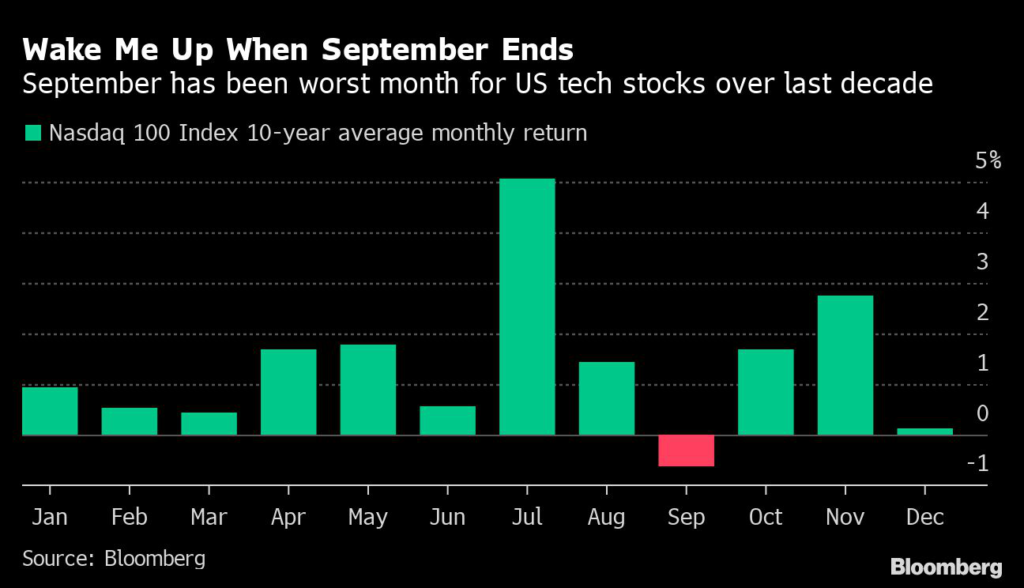
The month historically has been the worst of the year for returns, suggesting another reason for caution as investors also grapple with inflation and rising interest rates from the Federal Reserve. Over the last decade, the Nasdaq 100 Index has declined by an average of 0.6% during September, the only month of the year with a negative average. The tech-heavy index fell 5.7% in the Septembers of both 2020 and 2021.

Whether the month lives up to its reputation remains to be seen, but recent action has been to the downside. The Nasdaq 100 is down 3.9% in August, and it fell 6.1% over the past three sessions, its biggest three-day drop since mid-June. Fed Chair Jerome Powell added to recent losses when he indicated the central bank is likely to keep raising interest rates.

“Between the Fed, inflation, and all the conflicting signals we’re getting about the economy, we’re entering the month in a precarious position,” said Ryan Detrick, chief market strategist at Carson Group Holdings.

The index rose 0.9% on Wednesday.

Tech’s September weakness reflects a broader seasonal trend. The month has long been known as a bad one for equities, though analysts struggle to say exactly why that is. Some say individuals pay more attention to the market after the summer, selling stocks to lock in gains or book losses, while others cite mutual funds that begin selling losing positions before year end, which for some funds is in September or October. 

“You don’t want to blindly invest based on seasonality, but you shouldn’t ignore it, given how poor September typically is, especially for tech,” said Detrick. “The potential for more volatility seems quite high, and when you add in this downside seasonal trend, there’s plenty of risk for September.”

Investors seem to be bracing for such a prospect. According to Bank of America Corp., the firm’s clients were net sellers of US equities last week for a second straight week. 

Options pros also seem to think more pain is potentially in store. The number of outstanding bearish options contracts on an exchange-traded fund that tracks the Nasdaq 100 spiked on Aug. 19 to the highest level since the aftermath of the dot-com bust, and is hovering not too far from that level. 

“Until we get past the Fed’s hawkish stance, which will be a long and slow process, I have a hard time seeing how we get a clear runway for a risk-on trade,” said Don Calcagni, chief investment officer at Mercer Advisors. “I suspect we’ve put in our lows of the year, but tech continues to trade at a pretty significant premium, and because of that, I just don’t think there’s enough appetite for it to come roaring back.”

Valuations are especially elevated for some of the market’s biggest names. Apple Inc. trades at 24.7 times estimated earnings, above its 10-year average of 16.7. Microsoft Corp. at 25.1 is comfortably above its long-term average of 21.5. The Nasdaq 100’s price-earnings ratio is about 5% above its average over the past decade.

Carson’s Detrick is neutral on tech, citing valuations and higher Treasury yields. However, after September, seasonal trends will start to favor stocks, he said.

“The fourth quarter of a midterm year is historically very strong, so we could see some positive seasonal tailwinds toward the end of the year,” he said. “Meanwhile, tech earnings have overall been quite solid, so there could be some solid opportunities within the group when all is said and done.”

Tech Chart of the Day

The recent weakness in equities has been broad based, with almost 70% of Nasdaq 100 components making new four-week lows. That’s the highest pace since February, and it represents a rapid about-face from earlier this month, when zero components were at a four-week low.

Top Tech Stories

  • Apple Inc.’s top privacy executive will be leaving the company soon to work at a law firm, according to people with knowledge of the matter.
    • An Apple executive has left the board of Didi Global Inc., as the Chinese ride-hailing company struggles to regain ground it lost during Beijing’s crackdown on the country’s internet sector.
  • Snap Inc. is planning to lay off about 20% of its nearly 6,500 employees following weeks of planning, the Verge reported.
    • Netflix Inc. hired two Snap executives to develop its global advertising strategy. Chief Business Officer Jeremi Gorman and Vice President of Americas Peter Naylor will begin their role in in September, Ad Age reported, without saying how it obtained the information.
  • HP Inc. reported quarterly sales that missed estimates and reduced its annual profit forecast on falling demand for personal computers and printers, especially among consumers.
  • ByteDance Ltd., the parent of short-video hit TikTok, is planning to lower the price of its stock options to retain employees after a sharp downturn in technology valuations over the past year.
  • Onetime PayPal Holdings Inc. Chief Operating Officer David O. Sacks said he exchanged a few emails with investment bankers about possibly investing in his old friend Elon Musk’s Twitter Inc. acquisition but never became involved in the proposed deal.
  • Google employees are ratcheting up pressure on the internet-search giant to abandon its artificial intelligence work with the Israeli government, planning public demonstrations to draw greater attention to the controversial cloud-computing contract.
  • Grab Holdings Ltd. and Singapore Telecommunications Ltd. plan to roll out a banking app next week, joining tech giants like Jack Ma’s Ant Group Co. in taking advantage of the country’s fintech liberalization.
  • NetEase Inc. has acquired French game developer and publisher Quantic Dream SA, the companies announced in a statement Wednesday.

(Updates to market open.)

More stories like this are available on bloomberg.com

©2022 Bloomberg L.P.
Close Bitnami banner
Bitnami