Bloomberg

Xi’s Tech Crackdown Fuels Another Crisis: Out-of-Work Youth

(Bloomberg) — When Xi Jinping tightened the screws on China’s technology industry last year, he escalated a jobs crisis for the youngest and brightest minds needed to power the nation’s economy.

Rocked by a series of punishing regulations that froze deal-making and wiped out the once-swaggering industry’s growth, sector leaders from Alibaba Group Holding Ltd. to Tencent Holdings Ltd. and Xiaomi Corp. this year began firing people by the thousands.

Those cutbacks foreshadow a more fundamental shift in the giant industry’s traditional role as the largest and most sought-after employer, with potentially grave consequences. A record of almost 11 million new graduates are expected to flood the labor market this year. With the tech sector no longer offering them as lucrative and exciting a career path as it once did, many will join the jobless ranks in an economy where one in five people between the ages of 16 and 24 are already out of work.

25-year-old Yu Mingyue, a media studies student in Beijing, knows that struggle well, having spent 300 days trying to find work — an experience she says was “really beyond my expectations.”

“Before 2019, people were very eager about working for internet giants,” she says. Now her parents don’t want her to go near a private company given the myriad problems they face.

“Another good friend of mine is also finishing a graduate school considered quite good, and we thought we’d definitely be able to find a job,” she said. “But who knew the job market is so bad.”

The 20% record youth unemployment rate — almost four times the national urban rate — is a scar on the economy and a setback for the Communist Party before a major congress that’s set to usher Xi into a precedent-defying third term. Millions of young people out of work and disillusioned over their prospects could have lingering implications for China’s productivity and long-term growth. 

There’s no short-term relief on the horizon either, given the government’s hard-line Covid Zero policies and tech companies struggling to keep losses in check. China’s two largest internet firms, Alibaba and Tencent, let go of more than 14,000 people from April to June — almost 40% of the layoffs across the entire tech sector, according to layoffs.fyi.

High unemployment “may linger in the second half as more college graduates enter the workforce while zero-Covid policies are still in place,” said Liu Peiqian, chief China economist at NatWest Group Plc. Tech companies have long soaked up aspiring job-seekers and if that stops, it could destabilize the economy, she added. “If the unemployment rate remains high for a longer period of time, it may further weigh on social and economic stability.”

Tech giants were pummeled during the 2021 crackdown, which handcuffed money-making in sectors like online education, froze IPOs and deals, and forced Alibaba and its peers to pull out of promising businesses.

Many firms by and large avoided mass layoffs last year, in part because business boomed during the Covid era and there were hopes the government would eventually let up. While authorities did indeed ease up in early 2022, that was also when the global downturn hit and Covid fatigue set in across China, extinguishing many companies’ mid-term growth prospects.

While official data is hard to come by, stories of young tech workers ejected from cushy jobs abound. 27-year-old mobile game developer Amanda was one of the unlucky 5,000 or so that ran afoul of Tencent’s first staff reduction in nearly a decade.

China’s most valuable company — once the most promising candidate to become the nation’s first trillion-dollar corporation — hasn’t had a new game approved in about a year. More than 20 people or about a third of her team were abruptly fired before their Shenzhen-based employer reported its first decline in revenue.

Tencent is scaling back even teams at reliable money-spinners such as Peacekeeper Elite and Honor of Kings, according to Amanda, who wanted to be identified only by her first name to avoid getting blacklisted by employers.

“If even Tencent cannot navigate such a weak economy, how can other companies keep afloat for long?” she said. “What am I going to do next, where can I go?” 

Tencent declined to comment when contacted by Bloomberg News. The company’s president, Martin Lau, said on a recent earnings call that job cuts were part of measures to reduce costs and stabilize earnings.  

The accelerated downsizing is exacerbating the “lying flat” phenomenon that’s turned a generation of youngsters off the rat race. Even before Beijing’s regulatory assault laid waste to tech giants’ expansion plans, a growing number of people had quit in revolt at the increasing pressures that come with aggressive growth.

To address the issue, China’s central government is pushing plans from helping younger workers start their own businesses to strengthening vocational training and expanding headcounts at public institutions.

As tech fades into the background, government-backed firms are expected to take the lead in snapping up fresh graduates, said Iris Pang, chief economist for Greater China at ING Groep NV. Yet whether these positions are attractive to more highly educated job-seekers is an open question. 

One young worker named Hattie handled event planning for just such a state-run company — a stable job dubbed an “iron rice bowl.” But she quit to do a Master’s in education at the University of Glasgow, hoping to get into a then-flourishing online education sector. Then regulators effectively obliterated the sector. 

After graduating in October, she joined internet celebrity-driven e-commerce company Mogu Inc. in Hangzhou — a stepping stone to far greater prospects, she thought. Hattie was fired within 10 months, along with 10 others she knew of.

“I should have cried a lot, but in the end there were no tears but silence,” she wrote in a post on social media platform Xiaohongshu. “I’m really anxious. But anxiety is an only too-normal emotion in China’s society now,” she told Bloomberg News later, withholding her full name for fear of clouding her future prospects. 

Amanda, the developer, considered pivoting to other industries given the sharp downturn in gaming globally, but has struggled to find a job given how depressed the economy is. Promising opportunities from short video platform Kuaishou Technology and Perfect World Game Co. fell through after they failed to proceed with verbal offers. 

She finally scored a similar job at Bytedance Ltd.’s gaming platform Nuverse in July. Things could be worse, she surmised.

“I’m really worried about being laid off again,” Amanda said. “But the cruel reality is that the internet industry might be the last sector with high-paid jobs. Though it’s slowing down and laying off staff, other industries are even worse.”

More stories like this are available on bloomberg.com

©2022 Bloomberg L.P.

Stocks End at Lowest Level in a Month; Oil Sinks: Markets Wrap

(Bloomberg) — US stocks fell for the third consecutive day as fresh data pointed to resilience in household and labor demand, affirming the Federal Reserve’s resolve to continue to be aggressive in its fight against inflation. Commodities from oil to copper sank as the dollar rose. 

The S&P 500 and the tech-heavy Nasdaq 100 finished the session at their lowest levels in a month. Treasuries ended Tuesday mixed after an unexpected rebound in August consumer confidence pushed swap rates toward pricing in another three-quarter percentage point hike for the Fed’s September meeting.

Read More: Selloff’s Sequel Is Moment of Truth for Summer Stock Enthusiasts

Three regional Fed presidents, in separate remarks on Tuesday, reiterated Chair Jerome Powell’s intention to bring down inflation. A reading on job openings Tuesday added to signs that the labor market remains tight and wage pressures persist. Jobless claims will air Thursday before Friday’s August payrolls report.

“The repercussions from Friday are going to make us extra sensitive to a lot of the incoming data, especially around employment,” said Shawn Cruz, head trading strategist at TD Ameritrade. “It’s not surprising that getting that consumer sentiment data today and the JOLTS data had a pretty strong reaction in markets. That’s probably what you should expect from now until the September Fed meeting, in particular anything around employment.”

Analysts remain mixed on what recent remarks by Fed officials and upcoming data could mean for stocks. While Credit Suisse Group AG recommended investors go underweight global equities following the Jackson Hole symposium, JPMorgan Chase & Co. strategists say that a reading on the US labor market that spells bad news for the economy is actually a bullish signal for stocks.

Meanwhile, bonds are sliding toward the first bear market in a generation, burning investors who erred in bets that central banks would pivot away from rapid interest-rate hikes.

The Fed this week is also set to step up the unwinding of its near-$9 trillion balance sheet. The impact of quantitative tightening is going to be relatively benign for the first six to 12 months, but could start to amplify its effects on the economy around the middle part of next year, Jeff Schulze, investment strategist at ClearBridge Investments, said in an interview. 

Other risks range from China’s economic slowdown to an energy crisis that threatens to tip Europe into recession with winter approaching.

Here are some key events to watch this week:

  • ECB Governing Council members due to speak at event Tuesday through Sept. 2
  • China PMI, Wednesday
  • Euro-area CPI, Wednesday
  • Russia’s Gazprom set to halt Nord Stream pipeline gas flows for three days of maintenance, Wednesday
  • Cleveland Fed President Loretta Mester due to speak, Wednesday
  • China Caixin manufacturing PMI, Thursday
  • US nonfarm payrolls, Friday
  • UK leadership ballot closes Friday. Winner announced Sept. 5

Will Chinese sovereign bonds outperform Treasuries? China is the theme of this week’s MLIV Pulse survey. Click here to participate anonymously.

Some of the main moves in markets:

Stocks

  • The S&P 500 fell 1.1% as of 4 p.m. New York time
  • The Nasdaq 100 fell 1.1%
  • The Dow Jones Industrial Average fell 1%
  • The MSCI World index fell 1%

Currencies

  • The Bloomberg Dollar Spot Index rose 0.2%
  • The euro rose 0.2% to $1.0019
  • The British pound fell 0.5% to $1.1656
  • The Japanese yen was little changed at 138.73 per dollar

Bonds

  • The yield on 10-year Treasuries was little changed at 3.10%
  • Germany’s 10-year yield was little changed at 1.51%
  • Britain’s 10-year yield advanced 10 basis points to 2.70%

Commodities

  • West Texas Intermediate crude fell 5.1% to $92.02 a barrel
  • Gold futures fell 0.8% to $1,735.70 an ounce

More stories like this are available on bloomberg.com

©2022 Bloomberg L.P.

California Passes Law Requiring Companies to Post Salary Ranges on Job Listings

(Bloomberg) — California on Tuesday passed a law requiring all employers based or hiring in the state to post salary ranges on all job listings. The law will also require California-based companies with more than 100 employees to show their median gender and racial pay gaps — a first for a US state. 

The bill will head to Governor Gavin Newsom, who has until Sept. 30 to sign or veto. He hasn’t yet expressed a position and didn’t immediately respond to a request for comment. If he signs it, the law would affect some of the biggest US companies, including Meta Platforms Inc., Alphabet Inc. and Walt Disney Co. 

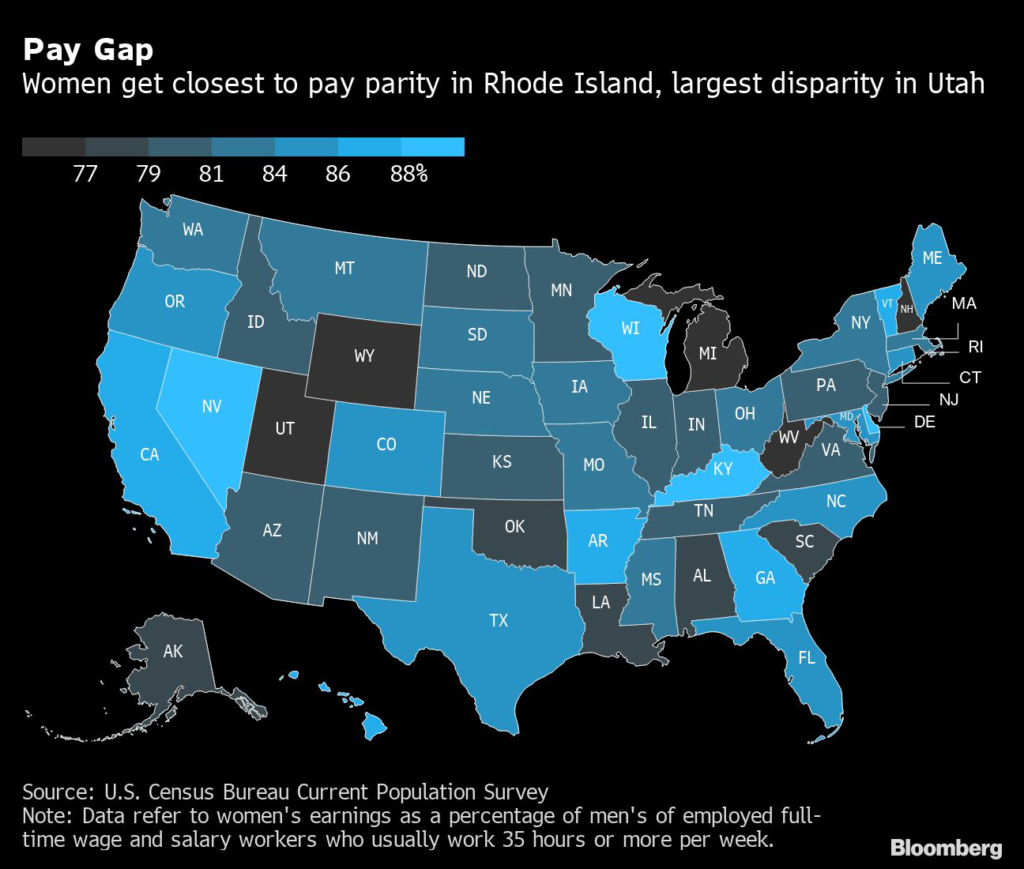
In recent years, more states have adopted an array of transparency laws to fight the stubborn gender and racial pay gaps. Women who work full-time earn around around 83% of what men do, according to US Census Bureau data — a figure that hasn’t budged much in recent years. Black and Hispanic women earn even less, on average, than their White counterparts. 

California joins Colorado, New York City, and Washington state in adopting the job-posting tactic. Only Colorado’s law is currently in effect; New York City-based employers will have to start listing pay ranges starting on Nov. 1. The New York state legislature also passed a similar bill that’s awaiting Governor Kathy Hochul’s signature.

If the California and New York governors, who are both Democrats, sign the pending laws, almost a quarter of the US population will live in states with such salary disclosure requirements. 

“I think this becomes a tipping point, frankly,” said Christine Hendrickson, the vice president of strategic initiatives at Syndio, which provides software that helps employers identify pay disparities. “It’s at this point that employers are going to stop going jurisdiction by jurisdiction and start looking for a nationwide strategy.” 

The California Chamber of Commerce opposes the bill, even after lawmakers stripped a requirement that would make all pay data public. New York City’s rule also faced business pushback, which delayed enforcement by six months. 

Pay transparency on job postings is just one of many tools cities and states have adopted to close wage gaps. Some also prohibit employers from asking about pay at past jobs and from disciplining workers who share pay information. Maryland requires pay to be disclosed for job postings upon request and Connecticut, Nevada and Rhode Island require disclosure during the hiring process.

More stories like this are available on bloomberg.com

©2022 Bloomberg L.P.

HPE Reports Sales in Line With Estimates as Supply Constraints Persist

(Bloomberg) — Hewlett Packard Enterprise Co.’s quarterly revenue rose 1%, propped up by strong demand for its newer subscription-based products, though the company continues to be hampered by supply-chain disruptions.

Sales increased to $6.95 billion and profit, excluding some items, was 48 cents a share, the Spring, Texas-based company said Tuesday in a statement. Both figures were in line with analysts average estimates, according to data compiled by Bloomberg.

HPE said fiscal-year profit, excluding some items, will be $1.96 to $2.04 a share, a decline of 6 cents a share from the company’s highest previous estimate. 

Demand remains strong and the reduction in the forecast is due to currency headwinds, the company’s business exit from Russia and supply chain challenges, Chief Executive Officer Antonio Neri said in an interview. He cited the company’s growing backlog as evidence of steady demand, and said the company hasn’t seen any “meaningful cancellations.”

HPE is trying to reduce its reliance on sales of hardware such as data-center servers by encouraging customers to pay for additional services with subscriptions. The company said its annualized revenue run-rate, which reflects future payments under the subscription software-as-a-service model, jumped 22% to $858 million in the quarter. 

Revenue from the Intelligent Edge unit grew 8% to $941 million in the period ended July 31, topping analysts’ estimates. The division, which is a key part of HPE’s transformation plan, covers products that let companies gather and process data where it is generated instead of sending it to an external storage center. High Performance Computing and AI revenue gained 12% to $830 million, also beating estimates.

For more on HPE’s transformation goals

Revenue generated by the company’s largest infrastructure unit declined 3% to $3 billion. Storage revenue fell 2% to $1.15 billion.

The stock was little changed in extended trading after closing at $13.65 in New York. The shares have dropped almost 14% this year. 

More stories like this are available on bloomberg.com

©2022 Bloomberg L.P.

Trump’s Truth Social App Blocked From Google Play Store

(Bloomberg) — Google’s Play store is declining to distribute Donald Trump’s Truth Social app, saying the network still needs to resolve the fact that it hosts violent threats and other content that goes against Google’s standards.

Alphabet Inc.-owned Google said it notified Truth Social of its violations and how to fix them on Aug. 19. “Having effective systems for moderating user-generated content is a condition of our terms of service for any app,” a Google spokesperson said in a statement.

Trump Media and Technology Group said that Truth Social was a family-friendly and vibrant community, which “has continuously worked in good faith with Google to ensure that the Truth Social Android App complies with Google’s policies without compromising our promise to be a haven for free speech,” the company said in a statement. “It is our belief that all Americans should have access to Truth Social no matter what devices they use.”

Truth Social is former President Trump’s social network of choice. Trump was banned from Twitter and suspended from Facebook and Instagram after the Jan. 6, 2021, Capitol insurrection. While the app is careful to remove some potentially offensive content, such as sexual images, it has played host to violent speech, such as calls for civil war to defend Trump’s honor.

Read more about Truth Social’s content moderation problems

Digital World Acquisition Corp., the special purpose acquisition company merging with Trump’s venture, touched a session low on the news. The stock tumbled 51% this year through Monday.

More stories like this are available on bloomberg.com

©2022 Bloomberg L.P.

Ukraine Latest: Russia Halts Gas Supply to French Utility Engie

(Bloomberg) — Ukraine reported heavy fighting as it started an offensive in the region around Kherson, a river port that was one of the first cities to fall to Russian forces at the start of the war. 

Artillery hit Russian positions around the Kherson region, according to the Ukrainian military’s southern command, which said a counteroffensive began Monday along several points on the front. Russia’s Defense Ministry confirmed the attacks in a statement, and said the push “failed miserably.” 

Europe’s energy crisis escalated as Russian natural-gas giant Gazprom PJSC said it will halt supplies to French utility Engie SA because of a disagreement over payments. Moscow has increasingly choked shipments of the fuel to Europe in retaliation for sanctions related to its invasion of Ukraine.

(See RSAN on the Bloomberg Terminal for the Russian Sanctions Dashboard.)

Key Developments

  • Ukraine Counterattacks in South, Leaves World Guessing on Scale
  • EU Agrees To Pursue Work on Ukraine Military Training Mission
  • EU Reaches Gas Storage Goal Early Despite Russian Supply Cut
  • France, Germany Want to Hit Support for Putin With TikTok, Visas
  • Russia Curbs Gas Supply to France’s Engie as Squeeze Worsens
  • EU Power Market Not Working Thanks to Putin, Von Der Leyen Says

On the Ground

Heavy fighting is taking place over large parts of the southern Kherson region, and Ukraine has destroyed most major bridges across the Dnipro river in the area, the presidential office in Kyiv said in a military update. Ukrainian artillery hit 13 control centers of Russian forces around Kherson, the country’s southern command said on Facebook. Russia struck the city of Zaporizhzhia overnight, Interfax-Ukraine reported, citing local authorities. To the east, Russian forces shelled the Donetsk, Sumy and Kharkiv regions, the Ukrainian military said. Four civilians were killed in central Kharkiv, according to local authorities. 

(All times CET)

Russia Halts Gas Supply to France’s Engie as Crisis Intensifies (9:35 p.m.)

Europe’s energy crisis escalated as Russian natural-gas giant Gazprom PJSC said it will halt supplies to French utility Engie SA because of a disagreement over payments. 

Gazprom has notified Engie about a full cutoff of gas from Sept. 1 becayse the utility hasn’t paid in full for July deliveries, the Russian gas producer said in a statement. Earlier, Gazprom said it would reduce gas supplies starting Tuesday. It also plans to shut the Nord Stream pipeline to Germany for three days of maintenance beginning Wednesday. 

Read the full story here.

Russia’s Iranian Drones Are Failing in Ukraine, US Says

Iranian drones that Russia has imported for use over Ukrainian battlefields have “already experienced numerous failures,” according to US State Department spokesman Vedant Patel.

He contended that US sanctions and export controls were hitting Russia’s arms industry and forcing Moscow to rely on “unreliable countries” such as Iran, an alliance he called a “profound threat.”

The US assesses that a shipment of Iranian drones was airlifted into Russia this month as part of a plan to import hundreds of pilotless aerial vehicles able to conduct air-to-surface attacks and electronic warfare and help Russia more accurately hit targets, Patel said in a telephone briefing in Washington.

Ukrainian Grain Arrives in Djibouti, Blinken Says (9:05 p.m.)

US Secretary of State Antony Blinken said in a statement that he welcomed the arrival in Djibouti of the ship Brave Commander, bearing 23,300 metric tons of Ukrainian grain for distribution in Ethiopia and Somalia, which “are dangerously food insecure after four years of drought.”

United Nations Secretary-General Antonio Guterres told reporters last week that he had seen the vessel, chartered by the World Food Program and “proudly flying the UN flag with its cargo destined for the Horn of Africa,” during his travel to Istanbul.

US Lawmakers Klobuchar, Portman Meet With Zelenskiy (8:04 p.m.)

US Senators Amy Klobuchar, a Minnesota Democrat, and Rob Portman, an Ohio Republican, met in Kyiv with President Volodymyr Zelenskiy, according to an emailed statement from his office.

Zelenskiy told them he expects sanctions against Russia to be tightened, including by imposing visa restrictions on Russians. They also discussed the situation at Ukraine’s Zaporizhzhia nuclear power plant that’s occupied by Russian troops. According to the statement, Zelenskiy reiterated that it must be returned to Ukrainian control. 

White House ‘Has Concerns’ on India Exercises With Russia (7:52 p.m.)

The White House press secretary expressed disappointment when asked about India’s participation in joint military exercises with Russia.

“The United States has concerns about any country exercising with Russia while Russia wages an unprovoked, brutal war against Ukraine,” Karine Jean-Pierre told reporters aboard Air Force One en route to Wilkes-Barre, Pennsylvania. “But of course every participating country will make its own decisions, and I’ll leave it at that”

EU Power Market Isn’t Working Due to Putin: Von Der Leyen (7:01 p.m.)

The European Union’s power price-setting system is no longer functioning properly and requires changes after Russian President Vladimir Putin turned energy into a weapon, according to Commission President Ursula von der Leyen.

“The electricity market is no more a functioning market because there’s one actor — Putin — who’s systematically trying to destroy it and to manipulate it so we really have to react to that and that’s why we’re addressing now the composition of the electricity market,” she told a news conference in Denmark.

The commission, the EU’s executive arm, is devising a plan to step into the energy market, intervening in the short term to damp down soaring power costs and overhauling its design in the longer term to break the link between gas and electricity prices. 

Ukraine Fills Gas Storage to 68% of Plan, Premier Says (6:11 p.m.)

Ukraine has 13 billion cubic meters of gas stored as of end-August, Prime Minister Denys Shmyhal said, more than two-thirds of its plan to have at least 19 bcm before the winter heating season begins. 

The country put more than 1 bcm into underground storage last month and is in talks with Norway to receive 200 million euros to purchase natural gas as well, he said.

China Fills Void as Foreign Brands Flee Russian Market Amid War (6:01 p.m.)

Chinese cars, televisions and smartphones are replacing German and South Korean imports in Russia as its market is reshaped by sanctions and an exodus of brands in the wake of Putin’s invasion of Ukraine. 

The result is upending trade, with Russia seeking to insulate itself from further disruptions by pivoting to goods from countries that haven’t joined sanctions imposed by the US and its allies. Moscow is also rewriting rules to allow its sovereign wealth fund to invest in the currencies of China, India and Turkey, after penalties blocked euro and dollar purchases.

Zelenskiy Meets IAEA Director in Kyiv (5:15 p.m.)

Ukrainian President Volodymyr Zelenskiy said he sees the IAEA mission to the Russian-occupied Zaporizhzhia nuclear power station as “tactical,” while a “strategic” solution would be to force Moscow’s troops to leave the plant. 

“This is how we will get rid of the risks associated with nuclear energy,” he said after meeting IAEA Director General Rafael Grossi in Kyiv.

EU Agrees To Pursue Work on Ukraine Military Training Mission

EU countries agreed to start hammering out details of a proposed training mission for Ukraine’s armed forces, with countries including Belgium and Slovakia offering to host.

The bloc’s defense ministers agreed “on launching the work necessary to define the parameters for an EU military assistance mission for Ukraine,” Josep Borrell, the EU’s foreign policy chief, told reporters after a meeting in Prague.

Member states have already agreed to allocate as much as 2.5 billion euros ($2.5 billion) to support the delivery of weapons and other aid to Ukraine.

EU Reaches Gas Storage Goal Early Despite Russian Supply Cut 

The EU met its gas storage filling goal two months ahead of target as the bloc braces for a tough winter with Russia limiting supplies and energy contracts trading at elevated levels throughout the continent. 

European Commission President Ursula von der Leyen celebrated the milestone on Monday, telling an audience at an energy conference in Denmark that the reserves hit an average of 80%, a target the EU had aimed to reach by Nov. 1. 

Vatican Clarifies Pope’s Condemnation of Russia (3:51 p.m.)

Pope Francis considers the war “initiated by the Russian Federation” in Ukraine as “morally unjust, unacceptable, barbaric, senseless, repugnant and sacrilegious,” the Vatican said in a statement.

The clarification follows harsh criticism of Francis from Ukrainian authorities and Catholics worldwide for his apparent ambiguity on the war and his refusal to condemn Russia for the invasion.

The Catholic leader has said that NATO was partly to blame for the war, placed a Russian and a Ukrainian woman side-by-side in an Eastern rite ceremony and recently called Darya Dugina — the daughter of Russian nationalist ideologue Alexander Dugin’s who firmly supported the war before she was killed by a car bomb — an “innocent victim.” The Vatican said the pope speaks to defend human life and promote peace, and that his words aren’t political statements.

Ukraine Expects to Get $1.5 Billion in US Aid Next Month (3:24 p.m.)

Ukraine expects to get a $1.5 billion tranche of US aid in September to help finance its budget, Finance Minister Serhiy Marchenko told public television.

The government also sees the EU starting to disburse aid to the country in late September or the start of October, he said.

EU Close to Tightening Rules on Russian Visas (2:48 p.m.)

European Union countries appear to be moving toward an agreement on tightening the visa regime for Russian citizens, according to Czech Foreign Minister Jan Lipavsky, who is hosting his counterparts from the bloc in Prague.

“I am sensing positive signals that key players are on board,” Lipavsky said when asked about his proposal to suspend the visa-facilitation agreements with Russia. Foreign ministers are due to discuss visas and the invasion of Ukraine on Wednesday morning.

Such a move would mean that Russians traveling to the EU will have to pay more and face additional bureaucracy to obtain short-term visas.

Exxon Files Dispute With Russia Over Sakhalin-1 Exit (2:41 p.m.)

Exxon Mobil Corp. filed a dispute with the Russian government after a decree from President Vladimir Putin blocked the oil major from exiting its only remaining operation in the country. 

Exxon has been trying to exit the Sakhalin-1 project in the country’s Far East since March but was recently prevented from doing so by a presidential decree, the company said Tuesday in a statement. 

One in Six Ukrainian Refugee Wants to Stay in Poland (2:39 p.m.)

Only 16% of refugees who fled from Ukraine to Poland want to stay there permanently, according to a report from the central bank in Warsaw. 

Almost two-thirds of Ukrainians in Poland plan to leave after less than a year, according to the survey conducted in April among 3,165 adults. Almost 6 million people have entered Poland from Ukraine since the war began on Feb. 24. 

Ukraine to Hit Dnipro Crossings, Military Says (1:50 p.m.)

Ukraine’s army will destroy all alternative crossings over the Dnipro river attempted by Russian troops, military spokeswoman Natalia Humenyuk said. The Russian army is not able to move resources from the east bank to the west bank of the Dnipro near Kherson after Ukrainian attacks destroyed transport links and made all bridges unusable.

“The main goal is the de-occupation” of the Kherson region, she said. “Powerful resistance in the Kherson region is yet more proof that Kherson is Ukraine,” Humenyuk added, saying that a “powerful” push to rid the area of Russian occupiers would happen in the near future.

“Battles are ongoing now,” she said.

Poland Plans to Boost Defense Spending Because of War (1:50 p.m.)

Poland will more than double military spending next year, to as much as 138 billion zloty ($29 billion), to strengthen its army in the face of the war in neighboring Ukraine.

Warsaw has been on a buying spree for arms since the war began and just last week signed a $5.8 billion deal to buy tanks and artillery in South Korea. The government also plans to expand its troop count by more than 20,000 in 2023, Premier Mateusz Morawiecki said in Warsaw on Tuesday.

Ukraine’s Attacks Show ‘Logic,’ Belgian Minister Says (1:27 p.m.)

Ukrainian soldiers are trying to disperse Russian means and logistics when they attack both Crimea and Kherson in parallel, Belgian Defense Minister Ludivine Dedonder said in an interview.

“There’s a logic,” Dedonder said on the sidelines of a gathering of EU defense ministers in Prague. 

Dedonder said Ukrainian forces have been resisting well and regaining territory if they lose it, meaning the front line has been “pretty stable” recently. She said she expected that to remain the case for some time as a harsh winter will make any major advances more complicated.

Russia Replacing Dollar With Chinese Yuan (12:30 p.m.)

The yuan is becoming the preferred vehicle for Russia’s government and companies to overcome their isolation from Western capital markets. 

Trading volumes in overnight yuan-ruble swaps on the Moscow Exchange doubled last week, reaching a record on Friday and outstripping the dollar-ruble pair.

Ukraine Says Russia Seeks to Prevent IAEA From Reaching Plant (12:10 p.m.) 

Russia is deliberately shelling corridors that the International Atomic Energy Agency could use to reach the Zaporizhzhia nuclear power plant, Mykhailo Podolyak, a senior adviser to Ukraine’s president, said on Twitter.

Ukrainian Presidential Chief of Staff Andriy Yermak accused the Kremlin’s forces of “imitating combat action” by “firing at the territory near the plant” to disrupt the visit.

Occupation Official, From Russia, Says No Threat to Kherson (12:05 p.m.)

The deputy head of Russia’s occupation government in Kherson posted a video aimed at reassuring people that Ukraine’s counteroffensive wouldn’t succeed. But his message was undermined by the fact it was filmed in the Russian city of Voronezh, about 450 miles away.

“Kherson was, is and will remain a Russian city, and all attacks on it are pointless,” the official, Kirill Stremousov, said in a video that was recorded in a hotel on Voronezh’s main artery, Prospect Revolutsii.

Another deputy head of the occupation forces in Kherson, Oleksiy Kovalyov, was killed on Sunday in a gun attack, according to Russia’s Investigative Committee. He is the highest-ranking collaborator with Russian forces to be murdered.

Ukraine Seeks Monthly Food Exports of 5 Million Tons (10:40 a.m.)

Ukraine wants 100 to 150 vessels per month carrying as much as 5 million tons of agricultural products from its three unblocked food ports, the country’s Infrastructure Ministry said on Facebook. That’s up from a previous goal of 3 million tons announced Aug. 17.

Renewed shipments have helped ease global supply concerns. A ship carrying Ukrainian wheat arrived in Djibouti and six more ships loaded with 183,000 tons of food left Ukrainian ports, Infrastructure Minister Oleksandr Kubrakov said on Twitter.

Engie Says Gazprom to Cut Gas Deliveries (9:40 a.m.)

Russian energy giant Gazprom PJSC has informed Engie SA of a reduction in gas deliveries starting Tuesday because of disagreements over some contracts, the French utility said, signaling a further squeeze in Europe’s energy supplies.

The announcement follows Monday’s call from French Prime Minister Elisabeth Borne for businesses to cut energy use or face possible rationing this winter if Russia halts gas deliveries in retaliation for Europe’s support for Ukraine.

IAEA Team Have “Set Off” for Zaporizhzhia Plant (8:10 a.m.)

IAEA Director General Rafael Mariano Grossi and a team of inspectors “set off” for the Zaporizhzhia nuclear plant, Europe’s largest, to ensure the facility’s safety, the agency said in a tweet. 

Ukrainian President Volodymyr Zelenskiy warned over the weekend that the situation at the plant remains dangerous, even after two power units were reconnected to the grid following a power failure.

US Seeks ‘Controlled Shutdown’ of Zaporizhzhia Nuclear Plant (9:49 p.m.)

The US believes that shutting down Ukraine’s Zaporizhzhia nuclear plant is the “safest and least risky option,” National Security Council spokesman John Kirby told reporters, amid renewed reports of shelling around the facility.

The plant’s reactors were taken offline briefly last week after fires broke out around the plant, which is now under Russian control. Both sides accuse the other of launching dangerous attacks nearby.

Why Ukraine’s Big Nuclear Plant Raises Worries Again: QuickTake

France, Germany Want to Beat Russian Doctrine With TikTok, Visas (9:16 p.m.)

Germany and France want the European Union to drive a wedge between President Vladimir Putin and the Russian people with a campaign to counter propaganda within Russia and a visa policy that signals Europe is still open to ordinary citizens. 

In an unofficial paper, France and Germany say the EU needs to pursue “creative ways” to allow for the dissemination of independent information in Russia. The countries also call for open channels of communication with the Kremlin, even as they urge broadening sanctions against Russian officials and continued financial and military support for Ukraine. 

Read the full story here.

More stories like this are available on bloomberg.com

©2022 Bloomberg L.P.

Stocks Drop for 3rd Day as Fresh Data Add to Woes: Markets Wrap

(Bloomberg) — US stocks sank after fresh data pointed to resilience in household and labor demand, affirming the Federal Reserve’s resolve to continue to be aggressive in its fight against inflation.

The S&P 500 and the tech-heavy Nasdaq 100 dropped for the third consecutive session. Treasuries slumped after an unexpected rebound in August consumer confidence sparked a selloff and pushed the two-year rate to a new multiyear high. Commodities from oil to copper sank as the dollar rose. 

Three regional Fed presidents, in separate remarks on Tuesday, reiterated Chair Jerome Powell’s intention to bring down inflation. Swaps referencing the Fed’s September meeting are now pricing in an above 70% chance of a three-quarter percentage point hike. A reading on job openings Tuesday added to signs that the labor market remains tight and wage pressures persist. Jobless claims will air Thursday before Friday’s August payrolls report.

“The repercussions from Friday are going to make us extra sensitive to a lot of the incoming data, especially around employment,” said Shawn Cruz, head trading strategist at TD Ameritrade. “It’s not surprising that getting that consumer sentiment data today and the JOLTS data had a pretty strong reaction in markets. That’s probably what you should expect from now until the September Fed meeting, in particular anything around employment. So this week is probably going to be a pretty volatile week.”

Analysts remain mixed on what recent remarks by Fed officials and upcoming data could mean for stocks. While Credit Suisse Group AG recommended investors go underweight global equities following the Jackson Hole symposium, JPMorgan Chase & Co. strategists say that a reading on the US labor market that spells bad news for the economy is actually a bullish signal for stocks.

Meanwhile, bonds are sliding toward the first bear market in a generation, burning investors who erred in bets that central banks would pivot away from rapid interest-rate hikes.

The Fed this week is also set to step up the unwinding of its near-$9 trillion balance sheet. The impact of quantitative tightening is going to be relatively benign for the first six to 12 months, but could start to amplify its effects on the economy around the middle part of next year, Jeff Schulze, investment strategist at ClearBridge Investments, said in an interview. 

Other risks range from China’s economic slowdown to an energy crisis that threatens to tip Europe into recession with winter approaching.

Here are some key events to watch this week:

  • ECB Governing Council members due to speak at event Tuesday through Sept. 2
  • China PMI, Wednesday
  • Euro-area CPI, Wednesday
  • Russia’s Gazprom set to halt Nord Stream pipeline gas flows for three days of maintenance, Wednesday
  • Cleveland Fed President Loretta Mester due to speak, Wednesday
  • China Caixin manufacturing PMI, Thursday
  • US nonfarm payrolls, Friday
  • UK leadership ballot closes Friday. Winner announced Sept. 5

Will Chinese sovereign bonds outperform Treasuries? China is the theme of this week’s MLIV Pulse survey. Click here to participate anonymously.

Some of the main moves in markets:

Stocks

  • The S&P 500 fell 1.4% as of 2:28 p.m. New York time
  • The Nasdaq 100 fell 1.6%
  • The Dow Jones Industrial Average fell 1.2%
  • The MSCI World index fell 1%

Currencies

  • The Bloomberg Dollar Spot Index rose 0.1%
  • The euro rose 0.3% to $1.0026
  • The British pound fell 0.4% to $1.1658
  • The Japanese yen was little changed at 138.64 per dollar

Bonds

  • The yield on 10-year Treasuries advanced one basis point to 3.11%
  • Germany’s 10-year yield was little changed at 1.51%
  • Britain’s 10-year yield advanced 10 basis points to 2.70%

Commodities

  • West Texas Intermediate crude fell 5.4% to $91.78 a barrel
  • Gold futures fell 0.8% to $1,735.90 an ounce

More stories like this are available on bloomberg.com

©2022 Bloomberg L.P.

Ukraine Latest: Kyiv Launches Offensive Along Southern Front

(Bloomberg) — Ukraine reported heavy fighting as it started an offensive in the region around Kherson, a river port that was one of the first cities to fall to Russian forces at the start of the war. 

Artillery hit Russian positions around the Kherson region, according to the Ukrainian military’s southern command, which said a counteroffensive began Monday along several points on the front. Russia’s Defense Ministry confirmed the attacks in a statement, and said the push “failed miserably.” 

A US National Security Council spokesman called for a “controlled shutdown” of the Russian-occupied Zaporizhzhia nuclear power plant, which is near the clashes and has come under shelling. European Union countries agreed to start hammering out the details of a proposed training mission for Ukraine’s armed forces.

(See RSAN on the Bloomberg Terminal for the Russian Sanctions Dashboard.)

Key Developments

  • Ukraine Counterattacks in South, Leaves World Guessing on Scale
  • EU Agrees To Pursue Work on Ukraine Military Training Mission
  • EU Reaches Gas Storage Goal Early Despite Russian Supply Cut
  • France, Germany Want to Hit Support for Putin With TikTok, Visas
  • Russia Curbs Gas Supply to France’s Engie as Squeeze Worsens
  • EU Power Market Not Working Thanks to Putin, Von Der Leyen Says

On the Ground

Heavy fighting is taking place over large parts of the southern Kherson region, and Ukraine has destroyed most major bridges across the Dnipro river in the area, the presidential office in Kyiv said in a military update. Ukrainian artillery hit 13 control centers of Russian forces around Kherson, the country’s southern command said on Facebook. Russia struck the city of Zaporizhzhia overnight, Interfax-Ukraine reported, citing local authorities. To the east, Russian forces shelled the Donetsk, Sumy and Kharkiv regions, the Ukrainian military said. Four civilians were killed in central Kharkiv, according to local authorities. 

(All times CET)

US Lawmakers Klobuchar, Portman Meet With Zelenskiy (8:04 p.m.)

US Senators Amy Klobuchar, a Minnesota Democrat, and Rob Portman, an Ohio Republican, met in Kyiv with President Volodymyr Zelenskiy, according to an emailed statement from his office.

Zelenskiy told them he expects sanctions against Russia to be tightened, including by imposing visa restrictions on Russians. They also discussed the situation at Ukraine’s Zaporizhzhia nuclear power plant that’s occupied by Russian troops. According to the statement, Zelenskiy reiterated that it must be returned to Ukrainian control. 

White House ‘Has Concerns’ on India Exercises With Russia (7:52 p.m.)

The White House press secretary expressed disappointment when asked about India’s participation in joint military exercises with Russia.

“The United States has concerns about any country exercising with Russia while Russia wages an unprovoked, brutal war against Ukraine,” Karine Jean-Pierre told reporters aboard Air Force One en route to Wilkes-Barre, Pennsylvania. “But of course every participating country will make its own decisions, and I’ll leave it at that”

EU Power Market Isn’t Working Due to Putin: Von Der Leyen (7:01 p.m.)

The European Union’s power price-setting system is no longer functioning properly and requires changes after Russian President Vladimir Putin turned energy into a weapon, according to Commission President Ursula von der Leyen.

“The electricity market is no more a functioning market because there’s one actor — Putin — who’s systematically trying to destroy it and to manipulate it so we really have to react to that and that’s why we’re addressing now the composition of the electricity market,” she told a news conference in Denmark.

The commission, the EU’s executive arm, is devising a plan to step into the energy market, intervening in the short term to damp down soaring power costs and overhauling its design in the longer term to break the link between gas and electricity prices. 

Ukraine Fills Gas Storage to 68% of Plan, Premier Says (6:11 p.m.)

Ukraine has 13 billion cubic meters of gas stored as of end-August, Prime Minister Denys Shmyhal said, more than two-thirds of its plan to have at least 19 bcm before the winter heating season begins. 

The country put more than 1 bcm into underground storage last month and is in talks with Norway to receive 200 million euros to purchase natural gas as well, he said.

China Fills Void as Foreign Brands Flee Russian Market Amid War (6:01 p.m.)

Chinese cars, televisions and smartphones are replacing German and South Korean imports in Russia as its market is reshaped by sanctions and an exodus of brands in the wake of Putin’s invasion of Ukraine. 

The result is upending trade, with Russia seeking to insulate itself from further disruptions by pivoting to goods from countries that haven’t joined sanctions imposed by the US and its allies. Moscow is also rewriting rules to allow its sovereign wealth fund to invest in the currencies of China, India and Turkey, after penalties blocked euro and dollar purchases.

Zelenskiy Meets IAEA Director in Kyiv (5:15 p.m.)

Ukrainian President Volodymyr Zelenskiy said he sees the IAEA mission to the Russian-occupied Zaporizhzhia nuclear power station as “tactical,” while a “strategic” solution would be to force Moscow’s troops to leave the plant. 

“This is how we will get rid of the risks associated with nuclear energy,” he said after meeting IAEA Director General Rafael Grossi in Kyiv.

EU Agrees To Pursue Work on Ukraine Military Training Mission

EU countries agreed to start hammering out details of a proposed training mission for Ukraine’s armed forces, with countries including Belgium and Slovakia offering to host.

The bloc’s defense ministers agreed “on launching the work necessary to define the parameters for an EU military assistance mission for Ukraine,” Josep Borrell, the EU’s foreign policy chief, told reporters after a meeting in Prague.

Member states have already agreed to allocate as much as 2.5 billion euros ($2.5 billion) to support the delivery of weapons and other aid to Ukraine.

EU Reaches Gas Storage Goal Early Despite Russian Supply Cut 

The EU met its gas storage filling goal two months ahead of target as the bloc braces for a tough winter with Russia limiting supplies and energy contracts trading at elevated levels throughout the continent. 

European Commission President Ursula von der Leyen celebrated the milestone on Monday, telling an audience at an energy conference in Denmark that the reserves hit an average of 80%, a target the EU had aimed to reach by Nov. 1. 

Vatican Clarifies Pope’s Condemnation of Russia (3:51 p.m.)

Pope Francis considers the war “initiated by the Russian Federation” in Ukraine as “morally unjust, unacceptable, barbaric, senseless, repugnant and sacrilegious,” the Vatican said in a statement.

The clarification follows harsh criticism of Francis from Ukrainian authorities and Catholics worldwide for his apparent ambiguity on the war and his refusal to condemn Russia for the invasion.

The Catholic leader has said that NATO was partly to blame for the war, placed a Russian and a Ukrainian woman side-by-side in an Eastern rite ceremony and recently called Darya Dugina — the daughter of Russian nationalist ideologue Alexander Dugin’s who firmly supported the war before she was killed by a car bomb — an “innocent victim.” The Vatican said the pope speaks to defend human life and promote peace, and that his words aren’t political statements.

Ukraine Expects to Get $1.5B in US Aid Next Month (3:24 p.m.)

Ukraine expects to get a $1.5 billion tranche of US aid in September to help finance its budget, Finance Minister Serhiy Marchenko told public television.

The government also sees the EU starting to disburse aid to the country in late September or the start of October, he said.

EU Close to Tightening Rules on Russian Visas (2:48 p.m.)

European Union countries appear to be moving toward an agreement on tightening the visa regime for Russian citizens, according to Czech Foreign Minister Jan Lipavsky, who is hosting his counterparts from the bloc in Prague.

“I am sensing positive signals that key players are on board,” Lipavsky said when asked about his proposal to suspend the visa-facilitation agreements with Russia. Foreign ministers are due to discuss visas and the invasion of Ukraine on Wednesday morning.

Such a move would mean that Russians traveling to the EU will have to pay more and face additional bureaucracy to obtain short-term visas.

Exxon Files Dispute With Russia Over Sakhalin-1 Exit (2:41 p.m.)

Exxon Mobil Corp. filed a dispute with the Russian government after a decree from President Vladimir Putin blocked the oil major from exiting its only remaining operation in the country. 

Exxon has been trying to exit the Sakhalin-1 project in the country’s Far East since March but was recently prevented from doing so by a presidential decree, the company said Tuesday in a statement. 

One in Six Ukrainian Refugee Wants to Stay in Poland (2:39 p.m.)

Only 16% of refugees who fled from Ukraine to Poland want to stay there permanently, according to a report from the central bank in Warsaw. 

Almost two-thirds of Ukrainians in Poland plan to leave after less than a year, according to the survey conducted in April among 3,165 adults. Almost 6 million people have entered Poland from Ukraine since the war began on Feb. 24. 

Ukraine to Hit Dnipro Crossings, Military Says (1:50 p.m.)

Ukraine’s army will destroy all alternative crossings over the Dnipro river attempted by Russian troops, military spokeswoman Natalia Humenyuk said. The Russian army is not able to move resources from the east bank to the west bank of the Dnipro near Kherson after Ukrainian attacks destroyed transport links and made all bridges unusable.

“The main goal is the de-occupation” of the Kherson region, she said. “Powerful resistance in the Kherson region is yet more proof that Kherson is Ukraine,” Humenyuk added, saying that a “powerful” push to rid the area of Russian occupiers would happen in the near future.

“Battles are ongoing now,” she said.

Poland Plans to Boost Defense Spending Because of War (1:50 p.m.)

Poland will more than double military spending next year, to as much as 138 billion zloty ($29 billion), to strengthen its army in the face of the war in neighboring Ukraine.

Warsaw has been on a buying spree for arms since the war began and just last week signed a $5.8 billion deal to buy tanks and artillery in South Korea. The government also plans to expand its troop count by more than 20,000 in 2023, Premier Mateusz Morawiecki said in Warsaw on Tuesday.

Ukraine’s Attacks Show ‘Logic,’ Belgian Minister Says (1:27 p.m.)

Ukrainian soldiers are trying to disperse Russian means and logistics when they attack both Crimea and Kherson in parallel, Belgian Defense Minister Ludivine Dedonder said in an interview.

“There’s a logic,” Dedonder said on the sidelines of a gathering of EU defense ministers in Prague. 

Dedonder said Ukrainian forces have been resisting well and regaining territory if they lose it, meaning the front line has been “pretty stable” recently. She said she expected that to remain the case for some time as a harsh winter will make any major advances more complicated.

Russia Replacing Dollar With Chinese Yuan (12:30 p.m.)

The yuan is becoming the preferred vehicle for Russia’s government and companies to overcome their isolation from Western capital markets. 

Trading volumes in overnight yuan-ruble swaps on the Moscow Exchange doubled last week, reaching a record on Friday and outstripping the dollar-ruble pair.

Ukraine Says Russia Seeks to Prevent IAEA From Reaching Plant (12:10 p.m.) 

Russia is deliberately shelling corridors that the International Atomic Energy Agency could use to reach the Zaporizhzhia nuclear power plant, Mykhailo Podolyak, a senior adviser to Ukraine’s president, said on Twitter.

Ukrainian Presidential Chief of Staff Andriy Yermak accused the Kremlin’s forces of “imitating combat action” by “firing at the territory near the plant” to disrupt the visit.

Occupation Official, From Russia, Says No Threat to Kherson (12:05 p.m.)

The deputy head of Russia’s occupation government in Kherson posted a video aimed at reassuring people that Ukraine’s counteroffensive wouldn’t succeed. But his message was undermined by the fact it was filmed in the Russian city of Voronezh, about 450 miles away.

“Kherson was, is and will remain a Russian city, and all attacks on it are pointless,” the official, Kirill Stremousov, said in a video that was recorded in a hotel on Voronezh’s main artery, Prospect Revolutsii.

Another deputy head of the occupation forces in Kherson, Oleksiy Kovalyov, was killed on Sunday in a gun attack, according to Russia’s Investigative Committee. He is the highest-ranking collaborator with Russian forces to be murdered.

Ukraine Seeks Monthly Food Exports of 5 Million Tons (10:40 a.m.)

Ukraine wants 100 to 150 vessels per month carrying as much as 5 million tons of agricultural products from its three unblocked food ports, the country’s Infrastructure Ministry said on Facebook. That’s up from a previous goal of 3 million tons announced Aug. 17.

Renewed shipments have helped ease global supply concerns. A ship carrying Ukrainian wheat arrived in Djibouti and six more ships loaded with 183,000 tons of food left Ukrainian ports, Infrastructure Minister Oleksandr Kubrakov said on Twitter.

Engie Says Gazprom to Cut Gas Deliveries (9:40 a.m.)

Russian energy giant Gazprom PJSC has informed Engie SA of a reduction in gas deliveries starting Tuesday because of disagreements over some contracts, the French utility said, signaling a further squeeze in Europe’s energy supplies.

The announcement follows Monday’s call from French Prime Minister Elisabeth Borne for businesses to cut energy use or face possible rationing this winter if Russia halts gas deliveries in retaliation for Europe’s support for Ukraine.

IAEA Team Have “Set Off” for Zaporizhzhia Plant (8:10 a.m.)

IAEA Director General Rafael Mariano Grossi and a team of inspectors “set off” for the Zaporizhzhia nuclear plant, Europe’s largest, to ensure the facility’s safety, the agency said in a tweet. 

Ukrainian President Volodymyr Zelenskiy warned over the weekend that the situation at the plant remains dangerous, even after two power units were reconnected to the grid following a power failure.

US Seeks ‘Controlled Shutdown’ of Zaporizhzhia Nuclear Plant (9:49 p.m.)

The US believes that shutting down Ukraine’s Zaporizhzhia nuclear plant is the “safest and least risky option,” National Security Council spokesman John Kirby told reporters, amid renewed reports of shelling around the facility.

The plant’s reactors were taken offline briefly last week after fires broke out around the plant, which is now under Russian control. Both sides accuse the other of launching dangerous attacks nearby.

Why Ukraine’s Big Nuclear Plant Raises Worries Again: QuickTake

France, Germany Want to Beat Russian Doctrine With TikTok, Visas (9:16 p.m.)

Germany and France want the European Union to drive a wedge between President Vladimir Putin and the Russian people with a campaign to counter propaganda within Russia and a visa policy that signals Europe is still open to ordinary citizens. 

In an unofficial paper, France and Germany say the EU needs to pursue “creative ways” to allow for the dissemination of independent information in Russia. The countries also call for open channels of communication with the Kremlin, even as they urge broadening sanctions against Russian officials and continued financial and military support for Ukraine. 

Read the full story here.

More stories like this are available on bloomberg.com

©2022 Bloomberg L.P.
Best Buy Has Good News for Inflation-Wary Shoppers: Holiday Deals Are Coming Back

(Bloomberg) — Best Buy Co. Chief Executive Officer Corie Barry has some good news for US consumers grappling with high inflation: Holiday deals are coming back. 

Discounting at Best Buy was deeper than expected during the second quarter as the company was forced to mark down items to match other retailers, Barry said Tuesday. Promotions are poised to last through November and December. That contrasts with the previous two years, when product shortages prompted shoppers to grab what they could before supplies ran out, with less regard to prices.

“This holiday pattern will be a little more like holidays prior to the pandemic,” Barry said on a call with reporters after the electronics retailer reported earnings. “We’re seeing a very value-oriented consumer.”

Driving the promotions are bloated stockpiles of goods at rival retailers, Barry said. While Best Buy’s inventory fell 5.8% from last year during the three months ending in late July, Target Corp.’s surged 36%. Walmart Inc. posted a 25% jump and warned earlier this month that electronic goods were ripe for markdowns.

“What makes the current environment the most volatile that I’ve seen is the quantity of inventory at other retailers,” Barry said. 

Price cuts and falling demand for discretionary items are hurting Best Buy, which slashed its profit outlook a month ago. In the second quarter, revenue tumbled 13% and comparable sales dropped 12%, dragged down by waning demand for computers and home theaters. 

Shoppers are trading down in categories such as televisions, shying away from the most tricked-out models even as they continue buying big sets, Barry said. There’s less leeway for trade-downs in mobile phones, an encouraging sign for Apple Inc., which is expected to introduce the iPhone 14 next month. And Best Buy continues to see strong demand for video games, Barry said.

More stories like this are available on bloomberg.com

©2022 Bloomberg L.P.
China Fills Void as Foreign Brands Flee Russian Market During War

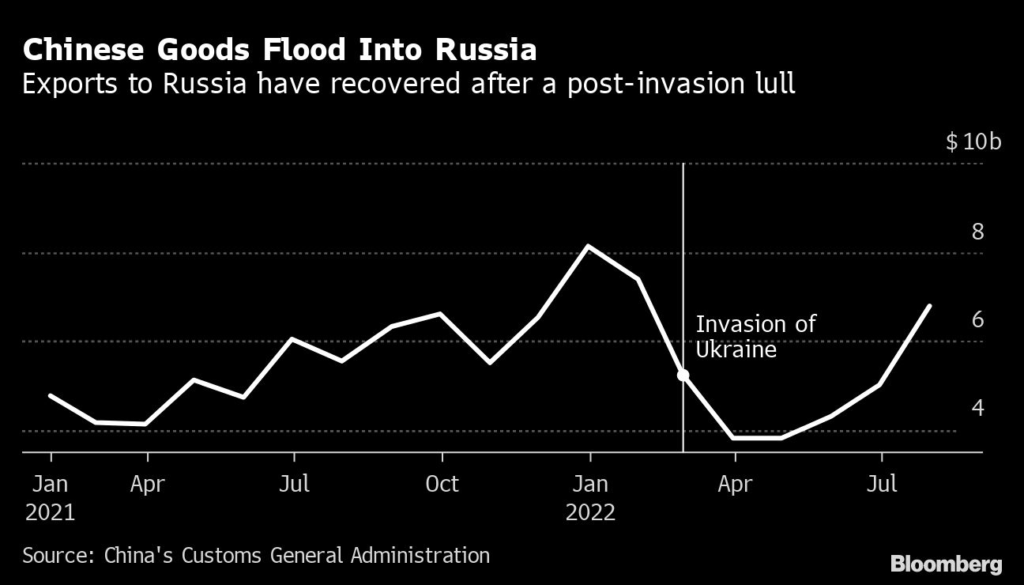
(Bloomberg) — Chinese cars, televisions and smartphones are replacing German and South Korean imports in Russia as its market is reshaped by sanctions and an exodus of brands in the wake of Vladimir Putin’s invasion of Ukraine. 

The result is upending trade, with Russia seeking to insulate itself from further disruptions by pivoting to goods from countries that haven’t joined sanctions imposed by the US and its allies. Moscow is also rewriting rules to allow its sovereign wealth fund to invest in the currencies of China, India and Turkey, after penalties blocked euro and dollar purchases.

“Apart from Chinese cars, there is nothing out there at all,” said Vladimir, a metals industry executive who bought a new Chery Automobile Co. Tiggo SUV in Moscow this month. He declined to give his last name. 

“Still, there’s a decent amount of choice and, surprisingly, the cars are very good,” he said.

The war has accelerated Russia’s tilt toward Asia, with shifts that had previously taken years happening in months. The transformation draws a line under a process begun near the start of Putin’s more than two-decade rule, with similar changes sweeping the economy from the banking sector to energy sales. 

Sales of Great Wall Motor Co. and Geely Automobile Holdings Ltd. vehicles held steady in July, even as the auto market collapsed by 75% compared to a year earlier, propelling their brands into the ranks of best-selling cars. Last quarter, 81% of new car imports were Chinese, compared with 28% in the first quarter, according to Avtostat data.

The Russian central bank said in an Aug. 24 report that business sentiment in the auto trade turned positive for the first time since the February invasion as the market shifted from European producers to Asian cars. 

Samsung Dethroned

The smartphone market has also shifted in China’s favor, with Apple Inc. and Samsung Electronics Co. suspending shipments. While their products are available via parallel, or gray, imports that don’t have the manufacturers’ blessing, such sales can put off consumers because they are more expensive and not under warranty. 

Xiaomi Corp. was Russia’s best-selling smartphone maker in the second quarter, dethroning Samsung, and three of the top five brands were Chinese, according to Mobile TeleSystems PJSC, the country’s biggest mobile operator. 

“There is a redistribution going on,” said Alexey Zaitsev, the head of e-commerce platform Ozon Holding Plc’s telecommunications division. “We are seeing increased demand for Android smartphones of Chinese brands.”

Demand for Chinese television sets nearly doubled after the invasion as Japanese and Korean companies stopped shipments, Izvestia newspaper reported last month, citing online retailers. 

The boom comes as retail sales have suffered their worst crash since the coronavirus pandemic, shrinking close to 10% each month on an annual basis in April-June. Spending by households in Russia accounts for more than half of gross domestic product.

Yuan Trading 

Trade with Beijing was rising even before the war, and China supplying about 25% of Russia’s total imports last year. Yet the relationship is asymmetrical, with the Russian market accounting for 2.3% of Chinese exports. 

Moscow needs the supplies more than ever as its consumers facing a future with fewer choices. Russia bought $6.7 billion of goods last month from China, up by more than 20% from a year earlier. Bilateral trade, fueled by higher energy prices, could grow by more than a third to $190 billion in 2022, Tass reported Aug. 17, citing a Russian official.

With China an ever-more essential partner, yuan trading has risen more than 40-fold on the Moscow Exchange so far this year and “has now started to dominate trading in other more traditional currencies,” according to Ivan Tchakarov, Citigroup’s chief economist for Russia. 

More Chinese companies are figuring out how to import into Russia without running afoul of sanctions, according to Boris Kopeikin, an analyst at the Center for Strategic Research, a Moscow-based think tank.

“The pace is picking up and by the end of the year we will see much wider choice of Chinese goods,” Kopeikin said.

More stories like this are available on bloomberg.com

©2022 Bloomberg L.P.
Close Bitnami banner
Bitnami