
Bloomberg

Stocks Stumble on Hawkish Fed Path; Oil Trims Drop: Markets Wrap

(Bloomberg) — Stocks in Asia fell Wednesday on the prospect of continued aggressive Federal Reserve monetary tightening and as traders evaluated data signaling China’s economy is continuing to struggle.

A drop in Chinese tech firms contributed to a retreat in an Asian share index. Hong Kong was in the red, with BYD Co. plunging after Warren Buffett’s Berkshire Hathaway Inc. trimmed its stake in the electric vehicle maker.

The Chinese figures indicated factory activity shrank for a second month. Power shortages, a property sector crisis and Covid outbreaks all took a toll.

Contracts for the S&P 500 and tech-heavy Nasdaq 100 stabilized after Wall Street shares hit a one-month low. Robust US labor demand and consumer confidence data added to the case for sharp interest-rate hikes to tackle inflation. Fed officials reiterated their determination to curb price pressures.

A dollar gauge and Treasuries were steady, while a deepening yield curve inversion pointed to fears that the Fed will trigger a recession. Oil pared a slide but was still headed for a third monthly drop — the longest losing run in more than two years — hampered by the likelihood of slower global growth.

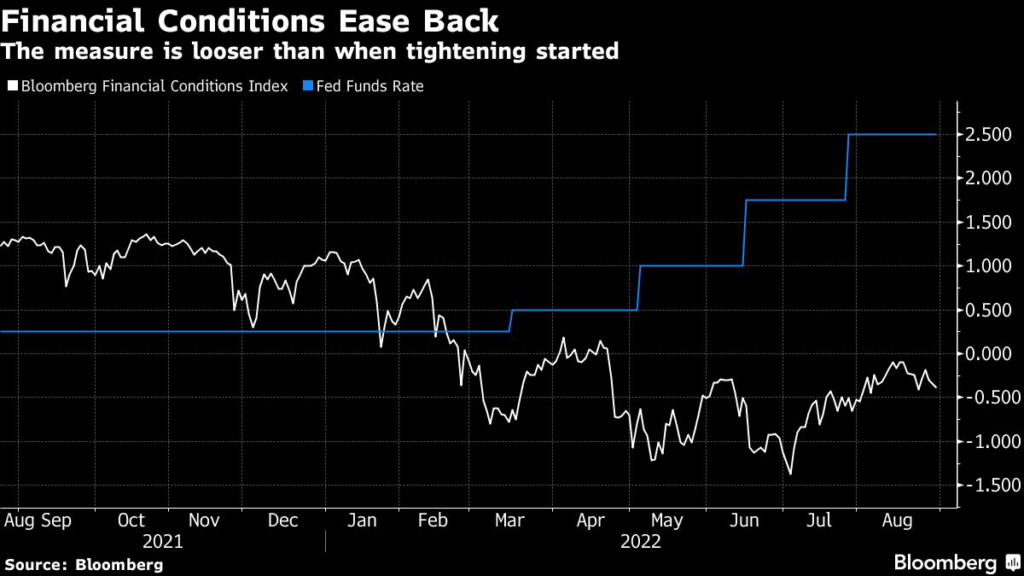
Market bets on a shallower trajectory for Fed tightening are receding, raising the prospect of more losses for stocks and bonds in an already difficult year. Investors are scouring incoming data for clues on the policy path, with August US jobs figures on Friday the next key report.

“What’s clear is that predicting this market is not clean cut,” Angeline Newman, a managing director at UBS Global Wealth Management, said on Bloomberg Television. “We are living in a world where conflicting economic signals are making the path of monetary policy very difficult to determine.”

Fed officials again stressed their commitment to defeating inflation while remaining vague on how big their policy move will be next month. 

New York Fed chief John Williams said rates will need to be held in restrictive territory for “some time,” adding that this meant through 2023 — the latest official to push back on financial-market expectations of cuts later next year.

“We’re still going to see some pretty volatile times and maybe some further downside for equities in the short term,” Steve Brice, chief investment officer at Standard Chartered Wealth Management, said on Bloomberg Television.

Investors are also contending with a European energy crisis as well as mounting friction between Beijing and Taipei after Taiwanese soldiers fired shots to ward off civilian drones. 

Here are some key events to watch this week:

  • ECB Governing Council members due to speak at event Tuesday through Sept. 2
  • Euro-area CPI, Wednesday
  • Russia’s Gazprom set to halt Nord Stream pipeline gas flows for three days of maintenance, Wednesday
  • Cleveland Fed President Loretta Mester due to speak, Wednesday
  • China Caixin manufacturing PMI, Thursday
  • US nonfarm payrolls, Friday
  • UK leadership ballot closes Friday. Winner announced Sept. 5

Will Chinese sovereign bonds outperform Treasuries? China is the theme of this week’s MLIV Pulse survey. Click here to participate anonymously.

Some of the main moves in markets:

Stocks

  • S&P 500 futures rose 0.3% as of 11:24 a.m. in Tokyo. The S&P 500 fell 1.1%
  • Nasdaq 100 futures added 0.4%. The Nasdaq 100 fell 1.1%
  • Japan’s Topix index fell 0.5%
  • Australia’s S&P/ASX 200 index dropped 0.2%
  • South Korea’s Kospi index lost 0.4%
  • Hong Kong’s Hang Seng Index slid 1.4%
  • China’s Shanghai Composite Index lost 1%
  • Euro Stoxx 50 futures shed 0.3%

Currencies

  • The Bloomberg Dollar Spot Index was steady
  • The euro traded at $1.0022, up 0.1%
  • The Japanese yen was at 138.51 per dollar, up 0.2%
  • The offshore yuan was at 6.9158 per dollar

Bonds

  • The yield on 10-year Treasuries was little changed at 3.11%
  • Australia’s 10-year bond yield was at 3.60%

Commodities

  • West Texas Intermediate crude was at $92.20 a barrel, up 0.6%
  • Gold was at $1,722.56 an ounce

More stories like this are available on bloomberg.com

©2022 Bloomberg L.P.
DigitalBridge, Equinix Vie for Time Dotcom’s Data Center Unit

(Bloomberg) — US digital infrastructure firms DigitalBridge Group Inc. and Equinix Inc. have been shortlisted into a final round of talks for the data center business of Malaysia’s Time Dotcom Bhd., according to people familiar with the matter.

DigitalBridge and Equinix outbid other companies in the industry and investment funds, the people said, asking not to be identified because the matter is private. The two companies are seeking to sign a deal for the assets, known as Aims Data Centre, within the next few weeks, the people said.

Time Dotcom may retain a stake in the business, which could be valued at $600 million or more in a sale, the people said.

No final decisions have been made and a deal could face delays or even fall apart, the people said. Representatives for Time Dotcom, Equinix and DigitalBridge declined to comment.

Beyond DigitalBridge and Equinix, I Squared Capital-owned BDx, Stonepeak-backed Digital Edge and Temasek Holdings Pte’s ST Telemedia Global Data Centres had been among bidders for the assets, people familiar with the matter have said.

Backed by Malaysia’s sovereign wealth fund Khazanah Nasional Bhd., Time Dotcom offers fixed-line voice and broadband services to consumers and businesses, as well as enterprise solutions in areas such as cloud and security. Beyond Malaysia, it has stakes in providers in Vietnam and Thailand, according to its latest annual report. 

Time Dotcom shares have climbed 4.6% this year, valuing the firm at around $2 billion. It reported net income of 118.3 million ringgit ($26 million) in the second quarter, up nearly 28% from the same period a year earlier.

Aims Data Centre, which is home to the Malaysia Internet Exchange, had about 111,640 square feet of net lettable area as of the end of last year, the annual report shows.

DigitalBridge, based in Boca Raton, Florida, invests in infrastructure such as data centers, cell towers and fiber networks, according to its website. It counts about 25 portfolio companies and had almost $48 billion in assets under management as of the end of June. Its stock has plunged 45% this year, valuing the company at about $3 billion.

Founded in Silicon Valley in 1998, Equinix provides digital infrastructure such as data centers to connect companies in sectors including finance, manufacturing and retail, according to its website. Its footprint in Asia Pacific includes Australia, China, India, Japan, South Korea, Singapore and Hong Kong. Equinix’s shares have dropped 22% this year, valuing the company at $60 billion.

(Updates with second quarter earnings in seventh paragraph.)

More stories like this are available on bloomberg.com

©2022 Bloomberg L.P.
Raimondo Says States Must Compete for New Chips Investment, Jobs

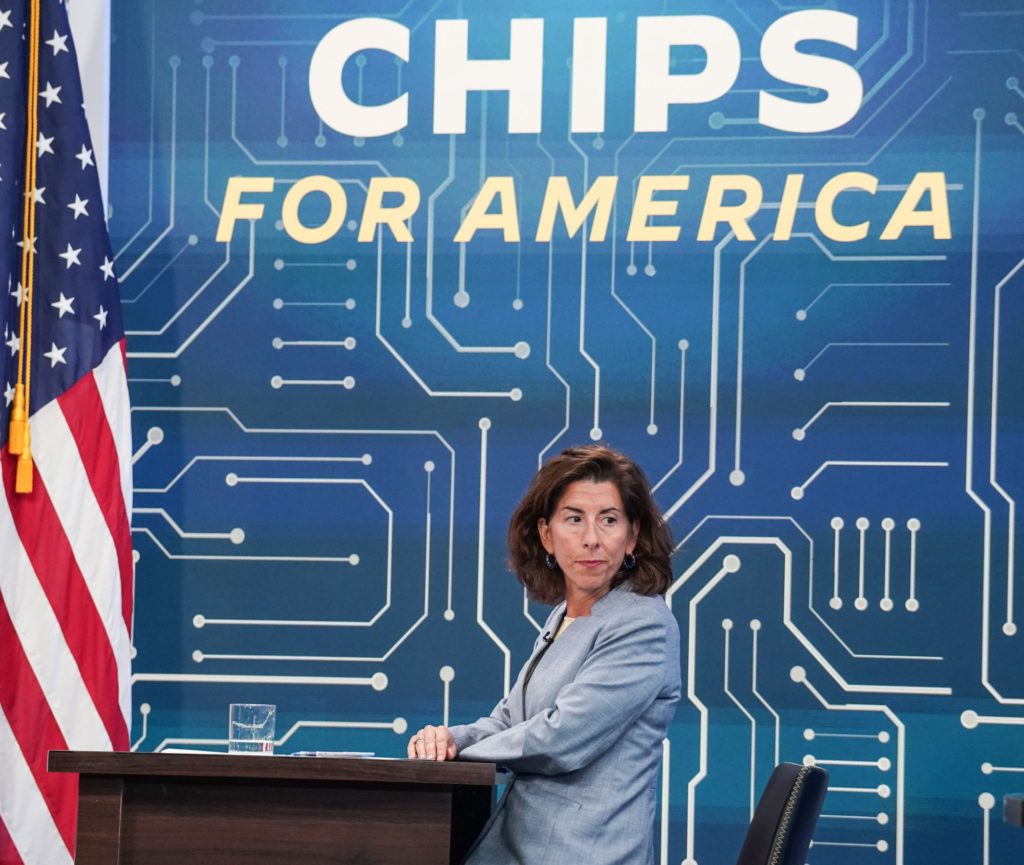
(Bloomberg) — Commerce Secretary Gina Raimondo said that with legislation to bolster the domestic semiconductor industry now enacted, US states should be prepared to contend with one another to lure companies and investment.

“This is a race,” she said after an event at an Arizona State University research park in Tempe. “It’ll be competitive. It’ll be transparent and I hope every state competes.”

Raimondo had been touring a university microchip manufacturing facility with Senator Mark Kelly, an Arizona Democrat who’s running for re-election.

“Every state ought to put their best foot forward,” Raimondo said. “Every governor, every state legislature, every president of public universities in every state ought to be now putting their plan of attack together. And of course, this is going to be a competitive process.”

Earlier this month, President Joe Biden signed into law a broad competition bill that included about $52 billion to strengthen US semiconductor research and development, calling it a “once-in-a-generation investment in America itself.”

The chips bill lies at the center of the administration’s effort to reduce dependence on Asian suppliers like Taiwan and South Korea, whose homegrown companies are leading the market, and to address supply-chain disruptions and resulting price increases for certain goods containing semiconductors.

Biden’s team and lawmakers stressed the national security implications of the measure, saying it was vital to competing with and countering China.

Spurred by its passage after a year of congressional wrangling, US semiconductor companies are planning billions of dollars in new investments. 

At a roundtable in Tempe with business executives and economic development leaders, Raimondo’s questions focused on how companies and universities intend to create a pipeline of workers to grow the semiconductor industry and construct new facilities in the US.

She said semiconductor and building trade jobs go overwhelmingly to White men and that diversity is a concern. “This is something that we all really have to commit ourselves to,” Raimondo said. 

More stories like this are available on bloomberg.com

©2022 Bloomberg L.P.
Korean Chipmakers Record First Drop in Shipments in Three Years

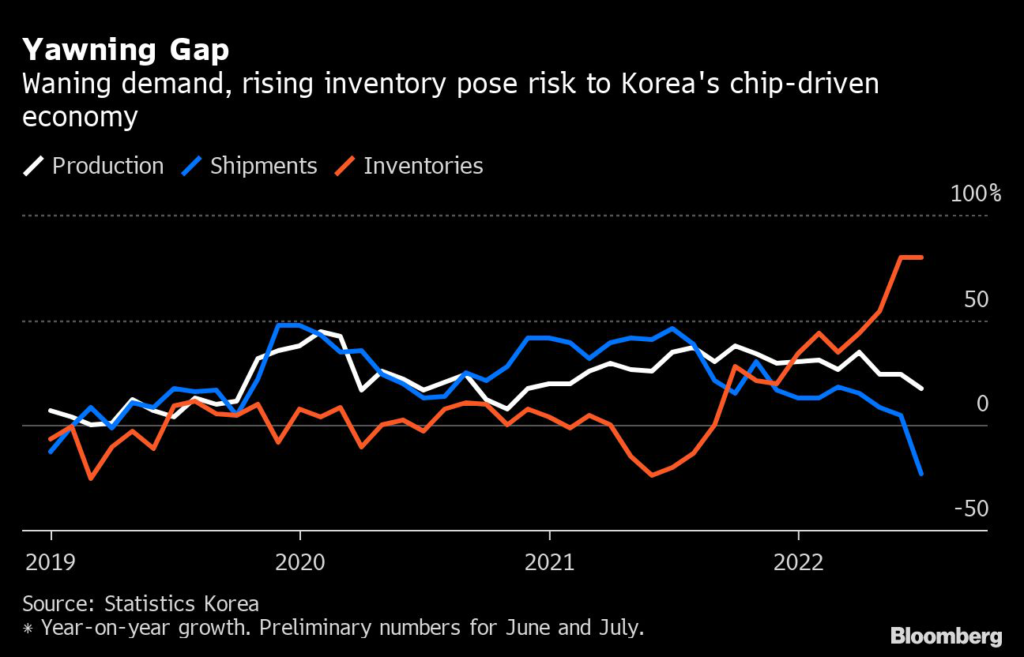
(Bloomberg) — South Korean chipmakers recorded their first fall in factory shipments in almost three years in July, highlighting weakening demand for semiconductors that serve as a barometer for the global economy.

Semiconductor shipments tumbled 22.7% from a year earlier, after having risen 5.1% in June, according to a statement from the national statistics office on Wednesday. Nationwide inventories remained elevated in July, up 80% from a year earlier and unchanged from the month prior.

Chip production slowed in July for a fourth straight month, suggesting key producers such as Samsung Electronics Co. and SK Hynix Inc. are adjusting output to reflect cooling demand and mounting stockpiles.

Weakening momentum in Korean chip sales reinforces a darkening outlook for the global economy. A combination of Russia’s war on Ukraine, Covid lockdowns in China and rapid interest-rate increases to tackle inflationary pressures are weighing on activity and crimping the bottom line for businesses.

Semiconductors are key components in a world economy that’s increasingly dependent on electronics and online services. Demand for chips surged during the pandemic as many people switched to remote work and education to minimize the risk of infection.

The decline in semiconductor shipments helps explain a drop in Korea’s technology exports in July, the first fall in more than two years. Memory-chip sales abroad slid 13.5% that month, even though the country’s overall exports advanced 9.4%.

Separately, Korea’s overall industrial production advanced 1.5% in July from a year earlier, less than the 2.6% forecast by economists, the statistics office said.

More stories like this are available on bloomberg.com

©2022 Bloomberg L.P.
Baidu Slides After Revenue Drop Adds to Concerns Over Economy

(Bloomberg) — Baidu Inc. plunged its most in more than two months after the company reported a decline in revenue, adding to concerns about the impact of China’s weakening economy on the private sector.

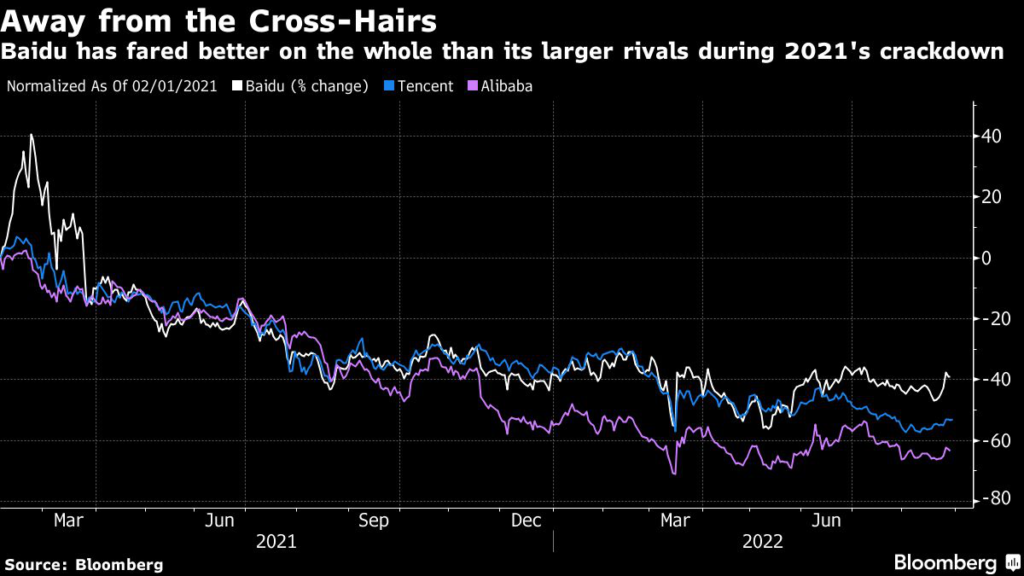
The Chinese search leader’s sales slumped 5% to 29.6 billion yuan ($4.3 billion) for the April-June period, just above the average of analysts’ forecasts. Its shares slid 6.5% in New York.

China’s tech giants have made peace with a new reality of low growth and cautious expansion, more than a year after Beijing’s crackdown on internet businesses from e-commerce to edtech and social media. A deepening economic malaise, coupled with strict Covid Zero measures, has crippled consumer demand in the world’s largest mobile app arena.

Most have pulled back on spending to tide them over and shore up the bottom line. Baidu reported a net income of 3.6 billion yuan, surpassing the 2.2 billion yuan expected. Baidu’s Netflix-like video service iQiyi Inc. reported revenue a shade weaker than estimates. But it also unveiled improving margins and a deal to place $500 million of convertible notes with Hong Kong private equity firm PAG. 

Baidu’s reliance on digital marketing leaves the Beijing-based company vulnerable to the same economic shocks that’ve laid low its bigger rivals. Alibaba Group Holding Ltd. and Tencent Holdings Ltd. both reported their first-ever sales contractions for the June quarter. Online marketing sales declined a better-than-feared 12% while Baidu’s AI cloud revenue grew 31%, slowing from 45% in the prior quarter. 

Baidu Falls as Challenging Environment Hits Results: Street Wrap

Baidu’s shares had nonetheless fared better than many of its rivals despite growing economic uncertainty. Beijing and Washington last week reached a preliminary deal allowing American officials to review audit documents of US-listed Chinese stocks including Baidu, in a move toward keeping the companies listed on US exchanges. Its shares surged after news of the agreement emerged.

Baidu is trying to reinvent itself as a supplier of deep technology by expanding into self-driving systems, cloud computing and chips. This month, it won approval to deploy the first fully autonomous taxis on Chinese roads. It also unveiled a self-made quantum computer, saying its resources will be open to the public. 

Baidu’s nascent AI cloud division is now its fastest growth engine, but it faces an uphill battle against market leaders including Alibaba and Huawei Technologies Co.

While waiting for these efforts to evolve into meaningful revenue, Baidu depends on its flagship news-search app to win advertising dollars and users from online entertainment platforms operated by Tencent and TikTok-owner ByteDance Ltd.

More stories like this are available on bloomberg.com

©2022 Bloomberg L.P.

Apple’s Chief Privacy Officer Set to Leave Company for Law Firm

(Bloomberg) — Apple Inc.’s top privacy executive will be leaving the company soon to work at a law firm, according to people with knowledge of the matter, stepping down from a high-profile role at the iPhone maker. 

Jane Horvath, who first joined Apple in 2011, is taking a job at Gibson, Dunn & Crutcher LLP, said the people, who asked not to be identified because the move hasn’t been announced publicly. Horvath recently informed Apple’s legal department of her plans in an internal memo.

She vacates a role that has become increasingly key to Apple’s strategy. Horvath, who took the title of chief privacy officer last year, served as the company’s face in promoting its safeguards, alongside Chief Executive Officer Tim Cook. The tech giant has touted features such as on-device processing and web-tracking prevention — as well as stricter app advertising policies that have been controversial.

Apple, which hasn’t named a replacement, didn’t respond to requests for comment.

Privacy has become central to Apple’s marketing efforts, and Horvath represented the company in its dealings with trade groups and Capitol Hill. She was also responsible for Apple’s compliance with privacy rules globally, such as GDPR, or General Data Protection Regulation, in the European Union. 

Horvath was one of a few Apple executives to hold a “chief officer” title, a group that includes the chief operating officer, chief compliance officer and chief financial officer. In her role, she reported to Apple General Counsel Kate Adams.

Trained as a lawyer, Horvath served as Apple’s senior director of global privacy before taking her current title. She rose to prominence inside the company after it clashed with the FBI in 2016 over whether to unlock a shooting suspect’s iPhone. Apple refused, saying the move would create a backdoor that undermines the iPhone’s security. The government ultimately unlocked the device without the company’s help.

Horvath is joining a law firm that has represented Apple on a number of issues over the past several years. Gibson Dunn most recently led Apple’s legal efforts in its fight against Epic Games Inc. over App Store commissions.

Before Apple, Horvath oversaw privacy efforts at Alphabet Inc.’s Google and the US Department of Justice.

More stories like this are available on bloomberg.com

©2022 Bloomberg L.P.
Ex-PayPal COO Says He Emailed Musk Bankers About Twitter Deal

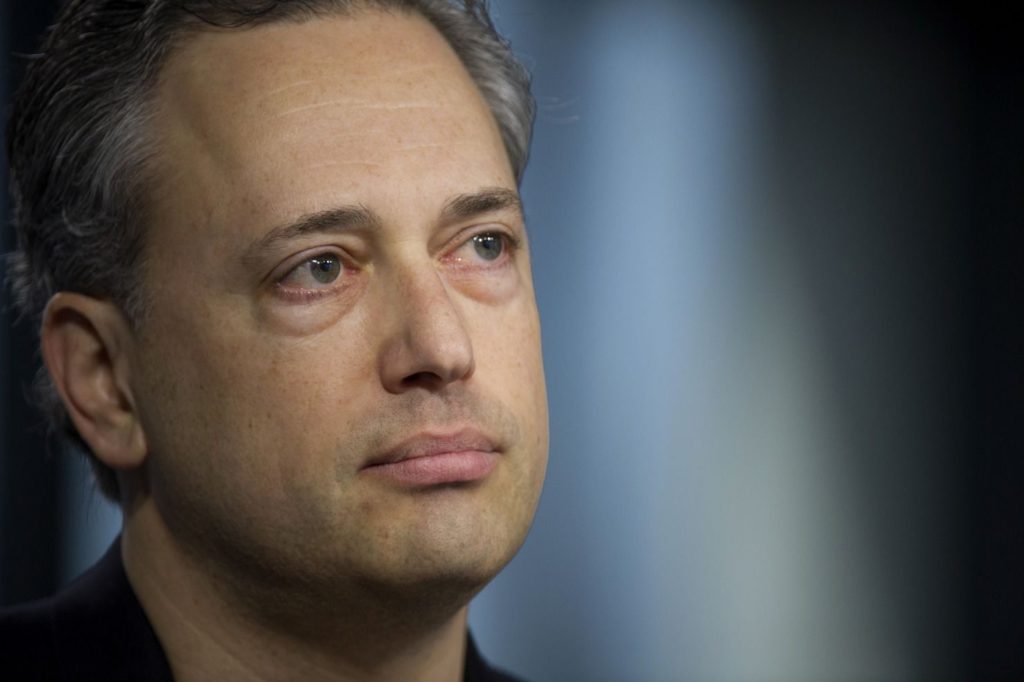
(Bloomberg) — Onetime PayPal Holdings Inc. Chief Operating Officer David O. Sacks said he exchanged a few emails with investment bankers about possibly investing in his old friend Elon Musk’s Twitter Inc. acquisition but never became involved in the proposed deal.

Sacks provided more detail about his contacts in a Tuesday court filing aimed at shooting down a subpoena served on him by Twitter. The social media company has cast a wide net seeking information from people and firms that expressed interest in backing Musk’s $44 billion bid before the billionaire reversed course, triggering a legal fight in Delaware.

Now a venture capitalist, Sacks said the emails with Musk’s bankers were about setting up a meeting for further discussions. That meeting never took place, and he never exchanged confidential information or committed to investing in the deal, he said. Sacks didn’t identify the bankers, but Morgan Stanley acted as Musk’s chief financial adviser. 

Sacks also denied what he said was Twitter’s contention that he was one of only four people with whom Musk discussed the deal. Though he acknowledged Musk identified him as a person with whom he had communicated, Sacks said Twitter had twisted the meaning of his former PayPal colleague’s words.

“Twitter ‘asked Mr. Musk the narrow question whether he had communicated with any of five named individuals singled out by Twitter, including Mr. Sacks,’” Sacks said. “It did not ask Mr. Musk to list all the individuals with whom he privately had communicated. Mr. Musk responded that he communicated with four of the five named individuals, including Mr. Sacks. To characterize that response as a statement that Mr. Sacks was ‘one of just four individuals with whom’ Mr. Musk ‘privately communicated about the deal’ is false and misleading in a way designed to overstate his involvement.”

Twitter didn’t immediately respond to an email seeking comment.

Twitter’s suit seeking to force Musk to complete the transaction is slated for trial on Oct. 17. Both sides are jockeying for position with a spate of subpoenas to people and firms involved in the deal. 

Sacks, often cited as a member of the “PayPal Mafia” along with Musk, Peter Thiel, Max Levchin and others, last week told Delaware Chancery Judge Kathaleen St. J. McCormick that he already told Twitter everything he knows and that the subpoenas were harassing him and his companies, including Craft Ventures LLC.

The case is Twitter v. Musk, 22-0613, Delaware Chancery Court (Wilmington). 

More stories like this are available on bloomberg.com

©2022 Bloomberg L.P.

Musk Seeks to Amend Twitter Complaint, Cites Whistle-Blower

(Bloomberg) — Elon Musk is asking a Delaware judge to let him amend his counterclaims against Twitter Inc., after saying earlier that new whistle-blower revelations add to his argument to walk away from his $44 billion purchase of the company.

Lawyers for Musk and Twitter traded barbed letters Tuesday over how a whistle-blower’s accusations of “egregious deficiencies” at the company will affect the scuttled deal and Twitter’s lawsuit seeking to force the billionaire to follow through on his agreement to pay $54.20 a share.

While the billionaire’s request was filed in court Tuesday under seal, one attachment detailed a report to Congress from former Twitter security chief Pieter Zatko. In his whistle-blower complaint last week, Zatko said he raised concerns over the number of robot and spam accounts, but company officials ignored him. 

In a separate securities filing, lawyers for Musk said the allegations by Zatko meant that Twitter had breached the terms of the merger agreement. Shortly after, Twitter’s lawyers responded, saying Musk’s case for termination of the deal is “invalid and wrongful.” Zatko is scheduled to testify before Congress on Sept. 13.

Musk has been attempting for months to try and extract himself from the takeover of Twitter, initially claiming the company’s user figures are inflated by millions of robot accounts. Twitter sued Musk in Delaware over the failed deal. Zatko’s claims, which emerged last week, have given Musk’s side new ammunition in his fight to walk away.

A trial is set for Oct. 17, though Musk’s lawyers on Tuesday asked to move it to November. They’ve complained Twitter is sitting on key evidence in hopes of weakening the billionaire’s case. In response, Twitter’s attorneys on Tuesday accused the Musk team in an unsealed letter of trying to “derail the trial schedule” with its requests.

Read More: Musk, Twitter Spar Over Whistle-Blower as Deal Feud Escalates

Delaware Judge Kathaleen St. J. McCormick is likely to allow Musk to amend his counterclaims, because it’s rare for such requests to be denied and the allegations by Zatko raise “really important” issues, said Robert Miller, a law professor at the University of Iowa.

Twitter argued in court filings it hasn’t breached any of its obligations to Musk and maintains Zatko’s complaint is “riddled with inconsistencies and inaccuracies and lacks important context.” 

The company has maintained spam and bots make up fewer than 5% of the social-media network’s accounts. Musk claims as much as a third of Twitter’s more than 230 million users may fall into the bot category.

As the legal fight escalates, two prominent shareholder advisory firms, Institutional Shareholder Services Inc. and Glass Lewis & Co., are urging Twitter’s investors to support Musk’s takeover. 

ISS said that while the situation is “unique,” investors should focus on the details of the proposal itself instead of the noise around it, while Glass Lewis said the offer price would allow shareholders a relatively attractive exit price, and a premium for the company’s unaffiliated shareholders.

In an Aug. 23 letter unsealed Tuesday, Twitter’s lawyer claimed it is Musk who has been loathe to turn over documents and names of key witnesses involved in the deal. They said the billionaire’s team has tried “to divert attention from their own dilatory conduct by contending documents Twitter has already produced” about the number of bots are fraudulent. “This court should not reward” Musk’s efforts to delay the case, according to the letter.

The case is Twitter v. Musk, 22-0613, Delaware Chancery Court (Wilmington).

(Updates with excerpt from unsealed letter starting in sixth paragraph)

More stories like this are available on bloomberg.com

©2022 Bloomberg L.P.

Cloudflare Urged to Cut Ties to Site That Promotes Harassment

(Bloomberg) — Cloudflare Inc., an internet services company, is facing mounting protests online calling for it to cease support for Kiwi Farms, a discussion forum for harassment and hate campaigns that has forced a well-known transgender Twitch streamer into hiding.

Clara Sorrenti, who live streams on Twitch under the name Keffals, has amassed a following on the platform for her political commentary, including discussions on LGBTQ rights. The 28-year-old Canadian said she recently became a target of unrelenting harassment from users on Kiwi Farms. 

Sorrenti said police descended on her home in London, Ontario, on Aug. 5 and wrongfully arrested her after someone pretending to be her emailed fake threats of violence to city officials, an incident known as swatting. After she moved undercover, Sorrenti said Kiwi Farms users tracked her every move and publicized her location — a tactic called doxxing. 

“There are countless people actively, every day, being harassed by this site — most neurodivergent or transgender,” Sorrenti said in an interview. “It would help a lot of people if Cloudflare no longer provided their services to Kiwi Farms.”

Founded in 2013, Kiwi Farms hosts content that would be unwelcome elsewhere online, including posts that contain slurs, personal information about others, and even videos and manifestos pertaining to mass shooters. At least two people who have died by suicide have been targets of Kiwi Farms users, according to victims themselves and friends of the people cited in news reports. As part of the campaign against Cloudflare, several Twitter users have publicly described the mental anguish they suffered as a result of threads about them on Kiwi Farms. Marjorie Taylor Greene, a Republican lawmaker from Georgia who has sought to criminalize gender-affirming surgery, has also called for Kiwi Farms to be taken down. She was recently a victim herself of swatting after false reports of violence sent police to her home, she said, sharing surveillance footage that captured the incident.

In August, the #DropKiwiFarms campaign was mentioned 10,000 times on Twitter.

“It’s been very emotional,” Sorrenti said, describing the support she’s gotten from the Cloudflare protests. “The advice most people who get targeted by Kiwi Farms are given is that, if they talk about it, it will make the harassment worse. But with this campaign, they decided to talk about it publicly. It made me feel a lot less alone knowing there were so many people out there who’ve had to deal with the same nightmare I’ve had to deal with. And they probably felt less alone, too.” 

Kiwi Farms owner and administrator Joshua Moon, who goes by Null, said “the forum does not condone behavior besides on-site discussion.” The site has gone offline several times since the campaign began, apparently as a result of DDoS (distributed denial of service) attacks from internet users. Kiwi Farms receives 10 million views a month, according to data from SimilarWeb, which analyzes web traffic.

On Tuesday, the #DropKiwiFarms campaign escalated as Sorrenti launched a website called dropkiwifarms.net and called for a protest outside the Cloudflare Connect conference in San Francisco on Oct. 18 if the company doesn’t drop support for the site. 

Social media companies have for years struggled over whether to deplatform accounts that break their terms of service or cause public harm. Sorrenti’s campaign seeks to highlight Cloudflare’s role — and the role of similar companies — in empowering alleged harm online. 

Cloudflare has made a point of not getting involved in moderation and has refused to deny services to companies or sites that are considered controversial. The San Francisco-based company has, however, ceased support for some sites in the past, including the White supremacist blog Daily Stormer in 2017 after the death of protester Heather Heyer in Charlottesville, Virginia. At the time, Chief Executive Officer Matthew Prince said the “tipping point” was Daily Stormer affiliates claiming that Cloudflare secretly supported their ideology.

In 2019, Cloudflare terminated service for controversial forum 8chan. Prince attributed the decision to 8chan’s ties to mass shootings in El Paso, Texas, and Christchurch, New Zealand. “We reluctantly tolerate content that we find reprehensible, but we draw the line at platforms that have demonstrated they directly inspire tragic events and are lawless by design,” Prince wrote at the time in a blog.

Cloudflare hasn’t responded to the #DropKiwiFarms campaign. Prince wrote in 2017 that the company doesn’t terminate customers due to political pressure. The company didn’t respond to repeated requests for comment.

More stories like this are available on bloomberg.com

©2022 Bloomberg L.P.
China Slowdown Means Contrasting Fortunes for Asia’s Exporters

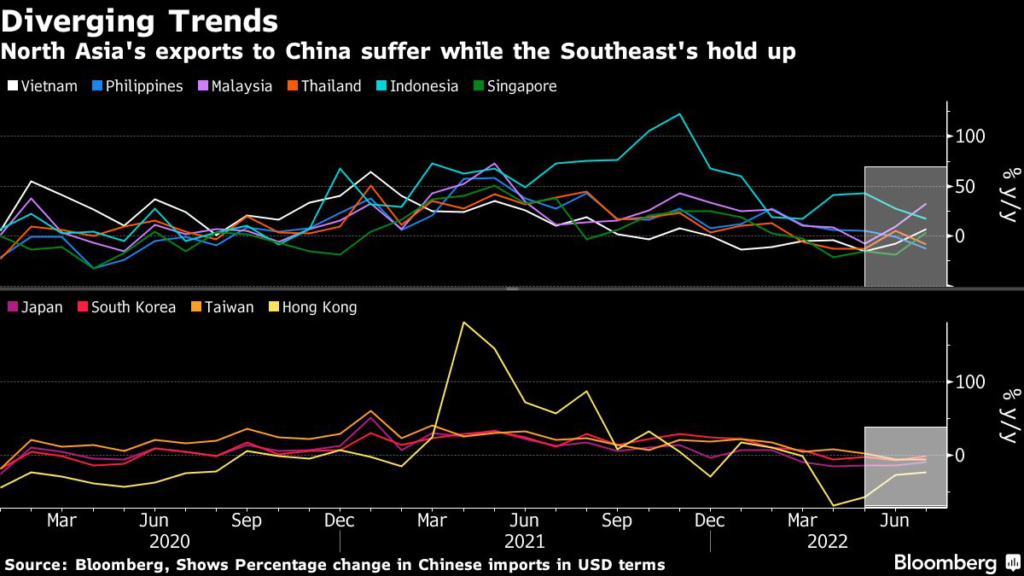
(Bloomberg) — China’s economic growth slowdown has triggered a stark contrast in fortunes for its trading partners across Asia, with northern neighbors suffering while economies in the southeast are broadly holding up.

The world’s No. 2 economy is still dealing with a slump in consumption and output brought on by lockdowns, compounding the hit to demand from a global semiconductor slowdown.

Meanwhile, exports from most of Southeast Asia’s top six economies, each of whom counts China as its No. 1 trading partner, are more resilient as their shipments are dominated by essential goods and commodities including palm oil and refined petroleum products.

With the world facing the prospect of weaker demand due to monetary policy favoring inflation-fighting over stabilizing growth, a further slowdown by China would be cause for alarm.

From a broader standpoint, Asean export resilience in the face of a Chinese slowdown can be attributed to “pent-up demand that built up from earlier days in the pandemic,” said Tamara Henderson, Bloomberg Economics’ Asean economist. It “will fade as this source of demand becomes satiated and with China’s economy now facing more strains.”

Here’s a closer look at the latest data on exports to China from North and Southeast Asian economies:

NORTH ASIA

  • Japan’s exports to China, including electronics and semiconductor equipment, are under pressure, although the weakness of the yen has masked some of the decline. While Japanese exports to the regional giant climbed 12.8% in yen terms in July, data on shipments received by Beijing showed a 9.2% decline in dollar terms. The Bank of Japan said last month that exports to China were “clearly being pushed down due to the lingering effects of the lockdowns of Shanghai and other places.”
  • South Korea saw initial exports — including for chips, displays, and refined oil — nearly stagnate in August as shipments to China fell 11.2%, official data showed. That follows July numbers in US dollar terms that displayed a 0.9% decline in Beijing’s imports from Seoul. The weaker numbers are a sign that the economic pain from China-related fragility may worsen as Korean manufacturers play a sizable role in global supply chains. The August data, which shows daily shipments through the first 20 days of the month, is a barometer for growth and indicator of risks in the region. “South Korea’s data was really quite terrible, especially from the drastic reduction in exports to China,” said Alicia Garcia Herrero, chief economist for Asia Pacific at Natixis SA. “All of this shows what we already knew, that China’s demand for goods overseas — its imports — are very weak.”
  • Taiwan posted a surprise drop in July export orders led by a 22.6% decline in orders from China and Hong Kong, which combined make up its second-largest source of demand after the US. Electronics and advanced chips make up around two-thirds of Taiwan’s exports to China, thanks to the island’s critical role in the semiconductor supply chain. While Taiwan has sought to reduce its trade reliance on China amid rising cross-strait tensions, China and Hong Kong still account for around 40% of its total exports.
  • Hong Kong’s exports to the mainland fell 10.7% in local dollar terms in July, contributing to a plunge in its overall exports last month from a year ago. The government cited ongoing interruptions to flows across the border with China as one of the factors that pushed exports into a year-on-year contraction for the third consecutive month. Major exports from Hong Kong to the mainland include plastics, metal ores, and pharmaceutical goods. The city has cut its growth forecast twice this year, and now expects gross domestic product to potentially contract, in part due to interruptions to the flow of goods with the mainland.

SOUTHEAST ASIA

  • Indonesia’s total exports to China rose 17% in July from a year ago. Non-oil exports on the other hand advanced 40.9% during the same period, with only a 1.27% decline seen on a month-on-month basis. While the data are wobbly, it doesn’t appear to show a cause for alarm in the region’s largest economy, which counts palm oil and coal briquettes among its biggest exports.
  • Thailand counts China as its second-largest customer after the US, with the value of those exports continuing to grow even if there’s been a deceleration this year. Thai exports to China, which include fruits and synthetic rubber, grew 25% last year to $37.3 billion, while growth in the first half of this year was only 0.8% to $18.5 billion. While data from the Commerce Ministry showed shipments contracted 2.7% in June after a 3.8% rise in May, fruits and rubber exports still grew while auto, auto parts and chemicals trade declined.
  • Singapore’s total exports to China grew 3.8% in July in US dollar terms, data show. The city-state’s goods sales to the world’s second-biggest economy include machinery, and ethylene polymers used in plastic packaging.
  • Malaysia’s shipments to China, which include refined petroleum products, have remained fairly strong, with double-digit year-on-year gains from December through May. After an easing to just over 4% in June from a year earlier, shipments rebounded to an almost 10% gain in July in ringgit terms, and 32.6% in US dollar terms.
  • Philippines’ shipments to China is the only cause for worry among the Southeast Asia pack. Manila, which counts integrated circuits, office machine parts and nickel ore as its biggest exports to China, saw a 18.8% drop in June, after a double-digit contraction in May, according to latest official data. Numbers compiled by Bloomberg based on China’s imports from the country showed a 12.8% drop in July. A further softening may be on the cards given electronics make up 56% of Philippines’ total goods exports and are linked to a global tech cycle that has lately been in a funk, Nomura analysts wrote in a report earlier this month.
  • Vietnam’s July shipments to China rose 6.6% from a year ago, snapping six straight months of contraction, according to Beijing’s customs authority data compiled by Bloomberg. China’s imports from the Southeast Asian nation include cotton yarn, phones and accessories, and computers and electrical products.

More stories like this are available on bloomberg.com

©2022 Bloomberg L.P.

Close Bitnami banner
Bitnami
