
Bloomberg

Electric Vehicles Have China’s Massive Middle Market Surrounded

(Bloomberg) —

As electric adoption takes off, different purchasing patterns are taking shape around the world. In some countries, automakers are mostly targeting the high end of the market and working their way down in terms of price points. Others are seeing more of a pincer movement, meaning manufacturers are attacking both entry-level and luxury segments.

Take the US and China, for example. Manufacturers led by Tesla have mostly succeeded in America by introducing EV models at the premium end of the market and slowly expanding into mid-price, higher-volume segments. In 2019, only 322,000 plug-in vehicles were sold in the US. This year, BloombergNEF is expecting 1.4 million.

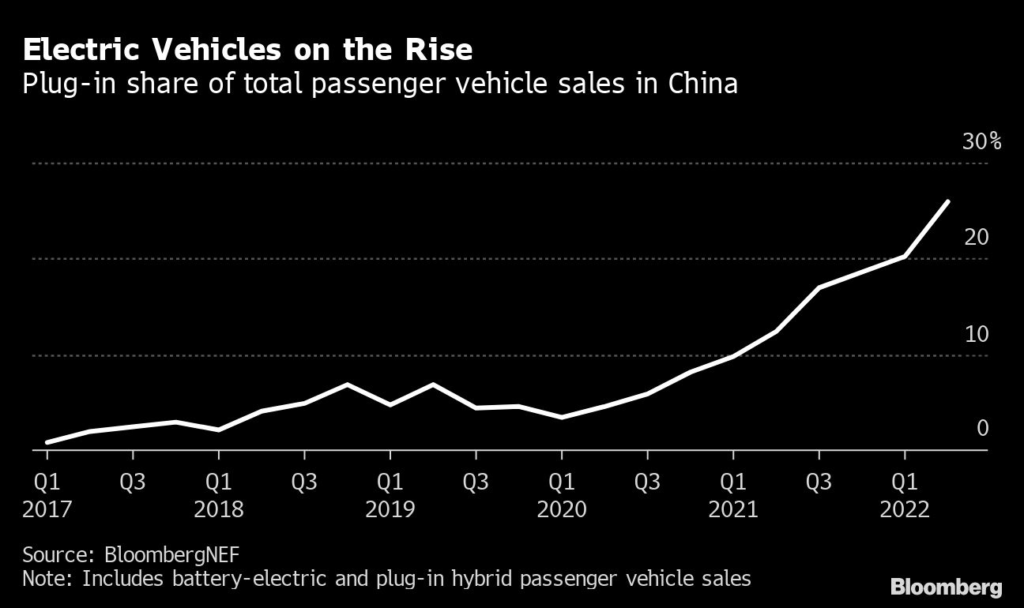
In China, EVs have been excelling both at the bottom and the top of the market. Roughly 567,000 plug-in passenger vehicles were sold just in July, up 120% from a year ago, and BNEF expects a total of 6 million deliveries this year. The plug-in share of total passenger vehicle sales so far in 2022 is hovering around 24%, with much higher numbers likely in the next few years as consumer interest takes off. Sales of combustion vehicles are falling rapidly as a result.

That’s the overall picture, but the segment story in China is even more interesting. If you plot the segments of the Chinese car market by vehicle size from smallest to largest, the EV adoption rate looks a bit like a pincer, or a vice.

The smallest cars — the mini segment — have already gone electric thanks to models like SAIC-GM-Wuling’s Hongguang Mini, which starts at just $5,000 and is the best-selling EV so far this year. Large cars and large sport utility vehicles also have high EV adoption rates, with 29% and 32% of sales already electric, respectively. Those segments are led by models including the BYD Han and Volkswagen ID.6.

The compact car and compact SUV segments — the area in the middle of the vice — are high-volume segments, representing about half of China’s auto market. EV adoption rates are much lower at around 16% of sales. These two segments are dominated by incumbent manufacturers such as Nissan, Toyota and VW. With the top and bottom of the market already going electric very quickly, this is where the next battles will play out.

New models, increased charging coverage and shared mobility fleets could help boost EV popularity in these middle segments, but it may take a bit longer to displace than the top and bottom of the market.

That’s because the EV success story in the smallest cars has been driven largely by cost-conscious urban buyers looking for a cheap, convenient option for commutes and short trips. High margins in the larger car segments made it an attractive place to automakers to launch EVs. These EV models have also become the place where consumers can access the latest digital technologies, like over-the-air software updates and advanced driver-assistance features.

Still, it’s worth remembering China’s goals haven’t changed. It’s pursing EVs primarily for industrial policy reasons, namely to help reduce oil imports and improve urban air quality. As EVs saturate the top and bottom of the market in the next few years, watch for more policies aimed at that middle market to help tip the scales favor of electrification. Incumbents in these segments should take note once the shift gets going — the vice may start to close quickly.

More stories like this are available on bloomberg.com

©2022 Bloomberg L.P.

Turkey Says Fugitive Crypto CEO Arrested in Albania Over Fraud

(Bloomberg) —

Turkey said Albanian police have arrested Fatih Ozer, the founder and CEO of cryptocurrency trading platform Thodex, who has been sought by Turkish authorities over fraud accusations. 

The process to extradite Ozer to Turkey has started, according to a statement from the Interior Ministry.  

Turkish prosecutors are pursuing jail sentences totaling thousands of years for the founders and executives of Thodex. They are accused of establishing a criminal organization, fraud through informatics systems and laundering proceeds from criminal activity, according to the prosecutors. 

Thodex was part of the cryptocurrency boom driven by local investors seeking to protect their savings from soaring inflation and an unstable currency. The prosecution indictment said total losses due to the collapse of the exchange amounted to 356 million liras ($24 million). 

Last year, Ozer disappeared following the shutdown of the platform. Earlier he’d made a statement from an unknown location in which he promised to repay investors and to return to Turkey to face justice at a later date. 

Story Link: Turkey’s Fugitive Crypto CEO Arrested in Albania: Anadolu

More stories like this are available on bloomberg.com

©2022 Bloomberg L.P.

Warren Buffett Cuts Stake in China’s BYD, Spurring Bets More May Come

(Bloomberg) — Warren Buffett’s Berkshire Hathaway Inc. trimmed its stake in BYD Co., just over a month after speculation the legendary US investor was preparing to shed his entire position in the Chinese carmaker sent its stock plummeting.

Berkshire cut its holding in BYD’s Hong Kong-listed shares to 19.92% from 20.04% on Aug. 24, according to an exchange filing Tuesday. That equated to around 1.33 million securities at an average HK$277.10 ($35.30) apiece, valued at about $47 million.

Theories about Buffett’s plans have swirled since a 20.49% stake — identical to the size of Berkshire’s last reported BYD position in Hong Kong as of December — entered the Central Clearing and Settlement System last month. The move triggered the biggest slump in BYD stock in nearly two years. 

A BYD spokesperson wasn’t immediately able to comment Tuesday, while representatives for Berkshire to date haven’t commented. The shares closed slightly lower at the end of Hong Kong trading. 

Read more: Buffett’s Silence on BYD Fuels Trader Theories on Next Move

This is “most likely profit taking,” said Kerry Goh, chief investment officer at Kamet Capital Partners Pte. in Singapore. “BYD has done very well for them especially in the last three years. It’s not their style to sell just because someone says China is uninvestable.”

Asked if Buffett could be gearing up to sell more of his BYD holding, Goh said it was hard to second guess the titan of investing. 

When Buffett sold shares in another of his Chinese investments, PetroChina Co., he did it in stages. The 2007 sale was conducted through at least seven transactions over a period of about three months.

“This may shake the firm belief in BYD shares for a lot of institutional investors,” said Franklin Tang, an analyst at Excel Investment Hong Kong Ltd. 

“While there are those that hold a bullish view based on fundamentals, with stock prices having been on a roll there’s bound to be plenty of speculators as well,” Tang said. “This will make the latter very skittish as their conviction was largely based in trusting the judgment of Buffett.”

BYD is one of China’s most-watched automakers. On Monday it reported net income for the six months through June at the top end of guidance as record output and sales shielded it from Covid-related production disruptions and supply-chain pain. BYD could deliver 1.5 million to 2 million vehicles this year as capacity expands to meet a backlog of orders, according to Bloomberg Intelligence analysts Steve Man and Joanna Chen.

The Shenzhen-based automaker is also expanding overseas, announcing sales in seven new markets in recent months including Japan, Thailand and Germany.

Read more: China’s BYD Aims to Rule EV World by Being Anything But Tesla

Chief to BYD’s success is its vertical integration strategy, which involves not only manufacturing vehicles but producing semiconductors and batteries. It’s now the world’s third-largest producer of batteries for EVs, with 14% of the global market, behind Chinese rival Contemporary Amperex Technology Co. Ltd. and South Korea’s LG Energy Solution Ltd. 

And Buffett, a long-time backer of BYD, has certainly ridden the wave. Shares in BYD gained 31% last year and surged 423% in 2020. 

Buffett’s investment in the automaker is worth north of $8 billion from around $230 million when he first invested in the company in 2008. The 92-year-old, the chairman and largest shareholder of Berkshire, has a net worth of about $100.2 billion, according to the Bloomberg Billionaires Index.

The BYD position that matched the size of Berkshire’s appeared in Hong Kong’s stock-market clearing system under a Citibank’s account. Since then, Citibank’s holding in BYD’s Hong Kong-listed stock has dropped by around 9 million shares, Hong Kong exchange data show.

Hong Kong regulations state that a shareholder who owns more than 5% of a listed company must notify the stock exchange within three business days of initiating a trade if that trade changes the percentage of the stake into the next whole number.

(Updates with further context in final paragraphs.)

More stories like this are available on bloomberg.com

©2022 Bloomberg L.P.
Kazuo Inamori, Founder of Kyocera and KDDI, Dies at Age 90

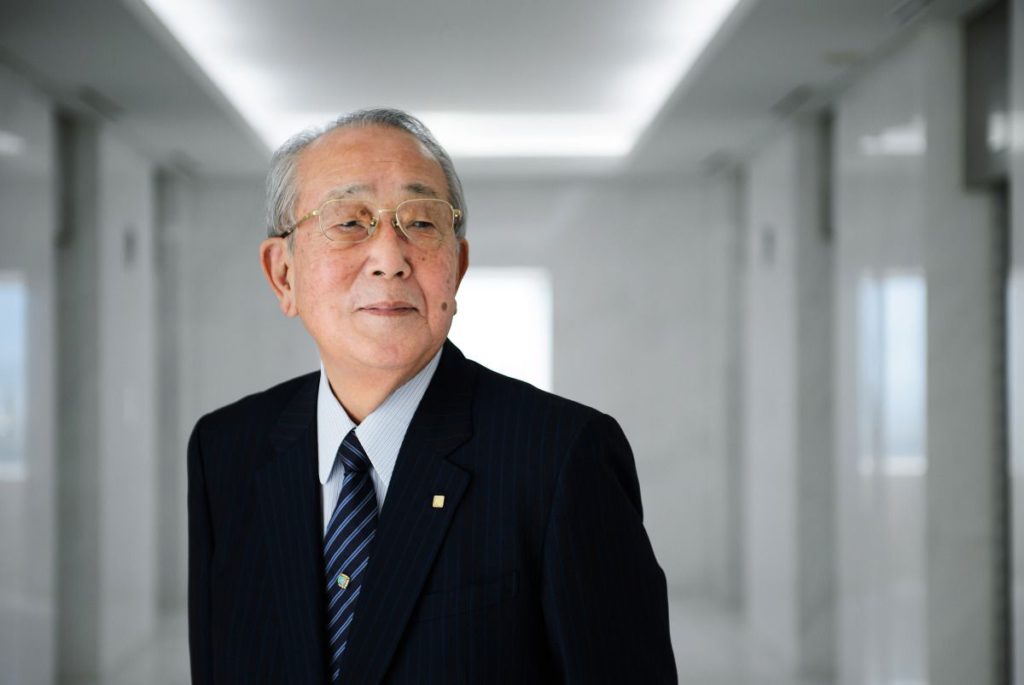
(Bloomberg) — Kyocera Corp. founder Kazuo Inamori — a former Buddhist priest who went on to influence Japanese entrepreneurs for decades — has died of old age. He was 90.

Inamori, who also founded the precursor to Japan’s No. 2 phone carrier KDDI Corp., was famous for prioritizing employees’ needs over shareholder demands. His “amoeba management” philosophy preached organic corporate growth. Companies should give employees more autonomy and let their insights into changing market needs guide the business, he said. That management style led Kyocera to grow in multiple directions, leading it to pioneer technologies in power semiconductor devices, fine ceramics and solar cells.

Company leaders aren’t there to work for shareholders, but to make employees happy, Inamori told Bloomberg in an interview in 2015. But he could be ruthless in creating the right eco-system for his management system to flourish.

When Inamori was 77, he stepped in to lead Japan Airlines Co. after the flagship carrier went bankrupt in 2010. He had no experience in the industry, but returned the airline to profitability the following year and relisted it on the Tokyo Stock Exchange in 2012. That turnaround involved cutting roughly a third of the carrier’s workforce, or around 16,000 people.

His skill in growing Kyoto Ceramic, which Inamori founded in 1959 at the age of 27, into the $21 billion Kyocera gained him the moniker of “god of management” in Japan. During his ascent, Inamori was able to browbeat SoftBank Group Corp. founder Masayoshi Son in 1986, when a young Son approached the older executive to sell a device that would automatically route telecom users to the lowest-priced carrier. Inamori convinced a cowed Son to sign over exclusive rights — a decision Son has said he immediately regretted. Son had to wait for Inamori to arrive at work in the morning and beg him to nullify the contract.

Widely read in Japan and China, Inamori’s books have been popular among entrepreneurs seeking alternatives to the capitalist models of the West, with Alibaba Group Holding Ltd. co-founder Jack Ma reportedly citing Inamori’s lessons on motivating employees to work harder.

“His books and philosophy inspired many, including myself,” said Shigehisa Murakami, chief executive officer of financial consultancy Fine Deals Inc. 

But Inamori lived to see his management style look dated and even quaint, as markets came to prioritize capital efficiency , analysts said. “Kyocera’s performance over the last decade has been lackluster. It needs a management style that matches modern times,” said Morningstar analyst Kazunori Ito.

(Adds executives’ reactions and details from fifth paragraph)

More stories like this are available on bloomberg.com

©2022 Bloomberg L.P.
Bitcoin May Have Hit a Floor After Powell’s Speech

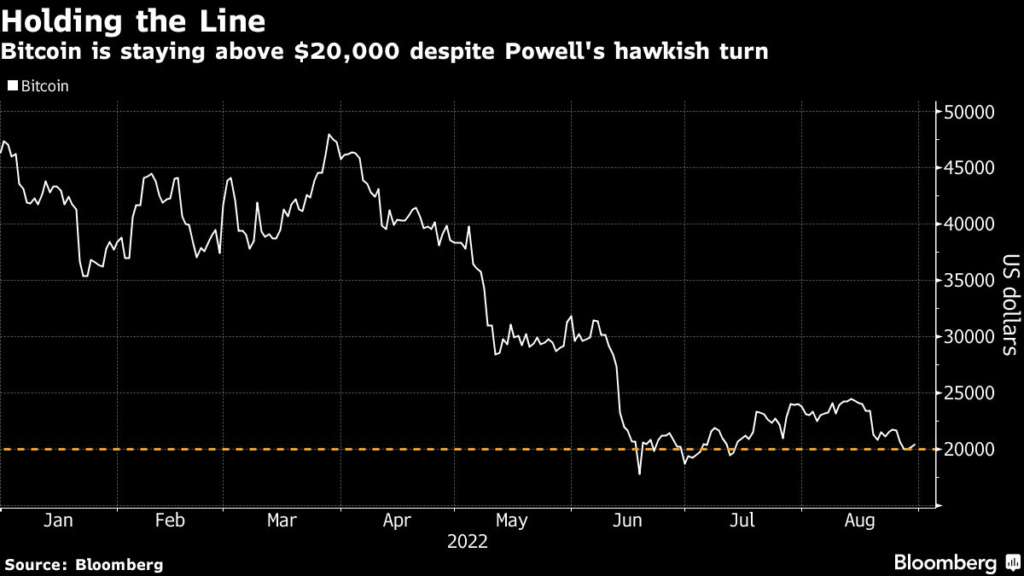
(Bloomberg) — Bitcoin quivered but didn’t fold after Jerome Powell signaled higher-for-longer interest rates to fight inflation, a pattern that for brave prognosticators could be a hint of a floor for the digital token.

The largest cryptocurrency is down about 6% since Powell’s hawkish Aug. 26 Jackson Hole speech underlined that the Federal Reserve wants to subdue financial markets as part of a push to curb economic activity and contain price pressures.

That’s a smaller drop than traders are conditioned to expect in a volatile asset. It’s roughly in line with the rout in the tech-heavy Nasdaq 100 index over the period, whereas in the past Bitcoin losses have sometimes been orders of magnitude above the weakness in traditional assets during times of stress.

“Bitcoin is showing some resilience here as it has clawed back above the $20,000 level, despite widespread stock market weakness,” Oanda Senior Market Analyst Ed Moya wrote in a note. “Crypto traders are not used to seeing Bitcoin withstand a rout on Wall Street, so this could be a promising sign.”

The $20,000 level — while a far cry from the near-$69,000 record hit in November 2021 — is for some market watchers a gauge of whether beaten-down investor sentiment is holding up or vulnerable to yet more damage in a stomach-churning year of losses across assets.

Bitcoin climbed as much as 2% on Tuesday and was trading at about $20,400 as of 10:03 a.m. in London. Tokens ranging from Ether to Solana also posted modest gains amid a steadier mood in global markets.

Average daily Bitcoin moves, either to the upside or downside, have also compressed this month compared with earlier in 2022 — coming in at 2.4% for drops and 1.4% for climbs versus peaks of 4.1% and 3.4% respectively in June, according to data compiled by Bloomberg. 

While the smaller swings might also support views that a floor is close, there are other indicators that caution against hasty judgments. For instance, seasonal trends peg September as a tough month and traders are paying a premium for options protecting against falls below $18,000.

For John Toro, head of trading at digital-asset exchange Independent Reserve, cryptocurrencies continue to trade as “a high-beta risk asset.” But he expects the upcoming upgrade of the Ethereum network — the Merge — to continue to “attract investment capital and support dips in cryptocurrency pricing.”

More stories like this are available on bloomberg.com

©2022 Bloomberg L.P.
Baidu Profit Beats Targets After Cost Cuts Offset Covid Hit

(Bloomberg) — Baidu Inc.’s profit beat expectations, helped by the Chinese search leader’s efforts to expand into new businesses and shield itself from an economic downturn.

Sales dropped to 29.6 billion yuan ($4.3 billion) in the April-June period, just above the average analysts’ forecast. But net income came to 3.6 billion yuan, surpassing the 2.2 billion yuan expected. 

Baidu’s Netflix-like video service iQiyi Inc. reported revenue a shade weaker than estimates. But it also unveiled improving margins and a deal to place $500 million of convertible notes with Hong Kong private equity firm PAG. Baidu’s and iQiyi’s shares climbed about 3% in pre-market trading in New York.

China’s largest tech giants have made peace with a new reality of low growth and cautious expansion, more than a year after Beijing’s crackdown on internet businesses from e-commerce to edtech and social media. A deepening economic malaise, coupled with strict Covid Zero measures, has crippled consumer demand in the world’s largest mobile app arena.

Baidu’s reliance on digital marketing leaves the Beijing-based company vulnerable to the same economic shocks that’ve laid low its bigger rivals. Alibaba Group Holding Ltd. and Tencent Holdings Ltd. both reported their first-ever sales contractions for the June quarter. Online marketing sales declined a better-than-feared 12% while Baidu’s AI cloud revenue grew 31%, down from 45% in the prior quarter. 

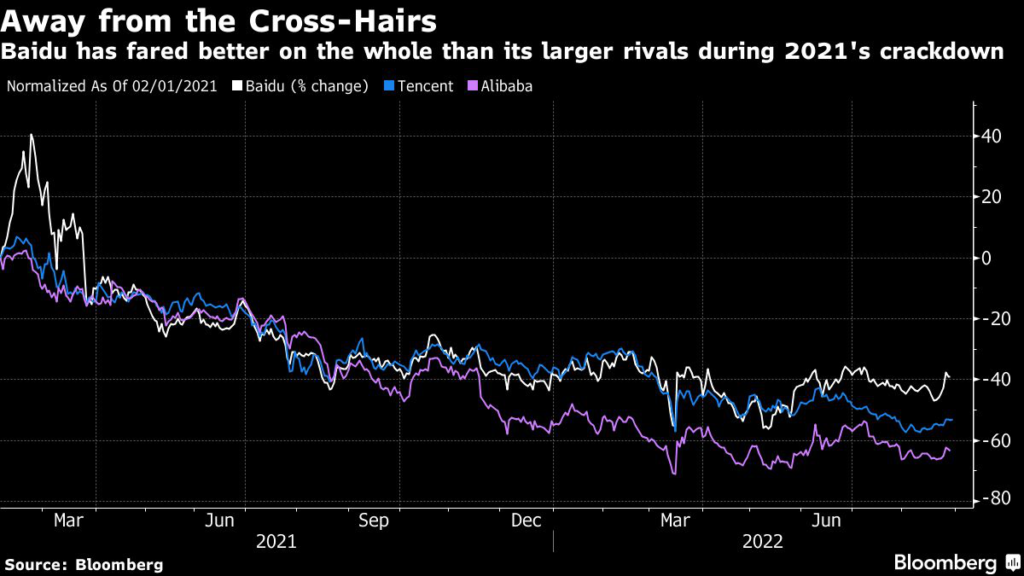
Baidu’s shares have nonetheless fared better than many of its rivals, staying largely unchanged since the start of the year despite growing economic uncertainty. Beijing and Washington last week reached a preliminary deal allowing American officials to review audit documents of US-listed Chinese stocks including Baidu, in a move toward keeping the companies listed on US exchanges. Its shares surged after news of the agreement emerged.

Baidu is trying to reinvent itself as a supplier of deep technology by expanding into self-driving systems, cloud computing and chips. This month, it won approval to deploy the first fully autonomous taxis on Chinese roads. It also unveiled a self-made quantum computer, saying its resources will be open to the public. 

Baidu’s nascent AI cloud division is now its fastest growth engine, but it faces an uphill battle against market leaders including Alibaba and Huawei Technologies Co.

While waiting for these efforts to evolve into meaningful revenue, Baidu depends on its flagship news-search app to win advertising dollars and users from online entertainment platforms operated by Tencent and TikTok-owner ByteDance Ltd.

(Updates with iQiyi’s numbers and PAG deal from the third paragraph)

More stories like this are available on bloomberg.com

©2022 Bloomberg L.P.
Anticipating the Coming Ethereum Merge

  • Listen to Bloomberg Crypto on the iHeartRadio App
  • Listen to Bloomberg Crypto on Apple Podcasts
  • Listen to Bloomberg Crypto on Spotify  

(Bloomberg) — For crypto enthusiasts, a big change is in the air – and it’s not just a change of seasons. It’s the phrase on everyone’s lips: The Merge. It would be the Ethereum blockchain’s most ambitious software upgrade ever, coming after years of delays. This upgrade would represent a fundamental overhaul of how the Ethereum blockchain works, and would – if all goes according to the very ambitious plan – represent a shift away from the energy-intensive approach known as “proof of work.” In its place, Ethereum would adopt the “proof of stake” model, which proponents say is significantly more energy efficient and skeptics worry is less secure. 

So: What does the Merge mean for users? What are the risks associated with this switch? And why is it finally happening now, after all these years? Bloomberg Crypto reporters Olga Kharif and David Pan join this episode to tackle these questions.

Follow us on Twitter @crypto, and subscribe to the Bloomberg Crypto Newsletter at https://bloom.bg/cryptonewsletter 


More stories like this are available on bloomberg.com

©2022 Bloomberg L.P.

Chinese Hackers Tied to Attacks on South China Sea Energy Firms

(Bloomberg) — Chinese hackers likely targeted energy companies operating in the South China Sea and the Australian government, according to a US tech security firm, the latest accusation of coordinated cybersnooping by the Asian nation to advance its geopolitical goals.

Researchers uncovered an ongoing phishing campaign lasting more than a year that has been aimed at projects including the Kasawari gas field and a wind farm in the Taiwan Strait, Proofpoint Inc. said in a report on Tuesday. The gas project is in Malaysian waters and operated by Petroliam Nasional Bhd., which declined to comment on the research report. Petronas did say it follows best practices to protect its assets and operations.

Proofpoint said it had “moderate confidence” that the hacking was being performed by a group called TA423, adding it is based in China and motivated by espionage.

The US government and cybersecurity companies have long alleged that China runs expansive hacking operations. In July, Federal Bureau of Investigation Director Christopher Wray warned Western companies that China aims to “ransack” their intellectual property so it can eventually dominate key industries. It operated a “lavishly resourced hacking program that’s bigger than that of every other major country combined,” he said.

China routinely denies the accusations, saying it is a victim of cyberattacks and countering that the US is the “empire of hacking.” The Foreign Ministry in Beijing didn’t immediately respond to a request for comment on Tuesday.

Blacklists, Trade and More U.S.-China Flashpoints: QuickTake

China claims more than four-fifths of the South China Sea as its own, angering Malaysia, the Philippines and Vietnam. The body of water is one of the world’s busiest shipping routes, and the US estimates that more than 30% of the global maritime crude oil trade passes through it.

Proofpoint said that emails used in the phishing campaign impersonated Australian media organizations including The Australian and Herald Sun to deliver ScanBox malware. PwC Threat Intelligence, which assisted Proofpoint in its research, “assesses it is highly likely that ScanBox is shared privately amongst multiple China-based threat actors,” its report said.

News Corp. representatives in Australia didn’t immediately respond to a request for comment. 

Proofpoint said a ScanBox campaign running from April to June targeted agencies of the Australian government at both the local and federal level. An earlier phishing effort centered on a European maker of heavy equipment for a wind farm in the Taiwan Strait, the report added.

Sherrod DeGrippo, vice president of threat research and detection at Proofpoint, said TA423’s “focus on naval issues is likely to remain a constant priority in places like Malaysia, Singapore, Taiwan and Australia.”

More stories like this are available on bloomberg.com

©2022 Bloomberg L.P.
Temasek to Lead $100 Million Funding for Crypto Landlord Animoca

(Bloomberg) — Singapore state investor Temasek Holdings Pte. is joining a $100 million funding for Animoca Brands Corp., betting on one of crypto’s most prolific investment houses even after a $2 trillion market meltdown.

Temasek will lead the financing through convertible bonds, said the people, asking not to be identified discussing private information. It adds to a funding round first announced by Animoca in January, they said, when the Hong Kong startup raised $359 million from backers including George Soros and the Winklevoss twins. Now valued at $6 billion, Animoca raised another $75 million in the same round earlier this summer.

Temasek has said it doesn’t directly invest in cryptocurrencies and prefers to back service providers in the space instead. In February, the state fund joined a $200 million funding for crypto lender Amber Group at a $3 billion valuation. Animoca and Temasek spokespeople declined to comment.

Animoca has evolved from a small mobile game publisher to Asia’s biggest blockchain investor by assembling a portfolio of more than 340 finance, gaming, and social media companies in less than five years. Co-founder Yat Siu envisions challenging the dominance of Big Tech firms like Meta Platforms Inc. and Microsoft Corp. by building virtual worlds on the blockchain, creating the so-called Web3 in the process.

Read more: Crypto Winter’s Night King Spends Big to Reanimate the Industry

The crypto winter, which has wiped out $2 trillion in digital asset value since November, has left most investors reeling. Funding for digital currency-related startups fell 26% last quarter from the one before, and it’s on pace to fall further still in the current period, according to PitchBook data.

Animoca, for its part, is seeking to take advantage of the crypto downturn to buy up stakes in industry players and digital tokens, Siu told Bloomberg News in a recent interview. The firm wants to go public, perhaps in the next two to three years. That will depend on the market’s acceptance of its core business of selling crypto tokens and taking a cut from secondary transactions, Siu said.

Animoca’s capital raise hasn’t been entirely smooth. Buyout giant KKR & Co. was among prospective backers who decided to withdraw from its funding round after the market rout, Bloomberg News reported in July.

More stories like this are available on bloomberg.com

©2022 Bloomberg L.P.

German Bitcoin Miner Northern Data Considers Buyback After Stock Drop

(Bloomberg) — German Bitcoin miner Northern Data AG is considering a proposal to buy back shares in a program valued in the tens of millions of euros, according to people familiar with the matter. 

The Frankfurt-based company may introduce the share repurchase plan at its annual shareholder meeting in October, the people said, asking not to be identified because the information is private. 

A spokesman for Northern Data declined to comment.

Shares in Northern Data rose about 3.8% to 22.60 euros in Frankfurt trading at 10:14 a.m. on Tuesday, a rebound after the company late Monday said that its auditor KPMG has approved its accounts for 2021 following a delay.

Uncertainty around Northern Data’s annual report weighed on the company’s shares after it disclosed last month that KPMG was taking longer than expected to complete the audit. The company had faced a similar delay with its 2020 report.

Northern Data’s stock is down about 70% year-to-date, in step with the plunge in cryptocurrencies. For this year, the firm said it expects higher revenue and declining profit, with pressures on the value of cryptocurrencies offsetting higher production.

The value of many digital currencies dropped this year, sinking along with equities that were pushed down as central bankers worldwide tighten monetary policy.


In-line with the wider industry, Northern Data said it expects operating earnings before interest, taxes, depreciation and amortization, or operating Ebitda, to drop to between 40 million euros ($40 million) and 75 million euros this year, down from almost 90 million euros in 2021.

The firm said it also took a 65.9 million-euro hit on mining assets it acquired in 2021, a similar step to US rivals Core Scientific Inc., Marathon Digital Holdings Inc. and Riot Blockchain Inc., which booked impairments on the value of their crypto holdings.

Because the firm is bringing additional mining capacities online, Northern Data expects revenue to rise to as much as 250 million euros this year, up from around 190 million euros last year. The figure stood at 150 million euros in the first six months this year, the upper end of its previously guided range.

Northern Data has been expanding mining capacities by purchasing new hardware and buying rivals Bitfield and Decentric.

More stories like this are available on bloomberg.com

©2022 Bloomberg L.P.

Close Bitnami banner
Bitnami