Bloomberg

Dell’s Shares Are Cheap, But Lately No One’s Buying

(Bloomberg) — As investors fled high-flying tech stocks this year, they turned to old-school companies such as computer maker Dell Technologies Inc., offering growth at a much cheaper price. Now that trade is running out of steam.

Dell has slumped 10.2% the past month, worse than the tech-heavy Nasdaq 100 Index. The market is pricing in the growing reality that corporations are pulling back on hardware purchases given that a recession may be looming. The thesis got support Thursday from Dell Co-Chief Operating Officer Jeff Clarke, who said the company is “in an increasingly challenging environment.”  

At 6 times estimated earnings for the next year, shares of Dell are still cheap — every component of the Nasdaq 100 is more expensive — yet analysts are now busily trimming those estimates. Federal Reserve Chair Jerome Powell added to the gloom Friday when he said the central bank will keep raising interest rates to cool inflation, which will bring “some pain” to households and businesses.

The weakness has spread to other hardware companies as well. HP Inc. and Hewlett Packard Enterprise Co., both of which report results after the market close on Tuesday, plunged on Friday and have underperformed tech over the past month, though by smaller margins than Dell. 

Shares of Dell rose 0.3% on Tuesday. HP fell 0.2% and HP Enterprise rose 0.3%.

“With every central bank trying to tighten monetary policy, and against very tough year-over-year comparisons, the setups for the stocks aren’t attractive,” said Ted Mortonson, a technology strategist at Robert W. Baird & Co. “They may screen as cheap, but based on the macro they look like value traps.”

The slowdown in business is all the more notable because the industry has just come through a period of robust demand related to the pandemic. Analysts predict that revenue will decline in each of the next two quarters, versus 17% growth in the last fiscal year. 

In addition, the group’s heavy overseas exposure — Dell, HP and HP Enterprise all got more than half their 2021 revenue from outside the US, according to data compiled by Bloomberg — puts them at a disadvantage. The US dollar index is hovering near the highest since 2002, meaning those international sales buy many fewer dollars when they’re brought back home.

The case for some of these stocks earlier this year was simple: They were profitable, paid dividends, were cheaper than broad tech indexes and offered a modicum of growth. To be sure, that argument is still working for another old-school tech company: International Business Machines Corp. is still outperforming broad tech indexes in the past month. 

Wayne Kaufman, chief market analyst at Phoenix Financial, said a discounted price isn’t enough to make hardware stocks attractive at the moment. 

“There’s no sign that fundamentals have bottomed, as hardware companies continue to work through inventory and demand issues, which suggests that investors should avoid them for the time being,” he said. 

Tech Chart of the Day

Shares of semiconductor companies have been struggling of late, with the primary industry benchmark index closing at its lowest level in more than a month on Monday. The Philadelphia Stock Exchange Semiconductor Index is coming off a 7.6% drop over the past two trading days, making for its biggest two-day decline since June 13. Over the past month, the chipmaker index is down about 6.2%, compared with a 1.2% decline in the Nasdaq 100 Index. Last week, Nvidia gave an outlook that was seen as weak, adding to concerns about a slump in the bellwether industry.

Top Tech Stories

  • Elon Musk has cited the recent accusations from a Twitter Inc. whistle-blower as a new reason to terminate the $44 billion takeover of the social media platform.
    • Lawyers for both Elon Musk and Twitter subpoenaed the whistle-blower who says the social-media platform’s officials didn’t know or care to find out how many accounts were spam or robot accounts as the billionaire seeks to cancel the buyout.
  • Microsoft Corp. outlined planned changes to the terms of its software licensing agreements, following complaints to antitrust regulators from some European cloud-computing service providers that the company’s practices put rivals at a competitive disadvantage.
  • An endemic shortage of chips costing anywhere from 50 cents to $10 is slowing down swathes of the $600 billion semiconductor industry, Taiwan Semiconductor Manufacturing Co.’s top executive warned Tuesday.
  • Y Combinator, the technology industry’s most prestigious business incubator, appointed venture capitalist Garry Tan as its new head.
  • Kyocera Corp. founder Kazuo Inamori — a former Buddhist priest who went on to influence Japanese entrepreneurs for decades — has died. He was 90.
  • Pakistani startup PostEx, a provider of courier and financing services to online merchants, acquired logistics company Call Courier in a deal that makes it the nation’s largest e-commerce delivery firm, according to its founder.

(Updates to market open.)

More stories like this are available on bloomberg.com

©2022 Bloomberg L.P.

Elon Musk Attacks Twitter Deal Over Whistle-Blower as Feud Escalates

(Bloomberg) — Lawyers for Elon Musk and Twitter Inc. are sparring over how a whistle-blower’s accusations could affect the outcome of Musk’s proposed $44 billion takeover of the social media platform. 

In a securities filing on Tuesday, lawyers for Musk said the allegations by Peiter Zatko, Twitter’s ex-head of security, including claims of “egregious deficiencies” in the platform’s defenses against hackers and privacy issues, meant that Twitter had breached the terms of the merger agreement. 

Read the full text of the letter here.

Shortly after, Twitter’s lawyers responded with their own filing, saying Musk’s case for termination of the deal is “invalid and wrongful.”

Musk has been attempting for months to try and extract himself from the takeover of Twitter, initially claiming that the company’s user figures are inflated by millions of robot accounts. But Zatko’s claims, which emerged last week, have given Musk’s side new ammunition. Zatko, who was fired from Twitter earlier this year, raised questions about severe shortcomings in the social media company’s handling of users’ personal data, including running out-of-date software. He also said executives had withheld information about breaches and lack of protections for user data.

Twitter reiterated on Tuesday that Zatko’s complaint is “riddled with inconsistencies and inaccuracies and lacks important context.” Twitter argues it hasn’t breached any of its obligations and it intends to enforce the deal and close the transaction “on the price and terms agreed upon.”

Twitter shares were down less than 1% Tuesday morning in New York at $39.72, far below Musk’s offer price of $54.20.

Lawyers for both Musk and Twitter have subpoenaed Zatko, who said the social-media platform’s officials didn’t know or care to find out how many accounts were spam or robot accounts. 

Here are all the banks, billionaires and VCs sucked into the Twitter v. Musk case

Twitter, which has maintained that spam and bots make up fewer than 5% of accounts, sued Musk in July to force him to complete his proposed acquisition. Since then, more than 100 people, banks, funds and other firms have been subpoenaed in the suit, with a trial scheduled to begin Oct. 17 in Delaware.

The new findings add to Musk’s claims, according to the letter from his lawyers published Tuesday, showing that Twitter is in “material noncompliance” with obligations around data privacy and consumer protection laws and that the company is vulnerable to data center failures and malicious actors.

Letters such as the one sent on Tuesday often precede a request to a chancery judge to allow court filings to be amended. Judge Kathaleen St. J. McCormick still must decide whether Musk can amend his counterclaims in the Twitter case to add Zatko’s allegations as reasons the deal can be nixed.

Under Delaware law, a judge’s power to grant such amendments is “liberally granted, unless, in a narrowly construed exception, there is inexcusable delay and prejudice to the defendant” according to a 2020 chancery ruling in the case of Posco Energy Ltd. v FuelCell Energy Inc.

Zatko’s attorneys said he didn’t make his whistle-blower disclosures to benefit Musk or to harm Twitter, “but rather to protect the American public and Twitter shareholders.”

More stories like this are available on bloomberg.com

©2022 Bloomberg L.P.

Read the Letter Elon Musk Sent to Twitter With More Reasons to Terminate His Buyout

(Bloomberg) — Elon Musk sent a letter to Twitter detailing additional reasons to terminate his $44 billion takeover deal.

In a filing on Tuesday, lawyers on behalf of Musk cited allegations by whistle-blower Peiter Zatko, Twitter’s ex-head of security, who claimed he raised questions about severe shortcomings in the social media company’s handling of users’ personal data. The letter said that the allegations meant that Twitter had breached the conditions in the merger agreement. 

Read the full text of the letter, addressed to Twitter’s chief legal officer from Musk’s lawyer: 

Dear Ms. Gadde:

We write on behalf of X Holdings I, Inc. and X Holdings II, Inc. (the “Musk Parties”) to provide an additional notice of termination of the Agreement and Plan of Merger by and among the Musk Parties and Twitter, Inc. (“Twitter”) dated as of April 25, 2022 (the “Merger Agreement”). On July 8, 2022, the Musk Parties terminated the Merger Agreement (the “July 8 Termination Notice”) on certain bases. Since that time, Twitter has challenged the validity of the July 8 Termination Notice and contends that the Merger Agreement remains in force, a position that the Musk Parties are contesting. Allegations regarding certain facts, known to Twitter prior to and as of July 8, 2022, but undisclosed to the Musk Parties prior to and at that time, have since come to light that provide additional and distinct bases to terminate the Merger Agreement. Although the Musk Parties believe this termination notice is not legally necessary to terminate the Merger Agreement because they have already validly terminated it pursuant to the July 8 Termination Notice, the Musk Parties are delivering this additional termination notice in the event that the July 8 Termination Notice is determined to be invalid for any reason.

On August 23, 2022, the Washington Post published a whistleblower report to Congress, the SEC, FTC, and DOJ filed by Peiter “Mudge” Zatko, Twitter’s former chief security officer, on July 6, 2022 (the “Zatko Complaint”). The Zatko Complaint alleges far-reaching misconduct at Twitter—all of which was disclosed to Twitter’s directors and senior executives, including Parag Agrawal—that is likely to have severe consequences for Twitter’s business. For example, Mr. Zatko alleges that:

  • Twitter is in material noncompliance with both its obligations under a 2011 FTC consent decree and its general obligations under data privacy, unfair trade practice, and consumer protection laws and regulations;
  • Twitter is uniquely vulnerable to systemic disruption resulting from data center failures or malicious actors, a fact which Twitter leadership (including its CEO) have ignored and sought to obfuscate;
  • Twitter’s platform is built in significant part on the misappropriation and infringement of third party intellectual property; and
  • Twitter acquiesced to demands made by the Indian government that its agents be hired by Twitter and given access to Twitter user information.

These allegations, if true, demonstrate that Twitter has breached the following provisions of the Merger Agreement, thereby giving the Musk Parties the right to terminate the Merger Agreement pursuant to its terms as more fully described below.

Section 4.5 Permits; Compliance With Laws. In the Merger Agreement, Twitter represented, inter alia, that it was in compliance with all applicable laws. That representation was apparently false when made on the date of the Merger Agreement and as of the date of the July 8 Termination Notice, and continues to be inaccurate. The Zatko Complaint alleges that Twitter has been violating a consent decree it entered into with the FTC in 2011. That consent decree required Twitter to establish and maintain “a comprehensive information security plan” to ensure that its users’ personal data was sufficiently protected from disclosure. Mr. Zatko’s statements purport to reveal that Twitter has not been, and perhaps never will be, in compliance with that decree. Twitter has already paid a fine of $150 million for violating an aspect of that decree, and Facebook recently paid $5 billion for similar user data violations. In addition, the Zatko Complaint alleges that Twitter has repeatedly violated the 2011 FTC consent decree (by going well beyond the violations settled in Twitter’s recent $150 million settlement), in addition to breaching a slew of other data privacy, unfair trade practice, cybersecurity, and consumer protection laws and regulations that Twitter must comply with, including but not limited to Twitter granting agents of the Indian government access to confidential user data. These violations would have material, if not existential, consequences to Twitter’s business, constituting a Company Material Adverse Effect as defined in the Merger Agreement.

Section 4.6 Company SEC Documents; Financial Statements. In the Merger Agreement, Twitter also represented, inter alia, that no documents it filed with the SEC since January 1, 2022, “contained any untrue statement of a material fact or omitted to state any material fact required to be stated therein or necessary to make the statements therein . . . not misleading.” That representation was apparently false when made on the date of the Merger Agreement and as of the date of the July 8 Termination Notice, and continues to be inaccurate. The Zatko Complaint alleges that Twitter’s SEC filings contained untrue statements of material fact or omitted to state material facts necessary to make the statements therein not misleading. For example, Twitter’s 2021 10-K, dated February 16, 2022, states that “concerns related to . . . privacy, data protection, safety, [and] cybersecurity” “could potentially negatively affect mDAU growth and engagement,” while omitting the significant privacy, data protection, safety, [and] cybersecurity risks Mr. Zatko alerted the board of prior to the filing of the 10-K, including those facts outlined above. Similarly, Twitter’s representation in its 2021 10-K that Twitter “strive[s] to comply with applicable laws and regulations relating to privacy, data protection, and cybersecurity” was materially misleading if, in reality, Twitter was ignoring Mr. Zatko’s warnings that the company was in violation of privacy, data protection, and cybersecurity laws and regulations.

Twitter’s material misrepresentations and/or omissions in the Merger Agreement and Twitter’s 2021 10-K regarding these serious allegations also constitute fraud in the inducement, giving the Musk Parties the right to recission.

Section 4.8 Disclosure Controls and Procedures. In the Merger Agreement, Twitter also represented, inter alia, that it had disclosed “any fraud to the Knowledge of the Company, whether or not material, that involves management or other employees who have a significant role in the Company’s internal control over financial reporting.” That representation was apparently false when made on the date of the Merger Agreement and as of the date of the July 8 Termination Notice, and continues to be inaccurate. One component of the Zatko Complaint is that Twitter’s CEO, Parag Agrawal, knowingly presented false and misleading reports to Twitter’s Board of Directors in order to cover up flagrant vulnerabilities in Twitter’s security and data protection infrastructure. Twitter was made aware of precisely that in an internal report prepared by Mr. Zatko in February 2022. Twitter was obligated to disclose Mr. Agrawal’s conduct “whether or not material” (although it was clearly material), and failed to do so.

Section 4.11. Litigation. In the Merger Agreement, Twitter represented, inter alia, that there were no threatened or pending lawsuits or Government investigations that would constitute a Company Material Adverse Effect (within the meaning of the Merger Agreement). It is likely the case—given the extensive information withheld from the Musk Parties detailed in the Zatko Complaint—that the representations set forth in Section 4.11 will be false as of the date of any potential closing of the transactions contemplated by the Merger Agreement, resulting in a failure of the closing condition set forth in Section 7.2(b). Indeed, Twitter is now facing multiple Congressional inquiries: the Senate Judiciary Committee has announced a full Committee hearing, the House Energy and Commerce Committee announced that it is “assessing next steps,” and multiple US Senators have publicly called for the FTC and DOJ to open investigations. See https://www.washingtonpost.com/technology/2022/08/24/twitter-whistleblower-senate-hearing; https://www.washingtonpost.com/technology/2022/08/23/twitter-whistleblower-congress-investigation. The data privacy authorities of Ireland and France are also investigating the claims in the Zatko Complaint. https://techcrunch.com/2022/08/24/twitter-whistleblower-security-eu/. It is likely that the SEC, FTC, and DOJ, as well as additional foreign regulators are not far behind. Twitter will also now face a myriad of civil lawsuits, asserting claims pursuant to various privacy and cybersecurity laws, state consumer protection laws, false advertising laws, intellectual property theft and misappropriation and common law claims, such as unjust enrichment, fraud, and breach of contract. Many of these civil claims are likely to be asserted as class action claims that could threaten the viability of the platform. This still-rolling litigation avalanche brings with it billions of dollars of potential damages, fines, and penalties, to say nothing of the significant reputational and operational harm that comes in parallel, clearly constituting a Company Material Adverse Effect under the terms of the Merger Agreement.

Section 4.14. Intellectual Property. In the Merger Agreement, Twitter represented, inter alia, that it was not infringing the intellectual property of others (the “Non-Infringement Rep”) and that it was in compliance with all applicable data privacy and protection requirements (the “Data Privacy Rep”). Both representations were apparently false when made on the date of the Merger Agreement and as of the date of the July 8 Termination Notice, and both continue to be inaccurate. As revealed by the Zatko Complaint, Twitter apparently never acquired the rights to Twitter’s core machine learning models, which the Musk Parties understand to be fundamental to the Twitter platform itself. That infringement threatens not just significant monetary damages, but the potential for injunctive relief that would threaten Twitter’s ongoing business as currently operated. Either alone would be a Company Material Adverse Effect under the terms of the Merger Agreement. Similarly, the Zatko Complaint lays out widespread, egregious violations of the data privacy protections that a company like Twitter is expected—and, indeed, legally required—to have in place. This would be a gross violation of trust by the Twitter platform that will have legal and commercial consequences, and which also gives rise to a Company Material Adverse Effect under the terms of the Merger Agreement.

Section 7.2. Conditions to the Obligations of Parent and Acquisition Sub. Finally, in the Merger Agreement, Twitter represented, inter alia, that it had not and would not (prior to closing) experience a Company Material Adverse Effect (within the meaning of the Merger Agreement). The breaches and consequences described above, individually and collectively, suggest that Twitter has in fact already experienced a Company Material Adverse Effect under the terms of the Merger Agreement, the full extent of which remains to be seen.

The facts supporting these breaches, which were withheld from the Musk Parties but known to Twitter as of the date of the Merger Agreement and at the time of the July 8 Termination Notice, provided additional bases to terminate the Merger Agreement as of that date and provide additional bases to terminate the Merger Agreement today if the Musk Parties’ termination of the Merger Agreement pursuant to the July 8 Termination Notice is determined to be invalid for any reason. This also provides a basis for recission. Because these facts were known to Twitter and withheld from the Musk Parties, and because Twitter has since taken the position that the Merger Agreement remains in effect, the Musk Parties hereby provide this additional notice of termination of the Merger Agreement effective as of July 8, 2022 pursuant to Section 8.1(d)(i) thereof on the basis of the facts set forth above. For the avoidance of doubt, these bases are in addition to, and not in lieu of, the bases for termination identified in the July 8 Termination Notice.

Sincerely,

Mike Ringler

Skadden, Arps, Slate, Meagher & Flom LLP


More stories like this are available on bloomberg.com

©2022 Bloomberg L.P.

Best Buy’s Profit Tops Estimates That Were Cut by Sliding Demand

(Bloomberg) — Best Buy Co. surpassed Wall Street’s profit estimate after warning a month ago that it was under pressure from waning consumer-electronics demand. 

Adjusted earnings fell to $1.54 a share in the fiscal second quarter, Best Buy said in a statement Tuesday. That exceeded the $1.35 average of analyst estimates compiled by Bloomberg, which had come down sharply since the company cut its forecast for the year in late July.

Best Buy is contending with flagging sales of discretionary goods as soaring US inflation forces shoppers to pay more for groceries and other essentials. Consumers are also shifting more spending to travel and other services after binging on televisions, computers and appliances during the first two years of the pandemic.

“We are clearly operating in an uneven sales environment,” Chief Executive Officer Corie Barry said. “We are focused on balancing our near-term response to difficult conditions and managing well what is in our control, while also delivering on our strategic initiatives and what will be important for our long-term growth.”

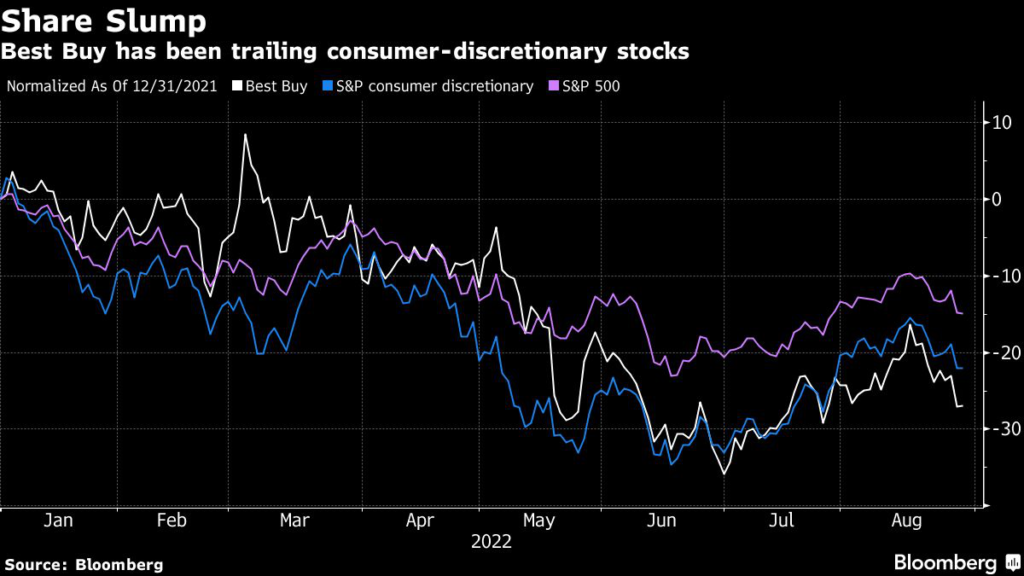
The shares rose 5.2% in New York trading at 9:39 a.m. Best Buy had fallen 27% this year through Monday, while an S&P index of consumer-discretionary companies had lost 23%.

Best Buy said it incurred $34 million in restructuring costs in the second quarter, mostly in the form of benefits stemming from job cuts, and said it would take on additional expenses during the rest of the year. The Wall Street Journal reported earlier this month that the company is cutting hundreds of jobs in stores.

In the second quarter, which ended in late July, sales tumbled 13% to $10.3 billion, matching analyst estimates. Enterprise comparable sales fell 12.1%, compared with an average analyst projection of a 13.1% decline.

Adjusted operating income amounted to 4.1% of revenue in the quarter. The company had forecast “a range around 3.7%” last month.

Best Buy reiterated its recently lowered profit and sales forecast for the year while noting that comparable sales will be down “slightly more” in the third quarter than they were in the second quarter. The decline in adjusted operating income rate this quarter “will be very similar to, or slightly more than” what the company saw in the second quarter.

“Best Buy’s steady outlook suggests demand isn’t worsening,” Bloomberg Intelligence analyst Lindsay Dutch said in a report. That’s “a positive signal ahead of the key holiday selling season.”

The company withdrew its forecast for fiscal 2025, which was unveiled less than six months ago.

“The current macro backdrop has changed in ways that we and many others were not expecting,” Barry said on a conference call with analysts. Best Buy will provide more detail on its longer-term expectations “once we begin to experience a more stable operating environment,” she said.

(Updates with fiscal 2025 forecast being withdrawn in final two paragraphs.)

More stories like this are available on bloomberg.com

©2022 Bloomberg L.P.
All the Banks, Billionaires and VCs Sucked Into Twitter v. Musk

(Bloomberg) — Ken Griffin’s on the list. So are Jack Dorsey, Larry Ellison and Marc Andreessen. Not to mention Morgan Stanley and Sequoia Capital.

Twitter Inc. is subpoenaing a veritable Who’s Who of Wall Street and Silicon Valley as part of its legal battle to force Elon Musk to complete his proposed $44 billion acquisition. The social media company is on the hunt for any evidence that Musk’s claim he pulled the plug on the deal over spam and bot accounts on the platform is just pretext. Investors, bankers, friends and anyone else Musk might have spoken to about the deal are fair game. 

Musk has sent out his own demands for information, seeking evidence that Twitter failed to provide him with accurate data on the accounts. Among the recipients is Dorsey, Twitter’s co-founder and a booster of his buyout bid, who was the first person at the company Musk called after he became the largest shareholder in late March.Both sides are  seeking information from Peiter Zatko, ex-Twitter head of security turned whistle-blower.  A handful of subpoenas don’t reveal the recipient. 

Here are the people and firms each side has subpoenaed so far:

Twitter’s Subpoenas

Individuals

  • Andreessen, Silicon Valley venture capitalist whose firm was an equity backer of Musk’s bid
  • Ellison, Oracle Corp. chairman whose trust committed $1 billion to Musk’s bid; his investment firm, Lawrence Investments, was also subpoenaed
  • Antonio Gracias, venture capitalist, former SpaceX and Tesla board member, and Musk pal who Twitter said in its lawsuit was meant to have taken over the financing effort from Bob Swan but “never appeared”
  • Griffin, Citadel CEO whom Twitter describes as an “actual or potential” co-investor in the equity financing for the deal
  • Steve Jurvetson, venture capitalist, SpaceX and former Tesla board member, whose DFJ Growth IV Partners committed equity financing
  • Joe Lonsdale, Palantir Technologies Inc. co-founder whose investment firm Eight Partners VC LLC is not known to have been a part of deal; Lonsdale has tweeted that he had “nothing to do” with the legal battle and called the subpoenas “a giant harassing fishing expedition”
  • Patrick O’Malley III, former chief financial officer of Avaya Holdings Corp., whom Twitter describes as an adviser to Musk
  • Robin Ren, former Tesla executive whose Robin Ren Family Foundation was an “actual or potential” co-investor
  • David O. Sacks, venture capitalist, former PayPal COO and longtime Musk associate who has tweeted critically of Twitter. He said on his podcast that he has no involvement in the transaction and has moved to quash the subpoena; his website was also subpoenaed
  • Kristina Salen, former CFO for World Wrestling Entertainment and Etsy who Twitter says advised Musk on the deal
  • Philip B. Simon, trustee for Ellison
  • Bob Swan, former Intel Corp. CEO and Andreessen partner who advised Musk on the deal but was sidelined because they “weren’t on the same wavelength,” according to the lawsuit
  • Zatko, former Twitter head of security turned whistle-blower

Firms Committed to Providing or Potentially Providing Equity Finance

  • Aliya Capital Partners, a Miami-based multi-family office and previous Tesla and SpaceX investor that committed $360 million
  • AH Capital Management LLC, Andreessen’s investment firm that committed $400 million and also advised on the deal, per the subpoenas
  • A.M. Management and Consulting LLC, a VC firm that committed $25 million
  • BAM Trading Services Inc., a unit of crypto exchange Binance that committed $500 million to Musk’s bid
  • BAMCO Inc., a unit of Baron Capital Management Inc., that committed $100 million
  • Bandera Partners LLC, a hedge fund that owns Twitter shares and was identified as an “actual or potential” co-investor
  • BDFJ Growth IV, a “potential” co-investor in the deal
  • Benefit Street Partners LLC, a credit-focused money manager named as an “actual or potential” co-investor
  • Brookfield Asset Management LLC, an investment management firm that committed $250 million
  • Cartenna Capital LP, a Connecticut hedge fund that committed $9 million
  • DFJ Growth IV Partners, Jurvetson’s VC fund that committed $100 million
  • Digital Rush 15 LLC, a “potential” co-investor in the deal
  • Eden Global Partners GP, a “potential” co-investor in the deal
  • Factorial Funds LLC, a VC and asset management firm described as an “actual or potential” co-investor
  • Fidelity Management & Research Co., an investment firm that committed $316.1 million
  • The Founders Fund Growth II Management, a VC fund owned by PayPal co-founder and longtime friend to Musk Peter Thiel; the subpoena identifies the firm as “actual or potential co-investor” in the deal 
  • Honeycomb Asset Management LP, a hedge fund that committed $5 million
  • J. Safra Asset Management Corp., an investment adviser that is part of the Safra Group of companies controlled by the Safra family; it’s identified as an “actual or potential” co-investor
  • Key Wealth Advisors, an investment management firm that committed $30 million
  • Linda Ye and Robin Ren Family Foundation, charity organization founded by former Tesla executive Ren and an “actual or potential” co-investor
  • LITANI Ventures LLC, family office of RXBar founder Peter Rahal, which committed $25 million
  • Manhattan Venture Partners LLC, a  venture capital firm identified as an “actual or potential” co-investor
  • Mirae Asset USA LLC, US unit of a Korean financial services group and an “actual or potential” co-investor
  • SC CDA1 LLC, a “potential” co-investor in the deal
  • Section 32 LLC, a VC firm run by former Google Ventures CEO Bill Maris and identified as an “actual or potential” co-investor
  • Sequoia Capital Fund LP, a VC firm that pledged $800 million to back Musk’s bid
  • Tomales Bay Capital, an investment firm involved in a failed deal to buy a piece of Musk’s space flight company SpaceX; it was described in the subpoena as an “actual or potential” co-investor
  • Tresser Blvd 402 LLC, a “potential” co-investor in the deal
  • Tru Arrow Technology Partners I, a private equity firm described as an “actual or potential” co-investor
  • Vy Capital Holdings LP, Alexander Tamas’s Dubai-based investment firm that committed $700 million
  • Witkoff Capital LLC, developer Steven Witkoff’s family office that committed $100 million
  • WKB Capital LLC, a “potential” co-investor in the deal

Data Firms

  • Concentrix Solutions Corporation, a data analytics firm
  • Cyabra Strategy Inc., a research firm that has estimated the percentage of inauthentic Twitter profiles at 13.7%
  • FGS Global Inc.
  • Innodata Inc., a data analytics firm
  • TaskUs USA, a content moderation company
  • ToSomeone Inc., which does business as CounterAction

Musk’s Companies

  • Space Exploration Technologies Corp.
  • Tesla Inc.

Musk’s Advisers

  • Davis Polk & Wardwell LLP 
  • McDermott Will & Emery LLP 
  • Morgan Stanley
  • Quinn Emanuel Urquhart & Sullivan LLP 
  • Skadden, Arps, Slate, Meagher & Flom LLP
  • Valor Equity Partners, Gracias’s firm

Banks Offering Debt Financing or Margin Loans

  • Bank of America Corp.
  • BNP Paribas SA 
  • Barclays PLC
  • Canadian Imperial Bank of Commerce
  • Citigroup
  • Credit Suisse Group AG
  • Deutsche Bank AG
  • Mitsubishi UFJ Financial Group Inc. 
  • Mizuho Financial Group Inc.
  • Morgan Stanley
  • Royal Bank of Canada
  • Societe Generale SA

Musk’s Subpoenas

Individuals

  • Kayvon Beykpour, Twitter’s former head of consumer product, whose team was key in expanding the user base
  • Dorsey, Twitter co-founder and former CEO
  • Bruce Falck, Twitter’s former head of revenue product
  • Zatko, former head of security and whistle-blower

Data, Ad Tech and Other Firms

  • Discord Inc., a chat service
  • DoubleVerify Inc.
  • 1stdibs.com, an e-commerce company whose CEO sits on Twitter’s board
  • Holocene Advisors LP 
  • Innodata Inc., a data analytics firm
  • Integral Ad Science Inc.
  • Mastercard Inc.
  • Salesforce Inc.

Financial and Other Advisers

  • Allen & Co.
  • BofA Securities Inc. 
  • Contour Asset Management LLC, subpoenaed partly for any analysis it performed on Twitter’s user base as it affected a price target for the stock 
  • D.E. Shaw & Co., subpoenaed partly for the same reason
  • Goldman Sachs Group Inc.
  • JPMorgan Chase & Co.
  • Joele Frank, Wilkinson Brimmer Katcher
  • PricewaterhouseCoopers LLP
  • Wells Fargo Securities LLC

Legal Advisers

  • Ballard Spahr LLP
  • Wachtell, Lipton, Rosen & Katz
  • Wilson Sonsini Goodrich & Rosati

Unknown Subjects

  • Seven subpeonas have been filed under seal

(Adds latest round of subpoenas)

More stories like this are available on bloomberg.com

©2022 Bloomberg L.P.
Stocks, Futures Up as Post-Powell Slide Subsides: Markets Wrap

(Bloomberg) — Stocks rose on Tuesday as investor sentiment stabilized following a rout sparked by the Federal Reserve’s signal of a sustained period of restrictive monetary policy to quell inflation. Treasury yields and the dollar slipped. 

US futures rallied, signaling a break in the equity slump that began Friday when Chair Jerome Powell stressed the Fed is willing to let the economy suffer to cool price pressures. Cryptocurrency-tied stocks climbed in premarket trading as Bitcoin advanced. Twitter Inc. fell after Elon Musk cited recent accusations from a whistle-blower as a new reason to terminate the $44 billion takeover.

Banks led gains in Europe, while energy companies underperformed as prices plunged on signs that the region is stepping up efforts to curb a crisis. Gold slipped.

Euro-area economic confidence dropped to its lowest level in 1 1/2 years. German inflation quickened to an all-time high, bolstering calls for a jumbo interest-rate increase when the European Central Bank meets next week. Governing Council member Klaas Knot said the ECB should continue raising interest rates quickly as inflation in the currency bloc will probably remain elevated for the foreseeable future.

Meanwhile, bonds are sliding toward the first bear market in a generation, burning investors who erred in bets that central banks would pivot away from rapid interest-rate hikes.

Powell’s push back against market hopes for a pivot to interest-rate cuts next year is the latest setback in a challenging year for investors. The Fed this week is also set to step up the unwinding of its near-$9 trillion balance sheet. Other risks range from China’s economic slowdown to an energy crisis that threatens to tip Europe into recession with winter approaching.

“The markets are spooked because they are afraid that the Fed could create a hard landing — that they’ll raise rates into a recession and that will be really painful for the economy and for corporate profits,” Terri Spath, chief investment officer at Zuma Wealth LLC, said on Bloomberg Television.

Minneapolis Fed President Neel Kashkari said sharp stock-market losses show investors have got the message that the US central bank is determined to contain inflation. “People now understand the seriousness of our commitment to getting inflation back down to 2%,” he said.

While Credit Suisse Group AG recommended investors go underweight global equities following the Jackson Hole symposium, JPMorgan Chase & Co. strategists say that a reading on the US labor market that spells bad news for the economy is actually a bullish signal for stocks.

Meanwhile, China’s central bank set a stronger-than-expected yuan fixing for a fifth day, a sign it doesn’t want an excessively weak currency. The move highlights how greenback strength is a challenge for Asia as the region’s currencies slip.

An Asian stock gauge rose as a climb in Japan helped to counter a retreat in Chinese tech shares. 


Here are some key events to watch this week:

  • US consumer confidence, Tuesday
  • New York Fed President John Williams due to speak, Tuesday
  • ECB Governing Council members due to speak at event Tuesday through Sept. 2
  • China PMI, Wednesday
  • Euro-area CPI, Wednesday
  • Russia’s Gazprom set to halt Nord Stream pipeline gas flows for three days of maintenance, Wednesday
  • Cleveland Fed President Loretta Mester due to speak, Wednesday
  • China Caixin manufacturing PMI, Thursday
  • US nonfarm payrolls, Friday
  • UK leadership ballot closes Friday. Winner announced Sept. 5

Will Chinese sovereign bonds outperform Treasuries? China is the theme of this week’s MLIV Pulse survey. Click here to participate anonymously.

Some of the main moves in markets:

Stocks

  • Futures on the S&P 500 rose 0.4% as of 8:35 a.m. New York time
  • Futures on the Nasdaq 100 rose 0.6%
  • Futures on the Dow Jones Industrial Average rose 0.3%
  • The Stoxx Europe 600 rose 0.5%
  • The MSCI World index fell 1%

Currencies

  • The Bloomberg Dollar Spot Index fell 0.1%
  • The euro rose 0.2% to $1.0015
  • The British pound fell 0.1% to $1.1693
  • The Japanese yen rose 0.2% to 138.38 per dollar

Bonds

  • The yield on 10-year Treasuries declined two basis points to 3.08%
  • Germany’s 10-year yield was little changed at 1.50%
  • Britain’s 10-year yield advanced 15 basis points to 2.75%

Commodities

  • West Texas Intermediate crude fell 2.4% to $94.64 a barrel
  • Gold futures fell 0.4% to $1,742.70 an ounce

More stories like this are available on bloomberg.com

©2022 Bloomberg L.P.
Women’s Voter Sign-Ups Surge After Roe Ruling, Buoying Democrats

(Bloomberg) — The number of women signing up to vote has jumped in key midterm battleground states since the Supreme Court struck down a national right to abortion, with Democrats benefiting as the issue pushes to the forefront in campaigns.

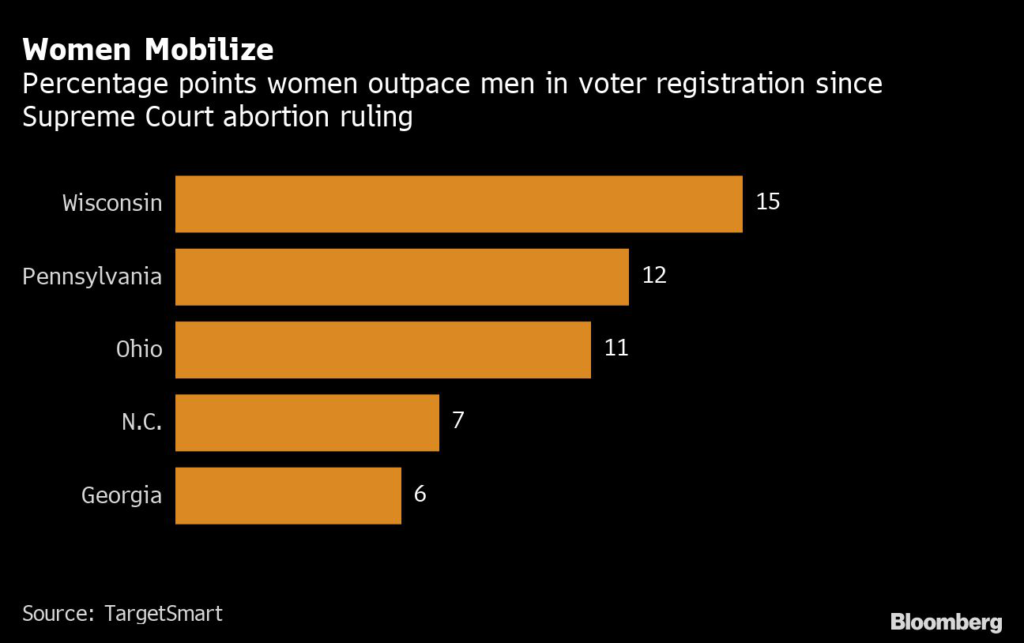
Women have outpaced men in new voter registrations by 11 percentage points in Ohio, 12 points in Pennsylvania and 15 points in Wisconsin since the court’s June 24 ruling. In Georgia, the margin was 6 points and in North Carolina 7 points. 

The new voters are overwhelmingly young and Democratic, according to TargetSmart, a Democratic data analytics firm that compiled the numbers from state voter files. That could prove pivotal in the party’s battle with Republicans for control of the House and Senate. Women have been an essential part of the Democratic base in past midterms.

Among many pro-abortion rights women, particularly those of child-bearing age, “there is sense of direct threat to their lives, literally deciding for them and having a direct impact on their reproductive rights,” said Kelly Dittmar, research director for the Center for American Women and Politics at Rutgers University.

The registration figures are another sign of the real-world political impact of the high court’s decision overturning the 1973 Roe v. Wade ruling, potentially shifting the November election from a referendum on President Joe Biden’s performance in office to one about choosing sides on potent cultural issues. 

Additional evidence includes the special election for a New York House seat last week that turned on the issue of abortion, the decisive defeat of an anti-abortion ballot measure in solidly Republican Kansas and polls showing Democrats pulling even with Republicans in voter preferences.

That’s a turnabout from earlier in the year when Republicans looked to be cruising toward a sweep in House and Senate races.

Other events also have contributed to the shift of attention away from the economy as a defining issue in the election. Those include a series of deadly mass shootings, House hearings on Donald Trump’s role in the Jan. 6, 2021 insurrection; and Trump’s headline-grabbing battle with the FBI over the agency’s seizure of classified materials from his Mar-a-Lago home.

The focus of voters may yet shift back to discontent over inflation and the economy. Republican campaigns will unleash millions of dollars in advertising as the election draws closer that will pound away at Biden on inflation and crime. The price of gasoline, which for more than a year had been the most visible sign of inflationary pain but as of Sunday was down 23% from the June 13 peak in the national average, could head back up, particularly if a September hurricane shuts down key refineries in the Gulf of Mexico.

For now, Democrats are making up ground. Democratic candidates have outperformed Biden’s 2020 vote share in all four special elections to fill vacant U.S. House seats since the Supreme Court ruling. In New York, Democrat Pat Ryan unexpectedly won an Aug. 23 House special election in a swing district in the Hudson Valley with a campaign focused on protecting abortion rights. 

Democrats in early August pulled even in national polling averages on which party voters would prefer to see in charge of Congress for the first time since last November. And after lagging behind Republicans on voting enthusiasm most of the year, Democrats also have gained, with 66% of Democrats versus 68% of Republicans saying they have a “high interest” in voting this year, according to an NBC News poll taken Aug. 12-16.

Campaign Ads

Since July 1, nearly a quarter of all television advertisements broadcast by Democratic candidates have featured abortion rights while only 2% mention Biden. Among Republican candidates, the proportions are reversed: 22% include Biden by name but only 4% mention abortion, according to data compiled by AdImpact through Friday.

Republicans are still favored to win control of the House, benefiting from redistricting and historical trends favoring the opposition party in midterm elections. But analysts at the non-partisan Cook Political Report have scaled back forecasts of GOP gains from 15 to 30 seats to 10 to 20 seats.

However in the Senate, even Republican leader Mitch McConnell said his party’s chances of getting a majority are only a “fifty-fifty proposition.” Pennsylvania, Wisconsin, Georgia, North Carolina and Ohio are among the battlegrounds where that will be decided. 

The court ruling “has taken an electorate that was decidedly more Republican and turned it into a more balanced electorate,” former Representative Tom Davis, who headed the campaign arm of House Republicans from 1999 to 2003, said. The November vote is “going to be a lot closer than a lot of Republicans anticipated.”

Populist Trump acolytes also dominated Republican primaries for high-profile competitive statewide gubernatorial and US Senate elections, with a few exceptions, heightening the focus on ideological differences.

The Trump Factor

“Trump has put himself back on the ballot through these extremist candidates,” said Sarah Longwell, an anti-Trump Republican strategist and publisher of the conservative website The Bulwark.

Longwell, who conducts voter focus groups on a weekly basis, said college-educated suburban women voters, a swing constituency she follows that leaned toward Biden in 2020, had been gravitating back to Republicans last year amid frustration over school coronavirus restrictions, crime and inflation but are now being repelled by the GOP again.

The surge in mostly Democratic-leaning women registering to vote has broader ramifications than mere numbers added to voter rolls. Not only are newly registered voters especially likely to cast ballots in the coming election but they are a telling gauge of a constituency’s mobilization, said Tom Bonier, TargetSmart’s chief executive officer.

“Registration trends can be a good indicator of intensity,” Bonier said. “If you see a group that is surging in registration, you should expect to see higher turnout from that group.”

More stories like this are available on bloomberg.com

©2022 Bloomberg L.P.
France Catches Tax-Dodging Swimming Pool Owners With AI

(Bloomberg) — The next time you take a plunge in a private pool in France, the tax-man may be watching. 

An experiment using artificial intelligence and satellite images of just a handful of French regions has already discovered around 20,000 undeclared swimming pools, enabling the tax office to collect 10 million euros ($10 million) in penalties and dues for 2022. 

The government expects that expanding the use of the new tool, which is also designed to detect building extensions and outhouses, will enable local authorities to collect another 40 million euros in levies in 2023. 

“The aim is to fight more effectively against anomalous declarations and respond to the demands of citizens for greater equity and tax justice,” the French tax office said in a report on the experiment to spot pools in nine of the country’s 100 regional jurisdictions known as departments. 

Private pools are big business in France. According to professional pool federation FPP, in 2020 there were almost 3 million measuring more than 10 square meters, making the country the largest market in Europe, and second only to the US in the world. 

To spot those hiding their pools, French authorities crossed publicly available satellite images with local authority records and tax declarations. All anomalies were then investigated by a tax inspector before households were informed and levies imposed. 

The French government hired Capgemini and Alphabet Inc’s Google for parts of the project that will cost a total of 24 million euros between 2021 and 2023. The expected income gains mean the measure will be profitable from the second year, the tax office said.

“Given the convincing character of the results in nine departments in the experiment, the measure will generalized gradually in the second half of 2022,” the tax office said. 

More stories like this are available on bloomberg.com

©2022 Bloomberg L.P.
Best Buy’s Profit Tops Diminished Estimates as Demand Slumps

(Bloomberg) — Best Buy Co. surpassed Wall Street’s profit estimate after warning a month ago that it was under pressure from waning consumer-electronics demand. 

Adjusted earnings fell to $1.54 a share in the fiscal second quarter, Best Buy said in a statement Tuesday. That exceeded the $1.35 average of analyst estimates compiled by Bloomberg, which had come down sharply since the company cut its forecast for the year in late July.

Best Buy is contending with flagging sales of discretionary goods as soaring US inflation forces shoppers to pay more for groceries and other essentials. Consumers are also shifting more spending to travel and other services after binging on televisions, computers and appliances during the first two years of the pandemic.

“We are clearly operating in an uneven sales environment,” Chief Executive Officer Corie Barry said. “We are focused on balancing our near-term response to difficult conditions and managing well what is in our control, while also delivering on our strategic initiatives and what will be important for our long-term growth.”

The shares rose 2.3% at 7:47 a.m. in early New York trading. Best Buy had fallen 27% this year through Monday, while an S&P index of consumer-discretionary companies had lost 23%.

Best Buy said it incurred $34 million in restructuring costs in the second quarter, mostly in the form of benefits stemming from job cuts, and said it would take on additional expenses during the rest of the year. The Wall Street Journal reported earlier this month that the company is cutting hundreds of jobs in stores.

In the second quarter, which ended in late July, sales tumbled 13% to $10.3 billion, matching analyst estimates. Enterprise comparable sales fell 12.1%, compared with an average analyst projection of a 13.1% decline.

Adjusted operating income amounted to 4.1% of revenue in the quarter. The company had forecast “a range around 3.7%” last month.

Best Buy reiterated its recently lowered profit and sales forecast for the year while noting that comparable sales will be down “slightly more” in the third quarter than they were in the second quarter. The decline in adjusted operating income rate this quarter “will be very similar to, or slightly more than” what the company saw in the second quarter.

“Best Buy’s steady outlook suggests demand isn’t worsening,” Bloomberg Intelligence analyst Lindsay Dutch said in a report. That’s “a positive signal ahead of the key holiday selling season.”

(Updates with restructuring in sixth paragraph, forecast in ninth, analyst in 10th.)

More stories like this are available on bloomberg.com

©2022 Bloomberg L.P.
Team USA Signs Merchandise Deal With Fanatics for LA Olympics

(Bloomberg) — Team USA has signed a long-term agreement licensing  Fanatics Inc. to make and sell merchandise for the Summer Olympic Games to be held in Los Angeles in six years.

The arrangement, set to be announced Tuesday, is wide-ranging and runs through 2028. Fanatics will offer the merchandise, which includes apparel and collectibles, online and in stores before and during the Olympics, according to a statement viewed by Bloomberg News. Financial terms weren’t disclosed.

Los Angeles and the state of California have been preparing for event since the International Olympic Committee awarded the games to the city in 2017. It will be the city’s third time as host after previous games in 1932 and 1984. The next Summer Olympics will take place in Paris in 2024.

Fanatics, which has previously handled online merchandise for Team USA, has been deepening its licensing agreements with partners in recent months. In July, it signed a deal with Nike Inc. to design and manufacture collegiate sports apparel and share the rights to serve many major universities.

Closely held Fanatics joins other Team USA partners in the apparel sector. Nike provides the on-field gear for U.S. athletes and Ralph Lauren Corp. designs the outfits for the ceremonies and podium appearances.

More stories like this are available on bloomberg.com

©2022 Bloomberg L.P.
Close Bitnami banner
Bitnami