Bloomberg

Musk Subpoenas Twitter Bot Whistle-Blower in Buyout Dispute

(Bloomberg) — Lawyers for Elon Musk subpoenaed a whistle-blower who says Twitter Inc. officials didn’t know or care to find out how many of the social-media platform’s accounts were spam and robot accounts as the billionaire seeks to cancel a $44 billion buyout of the company.

Peiter Zatko, Twitter’s ex-head of security, said in a lawsuit last week that the company had “egregious deficiencies” in its defenses against hackers and lacked concern for privacy issues. Zatko also said he raised concerns to company officials about the number of bots on the system and that those apprehensions were ignored.

Some analysts say Zatko’s claims bolster Musk’s legal argument that he can walk away from the Twitter deal over the bot issue. Twitter sued Musk in July to force him to complete his proposed acquisition. Since then, more than 100 people, banks, funds and other firms have been subpoenaed in the Delaware suit, with a trial scheduled to begin Oct. 17.

Read More: Musk Gets Potential Boost From Twitter Whistle-Blower Claims

A Twitter spokesperson declined to comment Monday. Last week, the company called Zatko’s complaint “a false narrative about Twitter and our privacy and data security practices that is riddled with inconsistencies and inaccuracies and lacks important context.” Whistleblower Aid, the group representing Zatko, didn’t immediately respond to a request for comment.

The subpoena is aimed at getting Zatko to hand over documents about his bot concerns and anything else he knows about Twitter’s metrics for evaluating customers that can be “monetized” for advertising purposes. The information demand also zeros in on what Zatko knows about Twitter’s securities filings, particularly its statements about bots making up about 5% of its customer base, according to court filings.

Musk’s lawyers said last week they’d already subpoenaed Zatko, but no record of the information demand was on the court docket until Monday.

In the complaint, Zatko said Twitter’s “Integrity Team” was reluctant to dig deeply into how many bot accounts were included in the platform’s customer base. That left the former security executive thinking “the company had no appetite to properly measure the prevalence of bots, in part because if the true number became public, it could harm the company’s value and image.”

Musk has argued that Twitter’s regulatory disclosures putting spam and bot accounts at no more than 5% of its customer base were misleading. The Tesla Inc. chief executive officer has made public some of his analysis of the issue, which holds that a full third of Twitter’s more than 230 million users may fall into the bot category.

If that’s the case, Musk contends it creates a material adverse event that justifies him cancelling his $54.20-a-share deal under Delaware law. The state is the corporate home of more than half of US public companies, including Twitter and Tesla, along with more than 60% of Fortune 500 firms. Its chancery court judges are business-law experts who hear cases on a fast-track basis.

Also on Monday, depositions were set for Patrick O’Malley and Kristen Salen, two Musk advisers on the Twitter deal, for later this week. O’Malley must appear for in-person questioning at the Wachtell Lipton law firm in New York on Aug. 30, and Salen, a former World Wrestling Entertainment Inc. executive, was set to appear on Aug. 31, court filings show.

The case is Twitter v. Musk, 22-0613, Delaware Chancery Court (Wilmington).

(Updates with deposition of Musk advisers in penultimate paragraph. An earlier version corrected the size of the buyout deal.)

More stories like this are available on bloomberg.com

©2022 Bloomberg L.P.

Ukraine Latest: Zelenskiy Says Russia Seeks to Sow War Fatigue

(Bloomberg) — Ukrainian President Volodymyr Zelenskiy accused Russia of trying to create a global sense of fatigue about its invasion, including by restricing the flow of gas to drive energy prices higher.

The European Union is working on “an emergency intervention and a structural reform of the electricity market” to drive down spiking power prices, according to Ursula von der Leyen, the head of the bloc’s executive arm. With power-plant outages further sapping supply, the EU’s energy ministers will meet in Brussels on Sept. 9 to seek a bloc-wide solution.

International Atomic Energy Agency Director General Rafael Mariano Grossi will lead an inspection of the Russian-occupied Zaporizhzhia nuclear power plant in Ukraine, with the team expected to reach Kyiv on Monday evening. Zelenskiy warned at the weekend that the situation at the plant remains dangerous, even after two power units were reconnected to the grid following an outage.

(See RSAN on the Bloomberg Terminal for the Russian Sanctions Dashboard.)

Key Developments

  • IAEA Monitors Will Visit Zaporizhzhia Nuclear Plant This Week
  • Why Ukraine’s Big Nuclear Plant Raises Worries Again: QuickTake
  • Zelenskiy Reinforces Nuclear Warning After Disruption 
  • EU to Propose New Training Mission to Boost Ukraine’s Military
  • EU Plans Emergency Intervention to Stem Surging Power Prices
  • Germany to Reach October Gas-Storage Target Already Next Month

On the Ground

The Ukrainian army launched an offensive in numerous areas in the south of Ukraine, Natalia Humenyuk, a spokeswoman for the military’s southern command, said on Suspilne TV. The city of Energodar near the Zaporizhzhia plant was shelled late Sunday, according to Ukrainska Pravda news site, which also reported that Russia hit the city of Sarny in Ukraine’s western Rivne region with missiles, striking a military target. Russia hit Ukraine’s second-largest city of Kharkiv again, regional Governor Oleh Synyehubov said on Telegram, while in Donbas several Russian attempts to conduct assaults in the vicinity of Slovyansk, Bakhmut and Avdiivka were unsuccessful, Ukraine’s General Staff said on Facebook. Officials said two people were killed and 24 injured in Mykolayiv on the Black Sea.

(All times CET)

Russian Missiles Hit Mykolayiv, Killing Two, Governor Says (7:02 p.m.)

Russian missile attacks killed two people and injured 24 people in Mykolayiv in the afternoon, regional governor Vitaliy Kim said on Telegram. 

The city, including residential buildings in its central district, was hit by 12 missiles, he said. Mykolayiv is a southern port city on the Black Sea, near the occupied Kherson region.

Ukraine Expects IAEA Team in Kyiv on Monday (6:05 p.m.)

The mission of the International Atomic Energy Agency is expected to arrive in Kyiv on Monday, Foreign Ministry spokesman Oleh Nikolenko said in a statement. The team including 14 international experts will start working at the Zaporizhzhia plant in coming days, he said.

Ukrainian Ex-Lawmaker Collaborating with Russia Is Murdered (5:25 p.m.)

Oleksiy Kovalyov, an ex-lawmaker from President Zelenskiy’s party who left Kyiv to help Russian occupation forces in Ukraine’s south, was murdered Sunday, according to a statement by Russia’s Investigative Committee on Telegram.

Kovalyov, who ran an agriculture business in the Ukrainian city of Kherson, became deputy-head of the Russian-installed authority in the region. Kovalyov, so far the highest-ranking collaborator with Russian forces to be murdered, died in an apparent gun attack at his home together with his partner, the committee said.

Zelenskiy Warns of Global Fatigue From Russian Invasion (4:20 p.m.)

Russia is trying to create a sense of global fatigue over its war in Ukraine, including by successfully pushing energy prices higher by restricting the flows of natural gas, Zelenskiy said.

EU Plans Emergency Intervention to Push Down Power Prices (2:55 p.m.)

The EU is planning urgent steps to force down soaring power prices, von der Leyen said. “The skyrocketing electricity prices are now exposing, for different reasons, the limitations of our current electricity market design,” she said at the Bled Strategic Summit in Slovenia. 

The unprecedented spike in power prices, which have soared almost 10-fold in the past year, has fueled inflation and increased the economic burden on businesses and households recovering from the pandemic.

US Officials, Allies to Meet in Germany Sept. 8 (2:10 p.m.)

Secretary of Defense Lloyd Austin is scheduled to host an in-person Ukraine Defense Contact Group meeting at Ramstein Air Base, Germany, on Sept. 8, the US said in a statement. Austin has invited ministers of defense and senior military officials from around the world to discuss Russia’s attack on Ukraine and various security issues facing allies and partners.

New Training Mission Plan Aims to Bolster Ukraine’s Military (1:35 p.m.)

The EU could offer Ukraine’s armed forces sniper, de-mining and officer training as part of a new mission the bloc’s foreign policy chief plans to propose to member states this week. Josep Borrell is due to suggest an EU training mission for Ukraine, with the aim of clinching political backing from defense ministers when they gather in Prague starting Monday evening.

While Ukraine’s needs are evolving, Kyiv has identified some specific training needs, including for medical, de-mining and sniper missions, as well as various kinds of officer training, according to a document obtained by Bloomberg. 

EU to Hold Emergency Talks on Sept. 9 as Prices Spike (1:25 p.m.)

The Czech Republic, which holds the EU’s rotating presidency, called an extraordinary meeting of energy ministers to discuss a bloc-wide solution to the spike in power markets. 

The meeting, which will take place in Brussels on Sept. 9, will debate concrete measures to tackle the energy crisis, according to Industry and Trade Minister Jozef Sikela. Czech officials are proposing to cap prices of natural gas used for power generation, Sikela said.

Record Number of Refugees Return to Ukraine From Poland (1:15 p.m.)

More than 73,000 people left Poland for Ukraine on Aug. 27-28, a record for any weekend since Russia’s invasion in February, Polish border guards said on Twitter. The return of refugees intensified at the start of the new school year on Sept. 1. Most people who fled the war are women with children.

Poland has been a major destination for people fleeing the war. Since Since Russia’s Feb. 24 invasion, 5.89 million people have entered Poland from Ukraine, while about 4 million crossed the border in the opposite direction.

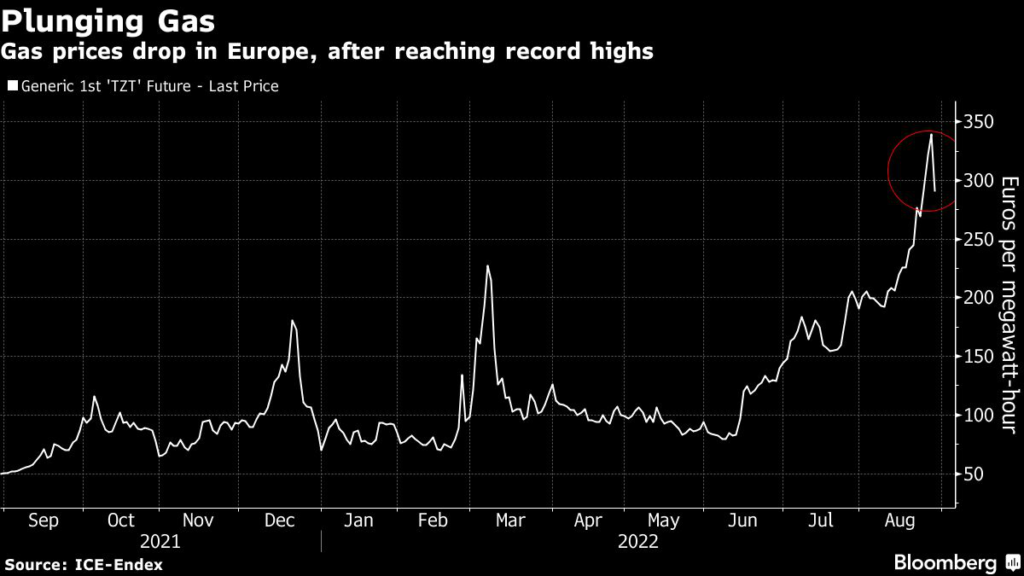
European Gas Prices Slump (12:20 p.m.)

European natural gas prices plunged the most since March after Germany said its gas stores are filling up faster than planned and some traders took profits following the rally of recent weeks.

Zelenskiy Offers Spare Gas Capacity (12:10 p.m.)

The Ukrainian president offered excess capacity at the country’s gas-storage facilities for the EU to use to build supplies for the winter. Ukraine can also be a contributor to the energy transition, he said via a webcast at the ONS conference in Stavanger, Norway.

Prime Minister Jonas Gahr Store told the same conference Norway aims to spend 2 billion kroner ($205 million) this year to ensure that Ukrainians can buy gas for the winter. The support will be distributed through the European Bank for Reconstruction and Development.

Russia to Ensure IAEA Security on Territory It Controls (12:05 p.m.)

Russia will ensure the security of a mission from the IAEA to the Zaporizhzhia nuclear power plant on the territory it controls in Ukraine, while it will be up to Kyiv to handle it on the other side of the front, according to Kremlin spokesman Dmitry Peskov.

“We’ve been waiting for this mission for a long time and consider it necessary,” he told a conference call. But he said there is “no discussion” of creating a de-militarized zone around the plant at the moment.

Ukraine Expects Clear IAEA Statement (11:50 a.m.)

Foreign Minister Dmytro Kuleba said he spoke to IAEA chief Rafael Mariano Grossi on Sunday to discuss details of an inspection of the Zaporizhzhia nuclear power plant this week.

“They have vast experience in inspecting nuclear power facilities across the world under the most difficult circumstances, but without exaggeration this mission will be the hardest in the history of the IAEA given the combat activities undertaken by the Russian Federation on the ground and also the very blatant way that Russia is trying to legitimize its presence” at the plant, Kuleba told reporters in Stockholm Monday. Ukraine expects a “clear statement of facts of violation of all nuclear safety protocols,” he added. 

The Moscow-appointed occupation governor told state television earlier on Monday that his officials would show the IAEA delegation evidence of what he said was shelling by Ukrainian forces. Kyiv has denied firing in the area around the plant.

Sweden Announces Aid for Ukraine (10 a.m.)

Half of Sweden’s 1 billion-krona ($93 million) aid package will involve military support and the other half help for the economy and reconstruction, Prime Minister Magdalena Andersson said at a press conference in Stockholm Monday as she received Ukrainian Foreign Minister Dmytro Kuleba. Sweden will also provide funds to the UN World Food Program, allowing it to buy 30,000 tons of wheat from Ukraine and ship it to countries at risk of famine, she said.

“The goal is for Ukraine to regain total control over your territory, within its internationally recognized borders,” Swedish Foreign Minister Ann Linde said.

Grain Vessels to Depart Ukrainian Ports (8:15 a.m.)

Three commercial vessels carrying 72,985 metric tons of grain and food products were authorized to leave Ukraine on Monday, the Joint Coordination Centre said in an emailed statement. They are destined for Turkey, Romania and Egypt. 

Zelenskiy Sacks Deputy National Guard Commander (8 a.m.)

The president dismissed Yaroslav Spodar as deputy commander of Ukraine’s National Guard, according to the Ukrinform site, which said that a decree notifying of the dismissal was published on the presidential website Sunday. It didn’t give any reason for the action.

Germany to Reach Gas-Storage Target Early (7:45 a.m.)

Germany’s economy ministry said gas-storage facilities are filling up faster than planned despite uncertainty over supplies through a key pipeline from Russia, and predicted that an October target of 85% capacity should already be reached early next month.

Germany has reduced its dependence on Russian gas from 55% before the war to about 30% now, and is moving to find alternative sources while filling storage facilities ahead of the winter. 

More stories like this are available on bloomberg.com

©2022 Bloomberg L.P.

Court Stymies African Bitcoin Adopter’s Gold-for-Crypto Offer

(Bloomberg) — The Central African Republic’s hopes of becoming Africa’s top cryptocurrency destination were dealt a blow on Monday, when the country’s highest court deemed its plan to offer land and mineral resources to investors unconstitutional.

The government must cease offering land and citizenship in exchange for investments in the CAR’s cryptocurrency, known as Sango Coin, according to the decision by the Constitutional Court in the capital, Bangui. Offering citizenship is unconstitutional “considering that nationality has no market value,” the court said. 

Read: African Bitcoin Adopter’s Cryptocurrency Sale Falls Flat

The CAR became the first country in Africa to adopt Bitcoin as legal tender in April.

Sales of Sango Coin continued on Monday, presidency spokesman Albert Yaloke Mokpeme said by phone. “We respect the court’s decision and we’re now looking at another way to offer land and citizenship to investors,” Mokpeme said. 

The mineral-rich but impoverished country last month said that investors would be able to acquire citizenship, land and access to its minerals for $60,000 worth of Sango Coin. CAR’s large reserves of mainly gold and diamonds remain largely unexploited due to decades of conflict.

Read: Russian Mercenaries Seek Gold, Sow Chaos in Central Africa

A 250 square-meter (2,691 square-foot) plot of land is listed as $10,000. Sango Coin sales have so far been slow.

More stories like this are available on bloomberg.com

©2022 Bloomberg L.P.

Italy’s Energy Agency Suffered Malware Attack, Halted IT Systems

(Bloomberg) — Italy’s energy agency Gestore dei Servizi Energetici SpA suffered a malware attack on Sunday night and Monday morning, according to a statement.

GSE’s IT systems and websites were shut down to protect the data, the statement said. The agency’s role as a gas buyer of last resort for Italy’s electricity network hasn’t been hampered.

Italian police and cybersecurity authorities are still assessing the extent of the attack and what kind of data have been compromised, a spokeswoman for GSE said.

Among other functions, GSE is one of the government agencies in charge of the running of Italy’s electricity market.

More stories like this are available on bloomberg.com

©2022 Bloomberg L.P.
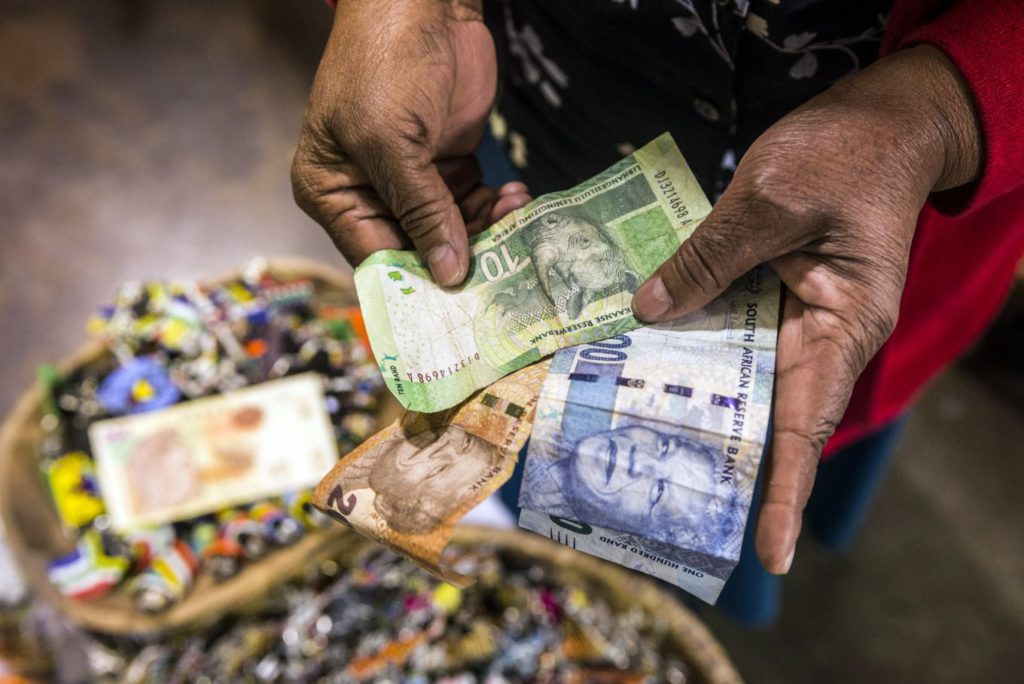
Cash Is King for South African Banks Planning Digital Transition

(Bloomberg) — South African banks see physical money remaining key to their business as almost a third of their customers aren’t ready to go cashless, according to a survey. 

While 86% of people already use digital banking, almost all customers said they still withdraw cash at least once a month to meet various needs, according to the survey conducted by Discovery Bank and Boston Consulting Group. As long as a significant percentage of the population uses cash, the country can’t move to a fully cashless system, according to the report.

“South Africa still has a high reliance on cash relative to some other countries,” Hylton Kallner, chief executive officer of Discovery Ltd.’s banking unit, said in Johannesburg. “But the direction, and the acceptance by consumers and embrace of digital payments, and the fact that they see the future in that direction, is accelerating.”

While digital transactions are affordable and secure in countries such as Kenya, the cost of online banking is expensive in South Africa. That deters as many as 11 million people living in townships — a relic of the apartheid era — and in rural areas of Africa’s most industrialized nation from switching to cashless banking, according to the report.

Regulatory changes will be needed to drive costs lower. 

South Africa’s central bank has unveiled a National Payment System Framework and Strategy plan aimed at increasing financial inclusion, reducing dependence on cash and creating an integrated platform for digital payments. 

The Reserve Bank is also expected to begin its Rapid Payments Programme this year that will offer a real-time clearing system for instant payments between banks, and allow users to request payments digitally. 

More stories like this are available on bloomberg.com

©2022 Bloomberg L.P.

US Firms’ Confidence in China Falls to Record Low on Covid Zero Policy, Political Tensions

(Bloomberg) — American firms’ optimism about China has fallen to a record low, with President Xi Jinping’s Covid Zero policy causing more than half of companies to delay or cancel investment, a new survey from an US business group shows.

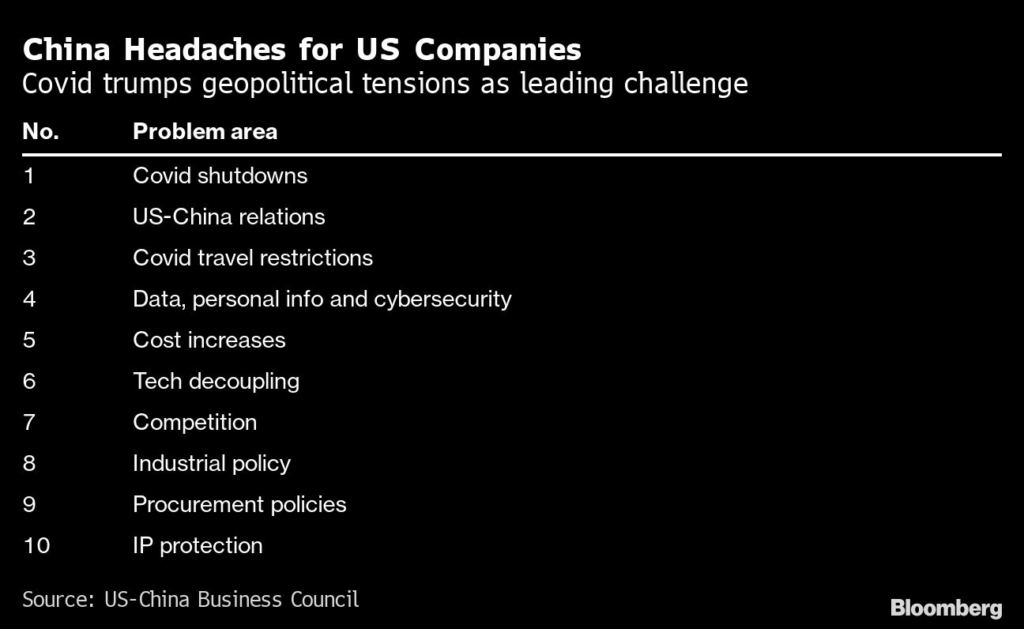
Pandemic-related shutdowns pose an even bigger headache to US companies in China than worsening relations between Beijing and Washington, according to a survey by the US-China Business Council. Only 51% of respondents expressed some degree of optimism about their five-year business outlook in the world’s second-largest economy, well down from 69% last year. 

“The looming possibility that companies will again be forced to partially halt operations due to lockdowns and the impacts of local controls on consumer demand have undermined confidence in the business environment,” according to the report, which was released Monday US time. Some 96% of companies were negatively impacted by China’s pandemic control measures, with more than half pausing, delaying or canceling altogether their investment plans in the country, according to the council, a private organization of over 270 American companies. 

New investment by US companies in China is expected to slow in 2023 as a result of the virus controls and other Chinese policies, including around data and cybersecurity, increasing difficulty in selling to government, and intellectual property protection issues, the report said. Due to the Covid-19 control measures, 17% of firms said that investments worth over $50 million had been affected.

“It is unclear if this pause in future capacity growth is another temporary blip or one point in a longer trend,” USCBC President Craig Allen said in a statement. In addition to longstanding concerns about China’s industrial policies which tend to disadvantage foreign companies, newer concerns such as geopolitical tensions or data security are becoming more prominent, Allen said, and this raises the specter of a tech decoupling which “would not be in anyone’s interest.”

Read more: China’s Lure for European Firms Outshines Flaring Tensions

Overseas companies have struggled to retain foreign staff already in China and to bring in new ones, the survey showed. “Most US-based executives have not been able to travel to China to see their business, employees, and customers for two and a half years, further compounding concerns with market conditions,” the report added. 

Meanwhile, onerous regulations have increased compliance costs of doing business, even as the country’s top leaders assert that China remains open to foreign business. 

Almost 90% of the companies studied said their China operations were profitable last year, although that has almost certainly fallen this year. In the first seven months of this year, profits of foreign industrial firms fell 14.5% from a year ago, a steeper decline than the 13.9% drop recorded through June.

“Geopolitical pressures are bleeding into the commercial realm, leaving companies — which depend on a stable and predictable trade environment — in increasingly challenging positions,” the report said. “Chinese customers’ real and perceived concerns about ongoing access to US technology due to US-China tensions continue to threaten US companies’ competitiveness in the market, an alarming trend that could be difficult to reverse.”

Allen is concerned that the economic relationship between the countries wasn’t getting the priority it deserved. “At tense times like these, we should capitalize on any opportunity for stability,” he said, urging “both countries to build upon the hard-earned commercial progress achieved over the last several decades and address outstanding barriers to doing business in China.”

Other highlights from the report:

  • Compared to other countries where companies do business, China remains a top five priority for 77% of respondents. However, this figure has declined consistently over the last decade. China was a top five priority for 96% of respondents a decade ago, and only 6% of companies indicated that China is their top priority market, an all-time low.
  • Over the past 12 months, nearly a quarter of respondents have moved segments of their supply chains out of China — a jump from 2021 — and the majority doing so are moving them to locations other than the US. The top reasons cited are Covid-19 shutdowns in China and boosting supply-chain resilience.
  • Half of respondents report the environment for selling to government and state-owned enterprises is deteriorating for foreign companies.
  • The survey was conducted in June and is based on responses from 117 member companies.

More stories like this are available on bloomberg.com

©2022 Bloomberg L.P.
Tech Leads Declines as Traders Rethink Rate Bets: Markets Wrap

(Bloomberg) — US stocks dropped and Treasuries slumped as traders recalibrated their expectations in response to the Federal Reserve indicating that it will continue to raise interest rates to tamp down on inflation.

The Nasdaq 100 sank more than 1% as investors anticipate rising yields and rate-hike bets will weigh on tech-stock valuations. The S&P 500 also fell. US Treasury yields rose, with the 10-year rate hovering around 3.12%. The two-year yield had climbed to its highest level since 2007 before paring the advance.    

Fed Chair Jerome Powell’s speech during the Jackson Hole symposium had made it clear that a dovish pivot that some investors had been positioning for was unlikely. He had also warned of the potential for economic pain for households and businesses as the central bank continues to be aggressive to battle inflation. 

“The process of a Fed funds hike cycle, especially in the early days of such a cycle, is never easily digestible for the markets,” wrote John Stoltzfus, chief investment strategist at Oppenheimer. “This process often comes with periods of elevated anxiety and volatility for market participants.”

The current rate-hike cycle to “particularly rough to manage” as it involves policy tightening combined with sky-high inflation, which the Fed has still not been able to slow meaningfully, he said. 

August and September also tend to be the worst months for the S&P 500 Index, with the index averaging declines of 0.6% and 0.7%, respectively, over the past 25 years.

“Since WWII, the S&P 500 posted the worst average monthly price change in September, joining February as the only two months to register declines,” Sam Stovall, chief investment strategist at CFRA wrote in a note. “Yet, September stands alone as the only month in which the market fell more frequently than it rose. What’s more, the best September return places it in the bottom quarter of all months, while its deepest one-month decline was among the four worst.”

But going forward, weaker earnings — not higher interest rates — could pose the largest threat to US stock prices, Morgan Stanley strategists led by Michael J. Wilson said in a research note Monday. The bank’s leading earnings model, which projects a steep fall in earnings per share growth over the next several months, confirms that view.

“The path for stocks from here will be determined by earnings, where we still see material downside,” the strategists said. “As a result, equity investors should be laser focused on this risk, not the Fed.” 

Seema Shah, chief global strategist at Principal Global Investors, echoed the sentiment.

“While earnings season has been positive, persistent challenges indicate an increasingly difficult operating environment, likely limiting profit persistence in the second half of the year,” she wrote.

Bonds in Europe tumbled, with Germany’s 10-year yield rising as high as 1.5% after a string of European Central Bank officials over the weekend stressed the need to act more forcefully to quash record inflation. 

ECB officials read from a similar script as Powell. Austria’s Robert Holzmann and Dutch colleague Klaas Knot both floated the prospect of an unprecedented three-quarter point hike at their meeting in September. Executive Board member Isabel Schnabel warned that the likelihood of inflation expectations becoming unanchored is uncomfortably high.

Bitcoin pushed above the $20,000 level that some view as a marker of a deeper slide in investor sentiment. Oil made gains on supply risks. 

Here are some key events to watch this week:

  • US consumer confidence, Tuesday
  • New York Fed President John Williams due to speak, Tuesday
  • ECB Governing Council members due to speak at event Tuesday through Sept. 2
  • China PMI, Wednesday
  • Euro-area CPI, Wednesday
  • Russia’s Gazprom set to halt Nord Stream pipeline gas flows for three days of maintenance, Wednesday
  • Cleveland Fed President Loretta Mester due to speak, Wednesday
  • China Caixin manufacturing PMI, Thursday
  • US nonfarm payrolls, Friday
  • UK leadership ballot closes Friday. Winner announced Sept. 5

Some of the main moves in markets:

Stocks

  • The S&P 500 fell 0.8% as of 11:46 a.m. New York time
  • The Nasdaq 100 fell 1.2%
  • The Dow Jones Industrial Average fell 0.6%
  • The Stoxx Europe 600 fell 0.8%
  • The MSCI World index fell 2.3%

Currencies

  • The Bloomberg Dollar Spot Index rose 0.2%
  • The euro rose 0.3% to $0.9994
  • The British pound fell 0.4% to $1.1702
  • The Japanese yen fell 0.9% to 138.84 per dollar

Bonds

  • The yield on 10-year Treasuries advanced eight basis points to 3.12%
  • Germany’s 10-year yield advanced 12 basis points to 1.51%

Commodities

  • West Texas Intermediate crude rose 3.5% to $96.32 a barrel
  • Gold futures rose 0.2% to $1,753.40 an ounce

More stories like this are available on bloomberg.com

©2022 Bloomberg L.P.
Walmart Takes Massmart Private to Revive S. African Business

(Bloomberg) — Walmart Inc. plans to take Massmart Holdings Ltd. private and will promote the unit’s chief operating officer to head of the company as it prepares to renew its focus on South Africa.

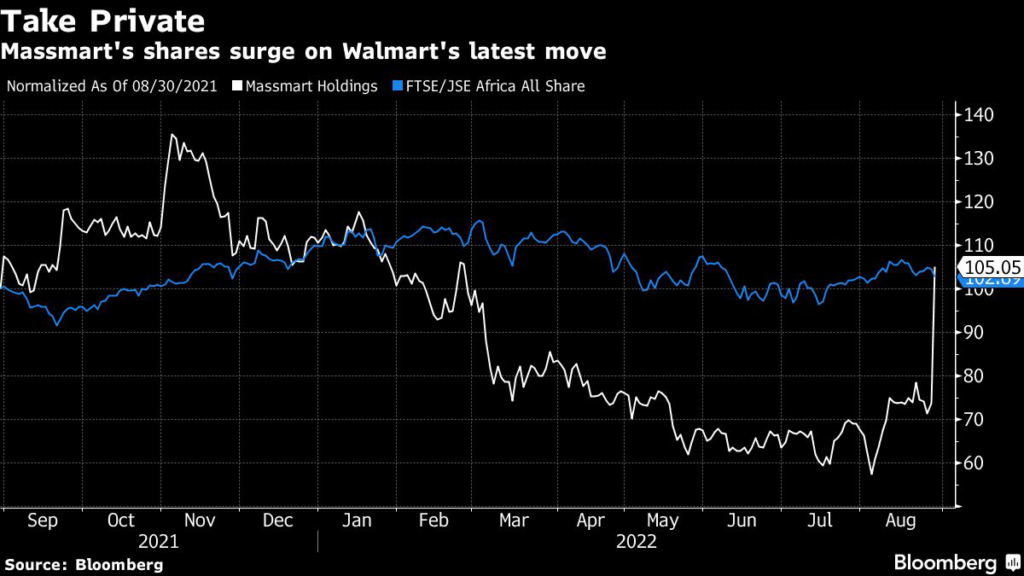
The global retail giant plans to buy all of the shares it doesn’t already own of Massmart for 62 rand ($3.65) apiece, a 53% premium to the last closing price, and delist the company from Johannesburg’s main bourse. Jonathan Molapo, who joined Massmart in January as COO will take over as chief executive officer a year after he joined the company. He replaces Walmart veteran Mitchell Slape.

Walmart is preparing for increased competition amid press reports that Amazon.com Inc. is planning to expand into Africa’s most-industrialized nation. Taking Massmart private may help Walmart cut costs and invest in the company that owns brands including Makro and Builders without the scrutiny that comes with being a public company.

“There is no question that Amazon is going to intensify competition in the market,” Slape said at a briefing on Monday. “We’ve been working hard to build our e-commerce business over the last few years. We think we’ll have a very competitive, very interesting offer for our consumers and you’ll see more of that in the coming months.”

The stock jumped 45% at the close in Johannesburg, paring its loss for the year to 3.3%.

Walmart has been exiting low-growth markets and concentrating on partnerships or stakes in local participants. The company has sold Asda in the UK, Seiyu in Japan and its Argentina operations. 

“Basically, all markets outside of the US, they haven’t made an imprint,” Evan Walker, money manager at 36ONE Asset Management Ltd. in Johannesburg, said referring to Walmart. “It’s going to be interesting to see if they come out now very aggressively against other retailers from a buyer perspective.”

Slape, who has worked for Walmart for 27 years, was sent to arrest a slump in profit at the Johannesburg-based company. Under his leadership, the company has cut jobs, shut its Dion Wired chain, disposed of underperforming Masscash stores and stopped selling fresh food in household-goods chain Game.

Slape “has made substantial progress towards the goals he set out and leaves the business in a far more sustainable state,” said Alec Abraham, an analyst at Sasfin Securities in Johannesburg. “I think this is particularly true in the vitally important online strategy.” 

Still, Game is struggling, even after the broad cost cuts, and the broader business has faced a string of difficulties ranging from pandemic-induced supply chain problems to a week of deadly South African riots a year ago. 

Widening Loss

Massmart on Monday also reported a first-half net loss of 1.1 billion rand, widening from a loss of 1.09 billion rand a year earlier. The company also has 14.9 billion rand of debt as of Dec. 31, according to data compiled by Bloomberg. 

COO Molapo has held various leadership positions in South Africa and internationally and was most recently the CEO of Astron Energy Ltd. His most significant retail experience has been developing retail forecourts at gas stations.

Molapo’s appointment as COO was “from the very outset, part of a carefully thought out succession planning process,” Massmart Chairman Kuseni Dlamini said on a briefing with reporters. This followed a local and international search, he said.

Walmart bought a majority stake in Massmart in 2011 for 16.5 billion rand. The purchase came under scrutiny from competition authorities and Walmart had to make various development commitments in order to get the deal passed. Still, as majority shareholders, Walmart’s new offer won’t be subject to regulatory approvals, Slape said at the same briefing.

Walmart “are excited about the future of Africa and the potential that it represents,” Slape said. “They take a long-term view, they’re a long-term holder.” 

(Updates with closing share price in fifth paragraph)

More stories like this are available on bloomberg.com

©2022 Bloomberg L.P.
FTC Sues Mobile Data Broker Over Abortion Location Data Sales

(Bloomberg) — The US Federal Trade Commission sued Kochava Inc., a data broker it alleges sells consumers’ mobile geolocation data that could be used to track visits to abortion providers, addiction recovery centers or other sensitive locations.

The agency voted 4-1 to file the complaint in Idaho federal court, with Republican Commissioner Noah Phillips dissenting. 

The FTC alleges that Kochava’s data put consumers at risk, letting buyers purchase time-stamped location data with few restrictions on its usage. Kochava didn’t immediately respond to a request for comment.

Kochava describes itself as an Idaho-based mobile analytics company. The company preemptively sued the FTC this month, alleging the agency misunderstands its business and that consumers can opt-out of geolocation data collection. 

The case is Federal Trade Commission v Kochava, 22-cv-00377, US District Court for the District of Idaho.

More stories like this are available on bloomberg.com

©2022 Bloomberg L.P.

Credit Suisse Hires Shak Thakur for Technology Banking

(Bloomberg) — Credit Suisse Group AG hired Shak Thakur as a managing director for its technology investment banking business, according to an internal memo.

Thakur, based in San Francisco, will report to Brian Gudofsky, global head of the technology group, the memo shows. 

A representative for Credit Suisse confirmed the contents of the memo. 

Thakur was most recently a vice president at telecommunications networking equipment and software company Ciena Corp. Prior to that, he was an investment banker for more than a decade, working with companies including including VMware Inc. and Arista Networks Inc.

“Senior software bankers are critical to the expansion of our business with clients such as mega-cap public companies, emerging private startups, private equity firms and venture capital firms,” Gudofsky said in the memo. 

More stories like this are available on bloomberg.com

©2022 Bloomberg L.P.
Close Bitnami banner
Bitnami