
Bloomberg

With Abbott’s Border Crackdown, New Mexico Looks to Take Texas Trade With New Port

(Bloomberg) — Twenty-five miles west of El Paso, in an unincorporated slice of the Chihuahuan desert where shipping containers outnumber humans, New Mexico is working to turn a quiet border crossing into an international port that rivals anything Texas has to offer.

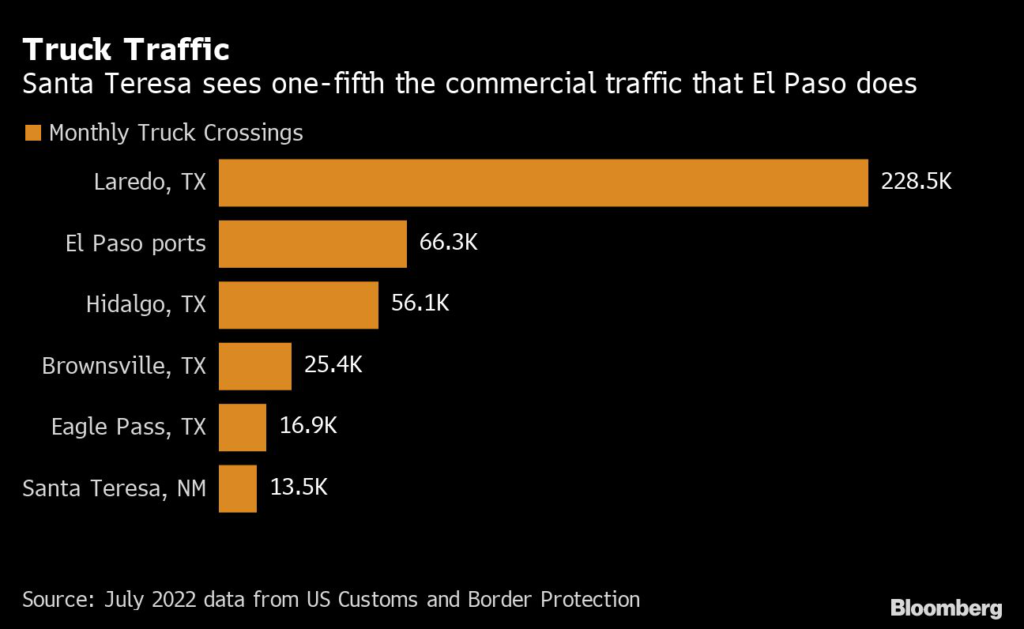
It is, by all measures, a wildly ambitious plan. The dusty little outpost, located just outside of the town of Santa Teresa, sees one-fifth of the truck traffic that moves through El Paso’s crossing; the surrounding area has less than one-10th the warehouse space of its rival; and there’s hardly any housing in the area for the would-be port workers to live in. 

Proponents of the plan are undaunted. They say the area’s lack of congestion, nearby freight-train lines and cheaper property taxes all are working in their favor just as a nearshoring boom fuels a jump in cross-border trade.

And there’s another crucial factor, too: Texas Governor Greg Abbott’s move to boost cargo-truck inspections in April — part of an election-year crackdown on undocumented immigration — caused massive shipping delays that left millions of dollars worth of Mexican food exports to rot. Officials in Mexico City were incensed. They quickly determined they needed to lessen their dependence on Texas and speed up efforts to help foster the development of the New Mexico port.

Perhaps in the end, the whole initiative falls flat. It is, after all, a long shot. But crazier, and less economically viable, projects have been born out of political tiffs before. And this one is pretty intense. Mexican President Andres Manuel Lopez Obrador has blasted Abbott as “dishonest” and “sensationalist” for the comments he’s made about immigrants and his use of the National Guard to patrol the border.

The truck inspections, Lopez Obrador said, were merely a political stunt to win votes. A few days after they began, his economy minister, Tatiana Clouthier, said the Mexican government would redirect a train route so that it runs through New Mexico instead of Texas. 

“We have to strengthen points of entrance and exit so that all our eggs are not in one basket,” Clouthier said in an interview this month. “That’s part of the vision that we have in the short, medium, and long term, so that it does not happen again.”

But if this is the start of an economic rivalry between Texas and New Mexico, it seems a bit one-sided. While New Mexican officials have been traveling regularly to Mexico City and the state of Chihuahua to promote Santa Teresa, Texans express little concern about losing out on business at the state’s 13 commercial crossings with Mexico. 

It’s reflective of the broader relationship between the states. While New Mexicans are notably outspoken in their only-slightly-tongue-in-cheek disdain for arrogant Texans, residents of the Lone Star State often seem like they can hardly be bothered to give New Mexico much thought at all.

George Chasteen thinks it would behoove Texas to pay more attention. As vice president of Mesilla Valley Transportation, which provides freight and logistics services in the area, he has a front-row seat to New Mexico’s efforts to win that business.

“Santa Teresa has carved out a niche of specialized freight” such as blades for wind turbines that would be too big to bring over the Rio Grande in El Paso, Chasteen said. “It’s less populated. There’s more room.”

New Mexico’s appeal has increased as congestion gets worse in El Paso and Juarez amid the nearshoring boom. As manufacturers leave Asia and build nearer their final market, often the US, the border zone has started to attract electric-vehicle suppliers. Mexico is also looking to lure chip factories to the country.

“Santa Teresa is a sweet spot,” said Alan Russell, owner of TECMA, an El Paso-based firm that helps US and foreign companies set up factories in Mexico and also includes a trucking division. “It has been much easier to use in the last few years since Texas bridges have been choked up.”

In one niche of global trade, New Mexico is already a big-time player: Santa Teresa is home to the largest cattle crossing on the southern border. And truck crossings have recently picked up to some 660 a day this year on average, about double the rate from 2019.

Santa Teresa, with a population of about 5,000, has just 4.7 million square feet of warehouse and manufacturing space, versus almost 52 million square feet in El Paso. But industrial developments in both Santa Teresa and the town across the border — San Jeronimo — have been growing. Combined, there’s about 2.1 million square feet of buildings under construction, according to Jerry Pacheco, who heads the Border Industrial Association.

On the Mexican side, Foxconn Technology Co. has a plant that builds computers for Dell Technologies Inc. and is building a 1.2-million-square-foot expansion, according to Pacheco. Mount Franklin Foods, which makes gummy bears and other sweets, is building an additional 280,000 square feet.

Over the longer term, the plan is for Santa Teresa to add more warehouses nearby so that shippers don’t need to bring their goods back to logistics hubs in El Paso. The port is an extra 15-mile drive for trucks on the Mexican side coming from Juarez, and then an additional 20 miles on the US side for those going to warehouses in El Paso.

City officials in Juarez plan to create a quicker route to the New Mexico crossing that would bypass crumbling roads and outdoor markets that slow traffic. New Mexico officials will construct a highway connector that would cut travel time to the Texas border to six minutes from 24. 

That could also make working in Santa Teresa a little easier. Most of the 6,000 employees at the town’s four industrial parks drive in from homes in El Paso or Las Cruces, New Mexico, because there’s not much residential housing available nearby. The town’s most prominent retailers are a Dollar General and a Family Dollar. The best dining option is the Chester’s Chicken counter housed within a sprawling gasoline station.

Abbott’s office defended the governor’s truck inspections, saying they were necessary to combat illegal immigration fueled by President Joe Biden’s border policies, and pointed out that the delays abated after Abbott signed accords with four Mexican border-state governors to begin enhanced security enforcement measures.

“It’s time for President Biden to do his job and secure our border, and it’s time for President Lopez Obrador to work with Texas and the U.S. to stop this flow of illegal immigration,” Renae Eze, Abbott’s spokeswoman, said in an email.

Her statement didn’t address New Mexico at all.

For now, Santa Teresa remains a relatively sleepy crossing. On a recent weekday morning, only a handful of passenger vehicles and 18-wheelers were lined up at the checkpoint.

“We want to keep trade growing,” Clouthier said. “By diversifying, we can make sure there are mechanisms so that things go better.”

More stories like this are available on bloomberg.com

©2022 Bloomberg L.P.
Biggest Power Exchange Urges European Governments to Aid Traders

(Bloomberg) — The European Energy Exchange AG said that traders need more government support to guarantee their buying and selling.

Billions of euros put up as collateral for trades are sapping liquidity and making prices even more volatile, trading houses have warned. German energy giant Uniper SE sought to extend a government credit line to 13 billion euros ($13 billion) to ensure its short-term survival. 

Electricity prices for next year surged above 1,000 euros per megawatt-hour earlier on Monday, before plunging more than 20% on EEX, Europe’s biggest marketplace for power contracts. 

Uniper Seeks $13 Billion Credit Line as Energy Crisis Grows (1)

The bourse’s exchange council, made up of market participants, said in a statement that it is “very important that companies receive support in financing collateral (margins) not only from Germany as so far, but also from other member states or the EU.” 

The front-year contract surged as much as 31% on Friday as the market spiraled out of control. However, the EEX management board said prices had been formed properly and there was no need to halt trading. 

In a sign of how fast capital requirements are increasing, Uniper’s parent Fortum Oyj said earlier Monday said that its collateral requirements rose by 1 billion euros in the past week to 5 billion — and that’s for the Nordic power market alone. 

Fortum’s Power-Market Collateral Climbs $1 Billion in a Week


More stories like this are available on bloomberg.com

©2022 Bloomberg L.P.
NASA Scrubs First Test Flight of Moon Rocket After Engine Fault

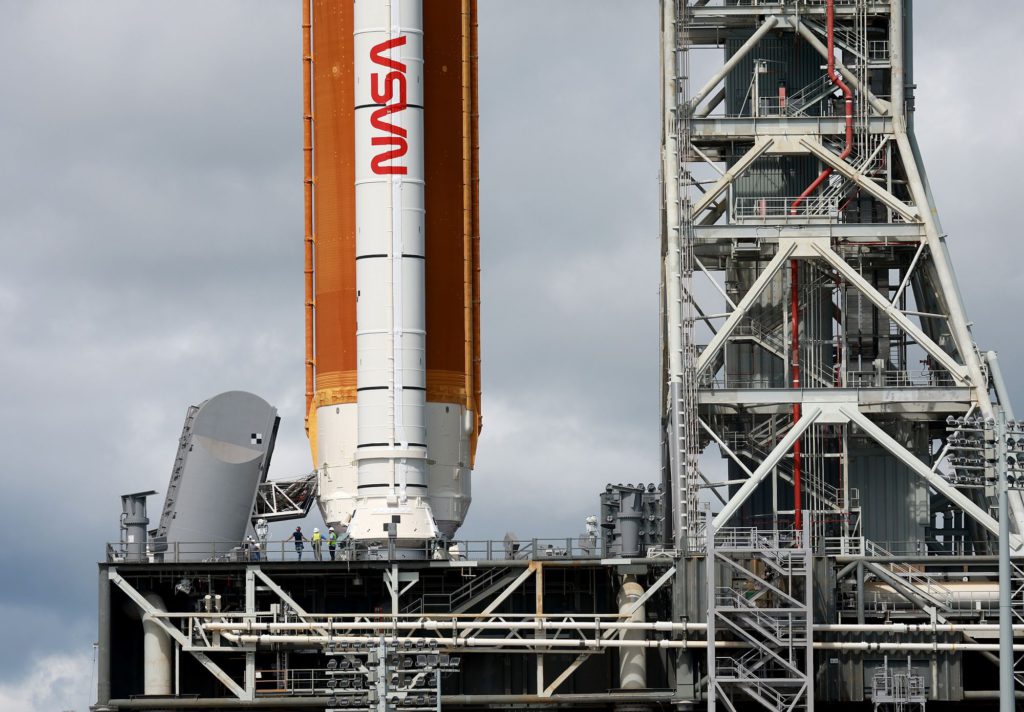
(Bloomberg) — NASA delayed the debut launch of its new massive rocket due to an issue with one of its engines, dealing a temporary blow to the space agency’s plan to return to the lunar surface.

With Vice President Kamala Harris in attendance at Florida’s Kennedy Space Center and a global audience watching online, the uncrewed Artemis I mission was called off at 8:34 a.m., one minute after its originally scheduled liftoff time.

The launch missed its window after controllers were unable to resolve a temperature problem with one of the rocket’s four main engines. The rocket and space capsule are in “a safe and stable configuration,” NASA said Monday in a statement, adding that engineers were continuing to gather data.

The earliest available opportunity to try again is on Sept. 2, NASA said in a webcast while announcing the scrubbed launch. No decision has been made on rescheduling.

Official confirmation of the delay came after the space agency spent the early morning hours investigating issues including a potential crack in material in the main body of the rocket as well as the temperature issue, officials said earlier Monday. Those came after engineers examined and resolved a suspected leak affecting the hydrogen tanking process.

The Artemis mission will be the first major flight in NASA’s ambitious plan to send the first woman and the first person of color to the lunar surface as early as 2025. Artemis I is aimed at testing out the Space Launch System, made by Boeing Co., and a new deep-space crew capsule called Orion that was developed by Lockheed Martin Corp. 

When Artemis I does launch, SLS will be sending Orion on a mission of more than five weeks, along with a host of payloads and sensors to track the journey. The capsule is tasked with inserting itself into lunar orbit and entering deep space before return to Earth in the Pacific Ocean off San Diego. NASA plans to stress test the systems ahead of later crewed missions.

Behind Schedule

The Space Launch System already is more than five years behind schedule. It has been in development for roughly a decade, slowed by a myriad of delays and cost overruns. Development costs of the program have soared from an original $7 billion to about $23 billion, according to an estimate by the Planetary Society.

If successful, the Artemis program — named for the twin sister of the god Apollo in Greek mythology — will see the return of people to the moon for the first time in 50 years. No one has visited since Apollo 17 in December 1972.

Boeing and Lockheed Martin shares each declined less than 1% at 9:36 a.m. in New York.

(Updates with additional details beginning in second paragraph)

More stories like this are available on bloomberg.com

©2022 Bloomberg L.P.
Peloton and Zoom Show More Pain for Covid Trade 

(Bloomberg) — Peloton Interactive Inc. and Zoom Video Communications Inc., perhaps the two stocks most associated with Covid-era gains, now are trading below where they were before the pandemic upended life around the globe.

Both the fitness subscription company and the video-conferencing software firm have slumped throughout 2022, building on losses from 2021 that came as the so-called stay-at-home trade began to unwind. Disappointing quarterly results from both last week underscored the difficulty they’re having in holding on to the robust demand they saw as millions worked — and worked out — from home.

Shares of Peloton are up 1% on Monday, while Zoom is up 0.7%.

Zoom has plunged 86% from its October 2020 peak and is one of the 10 biggest percentage decliners in the Nasdaq 100 Index this year. Peloton has collapsed more than 90% from its record January 2021 record, touching an all-time closing low last month. Bears say there’s no sign that the stocks will recover any time soon, given that analysts are still hacking away at their revenue estimates. 

“Both went crazy during the stay-at-home era because demand went off the charts, and the combination of hype and day traders bidding them up turned them into a bubble,” said Jordan Kahn, chief investment officer of ACM Funds.

The two are hardly the only Covid stocks that have seen sharp reversals from their pandemic-era heydays. Netflix Inc. and DocuSign Inc. are the two biggest Nasdaq 100 losers of the year, declining in the wake of disappointing results. 

In addition to the demand headwinds such companies have seen as customers return to offices and gyms, they are also facing an economic backdrop that has turned against stocks with their financial profiles. 

Aggressive moves by the Federal Reserve to combat inflation have led investors to seek out companies with consistent growth or which pay dividends, and away from companies that aren’t profitable or where fast growth rates are cooling off. Last week, Fed Chair Jerome Powell indicated the US central bank was likely to keep raising interest rates.

In another headwind to the valuation of growth stocks, the yield on the 10-year US Treasury note is above 3%, roughly double where it was at the start of the year.

“So much is predicated on the Fed and inflation, and in general this is an environment that is more focused on value and quality, and less hospitable to former high-flyers,” said Quincy Krosby, chief equity strategist at LPL Financial. “It looks like the market has abandoned the Covid trades, but the ones with good fundamentals should eventually find a bottom.”

Those fundamentals remain in question, especially for Peloton, which on Thursday reported a quarterly loss that widened sharply from the prior year, while it also gave a revenue forecast that was well below the analyst consensus. MKM Partners warned of “existential issues ahead,” and the stock fell 18% after the report, erasing a gain earlier in the week, when it agreed to offer bikes and accessories on Amazon.com Inc.

Zoom last week posted its slowest revenue growth on record and cut its full-year sales view, as it didn’t add as many enterprise customers as had been expected. However, the company is profitable and expected to continue growing, factors that Kahn says separate it from Peloton.

“While it got way ahead of itself, Zoom continues to gain traction and it is something I’ll continue to consider as an investment,” he said in a phone interview. “Peloton, on the other hand, seems like a terminal short. It’s projected to lose money for the foreseeable future, and I just don’t know how you determine a floor for that.”

Tech Chart of the Day

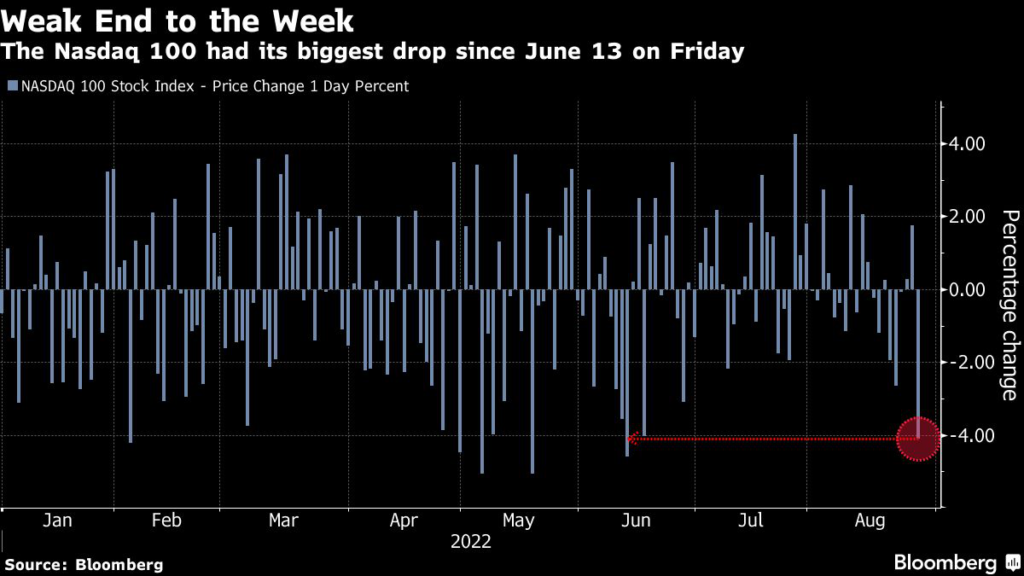
The Nasdaq 100 Index fell 4.1% on Friday, its biggest drop since June 13. The weakness followed comments by Fed Chair Powell, who indicated that the central bank would not soon reverse course in its work to combat inflation. With the drop, the tech-heavy index ended at its lowest since July 27.

Top Tech Stories

  • Jerome Powell’s latest hawkish missive threatens to open up a new front in the ever-raging battle between tech stocks and Treasury yields — potentially hurting money managers who’ve just plunged back into US megacap companies in droves.
  • Trademark filings suggest that Apple Inc. may be staking claim to potential names for its highly anticipated mixed-reality headset, part of the tech giant’s push into its first new product category in years.
  • Meta Platforms Inc. settled a long-running lawsuit that claimed Facebook illegally shared user data with the research firm Cambridge Analytica.
  • The Newport Wafer Fab near Cardiff in Wales has long churned out wafers for microchips used in cars or kettles. Now the UK government is deliberating whether to block a Chinese company from remaining the new owner, exposing the political dilemma between supporting a key industry and keeping Beijing’s influence in check.
  • Reliance Industries Ltd. will invest 2 trillion rupees ($25 billion) to roll out its 5G services in October across the largest Indian cities, its billionaire-chairman Mukesh Ambani said as he expands and diversifies the $221 billion empire.
  • WhatsApp, the popular messaging service owned by Meta Platforms Inc., is rolling out a shopping product in India, the first time users will be able to browse and purchase groceries and other household products without leaving the app.
  • Ericsson will wind down its activities in Russia, after previously saying that operations in the country were indefinitely suspended. The Swedish maker of 5G networks has notified employees in Russia “of redundancies because operations are gradually being scaled back,” the company said in emailed comments.

(Updates to market open.)

More stories like this are available on bloomberg.com

©2022 Bloomberg L.P.

Trademark Filings Suggest Apple May Be Securing ‘Reality’ Names for AR/VR Headset

(Bloomberg) — Trademark filings suggest that Apple Inc. may be staking claim to potential names for its highly anticipated mixed-reality headset, part of the tech giant’s push into its first new product category in years. 

Applications were filed in the US, EU, UK, Canada, Australia, New Zealand, Saudi Arabia, Costa Rica and Uruguay for the names “Reality One,” “Reality Pro” and “Reality Processor.” Though Apple itself didn’t make the filings, they follow a pattern that the iPhone maker has used in the past—including relying on law firms that the company has previously enlisted to lock down brands.

Apple’s headset is expected to combine virtual and augmented reality technology and vault the company into closer competition with Meta Platforms Inc., the leading provider of VR gear. It’s been seven years since the company last went after a new hardware category with the Apple Watch.

A spokeswoman for Cupertino, California-based Apple declined to comment on the filings. The trademark applications haven’t yet been approved, and there’s no guarantee that Apple’s future products will carry any of the names.

Still, there are clues to suggest that Apple is laying the groundwork for its expansion into headsets. Earlier this year, trademark filings linked to Apple also emerged for the realityOS name.

The new trademarks are all registered to a shell corporation named Immersive Health Solutions LLC that was incorporated in February, according to records obtained by Bloomberg News. That company itself was registered by another Delaware shell corporation, the Corporation Trust Co., typically used for filings by firms looking to avoid detection. The RealityOS trademark used that same firm.

In order to file the trademark paperwork, a process that began in Canada with an original application in February and in several other countries in August, the company behind the trademarks relied on several big-name and boutique law firms in each operating nation.

In the US, Canada and New Zealand, the filer enlisted law firms that Apple has used in the past to either register trademarks or for other matters. In New Zealand, for instance, the law firm Simpson Grierson was used for the “Reality” filings. Apple relied on that same firm to file the corporate name Apple Sales New Zealand. 

Apple has long followed this same process to register upcoming product names either months or years before their official debut. The approach allows Apple to secure the names early with less risk of having to buy them later from another trademark holder. The company didn’t take the approach ahead of the iPhone’s debut in 2007 and ultimately needed to reach an agreement with Cisco Systems Inc. for that name.

Apple shares were down about 1.2% in New York on Monday morning.

The company is aiming to release its first mixed-reality headset at the high end of the market in 2023, but the device has faced issues with camera sensors, software and overheating during development. 

If Apple is indeed behind the trademarks, “Reality One” and “Reality Pro” could be theoretical options for the new product. The company also could be registering multiple names in case it wants to release a range of devices in the future.

Apple typically uses the moniker “Pro” for high-end products, including the iPhone 13 Pro, iPad Pro and MacBook Pro. It has also put “One” in previous offerings, such as its Apple One subscription bundles. 

Apple’s first headset—codenamed N301—is expected to be one of the most powerful and expensive models on the market when it launches, and the company is already working on follow-up devices. Inside Apple, the device is sometimes referred to as “Reality,” indicating that the term is at least under consideration for the product.

A subsequent model, dubbed N602 internally, as well as a lightweight pair of augmented-reality glasses known as N421, aren’t expected to launch until later this decade. Apple showed the first headset to its board earlier this year, indicating that the device was nearing release.

The trademark for “Reality Processor” could refer to a specialized chip destined for the headset. The company is planning to use an M2 system-on-a-chip with 16 gigabytes of memory for the device, but it may need additional processing technology to handle high-resolution VR and AR graphics. 

The Reality name would match the planned name for the headset’s software. The device will include its own operating system dubbed “realityOS,” Bloomberg News has reported. The approach would be similar to Apple using the watchOS name for the Apple Watch’s software. Apple already offers RealityKit, a set of frameworks for developers to make AR apps for the iPhone. 

Apple’s headset is expected to include VR-based versions of Apple apps like Maps and FaceTime in addition to collaboration features for multiple users wearing the headsets. It’s also slated to have a focus on consuming media content like sports and movies in VR and gaming. The latest trademarks also imply the device may have health-related functions. 

The initial Apple headset will rival Meta’s upcoming Quest Pro, which that company plans to debut in October with features like eye and body tracking. Alphabet Inc.’s Google, Samsung Electronics Co. and other Apple rivals are also exploring their own VR and AR devices. 

(Updates with shares in 10th paragraph.)

More stories like this are available on bloomberg.com

©2022 Bloomberg L.P.
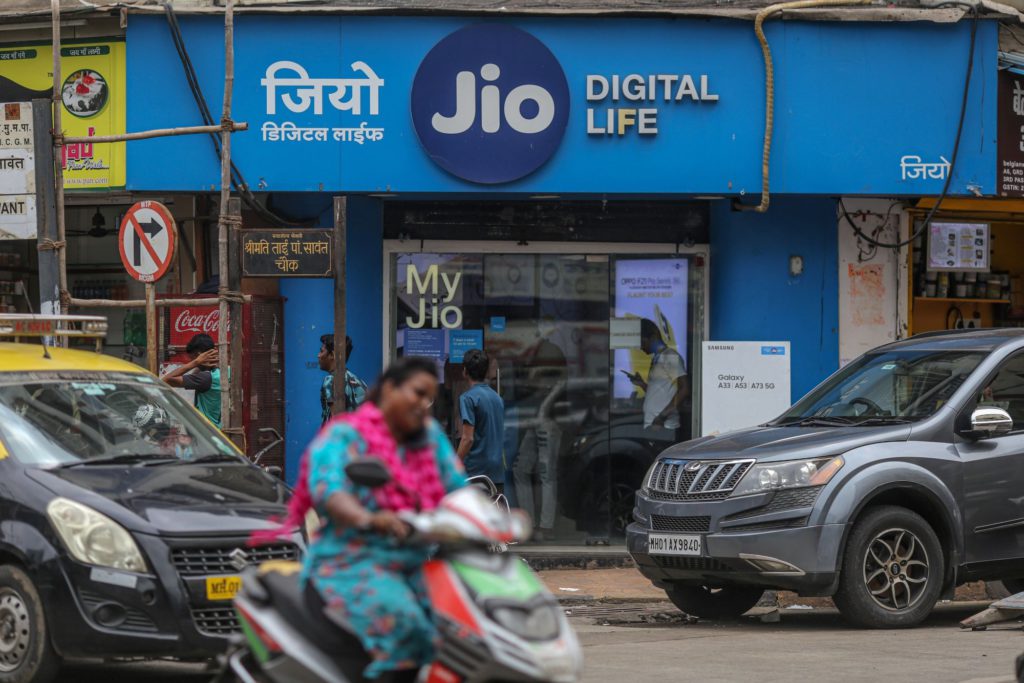
Ambani’s Reliance to Spend $25 Billion on 5G Across India

(Bloomberg) — Reliance Industries Ltd. will invest 2 trillion rupees ($25 billion) to roll out its 5G services across India, its billionaire-chairman Mukesh Ambani said as he continues to expand and diversify his $220 billion empire.

Reliance Jio Infocomm Ltd., the telecom unit of the retail-to-refining conglomerate will deploy a “standalone 5G” version that doesn’t depend on the earlier 4G network and will deliver speedier connectivity, Ambani told investors at an annual shareholder meeting on Monday. 

After its launch during the Hindu festival of Diwali in October, Reliance Jio 5G is expected to provide country-wide services by December 2023, he said, adding that the service has the potential to connect 100 million homes as well as accelerate the adoption of fixed broadband services.  

Ambani’s gambit on 5G comes after he emerged as the biggest buyer in an India spectrum auction earlier this year. Despite the technology yet to prove particularly profitable for other Asian wireless operators, which have invested billions of dollars, the powerful tycoon is hoping he can attract high-end users and bolster Reliance’s e-commerce and media ambitions.

Read more: India Sells $19 Billion of Airwaves With Reliance as Top Buyer

‘Privileged Few’

“Digital freedom is the birth right of every Indian,” Ambani said. “Therefore, 5G cannot remain an exclusive serivce, available only to the privileged few, or only to those in our largest cities — we plan to increase the Jio 5G footprint month after month.”

Reliance’s shares fell 0.8% at the close of trading on Monday, paring this year’s gain to 9.7%. 

Ambani, Asia’s second-richest person, has built Reliance into India’s largest company by market value and has sought to diversify the powerhouse conglomerate beyond its fossil fuel-led businesses and toward technology and renewable energy. Reliance Jio is now India’s largest wireless operators after entering the market in 2016 and instigating a ruthless price war the cut down rival players.

Reliance’s 5G service “will connect everyone, every place and everything with the highest quality and most affordable data,” Ambani said. “It will be world’s largest and most advanced 5G network.” He didn’t share tariff details.

Ambani said the new standalone 5G service will help Reliance Jio deliver “new and powerful services like low latency, massive machine-to-machine communication, 5G voice, edge computing and network slicing, and metaverse.” 

The wireless carrier also forged a collaboration with Qualcomm to develop 5G solutions for India, he said.

Ambani’s once-a-year speech to investors has over time evolved into an eagerly-awaited platform for announcing grand, new initiatives, akin to Warren Buffett’s annual letters to Berkshire Hathaway shareholders.

(Updates with Ambani comments, share price from fifth paragraph.)

More stories like this are available on bloomberg.com

©2022 Bloomberg L.P.
Salesforce, ServiceNow Suffer as Customers Delay Software Deals

(Bloomberg) — US companies aren’t sure if we’re in a recession, but they’re pulling back spending just in case. First it was travel and hiring — now they’re even getting nervous about buying the software considered essential for their businesses. 

Enterprise technology giants are finding that customers aren’t as eager to sign software subscription deals as they were a few months ago. Companies are still buying programs to help with data storage, customer relations and human resources, but they’re delaying those purchases a bit — and the chief financial officer probably needs to take a peek at the contract and sign off first.

“Executive teams are scrutinizing all purchasing decisions and we are seeing some deals take longer to close,” Salesforce Inc. Co-Chief Executive Officer Bret Taylor said on an earnings call last week after the company gave a quarterly revenue forecast that missed estimates and lowered its annual sales guidance. 

Salesforce isn’t alone — that phrasing, or a variant of it, was uttered often in recent weeks, including by executives from Palantir Technologies Inc., Workday Inc., Zoom Video Communications Inc. and many other technology companies.

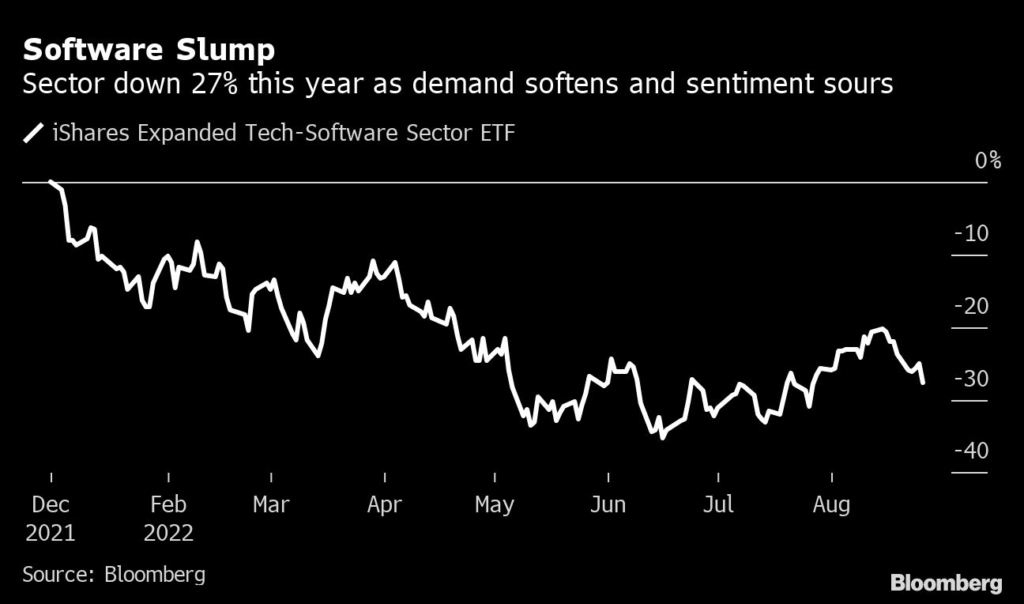
You can see it in the data: Longer sales cycles have been mentioned 52 times on earnings calls or investor days this quarter, the most in at least five years, according to a Bloomberg review of almost 120 companies listed in the S&P North American Expanded Technology Software Index. It’s more than double the previous quarter; the only other period that comes close is the second quarter of 2020 — when Covid-19 was starting to hit the US.

Those executives also talked about a challenging business environment and a softening of demand amid high inflation and fears of a recession. While there isn’t much evidence that customers have cut their software spending, they’re hesitant to add more, which is bad news for software makers that have promised investors consistently high growth. This trepidation amounts to billions in deferred revenue for companies that have already seen valuations drop this year. That same index is down 35% from a November peak, almost three times the drop of the S&P 500.

In addition to Salesforce, Palantir, Zoom and Twilio Inc. were among the software companies that gave revenue forecasts that fell short of analysts’ estimates or cut their outlooks.

ServiceNow Inc., a maker of workflow software, may have been the first to signal the trend. In July, CEO Bill McDermott outlined concerns about the economic environment in a CNBC interview, which drove down shares across the entire sector. A few weeks later, ServiceNow reduced its full-year revenue forecast in part due to a potential pullback in demand.

Now, more software executives sound like McDermott. Splunk Inc. CFO Jason Child said several customers slowed expansions that drove down deferred revenue and average contract length for the maker of data analytics software. Zoom finance chief Kelly Steckelberg said she recognized that “revenue results are disappointing and below our expectations as we navigate the current environment.”

Hardware tech providers aren’t immune from the buying anxiety either. Dell Technologies Inc., which sells computers and other business infrastructure, last week gave a gloomy outlook for the second half of the year, which on Friday triggered the stock’s worst drop since 2018. A slowdown in personal computers was expected, but softening demand for networking capacity and servers came as a surprise, wrote Bloomberg intelligence analyst Woo Jin Ho.

Dell’s warning also dragged down the shares of HP Inc. and Hewlett Packard Enterprise, which are scheduled to report results on Tuesday.

Not every firm has encountered these worries. Data architecture provider Snowflake Inc. had its best day since a red-hot 2020 initial public offering after the company reported it was having no problem picking up new customers. Part of its success may be that clients don’t have to sign contracts at all.

Snowflake charges based on a consumption model — customers pay as they use the products rather than an upfront fee for a certain period of time, which has long been the industry standard. Analysts have viewed Snowflake’s sales technique as a liability, figuring that customers can more quickly dial back spending when sentiment sours. But this quarter the model “flipped from a liability to an advantage,” David Holt, an analyst at CFRA Research, wrote in a note.

CEO Frank Slootman sounded vindicated during the company’s earnings call last week. “We actually think it’s an advantage in the type of times we’re living in, as opposed to a negative, which is what it has been portrayed by the sell side and the media,” he said.

More stories like this are available on bloomberg.com

©2022 Bloomberg L.P.
US Open Lures Companies With $10,000 Courtside Seats and Luxury Perks

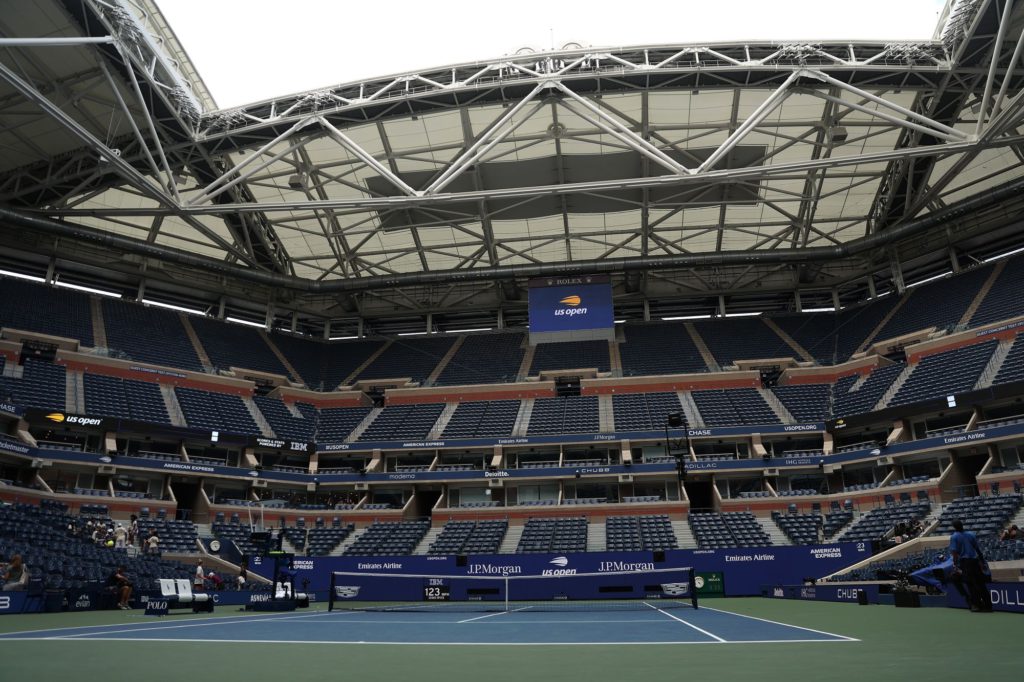
(Bloomberg) — When the US Open tennis tournament begins this week in New York’s Flushing Meadows, expect handshakes both on the court and on the sidelines.

New ticket packages combining courtside seats with exclusive dining or meeting spaces were snapped up by corporate buyers ahead of the event, according to Kirsten Corio, chief commercial officer of the US Tennis Association.

Perhaps most coveted are the two dozen seats — which can each cost more than $10,000, depending on the session — available through the tournament’s “Courtside Premier” program.

The lofty price tag comes with in-seat snacks and beverages, so patrons won’t have to miss a minute of the action to get their own chilled shrimp cocktail, Whispering Angel rose or Grey Goose Honey Deuce. Also included are photos with trophies, dining in the players’ cafe, and a “meet and greet” with former champions including Lindsay Davenport, Andy Roddick, Tracy Austin and Kim Clijsters.

“It’s astonishing how much demand exists for this kind of product — we’ve had to adapt and evolve to capture the demand that’s out there,” Corio said in an interview.

Read more: This US Open Will Cost You More, From Hotels to the Honey Deuce

Luxury spending has been largely resilient in the US despite decades-high inflation and signs of belt-tightening among lower-income consumers. The US Open has long been a favorite outing for Wall Street elites and corporate executives who want to wine and dine current and potential clients.

Courtside Premier was started last year by the USTA and Elevate Sports Ventures, a company backed by Harris Blitzer Sports & Entertainment and Arctos Sports Partners.

Individual suites at Arthur Ashe Stadium sold out in June, so what if a company wants to bring a large group of executives or clients to talk shop before taking in the action? Corio says this year, they’re offering 32 front-row seats for each session that come with dining access in the 1968 Room or bespoke pre-match private meeting space. Cryptocurrency and luxury-goods companies are among the firms that have bought these seats, Corio said, declining to provide specifics.

The USTA expects more than $50 million in revenue this year from courtside seats, suites that aren’t already pledged to sponsors and certain mezzanine, or loge, seats.

“We’re pleasantly surprised by how high that number has risen and the bar has been raised in terms of what we feel is possible,” Corio said.

To be sure, the US Open isn’t only enjoyed by those with big corporate spending budgets. The USTA, which uses demand-based dynamic pricing for individual tickets, says initial 2022 prices were in-line with prior years. For instance, upper-level tickets within Arthur Ashe started at $35 when they went on sale in June.

More stories like this are available on bloomberg.com

©2022 Bloomberg L.P.

Ambani Outlines Reliance Heirs’ Roles at $220 Billion Empire

(Bloomberg) — Billionaire Mukesh Ambani outlined the businesses each of his three children will oversee during Reliance Industries Ltd.’s annual shareholder meeting, laying down for the first time a clear succession path at the $220 billion Indian conglomerate that became mired in a bitter fraternal feud almost twenty years ago.

“Reliance’s next-gen leaders are confidently taking over the reins across businesses,” Ambani, 65, said on Monday, referring to his son Akash, daughter Isha and youngest son, Anant. “Akash and Isha have assumed leadership roles in Jio and Retail respectively. They have been passionately involved in our consumer businesses since inception. Anant has also joined our New Energy business with great zeal.”

While Akash took over as the chairman of wireless operator Reliance Jio Infocomm Ltd. in June — the first concrete sign of the leadership transition at the retail-to-refining conglomerate — roles for his two other children were still not publicly announced. With Ambani giving a clean steer on Isha helming of the the group’s retail ventures and Anant leading the front on the renewable energy, Asia’s second-richest person is seeking to avoid a repeat of the succession battle he was plunged into. 

His father and Reliance founder, Dhirubhai Ambani, died without a will in 2002, triggering an ugly and very public power struggle between Mukesh and his younger brother, Anil, who were both involved in the business at that time. This tussle eventually snowballed and three years after Dhirubhai’s death, their mother was forced to intervene and divvy up the businesses between the two brothers as part of a truce pact.

Ambani, with a net worth of almost $93 billion, built Reliance into India’s largest company by market value and has been diversifying the corporate behemoth beyond its fossil fuel-led origins toward technology and renewable energy. With Reliance far more exposed to global headwinds — thanks to marquee investors who pumped in $27 billion in 2020 — Ambani will be keen to avoid any leadership friction.

His twins, Akash and Isha, have played pivotal roles in the company’s shift toward retail and technology, including talks with Meta Platforms Inc., that secured a $5.7 billion investment in Reliance’s Jio Platforms Ltd., the vessel for Ambani’s e-commerce ambitions.

‘Being Mentored’

The three heirs are “part of a young team of leaders and professionals who are already doing amazing things at Reliance,” he said. “Of course, all of them are being mentored on a daily basis by our senior leaders, including myself and the board of directors.”

Ambani on Monday reassured investors that he’ll continue to provide “hands-on leadership” at Reliance as it navigates a world potentially primed for a global recession. 

“The succession plan addresses the market’s concern on business sustainability during leadership transition,” said Horace Chan, senior analyst at Bloomberg Intelligence. 

But Ambani’s speech “lacks thorough discussion over a long-term restructuring plan for the group, including spin-offs of each business arms,” he said referring to investor expectations around Reliance Jio and Reliance Retail Ltd.’s initial public offerings.

Succession, Spinoffs in Focus in Billionaire Ambani’s Big Speech

Here are some of the big announcements that were part of Ambani’s speech:

Telecom

  • Plan to invest 2 trillion rupees ($25 billion) to roll out its 5G services in October across the largest Indian cities, service to go nationwide in December, 2023
  • Deploy “standalone 5G” version which doesn’t depend on the earlier 4G network
  • Reliance Jio partners include Meta, Google, Intel, Microsoft; will partner Qualcomm
  • Reliance is also working with Google to develop ultra-affordable 5G smartphones for India
  • Jio platform building capability on digital ecosystem

Retail

  • Plans to launch consumer goods business
  • Launched an in-app shopping product with WhatsApp in which users can shop on JioMart from their WhatsApp chat

Energy

  • Plans to transition to green hydrogen from grey hydrogen by 2025
  • Launch new giga factory for “Power Electronics”
  • Aims to set up 20 gigawatts of solar generation capacity
  • Reliance will invest 750 billion rupees in its oil-to-chemical business in next five years
  • Plans to build largest single-train purified terephthalic acid plant of 3 million tones annual capacity and a one-million tons per annum polyethylene terephthalate plant in Gujarat


(Updates with other announcements at the shareholder meeting.)

More stories like this are available on bloomberg.com

©2022 Bloomberg L.P.
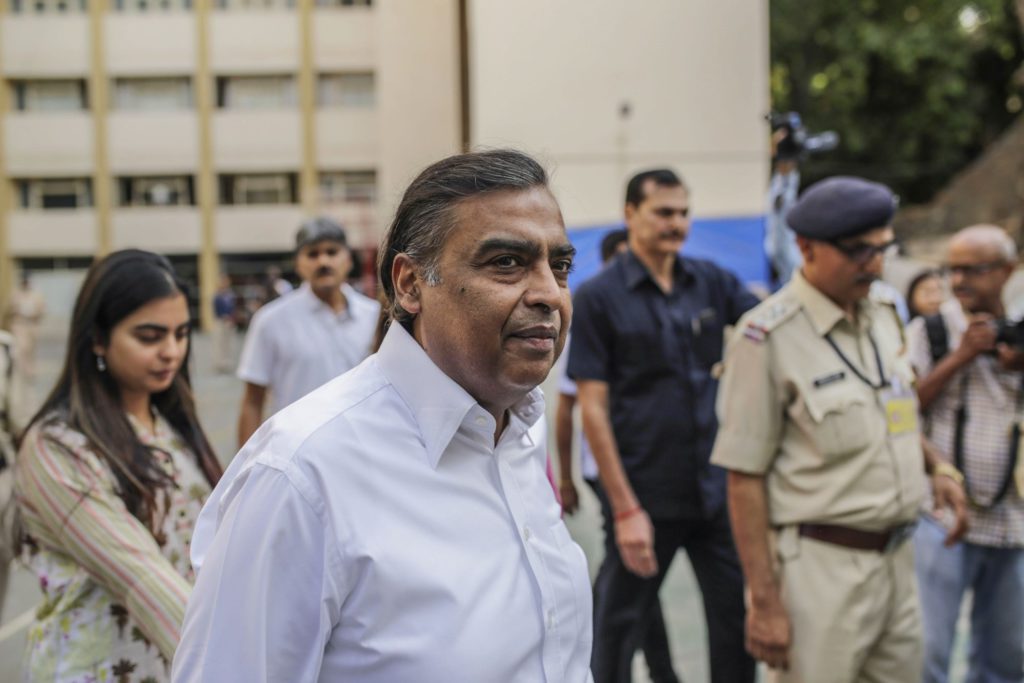
Ambani Outlines Heirs’ Roles in Future of $220 Billion Empire

(Bloomberg) — Billionaire Mukesh Ambani outlined the businesses each of his three children will oversee during Reliance Industries Ltd.’s annual shareholder meeting, laying down for the first time a clear succession path at the $220 billion Indian conglomerate that was mired in a bitter fraternal feud almost 20 years ago.

“Reliance’s next-gen leaders are confidently taking over the reins across businesses,” Ambani, 65, said on Monday, referring to his son Akash, daughter Isha and youngest son, Anant. “Akash and Isha have assumed leadership roles in Jio and Retail respectively. They have been passionately involved in our consumer businesses since inception. Anant has also joined our New Energy business with great zeal.”

While eldest son Akash took over as the chairman of wireless operator Reliance Jio Infocomm Ltd. in June — the first concrete sign of the leadership transition under way at the retail-to-refining conglomerate — roles for his two other children were still not publicly announced. With Ambani giving a clean steer that Isha will helm the the group’s retail ventures and Anant taking on the renewable energy flank, Asia’s second-richest person is seeking to avoid a repeat of the succession woes he faced. 

His father and Reliance founder, Dhirubhai Ambani, died without a will in 2002, triggering an ugly and very public power struggle between Mukesh and his younger brother, Anil, who were both involved in the business at that time. The tussle eventually snowballed and three years after Dhirubhai’s death, their mother was forced to intervene and divvy up the businesses between the two brothers as part of a truce pact.

Ambani, with a net worth of almost $93 billion, built Reliance into India’s largest company by market value and has been diversifying the corporate behemoth beyond its fossil fuel-led origins more toward technology and renewable energy. With Reliance now exposed to global headwinds — thanks to marquee investors who pumped in $27 billion throughout 2020 — Ambani will be keen to avoid any friction at the top.

The twins, Akash and Isha, have played pivotal roles in the company’s shift toward retail and technology, including talks with Facebook parent Meta Platforms Inc. to secure a $5.7 billion investment in Reliance’s Jio Platforms Ltd., the vessel for Ambani’s e-commerce ambitions.

‘Being Mentored’

The three heirs are “part of a young team of leaders and professionals who are already doing amazing things at Reliance,” Ambani said at Monday’s AGM. “Of course, all of them are being mentored on a daily basis by our senior leaders, including myself and the board of directors.”

Ambani also reassured investors that he’ll continue to provide “hands-on leadership” at Reliance as it navigates a world potentially primed for a global recession. 

“The succession plan addresses the market’s concern on business sustainability during leadership transition,” said Horace Chan, senior analyst at Bloomberg Intelligence. 

But Ambani’s speech, a must watch on India’s corporate calendar, lacked “thorough discussion over a long-term restructuring plan for the group, including spinoffs of each business arms,” Chan said, referring to investor expectations around initial public offerings for Reliance Jio and Reliance Retail Ltd.

Here are some of the other big announcements that were part of Ambani’s AGM address:

Telecommunications

  • Plan to invest 2 trillion rupees ($25 billion) to roll out its 5G services in October across the largest Indian cities; service to go nationwide in December, 2023
  • Deploy “standalone 5G” version which doesn’t depend on the earlier 4G network
  • Reliance Jio partners include Meta, Google, Intel, Microsoft; will partner with Qualcomm too
  • Reliance is also working with Google to develop ultra-affordable 5G smartphones for India
  • Jio platform building capability on digital ecosystem

Retail

  • Plans to launch consumer goods business
  • Launched an in-app shopping product with WhatsApp in which users can shop on JioMart from their WhatsApp chat

Energy

  • Plans to transition to green hydrogen from grey hydrogen by 2025
  • Launch new giga factory for “Power Electronics”
  • Aims to set up 20 gigawatts of solar generation capacity
  • Reliance will invest 750 billion rupees in its oil-to-chemical business in next five years
  • Plans to build largest single-train purified terephthalic acid plant of 3 million tones annual capacity and a one-million tons per annum polyethylene terephthalate plant in Gujarat

(Updates with other announcements at the shareholder meeting.)

More stories like this are available on bloomberg.com

©2022 Bloomberg L.P.

Close Bitnami banner
Bitnami
