
Bloomberg

Retail Traders Lose $350 Billion in Brutal Year for Taking Risks

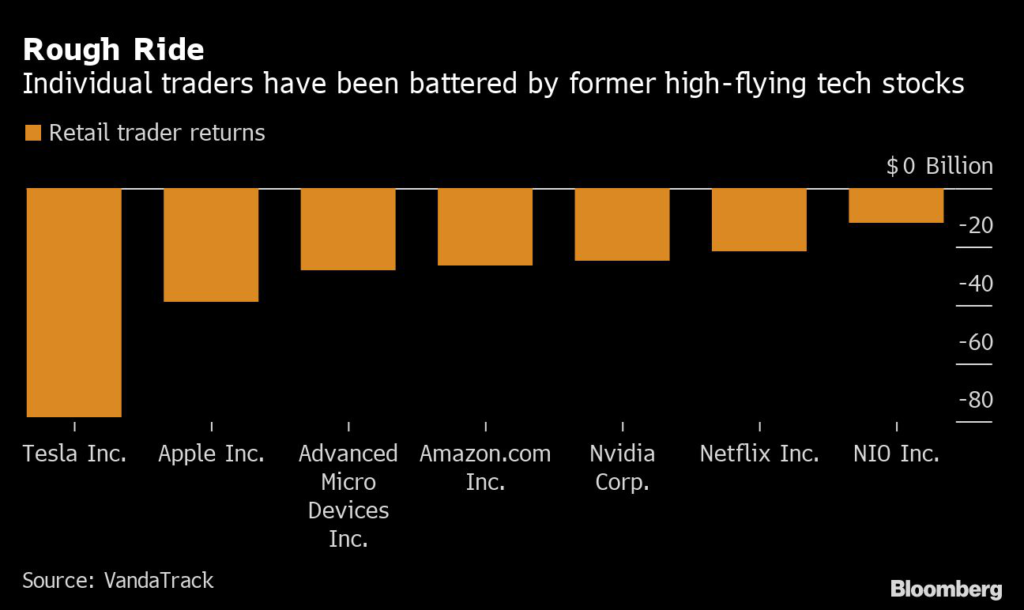
(Bloomberg) — Investment portfolios belonging to retail traders suffered a $350 billion blow this year as big bets on risky stocks and former high-fliers like Tesla Inc. backfired for the mom-and-pop set.

The average active amateur investor’s portfolio is down about 30% in 2022, according to data compiled by Vanda Research, which studies self-directed retail traders globally. By contrast, the S&P 500 Index has lost 17%. 

Of course, this group isn’t about the boring S&P 500. It tends to be concentrated in high-profile stocks like Elon Musk’s electric-vehicle company, which wiped out about $78 billion for retail traders alone as its shares plunged, according to Vanda.

Individual investors have had an outsize influence on the market since the start of pandemic lockdowns, when cooped-up 20- and 30-somethings flocked to no-cost trading to relieve boredom and make an easy buck buying almost any stock during a bull-market boom. Now, as equities head toward their worst year since the 2008 financial crisis, retail traders have suffered even sharper drops and their share of US equity market volume has slipped since the start of 2021. 

“The losses this year were unprecedented, especially for the younger generation of investors,” said Giacomo Pierantoni, the head of data at Vanda in Singapore. Whether they keep plowing money into the market — buying the dip, as they say — or lose faith in investing and give up altogether could help determine their ability to retire in the coming decades.

Another sharp selloff for Tesla, which accounts for about 10% of the average self-directed global retail trader’s portfolio, or Apple Inc. could determine sentiment, according to Pierantoni. 

Retail-trader portfolios have also seen big losses from chipmakers Advanced Micro Devices Inc. and Nvidia Corp., each of which are down more than 40% this year. Those who concentrated investments in index-tracking exchange-traded funds like the SPDR S&P 500 ETF Trust and the tech-heavy Invesco QQQ Trust Series 1, which follows the Nasdaq 100 Index, suffered too as major averages head to their worst years in more than a decade.

That said, there are signs that some retail investors took fairly defensive positions that paid off this year. Their portfolios were overweight energy companies like Chevron Corp. and Enphase Energy Inc. and drugmakers including AbbVie Inc., which broadly outperformed the broader markets.

“Investors have learned to be a little more nimble in this environment,” said Callie Cox, an investment analyst at eToro Group Ltd. “When everything isn’t going up, you need to be more strategic.” 

Of course, that 30% average drop estimated by Vanda speaks to how difficult it actually is to be nimble in a collapsing market. JPMorgan Chase & Co. is even more pessimistic about the performance of retail traders, estimating they suffered losses of 38% this year.

For individuals who also dabbled in the cryptocurrency market or digital assets like non-fungible tokens, the losses are likely even uglier. Bitcoin is down 64% this year, while the Bloomberg Galaxy Crypto Index, a basket of different tokens, has erased two-thirds of its value.

Meme Madness

One of the strangest phenomenons to emerge from the retail trader frenzy during the most severe pandemic lockdowns were so-called meme stocks that became popular on internet chat boards. A group of 37 meme stocks tracked by Bloomberg has tumbled 38% this year.


Of those stocks, 11 have crashed more than 70%, with companies like Newegg Commerce Inc. and Bed Bath & Beyond Inc. seeing some of the worst drops, data compiled by Bloomberg show. GameStop Corp., which helped spark the meme movement, has erased one-third of its value in 2022, while AMC Entertainment Holdings Inc., another meme poster-child, is down 64%.

“Going forward, investors will take this year as a lesson learned and will become more sophisticated,” Cox said. “Retail traders will probably stick in this longer than people expected because the traders that have been hit really, really hard this year are younger investors with higher risk tolerance.”

–With assistance from Denitsa Tsekova.

More stories like this are available on bloomberg.com

©2022 Bloomberg L.P.
Crypto’s Amber to End Chelsea Sponsorship, Axe Over 40% of Jobs in FTX Fallout

(Bloomberg) — Amber Group, one of Asia’s leading crypto trading and lending platforms, is cutting jobs, scrapping retail operations and terminating a sponsorship deal with Chelsea FC in the latest retrenchment to hit the digital-asset sector. 

The decisions are part of a major cost-cutting strategy, according to a person familiar with the matter, who asked not to be identified discussing private information. The Singapore-based crypto firm, whose backers include Temasek Holdings Pte and Sequoia China, will slash its workforce to less than 400 from about 700 currently, the person said, adding staff numbers earlier peaked at some 1,100.

The moves by Amber are just the latest indication of the diminished outlook for virtual assets following the spectacular bankruptcy of Sam Bankman-Fried’s FTX exchange and sister trading house Alameda Research a month ago.

Amber will now focus on large institutions, family offices and wealthy individuals, the person said, adding customer numbers will fall to about 100 from the hundreds-of-thousands because of the exit from the retail sector.

The company in recent days has rebutted online speculation that it may be the next domino to fall after a series of blowups in the crypto sector, which is reeling from a $2 trillion rout. A top executive tweeted Wednesday that the firm is conducting “business as usual.” 

Offices, Chelsea

Amber plans to move to a cheaper office space in Hong Kong, while some smaller offices in other regions will likely be shuttered, with remaining employees allowed to work from home, the person said.

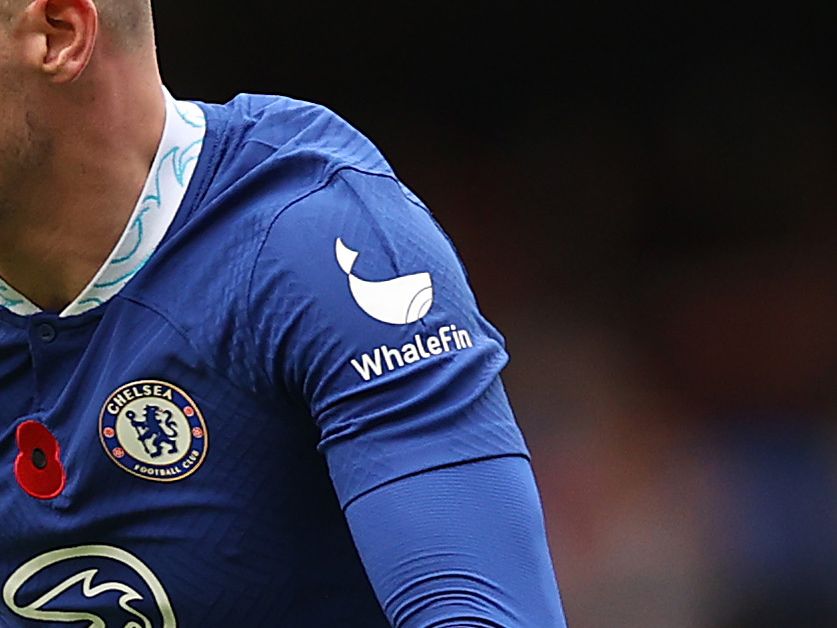
Chelsea FC and Amber announced a partnership in May that included displaying the logo for Amber’s WhaleFin trading platform on the sleeves of the team’s jersey during the 2022-2023 season. 

The sponsorship deal was reported to be worth £20 million ($25 million) a year. The person familiar said Amber was going through the legal process for ending the agreement.

Crypto firms have rushed to sponsor European football clubs in recent years, but some of these partnerships have backfired. FC Internazionale Milano SpA, one of Italy’ most prestigious football teams, hasn’t received two sponsorship payments from blockchain firm DigitalBits, prompting S&P to announce a review of its credit rating on Thursday.

Amber was launched in 2018 by a group of founders that included former Morgan Stanley traders and raised $200 million at a $3 billion valuation in February. Bloomberg News reported earlier this week that Amber had put a $100 million fundraising on hold.  

One of the company’s co-founders, Tiantian Kullander, passed away unexpectedly in his sleep in November at the age of 30.

For crypto market prices: CRYP; for top crypto news: TOP CRYPTO.

(Updates with Milan’s DigitalBits deal in ninth paragraph.)

More stories like this are available on bloomberg.com

©2022 Bloomberg L.P.
US Futures Climb, Yields Steady as Dollar Slips: Markets Wrap

(Bloomberg) — US equity futures rose Friday before a report on US producer prices that will be one of the final sets of data to inform a rate decision by the Federal Reserve next week. 

Contracts on the S&P 500 added 0.4% after the underlying benchmark notched its first advance this month. A European equity benchmark swung to a gain, paring its weekly loss to 1.2%. Asian equities headed for their sixth weekly gain, the longest such stretch in two years.

Treasury yields were little changed, with the 10-year rate just below 3.5%. A gauge of the dollar erased slipped.

Investors are taking heart from any signs of softness in prices that may allow policymakers around the world to be less hawkish and more supportive of growth. 

At the same time, Fed officials are leery of fanning stock rallies that ease financial conditions too much and thwart their inflation-fighting mission. Strategists have lined up to warn investors against piling back into risk on hopes the Fed is getting close to pivoting to easier policy.

“Central banks will rather be on the safe side when it comes to future inflation after having underestimated inflationary pressures last year,” Karsten Junius, chief economist at Bank J. Safra Sarasin Ltd., wrote in a note to clients, adding that a pause in rate hikes is some way off.

Friday’s US producer price index for November will offer a progress report on how effective the Fed’s campaign to quell inflation has been, with consumer-price data due next week. The PPI in October cooled more than expected. And there are some signs the labor market has tempered, with continuing jobless claims climbing to the highest since early February.

“Traders will be closely watching today’s PPI data, with S&P 500 options markets pricing the largest potential move around any PPI release this year,” said Hugo Bernaldo, senior cross-asset trader at Optiver. “Investors will also be looking for clues in today’s data of how Tuesday’s more important CPI figures will come in.”

Elsewhere in markets, oil rose Friday while heading for a weekly drop of around 10% after a volatile session on Thursday on concerns over economic outlook. Gold advanced for a fourth day.

Key events this week:

  • Wholesale inventories, University of Michigan consumer sentiment, Friday

Some of the main moves in markets:

Stocks

  • Futures on the S&P 500 rose 0.4% as of 7:26 a.m. New York time
  • Futures on the Nasdaq 100 rose 0.5%
  • Futures on the Dow Jones Industrial Average rose 0.2%
  • The Stoxx Europe 600 rose 0.4%
  • The MSCI World index rose 0.3%

Currencies

  • The Bloomberg Dollar Spot Index fell 0.1%
  • The euro was little changed at $1.0559
  • The British pound rose 0.3% to $1.2274
  • The Japanese yen rose 0.6% to 135.86 per dollar

Cryptocurrencies

  • Bitcoin rose 0.4% to $17,245.72
  • Ether rose 0.9% to $1,289.2

Bonds

  • The yield on 10-year Treasuries was little changed at 3.48%
  • Germany’s 10-year yield advanced six basis points to 1.88%
  • Britain’s 10-year yield advanced three basis points to 3.12%

Commodities

  • West Texas Intermediate crude rose 0.9% to $72.09 a barrel
  • Gold futures rose 0.6% to $1,812.10 an ounce

This story was produced with the assistance of Bloomberg Automation.


–With assistance from Rob Verdonck.

More stories like this are available on bloomberg.com

©2022 Bloomberg L.P.

Bankman-Fried Misses Deadline to Respond to Key Senate Committee

(Bloomberg) — Sam Bankman-Fried missed the deadline set by a US Senate committee for a response to a request to testify at a Dec. 14 hearing about cryptocurrency exchange FTX’s collapse into bankruptcy.

Bankman-Fried’s counsel didn’t reply in the stated time-frame, the Senate Committee on Banking, Housing, and Urban Affairs said in a statement.

“We believe it’s important that Bankman-Fried show he is willing to provide transparency and accountability to the American people by providing testimony,” committee Chairman Sherrod Brown and Ranking Member Pat Toomey said in the statement. “We will continue to work on having him appear before Congress as detailed in Wednesday’s letter.”

In that letter Senator Brown wrote that he and Senator Toomey are prepared to issue a subpoena if Bankman-Fried doesn’t choose to appear voluntarily. The disgraced former crypto mogul faces a slew of investigations and class-action lawsuits aimed at him or the companies in his defunct empire. 

Bankman-Fried, who hasn’t been charged with any crimes, has denied trying to perpetrate a fraud while admitting to grievous managerial errors at FTX. Bankman-Fried and his spokesman Mark Botnick didn’t return requests for comment on the latest statement from the Senate banking panel.

In a series of messages sent over Twitter on Friday, Bankman-Fried said he’s “willing to testify’ on Dec. 13, though he would be limited in what he would be able to say because of limited access to “much of my data.”   

Botnick on Tuesday confirmed that Bankman-Fried had retained New York defense attorney Mark Cohen to represent him. Cohen was previously part of the team that represented convicted sex trafficker Ghislaine Maxwell and successfully defended analyst Peter Black against a Securities and Exchange Commission suit in a 2014 trial.

Bankman-Fried has also been asked to testify before the House Financial Services Committee, with Chairwoman Maxine Waters saying Wednesday that it’s “imperative” that he attend a Dec. 13 hearing.

FTX’s new Chief Executive Officer John J. Ray III, the restructuring expert who took over the firm in bankruptcy, will testify at the House panel. He’s painted a picture of FTX as a mismanaged, largely out-of-control company bathed in conflicts and lacking basic accounting practices, calling it the worst failure of corporate controls he’d ever seen.

FTX imploded with an $8 billion hole in its balance sheet and there are many questions about whether it mishandled customer funds. It owes its 50 biggest unsecured creditors a total of $3.1 billion and there may be more than a million creditors globally.

For crypto market prices: CRYP; for top crypto news: TOP CRYPTO.

–With assistance from Victoria Batchelor, Olga Kharif and Allyson Versprille.

(Adds comment made by Bankman-Fried over Twitter in the sixth paragraph.)

More stories like this are available on bloomberg.com

©2022 Bloomberg L.P.

Twitter Badgered by Judge Over How It’s Treating Fired Workers

(Bloomberg) — A federal judge challenged Twitter Inc. over its refusal to tell the employees terminated in Elon Musk’s mass layoffs that there’s a class-action lawsuit on their behalf against the company. 

Twitter wants the workers to sign away their legal rights as part of a severance pay agreement — without mentioning the existence of the suit filed on the eve of hundreds of layoffs in early November just after Musk took over as boss. 

“Why not just do it, why is Twitter so reluctant to do this?” US District Judge James Donato asked during a hearing Thursday in San Francisco federal court. “There’s nothing to fear.”

The lawsuit, filed by a handful of workers, alleges the company failed to give employees the required 60 to 90 days notice about the mass layoffs and is shortchanging them on severance pay. Twitter faces separate claims that it retaliated against an employee who tried to organize a strike and that its layoffs disproportionately targeted female workers.

Donato questioned Twitter’s resistance to including in the severance agreements what he said should be a simple, single-page notice that “there is a lawsuit, period.”

After Musk bought the social media company for $44 billion, he fired half its workforce, asked some essential employees to return, rolled back its expansive work-from-home policy, and called on workers to sign a pledge to remain “extremely hardcore” at Twitter or quit. 

Read More: Twitter Faces More Legal Fallout Over Worker Firings Under Musk

The most recent version of Twitter’s severance agreements include one month of base pay and a waiver it asks former workers to sign agreeing not to join lawsuits against the company, the company’s lawyer, Eric Meckley, told the judge. Twitter argues its former employees are bound by contractual agreements requiring them to resolve any disputes with the company in closed-door arbitration rather than in open court.

“It’s misleading to give people notice of a class-action that they can’t participate in,” Meckley told Donato.

Shannon Liss-Riordan, an employment lawyer who previously tangled with Musk over layoffs at Tesla Inc., his electric-car company, has filed four suits so far stemming from the billionaire’s takeover of Twitter. The case before Donato, she says, seeks to hold Twitter accountable for the severance agreements employees were promised before Musk’s acquisition.

Based on Twitter’s policies prior to the take-over, Liss-Riordan argues, former workers are entitled to at least two months’ base pay, and maybe more depending on the number of years they worked there.

Under the previous agreement they’re also supposed to get three months of equity vesting, health-care contributions, and bonuses, she said. “That could be a lot of money that people are being deprived of, that they thought they were going to get,” she said in an interview, referring to the equity. 

She has asked Donato for an order requiring Twitter to add a notice of her lawsuit to its severance package. The judge agreed to allow Liss-Riordan to add former employees to her suit who opted out of arbitration agreements.

“People shouldn’t unwittingly be signing away their rights when they‘ve got cases that could adjudicate important claims for them — that could entitle them to much more pay than what Twitter says,” she said.

Musk is “doing this calculation of saying, ‘Oh, this will save us a lot of money and I think I can just get away with it,’” Liss-Riordan said, referring to the curtailed severance packages. “We’re here to say, no we’re going to hold him accountable.”

Donato on Thursday extended an order temporarily barring Twitter from issuing severance packages until he rules on Liss-Riordan’s request next week. The judge said if the company agreed to add notice about the lawsuit, that might make its waivers and severance packages more legally enforceable.

“You just believe in arbitration so strongly that you can’t stomach the idea of telling people there’s a lawsuit?” he said.

More stories like this are available on bloomberg.com

©2022 Bloomberg L.P.
World’s Top Money Managers See Double-Digit Stock Gains in 2023

(Bloomberg) — Some of the world’s biggest investors predict that stocks will see low double-digit gains next year, which would bring relief after global equities suffered their worst loss since 2008.

Amid recent optimism that inflation has peaked — and that the Federal Reserve could soon start to change its tone— 71% of respondents in a Bloomberg News survey expect equities to rise, versus 19% forecasting declines. For those seeing gains, the average response was a 10% return.

The informal survey of 134 fund managers incorporates the views of major investors including BlackRock Inc., Goldman Sachs Asset Management and Amundi SA. It provides an insight into the big themes and hurdles they expect to be grappling with in 2023 after inflation, the war in Ukraine and hawkish central banks battered equity returns this year.

The stock market could be derailed again by stubbornly high inflation or a deep recession, however. Those are the top worries for the upcoming year, cited by 48% and 45% of participants, respectively. Stocks could also reach new lows early in 2023, with many seeing gains skewed to the second half.

“Even though we might face a recession and falling profits, we have already discounted part of it in 2022,” said Pia Haak, chief investment officer at Swedbank Robur, Sweden’s biggest fund manager. “We will have better visibility coming into 2023 and this will hopefully help markets.”

Even after a recent rally, the MSCI All-Country World Index is on track for its worst year since the global financial crisis in 2008. The S&P 500 will probably end 2022 with a similarly poor performance.

The energy crisis in Europe and signs of slower economic growth have kept a lid on stock prices even as China begins to ease some of its tough Covid curbs. Plus, there are growing fears that the slowdown already underway in many economies will eventually take a bite out of earnings.

The Bloomberg survey was conducted by reporters who reached out to fund managers and strategists at major investment firms between Nov. 29 and Dec. 7. Last year, a similar survey predicted that aggressive policy tightening by central banks would be the biggest threat to stocks in 2022.

Tech Comes Back

Hideyuki Ishiguro, senior strategist at Nomura Asset Management, expects 2023 to be the “exact opposite of this year.” Part of that is due to valuations, which have slumped to leave the MSCI ACWI trading near its long-term average forward 12-month price-to-earnings ratio.

When it comes to specific sectors, respondents generally favored companies that can defend earnings through an economic downturn. Dividend payers and insurance, health care and low volatility stocks were among their picks, while some preferred banks and emerging markets including India, Indonesia and Vietnam.

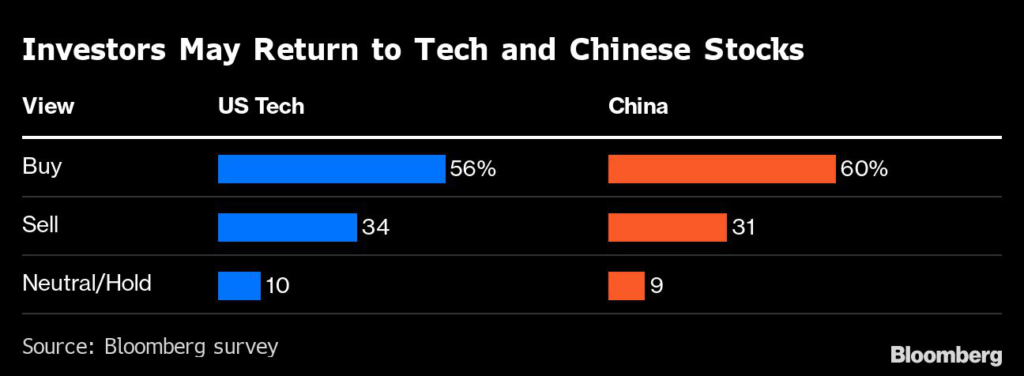
After being hammered this year as interest rates climbed, US technology stocks may also come back in favor, according to the survey. More than half of respondents said they’d selectively buy the sector.

With valuations still relatively cheap despite the recent rally and bond yields expected to fall next year, tech behemoths including Apple Inc., Amazon.com Inc. and Google parent Alphabet Inc. are expected to benefit, fund managers said.

Some are bullish on China, particularly as it moves away from Covid zero. A slump earlier this year has put valuations well below their 20-year average, making them more attractive compared with US or European peers.

Evgenia Molotova, senior investment manager at Pictet Asset Management, said she would be a selective buyer of Chinese shares “at current levels,” preferring industrials, insurance and health care in China.

In the Bloomberg survey, the 10% gain predicted for stocks in 2023 would fall short of previous market rebounds, such as in 2009 and 2019.

For fund managers, better news on inflation and growth could be the catalysts for a stronger performance. Almost 70% of respondents said they were the main potential positive factors. They also cited a full China reopening and a ceasefire in Ukraine as upside triggers.

The emphasis on inflation and growth as the make-or-break elements is in line with the findings of Bank of America Corp.’s latest fund manager survey. It showed recession expectations were at the highest since April 2020, while a “stagflation” scenario of low growth and high inflation was “overwhelmingly” the consensus view.

Such worries look warranted. According to Bloomberg Economics, the global economy is heading for its weakest performance in years, excluding the financial crisis and Covid periods. The IMF said last month the situation is rapidly worsening.

“The outlook from here onward will be influenced by the probability, depth and longevity of recession,” said Fabiana Fedeli, chief investment officer for equities, multi-asset and sustainability at M&G. “There are still pockets of opportunity where companies with strong fundamentals that are able to weather the storm get sold off in times of market panic.”

Heading into year-end, the market direction hinges on two key events coming next week – US inflation data on Tuesday and the Fed policy decision a day later. Some good news has emerged here: price increases have started to cool after hitting a four-decade high and the central bank has signaled it may slow the pace of rate hikes.

Despite those signs, investors remain cautious, and the S&P 500 is on course to snap a two-week winning streak ahead of the Fed meeting.

“A sustained rally in risk assets isn’t likely until inflation is more firmly downward trending toward target,” said Shoqat Bunglawala, head of multi-asset solutions for EMEA and Asia Pacific at Goldman Sachs Asset Management. He’s maintaining a relatively defensive asset allocation in balanced portfolios.

Ben Powell, chief investment strategist for APAC at the BlackRock Investment Institute, takes a similar tone, saying stocks aren’t yet reflecting the full impact of tighter monetary policy.

“We’ve had the lightning of policy tightening in 2022 and now the thunder will follow — that is to say, the damage,” he said. “Maybe we’re seeing some signs of the slowdown in exports and housing, but that’s going to become clearer next year and the market needs to price that a bit more effectively.”

–With assistance from Sagarika Jaisinghani, Jeanny Yu, Allegra Catelli, Joe Easton, Jonas Ekblom, Janet Freund, Nikolaj Gammeltoft, Ellie Harmsworth, Winnie Hsu, Sarah Jacob, Youkyung Lee, Katrina Lewis, Bailey Lipschultz, Macarena Munoz Montijano, Alexandra Muller, Lisa Pham, Julien Ponthus, Chiara Remondini, Henry Ren, Ryan Vlastelica, Aya Wagatsuma, Jeran Wittenstein and Charlotte Yang.

(Updates with weekly move for S&P 500 in 21st paragraph)

More stories like this are available on bloomberg.com

©2022 Bloomberg L.P.
Top Money Managers See Global Stocks Gaining in 2023

(Bloomberg) — Some of the world’s biggest investors predict that stocks will see low double-digit gains next year, which would bring relief after global equities suffered their worst loss since 2008.

Amid recent optimism that inflation has peaked — and that the Federal Reserve could soon start to change its tone— 71% of respondents in a Bloomberg News survey expect equities to rise, versus 19% forecasting declines. For those seeing gains, the average response was a 10% return.

The informal survey of 134 fund managers incorporates the views of major investors including BlackRock Inc., Goldman Sachs Asset Management and Amundi SA. It provides an insight into the big themes and hurdles they expect to be grappling with in 2023 after inflation, the war in Ukraine and hawkish central banks battered equity returns this year.

The stock market could be derailed again by stubbornly high inflation or a deep recession, however. Those are the top worries for the upcoming year, cited by 48% and 45% of participants, respectively. Stocks could also reach new lows early in 2023, with many seeing gains skewed to the second half.

“Even though we might face a recession and falling profits, we have already discounted part of it in 2022,” said Pia Haak, chief investment officer at Swedbank Robur, Sweden’s biggest fund manager. “We will have better visibility coming into 2023 and this will hopefully help markets.”

Even after a recent rally, the MSCI All-Country World Index is on track for its worst year since the global financial crisis in 2008. The S&P 500 will probably end 2022 with a similarly poor performance.

The energy crisis in Europe and signs of slower economic growth have kept a lid on stock prices even as China begins to ease some of its tough Covid curbs. Plus, there are growing fears that the slowdown already underway in many economies will eventually take a bite out of earnings.

The Bloomberg survey was conducted by reporters who reached out to fund managers and strategists at major investment firms between Nov. 29 and Dec. 7. Last year, a similar survey predicted that aggressive policy tightening by central banks would be the biggest threat to stocks in 2022.

Tech Comes Back

Hideyuki Ishiguro, senior strategist at Nomura Asset Management, expects 2023 to be the “exact opposite of this year.” Part of that is due to valuations, which have slumped to leave the MSCI ACWI trading near its long-term average forward 12-month price-to-earnings ratio.

When it comes to specific sectors, respondents generally favored companies that can defend earnings through an economic downturn. Dividend payers and insurance, health care and low volatility stocks were among their picks, while some preferred banks and emerging markets including India, Indonesia and Vietnam.

After being hammered this year as interest rates climbed, US technology stocks may also come back in favor, according to the survey. More than half of respondents said they’d selectively buy the sector.

With valuations still relatively cheap despite the recent rally and bond yields expected to fall next year, tech behemoths including Apple Inc., Amazon.com Inc. and Google parent Alphabet Inc. are expected to benefit, fund managers said.

Some are bullish on China, particularly as it moves away from Covid zero. A slump earlier this year has put valuations well below their 20-year average, making them more attractive compared with US or European peers.

Evgenia Molotova, senior investment manager at Pictet Asset Management, said she would be a selective buyer of Chinese shares “at current levels,” preferring industrials, insurance and health care in China.

In the Bloomberg survey, the 10% gain predicted for stocks in 2023 would fall short of previous market rebounds, such as in 2009 and 2019.

For fund managers, better news on inflation and growth could be the catalysts for a stronger performance. Almost 70% of respondents said they were the main potential positive factors. They also cited a full China reopening and a ceasefire in Ukraine as upside triggers.

The emphasis on inflation and growth as the make-or-break elements is in line with the findings of Bank of America Corp.’s latest fund manager survey. It showed recession expectations were at the highest since April 2020, while a “stagflation” scenario of low growth and high inflation was “overwhelmingly” the consensus view.

Such worries look warranted. According to Bloomberg Economics, the global economy is heading for its weakest performance in years, excluding the financial crisis and Covid periods. The IMF said last month the situation is rapidly worsening.

“The outlook from here onward will be influenced by the probability, depth and longevity of recession,” said Fabiana Fedeli, chief investment officer for equities, multi-asset and sustainability at M&G. “There are still pockets of opportunity where companies with strong fundamentals that are able to weather the storm get sold off in times of market panic.”

Heading into year-end, the market direction hinges on two key events coming next week – US inflation data on Tuesday and the Fed policy decision a day later. Some good news has emerged here: price increases have started to cool after hitting a four-decade high and the central bank has signaled it may slow the pace of rate hikes.

Despite those signs, investors remain cautious, and the S&P 500 is on course to snap a two-week winning streak ahead of the Fed meeting.

“A sustained rally in risk assets isn’t likely until inflation is more firmly downward trending toward target,” said Shoqat Bunglawala, head of multi-asset solutions for EMEA and Asia Pacific at Goldman Sachs Asset Management. He’s maintaining a relatively defensive asset allocation in balanced portfolios.

Ben Powell, chief investment strategist for APAC at the BlackRock Investment Institute, takes a similar tone, saying stocks aren’t yet reflecting the full impact of tighter monetary policy.

“We’ve had the lightning of policy tightening in 2022 and now the thunder will follow — that is to say, the damage,” he said. “Maybe we’re seeing some signs of the slowdown in exports and housing, but that’s going to become clearer next year and the market needs to price that a bit more effectively.”

–With assistance from Allegra Catelli, Joe Easton, Jonas Ekblom, Janet Freund, Nikolaj Gammeltoft, Ellie Harmsworth, Winnie Hsu, Sarah Jacob, Youkyung Lee, Katrina Lewis, Bailey Lipschultz, Michael Msika, Alexandra Muller, Macarena Munoz Montijano, Lisa Pham, Julien Ponthus, Chiara Remondini, Henry Ren, Ryan Vlastelica, Aya Wagatsuma, Jeran Wittenstein, Charlotte Yang and Jeanny Yu.

(Updates with weekly move for S&P 500 in 21st paragraph)

More stories like this are available on bloomberg.com

©2022 Bloomberg L.P.

The Money Rush Into Climate Startups Isn’t Dominated by VCs Any More

(Bloomberg) — This past fall, one of the busiest investors in climate technology wasn’t a blue-chip venture capital firm or a specialist decarbonization fund. It was a Swiss conglomerate that makes circuit breakers, light switches and electric car chargers.

ABB Technology Ventures, the investment arm of ABB Ltd., was among the most active financiers that collectively put $10.7 billion into climate tech businesses in the third quarter, according to clean energy research group BloombergNEF. It’s an unusual name to top this list—and its executives say the heavy spending will continue.

Investing in the sector is “certainly becoming more and more of a focus,” said Andreas Wenzel, ABB’s head of corporate strategy and mergers and acquisitions. “I would expect it continues.”

ABB has cut 10 checks to startups totaling $100 million in 2022, a record sum for the industrial giant that only invested $250 million over the prior 11 years. Earlier investments were mostly in robotics or industrial automation. More recently, ABB has looked for startups to supplement its business making electric vehicle charging equipment. And it’s branched into software — last month, ABB backed Tallarna, a British data analytics firm that helps companies manage energy projects. 

European industrial companies like ABB are racing to curb their greenhouse gas emissions and deal with the continent’s energy crisis. Early in the pandemic, industrials saw a surge in demand as factories, power plants and other customers, short on labor, sought to automate more of their operations. But inflation and a slowing economy has dampened that growth, and fed an urgency to find new markets, said Omid Vaziri, an analyst with Bloomberg Intelligence

There are few more promising markets now than electric vehicles and renewables. ABB is still a minor player next to big funds and the oil and gas industry. Still, the Swiss company is getting involved in larger deals. In July, ABB was part of a massive $1.1 billion financing round into Swedish battery-maker Northvolt AB.

Wenzel said more later stage deals like this will come. He described the investment strategy as producing “VC-like returns.” Yet, unlike venture capitalists, ABB’s primary interest is in scouting companies that it can partner with or eventually buy.

“We are never investing purely with a financial mindset,” Wenzel said.

One of ABB’s recent investments was in Hydrogen Optimized, a unit of the Canadian energy company Key DH Technologies Inc., and an existing business partner. Hydrogen Optimized makes electrolyzers, a key component for green hydrogen production. ABB makes rectifiers, electrical devices that allow hydrogen power to work. 

Andrew Stuart, the chief executive of Hydrogen Optimized, described the deal more as a corporate marriage than a financial investment. “In our case, it’s one plus one equals 800,” he said. “It’s just phenomenal.” (Stuart said ABB has a minority interest in his firm and a board seat, but he declined to share the investment details.)

In 2020, ABB replaced its CEO and has since been on a restructuring tear, shedding fledging divisions and moving deeper into the mobility sector. It’s soon set to spin out electric vehicle charging units worth $2.6 billion. “Clean tech investment is absolutely the place to be,” said Vaziri, the analyst. “The danger is that ABB could fall behind peers in capturing this opportunity.” 

ABB isn’t the only industrial conglomerate trying to become a clean-tech heavyweight. In November, SE Ventures, the investing arm of Schneider Electric SE, announced its second €500 million fund for startups in industrial automation and climate tech. Like ABB, it’s already backed companies in electrification, hydrogen and energy management software. It has a “good, solid pipeline” of new companies for its second fund, which starts next month, said Amit Chaturvedy, managing partner for SE Ventures.

Most investors welcome this insurgence from the stodgy corporates. “It’s great that we’re seeing it in climate,” said Sarah Hinkfuss, a partner with Bain Capital Ventures. “It’s increasing the size of the tent.”

But there’s a concern that big companies might lock startups into exclusive agreements when they they invest. Sometimes simply taking money from a corporation can cause startups to lose out on partnering or selling to  competitors of their investors, said Hinkfuss. “This can jeopardize their positioning as Switzerland.” 

Both ABB and SE Ventures said they don’t hamstring companies this way when they invest.

Hydrogen Optimized wouldn’t say whether its recent ABB deal around green hydrogen production is built on an exclusive arrangement. But Stuart, the CEO, said the market opportunity working with ABB far outweighs any downside of the association with the Swiss industrial giant. “It’s not an issue for us,” he said.

More stories like this are available on bloomberg.com

©2022 Bloomberg L.P.
Crucial F-35 Computing Upgrade Sees New Cost Overrun and Delay

(Bloomberg) — Cost overruns on a project to upgrade Lockheed Martin Corp.’s F-35 cockpit computer have risen another $236 million, nearly doubling the size of the original $712 million contract, US officials said.

The F-35 Joint Program Office said cost overruns on the project now total $680 million and that delivery of the first jet with the upgraded hardware and software would be pushed back several months from the planned completion date of July 2023. The original contract, from 2018, was valued at $712 million.

The Pentagon and Lockheed Martin “took on the challenge and risk of a lower than expected contract value” but the “unexpected risk has been realized,” the office said in written answers to Bloomberg News. “The team remains committed to a 2023 delivery.”

US taxpayers and allied nations that own the jet will absorb the cost of the overrun under the terms of the cost-plus development contract.

The previously unreported overrun and projected schedule delay add to the program’s funding complications. Lockheed Martin last year forfeited $60 million in profit for the earlier overrun and is not receiving any profit for the remaining upgrade work, the program office said. 

‘Technology Refresh’

Lockheed Martin continues “to work aggressively” with the Pentagon and subcontractors to deliver the top upgrade known formally as “Technology Refresh 3,” or TR-3, the Bethesda, Maryland-based company said in a statement.

“What you are looking at is consistent with what we have seen,” said Jon Ludwigson, lead analyst on the Government Accountability Office’s annual F-35 program review. “We are tracking the issue for inclusion in our report to be issued early next year.”

The overrun is tiny compared to the overall cost of the F-35 program, which edged up last year to $412 billion from $398 billion, according to a Defense Department report in September. The F-35’s expected cost was $233 billion when Lockheed Martin won the contract in 2001 to develop and build the fleet.

F-35’s Projected Cost Increases by Relatively Modest $14 Billion

The additional costs and delay mar what’s been a largely positive year for the world’s largest weapons program. Global interest has soared because of Russia’s invasion of Ukraine. International orders for the F-35 continue to rise, with Finland, Switzerland, Germany and Greece the latest overseas customers. 

South Korea has indicated it wants more of the jets. More than 875 F-35s have been delivered worldwide out of a potential fleet of more than 3,300 for the US and partner nations.

Twelve military services worldwide have declared the aircraft operational.

Still, major concerns remain about the aircraft’s long-term sustainment costs, mission capable rates and spare engines stocks, and the Pentagon’s contracts oversight agency has raised issues with F-35 production processes.

House and Senate defense appropriators are mulling whether to add as much as $1.4 billion in funding for the F-35 as part of the proposed fiscal 2023 defense bill after the Pentagon found it’s short that amount for the next major F-35 three-year mega-contract.

The TR-3 “has made significant progress recently,” demonstrating in ground testing that it’s safe to fly, said the program office. The upgrade’s on track to start development flight testing — a major milestone — at Edwards Air Force Base in California within two weeks, it said.

The cost overrun was driven mostly by “unexpected challenges” with the TR-3 Integrated Core Processor’s software development, component and system integration and system qualification testing, which had ripple effects, the program office said. “The team continues to work aggressively seven days a week” to shorten the projected delivery delay and “they are producing results at impressive speed,” it said.

The F-35 is essentially a flying computer, with more than 8 million lines of code. The TR-3 software and hardware provide the computational horsepower for fielding an upgrade known as “Block 4” that increases processing power 37 times and memory 20 times over the F-35’s current capability. 

The jet’s current hardware and software relies on “10-year-old processing and memory and cannot unlock the new capabilities needed,” the program office said.

More stories like this are available on bloomberg.com

©2022 Bloomberg L.P.

This Week in Crypto (Podcast)

(Bloomberg) — Listen to Bloomberg Crypto on the iHeartRadio App, Apple Podcasts or  Spotify.

The Sam Bankman-Fried apology tour continued this week, despite a number of high-profile lawyers — including one who represented Bernie Madoff — saying that SBF really needs to stop talking. Speaking of lawyers: as the bankruptcy winds through the courts, the 30-year-old has hired a new lawyer, Marc Cohen. Cohen had previously been one of the lawyers who represented convicted sex offender Ghislaine Maxwell.

Also up for discussion on this episode is that big Ethereum move to proof-of-stake earlier this year — dubbed The Merge. We consider whether it’s really had a meaningful effect on energy consumption. A new academic paper asks: What if all those computers no longer employed on proof-of-work duty…have just been reassigned ….to mine other energy intensive tokens?

And why is Senator Elizabeth Warren, a Democrat from Massachusetts, asking questions about  digital-asset-focused Silvergate Bank? We find out. Bloomberg reporter Annie Massa and senior editor Dave Liedtka join the show to talk about these stories and more.

Subscribe to the Bloomberg Crypto Newsletter at https://bloom.bg/cryptonewsletter


More stories like this are available on bloomberg.com

©2022 Bloomberg L.P.

Close Bitnami banner
Bitnami