Bloomberg

UK to Consult on Central Bank Digital Currency in Coming Weeks

(Bloomberg) — The UK government will bring forward a consultation on the case for a central bank digital currency “in the coming weeks,” Chancellor of the Exchequer Jeremy Hunt said on Friday.

The Bank of England will also release a paper setting out technology considerations informing the potential build of a digital pound, Hunt said in a written statement to Parliament. Hunt announced the plan as part of a wider set of reforms to spur the UK’s financial services industry.

BOE officials led by Deputy Governor Jon Cunliffe have become increasingly vocal about the need for so-called central bank digital currencies, or CBDC, which would give consumers and businesses a form of money that’s as safe as cash but usable in online transactions. 

They note a sharp drop in the use of cash is leaving money increasingly controlled by private companies that don’t have the explicit government guarantee carried by banknotes and coins.

However, a UK parliamentary panel said earlier this year that officials have given no convincing reason it is needed. The House of Lords Economic Affairs Committee. 

The group, which includes former BOE Governor Mervyn King, said at the time that the project might threaten the stability of the banking system and inject the BOE into controversial debates on privacy. One concern is that it could allow the state to have greater surveillance of people’s spending choices.

More stories like this are available on bloomberg.com

©2022 Bloomberg L.P.

BofA Says Don’t Bet on a Rise in Equities After Last Fed Hike

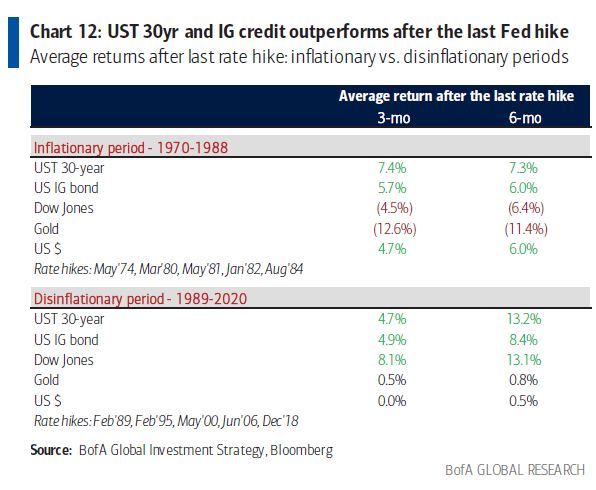
(Bloomberg) — While investors are impatient for the Federal Reserve to deliver its last rate hike to pile back into equities, history shows they should be wary of doing so while inflation remains persistently high, according to Bank of America Corp. strategists.

An analysis by Michael Hartnett and his team showed that stocks outperformed after the Fed stopped increasing rates during periods of disinflation in the past 30 years. However, during the era of persistently high inflation in the 1970s and 1980s, equities had fallen after the last hike, they wrote in a note. In the current cycle, they expect the Fed to raise rates for the last time in March 2023.

US stocks have already pulled back this week after rallying in the fourth quarter as signs of a resilient economy stoked fears the Fed would remain hawkish for longer, leading to the risk of a contraction next year. About $5.7 billion flowed out of global equity funds in the week through Dec. 7, Bank of America said, citing EPFR Global data.

Citigroup Inc. strategists this week became the latest to warn about weaker returns in 2023, saying the recovery had left valuations looking expensive again. A Bloomberg News survey of global fund managers also highlighted stubborn inflation and a recession as the main risks to stocks in 2023. Still, the majority of respondents were optimistic about low double-digit gains after the worst year for equities since the global financial crisis.

Read More: World’s Top Money Managers See Double-Digit Stock Gains in 2023

Bank of America’s Hartnett recommends buying assets that perform well against the backdrop of high, but stable, inflation, as well as dips in commodities, banks, small caps and value stocks, and European and emerging-market assets. Investors should avoid tech stocks, private equity and private credit, he said in the note.

The flows data, meanwhile, showed European equity funds had outflows for a 43rd straight week. By style, US value funds had inflows, while small caps, large caps and growth funds saw redemptions.

Among sectors, consumer and communication services had small inflows, while materials and tech had outflows of $300 million and $200 million, respectively.

–With assistance from Michael Msika.

More stories like this are available on bloomberg.com

©2022 Bloomberg L.P.

Li Auto’s Loss Bigger Than Expected After Power Cuts Snag Supply

(Bloomberg) — China’s Li Auto Inc. reported a bigger quarterly loss than expected after power outages in a key manufacturing region led to a shortage of parts, curtailing production, while a transition to new models hurt sales of an earlier electric vehicle. 

Li’s net loss widened to 1.65 billion yuan ($237 million) in the three months through September, from a loss of 21.5 million yuan a year earlier, according to a statement Friday. Analysts had forecast on average a loss of 815 million yuan, according to data compiled by Bloomberg. 

“With rapid production ramp-up, rigorous execution and responsible cost management, we will realize greater economies of scale and further drive down costs, putting us back on track,” Chief Financial Officer Li Tie said in the statement. Gross margin dropped to 12.7%, affected by a provision related to the company’s Li ONE vehicle, he said. 

Li Auto, which is listed in Hong Kong and the US, delivered 26,524 cars last quarter, missing an August forecast that it would ship 27,000-29,000. 

Revenue jumped 20% to 9.34 billion yuan in the third quarter, short of analysts’ expectations for 9.6 billion yuan, but beating the Beijing-based company’s earlier guidance of 8.96 billion yuan. It expects revenue of between 16.5 billion yuan and 17.6 billion yuan in the fourth quarter. 

Li Auto was among carmakers hardest hit by power cuts in Sichuan province, which suffered its worst drought in more than half a century in the summer. With the forced closure of some factories, August deliveries fell to just 4,571 vehicles. 

In a separate statement, the company said president and director Kevin Shen has resigned to “devote more time to his personal affairs.” He will be replaced by Chief Engineer Donghui Ma, with effect on Jan. 1.

Li Auto forecast fourth-quarter deliveries will rise to between 45,000 and 48,000 vehicles, helped by the introduction of two new models, including the L8 SUV. November deliveries jumped to a record 15,034 EVs. 

The company’s US-listed shares rose 6.7% Thursday, trimming their loss this year to 25%. The stock added 1% in Hong Kong on Friday. 

More stories like this are available on bloomberg.com

©2022 Bloomberg L.P.

Mercedes-Benz Commits to Making Electric Vehicles in Thailand

(Bloomberg) — Mercedes-Benz Group AG has committed to manufacturing electric vehicles in Thailand after signing an agreement to import its battery-powered cars — part of a government plan to bolster the Southeast Asian nation’s status as a clean automaking hub. 

The luxury carmaker will receive a slew of benefits including lower import duties and excise taxes for each fully electric car brought into the country by its Thai unit through 2023, Ekniti Nitithanprapas, director general of Thailand’s excise department, said in a statement Friday. 

The agreement also binds Mercedes to making electric car models in Thailand, likely at its plant in Samut Prakan province, although Ekniti didn’t say which models that may include or when production may start. Mercedes’ facility there has to date been used to assemble combustion engine cars and it recently started producing EV batteries.

At a local motor show last week, Mercedes displayed a fully electric EQS 500 car, which Roland Folger, chief executive of Mercedes-Benz Thailand, said was “the first local production made outside of Germany.” Folger didn’t elaborate on the model’s production timeline.

Mercedes is the latest global brand to enter Thailand’s electric passenger car market — an arena where new Chinese entrants are challenging legacy Japanese and European automakers. Earlier this week, Tesla Inc. opened bookings for two of its EV models, which should be available by the first quarter of next year.

Read more: China Electric Carmakers Eye Detroit of Asia in Next Sales Push

Chinese automaking giant BYD Co. meanwhile has started selling its first electric SUVs in Thailand and said in September it has signed a land-purchase deal to build its first EV plant in Southeast Asia.

Thailand has a comprehensive automotive supply chain that feeds scores of factories owned by many of the world’s largest carmakers including Toyota Motor Corp., Ford Motor Co., and Honda Motor Co. The government has said it wants 30% of car sales to be electric by 2030 and earlier this year allocated about 43 billion baht ($1.2 billion) through 2025 to achieving that goal. 

The government has paid out 81 million baht in subsidies for the around 540 electric cars purchased in Thailand so far, according to Ekniti.

More stories like this are available on bloomberg.com

©2022 Bloomberg L.P.

US Futures Gain as Traders Await Inflation Data: Markets Wrap

(Bloomberg) — US equity futures rose Friday before a report on US producer prices that will be one of the final pieces of data to inform a rate decision by the Federal Reserve next week. The dollar fell.

Contracts on the S&P 500 added 0.2% after the underlying benchmark notched its first advance this month. A European equity benchmark traded flat, paring its weekly loss to 1.7%. Asian equities headed for their sixth weekly gain, the longest such stretch in two years.

Treasury yields were little changed, with the 10-year rate hovering near 3.45%. The dollar dropped for the third day and against most of its major counterparts in the Group-of-10 currency basket as demand for haven investments eased.

Investors are taking heart from any signs of softness in prices that may allow policymakers around the world to be less hawkish and more supportive of growth. At the same time, Fed officials are leery of fanning stock rallies that ease financial conditions too much and thwart their inflation-fighting mission.

Friday’s US producer price index for November will offer a progress report on how effective the Fed’s campaign to quell inflation has been. The PPI in October cooled more than expected. And there are some signs the labor market has tempered, with continuing jobless claims climbing to the highest since early February.

Still, strategists from Morgan Stanley to JPMorgan Chase & Co. have warned investors against piling back into risk on hopes the Fed is getting close to pivoting to easier policy.

“We still think next year it’s going to be a pretty downbeat outlook for the global economy, given all the tightening we have seen so far this year,” Sylvia Sheng, global multi-asset strategist at JPMorgan Asset Management, said on Bloomberg Television.

Elsewhere in markets, oil rose Friday while heading for a weekly drop of around 10% after a volatile session on Thursday on concerns over economic outlook. Gold advanced for a fourth day.

Key events this week:

  • US PPI, wholesale inventories, University of Michigan consumer sentiment, Friday

Some of the main moves in markets:

Stocks

  • The Stoxx Europe 600 was little changed as of 8:31 a.m. London time
  • Futures on the S&P 500 rose 0.2%
  • Futures on the Nasdaq 100 rose 0.3%
  • Futures on the Dow Jones Industrial Average were little changed
  • The MSCI Asia Pacific Index rose 1.2%
  • The MSCI Emerging Markets Index rose 1.1%

Currencies

  • The Bloomberg Dollar Spot Index was little changed
  • The euro was little changed at $1.0565
  • The Japanese yen rose 0.2% to 136.42 per dollar
  • The offshore yuan rose 0.2% to 6.9472 per dollar
  • The British pound was little changed at $1.2237

Cryptocurrencies

  • Bitcoin rose 0.1% to $17,205.84
  • Ether rose 0.1% to $1,279.95

Bonds

  • The yield on 10-year Treasuries was little changed at 3.48%
  • Germany’s 10-year yield advanced five basis points to 1.87%
  • Britain’s 10-year yield advanced four basis points to 3.12%

Commodities

  • Brent crude rose 0.2% to $76.28 a barrel
  • Spot gold rose 0.1% to $1,791.29 an ounce

This story was produced with the assistance of Bloomberg Automation.

–With assistance from Rob Verdonck.

More stories like this are available on bloomberg.com

©2022 Bloomberg L.P.

India Agency Releases Vivo Phones Held Over Suspected Violations

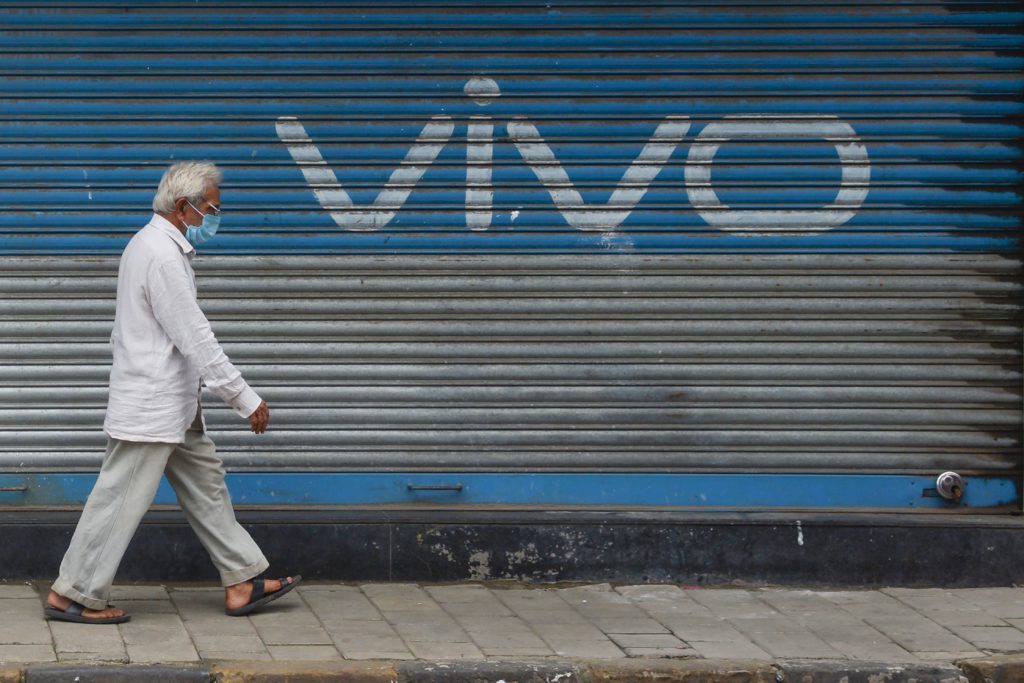
(Bloomberg) — An Indian state agency released nearly 27,000 Vivo Mobile Communications Co. smartphones for export after withholding the shipment for more than a week over alleged rule violations.

The federal finance ministry’s revenue intelligence unit late on Wednesday allowed the Chinese company to collect the devices it was holding at the New Delhi Airport over an alleged mis-declaration of phone models and their value, people familiar with the matter said, asking not to be named discussing a sensitive matter. Vivo had sought to export the devices to neighboring markets.

The government agency passed the order to release the smartphones a day after Bloomberg News reported that the devices were being withheld for inspection. It wasn’t immediately clear if the revenue intelligence unit will be pressing charges against Vivo.

The shipment, worth nearly $15 million, is unlikely to be exported as the packaging of many of the phones was damaged and the devices were switched on to check unique ID numbers, the people said.

The finance ministry and Vivo didn’t respond to emailed requests for comment. 

An industry lobby group called the seizure of the phones “unilateral and preposterous,” urging India’s technology ministry to help and warning that such moves could hit India’s ambitious plans to become an export hub.

The political chasm between India and China widened after the two nuclear-armed nations clashed at a disputed Himalayan border in the summer of 2020. New Delhi has also intensified scrutiny of Chinese companies operating in India, including SAIC Motor Corp Ltd.’s MG Motor India Pvt Ltd., and the local units of Xiaomi Corp. and ZTE Corp.

The blockage of the shipments is likely to unnerve other Chinese smartphone players in India where a nationalistic government, led by Prime Minister Narendra Modi, is pushing them to ramp up exports and build local supply chains. That could threaten India’s ambitious target of exporting electronics products worth $120 billion by the end of March 2026.

Vivo exported its first batch of India-made smartphones in early November to markets such as Saudi Arabia and Thailand. But the latest snag could cloud its future in the world’s second-biggest smartphone market, where the company is already under scrutiny for alleged money laundering, a claim that has yet to be proven in court.

More stories like this are available on bloomberg.com

©2022 Bloomberg L.P.

Union Wins Vote in First US Electric Vehicle Battery Plant

(Bloomberg) — The United Auto Workers union won an election at a General Motors Co. and LG Energy Solution Ltd. electric-car battery plant in Lordstown, Ohio, giving the union its first win in a factory of that kind.

Workers at Ultium Cells LLC voted in favor of union representation with 710 employees for and 16 opposed, the union said. The plant will make battery cells for electric vehicles such as the Hummer electric pickup and Cadillac Lyriq SUV.

The UAW’s success in gaining support from the workers gives the union an important entry into the electric car business. The union plans to organize workers in future plants that are being planned or built across the US to support automakers making the switch to zero-emission vehicles.

“Liberated is the best word you can use for it,” said Tony Russo, an employee in the plant who voted in favor of joining the union. “I’m overjoyed. We look forward to working with the company on the next stage.”

Next, the union will set up a bargaining committee and start working on a contract for workers.

The union needs to organize factories making EV parts as automakers race to replace internal combustion engines with zero-emission vehicles. Plants making engines, transmissions and other parts for today’s conventional vehicles will eventually be phased out in favor of plants making batteries, electric motors and other components.

UAW leaders could use a victory like the organizing drive in Lordstown. Current President Ray Curry faces a run off against challenger Shawn Fain in January and other incumbent candidates lost.

“As the auto industry transitions to electric vehicles, new workers entering the auto sector at plants like Ultium are thinking about their value and worth,” Curry said in a statement. “This vote shows that they want to be a part of maintaining the high standards and wages that UAW members have built in the auto industry.”

The UAW has identified about 135,000 jobs — mostly nonunion right now — that are at risk of going away in favor of new work making EV batteries and parts.

GM Chief Executive Officer Mary Barra has said the company is “very supportive” of the unionization efforts.

Workers at Ultium start at $15.50 or $16.50 an hour, depending on the work they do. The victory allows UAW to negotiate a labor contract that pushes toward the $32-an-hour rate for workers at GM’s wholly owned auto-assembly plants. The union will push for similar elections at Ultium’s planned plants in Tennessee and Michigan and other joint-venture battery plants operated by other automakers.

Workers interviewed last week said they hope to make at least $24 an hour if the union organizes the plant. They also sought improvements in relations with management, better work scheduling and said they’d like to establish a safety committee to create better standards for workers who handle chemicals used in EV batteries and do other potentially dangerous jobs.

The Lordstown plant was built to make batteries for the electric trucks made in Detroit and other EVs made in Spring Hill, Tennessee. Next year, Ultium will open a second battery plant for Lyriq vehicles and plans another plant in Michigan and a fourth in a US location that hasn’t been announced yet. The union plans to hold organizing drives at those facilities and factories jointly owned by Ford Motor Co., Stellantis NV and their battery suppliers.

GM has a plan to build 1 million EVs in 2025. Ford wants to sell the same amount in 2026. Both automakers will need a supply of batteries to do it. 

The union has tried to get into Tesla Inc. factories, so far unsuccessfully, and accused the electric-vehicle maker of unlawfully restricting organizing efforts. The National Labor Relations Board ruled that Tesla violated labor laws against promoting the union.

(Adds UAW President comment in 8th paragraph.)

More stories like this are available on bloomberg.com

©2022 Bloomberg L.P.

Stocks Climb as Inflation Data Take Center Stage: Markets Wrap

(Bloomberg) — Stocks climbed on Friday while the dollar and bond yields fell as investors looked to inflation readings for clues on the path of interest rate hikes.

European and US futures moved higher ahead of producer price data later Friday and after the S&P 500 notched its first advance this month. A benchmark of Asian equities headed for a sixth weekly gain, the longest such stretch in two years.

Chinese shares rose as factory-gate prices contracted while consumer inflation eased, giving the nation’s central bank some room to ease policy to foster economic recovery from the impact of the pandemic. Chinese property shares extended gains on expectations of more government support. 

Investors are taking heart from any signs of softness in prices that may allow policymakers around the world to be less hawkish and more supportive of growth. While central banks like the Federal Reserve want to see this cooling in inflation, the market reaction is problematic when it buoys financial assets too much. 

The dollar dropped for the third day and against most of its major counterparts in the Group-of-10 currency basket as demand for haven investments eased. The yen and offshore yuan strengthened.

Treasury yields declined, with 10-year rate hovering at 3.45%. Government bond yields also moved lower in Australia while Japan’s benchmark 10-year yield fell by half a basis point.

Friday’s US producer price index for November is one of the final pieces of data Federal Reserve policymakers will see before their Dec. 13-14 meeting. The PPI in October cooled more than expected. Meanwhile there are some signs the labor market is cooling, with continuing jobless claims climbing to the highest since early February.

Still, strategists from Morgan Stanley to JPMorgan Chase & Co. have warned investors against piling back into risk on hopes the Fed is getting close to pivoting to easier policy.

“We know that generally inflation should be coming down, so the Fed should be able to stop around 4.75% or 5% as the market is currently pricing in,” Esty Dwek, chief investment officer at Flowbank SA, said on Bloomberg Television. “My worry at some point next year is if inflation plateaus or stops falling and the Fed has to reprice more rate hikes that we take another leg down.”

JPMorgan Asset Management sees more room for equities to decline from the current levels. “We still think next year it’s going to be a pretty downbeat outlook for the global economy, given all the tightening we have seen so far this year,” Sylvia Sheng, global multi-asset strategist, said on Bloomberg Television.

Meanwhile, comments from Li Keqiang were supportive of sentiment in Hong Kong and mainland markets, with the Chinese premier saying that stable prices have left the nation further room for macro policy adjustments as it tries to bolster economic growth. 

JPMorgan strategist Marko Kolanovic said he “remains positive on China, due to favorable monetary conditions as well as an eventual full reopening and end of Covid.”  

Elsewhere in markets, oil rose Friday while heading for a weekly drop of around 10% after a volatile session on Thursday on concerns over economic outlook. Gold advanced for a fourth day.

Key events this week:

  • US PPI, wholesale inventories, University of Michigan consumer sentiment, Friday

Some of the main moves in markets:

Stocks

  • S&P 500 futures rose 0.2% as of 6:41 a.m. London time. The S&P 500 rose 0.8%
  • Nasdaq 100 futures rose 0.3%. The Nasdaq 100 rose 1.2%
  • Euro Stoxx 50 futures rose 0.4%
  • Japan’s Topix index rose 1%
  • Hong Kong’s Hang Seng Index rose 2.4%
  • China’s Shanghai Composite Index rose 0.4%
  • Australia’s S&P/ASX 200 index rose 0.5%

Currencies

  • The Bloomberg Dollar Spot Index fell 0.2%
  • The euro rose 0.2% to $1.0576
  • The Japanese yen rose 0.5% to 136.03 per dollar
  • The offshore yuan was little changed at 6.9582 per dollar

Cryptocurrencies

  • Bitcoin rose 0.2% to $17,212.74
  • Ether was little changed at $1,278.8

Bonds

  • The yield on 10-year Treasuries declined three basis points to 3.45%
  • Australia’s 10-year yield declined seven basis points to 3.30%

Commodities

  • West Texas Intermediate crude rose 0.8% to $72.02 a barrel
  • Spot gold rose 0.3% to $1,795.19 an ounce

This story was produced with the assistance of Bloomberg Automation.

–With assistance from Rita Nazareth and Rob Verdonck.

More stories like this are available on bloomberg.com

©2022 Bloomberg L.P.

Toshiba Plans Special Meeting Next Week for JIP-Led Bid, Sources Say

(Bloomberg) — Toshiba Corp. is planning a special committee meeting next week to discuss the buyout offer led by Japan Industrial Partners Inc., according to people familiar with the matter.

The Japanese conglomerate will deliberate about the next steps regarding the JIP-led bid, said the people, who asked not to be identified as the information is private. The meeting comes as banks are still considering issuing commitment letters for the financing, the people said.

Discussions are ongoing and the meeting could be delayed or canceled, the people said. A representative for Toshiba said the company can’t comment as it may undermine a fair process.

JIP’s consortium, which is the preferred bidder, has been in talks with banks for lending to fund its proposed takeover of Toshiba, which could value the company at about 2.2 trillion yen ($16.2 billion), Bloomberg News has reported. The bidding group is seeking about 1.2 trillion yen in syndicated loans. Banks including Sumitomo Mitsui Banking Corp. have been considering issuing commitment letters and could make a decision as soon as mid-December, people familiar with the matter have said.

Toshiba’s shares jumped on Friday after Reuters reported that the JIP-led group is closer to getting financing from banks as the lenders have become more confident in the post-acquisition plans. The report, which cited people familiar with the matter, said that banks haven’t decided on how much financing each lender will take on. Toshiba has a market value of about $14.5 billion on Friday.

The potential takeover of one of Japan’s most iconic companies faces headwinds including rising financing costs. Interest rates in many countries have risen sharply and major banks are failing to offload the tens of billions of dollars worth of buyout debt that’s still stuck on their own books.

–With assistance from Tom Redmond.

More stories like this are available on bloomberg.com

©2022 Bloomberg L.P.
Musk Twitter Leak Raises Concern About Outside Data Access

(Bloomberg) — Elon Musk is giving outside writers unprecedented access to internal Twitter Inc. information, instructing the current head of trust and safety to provide screenshots of users’ accounts.

Screenshots showing internal systems restricted to a relatively small number of people in charge of moderating content were shared by journalist Bari Weiss on Thursday. The images carry a watermark — a translucent label — indicating they were taken from the employee view of Twitter’s trust and safety head, Ella Irwin. 

The watermarked screenshots, taken since December 7, 2022, raised concerns about whether Weiss had access to Irwin’s internal account, which would also mean access to sensitive information like a user’s private messages, according to people with knowledge of Twitter’s systems.

Irwin later clarified that she took the screenshots herself to prevent such a scenario. “For security purposes, the screenshots requested came from me so we could ensure no PII,” or personally identifiable information, “was exposed,” Irwin said on Twitter. “We did not give this access to reporters and no, reporters were not accessing user DMs,” or direct messages.

The watermarks were added to employee accounts after Twitter was hacked in 2020, the people said, a move intended to make it easier for Twitter to know where screenshots of internal systems were coming from.

Weiss didn’t immediately respond to a request for comment.

The screenshots were shared as part of the “Twitter Files,” a collection of internal documents and emails from former Twitter employees that Musk handed over to outside reporters who are now publishing them.

Musk said earlier this month that Weiss and another writer, Matt Taibbi, have unfettered access to the Twitter Files. People with knowledge of Twitter’s systems are concerned that such broad access could leave Twitter in violation of its 2022 privacy agreement with the Federal Trade Commission.

“Feels like Weiss’ thread should be enough for the FTC to open an investigation into a violation of the consent decree and perhaps get a subpoena for Twitter’s internal access logs,” tweeted Alex Stamos, who formerly ran security at Meta Platforms Inc. and is now at the Stanford Internet Observatory.

Part of Twitter’s FTC agreement stipulates that employee access to sensitive user account data is only granted to people with a valid business justification for accessing said data. The executives who would have approved that access, or would have investigated its misuse, have left the company.

“The authors have broad and expanding access to Twitter’s files,” Weiss tweeted Thursday. “The only condition we agreed to was that the material would first be published on Twitter.”

More stories like this are available on bloomberg.com

©2022 Bloomberg L.P.

Close Bitnami banner
Bitnami