Bloomberg

Bitcoin Back Down Below $20,000 On Post-Jackson Hole Caution

(Bloomberg) — Bitcoin extended its drop below $20,000 on Monday as part of a wider cryptocurrency-market retreat, amid concern about the Federal Reserve’s rate-hike path.

The largest token fell as much as 2.3% on Monday to $19,527. That’s on course for a fifth straight day of declines, coming after US stocks fell on Friday following Fed Chair Jerome Powell’s speech at the Jackson Hole conference. The wider crypto market retreated Monday, with the MVIS CryptoCompare Digital Assets 100 Index dropping as much as 2.5%.

“Money is flowing out of risky assets. Crypto followed the sharp adjustment of the U.S. stock market” after Powell’s remarks, said Cici Lu, chief executive officer at consulting firm Venn Link Partners. “Markets didn’t like what he had to say and Bitcoin is resuming as a high-beta asset.” 

The $20,000 level acted as support for Bitcoin when it hit lows in recent months, but the cryptocurrency had worked its way higher in recent weeks. Before Saturday, it hadn’t been below $20,000 since July 14, and had even crossed above $25,000 earlier in August. 

The gyrations have come amid uncertainty about the path and magnitude of Fed rate hikes, and the effect they could have on riskier assets. 

Numerous strategists have flagged $20,000 as a key point for Bitcoin, though levels of support could lie lower as well.

Fairlead Strategies’ Katie Stockton sees long-term support in the $18,300 to $19,500 area. Fundstrat strategist Mark Newton has flagged some key areas in the $19,000 range, with a “real area of importance” around $17,500, near the June lows and which would allow for a 100% alternate wave projection of the most recent decline from mid-August, he said in a note Friday.

“If Bitcoin doesn’t hold $20,000, then $18,900 comes into play before a date with the June intraday low of $17,600,” said Antoni Trenchev, co-founder and managing partner of Nexo, in a note Sunday. “Close below that and it doesn’t look pretty.”

The past two Fridays have been tough in the crypto market, with $288 million of crypto longs liquidated on the most recent one, according to data from Coinglass. On Aug. 19, $562 million of longs were liquidated, the most since June 13. 

Second-biggest crypto Ether slid as much as 4.1% on Monday to $1,422.67, continuing a decline from around $2,000 a couple weeks ago. It has been fluctuating ahead of its much-anticipated Merge upgrade, which is due in mid-September.

“Ethereum’s drop ahead of the impending Merge is also of note as bearish sentiment appears to be taking hold across all so-called risk assets,” analysts at Bitfinex said in a note Friday. “The volatility that has become so characteristic of the digital token space shows no signs of abating.”

More stories like this are available on bloomberg.com

©2022 Bloomberg L.P.

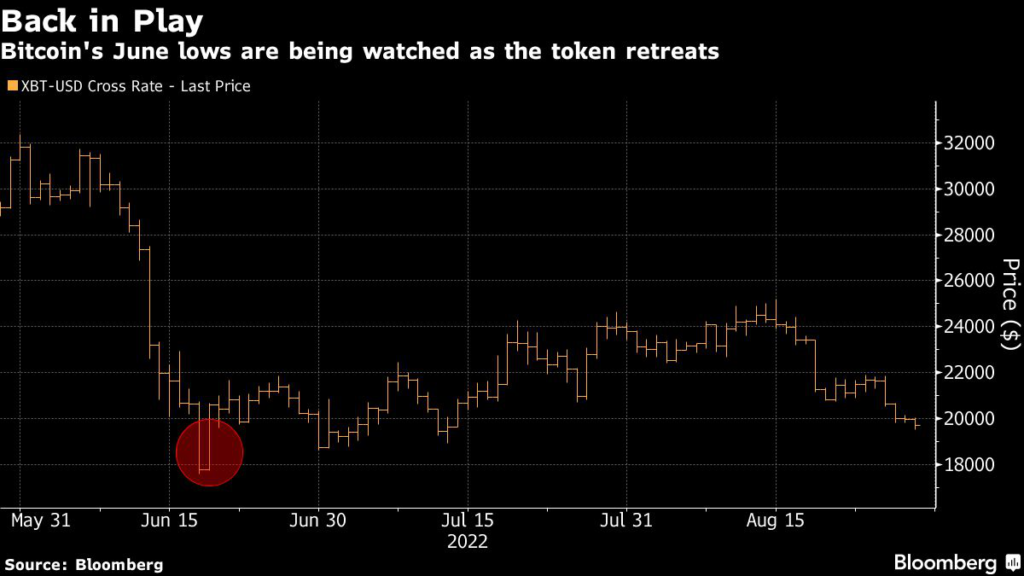
Bitcoin’s June Lows in Focus During Renewed Price Decline

(Bloomberg) — Bitcoin has retreated along with the wider cryptocurrency space, putting downside levels back into the conversation. The June lows, which sit right at $17,600, could be a key area to watch, according to Fundstrat technical strategist Mark Newton and Nexo co-founder Antoni Trenchev. Bitcoin fell as much as 2.3% on Monday to $19,526.

More stories like this are available on bloomberg.com

©2022 Bloomberg L.P.

Mickey Mantle Card Gets Record $12.6 Million in Memorabilia Boom

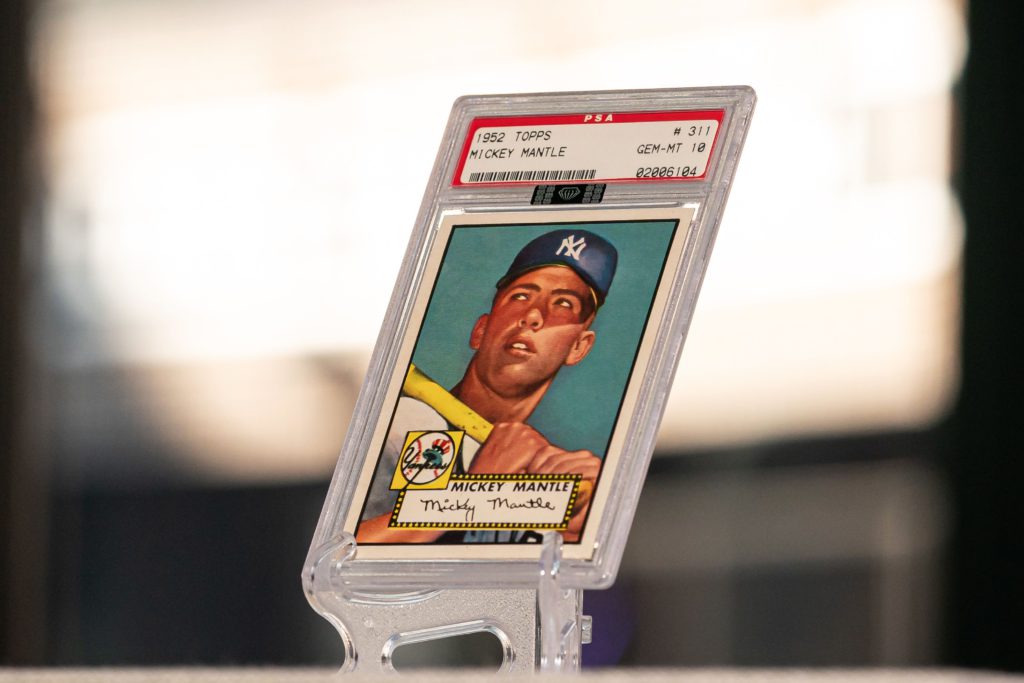
(Bloomberg) — A 1952 trading card of Major League Baseball Hall of Fame player Mickey Mantle was sold for $12.6 million, according to the auction house that sold the item, setting a new record for sports collectibles.

The price topped the $9.3 million paid earlier this year for the jersey worn by Argentinian football player Diego Maradona when he scored the so-called “Hand of God” goal in the 1986 World Cup. It was almost twice the previous record price for a sports card.

Sports collectibles have surged in value and popularity over the past year along with non-fungible tokens, sneakers and other alternative asset classes. Fanatics Inc. signed deals with Netflix Inc. and Legendary Entertainment to create collectibles earlier this year, and also bought the trading card division of Topps Co. for $500 million in January.

The card was sold by Anthony Giordano, who bought it for $50,000 in 1991, according to Sports Collectors Digest. 

Mantle, who was named to the Major League Baseball All-Century Team in 1999 and inducted into the Hall of Fame in 1974, played for the New York Yankees in the 1950s and 1960s. 

“We always knew this card would shatter records and expectations,” Heritage Director of Sports Auctions Chris Ivy said. ‘That doesn’t make it any less of a thrill to be part of an auction during which a single item breaks the eight-figure threshold for the first time.”

More stories like this are available on bloomberg.com

©2022 Bloomberg L.P.

Powell Heaps Pressure on Risk Sentiment as More Catalysts Loom

(Bloomberg) — The dog days of summer are firmly over as global investors absorb Federal Reserve Chair Jerome Powell’s stern message that interest rates are going higher for longer in a painful fight against inflation.

With further catalysts for volatility ahead — from the shutting of the key Nord Stream gas pipeline to Europe for maintenance to a ramp up of the Fed’s balance sheet rundown to crucial US labor data — caution is high after Friday’s post-Jackson Hole stock slide. That was sparked by Powell’s rebuttal of the notion that the trajectory of monetary tightening could soon be tempered. 

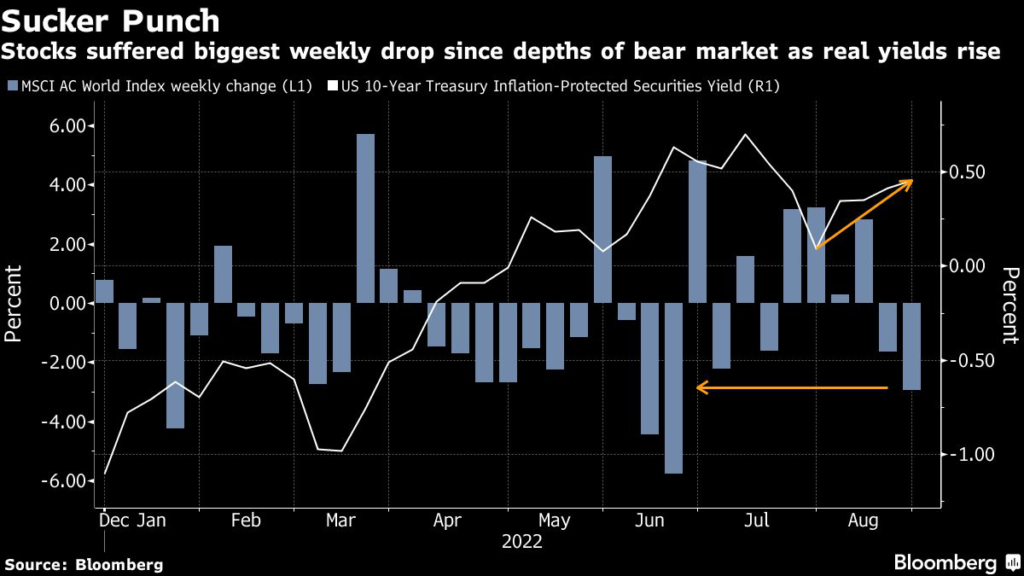
The slump further shriveled a global bounce in shares from June bear-market lows that was predicated partly on bets of a Fed shift to rate cuts next year as growth slows. Powell spelled out the need for sustained restrictive policy, comments that lifted the two-year Treasury yield and sent investors scurrying to the dollar as a shelter from volatility.

Powell was “really hawkish” at Jackson Hole, said Manish Bhargava, a Straits Investment Holdings fund manager in Singapore. There’ll be a “lot of red on Monday” in a fizzling summer rally as money exits emerging markets, he said.

Traders braced for a poor start to the week. US equity futures slid along with Asian stocks on Monday and the two-year Treasury yield reached the highest since 2007. Fizzling risk appetite was evident in Bitcoin, which slumped through the closely-watched $20,000 level.

READ: Asian Stocks Near 2-Year Lows as Hawkish Fed Spurs Risk-Off Mood

Powell’s comments are a further boost for the dollar, Westpac Banking Corp. and Bank of Singapore analysts said. The latter’s chief economist Mansoor Mohi-uddin said that’s both as a safe haven and higher-yielding carry trade versus lower yielding Group-of-10 currencies like the euro, pound and yen.

“Dollar-yen is the most obvious way to play for an increasingly determined Fed, with 140 likely to give way before the September FOMC meeting,” said Sean Callow, Westpac’s senior currency strategist.

The dollar is up over 10% this year while the yen’s 16% retreat leaves it at the bottom of the G-10, a schism reflecting the Bank of Japan’s continuing easy-money stance that Governor Haruhiko Kuroda reaffirmed at Jackson Hole.

Borrowing Costs

But the prevailing message from the symposium was that borrowing costs are going up from the US to Europe to Asia. Officials are combating some of the highest inflation in a generation, stoked by damage to supply chains for energy and components due to Russia’s war in Ukraine and Covid curbs in China. 

“Restoring price stability will likely require maintaining a restrictive policy stance for some time,” Powell told the audience at the Fed’s annual retreat. “The historical record cautions strongly against prematurely loosening policy.”

Investors now see the Fed’s policy rate peaking in March at around 3.80% and pared bets on a decline in 2023. The US yield curve between the five and 30-year maturities inverted for the second time this month, while the gap between the higher two-year yield and the 10-year rate widened.

The inversions suggest the bond market anticipates a recession is the necessary sacrifice to get price pressures back under control.

Hong Kong Catalyst

Jackson Hole overshadowed other developments, including a preliminary deal between Beijing and Washington to allow American officials to review audit documents of Chinese firms that trade in the US. That’s a first step toward averting the delisting of about 200 Chinese companies from US exchanges.

Equity futures for Hong Kong were steady and a gauge of US-listed Chinese shares bucked the worst of the wider Wall Street selloff on Friday.

“The risk of delisting is reducing and I think that’s a catalyst to support Hong Kong’s market,” said Grace Tam, chief investment adviser at BNP Paribas Wealth Management in Hong Kong.

The bigger picture, however, is the Fed’s goal of tightening financial conditions in the world’s largest economy until inflation is visibly defeated. Incoming data on employment and consumer prices will be crucial to gauging progress.

“The game of assessing the Fed outlook has shifted from guessing how high the peak rate might be to also understanding how long it might stay there for,” said Yanxi Tan, FX strategist at Malayan Banking Bhd. in Singapore.

(Updates with Monday’s trading.)

More stories like this are available on bloomberg.com

©2022 Bloomberg L.P.

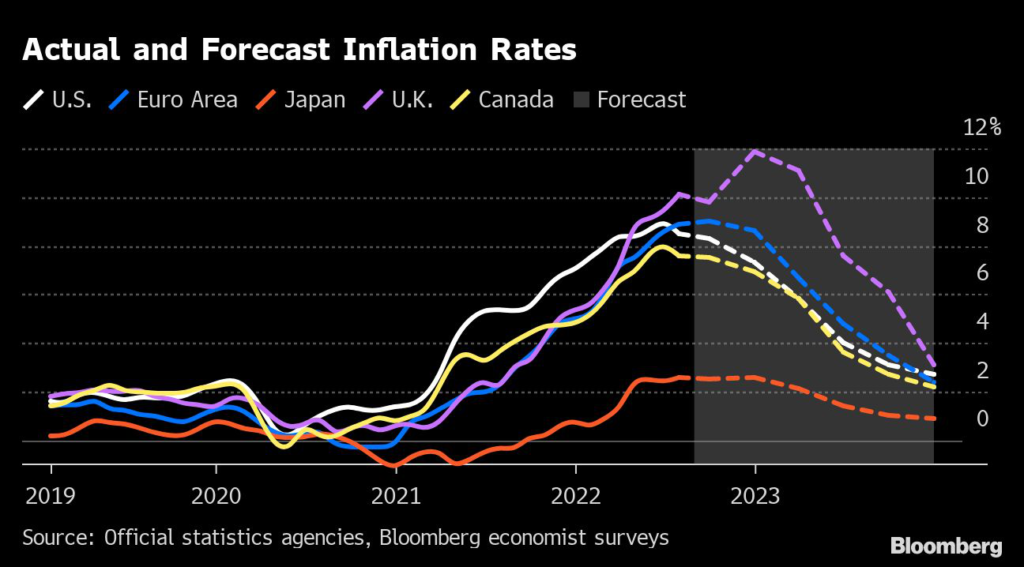
‘Inflation Fever’ Is Finally Breaking — But Central Banks Won’t Stop Hiking Rates

(Bloomberg) — Global inflation is finally coming off the boil, even if it’s set to remain far too hot for the liking of the world’s central bankers.

As economic growth slows, prices for key raw materials — from oil to copper and wheat — have cooled in recent weeks, taking pressure off the cost of manufactured goods and food. And it’s getting cheaper to move those things around, as supply chains slowly recover from the pandemic.

After the worst price shock in decades, the speed at which relief arrives will vary, with Europe in particular still struggling. But for the world as a whole, analysts at JPMorgan Chase & Co. estimate that consumer-price inflation will fall to 5.1% in the second half of this year — roughly half of what it was in the six months through June.

“The inflation fever is breaking,” says Bruce Kasman, the bank’s chief economist.

That doesn’t mean an early return to the subdued inflation that much of the world enjoyed before the twin shocks of Covid-19 and the war in Ukraine — or the end of monetary tightening anytime soon.

Fed’s Still Hiking

Rents and labor-intensive services are likely to keep getting more expensive, with job markets tight and wages on the rise. And there are broader forces at work, from slowing globalization to lackluster growth in the labor force, that may keep price pressures bubbling.

The major global central banks, which failed to see the pandemic price shock coming, are set to press ahead with interest-rate increases even as headline inflation tops out. The Federal Reserve, European Central Bank and Bank of England are all expected to hike rates again in September.

Fed Chair Jerome Powell left the door open to another jumbo 75 basis-point increase next month, telling fellow central bankers in Jackson Hole  on Friday that a recent ebbing of US inflation “falls far short” of what policy makers want to see.The following day, ECB Executive Board member Isabel Schnabel said “central banks need to act forcefully.”

Some central banks that were quicker off the mark than the Fed to raise rates may take advantage of cooling price pressures to pause their tightening moves.

The Czech National Bank this month left policy unchanged while the Brazilian central bank is expected to do the same in September. And New Zealand’s Reserve Bank may be nearing the end of its aggressive moves, Governor Adrian Orr told Bloomberg Television from Jackson Hole. 

The soaring cost of living has left politicians as well as central bankers feeling the heat — especially in Europe, where natural gas prices more than seven times higher than a year ago have triggered an energy emergency.

Inflation in the euro area is forecast to accelerate beyond July’s record 8.9% and Citigroup Inc. predicts that it could exceed 18% in the UK, in part because a cap on energy bills just got lifted. All kinds of once-unlikely proposals, from nationalization to power rationing, have been floated to address the crisis.

The US, by contrast, will experience the fastest slide in inflation among developed economies, thanks in part to the strength of the dollar, the JPMorgan economists say.

That won’t stop the Fed from tightening into restrictive territory. Anna Wong, chief US economist at Bloomberg Economics, expects the Fed will eventually have to raise rates as high as 5% to rid the US of its inflation problem.  

‘Truly the Issue’

Still, the recent decline in several important commodity markets should help dampen prices across the global economy:

  • Benchmark crude oil futures have fallen about 20% since early June
  • Prices for metals, lumber and memory chips have declined from their highs
  • A United Nations index of food costs plunged almost 9% in July, the most since 2008

Much of this appears to stem from a slackening in demand.  That’s partly because consumers are shifting away from the unusual shopping habits that emerged during pandemic lockdowns, when people spent less on services like hotel rooms or gym memberships, and more on goods such as exercise bikes and home computers. Goods inflation “is going to come off a lot,” says Jan Hatzius, chief economist at Goldman Sachs Group Inc.

The turnaround in commodity prices also reflects the fact that household budgets are increasingly stretched — and economies are slowing worldwide.

Most of Europe is expected to fall into recession in the coming months as the energy crisis takes a toll over the winter. China remains hobbled by its Covid Zero policy and a depressed property market, with spillovers for commodity prices. In the US, Fed rate hikes have undercut the once-ebullient housing market and turned high-tech companies cautious.

Even with recession risks rising, bond investors don’t see central banks letting up in the near future. Investors are currently betting that by next March the Fed will have raised rates to around 3.75%, while the ECB’s benchmark will be up to 1.75% and the UK’s to 4%.

“Inflation is truly the issue and it remains well above the targets of central banks,” said John Flahive, head of fixed-income investments at BNY Mellon Wealth Management. “They do not want to make the mistake of lowering rates and watching inflation go back up.’’

‘Seen the Worst’

One sure sign of slowing demand, according to economists at Morgan Stanley, is that growth in imports across major economies — after adjusting for inflation — is now subdued, while exports from Asia, the world’s factory floor, are starting to weaken. 

The easing of logistical logjams is also contributing to lower prices. The New York Fed’s index of global supply-chain pressure has dropped to the lowest level since early 2021. Short-term shipping rates are falling, transit times across oceans are shortening, and companies are even starting to moan about bloated inventories.

“We were getting about a 65% service level from our strategic suppliers. That’s back up to a plus 90% now,” Randy Breaux, the president of Motion Industries Inc., an Alabama-based provider of industrial components, told a conference this month. “We really think that we’ve seen the worst of the supply-chain issues.”

If that’s the case, the Fed may not have to raise rates as much as feared to reduce demand and rein in inflation, according to Apollo Management chief economist Torsten Slok.

Still, even if goods prices slow, there’s a risk that the post-lockdown spending shift will instead drive up the price of services such as going to the movies or staying in hotels. Those may prove stickier.

US rental costs, in particular, are being boosted by a dearth of affordable housing. That may put upward pressure on inflation into 2023 and “maybe even beyond,” Goldman’s Hatzius says.

‘Not Very Far’

Rising wages could also keep inflation around for longer.

Labor costs are by far the biggest expense for many businesses, especially in service industries. With job markets in the US and Europe still tight, companies are being forced to boost pay. To maintain profits, firms would then need to pass along their higher wage bills to consumers.

“We are quite worried about a wage-price spiral,” says Robert Dent, senior US economist at Nomura Securities.  “One may already be happening to a certain degree.”

There’s also the argument that inflation won’t return to pre-Covid levels because the world was already poised to change. Globalization is fraying — a process accelerated by the war in Ukraine — and measures to tackle climate change could add another layer of costs, at least in the short term.

In a report this month, economist Dario Perkins of TS Lombard predicted that such forces will combine to create what he calls a “new macro supercycle.”

Central banks “will try to prevent this secular transition, even at the cost of a recession,” but they “can’t stand in the way of structural shifts,” he wrote. “The persistent ‘low-flation’ era is over.”

For now, at least, there’s a growing consensus that the worst of the current inflationary episode is passing for many economies, even if doubt lingers over how fast the decline will be and how far it will go. 

“The inflation peak is not very far from here and should be in place soon,” said Priyanka Kishore of Oxford Economics. “There may of course be outliers. But this is more due to idiosyncratic country factors rather than the global price pressures.”Read More:

  • Pimco Is Among Bondholders Calling an End to Low-Inflation Era
  • Powell Talks Tough, Says Rates Likely to Stay High for Some Time
  • US Inflation Peak in Sight But Debate Rages Over What Comes Next
  • China Plans More Fiscal Stimulus as Economy Outlook Darken
  • European Energy Soars as Pressure Mounts on Leaders to Ease Pain
  • UK’s Surging Energy Bills Point to Higher Inflation and Rates

More stories like this are available on bloomberg.com

©2022 Bloomberg L.P.

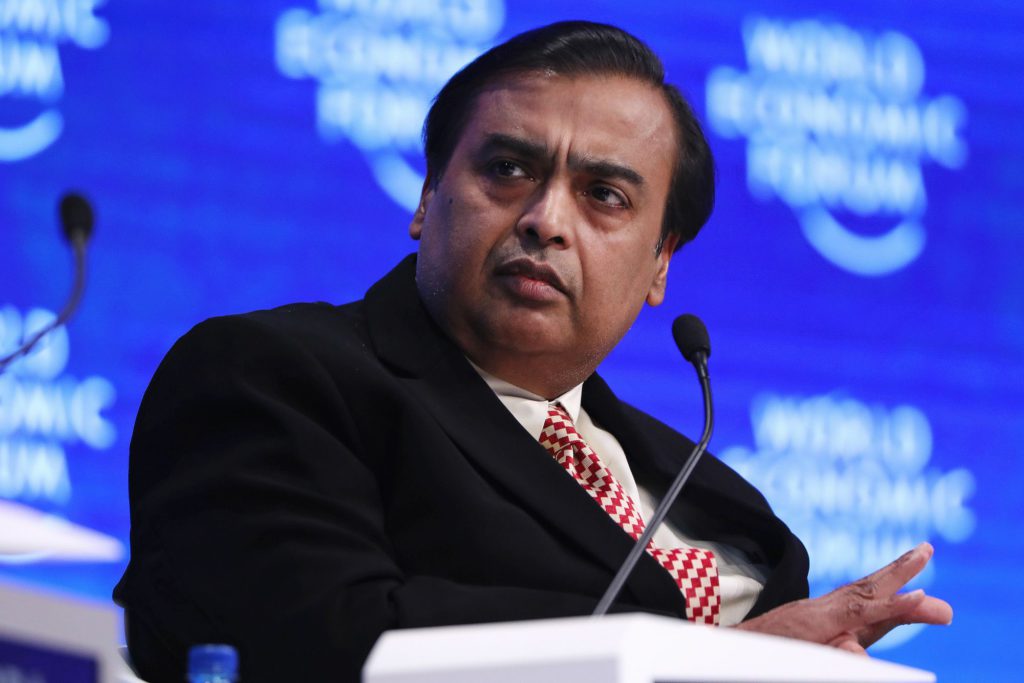
Succession, Spinoffs in Focus in Billionaire Ambani’s Big Speech

(Bloomberg) — Mukesh Ambani’s once-a-year speech to investors has over time evolved into an eagerly-awaited pronouncement on his $222 billion empire akin to Warren Buffett’s annual letters to Berkshire Hathaway shareholders.

This year, investors in the Indian billionaire’s Reliance Industries Ltd. will be looking for insight around the conglomerate’s 5G rollout, how Ambani plans to unlock the value of his telecommunications and retail units through separate listings, and when and how his children will take over the reins.

Anticipation is high as the 65-year-old tycoon, who built Reliance into India’s largest company by market value and a powerhouse conglomerate, has used the speech in the past for a series of big announcements. These include the launch of his disruptive telecom service in 2016, Saudi Arabian Oil Co.’s proposed investment in Reliance’s energy business in 2019 and a strategic shift to green energy last year.

This year’s shareholder meeting, set for Monday, comes as the refining-to-retail group faces the twin challenges of a global recession and the blistering rise of Gautam Adani, who eclipsed Ambani as India — and Asia’s — richest man earlier this year and is emerging as an alternative power center on the corporate landscape.

Reliance investors will have in mind how Adani’s conglomerate split its business into different listings years ago, unlocking value, and will expect “clarity and specific time lines for the next big things” from Ambani’s more-centralized holdings, Kranthi Bathini, equity strategist at WealthMills Securities Pvt in Mumbai. Adani’s wealth has surged $59.8 billion this year, riding a stocks rally and overshadowing the $2.8 billion increase in Ambani’s.

Here’s where investors are expecting news:

Succession 

The patriarch signaled that succession planning atop Reliance will be expedited at last year’s shareholder meeting and reiterated it explicitly in December. His three children — daughter Isha and sons Akash and Anant — already hold various directorships in the group’s unlisted firms and are becoming more visible in their leadership.

Ambani Looks to Walton Family Playbook on Succession

Ambani stepped down as the chairman of Reliance Jio Infocomm Ltd. in June, making way for his elder son, Akash, who took over the helm at what is India’s largest wireless operator. With rumors swirling around Ambani’s health, investors will look for more concrete steps to be taken on the leadership transition, with Isha, Anant and possibly Ambani’s wife, Nita, taking on more responsibility.

5G Rollout

Reliance Jio Infocomm bought airwaves worth more than $11 billion at India’s spectrum auction as it sought to cement its edge over smaller rivals, Bharti Airtel Ltd. and Vodafone Idea Ltd., in the rollout of speedier 5G networks. That will be key to boosting revenue and luring high-value users.

India Sells $19 Billion of Airwaves With Reliance as Top Buyer

Investors will be looking for proof of the pudding here. The technology is yet to return profits for Asian wireless operators despite many investing billions of dollars, even those in China which have been offering 5G service since 2019. Details like a nationwide rollout date, tariff plans for 5G services as well as where demand lies for the service will be crucial for Reliance Jio to reveal.

The Ambani children may demonstrate some of the key features of the 5G services at the meeting, just as they’ve showcased new telecommunications products in the past.

Spinoffs, IPOs

Market watchers have been waiting for greater clarity around the initial public offerings of Reliance Jio and Reliance Retail Ltd., especially after the two consumer-focused businesses raked in $27 billion from marquee global investors in 2020.

Ambani Sold a Tech Dream for $27 Billion. Now He Has to Deliver

Both companies are market leaders in their respective sectors with a formidable lead over rivals. Their listings — or even spinoffs — could propel Ambani’s net worth. “The timelines are crucial to get the mojo back for Reliance stock,” Bathini said. Reliance has gained about 11% this year, compared to the more than 40% rise by top performers on India’s S&P BSE Sensex.

New Energy, Old Energy

The $76 billion pivot toward green energy is the biggest transformation that Ambani is helming currently. It’s also a difficult transition given Reliance’s roots in petrochemicals and crude oil refining and the continued out-sized contribution of the fossil fuel-led businesses to the conglomerate’s yearly revenue.

Ambani Says Green Push to Outshine Other Reliance Businesses

Investors will look for updates around last year’s announced plans to build four giga-factories to make solar modules, hydrogen electrolyzers, fuel cells and storage batteries. Ambani has also been on a tear acquiring small green energy firms globally for expertise and technology. There are also plans to become among the world’s top blue hydrogen makers.

Going Global

Ambani emphasized his vision for the “internationalization of Reliance” in his speech last year. 

In the past year, Reliance has made overtures toward big overseas deals like a potential acquisition of the British drugstore chain Boots, which was never completed. Investors will want to see if the appetite for global acquisitions still exists amid a slowing worldwide economy.

Then there’s always the possibility of a curve ball at the meeting, said Bathini. “Never underestimate the power of senior Ambani” to surprise the market, he said.

More stories like this are available on bloomberg.com

©2022 Bloomberg L.P.
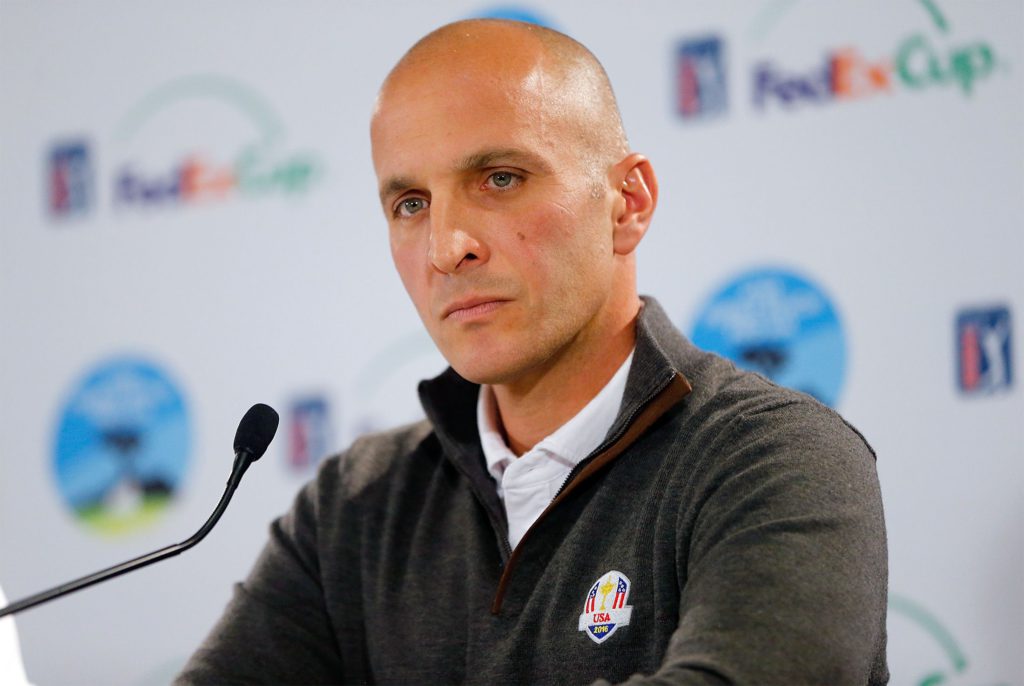
‘No Tour in Golf Like the PGA:’ NBC Sports Head Not Worried About LIV

(Bloomberg) — LIV Golf, the new Saudi-backed golf circuit, continues to lure big-name players away from the PGA Tour with the promise of massive paydays. But the head of one of the tour’s broadcast partners said he’s not worried. 

“There’s no tour in golf like the PGA Tour,” NBC Sports Chairman Pete Bevacqua said in an interview. “It’s without peer.”

Last week the PGA Tour said it will expand its schedule of marquee events and pay golfers additional prize money next year as it tries to fend off the threat from LIV — a move that drew praise from Bevacqua.

“We feel really bullish about the health of the PGA Tour and some of the moves that have been made of late by [Commissioner] Jay Monahan and the Tour,” he said. “We feel good about where things are headed.” He added that NBC is “keeping an eye on everything” and working to “make sure the best players in the world continue to play on the best tour in the world.”   

In 2020, Comcast Corp.’s NBCUniversal, which owns the Golf Channel, agreed to renew its PGA Tour rights for nine more years along with CBS and ESPN. NBC’s sports portfolio also includes the NFL, Premier League soccer, Notre Dame football and the Olympics. Earlier this month, the media company joined Fox and CBS in buying the rights to broadcast the Big Ten Conference.  

In an interview, Bevacqua also discussed his view of regional sports channels, how NBC made its pitch to the Big Ten, and why competitors like Apple Inc. and Amazon.com Inc. will have trouble wrestling away NBC’s sports rights anytime soon.

Why was the Big Ten attractive to NBC?  How much of your decision was about the possibility that Notre Dame could join the conference?

I would tell you with no ambiguity that trying to secure the Big Ten was at the top of our strategic priority list of major deals that were coming forward. We had that circled. It made sense to us to utilize the power of what we could do on NBC on Saturday nights. We brought [Big Ten Commissioner] Kevin Warren and his team to our headquarters in Stamford, Connecticut. We really transformed the building into a Big Ten presence. We showed him how all of NBCU would rally around the Big Ten. We put a video together of not just people on our NBC Sports team talking about their Big Ten education and experiences but really across NBCU. We said to Kevin, `OK, This is our vision: Imagine Notre Dame Football in the afternoon, moving into Big Ten prime-time football and leading right into `Saturday Night Live.’ So it was a real priority for us to make an aggressive play for the Big Ten. We think it’s the most powerful conference in sports. It’s the most national conference in sports, particularly with the addition of Southern Cal and UCLA.

Throughout the entire process we were consistently transparent with Notre Dame. Notre Dame was in favor of this. We have a three-plus decade relationship with Notre Dame. We think our Notre Dame partnership greatly increases the value of our Big Ten partnership, and we think our Big Ten partnership greatly increases the value of our Notre Dame partnership. And it’s our desire to keep that going.

Do you worry about competing against deep-pocketed tech companies like Amazon and Apple for sports rights?

Sports are competitive and more powerful now than ever. The good news for us is we like where we’re positioned: We have a streaming avenue in Peacock. Having renewed our Sunday Night Football deal. Having renewed our deal with the PGA Tour for the next decade. Having renewed with the Premier League. Having just entered into a seven-year deal with the Big Ten. Having a deal for the Winter and Summer Olympics through 2032. We have these unbelievably powerful deals locked in through this next decade.

How do you think about striking the balance between putting sports on TV versus streaming? 

We view every potential transaction as: Where does this make sense for us — on USA, Peacock, NBC or some combination? And where does it work for our partner? And that varies. Think about the NFL Sunday Night Football deal. We simulcast our games on Peacock. We’re going to add an exclusive game every season starting next year. But that ratio is different than the Big Ten. We have our Big Ten primetime games on NBC and then we have additional games exclusively on Peacock. That varies from the Premier League where we have a much bigger amount of content and exclusive games on Peacock. Leagues are different. The amount of games is different. So there’s no cookie-cutter model here. 

NBC recently sold its channel that airs the Washington Wizards and Washington Capitals. What’s your view of regional sports networks?

We have no intention of exiting the RSN business. Our RSN businesses are healthy and thriving. In many spots where are RSNs are, sports betting has taken off and that’s helped the business. We’re analyzing ways to continue making these businesses strong and healthy and what could we do on the direct-to-consumer level. The Washington RSN sale was very much a one-off.

Are there any other rights deals on the horizon that you’re interested in?

We have a wonderful relationship with Nascar. We think the world of their leadership team and the job they’ve done. And (Nascar President) Steve Phelps. And that is one we’re focused on, about what we can continue to do with Nascar. And we still have several years left on our Notre Dame deal. We want to keep that three-decade plus relationship going strong. But we’re not shy about the fact that there’s a Big 12 and Pac 12 deal on the horizon and the NBA. Like anything else that’s out there around the bend that’s material to the sports world like those transactions are, we’re going to  analyze it, and see what could make sense for us, if it makes sense for us absolutely put our best foot forward.

More stories like this are available on bloomberg.com

©2022 Bloomberg L.P.
Just as Wall Street Piles In, Tech Stocks Face Fresh Rates Storm

(Bloomberg) — Jerome Powell’s latest hawkish missive threatens to open up a new front in the ever-raging battle between tech stocks and Treasury yields — potentially hurting money managers who’ve just plunged back into US megacap companies in droves.

The Nasdaq 100 Index posted its biggest decline since the week ending June 10 after the Federal Reserve Chair touted Friday his iron-clad resolve to hike interest rates into restrictive economic territory to cool inflation at decade highs.

Portfolio managers, including long-term bulls on the sector, see the risk of fresh losses ahead for rate-sensitive technology stocks — as all signs suggest Powell will make good on his policy threat given prices for goods and services are still stubbornly high across the globe.

Read More: Powell Talks Tough, Says Rates Likely to Stay High for Some Time

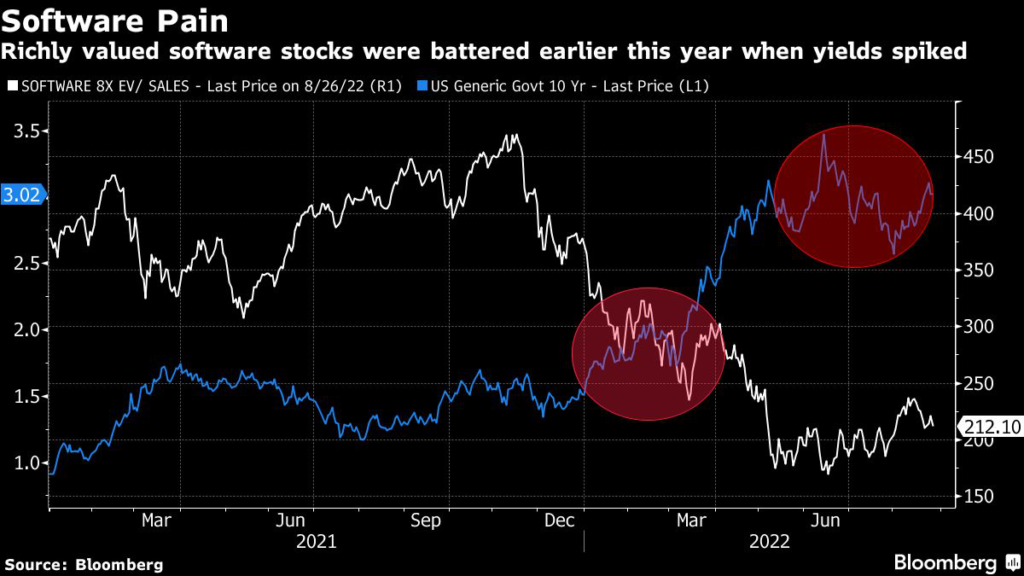
A fast rise in the 10-year note yield this month has already rocked so-called growth equities while igniting a cross-asset selloff after the recent $7 trillion stock rebound.

Wall Street worrywarts are now bracing for the Treasury benchmark to retest the near 3.5% peak reached in June or rise higher still to 4% — threatening fresh damage for blue-chip companies after the group rebounded more than 20% from the bear-market nadir.

“If yields spike back to 3.5%, that will jolt markets and be particularly painful for tech stocks,” said Nancy Tengler, chief investment officer of Laffer Tengler Investments. “If we get to 4%, the whole stock market will shift and recalibrate.”

All this threatens to catch hedge funds off-guard after the cohort in industry data tracked by Goldman Sachs Group Inc. ramped up tech bets last quarter to the highest since the start of the pandemic, on the conviction that a brewing economic slowdown would revive the megacap safety trade.

Another wave of volatility jolted Wall Street on Friday, after Powell’s jawboning at the Jackson Hole symposium as he warned of restrictive policy “for some time” given history “cautions strongly against prematurely loosening policy.” Futures contracts referencing the Fed’s September policy meeting priced in 64 basis points of tightening at one point Friday, compared to 59 basis points before the speech. But the stock market bore the brunt of Powell’s message that interest-rate increases may undercut economic growth as the tech-heavy Nasdaq 100 tumbled 4.1% even as the 10-year yield stayed broadly stable.

Generally speaking, technology companies are particularly susceptible to fears of rising interest rates because many of them are valued on projected profits delivered years in the future. The present value of those future profits are worth less as yields rise.

Read more: Stock Bulls’ Swagger Gets Deflated as Powell Delivers a Warning

Soaring interest rates also make financing operations more expensive. That’s not an issue for companies like Apple Inc. and Microsoft Corp. that are flush with cash, but it increases risks for younger companies that are burning cash in pursuit of rapid growth.

The 10-year US Treasury yield hovered around 3% Friday, versus around 2.57% in early August.

“Investors are grasping for a dovish pivot, but they’re not going to get it until inflation falls — it’s certainly peaked, but it needs to meaningfully come down,” said Sean Sun, portfolio manager at Thornburg Investment Management. “If it takes the Fed raising rates even more aggressively to get there, then we could see the 10-year back to around 3.5%. This transition will hardly be painless for tech stocks.”

Money managers with a long-term focus are famously reluctant to offload tech exposures due to the cohort’s reliable profit generation, healthy balance sheets and ability to ride disinflationary trends.

For investors looking to maintain their exposure to technology firms, Sun recommends clients snap up shares of companies in IT services, while shying away from unprofitable, longer-term plays like early-stage software companies.

Tengler at Laffer Tengler sees tech pain in the near term, though she favors the cohort over the next three to five years. She’s sticking with cyber security stocks and companies that invest in cloud services like Amazon.com Inc., Microsoft and Google parent Alphabet Inc., while steering clear of struggling social-media firms like Facebook parent Meta Platforms Inc.

Meanwhile, prices for electronics in the Adobe Digital Price Index, an alternative measure of consumer price trends, fell 9.3% in August from a year ago, which may help signal lower inflation in the coming months, according to Jim Paulsen, chief investment strategist at The Leuthold Group.

That’s one reason why he’s a bull on the sector.

“The real issue for longer-term investors is whether this is the 1970s, where we have inflation permanently higher for longer? If it is, then you don’t want tech stocks,” Paulsen said in an interview. “Or is this just a cyclical spike in inflation? The odds strongly favor that we’ll eventually return to disinflation.”

More stories like this are available on bloomberg.com

©2022 Bloomberg L.P.
Ukraine Latest: Germany Warns That War ‘Could Last Years’

(Bloomberg) —

German Foreign Minister Annalena Baerbock warned the war in Ukraine “could last years,” telling a newspaper that Berlin is ready to support Kyiv for the long haul.

The situation at the Zaporizhzhia nuclear plant “remains very risky, dangerous,” Ukrainian President Volodymyr Zelenskiy warned, even after two power units were reconnected to the country’s energy grid following an outage.

The plant is working “despite provocations by occupying Russian forces,” state-owned operator Energoatom said. Zelenskiy said in a video address that the International Atomic Energy Agency should be allowed to arrive “soonest” to help prevent further incidents. Several strikes were reported near the plant in recent days. 

(See RSAN on the Bloomberg Terminal for the Russian Sanctions Dashboard.)

Key Developments

  • Zelenskiy Reinforces Nuclear Warning After Disruption 
  • Britain Hasn’t Quite Managed to Kick Its Russian Diesel Habit
  • Price of Power Spirals Out of Control in Europe’s Key Markets
  • European Gas Posts Sixth Weekly Gain as Supply Woes Intensify
  • Why Ukraine Debt Relief Isn’t Matching Funding Needs: QuickTake
  • A Corner of Europe Leans to Live With Power Blackouts Again

On the Ground

Ukraine’s Defense Ministry reported that Russian forces had shelled its positions in the Sumy and Kharkiv regions. Fighting also continued in the Donbas near Slovyansk and Avdiivka, where Ukraine said its forces repulsed Russian attacks. Shelling was also reported in the Zhaporizhzhia region. Ukrainian forces struck Russian military infrastructure in the south, destroying munitions depots in two locations near Kherson, according to Ukraine’s presidential office.

(All times CET)

Safety Systems Working at Nuclear Plant, Ukraine Tells IAEA (4 p.m.)

Russian shelling of the Zaporizhzhia nuclear plant on Thursday, Friday and Saturday hit buildings at the station that were just 100 meters from the reactor building, the IAEA said on Twitter, citing communication from the Ukrainian government. There was also damage to some water pipelines that have since been repaired, the IAEA said. All safety systems at the plant remain operational and radioactivity levels are normal, Ukraine told the IAEA. 

EU Set to Suspend Visa Travel Agreement With Russia: FT (3 p.m.)

European Union foreign ministers are poised to support a suspension of the bloc’s visa facilitation agreement with Russia in a bid to curb the number of tourists allowed from the country, the Financial Times reported.

EU countries bordering Russia have called for a ban on Russian tourists, but under a compromise reported by Bloomberg earlier, Russians traveling to the bloc would have to pay more and withstand additional bureaucracy to obtain short-term visas. 

As an initial step, ministers will first show political support for the suspension of the accord at a meeting in Prague set to begin on Tuesday, the FT reported on Sunday, citing three officials involved in the talks.

German Minister Warns War ‘Could Last Years’ (7 a.m.)

Baerbock warned that the war could drag on “for years” and pledged that the government in Berlin will continue to provide financial and military support to Ukraine “for as long as necessary.”

“Of course I would like the war to be over as soon as possible, but regrettably we have to assume that Ukraine will still need new heavy weapons from its friends next summer,” Baerbock said in an interview with Bild am Sonntag newspaper. “Unfortunately, the Russian government has not given up on its obsession with subjugating Ukraine and its people.”

The country’s finance minister, Christian Lindner, separately told the newspaper that the government needs to address soaring power prices “with the utmost urgency,” as a leading economist warned of a “gigantic shock” to Europe’s biggest economy.

Kazakhstan Halts Military Exports to Keep Neutral (5 a.m.)

Kazakhstan’s defense industry commission, headed by prime minister Alikhan Smailov, will pause the export of “arms, military vehicles and defense products” through August 2023, according to a statement on the prime minister’s website.

Kazakhstan was once part of the Soviet Union, and both sides in the Ukraine war are seeking more military equipment. But central Asia’s largest energy producer is aiming to keep neutral and avoid secondary sanctions from the US or backlash from Russia, its largest neighbor.

EU Remains Split Over Russian Tourist Visas (2 p.m.)

France and Germany said that the EU should continue to issue visas to Russians not affiliated with the government — particularly students, artists, scholars and professionals — even as countries neighboring Russia, including the Baltic nations and Finland, want the bloc to ban Russian tourists.

“While understanding the concerns of some member states in this context, we should not underestimate the transformative power of experiencing life in democratic systems at first-hand, especially for future generations,” France and Germany wrote in a document seen by Bloomberg ahead of next week’s gathering of EU foreign ministers in Prague.

One compromise plan that ministers are expected to discuss would mean that Russians traveling to the EU pay more and withstand additional bureaucracy to obtain short-term visas.

Read more: Russians Face European Travel Hurdles as EU Mulls Restrictions

More stories like this are available on bloomberg.com

©2022 Bloomberg L.P.
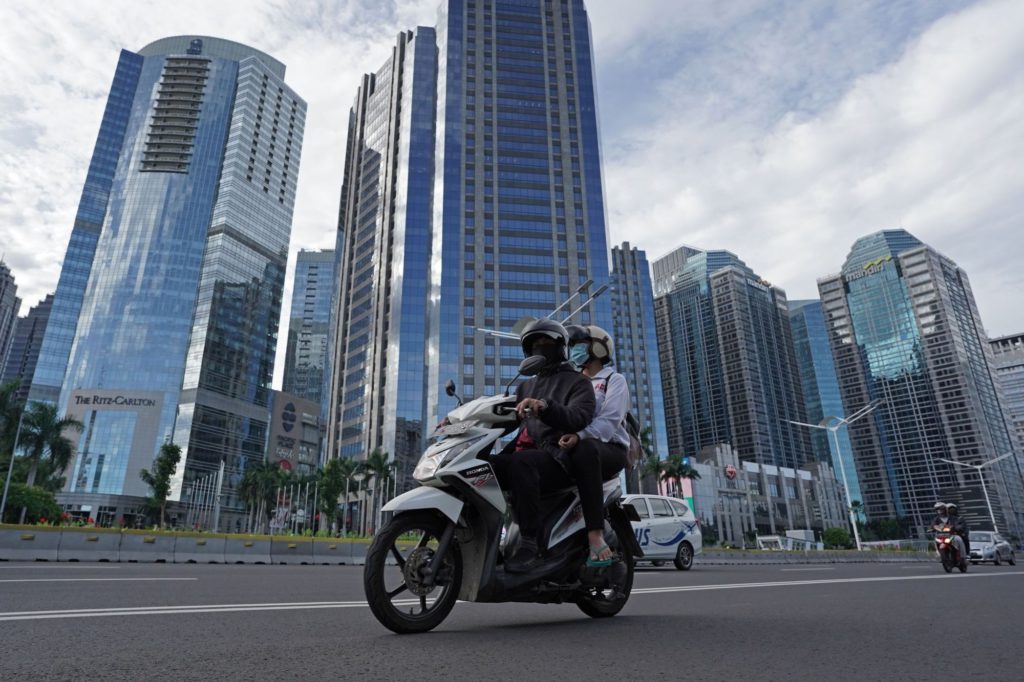
Indonesia’s Fare Hike for Ride-Hailing Motorbikes Postponed Anew

(Bloomberg) — Indonesia once again deferred the imposition of higher fares for ride-hailing motorcycle taxis that were set to come into force on Monday.

The Ministry of Transportation didn’t give a new a deadline for online motorcycle taxi operators to raise minimum tariffs, which would have raised prices by nearly 50% in the capital city of Jakarta. The hike was initially set for Aug. 14, then pushed back to Aug. 29.

“This decision to postpone takes into account various situations and conditions that develop in the community,” spokesperson Adita Irawati said in a statement on Sunday. “The delay is needed to get more input from stakeholders, as well as conduct a review to get the best results.”

Inflation in Southeast Asia’s largest economy is expected to accelerate from a seven-year high of 4.94% amid higher food and energy costs. The government is also considering to raise prices of subsidized fuels to ease the strain on the state budget.


More stories like this are available on bloomberg.com

©2022 Bloomberg L.P.
Close Bitnami banner
Bitnami