
Bloomberg

Divide Emerges Between Retail, Pros on How to Play Ether Upgrade

(Bloomberg) — The crypto world has been abuzz about Ethereum’s upcoming software upgrade. Yet there’s a divide in terms of how to position for the so-called Merge: retail investors have been selling the underlying token, while institutions continue to buy. 

The trading desk at Genesis saw “some fresh bullish ETH views expressed” with investors buying calls and selling puts. Analysts at Enigma say that traders are likely expecting a retracement following Ether’s big rally since June. Trading firm B2C2 is seeing a lot of Ether buying. And yet BlockFi’s customers have been selling in recent days. 

“Retail investors are getting a little nervous about another risk-off period for the markets,” given the Federal Reserve’s hawkish stance, said Matt Maley, chief market strategist at Miller Tabak & Co. “Therefore, they’re taking some chips off the table. However, institutional investors, who are more sophisticated, are taking advantage of the dip to add Ether.”

Ethereum’s upgrade has been long-awaited and news around it has been welcomed by investors, who have since the start of July pushed its token’s price up by roughly 50%. The blockchain is set to facilitate a move from the current system of using miners to a more energy-efficient one using staked coins. The switch to this so-called proof-of-stake system from proof-of-work is expected to happen soon after being kicked down the road for several years. 

Ethereum recently completed its last test before the upgrade, and developers said the main event should take place next month.  

Speculators had been positioning for the token to continue its run, though many are also betting that once the upgrade actually happens, Ether could plunge as part of a “sell-the-news”-type of event. And the token has already given back some of its recent gains, dropping roughly 8% over the seven days through Friday.

“The short-term rally on both BTC and ETH looked weak,” and “we were likely heading toward an inflection point,” wrote strategists at Securitize Capital. “This does seem likely to have been it.” 

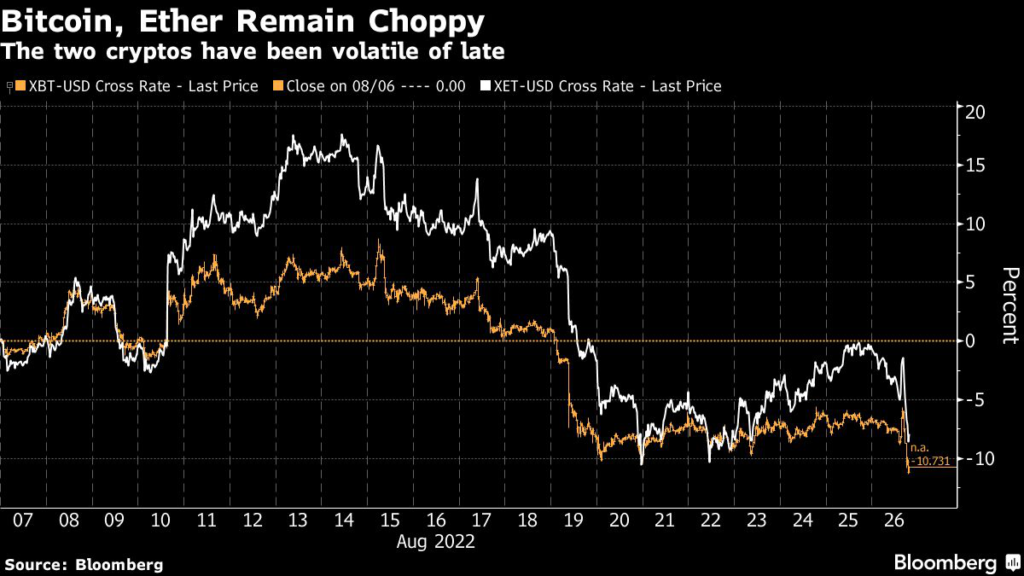
Both stocks and cryptocurrencies have been choppy of late following a red-hot rally over the summer, wavering as the Fed promises to be aggressive with its interest-rate hikes. Traders are likely expecting Ether and Bitcoin to retrace some of its gains, “which, if true, will make $ETHUSD the target of bears,” Eliott Attlan at Enigma Research wrote in a note. 

But BlockFi’s retail client have already been offloading. They were net sellers of Ether the weekend prior to the Fed’s Jackson Hole meeting on Friday. 

The typical trade recently has been to buy spot Ether and sell futures against it, according to a note from Cumberland on the Merge. Such a trade allows Ether holders to receive a token that will be forked off the network known as ETH PoW without downside price risk. Still, thanks to uncertainties around the upgrade, Ether holders have been selling September and December futures contracts. 

Over at B2C2, there’s been more buying than selling of Ether. The buy/sell ratio has been 55% to the buy side, with particular interest coming from funds, which is the largest cohort by volume and where the firm saw 62% buyers recently. Normally, that would be closer to 50% on any given week, “so this is sizable shift,” said Edmond Goh, head of trading at B2C2. “All eyes continue to track the Merge.”

Meanwhile, questions around the Ether chain-split are starting to accelerate, said Stephane Ouellette, chief executive of FRNT Financial Inc. His clients are looking to assess the value of a potential new proof-of-work chain emerging following the upgrade. “There are a growing number of arb strategies emerging around the complex and clients are also trying to decide if there are outright value plays in both the PoS and PoW chains around the merge event,” he said. 

Still, though some are selling Ether right now, sentiment hasn’t yet soured and the Merge is still being viewed positively. “That may change though, you’re starting to see a lot more philosophical debate of the value of PoW vs. PoS systems as the date approaches,” he added. 

More stories like this are available on bloomberg.com

©2022 Bloomberg L.P.

France Prepares $100 a Month Electric-Car Leasing Plan

(Bloomberg) —

France is readying a plan to subsidize electric-car leasing as part of President Emmanuel Macron’s campaign pledge to make them more affordable. 

The scheme will make EVs available for 100 euros ($100) a month, Budget Minister Gabriel Attal said Sunday on LCI television, noting that the cost is less than what many people spend on gasoline. The government is working on how quickly the measure can be rolled out and the availability of EVs, he said. 

Macron promised a state-sponsored leasing program for low-income households to counter criticism that even with subsidies, EVs are still out of reach for many.

The French government offers subsidies of as much as 6,000 euros for the purchase of EVs costing less than 47,000 euros, with possible additional aid under a cash-for-clunkers program for old combustion-engine vehicles. EVs represented 12% of new car sales in France in the first seven months of 2022.

“We know that for many French they remain very expensive,” Attal said Sunday. 

The leasing measure stands to benefit European carmakers rolling out new electric models including Renault SA, Volkswagen AG and Peugeot and Citroen-maker Stellantis NV.

More stories like this are available on bloomberg.com

©2022 Bloomberg L.P.
Bitcoin Back Down to Around $20,000 After Jackson Hole Caution

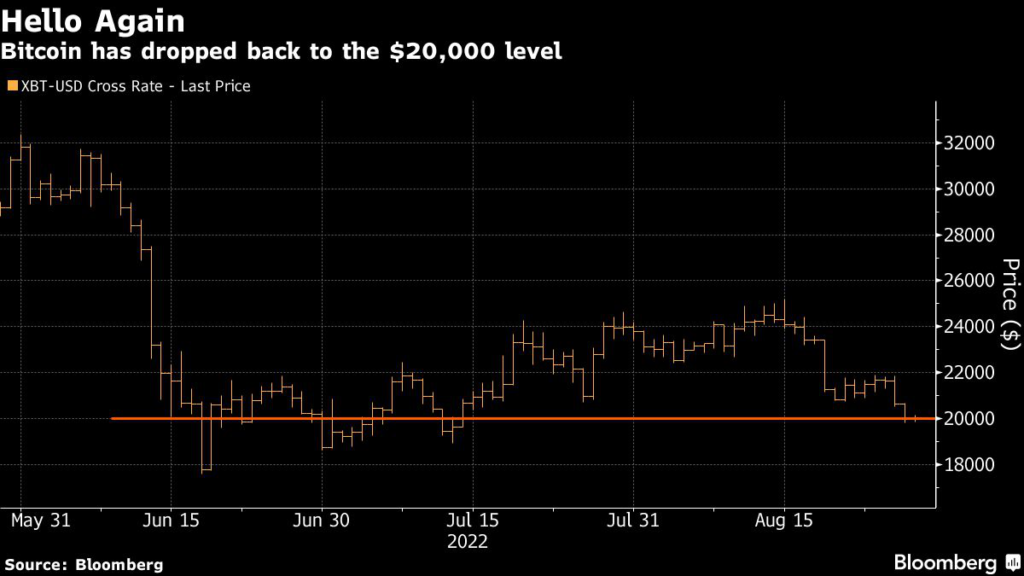
(Bloomberg) — Bitcoin appeared stuck around $20,000 on Sunday as part of a wider cryptocurrency-market retreat, amid concern about the Federal Reserve’s rate-hike path.

The largest token was little changed as of 7:45 a.m. in New York. That’s after a two-day drop of 7.6%, moving in tandem with US stocks on Friday after Fed Chair Jerome Powell’s speech at the Jackson Hole conference. The wider crypto market retreated Sunday, with the MVIS CryptoCompare Digital Assets 100 Index dropping 1% in its fourth straight day of declines.

“Money is flowing out of risky assets. Crypto followed the sharp adjustment of the U.S. stock market” after Powell’s remarks, said Cici Lu, chief executive officer at consulting firm Venn Link Partners. “Markets didn’t like what he had to say and Bitcoin is resuming as a high-beta asset.” 

The $20,000 level acted as support for Bitcoin when it hit lows in recent months, but the cryptocurrency had worked its way higher in recent weeks. Before Saturday, it hadn’t been below $20,000 since July 14, and had even crossed above $25,000 earlier in August. 

The gyrations have come amid uncertainty about the path and magnitude of Fed rate hikes, and the effect they could have on riskier assets. 

Numerous strategists have flagged $20,000 as a key point for Bitcoin, though levels of support could lie lower as well.

Fairlead Strategies’ Katie Stockton sees long-term support in the $18,300 to $19,500 area. Fundstrat strategist Mark Newton has flagged some key areas in the $19,000 range, with a “real area of importance” around $17,500, near the June lows and which would allow for a 100% alternate wave projection of the most recent decline from mid-August, he said in a note Friday.

The past two Fridays have been tough in the crypto market, with $288 million of crypto longs liquidated on the most recent one, according to data from Coinglass. On Aug. 19, $562 million of longs were liquidated, the most since June 13. 

Second-biggest crypto Ether was holding steady on Sunday around $1,500 after dropping 13% over the prior two days. It has been fluctuating in recent weeks ahead of its much-anticipated Merge upgrade, which is due in mid-September.

“Ethereum’s drop ahead of the impending Merge is also of note as bearish sentiment appears to be taking hold across all so-called risk assets,” analysts at Bitfinex said in a note Friday. “The volatility that has become so characteristic of the digital token space shows no signs of abating.”

More stories like this are available on bloomberg.com

©2022 Bloomberg L.P.
Stocks Face Another Sharp Slide After Powell’s Hawkish Pivot

(Bloomberg) — Losses loom for Asia’s stock market on Monday as investors absorb Federal Reserve Chair Jerome Powell’s stern message that interest rates are going higher for longer in a painful fight against inflation.

Futures shed almost 2% for Japan and 1.5% for Australia after a 3.4% plunge in the S&P 500 index. The slide was sparked by Powell’s rebuttal of the notion that the trajectory of monetary tightening could soon be tempered. 

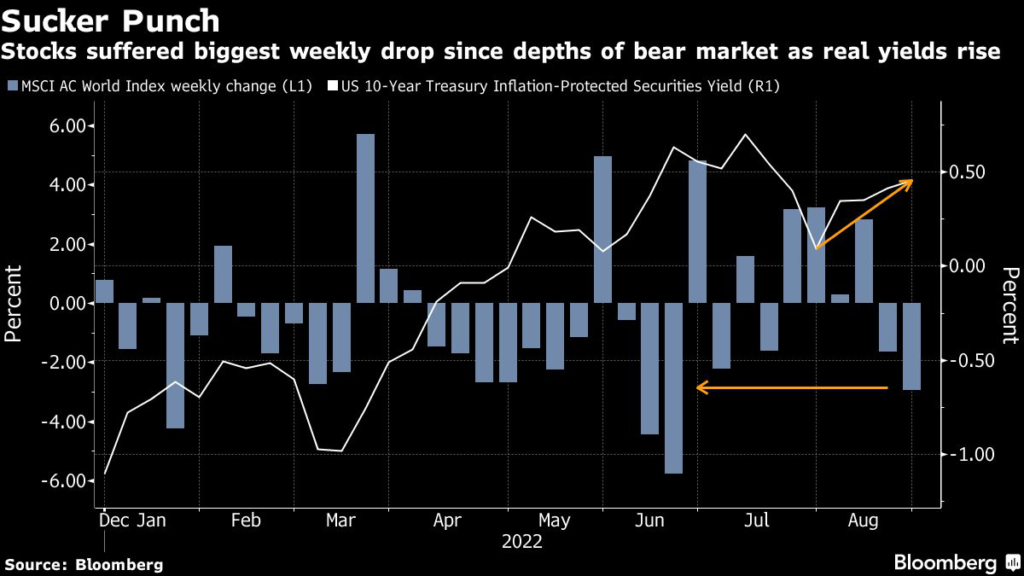
Friday’s US slump further shriveled a global bounce in shares from June bear-market lows that was predicated partly on bets of a Fed shift to rate cuts next year as growth slows. Powell spelled out the need for sustained restrictive policy, comments that lifted the US two-year Treasury yield toward 2022’s high and sent investors scurrying to the dollar as a shelter from volatility.

The greenback’s strength could be an impediment for Asia’s markets on Monday. Fizzling risk appetite was evident over the weekend in Bitcoin, which has succumbed to a near 8% three-day decline to about $20,000.

Powell was “really hawkish” at Jackson Hole, said Manish Bhargava, a Straits Investment Holdings fund manager in Singapore. There’ll be a “lot of red on Monday” in a fizzling summer rally as money exits emerging markets, he said.

Powell’s comments are a further boost for the dollar, Westpac Banking Corp. and Bank of Singapore analysts said. The latter’s chief economist Mansoor Mohi-uddin said that’s both as a safe haven and higher-yielding carry trade versus lower yielding Group-of-10 currencies like the euro, pound and yen.

“USD/JPY is the most obvious way to play for an increasingly determined Fed, with 140 likely to give way before the September FOMC meeting,” said Sean Callow, Westpac’s senior currency strategist.

The dollar is up over 10% this year while the yen’s 16% retreat leaves it at the bottom of the G-10, a schism reflecting the Bank of Japan’s continuing easy-money stance that Governor Haruhiko Kuroda reaffirmed at Jackson Hole.

Borrowing Costs

But the prevailing message from the symposium was that borrowing costs are going up from the US to Europe to Asia. Officials are combating some of the highest inflation in a generation, stoked by damage to supply chains for energy and components due to Russia’s war in Ukraine and Covid curbs in China. 

“Restoring price stability will likely require maintaining a restrictive policy stance for some time,” Powell told the audience at the Fed’s annual retreat. “The historical record cautions strongly against prematurely loosening policy.”

Investors now see the Fed’s policy rate peaking in March at around 3.80% and pared bets on a decline in 2023. The US yield curve between the five and 30-year maturities inverted for the second time this month, while the gap between the higher two-year yield and the 10-year rate widened.

The inversions suggest the bond market anticipates a recession is the necessary sacrifice to get price pressures back under control.

Hong Kong Catalyst

Jackson Hole overshadowed other developments, including a preliminary deal between Beijing and Washington to allow American officials to review audit documents of Chinese firms that trade in the US. That’s a first step toward averting the delisting of about 200 Chinese companies from US exchanges.

Equity futures for Hong Kong were steady and a gauge of US-listed Chinese shares bucked the worst of the wider Wall Street selloff on Friday.

“The risk of delisting is reducing and I think that’s a catalyst to support Hong Kong’s market,” said Grace Tam, chief investment adviser at BNP Paribas Wealth Management in Hong Kong.

The bigger picture, however, is the Fed’s goal of tightening financial conditions in the world’s largest economy until inflation is visibly defeated. Incoming data on employment and consumer prices will be crucial to gauging progress.

“The game of assessing the Fed outlook has shifted from guessing how high the peak rate might be to also understanding how long it might stay there for,” said Yanxi Tan, FX strategist at Malayan Banking Bhd. in Singapore.

(Updates Bitcoin performance in the fourth paragraph.)

More stories like this are available on bloomberg.com

©2022 Bloomberg L.P.
Ambani Succession, Spinoffs in Focus at Reliance Meeting

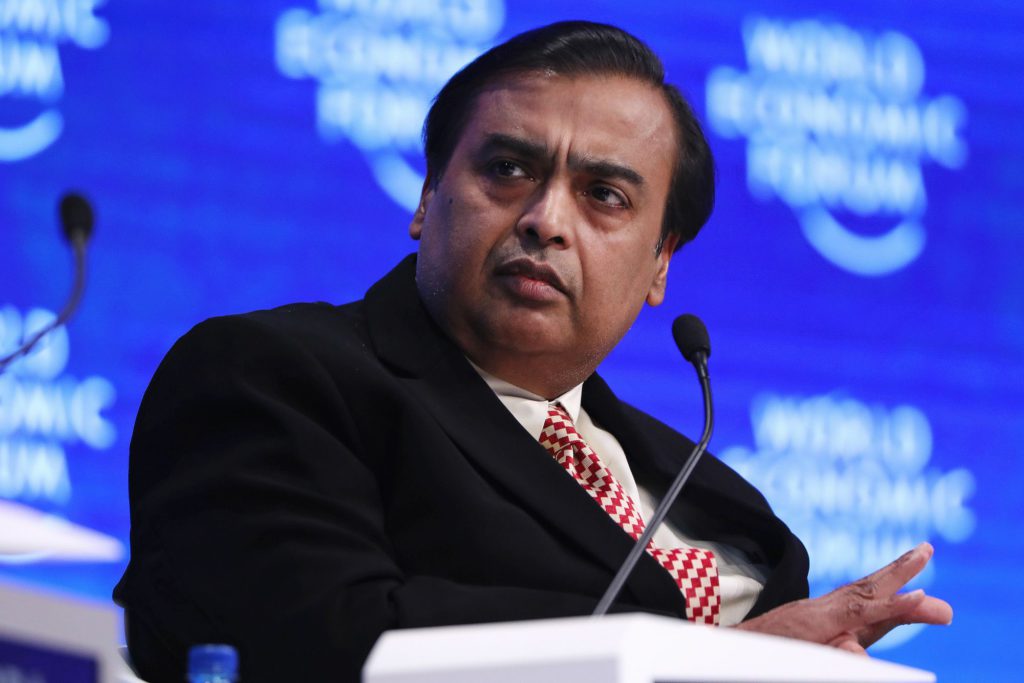
(Bloomberg) — Mukesh Ambani’s once-a-year speech to investors has over time evolved into an eagerly-awaited pronouncement on his $222 billion empire akin to Warren Buffett’s annual letters to Berkshire Hathaway shareholders.

This year, Reliance Industries Ltd.’s investors will be looking for insight on Monday around the company’s 5G rollout, how he plans to unlock the value of his telecom and retail units through separate listings, and when and how his children will take over the reins.

Anticipation is high as the 65-year-old billionaire, who built Reliance into India’s largest company by market value and a powerhouse conglomerate, has used the speech for a series of big announcements. These include the launch of his disruptive telecom service in 2016, Saudi Arabian Oil Co.’s proposed investment in Reliance’s energy business in 2019 and a strategic shift to green energy last year.

This year’s shareholder meeting comes as the refining-to-retail group faces the twin challenges of a global recession and the blistering rise of Gautam Adani, who eclipsed Ambani as Asia’s richest man earlier this year and is emerging as an alternative power center on the corporate landscape.

Reliance investors will have in mind how Adani’s conglomerate split its business into different listings years ago, unlocking value, and will expect “clarity and specific time lines for the next big things” from Ambani’s more-centralized holdings, Kranthi Bathini, equity strategist at WealthMills Securities Pvt in Mumbai. Adani’s wealth has surged $59.8 billion this year, riding the stocks rally and overshadowing the $2.8 billion rise in Ambani’s.

Here’s where investors are expecting news:

Succession 

The patriarch signaled that succession planning atop Reliance will be expedited in last year’s shareholder meet and reiterated it explicitly in December. His three children — daughter Isha and sons Akash and Anant — are already holding various directorships in the group’s unlisted firms and are becoming more visible in their leadership.

Ambani Looks to Walton Family Playbook on Succession

Ambani stepped down as the chairman of Reliance Jio Infocomm Ltd. in June, making way for his elder son, Akash, who took over the helm at India’s largest wireless operator. As rumors keep swirling around Ambani’s health, investors will look for more concrete steps to be taken in leadership transition, with Isha, Anant and possibly his wife, Nita, taking on more responsibility.

5G Rollout

Reliance Jio Infocomm bought airwaves worth over $11 billion at a local spectrum auction as it sought to cement its edge over the smaller rivals — Bharti Airtel Ltd. and Vodafone Idea Ltd. — in the rollout of speedier 5G networks. That will be key to boosting revenues and luring high-value users.

India Sells $19 Billion of Airwaves With Reliance as Top Buyer

Investors will be looking for proof of the pudding here. The technology is yet to return profits for Asian wireless operations despite investing billions of dollars, even for those in China which have been offering 5G service since 2019. Details like a nationwide rollout date, tariff plans for 5G services as well as where demand lies for the service will be crucial for Reliance Jio to reveal.

The Ambani children may demonstrate some of the key features of the 5G services at the meeting, just as they’ve showcased new telecoms products in the past.

Spinoffs, IPOs

The street has been waiting to get better clarity around the initial public offerings of Reliance Jio and Reliance Retail Ltd., especially after the two consumer businesses raked in $27 billion from marquee global investors in 2020.

Ambani Sold a Tech Dream for $27 Billion. Now He Has to Deliver

Both companies are market leaders in their respective sector with a formidable lead over their rivals. Their listings — or even spinoffs — could propel Ambani’s net worth. “The timelines are crucial to get the mojo back for Reliance stock,” Bathini said. Reliance has gained just about 11% this year compared to the more than 40% rise by top performers on the S&P BSE Sensex.

New Energy, Old Energy

The $76 billion pivot toward green energy is the biggest transformation that Ambani is helming currently. It’s also a difficult transition given the conglomerate’s roots in petrochemicals and crude oil refining and the continued out-sized contribution of the fossil fuel-led businesses in Reliance’s yearly revenue.

Ambani Says Green Push to Outshine Other Reliance Businesses

Investors will look for updates around last year’s announced plans to build four giga-factories to make solar modules, hydrogen electrolyzers, fuel cells and storage batteries. Ambani has also been on a tear acquiring small green energy firms globally for expertise and technology. There are also plans to become among the world’s top blue hydrogen makers.

Going Global

Ambani emphasized his vision for the “internationalization of Reliance” in his speech last year. 

In the past year, Reliance has made overtures toward big overseas deals like a potential acquisition of the British drugstore chain Boots, which was never completed. Investors will want to see if the appetite for global acquisitions still exists amid a slowing worldwide economy.

Then there’s always the possibility of a curve ball at the meeting, said Bathini. “Never underestimate the power of senior Ambani” to surprise the market, he said.

(Updates personal wealth gains by Adani, Ambani in fifth paragraph.)

More stories like this are available on bloomberg.com

©2022 Bloomberg L.P.
‘A Lot of Red’: Powell’s Hawkish Pivot to Roil Asian Market Open

(Bloomberg) — Losses loom for Asia’s stock market on Monday as investors absorb Federal Reserve Chair Jerome Powell’s stern message that interest rates are going higher for longer in a painful fight against inflation.

Futures shed almost 2% for Japan and 1.5% for Australia after a 3.4% plunge in the S&P 500 index. The slide was sparked by Powell’s rebuttal of the notion that the trajectory of monetary tightening could soon be tempered. 

Friday’s US slump further shriveled a global bounce in shares from June bear-market lows that was predicated partly on bets of a Fed shift to rate cuts next year as growth slows. Powell spelled out the need for sustained restrictive policy, comments that lifted the US two-year Treasury yield toward 2022’s high and sent investors scurrying to the dollar as a shelter from volatility.

The greenback’s strength could be an impediment for Asia’s markets on Monday. Investor angst was evident over the weekend as Bitcoin flirted with a sustained break below $20,000, a sign of fizzling risk appetite.

Powell was “really hawkish” at Jackson Hole, said Manish Bhargava, a Straits Investment Holdings fund manager in Singapore. There’ll be a “lot of red on Monday” in a fizzling summer rally as money exits emerging markets, he said.

Powell’s comments are a further boost for the dollar, Westpac Banking Corp. and Bank of Singapore analysts said. The latter’s chief economist Mansoor Mohi-uddin said that’s both as a safe haven and higher-yielding carry trade versus lower yielding Group-of-10 currencies like the euro, pound and yen.

“USD/JPY is the most obvious way to play for an increasingly determined Fed, with 140 likely to give way before the September FOMC meeting,” said Sean Callow, Westpac’s senior currency strategist.

The dollar is up over 10% this year while the yen’s 16% retreat leaves it at the bottom of the G-10, a schism reflecting the Bank of Japan’s continuing easy-money stance that Governor Haruhiko Kuroda reaffirmed at Jackson Hole.

Borrowing Costs

But the prevailing message from the symposium was that borrowing costs are going up from the US to Europe to Asia. Officials are combating some of the highest inflation in a generation, stoked by damage to supply chains for energy and components due to Russia’s war in Ukraine and Covid curbs in China. 

“Restoring price stability will likely require maintaining a restrictive policy stance for some time,” Powell told the audience at the Fed’s annual retreat. “The historical record cautions strongly against prematurely loosening policy.”

Investors now see the Fed’s policy rate peaking in March at around 3.80% and pared bets on a decline in 2023. The US yield curve between the five and 30-year maturities inverted for the second time this month, while the gap between the higher two-year yield and the 10-year rate widened.

The inversions suggest the bond market anticipates a recession is the necessary sacrifice to get price pressures back under control.

Hong Kong Catalyst

Jackson Hole overshadowed other developments, including a preliminary deal between Beijing and Washington to allow American officials to review audit documents of Chinese firms that trade in the US. That’s a first step toward averting the delisting of about 200 Chinese companies from US exchanges.

Equity futures for Hong Kong were steady and a gauge of US-listed Chinese shares bucked the worst of the wider Wall Street selloff on Friday.

“The risk of delisting is reducing and I think that’s a catalyst to support Hong Kong’s market,” said Grace Tam, chief investment adviser at BNP Paribas Wealth Management in Hong Kong.

The bigger picture, however, is the Fed’s goal of tightening financial conditions in the world’s largest economy until inflation is visibly defeated. Incoming data on employment and consumer prices will be crucial to gauging progress.

“The game of assessing the Fed outlook has shifted from guessing how high the peak rate might be to also understanding how long it might stay there for,” said Yanxi Tan, FX strategist at Malayan Banking Bhd. in Singapore.

More stories like this are available on bloomberg.com

©2022 Bloomberg L.P.
China Pessimism Prevails as Traders Overlook Key Earnings Beats

(Bloomberg) — Earnings from Chinese firms have shown resilience under harsh lockdowns, but traders are zeroing in on pockets of disappointment and dumping stocks while analysts continue to trim forward estimates.

A number of market heavyweights have seen shares slump after a good earnings show, as investors chose to focus on segment misses or simply used the event as an opportunity to take profit. One striking example was battery giant Contemporary Amperex Technology Co., whose stock slid nearly 6% earlier last week even as a 82% jump in profit trumped estimates.

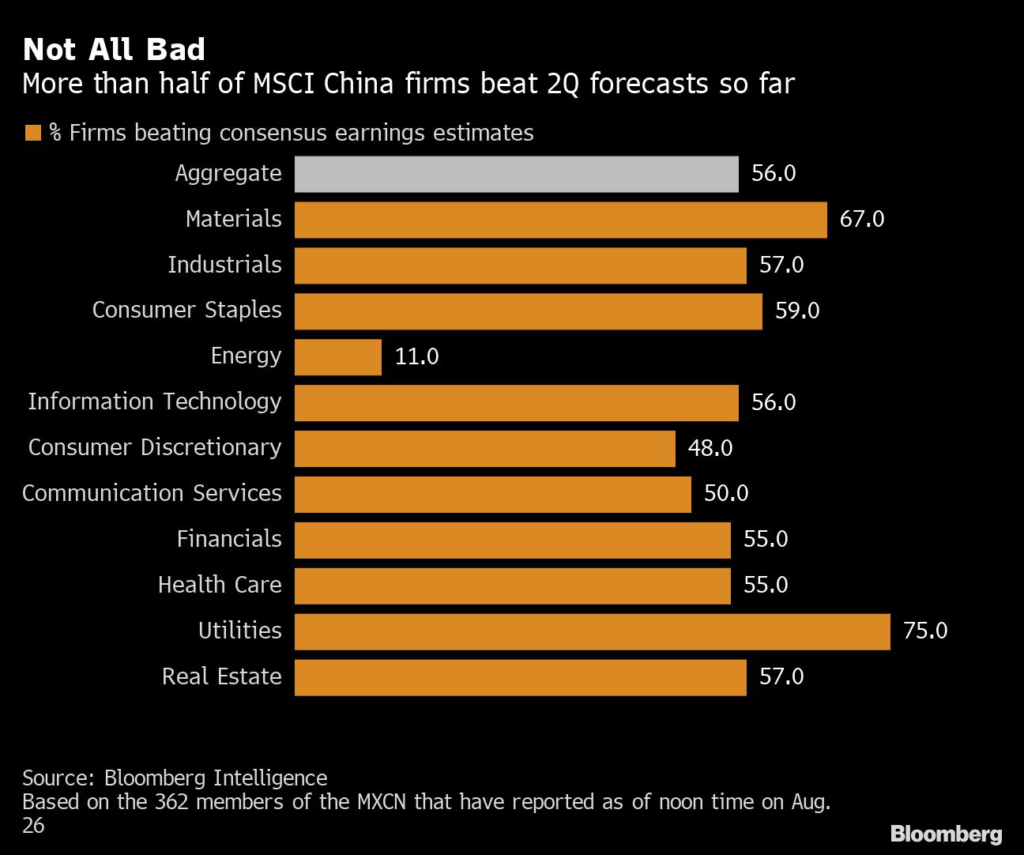
Aggregate earnings per share have delivered an upward surprise of 9.4% for over half of the 715 MSCI China Index members that have reported second-quarter results, as per calculations by Bloomberg Intelligence. While this could have cheered traders bracing for the worst from a quarter when the economy barely grew, the Chinese gauge is down over 3% in the past month, trailing the Asian benchmark’s rise of almost 1%.

That underscores widespread investor pessimism as concerns ranging from the property crisis to a power shortage and persistent Covid outbreaks cloud the outlook for Chinese equities. Even a policy rate cut and fiscal stimulus measures have failed to lift sentiment.

“These are indeed tough times, and with earnings season wrapping up next week and some of the firms waiting until the last minute to spill the bad news, it’s easy to find any kind of excuse to take profit,” said Wang Mingli, executive director at Shanghai Youpu Investment Co. “For some, there doesn’t seem to be enough reasons to buy.”

Twelve-month forward earnings estimates for the MSCI China gauge are set to fall for a third straight quarter. They are down 1.3% since the end of June, after being cut 9% in the previous three months, data compiled by Bloomberg show.

Market Reaction

Shares of CATL, China’s third-largest stock by market value, just capped their biggest weekly drop since early July as a year-on-year decline in battery margins disappointed investors.

Gaming giant NetEase Inc. slumped more than 6% in Hong Kong on Aug. 19 even as Citigroup analysts called its results a “solid beat,” while WuXi Apptec Co., a healthcare sector bellwether, earlier lost 4.4% post a bigger-than-expected 73% jump in profit. 

Similarly, electric-vehicle makers Li Auto Inc. and XPeng Inc. slid despite strong revenue growth that topped estimates, as traders were fixated on conservative delivery guidance for the third quarter.

Thanks to such reactions, there’s not been much of a stock divergence between winners and losers. Overall, firms that beat consensus saw their shares outperform the MSCI China gauge by just one percentage point on average on the first trading day after results, according to Bloomberg Intelligence. That’s versus 1.5 percentage points for the first quarter.

‘Broad-Based Miss’

While earnings for MSCI China have held up well so far, with a heavy tech weighting giving a boost, a Morgan Stanley report showed the number of onshore-listed firms missing consensus is on track to be the biggest since 2018.

Almost 28% of so-called A-share companies that have reported earnings so far have missed consensus, strategists including Fran Chen wrote in a report last week, adding that they see “further room for consensus earnings downward revisions.”

This “broad-based miss” is a clear indication of macro weakness, they wrote.

Share price declines have also been more pronounced for onshore firms. The benchmark CSI 300 Index has fallen 1.5% so far in August, the worst performance among national benchmarks in Asia.  

All of this comes against the backdrop of a deteriorating outlook for China’s economy. Economists surveyed by Bloomberg expect 3.7% growth for this year, far below the official 5.5% target and down from 4% at the end of July.

The equities weakness “could also be due to the fact that the impact of stimulus measures so far has been limited,” said Zhao Yuanyuan, a fund manager at Shenzhen Qianhai JianHong Times Asset Management Co. “Macro data suggests it will be difficult to have a sequential improvement in earnings by the third quarter.”

More stories like this are available on bloomberg.com

©2022 Bloomberg L.P.
Cleveland-Cliffs, United Steelworkers Reach Tentative Contract

(Bloomberg) — Cleveland-Cliffs Inc., the second-largest steel producer in the US, and the United Steelworkers union have reached a tentative labor agreement that will provide improved wages and other benefits to 12,000 workers in six states.

The agreement also includes a commitment by Cleveland-Cliffs to invest $4 billion in United Steelworker represented facilities, the union said Saturday in a press release.

“Our plants will continue to be safer and our jobs and benefits more secure under the proposed agreement,” said USW International Vice President (Administration) David McCall, who has helped lead negotiations with the steel and iron ore maker.

The union didn’t provide details of proposed wage increases or bolstered health insurance provisions for workers and retirees, but said they provide “important economic and contract language improvements that will improve working conditions along with the standard of living for USW members and their families.”

The four-year contract, if ratified by union members, will cover some 12,000 workers at plants in Indiana, Pennsylvania, Ohio, Illinois, West Virginia and Minnesota.

Cleveland, Ohio-based Cleveland-Cliffs also didn’t provide details on the proposed contract, but said the USW is a “partner and ally.”

‘We look forward to sharing in our future success together,” Cleveland-Cliffs Chairman, President and CEO Lourenco Goncalves said in a statement. “This agreement allows us to do just that, while keeping our cost structure highly competitive.”

Cleveland Cliffs this month said auto industry orders are robust, despite the shortage of computer chips, but that construction-sector demand is beginning to soften. The warning came after a key measure of US manufacturing activity weakened to a two-year low while overtime hours declined for three months, the longest downward stretch since 2015.

The USW represents 850,000 men and women employed in manufacturing, from metals to mining and chemicals, as well as public sector and service occupations.

More stories like this are available on bloomberg.com

©2022 Bloomberg L.P.
Bitcoin Drops Below $20,000 as Risk-On Optimism Fades Again

(Bloomberg) — Cryptocurrencies extended losses into the weekend after Jerome Powell warned against prematurely loosening policy, with Bitcoin dipping below the bottom end of the narrow range that it has traded in the past two weeks.

“Powell’s admission that there will be pain before there is relief is rather hawkish,” said Josh Olszewicz, head of research at digital asset fund manager Valkyrie Investments.

The largest cryptocurrency by market shed as much as 4% to $19,833 on Saturday as of 11:43 a.m. in New York, dipping below $20,000 for the first time since July 14 and extending its rout this year to 57%. It has traded in a range between that level and about $22,000 for the past week. 

Ether slid as much as 6.4% to $1,456. Solana and Avalanche fared worse, dropping as much as 6.4% and 7.2%.

Even so, some analysts say that the recent trading pattern presents a buying opportunity: 

  • Onchain metrics “signal that the price is at the accumulation zone, which has been historically market bottom formations and value investing,” CryptoQuant said in a report Thursday.
  • “Friday’s break looks important and negative in the short run but should line up with buying opportunities into early September as cycles remain bullish and project higher prices into November 2022,” Mark Newton, technical strategist at Fundstrat, said in a note Friday.

Powell, the Federal Reserve chairman, signaled the US central bank is likely to keep raising interest rates and leave them elevated for a while to stamp out inflation, and he pushed back against any idea that the Fed would soon reverse course. Low rates are seen as one of the catalysts for pushing investor into crypto during the Covid lockdowns. 

Ether had been outperforming the broader crypto market in recent weeks amid optimism over a pending network software upgrade called the Merge. 

More stories like this are available on bloomberg.com

©2022 Bloomberg L.P.

Social Media Buzz: Crypto, Zuckerberg, Mastriano, Britney Spears

(Bloomberg) — What’s buzzing on social media this morning:

BUZZING CURRENCY:

Bitcoin dipped briefly below $20,000 on Saturday for the first time since July 14, extending its rout this year to 57%, as hawkish comments a day earlier by Federal Reserve Chairman Jerome Powell rippled through global markets. Cryptocurrencies slid after Friday’s speech in which the US central bank signaled it would remain hawkish on policy to get inflation under control. Cryptos including Ether and Avalanche also slid. Despite the tumble, some analysts say the recent trading pattern presents a buying opportunity.

BUZZING COMPANIES:

The FBI said it “routinely notifies US private sector entities, including social media providers, of potential threat information” after Meta Platforms CEO Mark Zuckerberg said Facebook limited distribution of posts about Hunter Biden’s laptop in the days before the 2020 election. The FBI’s Friday press release was issued after a Thursday interview with podcaster Joe Rogan, in which Zuckerberg said the agency “came to us” with a warning to be on high alert for possible Russian misinformation. He said the FBI didn’t warn specifically about the Biden laptop story but that it “fit that pattern.” Meta said on Friday Zuckerberg had revealed the same information in October 2020.

BUZZING HEADLINES:

Doug Mastriano, the Donald Trump-backed Republican candidate for governor of Pennsylvania, donned a Confederate uniform in a 2013-2014 faculty photo at an Army war college, according to a copy of the image obtained by Reuters. The photo was released by the college under a Freedom of Information Act request. Of the nearly two dozen faculty members in the photo, Mastriano was the only one who chose to wear a costume of the Confederacy, Reuters reported. Mastriano, a current state senator who is trailing his Democratic rival in the gubernatorial race, did not respond to the news agency’s requests for comment. 

Britney Spears, months out of a conservatorship and supported by legions of #FreeBritney fans, has debuted a new song with music legend Elton John. Titled “Hold Me Closer,” it’s already gone to the top of the UK and US iTunes charts. 

More stories like this are available on bloomberg.com

©2022 Bloomberg L.P.

Close Bitnami banner
Bitnami