
Bloomberg

Dell Falls Most Since 2018 on Executives’ Demand Concerns

(Bloomberg) — Dell Technologies Inc. fell the most since the company returned to the public markets in December 2018 after executives’ pessimistic remarks about the business environment for the second half of the year outweighed solid quarterly results.

Company leadership talked Thursday about a greater sales challenge ahead for the maker of personal computers, servers and information technology. Co-Chief Operating Officer Chuck Whitten said Dell “observed more cautious customer behavior as the quarter progressed.” Whitten’s co-COO Jeff Clarke said the company is operating “in an increasingly challenging environment.”

In a conference call Thursday, Chief Financial Officer Tom Sweet said revenue in the current quarter will be $23.8 billion to $25 billion — a sales decline of about 8% from a year ago at the midpoint of the estimate. Analysts, on average, projected $26.4 billion.

Still, Dell said its long-term financial models project annual revenue growth of 3% to 4% and an increase of more than 6% in earnings per share. For the full year, Sweet said revenue should range from flat to 2% growth.

The long-range forecast wasn’t enough to overcome investors disappointment with the current outlook. The shares declined 14% to $41.43 at the close Friday in New York, the biggest one-day drop on record, which fueled a fall of 26% this year.

Sales climbed 9% to $26.4 billion in the fiscal second quarter, which ended July 29, in line with estimates. Earnings, excluding some items, were $1.68 share, the Round Rock, Texas-based company said Thursday in a statement. Analysts, on average, projected $1.64, according to data compiled by Bloomberg. 

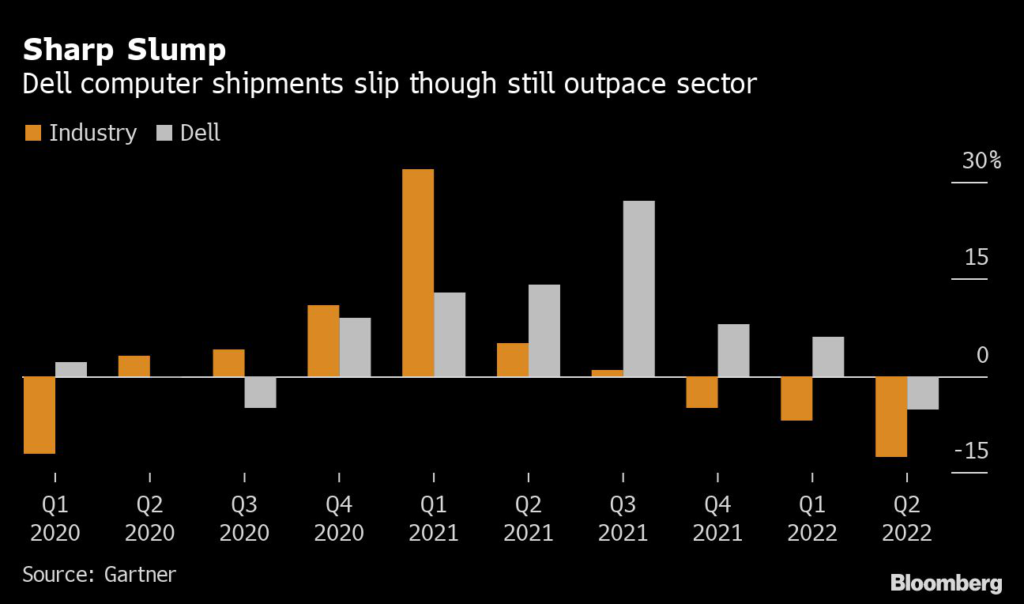
While personal computer sales make up about 60% of Dell’s revenue, the company overcame a downturn in consumer spending with gains among its business clients. Commercial PC sales grew 15% to $12.1 billion while consumer sales dropped 9% to $3.3 billion.

Global PC shipments fell 13% in the three months from April to June — the worst quarter in more than nine years, according to Gartner Inc., an industry analyst. Much of the decline was due to the ongoing downturn in demand for Chromebooks and inflation-squeezed budgets delaying consumer purchases. 

Fiscal second-quarter revenue from the Infrastructure Solutions Group, which includes most of Dell’s technology services, increased 12% to $9.5 billion from a year earlier. Server and networking sales climbed 16% to $5.2 billion, while storage revenue gained 6% to $4.2 billion.

Investors may have been expecting Dell’s infrastructure unit to beat estimates, and share gains heading into the results left little room for a rally, said Woo Jin Ho, an analyst at Bloomberg Intelligence.

“We’re somewhat surprised by (Dell’s) more-muted ISG view, given sturdier results from enterprise IT peers,” he said in a note. “Dell notes elongated purchasing decisions and smaller orders and could be a test case for broader weakness.”

To emphasize the continuing slump in the PC market, Sweet said current-quarter sales in Dell’s PC division are expected to decline by a “high teens” percentage from the period a year ago. Revenue will increase “in the low teens” in the infrastructure unit, where executives “see a more challenging” demand environment, he said.

Supply chain backlogs improved during the quarter for Dell, and backlog-clearing PC sales helped offset demand weakness, Clarke said. However, the backlog for its infrastructure unit, particularly for server components, remained elevated, and component cost inflation is expected in the third quarter, he said.

Gross margins decreased 2 percentage points from a year ago to 21.4%, mainly due to expense increases and currency value changes that haven’t yet been factored into product prices, Sweet said. The company slowed down external hiring as part of an effort to control costs, Sweet said.

Dell ended the quarter with remaining performance obligations of $41 billion, up 2% year-over-year. Recurring revenue was $5.2 billion, a gain of 8% from the period a year earlier. The company said annual recurring revenue for APEX, its cloud management service, is now more than $1 billion.

(Updates with Friday closing shares in the fifth paragraph.)

More stories like this are available on bloomberg.com

©2022 Bloomberg L.P.

Rogers M&A Bond Consent Gains Traction as Challenge Fizzles

(Bloomberg) — Rogers Communications Inc.’s request to extend a deadline to buy back $9.35 billion of bonds may succeed as a challenge from members of an investor group appears to lack the support needed to derail it.

The Toronto-based cable and wireless firm is seeking approval from creditors holding eight series of bonds in dollars and loonies to extend the deadline to complete its acquisition of Shaw Communications Inc. to December 2023. Under the current terms, Rogers has to repay the securities at 101 cents on the dollar if the C$20 billion ($15.4 billion) deal isn’t done by the end of this year.

The investor group holding US dollar-denominated securities wasn’t big enough to create a block in any series of notes, according to an emailed statement sent by bankers at Houlihan Lokey Inc. on Friday. On Thursday, the Credit Roundtable, an industry group representing investors, held a call with its members along with Houlihan and lawyers at Akin Gump Strauss Hauer & Feld LLP.

The Rogers purchase of Shaw has been delayed by Canada’s antitrust regulator, which has sued to block it, arguing that it will damage competition in a telecommunications sector that’s already dominated by a handful of large companies. Rogers and Shaw have agreed to sell most of Shaw’s wireless business to Quebecor Inc. to address those concerns, but the case appears headed to a hearing at the Competition Tribunal, Canada’s merger court. 

Representatives for Rogers, Houlihan, Akin and the Credit Roundtable weren’t immediately available for comment. 

Investors in the US notes would initially be paid a consent fee ranging from $23.50 to $62.60 per $1,000 in face value. They can receive additional fees of $11.45 to $31 if the merger doesn’t close by Dec. 31 and Rogers isn’t forced to repay the notes at that time. Owners of the Canadian notes are eligible for similar fees. 

Investors expressed concerns including that the total consent fees are undervalued, especially since the bonds declined after the consent solicitation was announced at the end of trading on Aug. 22, according to a communication sent by the Credit Roundtable early this week inviting creditors to the Thursday call. Also, the Canadian Bond investors Association said that the fees should be paid to all holders, not merely those who agree to Rogers’ request. 

“We advocate that consent fees be paid to all bond holders that participate in the solicitation regardless of whether they consent to the changes,” the Canadian Bond Investors’ Association said in a statement. “It is our reading of the Rogers consent solicitation that the consent fees will only be paid to bond holders that provide a positive consent.”  

(Adds details of the bond consent from the fourth paragraph.)

More stories like this are available on bloomberg.com

©2022 Bloomberg L.P.
Ukraine Latest: Both Nuclear Plant Units Reconnected to Grid

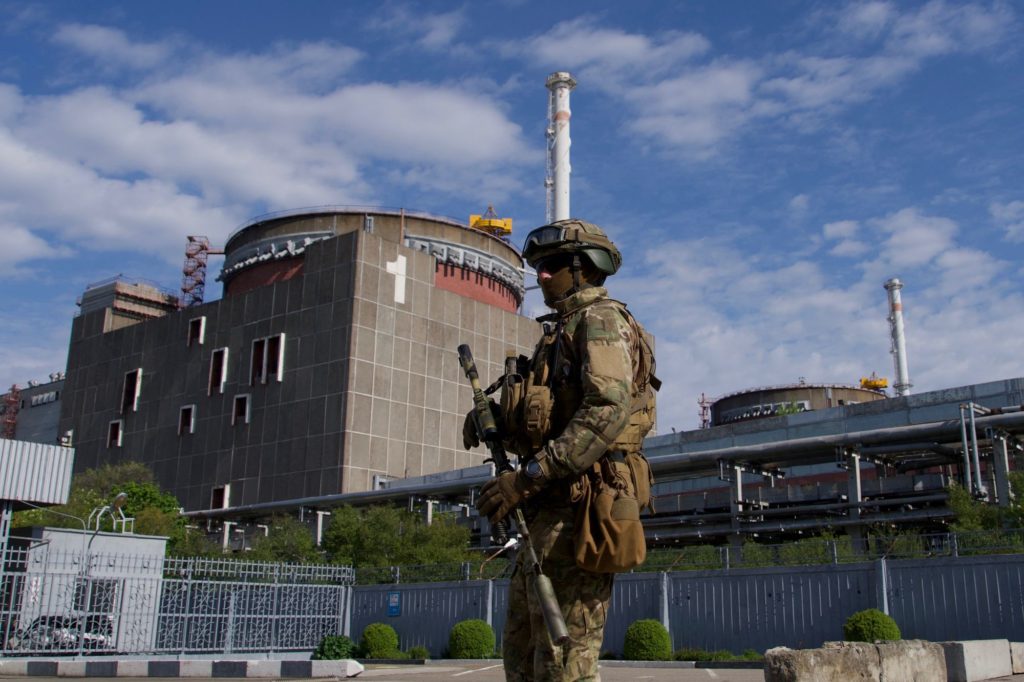
(Bloomberg) — Both power units of the Zaporizhzhia nuclear plant were reconnected to Ukraine’s energy grid after an outage, state-owned operator Energoatom said in a statement.

The first unit was brought back online at around 2 p.m., and the second was restored around 9:15 p.m. The plant is working “despite provocations by occupying Russian forces,” the company said. 

President Volodymyr Zelenskiy has been calling for Russian troops in the area around the plant, in southeastern Ukraine, to withdraw. On Friday afternoon, European Union foreign policy chief Josep Borrell expressed concern about the situation. 

(See RSAN on the Bloomberg Terminal for the Russian Sanctions Dashboard.)

Key Developments

  • Zelenskiy Reinforces Nuclear Warning After Power-Line Disruption
  • Russian Gas Flows to Europe Are at Stable Levels on Friday
  • Germany to Rethink Gas Levy After Outcry Over Energy Profits
  • Why Ukraine Debt Relief Isn’t Matching Funding Needs: QuickTake
  • A Corner of Europe Leans to Live With Power Blackouts Again

On the Ground

Russian forces kept up attempts to conduct an offensive on the Donetsk axis in eastern Ukraine, focusing efforts on areas around Bakhmut and Avdiivka, according to a statement by Ukraine’s General Staff on Facebook. Artillery strikes hit private residences, schools and farms in regions including Donetsk, Chernihiv and Kharkiv, Interfax-Ukraine reported, citing local officials. Seven Russian ammunition depots in southern Ukraine were destroyed this week, said Natalia Humenyuk, a Ukrainian military spokeswoman.

(All times CET)

Russian Corporate Profits Rise 25% (3:00 p.m.)

Profits jumped to 9.5 trillion rubles ($144 billion at the average rate for the period), with the year-on-year increase outpacing the 17% rise in consumer prices over the period, according to Sberbank CIB calculations based on data from the Federal Statistics Service. 

The net income gain came despite sweeping US and European sanctions imposed over the Kremlin’s invasion of Ukraine pushed the economy into recession.

Ukraine Evacuated More Than One Million Donetsk Residents (12:20 a.m.)

Almost three quarters of the population in the Donetsk region have been evacuated, the area’s head Pavlo Kyrylenko said on the regional administration’s You Tube channel. Ukraine controls approximately 45% of the Donetsk region, where about 350,000 residents currently live, Kyrylenko said.

“As of February 24, 1.6 million people lived in the part of the region that was controlled by the Ukrainian authorities,” Kyrylenko said. “Almost three quarters of the region’s population have been evacuated.” Kyrylenko said, adding that all the cities of the region are being shelled permanently.

Hungary Boosts Energy Links with Russia Despite EU Stance (10:55 a.m.)

Hungary issued a key permit for the Russian-led expansion of its sole nuclear power plant, bolstering the nation’s energy links with Moscow even as European Union peers seek to distance themselves over the invasion of Ukraine.

The National Atomic Energy Agency issued an “establishment permit” to build a fifth and sixth nuclear reactor in the city of Paks, next to four existing units whose lifetimes are expiring, according to a statement on the authority’s website. Russia’s state-owned Rosatom Corp. is the lead constructor. In May, Finland scrapped a construction contract with Rosatom.

Zelenskiy Says Ukraine Is Working to Avert Nuclear Accident (9:33 a.m.)

Ukrainian authorities are doing everything possible to prevent an emergency at the Zaporizhzhia nuclear power plant, which has stopped work for the first time after being cut off from the nation’s electricity grid, Zelenskiy said in an address late Thursday.

Zelenskiy called for “tough international pressure” to force occupying Russian forces to withdraw from the plant, which has suffered artillery attacks that both Ukraine and Russia have blamed on each other.

Zelenskiy said he had spoken to US President Joe Biden of the situation and warned that Russia’s actions at the plant risked a nuclear disaster that could affect all of Europe.

Zaporizhzhia Nuclear Plant Remains off Ukraine’s Grid (9:00 a.m.)

All power units of the Zaporizhzhia nuclear plant remained disconnected from the country’s electric grid as of 9 a.m. local time on Friday, state-owned operator Energoatom said on Telegram.

The nuclear plant is being powered via a restored link from Ukraine’s energy system, and transmission lines leading from the plant have also been repaired. Work is under way to reconnect two power units of the plant back to the grid. There are no concerns about equipment and safety systems at the plant, Energoatom said.

Report Details Russian ‘Filtration System’ for People in Donetsk (8:35 a.m.)

Russia has set up a “filtration system” in occupied areas of Ukraine’s Donetsk region which allegedly violates international law, according to a report from Yale School of Public Health’s Humanitarian Research Lab.

Russia and its proxies operate at least 21 facilities in and around the Donetsk region to screen, detain and interrogate people, according to the report based on open-source information and satellite imagery. The system was created weeks before the invasion in February and grew following Russia’s capture of the port city of Mariupol.

Russia dismissed the report. “This is yet another fabrication aimed at discrediting the Russian special military operation,” its embassy in the US said on Telegram. “Russia is committed to observing the international humanitarian law.”

Ukraine Pursues Effort to Ramp Up Food Exports (8:30 a.m.) 

Ukraine has received more than 60 requests for loading grain and agricultural products in the ports of Odesa, Chornomorsk and Pivdennyi as part of the Black Sea Grain Initiative signed almost a month ago between Ukraine, the UN, Turkey and Russia, Infrastructure Minister Oleksandr Kubrakov said on Twitter. 

European Commission head Ursula von der Leyen and UN Secretary General Antonio Guterres said earlier that they will continue to help boost exports from Ukraine.

Japan Looking to Reopen Kyiv Embassy, Asahi Says (8:15 a.m.)

Japan is considering reopening its embassy in Kyiv and sending back staff who had been working from other locations such as Poland since soon after Russia’s invasion of Ukraine started, the Asahi newspaper reported, citing government officials.

Japan’s ambassador to Ukraine has been in Kyiv this week looking at resuming operations, the paper said, adding that Japan has been the slowest among Group of Seven nations to bring diplomatic staff back to the Ukrainian capital.

More stories like this are available on bloomberg.com

©2022 Bloomberg L.P.

S&P 500 Heads Toward Worst Day Since Mid-June: Markets Wrap

(Bloomberg) — Stocks sank as Jerome Powell gave a short and clear message that rates will stay high for some time, pushing back against the idea of a Federal Reserve pivot that could complicate its war against inflation.

Losses deepened in afternoon New York trading, with the S&P 500 heading toward its worst day since mid-June and the tech-heavy Nasdaq 100 tumbling over 3%. Treasury two-year yields — which are more sensitive to imminent policy decisions — rose alongside the dollar. Swaps priced in roughly even odds of a half-point or three-quarter-point hike in September as well as lower chances of rate cuts in 2023.

Hawkish Fedspeak grew louder in the run-up to their Jackson Hole confab as financial conditions eased after a stock rally that began with short covering, restored $7 trillion to values since mid-June — and ironically was also linked to dovish expectations. Another reason cited by traders for Friday’s rout was the concern that a restrictive policy raises the odds of a recession in 2023.

“Powell wants financial conditions to tighten further and wanted the market to know that the Fed is not ready to declare victory over inflation yet,” said Joe Gilbert, portfolio manager at Integrity Asset Management. “He also renounced any prospects of interest rate cuts soon. The market is repricing this prospect.”

Powell reiterated that another “unusually large” hike could be appropriate next month, though he stopped short of committing to one, adding that the decision will depend on incoming data. Ahead of his speech, several officials emphasized the central bank is in no way done, with Kansas City Fed Chief Esther George noting that the destination of the federal funds rate may be higher than markets are currently priced for.

Former US Treasury Secretary Lawrence Summers handed out some rare praise for the Fed saying Powell’s latest pledge to restrain inflation was a “statement of being resolute.” He said the policy maker “did what he needed to do” and that it was clear the Fed’s “overwhelming priority” is pulling back inflation from the fastest pace in four decades.

Investors are rushing out of stocks and bonds alike as they worry about the economic risks from the Fed pressing on with rate hikes, according to Bank of America Corp. strategists.

Global equity funds had outflows of $5.1 billion in the week through Aug. 24, with US stocks seeing their first redemptions in three weeks, according to a note from the bank, citing EPFR Global data. Rate-sensitive technology funds posted their largest exodus since November 2021, while high-yield bonds led redemptions of $800 million from global bond funds. About $600 million left gold, the data show.

Data Friday showed consumer spending rose less than expected as a key inflation metric turned negative. US consumer sentiment rose more than expected in August as year-ahead inflation expectations eased, suggesting Americans are growing more optimistic as gas prices continue to drop.

Some of the main moves in markets:

Stocks

  • The S&P 500 fell 2.6% as of 2:31 p.m. New York time
  • The Nasdaq 100 fell 3.3%
  • The Dow Jones Industrial Average fell 2.3%
  • The MSCI World index fell 2%

Currencies

  • The Bloomberg Dollar Spot Index rose 0.4%
  • The euro was little changed at $0.9966
  • The British pound fell 0.7% to $1.1747
  • The Japanese yen fell 0.7% to 137.38 per dollar

Bonds

  • The yield on 10-year Treasuries was little changed at 3.03%
  • Germany’s 10-year yield advanced seven basis points to 1.39%
  • Britain’s 10-year yield declined one basis point to 2.60%

Commodities

  • West Texas Intermediate crude rose 0.7% to $93.20 a barrel
  • Gold futures fell 1.2% to $1,750.10 an ounce

More stories like this are available on bloomberg.com

©2022 Bloomberg L.P.

Zuckerberg Vents to Joe Rogan About Content-Moderation Mistakes

(Bloomberg) — Facebook co-founder Mark Zuckerberg sought to explain some of the company’s more complicated policy issues this week during an interview with podcast host and martial arts commentator Joe Rogan. 

During the podcast, which lasted nearly three hours, Zuckerberg spoke about the “trade offs” that come with trying to moderate a platform with billions of users, pages and posts. It’s not a responsibility Zuckerberg said he enjoys or set out to undertake, as chief executive officer of  Meta Platforms Inc., which owns Facebook, Instagram, WhatsApp and Messenger. The company tries to balance taking down as much bad content as possible while realizing that the more aggressive they are the more likely it means they will remove something by mistake, he said.

Those mistakes “suck,” Zuckerberg admitted. “It sucks though I think in the same way that probably having to go through a criminal trial but being proven innocent sucks,” he added. 

Rogan asked Zuckerberg about Facebook’s handling of a potentially damaging news story about Joe Biden’s son, Hunter, just before the 2020 election. Facebook cut the article’s distribution by tweaking its algorithms, Zuckerberg said. The company did so because of warnings it had received from the FBI about Russian propaganda. The FBI told Facebook, “you should be on high alert” for a data dump from Russia, Zuckerberg said. “Depending on what side of the political spectrum, you either think we didn’t censor enough or censored it way too much,” he said. 

Zuckerberg went on Rogan’s podcast to help promote the metaverse, his vision for the future of the internet that includes a series of virtual worlds where people will work and play as digital avatars. Zuckerberg also spoke about Meta’s plans for augmented reality glasses, which he expects will eventually be a major way to interact with the metaverse. Last year Meta launched a pair of “smart glasses” with Ray-Ban, but those don’t yet have augmented reality technology. 

More stories like this are available on bloomberg.com

©2022 Bloomberg L.P.
Texas Crypto-Mining Rush May Need as Much Power as Entire State of New York

(Bloomberg) — Crypto currency miners are accelerating their push to expand in Texas far beyond what authorities had initially expected, threatening to send the state’s electricity use skyrocketing.

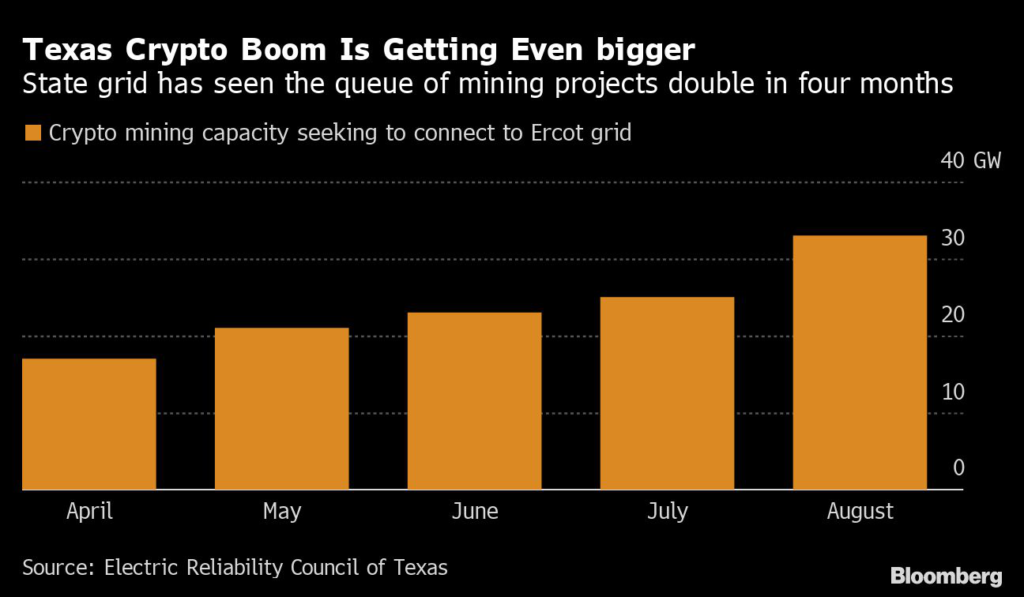
Enough miners have applied to connect to Texas’s power grid to use up to 33 gigawatts of electricity, the Electric Reliability Council of Texas, which runs the system, said in an email Friday. That’s a third more than what the grid operator’s chief executive officer said in April that officials were preparing to handle over the next decade. It’s also enough to power all of New York State.

A spokeswoman for the grid operator, known as Ercot, said officials expect to have enough power plants available to meet any rise in demand. The miners will need approval from Ercot before connecting to the grid.

The surging interest underscores how appealing Texas remains to crypto miners, even as the value of Bitcoin has plunged more than 50% in the past year. And while many of those miners may never actually set up shop, the shear number applying raises questions over whether the state’s grid, which collapsed during a deadly 2021 winter storm, will be able to meet the demand for electricity.

Also See: Texas Crypto Group Says Miners Apply for More Sites Than Needed


Also Read: Texas Grid’s Review of Crypto Miners Connection May Take Months

Crypto miners currently account for about 1.2 gigawatts of electricity demand in Texas, according to the Texas Blockchain Council, which represents miners. That’s enough to power about 240,000 homes. Over the past four months, the numbers of miners applying to plug into the grid has doubled. 

The state has aggressively recruited miners, touting its cheap power, abundant renewable energy and business-friendly regulatory environment. Texas has some of the cheapest electricity rates for big consumers, averaging about 7.57 cents per kilowatt-hour in June, a third lower than the national average, according to the US Energy Information Administration. It also has more wind power than any other state, which is appealing to miners pushing to appear more environmentally friendly.  

In April, Ercot’s interim CEO Brad Jones said he was working with miners to prepare the grid to handle about 25 gigawatts of crypto demand over the next decade. When asked if Texas aims to be the world’s largest mining center, he replied: “Yeah, that’s what we are planning.”

Crypto miners say they can actually help stabilize Texas’s grid by soaking up excess power from wind and solar farms during the day, then shutting down when demand spikes and the grid needs power. Nearly all of the state’s miners ceased operations during heat waves earlier this summer when Texas power demand soared to all-time highs, according to the Texas Blockchain Council. 

While miners typically pay up front for certain infrastructure to connect to the grid, the additional demand will likely require more expansive upgrades that critics say will raise costs for households and other businesses.

Also See: Incentives to Big Power Conservers Help Texas Grid Beat the Heat

More stories like this are available on bloomberg.com

©2022 Bloomberg L.P.
Bitcoin Drops for Second Week; Ether Merge Mania Fades Again

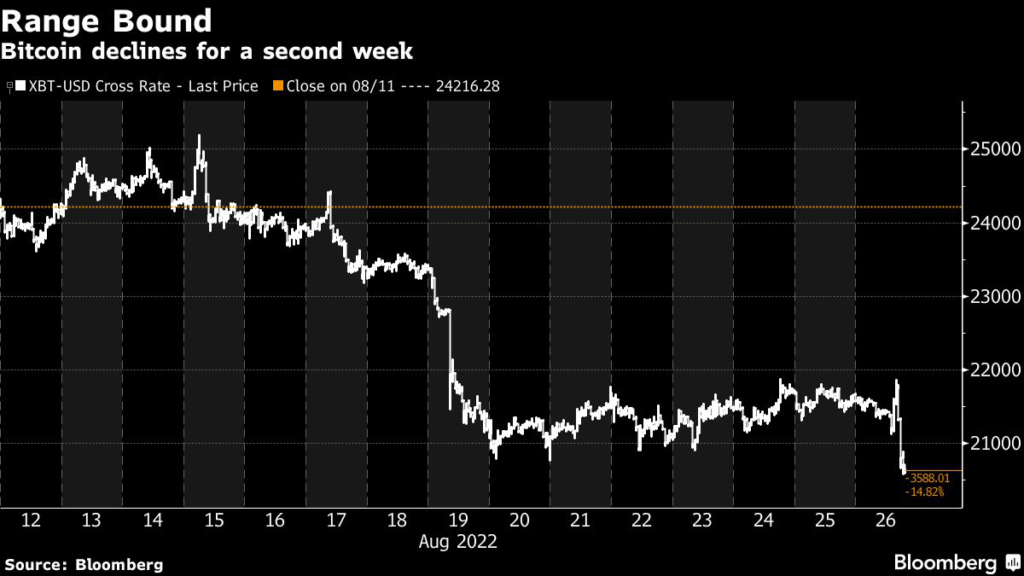
(Bloomberg) — Cryptocurrencies mirrored global markets and declined after Jerome Powell warned against prematurely loosening policy, with Bitcoin settling into the lower end of the narrow range that it has traded in the past two weeks. 

“Powell’s admission that there will be pain before there is relief is rather hawkish,” said Josh Olszewicz, head of research at digital asset fund manager Valkyrie Investments.

The largest cryptocurrency by market slumped as much as 4.9% to $20,579 in New York, putting it on pace for a second consecutive weekly loss. It has traded in a range of around $22,000 to $20,000 since last Friday. Ether fell for the first time in four trading sessions, and was also lower for a second week. Solana and Avalanche fell more. 

Even so, some analysts say that the recent trading patten presents a buying opportunity. 

Onchain metrics “signal that the price is at the accumulation zone, which has been historically market bottom formations and value investing,” CryptoQuant said in a report Thursday.

Powell, the Federal Reserve chairman, signaled the US central bank is likely to keep raising interest rates and leave them elevated for a while to stamp out inflation, and he pushed back against any idea that the Fed would soon reverse course. Low rates are seen as one of the catalysts for pushing investor into crypto during the Covid lockdowns. 

Ether had been outperforming the broader crypto market in recent weeks amid optimism over a pending network software upgraded called the Merge. 

More stories like this are available on bloomberg.com

©2022 Bloomberg L.P.

EA Pares Gains After Retraction of Report on Amazon Prepping Bid

(Bloomberg) — Electronic Arts Inc. found itself the subject of takeover speculation on Friday, sending its shares up as much as 16% in early trading before the report was walked back and other news outlets refuted the possibility of an imminent deal.

A report published in USA Today by GLHF — a gaming and esports site and content partner of USA Today’s For the Win column —  said Amazon.com Inc. could announce as soon as Friday an offer to acquire EA, the publisher of hit games Apex Legends, FIFA and Madden titles. The news sent EA’s shares surging early Friday morning before David Faber cast doubt on the report on CNBC following its publication. Later, USA Today added a note at the top of the original story saying that it “violated our editorial standards regarding the use of unnamed and unvetted sources,” and the language about a pending announcement had been removed.

EA and Amazon declined to comment on the report. EA shares were up 4.9% at 11:56 a.m. in New York, valuing the Redwood City, California-based company at $37 billion.

It has been a banner year for deals in the video game industry, from Microsoft Corp.’s pending $69 billion purchase of Activision Blizzard Inc. to Take-Two Interactive Software Inc.’s acquisition of Zynga for $11 billion. The sector boomed during the pandemic and, although sales have slowed this year, gaming companies are still seen as attractive sources of long-term revenue thanks to titles that can be monetized for years after they launch. Live-service games, which are continuously updated over time, and microtransactions made within games accounted for 71% of EA’s revenue last fiscal year.

Amazon, too, has been on the hunt for deals this year, despite already being under intense antitrust scrutiny. Earlier this month, Amazon announced an agreement to buy iRobot Corp. for $1.65 billion, coming on the heels of a $3.49 billion deal just two weeks earlier to buy the One Medical chain of doctors offices.

With the consolidation in the gaming industry, EA has long been suspected of being a takeover target. Amazon, Apple Inc. and Walt Disney Co. have been mentioned as potential suitors. 

Known for its Star Wars and sports games, EA has yet to release any major new titles this year and is still grappling with fallout from Battlefield 2042, which debuted last November to mediocre reviews and poor fan reception.

Amazon has failed to make much of an impact in gaming on its own, even after hiring industry veterans and buying the video game streaming service Twitch. EA has a suite of live-service titles such as Apex Legends and The Sims that could be appealing to the tech giant, especially after Netflix Inc.’s success with shows such as The Witcher and Arcane, which have been built around big video games. A deal could give Amazon franchises from the popular role-playing game developer BioWare such as Dragon Age, which is set for a Netflix animated series that was teased earlier this year.

EA has also dominated the sports sphere and regularly releases the most popular soccer and football games. Its FIFA franchise — which will no longer be officially associated with the world football governing body following this year’s release — sells millions of copies a year. It generates even more revenue with its FIFA Ultimate Team microtransactions, which brought in $1.62 billion during the company’s 2021 fiscal year. 

More stories like this are available on bloomberg.com

©2022 Bloomberg L.P.

Airstrike on Ethiopia’s Tigray Region Leaves Four People Dead

(Bloomberg) — At least four people died in an airstrike on the capital of Ethiopia’s Tigray province, as the government warned of impending attacks on the military installations of rebellious fighters in the northern region.

Among those killed were two children, Fasika Amdeslasie, a surgeon at the Ayder Referral Hospital in the city of Mekelle, said Friday. An aircraft dropped bombds on a civilian residential area and a kindergarten, according to a statement posted on Twitter by Kindeya Gebrehiwot, a member of the TPLF’s central committee.

Selamawit Kassa, state minister of Ethiopia’s Government Communication Service, declined to comment, while Billene Seyoum, spokeswoman for Prime Minister Abiy Ahmed, didn’t immediately respond to a request for comment sent by text message.

Fighting between Ethiopian troops and Tigray forces erupted on Aug. 24, ending a five-month humanitarian cease-fire. The truce in March halted 16 months of conflict that displaced millions of people and left most of Tigray without power or reliable communications.

The resumption of fighting will hamper efforts by Ethiopia’s government to improve relations with international financiers, as it awaits an International Monetary Fund loan amid efforts to revamp its debt. The nation’s eurobonds have slumped since hostilities started on Wednesday, with the yield on its 2024 debt up more than 300 basis points to 36.06% by Friday.

Read: End of Ethiopia Truce May Undermine Financing Talks: Eurasia

It was unclear if Friday’s airstrike was carried out by a drone or a fighter jet. Drone strikes earlier in the conflict killed hundreds of civilians in the Tigray region.

Ethiopia’s government warned on Friday it’s planning to take action against military forces in Tigray who oppose efforts to bring peace to the war-torn area.

“We call upon our people living in the Tigray region to stay away from the areas where the Tigray People’s Liberation Front’s military equipment and training facilities are located,” the government said in a statement posted on Twitter.

World Health Organization Director-General Tedros Adhanom Ghebreyesus on Thursday criticized the international community for not paying sufficient attention to the suffering of the people in Tigray — the second time in a weak he’s spoken out about the issue.

“Six million lives doesn’t matter?” said Tedros, an ethnic Tigrayan. “The only thing we are asking is: can the world come back to its senses and uphold humanity?”

More stories like this are available on bloomberg.com

©2022 Bloomberg L.P.

Stocks Tumble as Powell Throws Cold Water on Pivot: Markets Wrap

(Bloomberg) — Stocks slumped after Jerome Powell gave a short and clear signal that rates will stay high for some time, pushing back against the idea of a Federal Reserve pivot that could complicate its war against inflation.

In a volatile day, the S&P 500 erased the rally notched in the session leading up to the Fed Chair’s speech in Jackson Hole, Wyoming. Treasury two-year yields — which are more sensitive to imminent policy decisions — rose alongside the dollar.

Powell reiterated that another “unusually large” hike could be appropriate next month, though he stopped short of committing to one, adding that the decision “will depend on the totality of the incoming data and the evolving outlook.” Ahead of his speech, several officials emphasized the central bank is in no way done, with Kansas City Fed Chief Esther George noting that the destination of the federal funds rate may be higher than markets are currently priced for.

Futures contracts referencing the Fed’s September policy meeting priced in 63 basis points of tightening — giving roughly even odds to a half-point or three-quarter-point hike. Before Powell’s keynote, the September meeting-dated swap contract priced in 59 basis points of tightening. The amount of additional tightening priced in for this year increased to 1.32 percentage points from 1.29 percentage points. Traders priced in lower odds of rate cuts in 2023 to around 34 basis points via the contracts.

“Powell wants financial conditions to tighten further and wanted the market to know that the Fed is not ready to declare victory over inflation yet,” said Joe Gilbert, portfolio manager at Integrity Asset Management. “He also renounced any prospects of interest rate cuts soon – the market is repricing this prospect and unwinding the moves from yesterday. Overall, hawkish but not surprising.”

Data Friday showed consumer spending rose less than expected as a key inflation metric turned negative. US consumer sentiment rose more than expected in August as year-ahead inflation expectations eased, suggesting Americans are growing more optimistic as gas prices continue to drop.

The sharp rebound in stocks has faltered as investors fretted over a potential recession, with Fed officials signaling they will stay hawkish to fight historic inflation. Global equity funds had outflows of $5.1 billion in the week through Aug. 24, with US stocks seeing their first redemptions in three weeks, according to a note from Bank of America Corp., citing EPFR Global data.

Some of the main moves in markets:

Stocks

  • The S&P 500 fell 1.9% as of 11:34 a.m. New York time
  • The Nasdaq 100 fell 2.5%
  • The Dow Jones Industrial Average fell 1.6%
  • The Stoxx Europe 600 fell 1.7%
  • The MSCI World index fell 1.5%

Currencies

  • The Bloomberg Dollar Spot Index rose 0.2%
  • The euro rose 0.2% to $0.9995
  • The British pound fell 0.5% to $1.1774
  • The Japanese yen fell 0.6% to 137.26 per dollar

Bonds

  • The yield on 10-year Treasuries was little changed at 3.03%
  • Germany’s 10-year yield advanced seven basis points to 1.39%
  • Britain’s 10-year yield was little changed at 2.61%

Commodities

  • West Texas Intermediate crude fell 0.3% to $92.27 a barrel
  • Gold futures fell 1.3% to $1,747.70 an ounce

More stories like this are available on bloomberg.com

©2022 Bloomberg L.P.

Close Bitnami banner
Bitnami