

Bloomberg

T-Mobile Will Tap Musk’s Satellites for New Remote Phone Service

(Bloomberg) — T-Mobile US Inc. is partnering with Elon Musk’s SpaceX to offer wireless phone service in remote parts of the US where coverage is spotty. 

Musk and T-Mobile Chief Executive Officer Mike Sievert announced the partnership at an event Thursday evening at SpaceX’s Starbase in Boca Chica, Texas. The service will launch next year and work with existing phones for free on the company’s most popular plans, rolling out in stages, Sievert said. Customers on lower-priced plans may pay an extra fee.

Musk said the service, which leverages SpaceX’s Starlink satellites, should be able to handle messages, images and possibly small video files, but warned that transmissions may take as long as half an hour early in the roll-out. Voice capabilities will come later. 

MORE: How Musk Plans to Kill Off Cellphone Dead Zones Across the US

SpaceX is designing special antennae that will be attached to the company’s second-generation internet satellites to allow T-Mobile customers to connect, he said. The V2 satellites will launch on SpaceX’s Starship rocket, which is still in development.

Musk said the satellite-based service will work even during hurricanes and natural disasters that knock out traditional cell phone towers. He said it will ultimately save the lives of people injured or stranded in remote parts of the world.

The billionaire added that SpaceX is offering an “open invitation” to other carriers to work with Starlink. The service may ultimately work in space.

“We’d love to have T-Mobile on Mars,” he said.

Musk later tweeted the service will be added to Tesla Inc. vehicles to allow drivers to make emergency calls and texts.

Shares of T-Mobile slipped 0.1% at 9:48 a.m. in New York. 

The initial business model for SpaceX’s Starlink division was to provide broadband internet service to homes, particularly in rural areas not served by landline providers. The company has a fleet of about 2,800 satellites in low-Earth orbit which it’s launched in the last few years. 

T-Mobile is building one of the nation’s largest 5G networks to provide faster internet connections to phones and homes. 

Their move rivals fellow billionaire Amazon.com Inc.’s Jeff Bezos’ low-Earth orbit satellite subsidiary Kuiper Systems LLC, which announced a similar agreement with Verizon Communications Inc. last year. Amazon.com’s Project Kuiper made one of the largest launch deals ever in April to send more than 3,000 satellites into space. 

(Updates with T-Mobile shares in ninth paragraph.)

More stories like this are available on bloomberg.com

©2022 Bloomberg L.P.
Traders Flee China ETF at Record Pace Amid Headwinds: Tech Watch

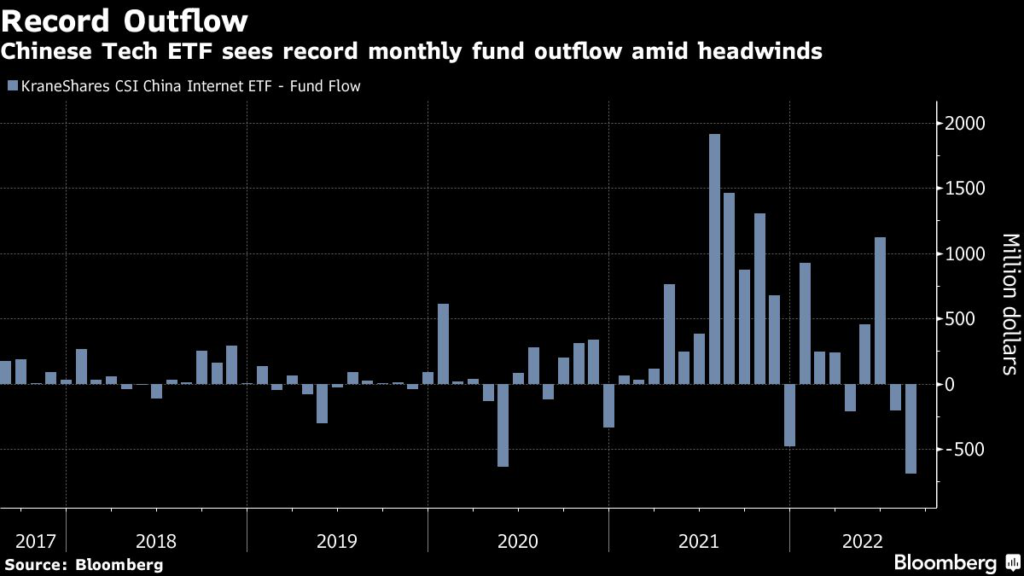
(Bloomberg) — Investors are offloading their holdings of Chinese technology shares at a record pace as worries over higher inflation coupled with dimming growth prospects hurt outlook for the sector.

The KraneShares CSI China Internet ETF has seen outflows of almost $700 million this month, according to Bloomberg data, on track to be the worst month ever for the US-traded fund. Similarly, the CSOP Hang Seng Tech Index ETF in Hong Kong is on track for the smallest monthly inflow since April 2021, which was the last time traders pulled money out of the fund.

Investors are bailing out even after tech stocks surged from their March lows and China’s biggest companies in the industry reported better-than-feared second-quarter earnings, which many analysts marked as the low point following Covid lockdowns. News this week that Chinese regulators are progressing in talks with their American counterparts to avoid US delistings will do little to turn around sentiment, some investors say. 

If the audit spat gets resolved, there is still a “laundry list of issues that have undermined investor sentiment towards China stocks — so this would be resolution of only one of those issues,” said Chetan Seth, Asia Pacific equity strategist at Nomura Holdings Inc.

While the Nasdaq Golden Dragon Index and the Hang Seng Tech Index have surged from their March lows, that’s barely put a dent in the epic rout that started some 18 months ago after Beijing’s regulatory crackdown escalated. The outflows in August took place despite vows by regulators to boost support for the economy through various stimulus measures.

“We would be looking at the following inflection points, including an improving China macro, policy and regulatory backdrop that would boost sentiment around China,” said Pruksa Iamthongthong, senior investment director of Asian equities at Abrdn, which remains underweight on the sector.

There’s also the problem of catalysts. Even when the economy recovers, investors have already changed their valuation models and thinking when it comes to Chinese tech firms. The regulatory crackdown caused firms to downsize and trim non-core businesses, which has stemmed growth after years of unfettered expansion.

Alibaba Group Holding Ltd.’s Hong Kong shares, for example, are trading at about 12.5 times its estimated earnings for the next year. That’s even cheaper than utility firm CLP Holdings Ltd.’s 15.7 times and Hong Kong & China Gas Co.’s 20 times multiples, Bloomberg data showed. 

“The market is valuing this sector differently,” said Jessica Tea, senior investment specialist for Greater China equities at BNP Paribas Asset Management. “Some of those participants in this sector are becoming more mature, so we think that this sector’s golden age is probably over.”

Tech Chart of the Day

The Nasdaq 100 has rallied 18% from its June 16 low, but there are nine components that have lost out on this rebound. Zoom Video Communications Inc. is down 19% as the software maker’s transition from an essential Covid-era tool to an enterprise business platform proves more difficult than anticipated. It’s followed by Match Group Inc. and Intel Corp., both of which issued disappointing forecasts this month. The tech-heavy gauge was trading slightly lower on Friday. 

Top Tech Stories

  • T-Mobile US Inc. is partnering with Elon Musk’s SpaceX to offer wireless phone service in remote parts of the US where coverage is spotty.
  • Dell Technologies Inc. fell in premarket trading after executives’ pessimistic remarks about the business environment for the second half of the year outweighed solid quarterly results.
  • Marvell Technology Inc., a maker of chips for data centers, networking and other equipment, fell in premarket trading after a weaker-than-expected sales forecast fueled concerns about a slowdown in the semiconductor industry.
  • Xiaomi Corp. is in talks with Beijing Automotive Group Co. to collaborate on producing electric vehicles, according to people familiar with the matter, as the technology company races to fulfill a promise to make its own cars by 2024.
  • Chinese technology shares headed for a second day of gains after talks between Beijing and Washington to avoid the delisting of companies in New York was said to show signs of progress.
  • Everbridge Inc., an enterprise software company, is exploring strategic options including a sale, according to people with knowledge of the matter.
  • Twitter Inc. was ordered to hand over more information about spam and bot accounts to Elon Musk as part of its legal fight to make the billionaire complete his $44 billion acquisition of the social-media platform.
  • Chinese food-delivery titan Meituan reported a better-than-expected 16% increase in quarterly revenue, after appetite for meal takeout remained largely intact despite an economic downturn and Covid-related disruptions.

(Updates stock moves in last paragraph.)

More stories like this are available on bloomberg.com

©2022 Bloomberg L.P.

Open Text Strikes Biggest Deal With Micro Focus at 99% Premium

(Bloomberg) — Canada’s Open Text Corp. agreed to buy UK software firm Micro Focus International Plc for about $6 billion including debt, building on a strategy of growth by acquisition with its largest deal yet. 

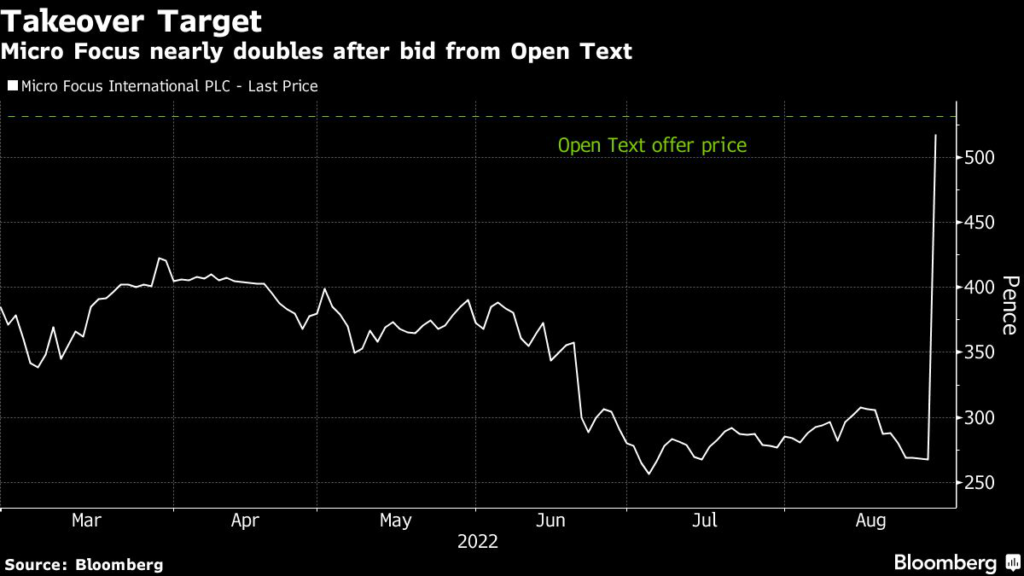
The Waterloo, Ontario-based company is offering 532 pence per share, a 99% premium to Thursday’s closing price. Micro Focus soared 94% to 521 pence as of 2:08 p.m. London time on Friday. 

It’s Open Text’s largest acquisition to date, according to BMO Capital Markets, and the firm doesn’t plan to issue equity to fund it. Instead, it intends to raise $4.6 billion in new debt, draw $600 million from an existing credit line and use cash on its balance sheet. The shares dropped as much as 10% in US premarket trading. 

FIRST WORD: Open Text Falls as Analysts Mull Micro Focus Deal: Street Wrap

Newbury, UK-based Micro Focus sells enterprise software to thousands of organizations including Airbus SE, Hewlett Packard Enterprise Co. and Kellogg Co., according to its website. Its products help companies with cybersecurity, IT operations management, communications and messaging. Micro Focus says it does business with a majority of the Fortune Global 500. 

But the company has seen declines in its revenue and adjusted earnings before interest, taxes, depreciation and amortization every fiscal year since 2018. 

“We expect Micro Focus to be a multiyear turnaround story,” CIBC analyst Stephanie Price said in a note to investors that downgraded the stock to neutral and cut the price target to $44 from $51. “We see upside if Open Text is able to turn the Micro Focus business around faster than expected.”

$170 Billion Market 

Under Chief Executive Officer Mark Barrenechea, Open Text has made a series of deals to bolster its software portfolio in recent years, including email encryption company Zix Corp. and cybersecurity firm Carbonite Inc. 

The Micro Focus acquisition is notable for its relative size: it’s worth nearly half of Open Text’s current enterprise value of more than $12 billion, according to data compiled by Bloomberg. 

“Micro Focus brings meaningful revenue and operating scale to OpenText, with a combined total addressable market of $170 billion,” Barrenechea said in a statement. “With this scale, we believe we have significant growth opportunities and ability to create upper quartile adjusted Ebitda and free cash flows.”

In an interview with Bloomberg last year, Barrenechea bemoaned the price of deals, saying the company’s desired targets were “too expensive, too overvalued.” The correction in technology stocks has brought valuations down quickly. 

Open Text is paying 2.2 times Micro Focus’s pro forma revenue for the past 12 months. The company said it sees the deal closing in the first quarter of 2023. 

Bloomberg first reported Open Text’s interest in Micro Focus in 2019. 

(Updates shares, adds analyst comment from CIBC.)

More stories like this are available on bloomberg.com

©2022 Bloomberg L.P.
Biden Administration Urged to Probe Worker-Monitoring Technology

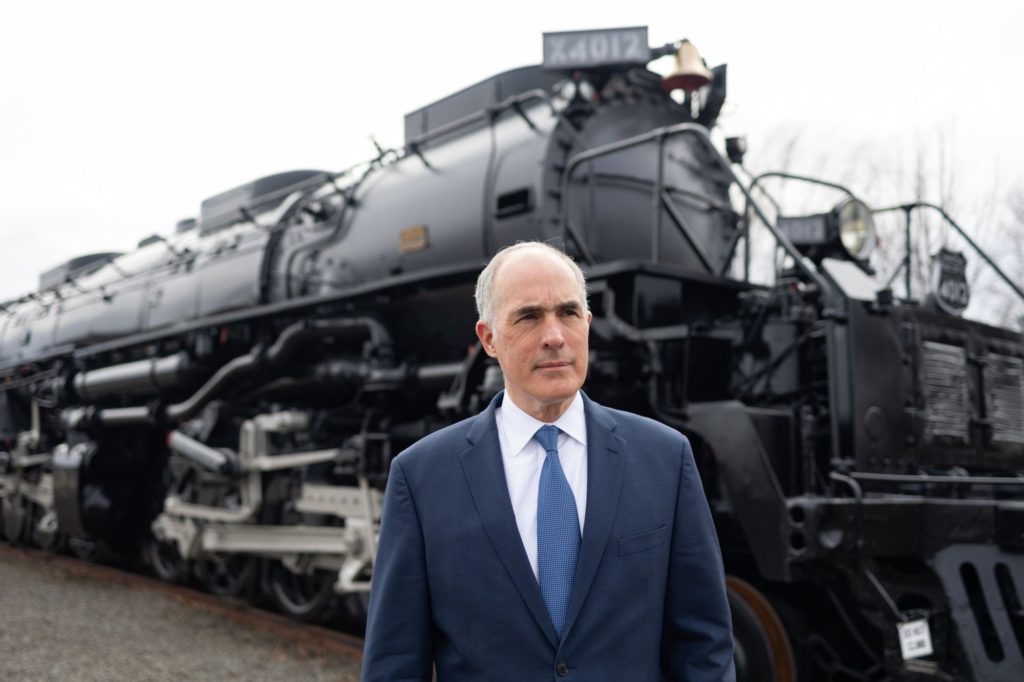
(Bloomberg) — The Biden Administration should investigate and regulate how companies use technology to surveil and punish workers, a Democratic senator urged in a letter to the US labor secretary.

“The implementation of novel technologies to track, monitor, manage and discipline workers is growing due to an imbalance of power in the workplace and a lack of legal protections or regulatory restrictions on these behaviors,” US senator Bob Casey wrote Friday to Secretary Marty Walsh. The letter urged the Labor Department to take on “the largely unchecked spread of invasive and exploitative workplace surveillance and technologies across the United States.”

Casey’s missive cited a 2021 Bloomberg News article detailing complaints from Amazon.com Inc. Flex delivery drivers, who said performance-tracking algorithms unfairly penalized and even terminated them while ignoring real-world hurdles such as traffic jams and locked apartment complexes. The gig drivers also said they had little recourse beyond sending emails to generic support addresses that seldom responded to their specific concerns. (Amazon said their experiences were unrepresentative and that all appeals from drivers are investigated.) 

The Pennsylvania Democrat’s letter also cited a recent New York Times investigation into the spread of workplace productivity monitoring, which is now used to assess workers including lawyers, therapists and chaplains.

Casey, a former state auditor general and treasurer who sits on the Senate’s Health, Education, Labor and Pensions committee, urged the Labor Department to study “novel and high-risk technologies” such as “facial and emotional recognition, biometric monitoring, wearables, productivity management systems and algorithm-driven employee performance systems,” which he said could harm employees’ physical or mental health. 

He suggested the agency follow the example of the Federal Trade Commission, which earlier this month announced it was “exploring rules to crack down on harmful commercial surveillance and lax data security.”

Amazon and the Labor Department didn’t immediately respond to requests for comment.

More stories like this are available on bloomberg.com

©2022 Bloomberg L.P.
Futures Waver, Yields Rise Before Powell’s Keynote: Markets Wrap

(Bloomberg) — Stock futures fluctuated and bond yields rose ahead of Federal Reserve Chair Jerome Powell’s much anticipated speech at Jackson Hole.

S&P 500 swung between gains and losses after data showed US consumer spending rose less than expected as a key inflation metric turned negative amid falling gas prices. Treasury 10-year rates remained above 3%, while the dollar retreated.

Powell may restate the Fed’s resolve to keep hiking interest rates to fight high inflation when he speaks at 10 a.m. Washington time Friday in Jackson Hole, Wyoming. Fed officials gathering for the conference are already singing from a hawkish script, pushing back on expectations of tempered tightening.

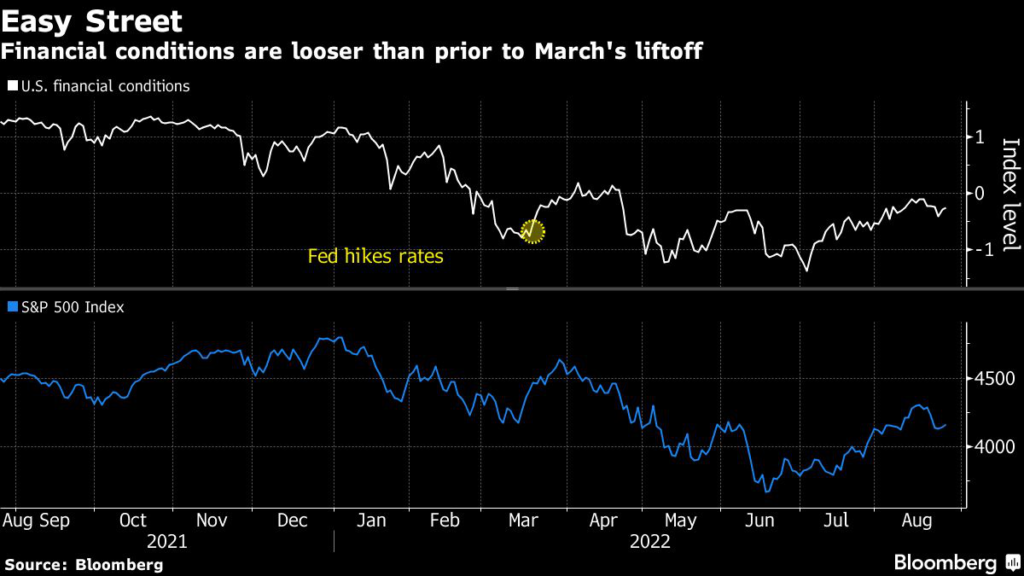
A rebound in stocks and bonds from June lows, fueled by speculation the Fed may turn more dovish as inflation peaks, has left financial conditions at easier levels than before the central bank began its aggressive tightening campaign. The question is whether Powell will try to reset market expectations to ensure that the brakes continue to be applied to economic activity.

“The ‘dovish pivot’ played nicely into the hands of the perma-bulls that have waited impatiently for the stock market to recover,” said Craig Erlam, a senior markets analyst at Oanda. “Attempts to correct this narrative have been brushed aside and the view today is that Powell may try to address this in a more forceful and convincing way. If he fails or gives the slightest impression that there is any substance to the dovish pivot narrative, we could see yields slip and stock markets end the week on a high.”

US central bankers at Jackson Hole stressed the need to keep raising rates. Kansas City Fed President Esther George said that a peak higher than 4% can’t be ruled out. The bond market remains divided on whether the Fed will hike by 50 basis points or 75 basis points in September. 

Some of the main moves in markets:

Stocks

  • Futures on the S&P 500 were little changed as of 8:52 a.m. New York time
  • Futures on the Nasdaq 100 were little changed
  • Futures on the Dow Jones Industrial Average were little changed
  • The Stoxx Europe 600 fell 0.2%
  • The MSCI World index rose 0.1%

Currencies

  • The Bloomberg Dollar Spot Index fell 0.2%
  • The euro rose 0.5% to $1.0025
  • The British pound rose 0.2% to $1.1851
  • The Japanese yen fell 0.2% to 136.70 per dollar

Bonds

  • The yield on 10-year Treasuries advanced three basis points to 3.05%
  • Germany’s 10-year yield advanced four basis points to 1.35%
  • Britain’s 10-year yield declined four basis points to 2.58%

Commodities

  • West Texas Intermediate crude was little changed
  • Gold futures fell 0.7% to $1,758.70 an ounce

More stories like this are available on bloomberg.com

©2022 Bloomberg L.P.
Three Arrows’ Zhu Worries About Jail Time in Liquidator Spat

(Bloomberg) — The fight between the founders of defunct crypto hedge fund Three Arrows Capital and the court-appointed liquidators charged with unwinding their assets has reached Thailand. Su Zhu, who along with his co-founder Kyle Davies, has been evasive about his whereabouts since the spectacular collapse of their fund, delivered an affidavit in person in Bangkok on August 19, according to a notarized document seen by Bloomberg News. 

In the affidavit, Zhu accused the liquidators of misleading the High Court of Singapore about the hedge fund’s structure. Three Arrows shifted its registration to the British Virgin Islands after having previously operated out of Singapore. Zhu in April had also disclosed plans to move the fund’s headquarters to Dubai. 

A court in the British Virgin Islands in June appointed advisory firm Teneo to liquidate Three Arrows’ assets. The fund’s implosion and failure to meet margin calls precipitated a series of market declines and fueled significant distress among its creditors. The fund’s liquidators have accused the two founders of failing to cooperate with their efforts, court papers show, a characterization Zhu challenged on Twitter.

The liquidators have said in court that Zhu and Davies have provided “rather selective and piecemeal disclosures” about the fund’s assets. Zhu’s affidavit alleges the liquidators “had not provided an entirely complete or accurate version of events” to the Singapore court, which earlier this week formally granted a petition by Teneo to recognize the liquidation order in the country.

In the affidavit, Zhu cites multiple different entities in his and his co-founder’s financial universe. According to Zhu, the liquidators have offered “inaccurate and misleading” representations of the operations, relationships and timelines associated with these entities in their petitions to the Singapore court. 

Seeking Cooperation

“The joint liquidators strongly disagree with the positions set out in Su Zhu’s affidavit,” a statement provided by Teneo representatives said. The liquidators have filed responses to the Singapore court, according to the statement. They declined to comment on specific positions pending the court’s decision. 

Zhu identified himself as a director of Three Arrows Capital Pte Ltd, or TACPL. This entity, according to Zhu, first became a registered fund manager in Singapore “in or around” August 2013 and was licensed there until July 31, 2021.

Zhu also described two feeder funds: Three Arrows Fund Ltd, or TAFL, registered in the British Virgin Islands, and Three Arrows Fund LP, or TAFLP, registered in the US state of Delaware. These entities fed into a master fund named in the affidavit as “the Company.”

‘Draconian Consequences’

The entity formerly registered in Singapore, TACPL, ceased to be the investment manager for the master and feeder funds as of Sept. 1, 2021, according to the affidavit. In its place, enter a fourth entity: ThreeAC Ltd, domiciled in the British Virgin Islands and which has operated as investment manager for those funds “since in or around August 2021.”

The specifics of these representations matter, according to Zhu, because the fund’s Singapore entity, TACPL, may not be able to fully comply with the liquidators’ wide-ranging demands for information. TACPL is the entity of which Zhu identified himself as a director. 

TACPL is concerned “about the potentially draconian consequences arising from the Liquidators’ exercise of their wide powers,” the affidavit said. 

Zhu noted that TACPL’s officers and representatives, of which as a director he is one, could themselves face fines and imprisonment if they are found in contempt of the court. 

Zhu declined to comment beyond the affidavit. The Singapore court had no comment.  

The liquidators “rely on full and immediate cooperation from relevant parties, including those situated in Singapore,” according to the statement provided by Teneo. “We remain optimistic that such parties will provide access to complete records and all relevant information to enable us to discharge our responsibilities fully in the interests of the creditors of 3AC.”

(Updates with comments from liquidators in sixth, final paragraph.)

More stories like this are available on bloomberg.com

©2022 Bloomberg L.P.

Mukesh Ambani Is Mystery Buyer of Dubai’s Costliest Home Ever

(Bloomberg) —

Mukesh Ambani’s Reliance Industries Ltd. is the mystery buyer of an $80 million beach-side villa in Dubai, the city’s biggest ever residential property deal, two people familiar with the deal said.

The property on Palm Jumeirah was purchased earlier this year for Ambani’s youngest son, Anant, one of the people said, asking not to be named as the transaction is private. The beach-side mansion sits in the northern part of the palm-shaped artificial archipelago and has 10 bedrooms, a private spa, and indoor and outdoor pools, local media reported without saying who the buyer is.

Dubai is emerging as a favorite market for the ultra-rich, whom the government has actively courted by offering long-term “golden visas” and relaxing curbs on home ownership for foreigners. British footballer David Beckham with his wife Victoria and Bollywood mega star Shahrukh Khan will be some of Ambani’s new neighbors.  

Anant is one of three heirs to Ambani’s $93.3 billion fortune, according to the Bloomberg Billionaires Index. The world’s 11th richest person, now 65-years-old, is slowly handing the reins to his children after a diversification push that expanded his empire into green energy, tech and e-commerce. 

The family has been increasing its real estate footprint overseas, with all three siblings looking Westward for second homes, one of the people said. Last year, Reliance spent $79 million to buy Stoke Park Ltd. in the UK, which houses a Georgian-era mansion said to be for older son Akash, who was recently named chairman of telecom operator Reliance Jio Infocomm Ltd. His twin sister, Isha, is scouting for a home in New York, the person added. 

The Dubai property deal has been covert and will be held by one of Reliance’s offshore entities, said one of the people, adding that the Ambanis will spend millions of dollars to customize it and ensure its security. Longtime Ambani associate Parimal Nathwani, a director of corporate affairs at the group and member of parliament, will manage the villa.

The Ambanis’ primary residence will remain Antilia, a 27-story skyscraper in Mumbai with three helipads, parking for 168 cars, a 50-seat movie theater, a grand ballroom and nine elevators.

Reliance did not respond to emails and calls seeking comment.

In addition to luxury homes, Palm Jumeirah’s string of islands comprises posh hotels, glitzy clubs, spas, restaurants and splashy apartment towers with breathtaking views of the Persian Gulf’s blue waters. Its construction began in 2001, with the first residents moving in around 2007.   

Dubai’s property market, which contributes around a third of its economy, is recovering from a seven-year slump thanks to the city’s nimble handling of the Covid-19 pandemic and initiatives aimed at giving expatriates a bigger stake in the economy. Under new rules, investors can obtain a 10-year visa if they buy property worth at least 2 million dirhams.

Foreign residents make up more than 80% of the population of the United Arab Emirates and have been a mainstay of the economy for decades, doing mostly private-sector jobs and spending their money on property or shopping in some of the world’s largest malls. Indians, in particular, have consistently ranked among the top buyers of Dubai real estate.

The global property market has been on fire lately. Swiss billionaire Ernesto Bertarelli was said to be buying a home in London’s exclusive Belgravia district for about £92 million ($108 million) in June, and the Financial Times reported earlier this month that an estate 20 miles west of London sold for £125 million. 

In the US, Joe Tsai’s Blue Pool Capital recently acquired a New York penthouse previously owned by Dan Och for $188 million, while Asia’s most-expensive apartment per square foot sold in Hong Kong for HK$640 million ($82 million) in November.

More stories like this are available on bloomberg.com

©2022 Bloomberg L.P.
Electronic Arts Surges on Report Amazon Preparing Takeover Bid

(Bloomberg) — Electronic Arts Inc. surged in early trading Friday after a report said Amazon.com Inc. is preparing an offer to buy the US video game publisher. 

According to a column in USA Today, Amazon could announce as soon as Friday an offer to acquire the publisher of hit games Apex Legends, FIFA and Madden titles. The report, if true, would accelerate Amazon’s efforts to become a major player in the game industry.

EA shares surged as much as 16% in premarket trading before giving up some of those gains. The stock is down about 3% this year, valuing the Redwood City, California-based company at about $35 billion. David Faber cast doubt on the report on CNBC following its publication.

It has been a banner year for deals in the video game industry, from Microsoft Corp.’s pending $69 billion purchase of Activision Blizzard Inc. and Take-Two Interactive Software Inc.’s purchase of Zynga for $11 billion. The sector boomed during the pandemic and although sales have slowed this year, gaming companies are still seen as attractive sources of long-term revenue thanks to titles that can be monetized for years after they launch. Live-service games, which are continuously updated over time, and microtransactions made within games made up 71% of EA’s revenue last fiscal year.

Amazon, too, has been on the hunt for deals this year, despite already being under intense antitrust scrutiny. Earlier this month, Amazon announced an agreement to buy iRobot Corp. for $1.65 billion, coming on the heels of a $3.49 billion deal just two weeks earlier to buy the One Medical chain of doctor’s offices.

With the consolidation in the gaming industry, EA has long been suspected of being a takeover target. Amazon, Apple Inc., and the Walt Disney Co. have been mentioned as potential suitors. 

Known for its Star Wars and sports games, EA has yet to release any major new titles this year and is still grappling with fallout from Battlefield 2042, which was released last November to mediocre reviews and poor fan reception.

Amazon has failed to make much of an impact in gaming on its own, even after hiring industry veterans and buying the video game streaming service Twitch. EA has a suite of live-service titles such as Apex Legends and The Sims that could be appealing to the tech giant, especially after Netflix Inc.’s success with shows such as The Witcher and Arcane, which have been built around big video games. A deal could give Amazon franchises from the popular role-playing game developer BioWare such as Dragon Age, which is set for a Netflix animated series that was teased earlier this year.

EA has also dominated the sports sphere and regularly releases the most popular soccer and football games. Its FIFA franchise — which will no longer be officially associated with the world football governing body following this year’s release — sells millions of copies a year. It generates even more revenue with its FIFA Ultimate Team microtransactions, which brought in $1.62 billion during the company’s 2021 fiscal year. 


More stories like this are available on bloomberg.com

©2022 Bloomberg L.P.
Jefferies Tech Call Helps Investors Double Money in a Single Day

(Bloomberg) — Investors who heeded a well-timed research report from Jefferies Financial Group Inc. could have nearly doubled their money in a single day. 

Charles Brennan, a London-based analyst at Jefferies, predicted in a note to clients late Wednesday that the wave of takeovers in the European technology industry would continue. It included a helpful diagram of possible targets in the space, with UK enterprise software developer Micro Focus International Plc shown as the second-most likely candidate to get bought. 

The next evening, Canada’s Open Text Corp. said it would buy Micro Focus for about $6 billion including debt. The offer price of 532 pence per share was a 99% premium to the British target’s last closing price. 

When London trading opened Friday, Micro Focus predictably soared the most on record, touching close to the bid price. Anyone who bought shares after reading the Jefferies report would have nearly doubled their money in roughly 24 hours. 

Another part of Jefferies was a financial adviser to Micro Focus on the transaction, in addition to its recently-won role as a corporate broker to the software company. The bank worked alongside Goldman Sachs Group Inc., lead financial adviser to Micro Focus, and the firm’s longtime broker Numis Corp., according to a filing Friday. 

Jefferies had only been appointed as joint corporate broker to Micro Focus in early August. 

Banks have so-called Chinese walls preventing information sharing between different parts of the business to ensure that research analysts aren’t aware of takeovers the firm is advising on. The Jefferies research team has now gone restricted on Micro Focus, according to data compiled by Bloomberg. 

A representative for Jefferies declined to comment. 

More stories like this are available on bloomberg.com

©2022 Bloomberg L.P.

Moderna Says It’s Suing Pfizer, BioNTech Over Covid Shots

(Bloomberg) — Moderna Inc. said it’s suing Pfizer Inc. and BioNTech SE, claiming the technology in the partners’ Covid-19 shot infringes on its patents, a move that sets the stage for a massive legal clash between the three vaccine titans.

Moderna, in a statement Friday, accused Pfizer and BioNTech of violating intellectual property protecting key elements of Moderna’s messenger RNA technology in developing the Comirnaty vaccine. Cambridge, Massachusetts-based Moderna said it had patents from 2010 to 2016 on the mRNA technology that made its Spikevax shot possible but that the other two companies copied the technology without permission.

Moderna said it’s filing suit in the US District Court in Massachusetts and a regional court in Germany. The complaints couldn’t immediately be verified in court records. Pfizer said it has not been served with the lawsuit and can’t comment at this point.  

Pfizer shares fell 1.2% in trading before US markets opened, while BioNTech’s American depositary receipts fell 2.6%. Moderna shares were little changed.

Moderna said it’s not asking the courts to pull the Pfizer-BioNTech Covid vaccine from the market nor to block future sales. The company is seeking damages for the period starting March 8 of this year and says it will not seek damages for Pfizer’s sales to 92 lower- and middle-income countries. Early in the Covid crisis, Moderna promised not to enforce its intellectual property during the pandemic, but on March 7 it modified that pledge to apply only to lower-income countries, essentially making this litigation possible.

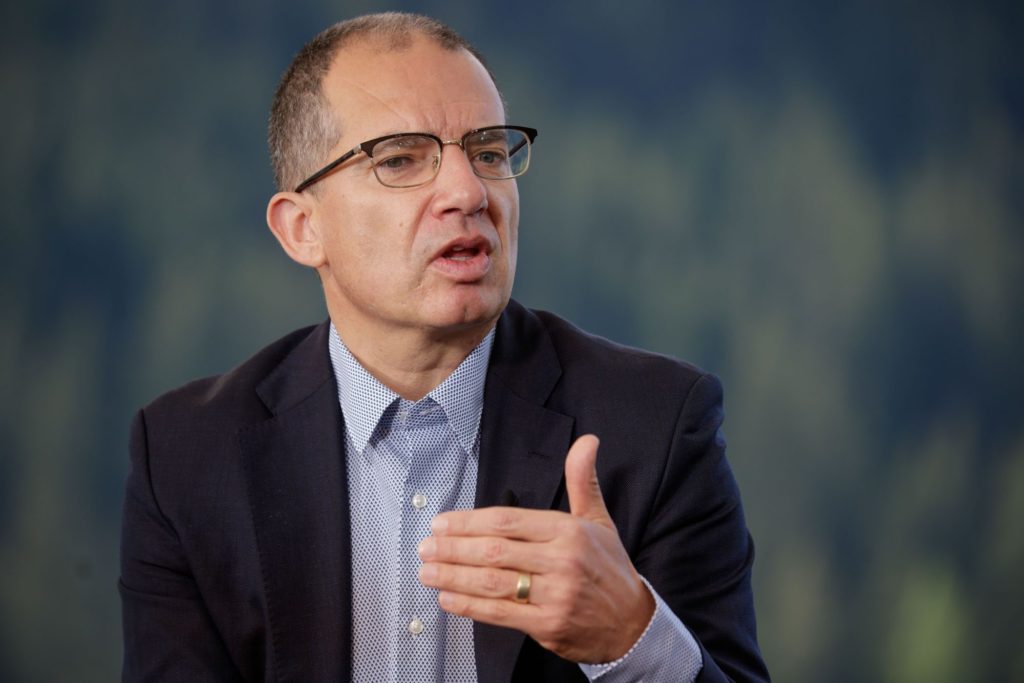
“We are filing these lawsuits to protect the innovative mRNA technology platform that we pioneered, invested billions of dollars in creating, and patented during the decade preceding the Covid-19 pandemic,” Moderna Chief Executive Officer Stephane Bancel said in a statement.

The mRNA vaccines have played a crucial role in the pandemic response, particularly in the US. Pfizer last year recorded almost $37 billion in sales from Comirnaty, while Moderna posted roughly $18 billion of revenue from Spikevax. 

Intellectual property battles over technology used in both the Moderna and Pfizer-BioNTech vaccines are proliferating. Alnylam Pharmaceuticals Inc. earlier this year sued Moderna, Pfizer and BioNTech over the lipid nanoparticle technology used in both of their Covid vaccines. Moderna has sparred with the National Institutes of Health over whether to list the agency’s scientists as inventors on patents for Moderna’s Covid vaccine. 

Moderna said Pfizer and BioNTech had other options but “decided to proceed with a vaccine that has the same exact mRNA chemical modification to its vaccine” as Moderna’s shot. Moderna also accused Pfizer and BioNTech of copying its approach of encoding a full-length spike protein in a lipid nanoparticle. 

(Updates with Pfizer comment in third paragraph, shares in fourth)

More stories like this are available on bloomberg.com

©2022 Bloomberg L.P.

Close Bitnami banner
Bitnami