Bloomberg

Ukraine Latest: Nuclear Plant Unit Reconnected to Ukraine’s Grid

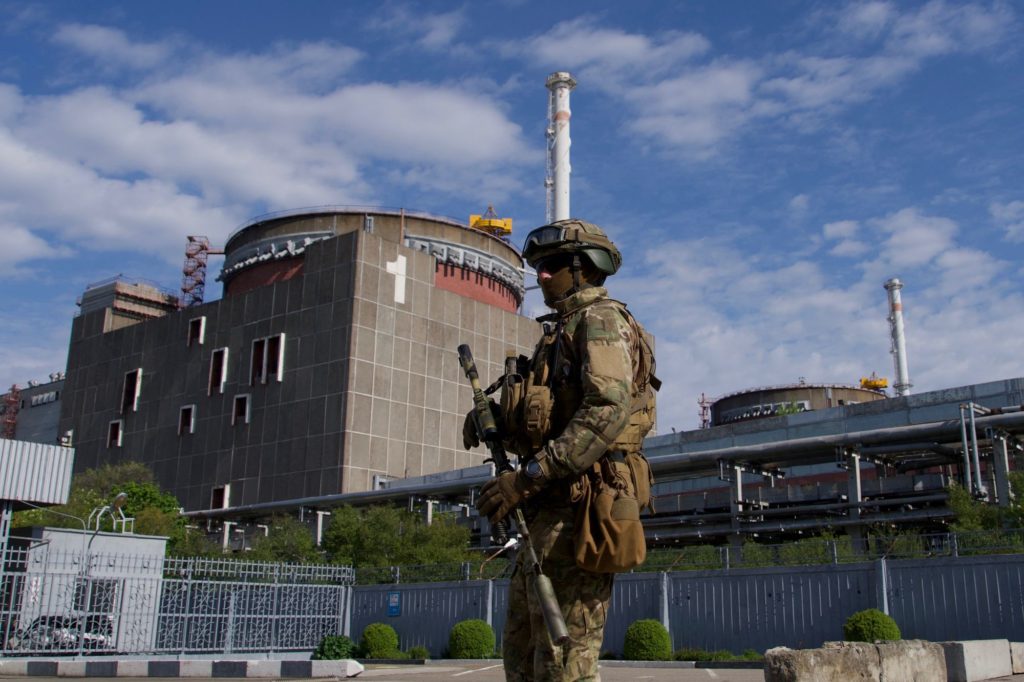
(Bloomberg) — One of the power units of the Zaporizhzhia nuclear plant has been reconnected to Ukraine’s energy grid.

Equipment and safety systems are functioning with no concerns and the unit is gaining power, with the plant producing electricity for the country’s needs, state-owned operator Energoatom said. President Volodymyr Zelenskiy has been calling for Russian troops in the area, in southeastern Ukraine, to withdraw.

(See RSAN on the Bloomberg Terminal for the Russian Sanctions Dashboard.)

Key Developments

  • Zelenskiy Reinforces Nuclear Warning After Power-Line Disruption
  • Russian Gas Flows to Europe Are at Stable Levels on Friday
  • Germany to Rethink Gas Levy After Outcry Over Energy Profits
  • Why Ukraine Debt Relief Isn’t Matching Funding Needs: QuickTake
  • A Corner of Europe Leans to Live With Power Blackouts Again

On the Ground

Russian forces kept up attempts to conduct an offensive on the Donetsk axis in eastern Ukraine, focusing efforts on areas around Bakhmut and Avdiivka, according to a statement by Ukraine’s General Staff on Facebook. Artillery strikes hit private residences, schools and farms in regions including Donetsk, Chernihiv and Kharkiv, Interfax-Ukraine reported, citing local officials. Seven Russian ammunition depots in southern Ukraine were destroyed this week, said Natalia Humenyuk, a Ukrainian military spokeswoman.

(All times CET)

Ukraine Evacuated More Than One Million Donetsk Residents (12:20 a.m.)

Almost three quarters of the population in the Donetsk region have been evacuated, the area’s head Pavlo Kyrylenko said on the regional administration’s You Tube channel. Ukraine controls approximately 45% of the Donetsk region, where about 350,000 residents currently live, Kyrylenko said.

“As of February 24, 1.6 million people lived in the part of the region that was controlled by the Ukrainian authorities,” Kyrylenko said. “Almost three quarters of the region’s population have been evacuated.” Kyrylenko said, adding that all the cities of the region are being shelled permanently.

Hungary Boosts Energy Links with Russia Despite EU Stance (10:55 a.m.)

Hungary issued a key permit for the Russian-led expansion of its sole nuclear power plant, bolstering the nation’s energy links with Moscow even as European Union peers seek to distance themselves over the invasion of Ukraine.

The National Atomic Energy Agency issued an “establishment permit” to build a fifth and sixth nuclear reactor in the city of Paks, next to four existing units whose lifetimes are expiring, according to a statement on the authority’s website. Russia’s state-owned Rosatom Corp. is the lead constructor. In May, Finland scrapped a construction contract with Rosatom.

Zelenskiy Says Ukraine Is Working to Avert Nuclear Accident (9:33 a.m.)

Ukrainian authorities are doing everything possible to prevent an emergency at the Zaporizhzhia nuclear power plant, which has stopped work for the first time after being cut off from the nation’s electricity grid, Zelenskiy said in an address late Thursday.

Zelenskiy called for “tough international pressure” to force occupying Russian forces to withdraw from the plant, which has suffered artillery attacks that both Ukraine and Russia have blamed on each other.

Zelenskiy said he had spoken to US President Joe Biden of the situation and warned that Russia’s actions at the plant risked a nuclear disaster that could affect all of Europe.

Zaporizhzhia Nuclear Plant Remains off Ukraine’s Grid (9:00 a.m.)

All power units of the Zaporizhzhia nuclear plant remained disconnected from the country’s electric grid as of 9 a.m. local time on Friday, state-owned operator Energoatom said on Telegram.

The nuclear plant is being powered via a restored link from Ukraine’s energy system, and transmission lines leading from the plant have also been repaired. Work is under way to reconnect two power units of the plant back to the grid. There are no concerns about equipment and safety systems at the plant, Energoatom said.

Report Details Russian ‘Filtration System’ for People in Donetsk (8:35 a.m.)

Russia has set up a “filtration system” in occupied areas of Ukraine’s Donetsk region which allegedly violates international law, according to a report from Yale School of Public Health’s Humanitarian Research Lab.

Russia and its proxies operate at least 21 facilities in and around the Donetsk region to screen, detain and interrogate people, according to the report based on open-source information and satellite imagery. The system was created weeks before the invasion in February and grew following Russia’s capture of the port city of Mariupol.

Russia dismissed the report. “This is yet another fabrication aimed at discrediting the Russian special military operation,” its embassy in the US said on Telegram. “Russia is committed to observing the international humanitarian law.”

Ukraine Pursues Effort to Ramp Up Food Exports (8:30 a.m.) 

Ukraine has received more than 60 requests for loading grain and agricultural products in the ports of Odesa, Chornomorsk and Pivdennyi as part of the Black Sea Grain Initiative signed almost a month ago between Ukraine, the UN, Turkey and Russia, Infrastructure Minister Oleksandr Kubrakov said on Twitter. 

European Commission head Ursula von der Leyen and UN Secretary General Antonio Guterres said earlier that they will continue to help boost exports from Ukraine.

Japan Looking to Reopen Kyiv Embassy, Asahi Says (8:15 a.m.)

Japan is considering reopening its embassy in Kyiv and sending back staff who had been working from other locations such as Poland since soon after Russia’s invasion of Ukraine started, the Asahi newspaper reported, citing government officials.

Japan’s ambassador to Ukraine has been in Kyiv this week looking at resuming operations, the paper said, adding that Japan has been the slowest among Group of Seven nations to bring diplomatic staff back to the Ukrainian capital.

More stories like this are available on bloomberg.com

©2022 Bloomberg L.P.

Dubai to Scour New York Looking for Next Great American Watchmaker

(Bloomberg) — Dubai watch experts are headed to New York City in search of the next great American watchmaker. 

The problem is they don’t have many to choose from.

“Where are the American watchmakers?” asks Hind Abdul Hamied Seddiqi, director general of Dubai Watch Week. “That’s one of the things we would like to discuss there and hopefully come up with an answer.”

The group will hold a two-day conference in New York starting on Sept. 24, in an off year for the main event in Dubai, which occurs every two years. The horology show aims to bring together collectors, artists, industry professionals, and neophytes to explore the trends and challenges around watchmaking.

The event comes at a bumper time for the industry: Swiss watch exports reached a near record in July, with the US market growing 13.5% from a year earlier. There are long waiting lists for the most desirable timepieces. Even stores in Dubai—a destination for luxury consumption—can’t keep up with demand.

“Shops are empty,” Seddiqi says of inventory. “Whatever we receive goes directly to people on the waiting list.”

The secondhand market, however, has softened since the collapse of crypto prices. Some trophy watches are easier to come by, and prices are falling for several of the most coveted Rolexes and Patek Philippes.

As for why a Dubai-based show that’s all about drumming up enthusiasm for watchmaking might care to make an appearance in the US, Seddiqi says she’s still hoping the country that produced the Apple Watch will find a way to create an elite mechanical brand for enthusiasts. America, she says, can reach higher than Timex. 

“What’s missing is the haute horology,” she says. “Why not come into the world of horology and create really complicated watches?”

Shinola, currently the best-known brand selling mechanical watches out of the US, still uses Swiss-made Sellita movements to power its pieces—which are designed and assembled in Detroit.

The event, in Manhattan’s Meatpacking District, is free and open to the public. It will feature horologists and industry professionals including Aldis Hodge, Mark Cho, and Christopher Sealey.

More stories like this are available on bloomberg.com

©2022 Bloomberg L.P.

Ethiopia Says It Plans Action Against Tigray Military Forces

(Bloomberg) — Ethiopia’s government plans to take unspecified action against military forces in the northern Tigray region who oppose efforts to bring peace to the war-torn area.

“We call upon our people living in the Tigray region to stay away from the areas where the Tigray People’s Liberation Front’s military equipment and training facilities are located,” the Government Communication Service said in a statement posted on Twitter on Friday.

Fighting between Ethiopian troops and Tigray forces erupted two days ago, five months after the two sides agreed a humanitarian cease-fire. The truce halted 16 months of conflict that displaced millions of people and left most of Tigray without power or reliable communications.

The resumption of fighting will hamper efforts by Ethiopia’s government to improve relations with international financiers, as it awaits an International Monetary Fund loan amid efforts to revamp its debt. The nation’s eurobonds have slumped since hostilities started on Wednesday, with the yield on 2024 debt surging more than 200 basis points to trade at 36.22% on Friday.

Read: End of Ethiopia Truce May Undermine Financing Talks: Eurasia

(Updates with bond yields surging in fourth paragraph.)

More stories like this are available on bloomberg.com

©2022 Bloomberg L.P.

Ardian Shelves $3 Billion Sale of Health IT Firm Dedalus

(Bloomberg) — Ardian SAS is shelving the planned sale of a majority stake in Italian health-care software provider Dedalus, people with knowledge of the matter said. 

The Paris-based buyout firm is putting the process on hold due to valuation and financing concerns, the people said, asking not to be identified because the information is private. 

Ardian was seeking to value the business at more than 3 billion euros ($3 billion), Bloomberg News has reported. The deal joins a number of transactions that have recently been put on ice as rocky credit markets make it more challenging for private equity firms to borrow money cheaply. 

Ardian is still considering other options for Dedalus, including the potential sale of a minority stake, one of the people said. Deliberations are ongoing, and it could also revive a full sale at a later date, the people said. 

Representatives for Ardian and Dedalus declined to comment. 

Private equity dealmakers are struggling to get the cheap credit they need to finance buyouts, as the debt markets have been rocked by skyrocketing inflation and fears of an economic slowdown. 

Investment banks are nervous to add more underwritten debt to the $80 billion they already hold on their balance sheet, while private lenders are pulling back on risk by cutting how much debt they are offering in a single deal.

Dedalus provides information and clinical and administrative software to hospitals, clinics and laboratories in about 40 countries. The company has expanded rapidly through acquisitions since being bought by Ardian in 2016. Sovereign wealth fund Abu Dhabi Investment Authority took a minority stake in Dedalus for an undisclosed amount last year.

(Updates with Dedalus response, dealmaking context from fourth paragraph.)

More stories like this are available on bloomberg.com

©2022 Bloomberg L.P.

VW’s Trucking CEO Sees Electric Rigs Hauling Timber in the Cold

(Bloomberg) — Christian Levin has a difficult job at the Volkswagen group. 

The 55-year-old Swede was named chief executive officer of the Traton trucking unit after a management shakeup last year. He’s to steer a turnaround of the business after Europe’s biggest carmaker struggled for years to improve cooperation between its different commercial-vehicle brands. Levin is supposed to make Traton fit for the electric age, lead the integration of the Navistar International acquisition and create a new manufacturing hub in China.

Like VW’s incoming CEO Oliver Blume, Levin is doing double duty. He’s also heading Scania, Traton’s Swedish bus and truck business that’s electrifying its lineup. Scania aims to cut its Scope I and II emissions to 50% of 2015 levels by mid-decade — all while reaching double-digit margins. The brand has partnered with startups including electric-truck maker Einride and Northvolt, which will supply cells to a battery-assembly plant Scania is setting up next to its existing chassis factory near Stockholm.

Reporter Rafaela Lindeberg spoke with Levin about his push to transform Scania into a maker of emissions-free trucks and buses, and the challenges ahead. Here’s an excerpt of the interview, edited for length and clarity.

Scania, Volvo and startups like Volta Trucks or Einride are all based in Sweden — is the country aiming to lead in electric trucking?

Sweden is becoming a Silicon Valley for sustainable solutions and for electrification. We should be proud of that. We no longer need to run to Asia to find all the solutions. Of course, we are still quite dependent on Asia and the US in terms of hardware around digitalization. But when it comes to software and electrification we are beginning to find quite a lot here at home.

What’s the nature of your partnership with Einride?

We are at an early stage. Now in the beginning we take the vehicle supplier role, they take the logistics role, and we collaborate on the software interface. Einride is a logistics company offering a green transport solution which is incredibly cool. All our traditional customers are thinking about: What will the business case look like, will there be enough charging capacity, will there be green electricity? There are a lot of big questions. Einride is pretty brave. They throw themselves out there and say, we’ll solve it. They sign transport buyers who want green transport, and there are a lot of them.

Where do you see the heavy-truck sector going?

It’s clearly moving toward battery-electric as the dominant technology. That path will go via alternative fuels. It’s easy to forget that we have millions of vehicles — I believe it’s four million heavy trucks in Europe —  that you can refuel with something other than fossil if you get political pressure on that front. But technically speaking, it’s battery-electric. We have proven it’s possible by delivering a number of pre-series vehicles that can handle the most difficult tasks. This spring, SCA got a battery-powered truck with an 80-ton capacity from us. It’s a timber truck that will go off-road in northern Sweden where it can get insanely cold. So you have three difficult things to deal with: the load’s heavy, it’s cold and you have bad roads. Most people including myself believed that could never work with an electric rig. But we proved that we can do that now, and that’s a signal to our customers and to politicians that this works without any doubt.

So what happens now?

It’s necessary to get the conditions in place to get this technology out on the roads in large volumes. For that to happen we need a bit of help from politicians. As battery cells are very expensive, these vehicles will also be very expensive, making them a significant investment for a customer. At the same time, the cost per mile is significantly lower. While electricity has become more expensive, so has diesel — so you are still saving on every kilometer you drive. We and many others have done the math to figure out when the diesel vehicle becomes more expensive than the electric version. For city buses, that has already happened, and for smaller distribution vehicles it’s happening right now. For heavy vehicles it will happen on a large scale in 2025-2030 in developed markets and first in Europe. But that requires a price on carbon-dioxide emissions, a functioning charging network and access to enough green electricity.

What made you invest in battery startup Northvolt?

An electric truck may be green during its operation, but if you emit several thousand tons of CO2 to produce the battery, then it’s not green. We like Northvolt as their batteries have a very good performance, but even more because they have thought from the beginning about a sustainable and circular system. That means we can have a good environmental conscience when we deliver the vehicle — that the batteries do not have a large carbon footprint — and also that Northvolt is committed to taking batteries back for recycling.

So what’s your thinking behind setting up your own battery assembly line?

What we get from Northvolt — rectangular battery cells in the hundreds of thousands — is something that looks like old VHS tapes. They are put together in large modules and then packed in big boxes which are then attached to the vehicle, anything from 1 box to 6 or 7 boxes to get enough energy. It sounds like you just pack small battery cells into a toy, but it’s not as easy as it sounds. It requires an enormous amount of care, cooling, heat and protection against vibrations. It requires collision protection and a number of other things. That part is so difficult and so crucial that we want to do it ourselves. That’s why we’re building that assembly plant right next to where the trucks are bolted together. 

You’re also backing Swedish fossil-free steel startup H2 Green Steel.

Yes, just like at Northvolt, we were one of the first investors and a bit for the same reason. When it comes to our carbon footprint, we have come a long way. We will reduce emissions 50% by 2025 and we will manage that with a fairly large margin. What remains then is the material in the vehicle. A traditional truck is made up of 75% steel, and steelmaking emits a lot of CO2. Just like in our industry, we have steel producers that want to be ahead and are prepared to invest in the technology of the future. So we wanted to support that by buying a small share.

More stories like this are available on bloomberg.com

©2022 Bloomberg L.P.

A Utah Startup Is Making a ‘Treasure Map’ for Geothermal Energy

(Bloomberg) —

Carl Hoiland grew up in a rural Oregon, taking trips into the Sierra Mountains with his grandfather to prospect gold and uranium. In grad school, Hoiland studied geothermal energy, the complex science of converting heat sources buried within the earth into electricity.

He quickly learned how little the field had advanced. Geothermal developers sometimes gets lucky with a geyser or natural hot spring, but otherwise the operations know as much about the risks and rewards of terrain as gold prospectors or oil explorers did decades ago. “You just have to go by instincts,” Hoiland says. “That’s how my grandfather worked.”

In 2019, Hoiland co-founded Zanskar, a data-analysis company intent on solving that problem. Technical progress has renewed interest in geothermal as a clean method for heating homes and providing utility-grade power. Hoiland’s startup, based in Utah, constructs a software model of wells—with insight on reservoir volume, rock density and magnetic fields—to give a snapshot of potential energy output. It then sells this data to developers, giving them a clearer sense of where to dig and the risks for certain locations. Hoiland calls it “a treasure map” for a renewable sector getting a sudden resurgence of attention.

“There’s enough energy in the Earth’s crust to power billions of electric vehicles, heat pumps, and data centers, if only we could locate it,” says Chris Sacca, managing partner for Lowercarbon Capital, an investor. “Enter Zanskar.”

Geothermal power was fashionable a few decades ago but investment dried up since solar and wind energy required far less upfront capital. The method, as a one energy analyst put it last year, has “oil and gas risk but with utility returns.” 

New methods for drilling into deeper, hotter resources has made investors more optimistic about returns. Fervo, a geothermal startup that’s working with Google, announced a $138 million funding round earlier this week. Oil majors have invested in the field. 

The US Department of Energy has unleashed funds for geothermal. And the new Inflation Reduction Act puts geothermal on an equal footing with wind and solar for tax credits on projects that commence construction through 2024, according to BloombergNEF. 

“The potential win looks so much larger,” says Michael Sachse, chief executive officer of Dandelion Energy, a company working on geothermal for residential heating. “Now there are just many more dollars available.” 

Zanskar is targeting grid-scale developers, not startups or residential operations, although Hoiland declined to share customers. His startup recently wrapped a $12 million investment from Lowercarbon, Union Square Ventures and the venture arm of Munich Re, the German insurer. Albert Wenger, a managing partner with Union Square Ventures, says Zanskar is “far ahead of anybody else” with its offering.

A 2019 report from the Energy Department calculated the success rate of geothermal wells during exploration at around 50 percent. Some estimates put the rate of productive wells even lower. 

Hoiland sees his edge from data. During a videoconference call, he flips his camera around to show piles of boxes sitting across from his desk. They are filled with surveying material Zanskar purchased from a geologist who once worked for a geothermal company that went bankrupt decades ago. (Hoiland declines to name the company.) The files, gathering dust in an attic, are now being uploaded digitally and plotted onto Zanskar’s treasure map. By crunching this historical data with machine learning software, the startup promises a stronger forecast of the energy available in geothermal sites.

Hoiland says his company has mapped hundreds of geothermal sites and can measure seismic signals that conventional modeling from the oil and gas sector typically ignores. “We’ve been able to find anomalies that no one else has,” he says.

Today, geothermal accounts for a meager 0.2% of the world’s power generation capacity, around 16 gigawatts, according to BNEF. As costs drop and investment grows, however, the research firm expects that output to reach 27 gigawatts by 2030. 

“It’s a totally under-leveraged resource,” says Wenger, the investor. “It’s right under our feet.”

More stories like this are available on bloomberg.com

©2022 Bloomberg L.P.

Greece, EU Accused of Probing Spy Scandal Only in ‘Superficial’ Way

(Bloomberg) — The Greek government and the European Union should move faster on probes over surveillance of an opposition politician and a journalist, a senior European lawmaker said, as the scandal threatens further domestic turmoil. 

The authorities’ investigation into the national intelligence service has been “extremely superficial,” said Sophie in ‘t Veld, the rapporteur at the European Parliament committee for inquiry into the use of Pegasus and other surveillance spyware.

The scandal centers on decisions by the national intelligence service to spy on Nikos Androulakis, the leader of Greece’s opposition socialist Pasok party and a member of the European Parliament, and journalist Thanasis Koukakis. 

The head of Greek intelligence, Panagiotis Kontoleon, and the prime minister’s chief of staff — and nephew — Grigoris Dimitriadis, resigned earlier this month amid the fallout. Greek Prime Minister Kyriakos Mitsotakis, who upon taking office assumed direct oversight of the spy agency, denied any knowledge or involvement. 

With many questions remaining unanswered, this could prove to be a significant political crisis for Greece, which heads to national elections expected next spring. Political party leaders discussed the issue in parliament on Friday and a parliamentary committee will convene next week to further investigate the issue.

“The Greek authorities, on the one hand, they claim they are innocent so they’ve got nothing to hide, and on the other hand they are very reluctant to shed light on the whole matter, and so far all their moves over the last year or so have been to cover things up,” in ‘t Veld said.

Read more: Greek Premier Says He Was Unaware of Phone Tapping Operations

The government and the intelligence services have said that the surveillance was legal for national security purposes and approved by a prosecutor, but haven’t disclosed what method was used to tap the two men’s phones and why the phones were hacked. The government has also denied that security services bought or used a spyware called Predator, which was detected on Androulakis’s phone during a check by European Parliament security experts.

‘Dark Practices’

“The Predator spyware was used to tap my phone, while only a few days earlier I had been placed under surveillance” by the Greek intelligence agency, Androulakis said in early August. “Had it not been for the European Parliament’s official report, we would not have been aware of these dark practices.”

The malware, made by Cytrox Ltd., a surveillance startup with reported ties to North Macedonia, was deployed against Androulakis and Koukakis, according to forensic analysis by the digital rights group Citizen Lab and the European Parliament. The spyware has been marketed by a Greece-based company called Intellexa, which didn’t respond to multiple requests for comment.

“It’s been months since it was revealed that the phones of a journalist, and more recently of a lawmaker of the political opposition, were hacked, and yet a lot of questions remain unanswered,” said Ilia Siatitsa, the senior legal officer at the London-based nonprofit Privacy International. “The Greek government has not been able so far to explain the coincidence that the phones of the journalist and the parliamentarian of the political opposition were targeted by Predator around the same period that there was a warrant allowing the Greek National Service to tap their phones.”

A report from Google’s Threat Analysis Group published in May suggested that the software is routinely used by “government-backed actors” in nations including Greece, Egypt, Indonesia and Spain. It was also used to breach phones belonging to US officials stationed around the world.

Androulakis filed a complaint last month with the prosecutor saying that someone had tried to tap his mobile phone and intercept personal data. Koukakis has alleged that his smartphone was infected with surveillance software, prompting a separate investigation by a prosecutor.

Greek Denial

Separately, the European Commission said it is studying Greece’s response to questions about the surveillance and whether any of it could have violated the the European Union’s data protection laws. 

“I can assure you that the National Intelligence Agency (EYP) has not bought or ever used this software or any other illegal surveillance system,” Ioannis Vrailas, Greece’s representative to the EU, wrote in a letter dated Aug. 2. Mitsotakis asked parliament’s speaker on Friday to give a classified report to the parties proving that no such software is being used by Greek authorities. 

In ‘t Veld said the commission’s response so far has been inadequate. “One thing is certain: They cannot be accused of having an excessive sense of urgency,” she said. “And they seem to think it is a diplomatic thingy, to be settled discreetly with the governments. Wrong. It is a deeply political issue, affecting the fundamentals of EU democracy.”

She also lamented that neither European Parliament’s biggest party, the EPP, nor Jeroen Lenaers, an EPP member who chairs the spyware inquiry, have supported her Renew party’s call for testimony from both Androulakis and Koukakis this month, as well as a fact-finding mission to Greece. The inquiry committee, set up in March, is mired in talks of procedures, rules and planning, she said.

“It is bigger than Watergate, but nobody seems to be moving,” in ‘t Veld said. “I believe the leadership of this inquiry committee should be alert and committed. We need to get to the heart of the matter, we need to be on top of things.”

EPP spokespeople didn’t reply to requests seeking comment. A spokesperson for European Parliament President Roberta Metsola said she is taking the allegations of illegal surveillance seriously and will ensure they’re investigated.

Spy History

Surveillance operations have become increasingly routine in Greece, with more than 15,000 phones being monitored at any given time — up more than 30% since 2019. 

After the country’s spy chief resigned earlier this month, the Greek government said it will reform how its intelligence service is supervised. The Greek parliament’s committee on institutions and transparency on Wednesday approved the appointment of the new head of the spy service, Themistoklis Demiris. 

Mitsotakis is under pressure for his administration’s handling of the case and the opposition has called on Mitsotakis to resign over the case. The premier repeated Friday that the election will take place at the end of the government’s term, dismissing the opposition’s calls for an early ballot at a time of crisis. 

Pasok asked for the creation of a special inquiry commission to investigate the surveillance of its leader. The main opposition Syriza party of former Prime Minister Alexis Tsipras has indicated it’s willing to support the request. 

The Greek premier’s New Democracy party also agrees on the need for a commission, but will try to extend the investigation to include the spy service’s conduct over the past decade.

(Updates throughout with Greek prime minister’s comments.)

More stories like this are available on bloomberg.com

©2022 Bloomberg L.P.

Futures Dip, Bonds Fall as Clock Ticks to Powell: Markets Wrap

(Bloomberg) — US equity futures slipped Friday and Treasuries retreated as a chorus of Federal Reserve hawks prepared the ground for a much-anticipated speech by Chair Jerome Powell that’s set to shape views on the pace of monetary tightening.

S&P 500 and Nasdaq 100 contracts were in the red after Wall Street’s rally on Thursday. The 10-year Treasury yield climbed about five basis points to 3.08%. The dollar was steady. In addition to Powell’s speech later on Friday, traders have to keep an eye on a raft of US data, including personal spending and the Fed’s preferred measure of inflation, both of which are expected to show price pressures cooling.

Stocks in Europe reversed gains to set the benchmark Stoxx Europe 600 index on track for a second weekly drop, with media and travel the biggest decliners. Miners climbed as prices of iron ore, copper and other industrial metals rallied after China’s latest effort to stimulate its flagging economy. European sovereign bonds declined.

Powell may restate the Fed’s resolve to keep hiking interest rates to fight high inflation when he speaks at 10 a.m. Washington time Friday in Jackson Hole, Wyoming. Fed officials gathering for the conference are already singing from a hawkish script, pushing back on expectations of tempered tightening.

A rebound in stocks and bonds from June lows has left financial conditions at easier levels than before the Fed began its aggressive tightening campaign. The question is whether Powell will try to reset market expectations to ensure that the brakes continue to be applied to economic activity.

Powell will likely “endorse the re-tightening of financial market conditions and thus also the trend towards higher market rates of late, given that the Fed still is a stretch away from getting inflation under control,” said Benjamin Schroeder, senior rates strategist at ING Groep NV. “Our economists see the risk of the core inflation reading still heading higher.”

US central bankers at Jackson Hole stressed the need to keep raising rates. Kansas City Fed President Esther George said that a peak higher than 4% can’t be ruled out. The bond market remains divided on whether the Fed will hike by 50 basis points or 75 basis points in September. 

The latest US growth data pointed in different directions in the first half of 2022, adding to the ongoing debate on the health of the economy. Europe’s outlook is darkening due to a continuing surge in energy prices.

Brent crude oil scaled $100 a barrel, gold wavered and Bitcoin slipped toward $21,000. MSCI Inc.’s Asia-Pacific equity gauge edged up to a one-week high. Apparent progress on averting the delisting of Chinese shares in the US over an audit dispute helped sentiment.

What to watch this week:

  • Fed Chair Powell speaks at Jackson Hole, Friday
  • US personal income, PCE deflator, University of Michigan consumer sentiment, Friday

Will the meme mania fizzle out? That’s the theme of this week’s MLIV Pulse survey. Click here to participate anonymously.

Some of the main moves in markets:

Stocks

  • The Stoxx Europe 600 fell 0.2% as of 10:38 a.m. London time
  • Futures on the S&P 500 fell 0.3%
  • Futures on the Nasdaq 100 fell 0.5%
  • Futures on the Dow Jones Industrial Average fell 0.2%
  • The MSCI Asia Pacific Index rose 0.4%
  • The MSCI Emerging Markets Index rose 0.3%

Currencies

  • The Bloomberg Dollar Spot Index was little changed
  • The euro rose 0.3% to $1.0005
  • The Japanese yen fell 0.3% to 136.85 per dollar
  • The offshore yuan fell 0.2% to 6.8680 per dollar
  • The British pound was little changed at $1.1835

Bonds

  • The yield on 10-year Treasuries advanced five basis points to 3.08%
  • Germany’s 10-year yield advanced three basis points to 1.35%
  • Britain’s 10-year yield was little changed at 2.62%

Commodities

  • Brent crude rose 1.2% to $100.49 a barrel
  • Spot gold fell 0.4% to $1,751.31 an ounce

More stories like this are available on bloomberg.com

©2022 Bloomberg L.P.

Ukraine Latest: Zelenskiy Warns of Nuclear Plant Accident Risk

(Bloomberg) — Ukraine is working to prevent an accident at the Zaporizhzhia nuclear plant after it lost its connection to the national grid, President Volodymyr Zelenskiy said, calling for pressure to force Russian troops there to withdraw.

Kyiv is seeking to ramp up its efforts to export food, receiving more than 60 requests for loading grain and agricultural products in its Black Sea ports Infrastructure Minister Oleksandr Kubrakov said.

Russia has set up a “filtration system” in occupied areas of Ukraine’s Donetsk region which allegedly violates international law, according to a report from Yale School of Public Health’s Humanitarian Research Lab. The system serves to screen, detain and interrogate people, according to the report, which Russia’s US embassy called a “fabrication.”

(See RSAN on the Bloomberg Terminal for the Russian Sanctions Dashboard.)

Key Developments

  • Russian Gas Flows to Europe Are at Stable Levels on Friday
  • Germany to Rethink Gas Levy After Outcry Over Energy Profits
  • Why Ukraine Debt Relief Isn’t Matching Funding Needs: QuickTake
  • A Corner of Europe Leans to Live With Power Blackouts Again

On the Ground

Russian forces kept up attempts to conduct an offensive on the Donetsk axis in eastern Ukraine, focusing efforts on areas around Bakhmut and Avdiivka, according to a statement by Ukraine’s General Staff on Facebook. Artillery strikes hit private residences, schools and farms in regions including Donetsk, Chernihiv and Kharkiv, Interfax-Ukraine reported, citing local officials. Seven Russian ammunition depots in southern Ukraine were destroyed this week, said Natalia Humenyuk, a Ukrainian military spokeswoman.

(All times CET)

Hungary Boosts Energy Links with Russia Despite EU Stance (10:55 a.m.)

Hungary issued a key permit for the Russian-led expansion of its sole nuclear power plant, bolstering the nation’s energy links with Moscow even as European Union peers seek to distance themselves over the invasion of Ukraine.

The National Atomic Energy Agency issued an “establishment permit” to build a fifth and sixth nuclear reactor in the city of Paks, next to four existing units whose lifetimes are expiring, according to a statement on the authority’s website. Russia’s state-owned Rosatom Corp. is the lead constructor. In May, Finland scrapped a construction contract with Rosatom.

Zelenskiy Says Ukraine Is Working to Avert Nuclear Accident (9:33 a.m.)

Ukrainian authorities are doing everything possible to prevent an emergency at the Zaporizhzhia nuclear power plant, which has stopped work for the first time after being cut off from the nation’s electricity grid, Zelenskiy said in an address late Thursday.

Zelenskiy called for “tough international pressure” to force occupying Russian forces to withdraw from the plant, which has suffered artillery attacks that both Ukraine and Russia have blamed on each other.

Zelenskiy said he had spoken to US President Joe Biden of the situation and warned that Russia’s actions at the plant risked a nuclear disaster that could affect all of Europe.

Zaporizhzhia Nuclear Plant Remains off Ukraine’s Grid (9:00 a.m.)

All power units of the Zaporizhzhia nuclear plant remained disconnected from the country’s electric grid as of 9 a.m. local time on Friday, state-owned operator Energoatom said on Telegram.

The nuclear plant is being powered via a restored link from Ukraine’s energy system, and transmission lines leading from the plant have also been repaired. Work is under way to reconnect two power units of the plant back to the grid. There are no concerns about equipment and safety systems at the plant, Energoatom said.

Report Details Russian ‘Filtration System’ for People in Donetsk (8:35 a.m.)

Russia has set up a “filtration system” in occupied areas of Ukraine’s Donetsk region which allegedly violates international law, according to a report from Yale School of Public Health’s Humanitarian Research Lab.

Russia and its proxies operate at least 21 facilities in and around the Donetsk region to screen, detain and interrogate people, according to the report based on open-source information and satellite imagery. The system was created weeks before the invasion in February and grew following Russia’s capture of the port city of Mariupol.

Russia dismissed the report. “This is yet another fabrication aimed at discrediting the Russian special military operation,” its embassy in the US said on Telegram. “Russia is committed to observing the international humanitarian law.”

Ukraine Pursues Effort to Ramp Up Food Exports (8:30 a.m.) 

Ukraine has received more than 60 requests for loading grain and agricultural products in the ports of Odesa, Chornomorsk and Pivdennyi as part of the Black Sea Grain Initiative signed almost a month ago between Ukraine, the UN, Turkey and Russia, Infrastructure Minister Oleksandr Kubrakov said on Twitter. 

European Commission head Ursula von der Leyen and UN Secretary General Antonio Guterres said earlier that they will continue to help boost exports from Ukraine.

Japan Looking to Reopen Kyiv Embassy, Asahi Says (8:15 a.m.)

Japan is considering reopening its embassy in Kyiv and sending back staff who had been working from other locations such as Poland since soon after Russia’s invasion of Ukraine started, the Asahi newspaper reported, citing government officials.

Japan’s ambassador to Ukraine has been in Kyiv this week looking at resuming operations, the paper said, adding that Japan has been the slowest among Group of Seven nations to bring diplomatic staff back to the Ukrainian capital.

More stories like this are available on bloomberg.com

©2022 Bloomberg L.P.

Catching Up With the Crypto Editors

  • Listen to Bloomberg Crypto on the iHeartRadio App
  • Listen to Bloomberg Crypto on Apple Podcasts
  • Listen to Bloomberg Crypto on Spotify  

(Bloomberg) — The day-to-day pace of crypto can be unrelenting, and no two days are alike. To help distill the latest developments in the world of digital assets, stacy-marie is  joined by Bloomberg senior editors Anna Irrera and Philip Lagerkranser, for the latest edition of Friday in the Editor’s Room.In today’s episode, the team tackles everything from why editors still need to be reporters to the Great Mayo Mystery and what condiments have to do with inflation. Indeed, the plot does thicken.

Follow us on Twitter @crypto, and subscribe to the Bloomberg Crypto Newsletter at https://bloom.bg/cryptonewsletter  

More stories like this are available on bloomberg.com

©2022 Bloomberg L.P.
Close Bitnami banner
Bitnami