Bloomberg

Software Firm Everbridge Is Exploring Potential Sale

(Bloomberg) — Everbridge Inc., an enterprise software company, is exploring strategic options including a sale, according to people with knowledge of the matter. The stock rose more than 17% in after-market trading. 

The Burlington, Massachusetts-based company is working with an adviser, said the people, who asked to not be identified because the talks are private. Potential buyers could include industrial companies and private equity firms, the people said. Deliberations are ongoing and Everbridge could still decide to remain independent, they added. 

A representative for Everbridge declined to comment. 

Everbridge rose 3.7% to close at $35.77 in New York trading Thursday, giving the company a market value of about $1.4 billion. The stock has fallen about 76% in the past year. 

Everbridge provides software to companies that helps them contact employees in the case of natural disasters and other emergencies. Activist investor Ancora Holdings Group said in May that it could fetch more than $70 per share in a sale. 

It appointed a new chief executive officer, David Wagner, in late July.

(Updates trading in first paragraph, line about CEO in last paragraph)

More stories like this are available on bloomberg.com

©2022 Bloomberg L.P.

These Are the Megaprojects in China’s $1 Trillion Infrastructure Plan

(Bloomberg) — China is pumping trillions of yuan into infrastructure investment, stimulus that could benefit the world’s second-largest economy well beyond this year’s gloom of Covid lockdowns and property market turmoil. 

Beijing is making 6.8 trillion yuan (about $1 trillion) of government funds available for construction projects, according to Bloomberg calculations based on official announcements. Total spending could be even higher than that — three times that amount, by some estimates — once bank lending and corporate funds are added. 

In the near term, infrastructure investment could give a boost to employment, providing much-needed relief to millions of jobseekers hit by the downturn. Over the longer-term, the stimulus helps China’s ambition of becoming a more urbanized, high-income economy that’s better able to compete with the US in high-tech areas like semiconductors. 

Whether the projects are a success or end up as white elephants will help determine the outlook for China for years to come. Here’s a guide to where the funds are going.

More Renewables Than Europe

Deserts in north China are set to host an unparalleled build-up of renewable energy. In recent months, construction began on wind and solar-power “bases,” which by 2030 will contain about as much renewable capacity as currently in all of Europe.

The first phase, with about 100 gigawatts of turbines and solar panels, is due to be completed by next year, with another 450 GW phase started this year. 

“The wind and solar bases are the main engines of China’s renewable installation,” said Tianyi Zhao, a China solar analyst at BloombergNEF.

The second phase will cost more than 3 trillion yuan, according to state media. Ultra-high voltage transmission lines will transport the energy to the densely populated eastern seaboard. China’s state-owned grid company plans to build 13 of them this year.

Combining investment in renewable energy and power transmission, China’s total “green investment” could reach 2.6 trillion yuan this year alone, according to Australia & New Zealand Banking Group.

The World’s Longest Water Tunnel

Construction of canals, dams and reservoirs has been stepped up, with more than 800 billion yuan set to be invested in those projects this year.

The most ambitious is a 200 kilometer-long tunnel moving water from the country’s Yangtze river to a reservoir that feeds northern China, a scheme known as the South-North Water Transfer Project. It would be the world’s longest water tunnel, beating the current record holder in Finland, and parts of it would be as deep as 1 km underground.

Projects that move water around the country account for about a third of China’s water infrastructure spending, according to estimates by Wenjing Zhang and Sarah Rogers, researchers at the University of Melbourne. Planned projects could increase the amount of water available for use in China by 122 billion cubic meters annually, they estimate — that’s about five times the amount of water Germany uses each year.

“China has been quietly moving towards a highly integrated water supply network,” the researchers wrote in a recent report. “Such a network will allow the Chinese state to move water around at an unprecedented scale.”

The government also favors the projects because they are highly labor intensive. About 30,000 ongoing water conservation projects employ about 1 million workers, the country’s water ministry has said.


From Concrete Sprawl to Greener Cities

Building urban infrastructure — including urban roads, gas and water pipe networks and parks — is the most popular choice for spending by local governments, which account for the bulk of China’s infrastructure spending.

The latest plan involves linking together existing cities into a single area. For example, a zone approved around the city of Xi’an in March has a current population of 18 million people.

After decades of concrete sprawl, focus is shifting toward greener cities. Central China’s “Songya Lake Ecological New City,” which began construction this year at an estimated cost of 200 billion yuan, has specified it will leave 70% of the area for green spaces and water. That’s the same ratio of buildings to natural space as in the under-construction city of Xiong’an near Beijing, which planners around the country are taking as a model after it was championed by President Xi Jinping.

The other favored investment of local governments are industrial parks providing low-cost facilities to businesses. Local governments spent about a third of funds raised from selling bonds on urban infrastructure and industrial parks in the first quarter, according to official data. At that rate, they could spend about 1.4 trillion yuan on such projects this year alone.

A typical example is the 20 billion-yuan Qingdao Integrated Circuit Park in eastern China, started this year in an attempt to support the chip industry, which has become a national priority due to US sanctions.

Success is far from guaranteed though.

“Regions compete against each other through various incentives, for example free office space, or free factory space, or at least subsidized,” said Stewart Randall, a China-based semiconductor analyst at IntraLink. However, there’s “plenty of empty office space already,” he said. “What they need more of is IP, research labs, talent.”


More Than Twice the High Speed Rail in the World

China already has 40,000 km of high-speed rail — more than twice as much as the rest of the planet combined — and dozens of big-ticket projects are still ongoing. 

The most ambitious is a 1,629 km line from Sichuan province in the southwest to the Tibetan capital Lhasa, climbing more than 3,000 meters through earthquake-prone terrain and glaciers. It’s expected to be completed by 2030. The total cost of the entire project is about 320 billion yuan.

China said this year it plans to have 70,000 km of high-speed rail by 2035. But that actually implies about a 40% decline in the amount of track built each year compared with the pace set over the past five years. In other words, while China will continue to outspend the rest of the world on rail, its spending could gradually decline.

The same is true for highways and subways. China plans to construct or restore 58,000 km of expressways by 2035, implying a sharp slowdown in the pace of annual building compared with the past five years. One route under construction includes the 1,176 meter-long Changtai Yangtze River Bridge, the world’s longest road and rail suspension bridge.

Chinese cities are still adding underground subway lines at a rapid pace, but national spending peaked in 2020 at 629 billion yuan, according to the China Metro Association.

400 Billion Yuan a Year on Data Centers

As part of an effort to build a more digital economy, China’s “East Data West Computing” plan involves building huge data centers in poorer Western provinces to hold data generated by internet companies based in the east. Building eight data center clusters will cost about 400 billion yuan a year — most of which will come from state-owned telecoms companies.

Jeroen Groenewegen-Lau, an analyst at the Mercator Institute for China Studies, says the plan “defies market logic.” Technology firms “want to process data close to most of their customers,” he wrote in a note on the scheme, adding that for Beijing the benefits are more than can be captured financially. 

“The central government sees data-center construction as a way to spread the benefits of the digital economy beyond developed coastal cities, with the added benefit of better insulating China’s domestic market from external shocks,” he said. 


More stories like this are available on bloomberg.com

©2022 Bloomberg L.P.

Thai Energy Billionaire Doubles Down on Crypto Despite Market Turmoil

(Bloomberg) — Thailand’s second-richest man — who made most of his fortune in power generation — is doubling down on his digital-asset plans despite increased scrutiny of the crypto industry and a decline in local trading accounts. 

Sarath Ratanavadi, chief executive officer of Gulf Energy Development Pcl, said his company will boost investments in blockchain ecosystems to diversify earnings sources even as Thai regulators tighten supervision of fintech and related platforms amid a plunge in the value of many tokens. 

The Bangkok-based company is seeking licenses to operate a digital-asset exchange and brokerage in partnership with Binance Holdings Ltd., the world’s largest crypto bourse by trading volume, said Sarath, whose $11.9 billion fortune matches that of oil tycoon and Dallas Cowboys owner Jerry Jones, according to the Bloomberg Billionaires Index.  

“Digital assets and blockchain technology platforms will be the key drivers for the company’s strongest returns, and our aim is to become the country’s market leader,” Sarath said in an interview Wednesday. “Recent issues involve individual cases, with the overall market still being sound and having high potential.”

Zipmex (Thailand), a locally licensed cryptocurrency exchange, and its regional parent last month halted some withdrawals, joining other domestic and global platforms facing a liquidity crunch amid the bankruptcies of Celsius Network Ltd. and Three Arrows Capital. Thailand’s Securities & Exchange Commission has pledged to amend current regulations to provide more protection for small investors. 

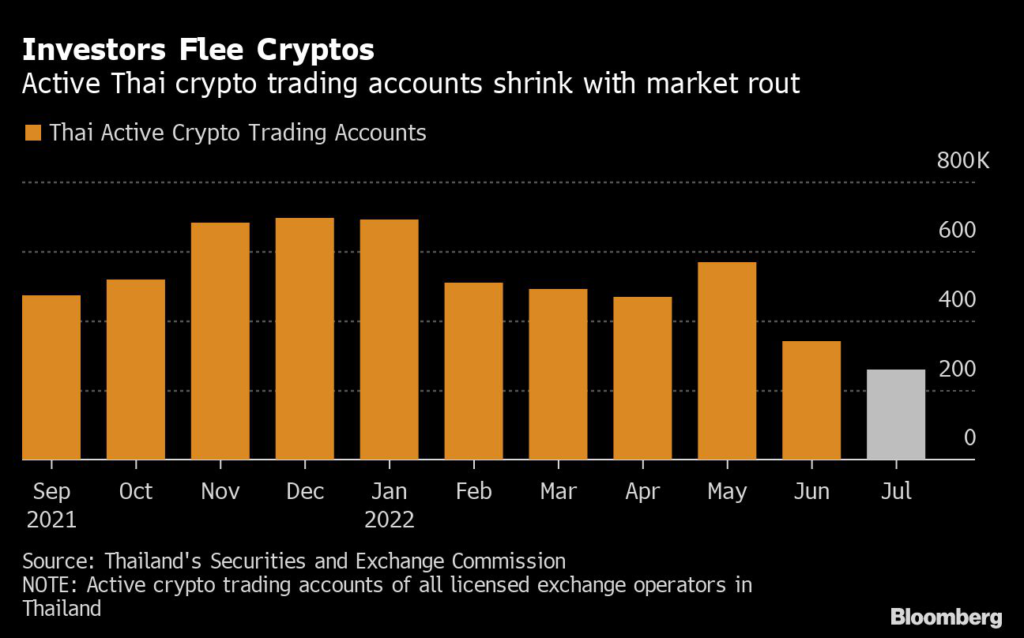
The number of active crypto-related trading accounts in Thailand shrank to about 260,000 in July from a peak of almost 700,000 in December, official data show. Trading turnover of cryptocurrencies at Thailand’s licensed exchange operators slid to 54 billion baht ($1.5 billion) in July, the least since January 2021.  

The interview with Sarath on the sidelines of a conference organized by the Stock Exchange of Thailand was conducted a day before SCB X Pcl, which owns Thailand’s second-largest bank by market value, announced the termination of an 18 billion baht deal to buy a majority stake in Bitkub Online Co., the country’s largest cryptocurrency exchange.

“Whilst the results of the due diligence exercise did not reveal any significant abnormal issues which are irremediable, Bitkub is currently in the process of resolving various issues as per the recommendations and orders of the Securities and Exchange Commission,” SCB X CEO Arthid Nanthawithaya, said in a statement. 

Expanding into the crypto community isn’t the only area of diversification for Sarath, who has an undergraduate degree in engineering from Chulalongkorn University in Bangkok and a master’s from the University of Southern California. 

His flagship Gulf Energy has not only increased its investment in wind- and solar-energy projects to supplement gas-fired power generation, but it’s also taken a major stake in Intouch Holdings Pcl, which controls Thailand’s biggest wireless-services and satellite operator.

Brokerages are mixed on the outlook for Gulf Energy shares, with seven recommending buy, seven hold and one sell, according to data compiled by Bloomberg. 

Other highlights from Sarath’s interview:

  • Gulf Energy is considering investments in renewable-energy projects in the US and Europe
  • A surge in LNG costs is having little impact on earnings, as most of the firm’s power plants are selling output to state utilities at guaranteed rates plus fuel costs
  • Allocating about 100 billion baht for equity investments, most of which are for renewable-energy projects over the next five years
  • Company has no plans to take majority control of Intouch

More stories like this are available on bloomberg.com

©2022 Bloomberg L.P.

Stocks Undaunted by Hawkish Drumbeat Before Powell: Markets Wrap

(Bloomberg) — Stocks rallied and bond yields fell, with traders awaiting Jerome Powell’s keynote for clues on how much further the Federal Reserve will pump the brakes on the economy to bring inflation back under control.

The S&P 500 closed near session highs, trimming a selloff that knocked down the market earlier in the week. Following the slowest trading day of 2022 for US equities, volume was once again below average. Megacaps like Apple Inc. and Amazon.com Inc. jumped, though Tesla Inc. whipsawed as its stock split took effect. Treasury 10-year rates traded near 3%, while the dollar slipped.

Investors were mostly unfazed by hawkish comments from Fed officials gathering for the annual conference in Jackson Hole, Wyoming. Powell’s speech at 10 a.m. Washington time Friday will mark the highlight of an event that’s been used for making key announcements. The Fed’s boss is widely expected to restate his resolve to keep tightening policy to fight inflationary spirals.

“We are not convinced Jackson Hole tomorrow will be a negative market shock because expectations are hawkish while exposure still low,” said Dennis DeBusschere, founder of 22V Research. “We thought the market correction would be leading into Jackson Hole, and that has largely played out. We are neutral short term.”

Read: Fed Officials Push for More Hikes; Bullard Favors Front-Loading

Traders will also be watching out for any signals about the pace of the Fed’s balance-sheet runoff — known as quantitative tightening — which gets up to full speed in September at a monthly clip of up to $95 billion. While some strategists are convinced the unwinding could pose a threat to equities, others say there’s still plenty of liquidity left from stimulus measures to prop up the market.

In fact, stocks surged 18% during QT from October 2017 through July 2019, Ed Yardeni, president of Yardeni Research, wrote in a recent note. Meantime, a survey conducted by DeBusschere’s firm showed that over half of the respondents believe QT will push Treasury yields higher, 32% say they will be unchanged and only 12% bet on a drop.

The Fed “should not blink” as it addresses hot inflation, and Powell faces a “huge” challenge finding ways to cool price growth without damaging the economy, Mohamed El-Erian, chief economic adviser at Allianz SE, told Bloomberg Television.

“We are confident that Powell’s commentary will be void of any major-market moving surprises,” said Robert Schein, chief investment officer at Blanke Schein Wealth Management. Should Friday’s PCE inflation reading top forecasts, “that will firmly quash any expectations of a policy pivot,” he added.

Investors also waded through data showing the government’s main measures of US growth pointed in different directions in the first half of 2022, adding to the ongoing debate on the health of the economy. Another report showed applications for unemployment benefits fell for a second week, suggesting employers are holding on to workers despite growing uncertainties.

In corporate news, China stocks listed in the US rallied as talks between both countries to avoid delisting of firms on the New York Stock Exchange ramp up. Snowflake Inc. surged as an upbeat forecast reassured Wall Street that companies are still investing in their technology systems to boost efficiency. Peloton Interactive Inc. tumbled as a bleak outlook renewed concerns about the fitness company’s comeback plan.

Read: US Corporate Profits Soar, Taking Margins to Widest Since 1950

What to watch this week:

  • Fed Chair Powell speaks at Jackson Hole, Friday
  • US personal income, PCE deflator, University of Michigan consumer sentiment, Friday

Will the meme mania fizzle out? That’s the theme of this week’s MLIV Pulse survey. Click here to participate anonymously.

Some of the main moves in markets:

Stocks

  • The S&P 500 rose 1.4% as of 4 p.m. New York time
  • The Nasdaq 100 rose 1.7%
  • The Dow Jones Industrial Average rose 1%
  • The MSCI World index rose 1.3%

Currencies

  • The Bloomberg Dollar Spot Index fell 0.2%
  • The euro rose 0.1% to $0.9977
  • The British pound rose 0.3% to $1.1835
  • The Japanese yen rose 0.4% to 136.52 per dollar

Bonds

  • The yield on 10-year Treasuries declined eight basis points to 3.02%
  • Germany’s 10-year yield declined five basis points to 1.32%
  • Britain’s 10-year yield declined eight basis points to 2.62%

Commodities

  • West Texas Intermediate crude fell 1.8% to $93.16 a barrel
  • Gold futures rose 0.5% to $1,770.50 an ounce

More stories like this are available on bloomberg.com

©2022 Bloomberg L.P.

Chinese Expats Looking for Safety, Luxury Apartments Turn to Ehomie

(Bloomberg) — After viewing 40 apartments online and touring 10 in person in the spring, Sicheng Wan finally decided on a $3,000-a-month one-bedroom in a luxury building in Jersey City, N.J., a one-transfer commute from his graduate studies at Columbia. The rental platform the Chinese expatriate used: Ehomie.

By offering an all-in-one internet service, Ehomie New York Inc. is like a combination of StreetEasy, Zillow, and Facebook Marketplace for Chinese renters, using an embedded application in the social media app WeChat and a separate brokerage service on its website. The company targets overseas Chinese students and new graduates looking to rent, sublet, or co-sign an apartment, as well as sell and buy second-hand furniture in 16 cities across North America, the UK, and Australia.

“We’re creating a community for overseas Chinese students,” says Ehomie’s founder, Felix Gui, during a tour of the company’s Times Square headquarters. Gui started Ehomie with $100,000 of his own money in 2016 and says it now brings in $5 million a year in revenue, with an average annual growth rate of 30%. The 100-person company sees up to 3,000 daily active users on its WeChat platform, and the brokerage service closes about 100 to 300 rental deals per month, Gui estimates. 

Yet Ehomie’s future could be in jeopardy, as the US loses its allure for Chinese students because of Covid-19 travel restrictions and geopolitical spats between the US and China. In the first six months of 2022, the US issued 31,055 F-1 visas to Chinese nationals, down from 64,261 for the same period in 2019, according to data from the US State Department, reported by the Wall Street Journal. 

“Compared to last year, we do see fewer Chinese students coming to the US,” Gui says, noting foreign students are an essential part of the company’s business strategy. “So while trying to do well on our existing business on the one hand, we’re developing new services.”

Ehomie now consults 500 to 1,500 customers monthly on buying real estate and plans to enter the communal living space, renting a collection of apartments and subletting the fully furnished rooms to short-term renters.

It’s also attempting to become a concierge of sorts of Chinese-speaking households. Under the name Shi Yi Da Dao, which translates to “ 11th Avenue,” Ehomie offerings include installing dividers for flex bedrooms, selling new furniture in sets, cleaning services, airport pickups and drop-offs, and international shipping between China and the US. “From a marketing standpoint, we want the 11th Ave. to be independent,” says Gui, so that even its competitors can refer clients to it.

These services are an essential pivot to garner repeat business, especially as Ehomie’s WeChat integration has proven to be a branding success but revenue failure.

If  you click open Ehomie application on WeChat and set your location to New York, the company’s biggest market, you can scroll through hundreds of listings posted by Chinese-speaking users seeking subletters or looking for roommates to co-sign a lease. Users must speak Mandarin to navigate the platform. A typical listing includes a description of the property, a floorplan image of the apartment, and videos of the rooms, sometimes coupled with photos of the building’s lobby, gym, and rooftop swimming pool. 

Once they’ve seen a listing they like, a user can contact the owner of the post by friending them on WeChat or sending a direct message via Ehomie. Yang Zhou, an electrical engineering Ph.D. student at New York University, has used Ehomie to both sublet from and to other people. He says the WeChat integration not only makes the whole process easier and smoother but also provides a safe space for subletters, allowing them to simplify the renting process, oftentimes by having a verbal agreement and skipping a sublease altogether. WeChat, the most popular messaging app in China,  dominates almost every facet of a person’s daily online existence.

“The trust comes from the fact that people are posting their WeChat contacts in public,” says Zhou, who considers his WeChat account as a part of his personal information. The platform requires users to register accounts with a government-issued ID number and asks an existing user to verify the registrant’s identity. “Once you put it out there, it gives everyone the impression that you are serious about renting, instead of having some other motives.”

However, such trust can undercut Ehomie’s profit opportunities. As a free marketplace, the company’s WeChat platform isn’t bringing in revenue, because users can list their properties for free, sidestep the app, and make transactions on their own. Ehomie’s previous efforts to keep money flow on the platform and charging a small fee also didn’t catch on; only the brokerage sector has been profitable.

It’s too early to tell if Ehomie’s new endeavors will pay off. Still, by existing largely on WeChat and only available in Mandarin, Ehomie has, by default, become an exclusive go-to rental platform for Chinese internationals. Companies such as USWOO, owned by Overseas Student Service Corp., and Uhomes are also vying for the position, but Ehomie’s WeChat platform has amassed such a sizable following that some of its competitors also list postings on it.

“The properties listed on Ehomie provide the kind of rental information that hit the sweet spot for Chinese international students and those who just entered the job market,” says Zhou. Compared to Facebook rental groups, StreetEasy, and Zillow, Ehomie has fewer listings, but they’re more likely to be viable options for a Chinese student.

This “sweet spot” means luxury buildings, which make up the majority of listings on Ehomie, often with “flex” layouts where the living room has been sectioned off into a bedroom to reduce costs; in Manhattan a true one-bedroom can easily top $4,000 per month.

Over the past five years, Chinese students coming to the US have higher budgets, $1,500–$1,800 on average, which is a 25% increase compared to 2017, according to Gui. For them, a 24/7 doorman, mailroom, modern utilities such as a gym, a lounge, and basketball courts, and a safe neighborhood close to grocery stores and public transportations are all important—and sometimes necessary—for living.  

Rising hate crimes against Asians “is having an impact” on where Chinese expatriates choose to live, Zhou says. “We like to live together in an area where there are other Chinese people.”

(Adds name and offerings of the 11th Avenue concierge service in seventh paragraph. A previous update corrected where Yang Zhou is getting his Ph.D.)

More stories like this are available on bloomberg.com

©2022 Bloomberg L.P.
Marvell Technology Slides on Weaker-Than-Expected Sales Forecast

(Bloomberg) — Marvell Technology Inc., a maker of chips for data centers, networking and other equipment, fell in late trading after a weaker-than-expected sales forecast fueled concerns about a slowdown in the semiconductor industry. 

Revenue in the fiscal third quarter will be about $1.56 billion, the company said Thursday. That compares with an average analyst estimate of $1.58 billion. Marvell expects earnings of roughly 59 cents, excluding some items, just short of the 60-cent projection. 

Like many chipmakers, Marvell has struggled with supply shortages, hampering its ability to ship products. But the industry is now also contending with a slowdown in technology spending, spurred by inflation and a more sluggish economy. That’s sent shares of Marvell and its chip peers tumbling in 2022.

The stock fell as much as 6.5% in extending trading before paring some of the losses. Marvell was down 37% this year through Thursday’s close.

Chief Executive Officer Matt Murphy said that the supply situation is improving, and that should boost sales by the fourth quarter.

More stories like this are available on bloomberg.com

©2022 Bloomberg L.P.

Snowflake Has Best Day Since IPO on Strong Sales Forecast

(Bloomberg) — Snowflake Inc. jumped to its largest single-day increase since going public after its forecast for quarterly sales topped analysts’ estimates, reassuring Wall Street that companies are still investing in their technology systems to boost efficiency.

Product revenue at the maker of software to organize and analyze data in the cloud will be as much as $505 million in the period ending in October, the company said Wednesday in a statement. Analysts, on average, estimated $501.1 million, according to data compiled by Bloomberg. Product sales make up the majority of Snowflake’s total revenue and are watched closely by investors and analysts.

The shares gained 23% to $196.28 at the close Thursday in New York, the biggest rise since Snowflake’s first day of public trading on Sept. 16, 2020, after it debuted with one of the biggest U.S. initial public offerings for a software company. Since reaching a record of $401.89 in November, the stock had tumbled 60% through Wednesday’s close, as growth slowed and valuations across the industry were battered by a weaker economic outlook.

Snowflake charges customers based on how much they use the company’s data storage and analytics products rather than charging a flat-rate subscription. While this consumption-based model can be affected by economic conditions, Snowflake has consistently seen clients re-accelerate spending once uncertainties fade, Derrick Wood, an analyst at Cowen & Co., said before the results.

Read More: Snowflake Rises on Robust Spending on Tech Systems: Street Wrap

Chief Executive Officer Frank Slootman said during a conference call that the consumption model is an advantage in tough economic times because customers know they can slow down spending if needed.

In the fiscal second quarter, product revenue increased 83% to $466.3 million — better than expected, but still Snowflake’s slowest rate of growth as a public company. Analysts estimated $438.1 million. Snowflake said it had 6,808 customers at the end of the period on July 31, beating analysts’ average estimate.

While software giant Salesforce Inc., which also reported results Wednesday, gave a revenue forecast that missed estimates, saying customers are slowing their purchasing amid concerns about the economy, Snowflake’s sales growth remained strong.

The results are “a likely sign there’s been no pullback in new customer additions and use by existing clients,” said Bloomberg Intelligence’s Mandeep Singh. He added that the company is broadening its database offerings, which could further fuel revenue growth.

Total revenue in the July quarter was $497.2 million, compared with Wall Street estimates of $467.9 million. Snowflake said its net loss widened to $222.8 million, or 70 cents a share, from a loss of $189.7 million, or 64 cents, in the period a year earlier.

(Updates with closing shares in the third paragraph.)

More stories like this are available on bloomberg.com

©2022 Bloomberg L.P.

Avaya Lenders Send Letter Demanding Company Keep Cash in Escrow

(Bloomberg) — A group of Avaya Holdings Corp. lenders who saw their recently issued loan holdings plunge nearly 25% in two months sent a letter to the struggling telecommunications software company asking it to preserve cash and provide new business projections, according to people with knowledge of the matter.  

The lenders, who hold more than half of the company’s new $350 million loan, are asking the company to hold on to funds it had placed in an escrow account to pay off convertible bonds due next year, said the people, who asked not to be identified because the matter is private.

The group, which is working with Glenn Agre Bergman & Fuentes and FTI Consulting, also asked for more clarity on how the company represented itself when it raised $600 million of new debt in June, only to project a steep decline in financial performance and oust its chief executive weeks later. The company later delayed filing results through June 30 amid ongoing internal probes. 

A representative for Avaya declined to comment. Glenn Agre and FTI didn’t respond to requests for comment.

Holders of Avaya’s older debt told agent Goldman Sachs that they intend to call a default if the company fails to file its quarterly results by the end of a grace period. 

In response, Avaya posted its quarterly financial results to private investors, the people said. CreditSights estimated that the company has until mid-September to avert a default.

Avaya is working with advisers to help it tackle convertible notes due 2023, which trade around 35 cents on the dollar, according to Bloomberg-compiled data. 

The company’s 6.125% note due 2028 and older term loan are quoted between 58 cents and roughly 60 cents, the people said. The newly issued loan due 2027 is quoted around 66 cents, down from roughly 90 cents in late June, they said.

More stories like this are available on bloomberg.com

©2022 Bloomberg L.P.

Tesla Split Will Struggle to Feed $280 Billion Rally

(Bloomberg) — After a $280 billion rally since late May, Tesla Inc. is using a trusted method for fueling further gains. It may not pan out like that.

The electric vehicle maker’s second stock split in as many years took effect when US markets opened on Thursday, a move aimed at bolstering an already strong retail investor base. The previous one in 2020 was among a number of factors that drove the stock up more than eightfold that year.

The latest split comes close on the heels of similar moves by Amazon.com Inc. and Alphabet Inc., whose subsequent stock performances have suggested this once dependable tactic to boost valuation is losing its potency amid the ravages of a bear market. Amazon shares fell more than 10% from when it announced the split to the day it became effective, while Alphabet lost 21% between those events.


“The stock split smoke-and-mirror boost is much more prevalent in a bull market when retail investors rush into stocks,” said Greg Martin, managing director and co-founder of Rainmaker Securities. “In bear markets retail investors tend to be less involved and the institutional players would never be fooled by a stock split to move into a stock.”

Shares of the Elon Musk-led company fell 12% through Thursday’s close since late-March when it declared its plan for a split, a far cry from 2020 when the stock surged 60% from announcement to the last close prior to the beginning of split-adjusted trading. 

The shares rose as much as 2% at the open in New York, before slipping and turning negative. They closed down 0.4%, at the split-adjusted price of $296.07 Thursday. 

Riskier growth stocks like Tesla have borne the brunt of a souring equities market mood this year amid the threat of a recession. The stock is down 16% year-to-date, headed for its first annual decline since 2016. And having rallied 41% since hitting a year low on May 24, the rebound has hit a wall in August as broader enthusiasm among retail investors has started to flag again.

According to Vanda Research, investors tend to “drastically scale back” purchases of stocks in the weeks after a split takes effect. The firm doesn’t believe it will be any different for Tesla this time round, it said in a note.

Highly Valued

In addition to a tentative investor mood, the stock’s eye-watering valuation may also make gains harder to come by. Tesla trades at about 58 times forward earnings estimates compared with 18 times for the S&P 500 Index. And the average analyst price target implies a decline of about 4% over the next 12 months, even as the benchmark index is expected to rise more than 15%.

“There is a lot of hope, speculation, hero worship in the current valuation,” said Catherine Faddis, chief investment officer of Grace Capital. In order to buy the stock right now, an investor needs to believe that in 10 years Tesla will have revenue of $800 billion, Faddis said, almost 10 times estimates for this year.

Then there is the company’s litany of challenges — production troubles in China, the persisting supply-chain shortages across the automotive industry and high raw material costs, as well as Musk’s litigation with Twitter Inc. — that can dull the shine of any potential exuberance driven by the split.

Still, Tesla’s strong popularity with the mom-and-pop investing crowd can ensure a short-term bump in the stock, if wider investor sentiment improves again.

“A strong retail following is the key ingredient for a stock split to make a difference,” said Martin of Rainmaker Securities, adding that Tesla’s timing for the split may prove to be lucky as the climate act will “create substantial new demand for electric vehicles and Tesla is the market leader in the EV market.”

Tech Chart of the Day

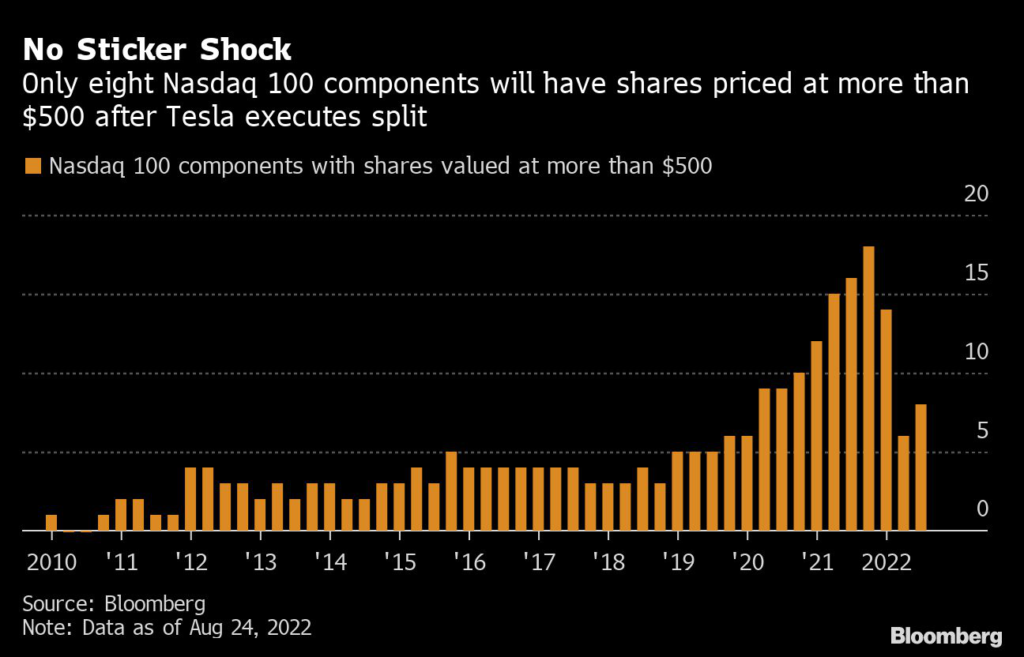
After Tesla executed its split there are now only eight Nasdaq 100 components with stocks priced at more than $500. This year’s market selloff, coupled with a series of splits, has meant that the number of companies with share prices exceeding $500 has halved from the beginning of the year.

Top Tech Stories

  • Nvidia Corp., which warned earlier this month that its sales were slipping, gave a disappointing forecast for the current period that added to signs of weakness in the semiconductor industry.
  • Pinterest Inc. is facing an investigation by the California Civil Rights Department, the company confirmed, after a number of employees brought forward discrimination claims in recent years.
  • Salesforce Inc. gave a forecast for quarterly revenue that fell short of analysts’ estimates, suggesting that a choppy economy may be causing some customers to slow spending on business software. The shares declined in extended trading.
  • Snowflake Inc. surged in late trading after its forecast for quarterly sales topped analysts’ estimates, reassuring Wall Street that companies are still investing in their technology systems to boost efficiency.
  • Amazon.com Inc. is closing its primary care and telehealth service, a sudden move that follows the company’s deal to buy the One Medical chain of clinics.
  • Singapore’s Grab Holdings Ltd., once Southeast Asia’s most valuable startup, is faltering behind GoTo Group in the public markets as it fights to gain ground on its Indonesian ride-hailing rival’s home turf.
  • South Korean agriculture and food trading platform Tridge Co. raised 50 billion won ($37 million) at a 3.6 trillion-won valuation, becoming the latest billion-dollar startup in SoftBank Group Corp.’s stable.
  • Nidec Corp. President and Chief Operating Officer Jun Seki is planning to leave the electric-motor maker ahead of a management overhaul by founder Shigenobu Nagamori, 77, people with knowledge of the matter said.

(Updates stock moves in fifth, sixth and seventh paragraphs.)

More stories like this are available on bloomberg.com

©2022 Bloomberg L.P.

Peloton Suffers Worst Rout in Seven Months After Dire Forecast

(Bloomberg) — Peloton Interactive Inc. suffered its worst stock rout in seven months after the fitness company gave a bleak forecast for the current quarter, with losses piling up and sales falling more steeply than Wall Street expected. 

Revenue will be $625 million to $650 million in the fiscal first quarter, the company said Thursday, far short of the $772 million analysts were predicting. Its loss on an adjusted basis will be $90 million to $115 million, compared with an average estimate of about $93 million.

The outlook follows a similarly dire fourth quarter, when sales plunged 28% to $678.7 million and the adjusted loss was $288.7 million. On a net basis, the loss was $1.2 billion — about four times the size of the company’s loss a year earlier.

The numbers suggest that a turnaround plan under Chief Executive Officer Barry McCarthy still has a long way to go. He took the reins in February and slashed expenses — cutting thousands of jobs and shuttering operations — but the company is facing sluggish demand and a buildup of inventory. On Wednesday, Peloton announced plans to begin selling its bikes and accessories on Amazon.com Inc.’s site, aiming to broaden its distribution.

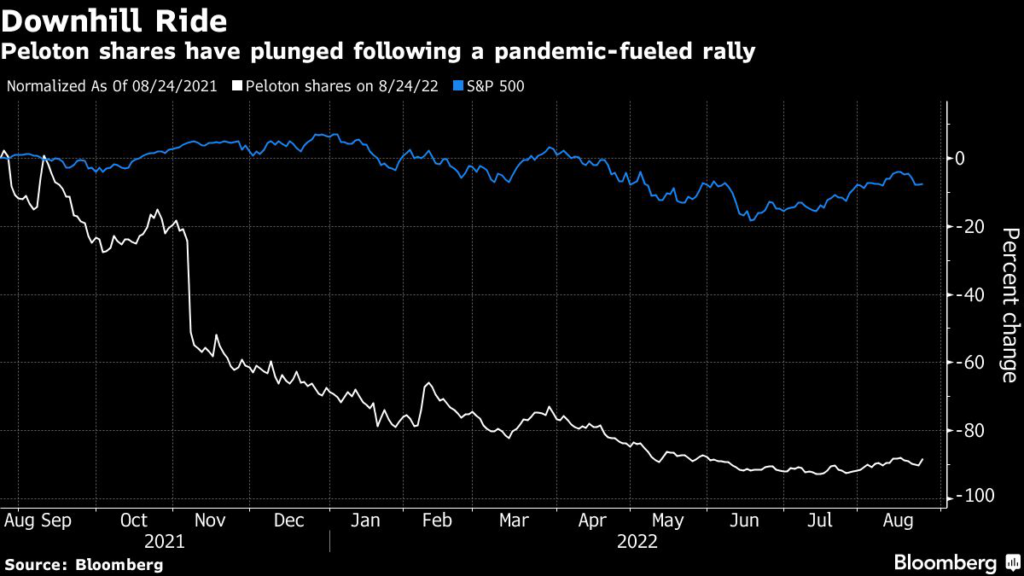
The shares fell 18% to $11.01 in New York, marking the biggest one-day decline since Jan. 20. The stock is down more than 90% in the past 12 months. 

McCarthy was blunt about the challenges in a letter to shareholders Thursday, but said Peloton is making headway.

“The naysayers will look at our Q4 financial performance and see a melting pot of declining revenue, negative gross margin and deeper operating losses. They will say these threaten the viability of the business,” McCarthy said. “But what I see is significant progress driving our comeback and Peloton’s long-term resilience.”

The net loss in the fourth quarter, which ended June 30, included $415 million in costs related to the comeback plan.

A slowdown in subscriber growth has added to Peloton’s challenges. Last quarter, it had 2.97 million connected fitness subscribers — people who receive content on Peloton equipment — up 27% from a year earlier. But the figure was flat from the previous quarter.

“Peloton’s turnaround may be a ways off,” Bloomberg Intelligence analyst Geetha Ranganathan said in a report. “Limited visibility into demand gives little confidence.”

Workouts on Peloton equipment fell 4% from a year earlier and 20% from the last quarter. The company had seen a surge in use during the pandemic, when stuck-at-home consumers snapped up its equipment. But even with the slowdown, engagement is “tracking well above pre-Covid levels,” Peloton said. The connected fitness number is expected to stay around 3 million in the coming quarter. 

McCarthy’s goal is to make Peloton cash flow positive in the second half of the coming fiscal year. “We continue to make steady progress, but we still have work to do,” he said.

In an interview earlier this month, McCarthy said the company should prioritize its digital offering over hardware and that it’s exploring allowing subscribers to beam content from their smartphone to non-Peloton fitness equipment.

In recent weeks, the company also announced a plan to outsource all manufacturing to third-party factories, cut its customer service operations in half, shift away from in-house deliveries and warehouses, and lay off hundreds of workers. It’s also planning to shut stores next year. The move is designed to let Peloton reallocate $50 million in annual spend, McCarthy said on a call with analysts Thursday. 

In an effort to increase cash flow, the company also hiked prices for its Bike+ model and Tread treadmill by $500 and $800, respectively.

“Our Q1 outlook reflects near-term demand weakness associated with our recent hardware price increases as well as typical seasonal demand softness,” the company said Thursday.

Peloton believes its new leasing program — which combines a bike and content into a monthly price without a down payment — may help with the turnaround, saying that churn for the initiative is low and that it will expand its marketing for the program in September.

“Our test results show the program is driving increased traffic to the top of our marketing funnel and clearly appeals to a younger, more value-conscious consumer,” McCarthy said. 

On the call with analysts, McCarthy said the company is currently seeing a run rate of about 40,000 leases per year from the leasing program, but he hopes to raise that to about 150,000 leases annually. The company also said it hopes to have $1 billion of cash on hand at all times. 

The company isn’t giving full-year guidance for fiscal 2023, citing “broader macroeconomic uncertainties and the pace and number of changes we’re making to our business.” It also will no longer report quarterly engagement metrics. 

In describing Peloton’s challenges, McCarthy reflected on his time working on a cargo ship in high school. 

“After midnight on my second voyage, I was asleep when the alarm for general quarters woke me,” he said in the shareholder letter. “The ship was healing sharply to starboard and the steel hull was shuddering. The captain was trying to turn the ship around, but a ship that big, going that fast, takes miles and miles to change direction.”

Peloton, he said, is like that cargo ship. “We’ve sounded the alarm for general quarters. Everyone’s at their station,” McCarthy said. “When will the ship respond is the question. Our goal is FY23.”

More stories like this are available on bloomberg.com

©2022 Bloomberg L.P.
Close Bitnami banner
Bitnami