
Bloomberg

Hottest Tokyo Prices Since 1992 Ramp Up Heat on BOJ Messaging

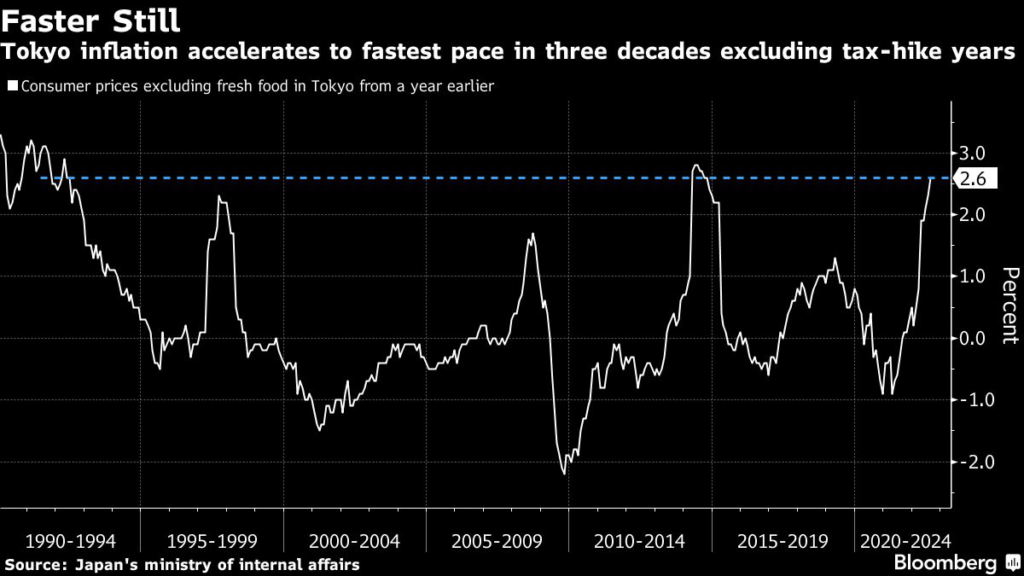
(Bloomberg) — The cost of living in Tokyo rose at a quicker-than-expected pace in August to reach the fastest clip since 1992 excluding tax-hike years, adding to the communication challenges for the Bank of Japan.

Consumer prices excluding fresh food rose 2.6% in the capital this month, according to the ministry of internal affairs Friday. The gain beat economists’ forecast of a 2.5% increase. 

Energy and processed foods drove most of the growth in overall Tokyo prices, which rose 2.9% from a year earlier. The two factors accounted for 2 percentage points of increase, while a smaller drop in mobile fees also helped push up the rate by 0.1 percentage point.

The acceleration in the leading indicator of nationwide inflation is still unlikely to nudge BOJ Governor Haruhiko Kuroda toward an adjustment of policy at the central bank’s next meeting in September. 

While his overseas counterparts have kept raising rates, Kuroda has insisted on the need for wage growth to achieve stable inflation before any policy change after nearly a decade of stimulus to generate rising prices.

“This confirms there is a good chance national figures will reach 3% or more in the final quarter of this year,” said Yoshiki Shinke, economist at Dai-Ichi Life Research Institute. “But this inflation won’t make the BOJ consider tightening. Japan’s inflation is still driven by energy, commodity prices and a weak yen and those are all one-off factors.”

Still, people are seeing their spending power fall as paychecks fail to keep up with inflation, fueling both frustration among squeezed households and concerns that consumer spending will cool amid Japan’s already-slow recovery from the pandemic. 

That leaves Kuroda with an increasingly tough job to convince both members of the public and the government that it makes sense to keep stimulating the economy with rock-bottom interest rates.

He also faces a difficult task to persuade market players that he will not buckle on rates like so many of his peers in the face of inflation. 

What Bloomberg Economics Says…

“We see Tokyo’s core inflation hovering around 2.5% in 3Q and then rising slightly in 4Q. A weaker yen could buoy prices of processed foods and other imports. Pushing the other way, fuel subsidies aimed at restraining gasoline prices and steps to cap imported wheat prices should restrain some inflationary pressures.”

— Yuki Masujima, economist

For the full report, click here

Japan’s inflation is expected to continue accelerating as an increasing number of businesses have announced they will bump up their prices this fall. Food company price hikes will likely affect 6,305 items in October, according to a Teikoku Databank survey. That compares with a monthly average of 1,151 rising items through July this year.

In October another boost is expected from a further fading of last year’s cheaper cell phone fees. After the government urged telecommunication firms to cut overly high fees, the companies responded in several waves with sharp cuts that put strong downward pressure on the consumer price index.  

Considering all those factors, some economists including those at Citigroup are predicting the nationwide inflation to hit 3% or above in the final quarter of this year. 

Even so that won’t push Kuroda to unwind stimulus before his term ends in April, according to analysts surveyed by Bloomberg this month. They say 3% inflation needs to last for half a year at least to trigger policy action from the BOJ — a scenario that’s way beyond their current price forecasts.  

“Prices aren’t rising on a solid economic recovery like elsewhere,” said Dai-Ichi Life’s Shinke. “Japan’s situation remains completely different from the US and Europe.”

(Updates with more details from the report, economist comments)

More stories like this are available on bloomberg.com

©2022 Bloomberg L.P.
Chinese Stocks May Extend Gains as Delistings Talks Progress

(Bloomberg) — Chinese equities may extend gains on Friday after news that regulators were progressing in talks to avoid the delisting of companies in New York gathered momentum.

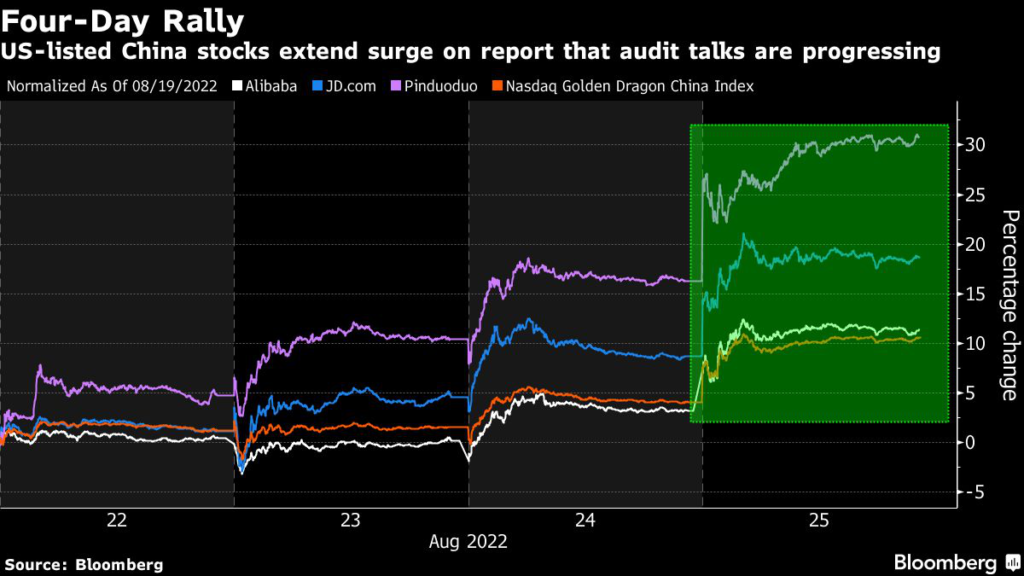
The Nasdaq Golden Dragon China Index jumped 6.3% overnight, the most since June, with shares of Alibaba Group Holding Ltd. and JD.com Inc. both gaining at least 8%. China regulators have instructed major accounting firms to prepare to bring audit work papers of US-listed Chinese companies to Hong Kong, where they can be reviewed by US officials, according to a person familiar. 

Congress imposed a 2024 deadline for kicking off businesses that don’t comply with US exchange listing rules and investors have remained wary over the fate of the more than 200 Chinese firms with American Depositary Receipts. The conversations, which remain ongoing, may result in a positive step forward in the years-long standoff. 

“This is a fascinating development,” said Ed Moya, senior market analyst at Oanda Corp. “An official confirmation is needed but expectations were growing that this would get done as both countries are dealing with economic fragility,” he added.

Read more: US-China Talks on Delistings Advance With Hong Kong Inspections

Concern that an audit dispute may trigger a mass, forced exit of Chinese names from US markets has weighed on the shares for more than a year. Earlier this month, China Life Insurance Co., PetroChina Co. and China Petroleum & Chemical Corp. were among a group of state-owned companies that announced plans to delist from American exchanges. 

As a result, the prospect of a resolution is a boon for embattled Chinese stocks.

The rally in US trading followed what was the best day in nearly four months for Hong Kong’s Hang Seng Tech Index, which rose 6% on Thursday. It helped lead the city’s benchmark Hang Seng Index to a 3.6% gain, making it the best performer among Asia’s major equity gauges.

In addition to the Chinese government’s 1 trillion yuan ($146 billion) of support for the economy, traders cited short covering and an adjustment of positions ahead of Jackson Hole.

“Whether or not the rumor on an audit deal is true, Hong Kong shorts have pressed their bets in a light summer tape,” said Brendan Ahern, chief investment officer at Krane Fund Advisors LLC. “We have been setting up for an epic short squeeze that is contributing to today’s move.”

Stocks in Hong Kong had slumped to the lowest in months this week, as global risk-off sentiment spread ahead of the Federal Reserve’s Jackson Hole symposium. Concerns over China’s economic growth, with a deepening property crisis and power shortages spurred by a severe drought, had added to the gloom.

Following three days of losses, the Hang Seng Index was also looking ripe for a rebound to some market watchers based on various technical indicators.  

The gauge was near “oversold” levels on monthly measures of the relative strength index, approaching the 30-threshold that’s never been reached in data going back to 1972. Morgan Stanley strategist Gilbert Wong said “the risk of short squeeze in China and Hong Kong equities is rising.” 

Even as talks progress, some are staying cautiously optimistic. “At this point it appears details are lacking but if a deal between U.S. and Chinese regulators comes to a fruition, it would be a very good sign for investors in U.S. listed Chinese ADRs,” said Michael O’Rourke, chief market strategist at JonesTrading.

“Considering the fact that some Chinese companies have commenced the U.S. delisting process, it is a positive sign to see the situation stabilize,” he added.

(Updates first three paragraphs with background)

More stories like this are available on bloomberg.com

©2022 Bloomberg L.P.
Chinese Stocks May Extend Gains on Talks to Avoid Delistings

(Bloomberg) — Chinese equities may extend gains on Friday after news that regulators were progressing in talks to avoid the delisting of companies in New York gathered momentum.

The Nasdaq Golden Dragon China Index jumped 6.3% overnight, the most since June, with shares of Alibaba Group Holding Ltd. and JD.com Inc. both gaining at least 8%. China regulators have instructed major accounting firms to prepare to bring audit work papers of US-listed Chinese companies to Hong Kong, where they can be reviewed by US officials, according to a person familiar. 

Congress imposed a 2024 deadline for kicking off businesses that don’t comply with US exchange listing rules and investors have remained wary over the fate of the more than 200 Chinese firms with American Depositary Receipts. The conversations, which remain ongoing, may result in a positive step forward in the years-long standoff. 

“This is a fascinating development,” said Ed Moya, senior market analyst at Oanda Corp. “An official confirmation is needed but expectations were growing that this would get done as both countries are dealing with economic fragility,” he added.

Read more: US-China Talks on Delistings Advance With Hong Kong Inspections

Concern that an audit dispute may trigger a mass, forced exit of Chinese names from US markets has weighed on the shares for more than a year. Earlier this month, China Life Insurance Co., PetroChina Co. and China Petroleum & Chemical Corp. were among a group of state-owned companies that announced plans to delist from American exchanges. 

As a result, the prospect of a resolution is a boon for embattled Chinese stocks.

The rally in US trading followed what was the best day in nearly four months for Hong Kong’s Hang Seng Tech Index, which rose 6% on Thursday. It helped lead the city’s benchmark Hang Seng Index to a 3.6% gain, making it the best performer among Asia’s major equity gauges.

In addition to the Chinese government’s 1 trillion yuan ($146 billion) of support for the economy, traders cited short covering and an adjustment of positions ahead of Jackson Hole.

“Whether or not the rumor on an audit deal is true, Hong Kong shorts have pressed their bets in a light summer tape,” said Brendan Ahern, chief investment officer at Krane Fund Advisors LLC. “We have been setting up for an epic short squeeze that is contributing to today’s move.”

Stocks in Hong Kong had slumped to the lowest in months this week, as global risk-off sentiment spread ahead of the Federal Reserve’s Jackson Hole symposium. Concerns over China’s economic growth, with a deepening property crisis and power shortages spurred by a severe drought, had added to the gloom.

Following three days of losses, the Hang Seng Index was also looking ripe for a rebound to some market watchers based on various technical indicators.  

The gauge was near “oversold” levels on monthly measures of the relative strength index, approaching the 30-threshold that’s never been reached in data going back to 1972. Morgan Stanley strategist Gilbert Wong said “the risk of short squeeze in China and Hong Kong equities is rising.” 

Even as talks progress, some are staying cautiously optimistic. “At this point it appears details are lacking but if a deal between U.S. and Chinese regulators comes to a fruition, it would be a very good sign for investors in U.S. listed Chinese ADRs,” said Michael O’Rourke, chief market strategist at JonesTrading.

“Considering the fact that some Chinese companies have commenced the U.S. delisting process, it is a positive sign to see the situation stabilize,” he added.

(Updates first three paragraphs with background)

More stories like this are available on bloomberg.com

©2022 Bloomberg L.P.
US-China Talks on Delistings Advance With H.K. Inspections

(Bloomberg) — Talks between Beijing and Washington to avoid the delisting of about 200 companies from New York stock exchanges are gathering pace with a plan to let US inspectors travel to Hong Kong to review audit documents of Chinese businesses.

Chinese regulators have instructed major accounting firms to prepare to bring the audit work papers of US-listed Chinese companies to Hong Kong, where they can be reviewed by the Public Company Accounting Oversight Board, according to a person who asked not to be identified as the discussions are private. The conversations, which remain ongoing, could result in a significant advance in a years-long standoff over the inspections, which are required for all firms that trade in the US.

The clock is ticking to avoid a congressionally imposed deadline of 2024 for kicking out businesses that don’t comply from the New York Stock Exchange and Nasdaq. The Nasdaq Golden Dragon Index, which tracks Chinese firms trading in the US, surged the most in more than two months after The Wall Street Journal reported on the discussions earlier Thursday. 

The PCAOB declined to comment. The China Securities Regulatory Commission and the US Securities and Exchange Commission didn’t immediately respond to requests for comment. 

The SEC has remained unwavering in its demand that US regulators get full access to the audits. SEC Chair Gary Gensler has said that US law gives him little room for compromise. 

(Updates with SEC stance in fifth paragraph)

More stories like this are available on bloomberg.com

©2022 Bloomberg L.P.
Revolut Users Embrace Budgeting Tools in Cost-of-Living Crisis

(Bloomberg) — Revolut Ltd. users are increasingly checking budgeting tools on the app and looking to rein in some spending and save more, the latest sign of inflation hitting consumer confidence.  

There was a 15% increase in the number of customers checking the budgeting tools in the first half of this year, according to Revolut. The app’s ‘savings vault,’ which enables customers to set aside separate saving pots, has seen July UK usage increase 150% year-on-year. 

A feature that recommends spending limits to customers is also proving popular, according to Ankit Khemka, Revolut’s global general manager. “We’ll send notifications to customers when they’re nearing their limit, and they can get a clear view of their spending with a breakdown by merchants, categories, countries, and more,” he said. 

Inflation is clearly adding to costs and users are cutting back where they can, he said, citing the firm’s July card spend data in the UK that showed grocery spending dropping by 8% per consumer year on year. Still, demand for travel remains with outlay on hotels and resorts up 86%

The London-headquartered fintech now has 5 million UK customers, putting it among the country’s most popular finance apps. Revolut generates about a quarter of its revenue in Britain, although it is still waiting for a full banking license, which means it operates as an e-money institution.

Read More: Revolut’s Frustrated Billionaire Is Forced to Wait in Line

Despite its growing heft, the fintech firm is still positioning itself as an upstart. A new marketing campaign emphasizes how its various services will allow “any money underdog” to access and easily manage a range of financial services, including insurance and crypto investments.

More stories like this are available on bloomberg.com

©2022 Bloomberg L.P.
Dell Declines After Executives Signal Tighter Times Ahead

(Bloomberg) — Dell Technologies Inc. fell about 5% in late trading after executives’ pessimistic remarks about the business environment for the second half of the year outweighed solid quarterly results.

Company leadership suggested a greater sales challenge ahead for the maker of personal computers, servers and information technology. Co-Chief Operating Officer Chuck Whitten said Dell “observed more cautious customer behavior as the quarter progressed.” Whitten’s co-COO Jeff Clarke said the company is operating “in an increasingly challenging environment.”

Revenue in the current quarter will be $23.8 billion to $25 billion — a sales decline of about 8% from a year ago at the midpoint of the estimate, Chief Financial Officer Tom Sweet said during a conference call. Analysts, on average, projected $26.4 billion.

Still, Dell said its long-term financial models project annual revenue growth of 3% to 4% and an increase of more than 6% in earnings per share. For the full year, Sweet said revenue should range from flat to 2% growth.

Sales climbed 9% to $26.4 billion in the fiscal second quarter, which ended July 29, in line with estimates. Earnings, excluding some items, were $1.68 share, the Round Rock, Texas-based company said Thursday in a statement. Analysts, on average, projected $1.64, according to data compiled by Bloomberg. 

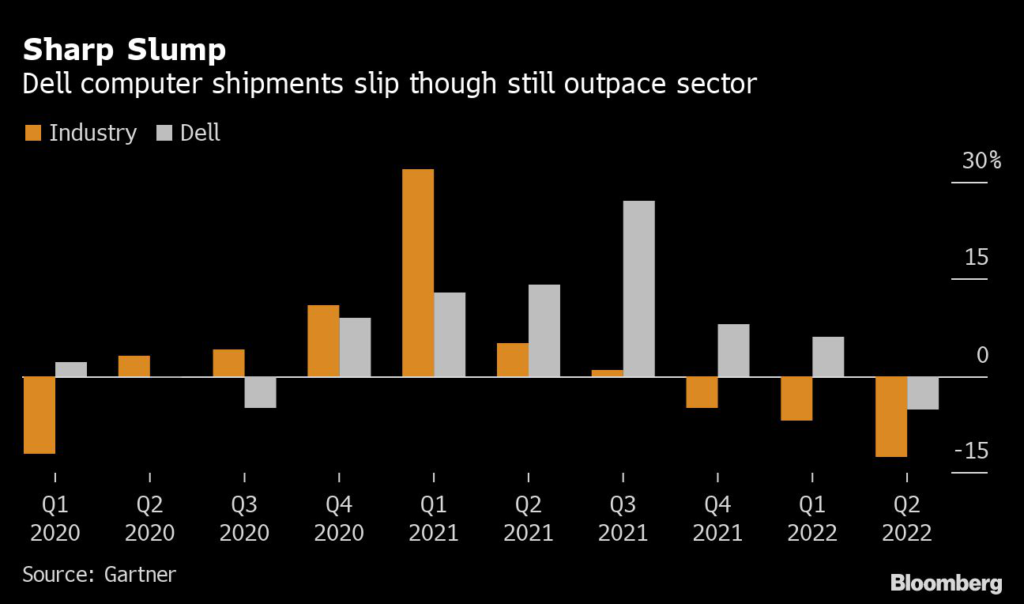
While personal computer sales make up about 60% of Dell’s revenue, the company overcame a downturn in consumer spending with gains among its business clients. Commercial PC sales grew 15% to $12.1 billion while consumer sales dropped 9% to $3.3 billion.

Global PC shipments fell 13% in the three months from April to June — the worst quarter in more than nine years, according to Gartner Inc., an industry analyst. Much of the decline was due to the ongoing downturn in demand for Chromebooks and inflation-squeezed budgets delaying consumer purchases. 

Fiscal second-quarter revenue from the Infrastructure Solutions Group, which includes most of Dell’s technology services, increased 12% to $9.5 billion from a year earlier. Server and networking sales climbed 16% to $5.2 billion, while storage revenue gained 6% to $4.2 billion.

Investors may have been expecting Dell’s infrastructure unit to beat estimates, and share gains heading into the results left little room for a rally, said Woo Jin Ho, an analyst at Bloomberg Intelligence.

To emphasize the continuing slump in the PC market, Sweet said current-quarter sales in Dell’s PC division are expected to decline by a “high teens” percentage from the period a year ago. Revenue will increase “in the low teens” in the infrastructure unit, where executives “see a more challenging” demand environment, he said.

Supply chain backlogs improved during the quarter for Dell, and backlog-clearing PC sales helped offset demand weakness, Clarke said. However, the backlog for its infrastructure unit, particularly for server components, remained elevated, and component cost inflation is expected in the third quarter, he said.

Gross margins decreased 2 percentage points from a year ago to 21.4%, mainly due to expense increases and currency value changes that haven’t yet been factored into product prices, Sweet said. The company slowed down external hiring as part of an effort to control costs, Sweet said.

Dell ended the quarter with remaining performance obligations of $41 billion, up 2% year-over-year. Recurring revenue was $5.2 billion, a gain of 8% from the period a year earlier. The company said annual recurring revenue for APEX, its cloud management service, is now more than $1 billion.

The shares fell to a low of $43.65 in extended trading after closing at $47.90 in New York. The stock has declined 15% this year. 

(Updates with fiscal third-quarter forecast in the third paragraph.)

More stories like this are available on bloomberg.com

©2022 Bloomberg L.P.

World’s Most Popular Password Manager Says It Was Hacked

(Bloomberg) — LastPass, a password manager used by more than 33 million people around the world, said a hacker recently stole source code and proprietary information after breaking into its systems.

The company doesn’t believe any passwords were taken as part of the breach and users shouldn’t have to take action to secure their accounts, according to a blog post on Thursday. 

An investigation determined that an “unauthorized party” cracked into its developer environment, which is the software that employees use to build and maintain LastPass’s product. The perpetrators were able to gain access through a single compromised developer’s account, the company said.

The attack struck a company that generates and stores hard-to-crack, auto-generated passwords for multiple accounts, like Netflix or Gmail, on behalf of its users — without the need to manually enter credentials. LastPass lists Patagonia, Yelp Inc. and State Farm as customers on its website.

Cybersecurity website Bleeping Computer reported that it had asked LastPass about the breach two weeks ago. 

Allan Liska, an analyst on the Computer Security Incident Response Team at cybersecurity company Recorded Future, said he was impressed with the “speedy notification” from LastPass.

“While two weeks might seem like a long time to some, it can take a while for incident response teams to fully assess and report on a situation,” he said. “it will take time to fully determine the extent of any damage that may have been as result of the breach. However, for now it appears to not be client-impacting.”

LastPass didn’t immediately respond to a request for further comment.

There was speculation on social media that hackers may be able to access the keys to password vaults after stealing source code and proprietary information. 

“It is unlikely that the stolen source code will give the criminals access to customer passwords,” Liska said.

More stories like this are available on bloomberg.com

©2022 Bloomberg L.P.

Twitter Must Give Musk More Data on Bots in Battle Over Deal

(Bloomberg) — Twitter Inc. was ordered to hand over more information about spam and bot accounts to Elon Musk as part of its legal fight to make the billionaire complete his $44 billion acquisition of the social-media platform.

Delaware Chancery Court Judge Kathaleen St. J. McCormick Thursday ruled Twitter must turn over information about 9,000 accounts it surveyed last year in hopes of identifying which had human beings attached to them. Twitter sought to deny Musk access to this “historical snapshot” on privacy and other grounds.

Twitter also “must produce documents sufficient to show how those 9,000 accounts were selected for review,” McCormick said in her ruling. At a hearing on Wednesday, Musk’s lawyers accused their Twitter counterparts of stonewalling them on the bots information in pre-trial information exchanges.

Twitter didn’t immediately respond to a request for comment. “We look forward to reviewing the data Twitter has been hiding for many months,” Alex Spiro, a lawyer for Musk, said in an emailed statement.

Musk has said misleading information put out by Twitter about the number of spam and bot accounts gives him a valid reason to exit his $54.20-per-share bid for the platform. Twitter counters he’s legally handcuffed by the merger agreement and must consummate the deal.

The ruling on the bot survey was only among multiple orders McCormick issued Thursday to resolve discovery issues raised by both sides in the case. The judge didn’t give Musk everything he wanted on the bots issue, noting his demands for the data were “absurdly broad.”

She also ruled Twitter didn’t have to broaden the date range of the documents it’s offering to Musk on the question of whether spam and robot accounts make up more than the 5% disclosed in the firm’s securities filings. But she also said Musk’s lawyers could withhold reports from their computer experts’ digging into the bot issues as privileged-work product. 

While Twitter has to hand over details on the 9,000 accounts, McCormick warned they are subject to strict confidentiality rules. “The historical-snapshot data that I have ordered produced is highly sensitive,” the judge said, adding that Musk’s lawyers agreed to “treat this data as highly confidential.”

At a hearing Wednesday, one of Twitter’s lawyers worried about Musk’s propensity for sharing confidential data in some of his tweets. Bradley Wilson, one of the platform’s attorneys, reminded McCormick that Twitter was being asked to turn over user data to “someone who publicly mocked” the company and threatened to disclose its internal data.

Both sides are jockeying for position as they prepare for an Oct. 17 trial, sending out a spate of subpoenas to equity investors, advisers and banks involved in the proposed acquisition. Earlier this week, ex-Twitter CEO Jack Dorsey was subpoenaed along with whistle-blower Peiter Zatko, who raised concerns about the bot issue before being fired from the platform.

The case is Twitter v. Musk, 22-0613, Delaware Chancery Court (Wilmington). 

(Updates with more details from ruling starting in seventh paragraph)

More stories like this are available on bloomberg.com

©2022 Bloomberg L.P.
DoorDash Data Breach Exposed Some Personal Customer Data

(Bloomberg) — DoorDash Inc. said customer data including phone numbers, emails and delivery addresses were compromised by hackers who infiltrated the computer system of a vendor. 

Hackers gained access to some of DoorDash’s internal tools by using a phishing attack on a third-party vendor that exposed employee credentials, the company said Thursday in a blog post. DoorDash said the vendor’s access to its systems was “swiftly disabled.” It didn’t disclose the name of the vendor.

A DoorDash spokesman said the attack is linked to a Twilio Inc. breach earlier this month that compromised employee and customer information after outsiders duped Twilio employees into handing over their passwords. Twilio provides business-to-consumer messaging and digital authentication services among its software products.

DoorDash said hackers primarily accessed customer information such as names, emails, delivery addresses and phone numbers. Basic order information and partial payment card information was compromised for “a smaller set of consumers.” The San Francisco-based company added that “based on our investigation to date,” the breach didn’t include passwords or full credit card, bank account or Social Security numbers. 

Names and phone numbers or email addresses for DoorDash’s delivery couriers, or Dashers, were also exposed.    

“The advanced tactics used appear to be connected to a wider phishing campaign that has targeted a number of other companies,” DoorDash said in the blog post. “We understand that law enforcement is aware of this campaign and is actively investigating.” 

In addition to working with authorities, DoorDash said it retained a “leading cybersecurity firm” to assist with the investigation into the attack.

More stories like this are available on bloomberg.com

©2022 Bloomberg L.P.

NYC Brokerage Compass Parts Ways With Chief Technology Officer Joseph Sirosh

(Bloomberg) — Compass Inc. said it’s parting ways with Chief Technology Officer Joseph Sirosh as part of a cost-reduction program, a week after the executive sold 40% of his shares in the real estate brokerage.

Sirosh, who previously worked at Microsoft Corp., was hired by Compass in late 2018. He offloaded more than 222,460 shares last week and collected $868,000 in proceeds, according to a regulatory filing that said the sales were made under a plan set in May. He didn’t immediately respond to a request for comment.

Compass, which sold the most residential real estate of any US brokerage last year, is grasping for a path to profit as the once-frenzied housing market slows. Earlier this month, Chief Executive Officer Robert Reffkin promised to slash $320 million in expenses while seeking to generate positive cash flow. 

Those cuts are expected to land heavily on the company’s technology operation. 

Compass has invested more than $900 million to build out a software platform designed to help its agents do their jobs more effectively. While the technology is viewed by some as industry-leading, it has yet to help Compass turn an annual profit. The company, which cut 10% of its workforce in June, said last week it plans another round of layoffs by October.

“With the successful rollout of the Compass technology platform, Compass now enters its next phase,” the company said in a statement. It’s “focused on enhancing and building tools that help our over 28,000 agent-entrepreneurs grow their businesses.” 

Chief Financial Officer Kristen Ankerbrandt announced in May that she would be leaving Compass in September. The company isn’t planning to appoint another CTO to replace Sirosh. Instead, Kendra Shimmell will be head of product and Shay Artzi will be head of engineering.

Shares of Compass, which started trading at $18 in early 2021, closed Thursday at $3.26. 

More stories like this are available on bloomberg.com

©2022 Bloomberg L.P.

Close Bitnami banner
Bitnami