
Bloomberg

Peloton Gives Gloomy Forecast in Sign Comeback Is Still Far Off

(Bloomberg) — Peloton Interactive Inc. gave a bleak forecast for the current quarter, with losses piling up and sales falling more steeply than Wall Street expected, renewing concerns about the fitness company’s comeback plan. 

Revenue will be $625 million to $650 million in the fiscal first quarter, the company said Thursday, far short of the $772 million analysts were predicting. Its loss on an adjusted basis will be $90 million to $115 million, compared with an average estimate of about $93 million.

The outlook follows a similarly dire fourth quarter, when sales plunged 28% to $678.7 million and the adjusted loss was $288.7 million. On a net basis, the loss was $1.2 billion — about four times the size of the company’s loss a year earlier.

The numbers suggest that a turnaround plan under Chief Executive Officer Barry McCarthy still has a long way to go. He took the reins in February and slashed expenses — cutting thousands of jobs and shuttering operations — but the company is facing sluggish demand and a buildup of inventory. On Wednesday, Peloton announced plans to begin selling its bikes and accessories on Amazon.com Inc.’s site, aiming to broaden its distribution.

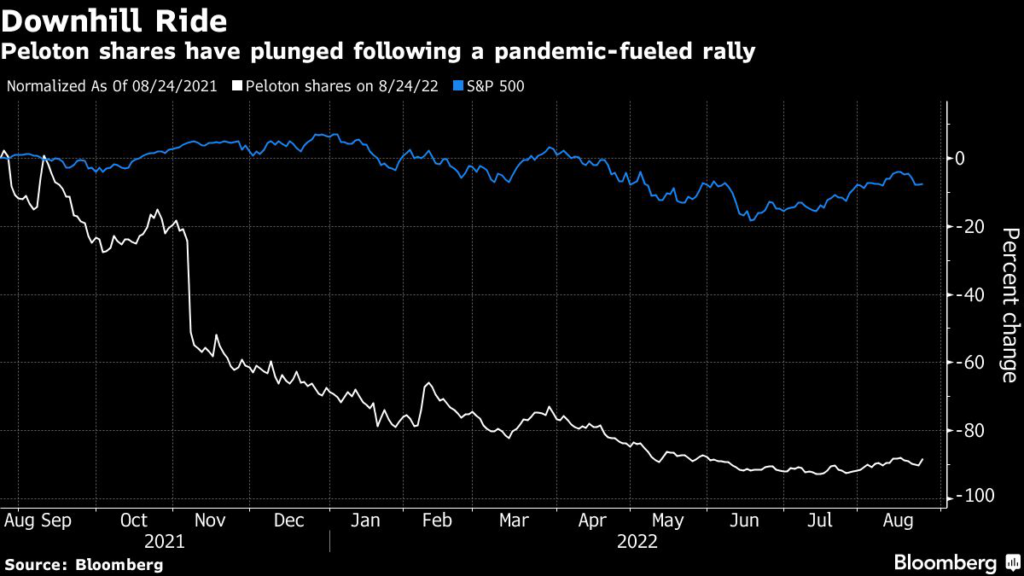
The Amazon news gave a boost to shares, but they remain down nearly 90% over the past year. After the company published its outlook on Thursday, the stock dropped 6.5% in premarket trading before markets opened in New York. 

McCarthy was blunt about the challenges in a letter to shareholders Thursday, but said Peloton is making headway.

“The naysayers will look at our Q4 financial performance and see a melting pot of declining revenue, negative gross margin and deeper operating losses. They will say these threaten the viability of the business,” McCarthy said. “But what I see is significant progress driving our comeback and Peloton’s long-term resilience.”

The net loss in the fourth quarter, which ended June 30, included $415 million in costs related to the comeback plan.

A slowdown in subscriber growth has added to Peloton’s challenges. Last quarter, it had 2.97 million connected fitness subscribers — people who receive content on Peloton equipment — up 27% from a year earlier. But the figure was flat from the previous quarter.

Workouts on Peloton equipment fell 4% from a year earlier and 20% from the last quarter. The company had seen a surge in use during the pandemic, when stuck-at-home consumers snapped up its equipment. But even with the slowdown, engagement is “tracking well above pre-Covid levels,” Peloton said. The connected fitness number is expected to stay around 3 million in the coming quarter. 

McCarthy’s goal is to make Peloton cash flow positive in the second half of the coming fiscal year. “We continue to make steady progress, but we still have work to do,” he said.

In an interview earlier this month, McCarthy said the company should prioritize its digital offering over hardware and that it’s exploring allowing subscribers to beam content from their smartphone to non-Peloton fitness equipment.

In recent weeks, the company also announced a plan to outsource all manufacturing to third-party factories, cut its customer service operations in half, shift away from in-house deliveries and warehouses, and lay off hundreds of workers.

In an effort to increase cash flow, the company also hiked prices for its Bike+ model and Tread treadmill by $500 and $800, respectively.

“Our Q1 outlook reflects near-term demand weakness associated with our recent hardware price increases as well as typical seasonal demand softness,” the company said Thursday.

Peloton believes its new leasing program — which combines a bike and content into a monthly price without a down payment — may help with the turnaround, saying that churn for the initiative is low and that it will expand its marketing for the program in September.

“Our test results show the program is driving increased traffic to the top of our marketing funnel and clearly appeals to a younger, more value-conscious consumer,” McCarthy said. 

The company isn’t giving full-year guidance for fiscal 2023, citing “broader macroeconomic uncertainties and the pace and number of changes we’re making to our business.” It also will no longer report quarterly engagement metrics. 

In describing Peloton’s challenges, McCarthy reflected on his time working on a cargo ship in high school. 

“After midnight on my second voyage, I was asleep when the alarm for general quarters woke me,” he said in the shareholder letter. “The ship was healing sharply to starboard and the steel hull was shuddering. The captain was trying to turn the ship around, but a ship that big, going that fast, takes miles and miles to change direction.”

Peloton, he said, is like that cargo ship. “We’ve sounded the alarm for general quarters. Everyone’s at their station,” McCarthy said. “When will the ship respond is the question. Our goal is FY23.”

More stories like this are available on bloomberg.com

©2022 Bloomberg L.P.

Electric Vehicle Startup Set Out to Beat Google, Got Stuck at the Starting Line

(Bloomberg) —

When Arrival, the primarily UK-based electric van and bus maker, was preparing to go public via a blank-check deal early last year, its ambition seemingly knew no bounds.

This would be the company’s first year of revenue, and Arrival forecast it would generate more than $1 billion. The company expected about $5.1 billion in 2023 and $14.1 billion in 2024. The Wall Street Journal noted this dash past the $10 billion sales mark would be years faster than Google, which crossed that threshold in record time for a US startup.

But earlier this month, Arrival disclosed a series of setbacks continue to plague its efforts to start production, telling investors it doesn’t expect any revenue at all this year. The bus the company just got certified for European roads will be set aside indefinitely while it focuses on beginning to build vans for United Parcel Service, which years ago invested in the startup and ordered 10,000 vehicles.

Arrival opened the doors of its research-and-development facility this week in Banbury, northwest of London, to make clear that while its other big customer — major UK operator First Bus — will have to wait for its wares, all enthusiasm is not lost.

“The focus right now for the organization is to start production on the van, because once that happens, we fundamentally rewrite the rules of the industry,” Avinash Rugoobur, Arrival’s president, said in an interview.

Arrival has all the same things going for it that it did when Denis Sverdlov, its founder and chief executive officer, was making similar proclamations about disrupting the status quo before merging his startup with a special purpose acquisition company. Rather than rely on the single-speed conveyer belt production method honed for more than a century, Arrival would apply what it calls a technology cell approach to manufacturing. Autonomous mobile robots developed in-house would pick and place parts in various stations for highly automated processes.

Whereas Tesla refers to its plants as giga-sized, Arrival calls its facilities microfactories. All the company expected to need to make vans and buses were small warehouses, $60 million or so, and six to 12 months. This was an extremely promising prospect for an industry that’s used to massive construction sites costing hundreds of millions or billions to develop. This, along with the process of designing new vehicles and commissioning new factories, typically takes several years.

This radical rethink would have been difficult to pull off in normal times. Throw in a pandemic, supply chain crises, inflation and war, and it’s no wonder Arrival learned the hard way it was trying to do too much. Just building prototypes is costing the company 25% or 30% more now than it would have only six months ago. Supplier shortages and delays have been setting back plans to validate software, conduct durability testing and book time at proving grounds.

Sverdlov said earlier this month Arrival would operate in a “downscaled” manner through at least next year so that it won’t need to raise more capital, though it’s not ruling out considering additional sources. It’s targeting a 30% spending cut across the company and has said it may dismiss roughly that portion of its more than 2,600 employees.

“Arrival needs to prove that the microfactory works,” Rugoobur said. “We can say whatever we want, and you can see all the YouTube videos that you want. But it’s only when you come in and see the factory for yourself, and you’ll see how it all comes together, that you truly understand the impact of it.”

More stories like this are available on bloomberg.com

©2022 Bloomberg L.P.

Even Billionaire Tom Steyer Can’t Get an EV Right Now

(Bloomberg) —

A key part of Tom Steyer’s failed 2020 presidential campaign platform called for big investment in clean energy and action on climate change. Two years later, the billionaire businessman is overjoyed that President Joe Biden and congressional Democrats enacted landmark legislation.

“I was worried about it for a long time — whether it would happen. I’m very relieved and very grateful to the people who got it done,” Steyer said. “The alternative was a really terrible alternative.” He’s co-chair of Galvanize Climate Solutions, a mission-driven investment firm that provides capital and expertise to accelerate climate solutions, and he helps fund NextGen America, the political advocacy group he founded in 2013 to drive youth voter turnout.

Steyer spoke with Bloomberg Green in a wide-ranging interview about the new law, how it could impact the midterm elections, his step back from NextGen America and how he’s stuck waiting for a new electric car. The interview has been edited and condensed.

The Inflation Reduction Act is easily the biggest climate legislation yet, but many progressives are frustrated that it also includes perks for fossil fuels. Are you happy or disappointed?

I believe the verb is thrilled. Look, I think this has been a very long time coming. I was very scared we wouldn’t have a bill. So I’m very happy to have a “climate” bill because it’s obviously not just climate.

After the bill passed the Senate, some analysts said it restored the US’s credibility on climate. But does the fact that only Democrats supported the bill —  not a single Republican voted for it —  weaken its legitimacy internationally?

I don’t think there’s anybody in the world who’s paying attention who hasn’t noticed what a divided country we have. Do I wish this was something that was either non- or bi-partisan? Of course. I think every measure of partisanship in the United States right now is super extreme and this is no different.

I think this [law] enables the private sector to move forward in a way that’s going to be very hard to undo. How do you undo the cheap cost of solar or wind power? How do you put EVs back in the bottle, so to speak?

The amount of money pouring into clean tech has already been increasing. So why is this legislation  necessary to spur private investment if Silicon Valley and institutional investors are on board?

This is really about pace. If you think about technology, there are two things this bill is going to do. It’s going to help people come up with new technologies and it’s going to get technologies adopted faster. Solar and wind on a per-kilowatt-hour basis are already the cheapest. But what we’re really looking for is to get solar and wind built out and adopted at a completely different pace than they were going on their own. If you look at the electric-vehicle market, it’s really about what are we going to do so that the number of EVs on the road goes up really dramatically.

I have been trying to buy an EV and it is almost impossible. We’ve built the demand. We’re trying to build the charging stations. The problem is there aren’t any cars to buy.

Which EV are you trying to get and what timeline are you on?

I’m on the waiting list for the extended-range Mustang. I have been driving, for about seven years, a Chevy Volt. I’m not a snob about it. I need a new car because that car — some of the systems are failing.

So I want to get a new car. I’d like it to be an American car. I’d like it to be one that has a pretty good range so I can plug in at home at night or plug in at the office and not worry about it. I really care about the extended range.

And I know you’re not going to believe this, but I’d kind of like it to be a fun car.

Getting back to the Inflation Reduction Act, do you think it will have an impact on the midterm elections in the US? How should Democrats communicate the climate implications on the campaign trail?

I started NextGen. Obviously, I believe in the importance and significance for a representative fair democracy of the United States of young people. That’s what I think wins for Democrats.

To them, I think there’s a very different message because they are much more climate-centric.

For older voters, I am very happy to go make a market-driven business argument about why we’re winning in the markets — why for American prosperity, job growth and leadership, economically we need to win on this.

There are multiple messages here for different audiences.

People who are younger tend to vote more in presidential elections than in midterms. How confident are you that the bill, with its various compromises, will drive them to vote in November?

Our job at NextGen is to try to convince them that their vote really, really, really matters, which it does. The person who’s running NextGen is a woman named Cristina Tzintzún Ramirez.

Our goal has always been to be in swing states. We’re in Wisconsin, Michigan, New Hampshire, North Carolina, Arizona and Nevada. Cristina is from Texas and lo and behold, we’re in Texas. She’s convinced us that that is a state which has an enormous number of young people who do not vote.

I kind of have a deal that I’m going to fund at least half of everything they do. I feel like having people think it was just me was a big problem for NextGen.

I don’t want to be the spokesperson for young people — that doesn’t make any sense. But I do want to enable an organization to give power to those young people who I have an amazing amount of respect for.

More stories like this are available on bloomberg.com

©2022 Bloomberg L.P.

UN Rights Chief Vows to Publish Xinjiang Report by Tenure’s End

(Bloomberg) — UN rights chief Michelle Bachelet vowed to release a long-awaited report on human rights abuses in Xinjiang, despite significant work remaining with six days left in her tenure.

“I had fully intended for it to be released before the end of my mandate,” Bachelet, who is due to step down from her UN role at the end of August, said at a news briefing in Geneva on Thursday. “Now, we have received substantial input from the government that we will need to carefully review as we do every time with any report with any country.”  

Bachelet became the first UN human rights chief since 2005 to visit China in May. Her observations from Xinjiang are expected to be reflected in the UN report on the region, where Beijing is alleged to have practiced forced labor and committed genocide against mainly Muslim ethnic Uyghurs. 

China regularly denies all such allegations, dismissing them as efforts to smear the country and delay its economic rise. Earlier this month, a UN slavery expert found claims of forced labor in Xinjiang to be “reasonable,” in one of the clearest critiques of Beijing’s alleged abuses from within the body.

The US government and human rights activists and scholars have criticized Bachelet’s visit to China, questioning her ability to get the requisite access to conduct an independent assessment of the situation. The high commissioner later admitted her trip had “limitations,” saying she was unable to meet detained Uyghurs and was accompanied by authorities. 

Bachelet, who was the first woman elected to lead a South American nation as president of Chile, reiterated Thursday that Xinjiang was a serious issue and vowed not to be influenced by external forces. 

“I have been under tremendous pressure to publish or not to publish but I will not publish or withhold publication due to any such pressure,” Bachelet said. “I can assure you of that.”

Since she returned from China, Bachelet said the report had been reviewed and those findings had been shared with the Chinese authorities. “That’s the situation,” she added. “We’re trying very hard to do what I promised.’

More stories like this are available on bloomberg.com

©2022 Bloomberg L.P.
China Stimulus Lifts Mood in Countdown to Powell: Markets Wrap

(Bloomberg) — US futures rose Thursday as China’s massive stimulus steadied some nerves in the anxious wait for a key speech by Federal Reserve Chair Jerome Powell. Treasury yields and a dollar gauge dipped. 

Contracts on the S&P 500 and Nasdaq 100 pushed higher in the wake of positive closes for both gauges, though they came off session highs. Sentiment was boosted after China stepped up stimulus with a further 1 trillion yuan ($146 billion) of measures. Traders expect markets to remain volatile as they look to Powell’s comments due Friday at the Jackson Hole meeting for clues on the pace of US monetary tightening. 

Europe’s stock benchmark erased gains amid mixed economic data from the region’s biggest economy. Energy and healthcare stocks were the biggest gainers, with retailers underperforming. Germany’s economy proved more resilient than initially thought in the second quarter, though worsening business confidence pointed to a still-cloudy outlook. 

Crude oil held around $95 a barrel, with elevated energy prices feeding into renewed jitters about whether price pressures have peaked. Natural gas prices have surged to fresh highs, intensifying an energy crisis that threatens the euro-area economy and hence the global outlook.

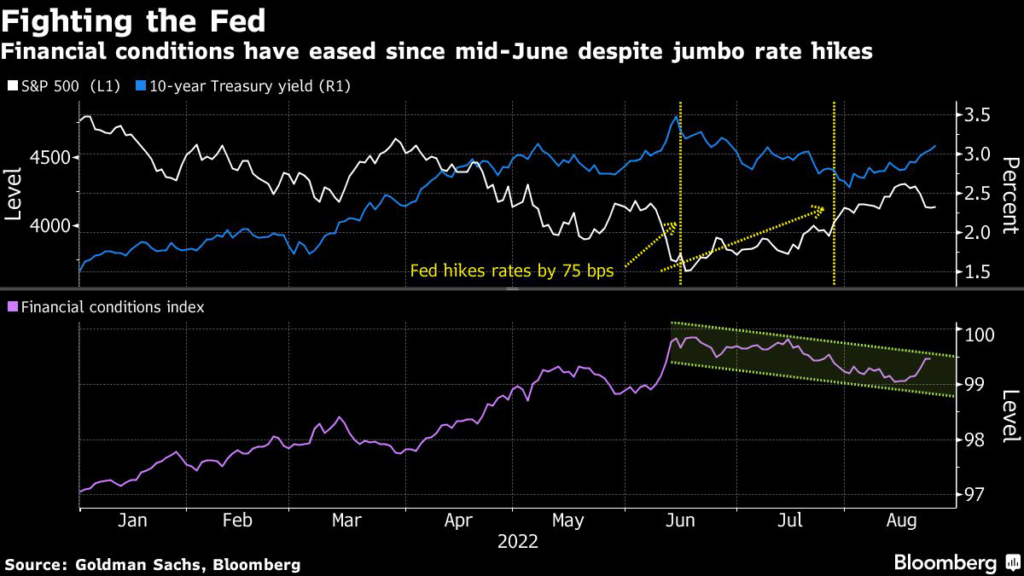
Fed officials in the run-up to Jackson Hole have been clear they see more monetary tightening ahead, a message that’s eroded a bounce in stocks and bonds from mid-June troughs. The tension in markets is whether those assets will continue to head back toward the lows of the year.

“Powell is likely to push back on premature expectations of a dovish pivot, reiterating the focus on the fight against high inflation,” said Silvia Dall’Angelo, a senior economist at Federated Hermes Ltd. “Whether markets take him seriously amid an increasingly gloomy outlook for the global economy is yet to be seen.”

Will the meme mania fizzle out? That’s the theme of this week’s MLIV Pulse survey. Click here to participate anonymously.

What to watch this week:

  • US GDP, initial jobless claims, Thursday
  • Kansas City Fed hosts its annual economic policy symposium in Jackson Hole, Wyoming, Thursday
  • ECB’s July minutes, Thursday
  • Fed Chair Powell speaks at Jackson Hole, Friday
  • US personal income, PCE deflator, University of Michigan consumer sentiment, Friday

Some of the main moves in markets:

Stocks

  • Futures on the S&P 500 rose 0.5% as of 5:53 a.m. New York time
  • Futures on the Nasdaq 100 rose 0.6%
  • Futures on the Dow Jones Industrial Average rose 0.3%
  • The Stoxx Europe 600 was little changed
  • The MSCI World index rose 0.3%

Currencies

  • The Bloomberg Dollar Spot Index fell 0.4%
  • The euro rose 0.3% to $1.0000
  • The British pound rose 0.4% to $1.1844
  • The Japanese yen rose 0.5% to 136.40 per dollar

Bonds

  • The yield on 10-year Treasuries declined three basis points to 3.08%
  • Germany’s 10-year yield declined four basis points to 1.33%
  • Britain’s 10-year yield declined seven basis points to 2.63%

Commodities

  • West Texas Intermediate crude was little changed
  • Gold futures rose 0.9% to $1,778.10 an ounce

More stories like this are available on bloomberg.com

©2022 Bloomberg L.P.

Crypto Takes Leading Role in Illegal South Korea Currency Trades

(Bloomberg) —

Illicit foreign-exchange transactions in South Korea are increasingly dominated by cryptocurrency-linked deals, according to government data.

Four crypto-related cases this year involving 1.5 trillion won ($1.1 billion) that violated local foreign-exchange transaction rules have been sent to the prosecutor’s office, according to a customs office report submitted to lawmaker Min Byoung Dug.

That’s nearly double the 827 billion won reported for the whole of last year and a more than 70-fold jump from 2020, according to the report. Nearly 75% of transactions violating foreign-exchange rules are crypto-linked, up from 61% last year, the data show.

The four cases reported by the customs office are unrelated to a separate, ongoing probe by South Korea’s Financial Supervisory Service into $3.4 billion worth of “abnormal” foreign-exchange transactions at local banks for possible links to illegal crypto-related activities.

Regulatory probes in the wake of this year’s crypto rout have dented a previously enthusiastic embrace of digital tokens in Asia’s fourth-largest economy. The $40 billion wipeout in South Korean entrepreneur Do Kwon’s Terraform Labs ecosystem and the TerraUSD stablecoin hurt confidence. 

More stories like this are available on bloomberg.com

©2022 Bloomberg L.P.
Salesforce Falls as Revenue Forecast Misses Analysts’ Estimates

(Bloomberg) — Salesforce Inc. gave a forecast for quarterly revenue that fell short of analysts’ estimates, suggesting that a choppy economy may be causing some customers to slow spending on business software. The shares declined in premarket trading.

Sales will be as much as $7.83 billion in the period ending in October, the San Francisco-based company said Wednesday in a statement. Analysts, on average, projected $8.05 billion, according to data compiled by Bloomberg. For the full year, the company cut its revenue forecast slightly to as much as $31 billion from $31.8 billion. 

The reduced guidance reflects a shift in the tone of customers as the quarter progressed, which particularly hit in July, said Mike Spencer, recently appointed head of investor relations, in an interview.

Co-Chief Executive Officer Bret Taylor said the company was facing a “more measured buying environment.”

Salesforce, the leader in cloud-based customer management software, has a wide variety of clients across industries. It maintained high revenue growth through the pandemic and expanded its business productivity products with the $27.7 billion purchase of the messaging platform Slack, which was completed in July 2021. This year, however, it has tried to rein in some costs, including slowing the pace of hiring and reducing travel. Earlier this month, the company appointed Brian Millham as chief operating officer, filling a role that had been vacant since Taylor was promoted to co-CEO about nine months ago.

Read More: Salesforce Falls as FX Headwinds Weigh on Forecast: Street Wrap

Many software peers such as ServiceNow Inc. have seen clients extend their purchasing cycles as the economy has weakened in past months, and it’s likely that Salesforce has experienced the same dynamic, Keith Bachman, an analyst at BMO Capital, wrote in a note ahead of earnings.

Spencer said the company is seeing “longer deal cycles,” from its customers. “We’re seeing extra approvers getting inserted into deals — CFOs are getting included in deals a lot more frequently than in the past,” he said.

The shares dropped about 6.6% in premarket trading on Thursday before New York exchanges opened after closing at $180.01. The stock has declined 29% this year amid a broad technology rout that has particularly hit software vendors.

The company also announced a $10 billion share buyback program.

The buyback may be management signaling to investors that they’re conscious of the company’s share price, said Anurag Rana, an analyst at Bloomberg Intelligence. “The stock has been so much under pressure over the last year and a half — that may have sparked it,” he said in an interview with Bloomberg Television.

In the fiscal second quarter, revenue increased 22% to $7.72 billion, beating analysts’ projections. The current remaining performance obligation — or contracted sales that have yet to close, which is a metric of near-term demand — grew 15% to $21.5 billion. Profit, excluding some items, was $1.19 a share, compared with analysts’ average estimate of $1.03.

Currency fluctuations, particularly the strength of the US dollar, caused about $50 million more in headwinds than anticipated in the quarter, Chief Financial Officer Amy Weaver said on a conference call. For the full year, currency fluctuations are now expected to cost about $800 million in revenue, an increase of $200 million from last quarter’s estimate.

Subscription revenue generated by its platform unit, which includes Slack, gained 34% to $1.48 billion in the period ended July 31 — the biggest increase any division. Marketing and commerce software gained 12% to $1.12 billion, which was the smallest jump of any unit. Many analysts anticipated a slowdown in this division due to a wider pullback in marketing spending.

(Updates with premarket trading in eighth paragraph.)

More stories like this are available on bloomberg.com

©2022 Bloomberg L.P.
Snowflake Surges on Strong Sales Forecast and New Customers

(Bloomberg) — Snowflake Inc. surged in premarket trading after its forecast for quarterly sales topped analysts’ estimates, reassuring Wall Street that companies are still investing in their technology systems to boost efficiency.

Product revenue at the maker of software to organize and analyze data in the cloud will be as much as $505 million in the period ending in October, the company said Wednesday in a statement. Analysts, on average, estimated $501.1 million, according to data compiled by Bloomberg. Product sales make up the majority of Snowflake’s total revenue and are watched closely by investors and analysts.

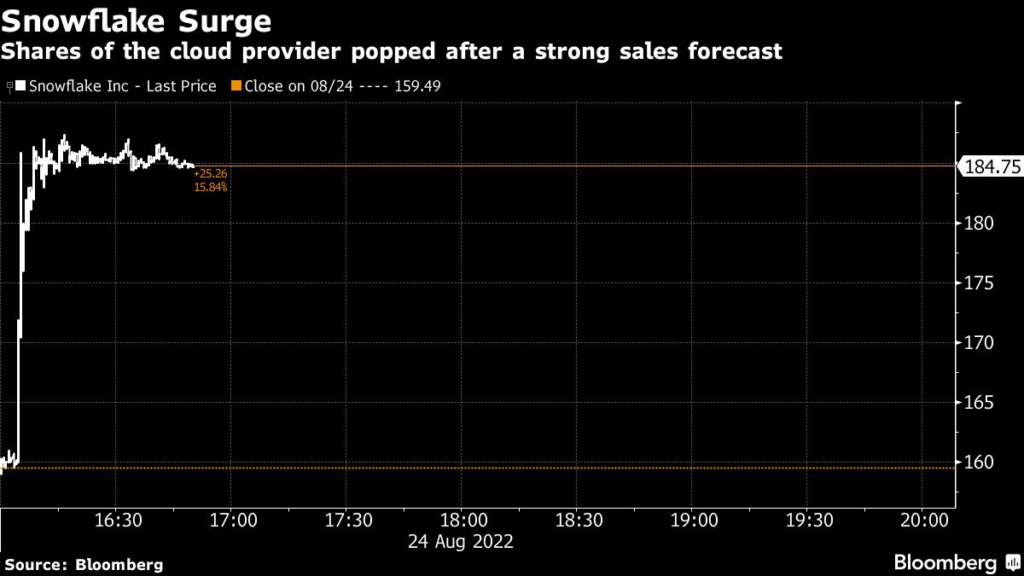
Snowflake rose to prominence in September 2020 with one of the biggest U.S. initial public offerings for a software company. Since reaching a record share price of $401.89 in November, the stock has tumbled 60%, as growth has slowed and valuations across the industry have been dented by a weaker overall economic outlook. The shares jumped 18% in premarket trading on Thursday before exchanges opened in New York, having closed earlier at $159.49.  

The company charges customers based on how much they use Snowflake’s data storage and analytics products rather than charging a flat-rate subscription. While this consumption-based model can be affected by economic conditions, Snowflake has consistently seen clients re-accelerate spending once uncertainties fade, Derrick Wood, an analyst at Cowen & Co., wrote in a note before the results.

Read More: Snowflake Rises on Robust Spending on Tech Systems: Street Wrap

In the fiscal second quarter, product revenue increased 83% to $466.3 million — better than expected, but still Snowflake’s slowest rate of growth as a public company. Analysts estimated $438.1 million. Snowflake said it had 6,808 customers at the end of the period on July 31, beating analysts’ average estimate.

While software giant Salesforce Inc., which also reported results Wednesday, gave a revenue forecast that missed estimates, saying customers are slowing their purchasing amid concerns about the economy, Snowflake’s sales growth remained strong.

The results are “a likely sign there’s been no pullback in new customer additions and use by existing clients,” said Bloomberg Intelligence’s Mandeep Singh. He added that the company is broadening its database offerings, which could further fuel revenue growth.

Total revenue in the July quarter was $497.2 million, compared with Wall Street estimates of $467.9 million. Snowflake said its net loss widened to $222.8 million, or 70 cents a share, from a loss of $189.7 million, or 64 cents, in the period a year earlier.

(Updates with premarket trading in the third paragraph.)

More stories like this are available on bloomberg.com

©2022 Bloomberg L.P.

Nvidia Gives Weak Forecast, Adding to Concerns of Chip Slump

(Bloomberg) — Nvidia Corp., which warned earlier this month that its sales were slipping, gave a disappointing forecast for the current period that added to signs of weakness in the semiconductor industry. 

Fiscal third-quarter revenue will be about $5.9 billion, the company said late Wednesday in a statement. That compares with an average analyst estimate of $6.92 billion. Gross margin, the percentage of sales remaining after deducting the cost of production, will be 65%, minus certain items.

Nvidia issued the forecast just two weeks after warning that sales for the latest quarter would come in well below original expectations. The company blamed declining demand for chips used in gaming computers, citing “challenging market conditions.” 

The guidance suggests the tech slump is going to last. After a massive run-up during the Covid pandemic, the chip industry is bracing for a particularly sharp downturn as signs of trouble pile up. World Semiconductor Trade Statistics, a non-profit body that tracks shipments, just lowered its market outlook to 13.9% growth this year from a previous 16.3%. In 2023, it sees chip sales rising just 4.6%, the weakest pace since 2019.

Shares of Nvidia fell 3.2% in premarket trading on Thursday before New York exchanges opened. The stock was already down 41% this year through the Wednesday close, making it one of the worst performers on the Philadelphia Stock Exchange Semiconductor Index.

Chief Executive Officer Jensen Huang said Wednesday that the company is deliberately shipping fewer chips to customers than they’re selling in their products. Nvidia wants to make sure excess inventory is cleared out — and is cutting prices to help — before it introduces new products, he said. 

“We’re going to sell into the market a lot fewer graphics cards than the market is buying to reduce inventory,” he said in an interview. “We should be through that before the end of the year.”

Nvidia’s sales of data-center chips hit a record last quarter, but still fell short of expectations for what has been a promising growth market. The company struggled to obtain enough support chips, including power converters and transceivers, to make as many data center products as it wanted to and that hurt sales. Because of the complexity of the supply chain, sorting out those challenges will take time, Huang said. 

Overall, the drop-off in demand started to hit around June and happened too quickly — driven by inflation’s impact on consumer spending — for the company to respond in time. That left Nvidia and its distributors with too many graphics chips, he said. China’s PC market, the world’s second-largest, fell 16% during the June quarter, its worst decline since 2013 according to Canalys.

“It comes down to gaming and how long this will last,” said Daniel Morgan, a portfolio manager for Synovus Trust Co. “I would guess it’s going to work its way into 2023 because of tough comparisons they have with the big pandemic boom.”

Nvidia had been a growth engine in recent years, outshining other chipmakers. Prior to the three months ended in July, its worst quarter in the previous 10 came in 2021 when it posted a sales increase of 39%. 

Second-quarter revenue grew just 3% to $6.7 billion. And net income declined 72% to $656 million. Excluding some items, earnings came in at 51 cents a share. 

Like many of its peers that outsource manufacturing, Nvidia is contending with a rapid transition from supply shortages — which forced customers to pay in advance to secure what they needed — to having ballooning stockpiles of unsold products.

Nvidia is now saddled with advanced payments it made for materials and the manufacture of products at a time when its own demand is falling and its in-house stockpile of finished chips is growing.

Inventory was $3.89 billion in the latest quarter, up from $2.11 billion at the same point a year earlier. Gross inventory purchase and long-term supply obligations were $9.22 billion — almost double where they were a year earlier. Prepaid supply agreements were $3.14 billion, Nvidia said.

Nvidia’s GeForce graphics chips are a must-have for high-end personal computer owners looking for the most realistic gaming experience. The chips also became popular with digital currency miners, though the crypto rout and changes to the way the asset is mined have undercut that market.

Gaming revenue in the second quarter fell 44% from the previous quarter and 33% from a year earlier to $2.04 billion, Nvidia said, confirming preliminary numbers given earlier this month.

Nvidia’s rise to the top of the US chip industry by market valuation was driven by the explosive growth of its data center business. Owners of large cloud data centers are increasingly using its graphics chips for artificial intelligence computing. While revenue from that division increased 61% to $3.81 billion, it fell short of Nvidia’s projections, the company said. Performance was “impacted by supply chain disruptions.”

(Updates with premarket trading in fifth paragraph. A previous story corrected WSTS’s forecasts.)

More stories like this are available on bloomberg.com

©2022 Bloomberg L.P.

The Highs and Lows of Being a Bitcoin Maximalist

  • Listen to Bloomberg Crypto on the iHeartRadio App
  • Listen to Bloomberg Crypto on Apple Podcasts
  • Listen to Bloomberg Crypto on Spotify  

(Bloomberg) — Some of the biggest and brashest figures in crypto have faced staggering losses as markets slumped. Multiple crypto companies have filed for bankruptcy and more than one high-flying crypto CEO has found themselves out of a job. 

Case in point: Michael Saylor, the co-founder and former CEO of a software services firm called MicroStrategy. Saylor’s decision to use the company’s balance sheet to bet big on Bitcoin back in 2020 catapulted Microstrategy into the headlines. For a while, as Bitcoin prices rallied, that $250 million dollar bet looked like a genius move. But as prices fell, the firm found itself facing significant losses.

What does this loss mean for the future of MicroStrategy, and for Michael Saylor? 

Bloomberg senior editor Dave Liedtka and Bloomberg accounting specialist Tom Contiliano join this episode to discuss what happened at MicroStrategy.

Follow us on Twitter @crypto, and subscribe to the Bloomberg Crypto Newsletter at https://bloom.bg/cryptonewsletter

More stories like this are available on bloomberg.com

©2022 Bloomberg L.P.

Close Bitnami banner
Bitnami
