
Bloomberg

US Futures Waver, Treasuries and Dollar Steady: Markets Wrap

(Bloomberg) — US index futures wavered, Treasuries nursed losses and the dollar was steady as markets awaited more clarity on the Federal Reserve’s monetary policy path from the Jackson Hole central bankers’ symposium later this week.

Futures on the the S&P 500 and Nasdaq 100 fluctuated after US stocks plunged the most in two months on Monday. The 10-year Treasury yield held above 3% and a gauge of the dollar hovered at a five-week high as investors also weighed new evidence that that soaring prices and the war in Ukraine are tipping the world into a recession.

Traders are bracing for hawkish talk at the Jackson Hole event after recent comments from Fed officials convinced many investors the central bank will continue to tighten aggressively, even into a slowing economy. Some analysts, however, see a risk that Chair Jerome Powell will catch markets off-guard with a more nuanced approach, sparking a fresh relief rally. 

“For the moment, global sentiment is both skittish and volatile,” said Richard Hunter, head of markets at Interactive Investor. “There is little cause for optimism on the immediate horizon, with any glimmers of economic hope yet to take hold on a sustainable basis.”

The Stoxx Europe 600 slipped, on track for a three-week low, after euro-area economic activity declined for a second month, signaling that fears of a recession may already be coming to pass as record inflation saps demand. Energy stocks advanced thanks to a boost for crude oil from the possibility of OPEC+ output cuts. The euro hovered near a two-decade through and bond yields edged higher.

The drop in the euro-area Purchasing Managers’ Index presents a dilemma for the European Central Bank, which is raising interest rates to curb the hottest inflation in decades, even as uncertainty about the outlook is high and economic momentum fades.

The Fed, meanwhile, is walking a tightrope in trying to contain price pressures while averting recession. The US purchasing managers’ index due later Tuesday will provide fresh clues on the outlook for the world’s biggest economy, after data from Europe to Asia showed weakening activity. Quantitative tightening by the US central bank is set to kick into gear next month, presenting another potential headwind for equities.

“The near-term outlook for equity markets remains challenging,” said Mathieu Racheter, head of equity strategy at Julius Baer. “The impact of quantitative tightening on financial markets have yet to be felt, while the earnings downgrade cycle has just started.”

Elsewhere, Bitcoin held above $21,000, though it remains more than $2,000 off levels that prevailed before a crypto swoon on Aug. 19. UK stocks underperformed the European benchmark after underwhelming manufacturing data. Emerging-market equities dropped for a fourth day.

Will the meme mania fizzle out? That’s the theme of this week’s MLIV Pulse survey. Click here to participate anonymously.

What to watch this week:

  • US new home sales, S&P Global PMIs, Tuesday
  • Minneapolis Fed President Neel Kashkari speaks at a Q&A session, Tuesday
  • US durable goods, MBA mortgage applications, pending home sales, Wednesday
  • US GDP, initial jobless claims, Thursday
  • Kansas City Fed hosts its annual economic policy symposium in Jackson Hole, Wyoming, Thursday
  • ECB’s July minutes, Thursday
  • Fed Chair Powell speaks at Jackson Hole, Friday
  • US personal income, PCE deflator, University of Michigan consumer sentiment, Friday

Some of the main moves in markets:

Stocks

  • Futures on the S&P 500 were little changed as of 7:27 a.m. New York time
  • Futures on the Nasdaq 100 rose 0.1%
  • Futures on the Dow Jones Industrial Average were little changed
  • The Stoxx Europe 600 fell 0.3%
  • The MSCI World index fell 0.2%

Currencies

  • The Bloomberg Dollar Spot Index was little changed
  • The euro fell 0.2% to $0.9928
  • The British pound was little changed at $1.1774
  • The Japanese yen was little changed at 137.37 per dollar

Bonds

  • The yield on 10-year Treasuries was little changed at 3.02%
  • Germany’s 10-year yield was little changed at 1.31%
  • Britain’s 10-year yield advanced two basis points to 2.53%

Commodities

  • West Texas Intermediate crude rose 1.5% to $91.75 a barrel
  • Gold futures were little changed

More stories like this are available on bloomberg.com

©2022 Bloomberg L.P.

DigitalOcean to Buy Web-Hosting Firm Cloudways for $350 Million

(Bloomberg) — DigitalOcean Holdings Inc., a cloud services provider, agreed to acquire website-hosting firm Cloudways for $350 million in an all-cash deal. 

DigitalOcean will buy Malta-based Cloudways in a bid to pick up more small-and-medium sized business customers. The transaction is expected to close in September, and a “significant portion” of the $350 million will be paid over a 30-month period following the completion of the acquisition, DigitalOcean said Tuesday in a statement. 

The two firms have worked together since 2014, with about half of Cloudways’s clients already using DigitalOcean. “We have always felt like a part of the DigitalOcean team so we are incredibly excited to officially become a part of the company,” said Cloudways Chief Executive Officer Aaqib Gadit said in the statement.

Earlier this month, DigitalOcean reported 29% sales growth to $133.9 million and a net loss of 6 cents a share for the quarter ending June 30. The deal is expected to add to DigitalOcean’s revenue growth, contributing $13 million to $15 million in the current fiscal year, and won’t affect the annual margin outlook provided in August, the company said in the statement. Cloudways revenue is expected to exceed $52 million in fiscal 2022, with a three-year compound annual growth rate in excess of 50%. The company generates free cash flow, DigitalOcean said.

DigitalOcean had its initial public offering in March 2021, and the stock has dropped 68% from a November peak to $41.96 by Monday’s close — below IPO levels.

More stories like this are available on bloomberg.com

©2022 Bloomberg L.P.
JD Sales Beat Estimates, Defying China’s Economic Slowdown

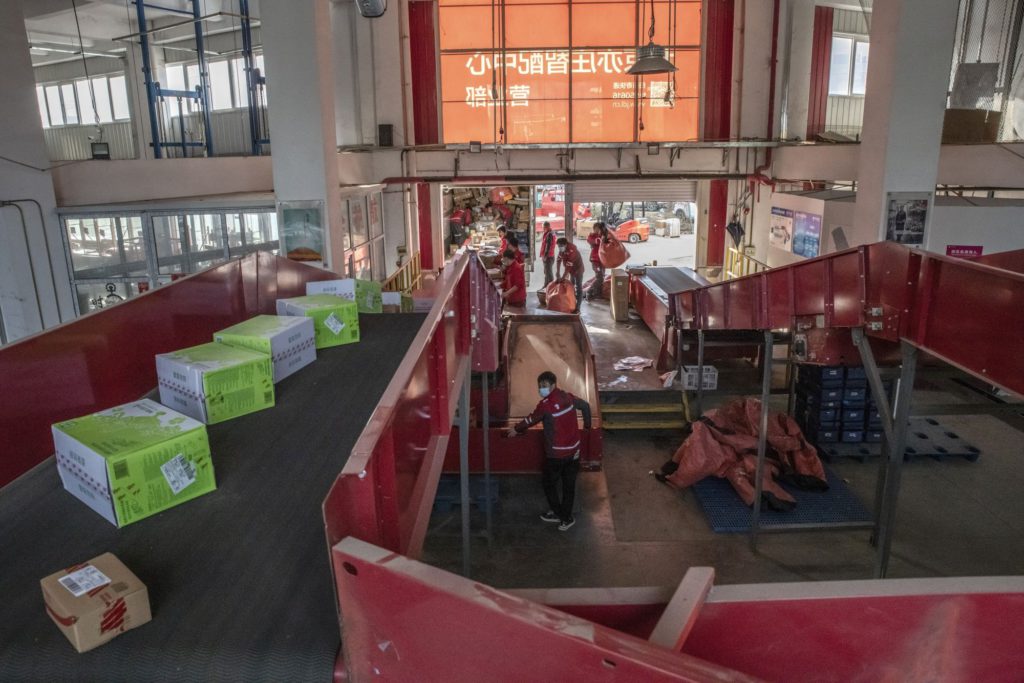
(Bloomberg) — JD.com Inc. reported stronger-than-projected revenue growth after consumers continued to flock to the country’s second-largest online retailer despite an economic slowdown.  

Sales hit 267.6 billion yuan ($39.1 billion) during the second quarter, beating the average forecast of 261.7 billion yuan. The Beijing-based company logged net income of 4.4 billion yuan, following three consecutive quarters of losses. Its shares rose more than 5% in pre-market trading in New York.

JD and larger rival Alibaba Group Holding Ltd. are navigating a softer Chinese economy and Covid-related disruptions that are slowing growth in e-commerce and advertising. This month, Alibaba reported its first-ever revenue contraction since its 2014 listing, marking an end to an era of non-stop growth. 

Billionaire Richard Liu’s empire has largely avoided a direct hit from Beijing’s yearlong crackdown on Big Tech. But concern about China’s priorities and fallout from the country’s Covid lockdowns, along with US regulators’ plans to possibly force JD and some of China’s biggest companies to delist, are weighing on the stock. 

JD’s market valuation has shrunk by about 20% so far this year.

More stories like this are available on bloomberg.com

©2022 Bloomberg L.P.
Xpeng Reports Worse-Than-Expected Loss After Shanghai Lockdowns

(Bloomberg) — Chinese EV maker Xpeng Inc. reported a wider-than-expected loss after Shanghai’s lockdown and supply chain snarls troubled automakers last quarter.   

The net loss widened to 2.7 billion yuan ($394 million) in the three months ended June 30, the Guangzhou-based company said Tuesday. That compares to a 1.19 billion yuan shortfall a year earlier and analyst estimates of a 1.94 billion yuan deficit, according to data compiled by Bloomberg.

While revenue for the second quarter almost doubled to 7.44 billion yuan, beating the 7.29 billion yuan forecast, the electric carmaker’s expected deliveries for the third quarter missed average analyst estimates. Xpeng sees car shipments of between 29,000 to 31,000 units in the three months through September versus the 45,865 the market was looking for.

Although its headquarters are located around 1,500 kilometers (930 miles) from Shanghai, Xpeng was still subject to production losses and chip shortages. Delays also hit rivals including Tesla Inc. and Li Auto Inc. during the city’s two-month pandemic lockdown. Even so, it delivered 34,422 vehicles last quarter, almost doubling from a year earlier and just above the upper range of the company’s own forecast of between 31,000 and 34,000 units.

“Our deliveries sustained robust growth momentum in the second quarter despite unprecedented circumstances brought by the resurgence of Covid in certain areas of China,” Chief Executive Officer He Xiaopeng said in the statement, adding the company is accelerating the pace of new product launches priced between 150,000 yuan to 500,000 yuan. 

In addition to the G9 sports utility vehicle expected to come later this year, the company plans to roll out two new models in 2023 that will “further propel rapid sales volume growth,” He said.

Despite raising prices earlier this year, surging raw material costs continued to eat away at margins. Xpeng reported a gross margin of 10.9% for the second quarter, compared with 12.2% the previous quarter and 11.9% a year earlier.

More stories like this are available on bloomberg.com

©2022 Bloomberg L.P.

Startups Binge on Private Money as Public Market Appeal Fades

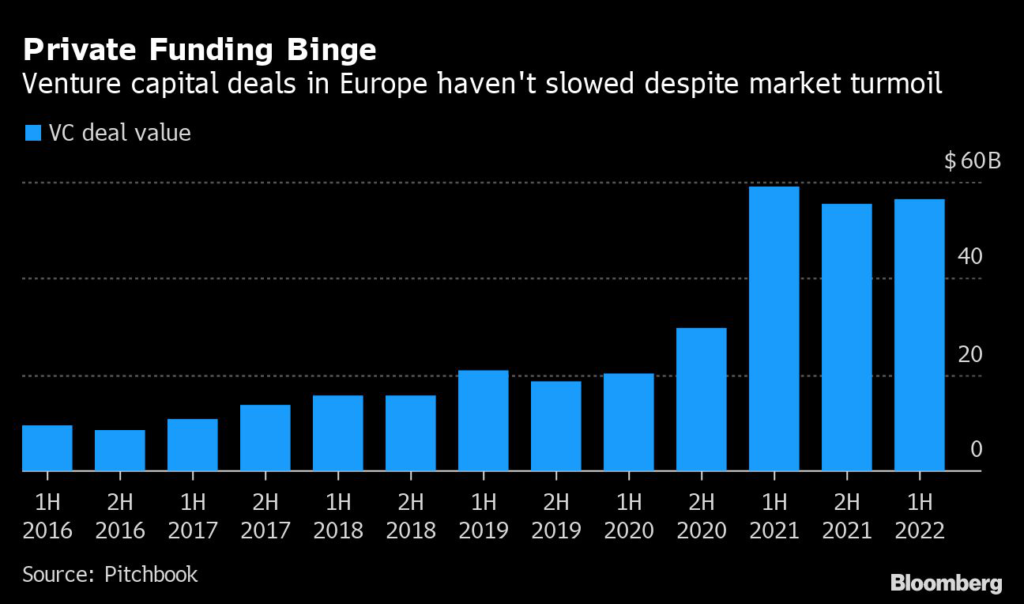
(Bloomberg) — Venture capital deals are going strong in Europe as an abundance of cash, public market turmoil and slumping valuations motivate companies to stay private ever longer.

In the first half of the year, European venture capital transactions raised nearly $57 billion, down just 4% from the same period last year, according to data provided by analytics firm PitchBook.

The war in Ukraine and a deepening energy crisis, along with the threat of recessions as central banks hike rates to curb runaway inflation have put a damper on risk appetite, virtually shutting down initial public offerings globally. Private investors awash with cash have been keen to put their money to work, allowing companies to put off listing to a later point in their life cycles than ever before.

“There’s still a lot of money to be invested, although private market investors are also being more careful, cautious and responsible,” said Jason Hutchings, head of private financing markets for Europe, the Middle East and Africa at UBS Group AG. “They are being more thorough in their due diligence, but we are still seeing more companies turn to private capital markets than pursue IPOs.”

This is bad news for Europe’s flagging IPO market, with just $6.4 billion raised over the first six months of 2022, according to data compiled by Bloomberg. That’s a whopping 88% slump from the same period a year ago, the data show.

To be sure, companies that have grown up in an era of cheap credit and easy financing are finding that the path to private funding is fraught with difficulties of its own. Stock market volatility has weighed on valuations, forcing some startups to swallow hefty markdowns recently.

In a dramatic reversal, buy-now-pay-later giant Klarna Bank AB in July saw its valuation slashed to $6.7 billion, down from the $45.6 billion it achieved in June 2021. This came after a massive slump in the stock prices for its publicly traded competitors such as New York-listed Affirm Holdings Inc.

Startups have stepped up efforts to adjust. Keen to keep costs low and delay fresh funding rounds, companies ranging from online brokerage Trade Republic Bank GmbH to delivery firm Gorillas have laid off hundreds of employees in recent months.

“The heady days of free money, when growing companies could get funded simply for the asking are over,” said Hutchings.

More stories like this are available on bloomberg.com

©2022 Bloomberg L.P.
ByteDance Rival Turns Profitable in China as Cost Cuts Kick In

(Bloomberg) — Kuaishou Technology turned profitable at home after revenue beat estimates, defying China’s worsening economic malaise and competition against TikTok-owner ByteDance Ltd.

Revenue rose to 21.7 billion yuan ($3.2 billion) for the three months ended June, compared with an average projection for 20.7 billion yuan. Its global net loss came in at 3.18 billion yuan, versus a 5.1 billion yuan estimated loss.

China’s second-largest short-video company has joined its peers in embracing a new era of cautious expansion in the country’s giant internet sector. The industry’s Big Two, Tencent Holdings Ltd. and Alibaba Group Holding Ltd., logged their first-ever quarterly revenue falls this month, after grappling with a deepening downturn in the world’s No. 2 economy, the product of a property slump and ad-hoc Covid lockdowns.

Kuaishou’s domestic business delivered an operating profit of 93.6 million yuan in the second quarter, ahead of management’s timeline for moving into the black. Its overseas division now represents less than 1% of total sales, but more than half of total operating losses.

Read more: Tencent-Backed Giants Dive on $24 Billion Meituan Sale Talk

The company has shifted its focus to profitability over market-share by ramping up monetization while cutting cost — especially in global markets. Executives had said that Kuaishou’s domestic business should be in the black sometime in 2022 on an adjusted net income basis, which excludes one-off items like investment gains or losses.

In the wake of stricter rules on content and spending, Kuaishou is moving away from live-stream tipping to more lucrative businesses like e-commerce. It has teamed up with food-delivery giant Meituan to let Kuaishou users access local services through download-free lite apps inside the short-video platform. But such efforts to expand its reach across China’s digital economy was countered last week by a similar tie-up between ByteDance and Alibaba.

In the longer run, Kuaishou is locked in a prolonged duel with ByteDance, whose viral hit Douyin continues to lure away users and advertisers from the broader Chinese social media sphere. Tencent’s ubiquitous app WeChat is also closing the gap between the two front-runners in short videos, by serving more ads and content in its TikTok-style feed.

In August, Kuaishou announced changes to its top leadership by installing a 12-person management committee, including co-founder and chief executive officer Cheng Yixiao, chief financial officer Jin Bing, tech chief Chen Dingjia and other divisional leaders.

More stories like this are available on bloomberg.com

©2022 Bloomberg L.P.

Congo Bans Orange, Airtel, Vodacom Executive Travel in Tax Row

(Bloomberg) — The Democratic Republic of Congo has banned some telecommunications executives from leaving the country after they resisted paying a new tax on the industry, according to people familiar with the matter. 

Executives from the country’s four major carriers — Orange SA, Airtel Africa Plc, Vodacom Group and Africell Holding SAL — have been prevented from traveling and some have had their passports taken, the people said, asking not to be identified because they aren’t authorized to talk about the travel bans. 

The government decree increases the tax on carriers’ revenue to 35% from 20%, one of the people said. The carriers initially rejected the new levy as “irregular and therefore unenforceable,” the Federation des Entreprises du Congo, the country’s main business association, said in June after Bloomberg’s initial report.

Read More: Wireless Firms Receive Notice to Pay About $180 Million to Congo

Orange’s local chief executive officer and Africell’s DRC finance chief were blocked from leaving the country and had their passports confiscated at the Kinshasa airport earlier this month, according to a letter from the FEC to the interior minister that was seen by Bloomberg. A Vodacom executive had her passport taken when she returned from a trip, one of the people said. 

“To this day, no reason has been offered to the executives that justified these actions,” the letter said. The business group said it was “worried” and “strongly concerned by this measure affecting company directors, notably, those of the telecommunications sector.”

Representatives for Orange, Vodacom, Airtel, and Africell declined to comment. 

FEC head Kimona Bononge said the group is engaging with the “highest authorities of the government on this subject,” and declined to comment further. Representatives for the government and telecoms regulator didn’t immediately respond to requests for comment. 

The government is looking for ways to shore up its finances after years of mismanagement left the country without the revenue it needs. President Felix Tshisekedi’s government wants to broaden its tax base and boost its revenue as it undertakes a nationwide infrastructure development plan before elections scheduled for the end of next year.

Congo last year dropped a plan to tax mobile operators, following opposition from the public as it could lead higher costs.  

More stories like this are available on bloomberg.com

©2022 Bloomberg L.P.

Alibaba-Backed Artist Agent Said to Open HK IPO Books Wednesday

(Bloomberg) — YH Entertainment Group, a Chinese artist management company most famous for its star Wang Yibo, is planning to start taking retail investor orders for its Hong Kong initial public offering as soon as Wednesday, according to people with knowledge of the matter.

The Beijing-based company will start taking institutional investor orders on Thursday for the IPO, which could raise as much as HK$1.1 billion ($140 million), said the people, asking not to be identified as the information is private. There is a potential over-allotment option that could increase the size of the listing to HK$1.3 billion, they said. 

The company, which counts Alibaba Group Holding Ltd., ByteDance Ltd.’s Douyin app and media conglomerate CMC as backers, manages artists, produces music and sells merchandise, according to a preliminary exchange filing.

Deliberations are ongoing and details of the IPO could change, the people said. IFR on Tuesday first reported the book opening and IPO size. A representative for YH didn’t immediately respond to a request for comment.

Other big-name artists in YH’s client roster include Meng Meiqi, Fan Chengcheng and Zhu Zhengting, all of whom shot to fame after appearing on popular variety shows.

China Securities International and China Merchants Securities are joint sponsors of YH Entertainment’s offering, the filing shows.

More stories like this are available on bloomberg.com

©2022 Bloomberg L.P.

BT Says UK Won’t Take Action on Drahi’s Stakebuilding

(Bloomberg) —

French billionaire Patrick Drahi received a nod of approval from the UK government over his late-2021 stakebuilding in BT Group Plc, after authorities weighed implications for national security.

The Secretary of State for Business, Energy and Industrial Strategy will take no further action on Altice UK’s decision to increase its holding in BT to 18% from 12.1%, BT said in a statement on Tuesday. 

The review was extended past its initial July deadline and into August after officials requested more information about the BT deal, Bloomberg reported last month. 

BT shares rose 1.7% to 159 pence at 9:37 a.m. in London.

Drahi became the telecommunication company’s biggest shareholder last year via Altice, surpassing the stake held by Germany’s Deutsche Telekom AG. But his move to increase that stake to 18% was being scrutinized under the National Security and Investment Act, which came into effect in January.

Read More: UK Flexes Its New National Security Powers to Intervene on Deals

The law gives ministers the options of clearing or blocking deals, imposing conditions or even unpicking them retrospectively. These early probes are seen as important test cases as the UK takes a closer interest in major industries.

What Bloomberg Intelligence Says:

Government clearance of Patrick Drahi’s recent stakebuilding puts BT back in play, though we believe a take-private bid looks unlikely anytime soon and may still face fierce political resistance. A deal would require strong safeguard measures for Openreach, and the unit’s perceived value may have been dented by Liberty Global and Telefonica’s investment in a rival full-fiber infrastructure. Read more.

— Matthew Bloxham, BI media and telecoms analyst

With the review into Altice’s BT stakebuilding concluded, Drahi will be free to acquire more of more of Britain’s former telecom monopoly if he wants to. He’s publicly supported the carrier’s strategy; Chief Executive Officer Philip Jansen has said he regularly hears from his shareholder after quarterly results and Drahi pushes for faster execution on BT’s fiber plans. 

“We see this as a removal of a potential overhang for BT shares,” Morgan Stanley analyst Terence Tsui wrote in a note to clients Tuesday.

Still, the decision doesn’t close the door to future government interventions. 

“We will always act to protect our critical national telecoms infrastructure if we judge action is necessary,” a spokeswoman for the BEIS said in a statement. “Under the National Security and Investment Act, acquisitions are assessed on a case by case basis, so any future transaction could be subject to a separate assessment under the Act.”

Read More: Billionaire Drahi Soon Gets a Fresh Shot at BT. Will He Take It?

Attention will now move to the assessment of a Chinese-led takeover of the country’s biggest microchip factory. Originally due last month, a probe into Nexperia Holding’s acquisition of Welsh chipmaker Newport Wafer Fab was officially extended until Sept. 12. 

(Updates shares in fourth paragraph, analyst comment in eighth)

More stories like this are available on bloomberg.com

©2022 Bloomberg L.P.

Crypto May Get Its Own Legal Lane in the UK

  • Listen to Bloomberg Crypto on the iHeartRadio App
  • Listen to Bloomberg Crypto on Apple Podcasts
  • Listen to Bloomberg Crypto on Spotify  

(Bloomberg) — If you’ve ever found yourself outside of Bank Station on a rainy day in Central London, you’ll have a feel for exactly how the city came to be one of the world’s top financial centers. London’s convenient time zone, bustling city atmosphere, and impressive set of financial regulations have made it a top destination for banks and financial services companies to operate over the years. But when it comes to crypto, there’s an international gap in setting legal standards on digital assets, and the UK is no exception. The Law Commission of England and Wales — an independent regulatory body that advises the UK government on reform — has been tasked with rectifying that situation and getting London ahead of the pack. 

In this episode, Emily Nicolle, Crypto blogger for Bloomberg News, is in for Stacy-Marie Ishmael. She’s joined by Sarah Green and Matthew Kimber from the Law Commission to discuss the proposals they’ve made to Westminster that could solve questions like who really owns their crypto, and what it means to codify blockchain into the legal system.

Follow us on Twitter @crypto, and subscribe to the Bloomberg Crypto Newsletter at https://bloom.bg/cryptonewsletter

More stories like this are available on bloomberg.com

©2022 Bloomberg L.P.

Close Bitnami banner
Bitnami