Bloomberg

China Resources Land’s Ex-Chairman Faces Probe for Violations

(Bloomberg) — China is investigating the former chairman of state-owned developer China Resources Land Ltd., the latest executive to face scrutiny for suspected misconduct in the country. 

Tang Yong is being probed on suspicion of severe disciplinary and legal violations, the Sichuan branch of China’s discipline inspection body said on its WeChat account Tuesday. 

China has been investigating a string of high-profile officials and executives in the run-up to a sensitive Communist Party congress where key leadership positions will be decided. The country recently announced investigations into top executives in a state-backed semiconductor fund as well as Minister of Industry and Information Technology Xiao Yaqing. 

Shares of China Resources Land dropped as much as 3% in Hong Kong trading. The stock has lost more than 5% this year. 

China Resources Land has been embroiled in the country’s property downturn. The developer could suffer another blow from weak contracted sales, which fell 26.6% in the first half, according to Bloomberg Intelligence.

Tang, a Henan native, became chairman of China Resources Land in 2019, a role he held for less than a year. He later joined an energy unit of state-owned conglomerate China Resources Group. 

More stories like this are available on bloomberg.com

©2022 Bloomberg L.P.

From World’s Most Congested City, Hailing App Defies SPAC Slump

(Bloomberg) — When Oguz Alper Oktem spotted a couple of electric scooters outside his Los Angeles apartment in the summer of 2017, the then-head of Turkey’s answer to Netflix.com wondered how they could help to ease traffic in his home city of Istanbul where congestion is among the worst in the world. 

After returning to the Turkish financial hub a year later, Oktem quit his job with BluTV and set about with plans to set up a micro-mobility app. One of the first challenges, Oktem recalls, was tracking down a scooter in Turkey. The chase led him to Athens, and after a lengthy journey back home with the two-wheeler, Marti was created. 

Now, just four years later, Marti — the Turkish word for “seagull” — is set to become the first Turkish firm to go public in New York via a merger with a blank-check company. With an enterprise value of $532 million, the firm, formerly known as Marti Ileri Teknoloji AS, has set an ambitious target to grow this valuation by more than 10 times.

Oktem, 31, a passionate environmentalist and former Deutsche Bank AG banker, is pushing ahead with the plans to merge with Galata Acquisition Corp. — a special purpose acquisition company with a focus on Turkey and backed by Callaway Capital Management LLC — even as a SPAC boom that started at the onset of the pandemic wanes.

A series of prominent mergers have fizzled out in recent months due to market volatility and fading investor appetite. As of the beginning of July, the value of SPAC deals had dropped to around $10 billion this year, compared with $149 billion in all of 2021, according to Bloomberg Intelligence. 

Meanwhile, the De-SPAC Index, a basket of companies that completed their tie-ups, has slumped almost 60% this year, compared with a 13% decline in the S&P 500 Index.

SPACs from the Middle East have also struggled. Dubai-based ride sharing firm Swvl Holdings Corp. and music-streaming business Anghami Inc. both plunged earlier this year after their post-merger debuts.

Hailing Boom

Dismissing the downturn, Oktem says there’s nothing to worry about if both the SPAC and the target company are strong.

“We don’t lose money, we make money,” he said in an interview at Marti’s Istanbul headquarters where several vehicles are ready to be deployed. “We believe we have only done 10% of the business that we’ll eventually build in Turkey.”

Marti is tapping a boom in ride-hailing apps, which attracted $2.83 billion of investment in 2021, up from $1.31 billion the previous year, according to research by BloombergNEF, CB Insights and PitchBook. The company also offers bicycle and moped services.

The company expects an Ebitda of $835,000 this year and forecasts a jump to $31.7 million in 2023 as the firm expands its fleet. By comparison, Texas-based Bird Global Inc., which operates in 35 countries, and Helbiz Inc., which is active in North America and Italy, both have negative Ebitda figures, according to company presentations and TradingView data.

Turkey Expansion

At home, Marti has already nabbed a 64% market share — three times larger than its closest rival — with total app downloads of 5.6 million, according to an investor presentation. It competes with the likes of Dubai-based Fenix, Superpedestrian Inc.’s Link, Dutch-based Go Sharing and local Binbin in Turkey. 

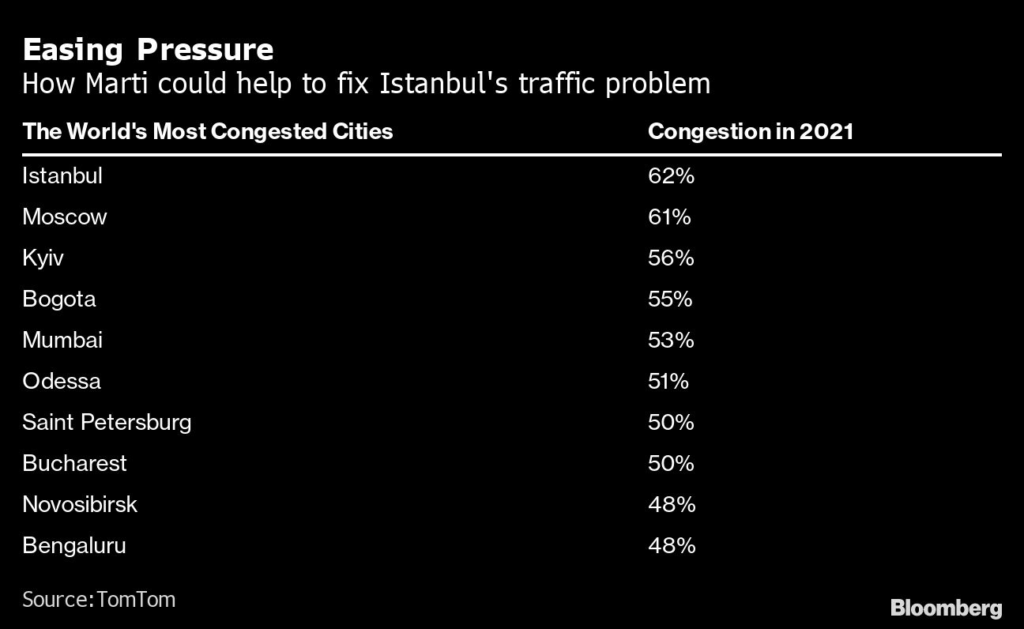
And there should be enough business to go around. Istanbul ranked as the world’s most congested city in 2021, according to navigation system developer TomTom.

Oktem has dismissed an investigation by the Turkish Competition Authority, which will look into allegations that Marti abused its dominant position in the market, and is pressing ahead with expansion. He plans to use the proceeds from the New York listing to more than double Marti’s fleet to around 96,000 scooters. 

Marti was valued at about $100 million last year when it attracted $30 million of investment from the likes of the European Bank for Reconstruction and Development and Turkish private equity firm Actera. Other investors include AutoTech Ventures LLC and Beco Capital.

For now, Oktem will focus on the business in Turkey due its low labor costs, and the firm plans to expand its services like its global rivals Uber Technologies Inc., Lyft Inc. and Indonesia’s PT GoTo Gojek Tokopedia Tbk.

“Local mobility super apps in other emerging markets, such as Indonesia, Brazil, and India, are valued in the billions of dollars,” Oktem said. “We hope to get there too.” 

(Updates with De-SPAC Index numbers in sixth paragraph.)

More stories like this are available on bloomberg.com

©2022 Bloomberg L.P.

Bosch-Backed Self-Driving Startup WeRide Weighing IPO, Sources Say

(Bloomberg) — Chinese driverless technology startup Guangzhou WeRide Technology Co. is considering an initial public offering that could raise about $500 million, according to people familiar with the situation.

The robotaxi company is working with advisers on the potential listing and is weighing venues including the US and Hong Kong, the people said, asked not to be identified discussing a private matter. It could face significant challenges from Chinese regulators if it chooses to pursue a US IPO, they said.

WeRide could file for a first-time share sale as soon as September and aim for a listing as early as this year, they said. It was valued at about $4.4 billion in its latest funding round in March, the people said.

Discussions are ongoing and details of the IPO including size, venue and timeline could change, the people said. 

WeRide does not have specific plans for a listing and will announce its progress at a suitable time, a representative for WeRide said in response to a Bloomberg News query.

Backed by the Renault-Nissan-Mitsubishi Alliance and Guangzhou Automobile Group, WeRide received a strategic investment from Bosch in May as part of a partnership to jointly develop autonomous driving software, according to a press release.

Chinese firms have largely avoided US listings since Didi Global Inc.’s IPO last year, after regulators in both countries began cracking down and Beijing introduced sweeping rules in December around overseas share sales. Chinese companies whose activities raise cyber security concerns would need to go through security reviews, and overseas listings that threaten national security are barred. 

US-traded Chinese companies are also facing delisting unless regulators can reach a deal on audit rules. The largest such IPO since Didi is the Hong Kong-based AMTD Digital Inc., which raised $144 million in a May listing before its shares briefly soared more than 32,000%, according to Bloomberg calcluations.

Founded in 2017, WeRide develops autonomous driving technology and is testing the technology in 23 cities globally, its website showed. In addition to its full stack software and hardware solutions, it produces autonomous vehicles including robotaxis, mini buses, vans and street sweepers. It has been operating a robotaxi service in Guangzhou since 2019, according to a separate release.

The self-driving vehicle industry has long been divided over the best way to advance the technology. WeRide is hedging its bets by offering both partially automated Level 2 and highly automated Level 4 systems in-house through its collaboration with Bosch, taking a similar approach to peers including Baidu Inc., Huawei Technologies Co., and General Motors Co.-backed Momenta.ai.

Read More: The Cars of Today Are Funding the Self-Driving Revolution: BNEF

More stories like this are available on bloomberg.com

©2022 Bloomberg L.P.
Dubai’s Damac Explores €1 Billion in Tech Investments in Germany

(Bloomberg) —

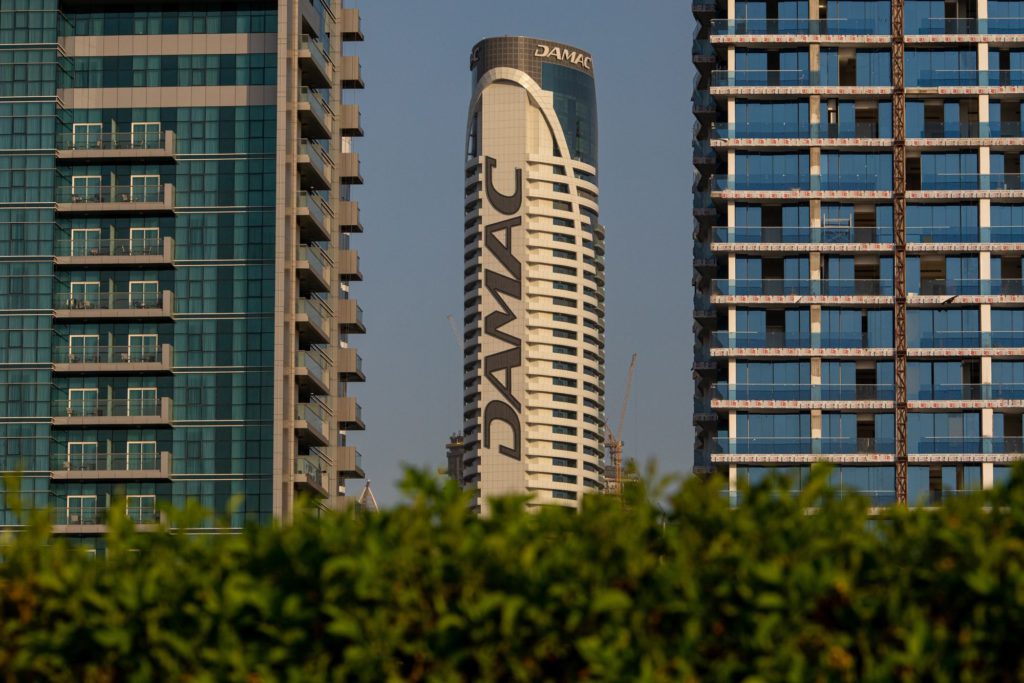
Billionaire Hussain Sajwani’s Damac Group is exploring investment opportunities worth €1 billion in Germany as part of the Dubai firm’s expansion into technology.

Damac is interested in data centers and tech-related investments and is in the process of identifying partners, according to a statement. “I see a lot of opportunity and potential, especially in Eastern Germany that I would like to explore and learn more,” Chairman Sajwani said.

Privately-held Damac, which focuses primarily on real estate in Dubai, has been diversifying into sectors such as technology and fashion. The company in May purchased De Grisogono SA, a Swiss luxury jeweler, after buying Italian fashion group Roberto Cavalli SpA in 2019.

It set up Edgnex in 2021, a digital infrastructure provider to invest in data centers.

More stories like this are available on bloomberg.com

©2022 Bloomberg L.P.
India Inflation to Ease to 4% in 2 Years After Peaking, Das Says

(Bloomberg) — Reserve Bank of India Governor Shaktikanta Das seeks to slow India’s inflation to 4% within two years after hitting its peak in the last few months. 

“Inflation has peaked and price gains are getting anchored,” Das said in an interview with television channel ET Now on Tuesday, adding that the central bank is watching every incoming data and there’s “no room for complacency.”

The RBI has raised policy repurchase rate by a total of 140 basis points since May, including back-to-back half point increases in June and August, to cool down inflation within its mandate of 2%-6%. Consumer prices have fallen for three straight months in July but continue to remain above 6% mark.

“We will approach the 4% inflation target in a steady manner, without much of a growth sacrifice,” Das said. He also indicated that stable bond yields reflect that the central bank actions may have worked to tame prices. 

India Rate Hawk Sees RBI Credibility Restored After Hikes

Indian bonds pared losses on Das’s outlook on inflation. The 10-year bond yield was trading 1 basis point higher at 7.28%, compared with an intraday high of 7.31%. Bond yields have also steadily eased after surging post the August policy on the back of a fall in crude prices and return of foreign fund inflows.

“Bond markets are functioning in an orderly manner. We will come in only when we sense disruption in the market,” Das said. 

More from Governor Das  

  • Current account gap will be within manageable levels, Das said, adding that exports are likely to pick up in the coming months
  • Favor a more orderly evolution of rupee exchange rate
  • Cryptocurrencies can create a lot of financial instability and it can have adverse effect on forex rate and policy, Das said. “Dollarization of economy doesn’t work in favor of India”
  • RBI is neutral to the issue of state-run banks privatization


More stories like this are available on bloomberg.com

©2022 Bloomberg L.P.

Tencent-Backed Startup Seeks Pre-IPO Funds at $1.5 Billion Value

(Bloomberg) — Yonghui Fresh Food, the fast-growing grocery supply affiliate of one of China’s biggest retail conglomerates, is seeking to raise about $200 million ahead of a Hong Kong initial public offering next year, people familiar with the matter said.

The business-to-business-focused startup is aiming for a valuation of 10 billion yuan ($1.5 billion) despite the cooling climate for private investment, the people said, asking for anonymity when discussing a private deal. The seven-year-old firm has also been in talks with financial advisors for a Hong Kong listing that could take place as soon as the second quarter of 2023, the people added.

Yonghui Fresh Food — backed by Sequoia Capital, Hillhouse Capital and Tencent Holdings Ltd. — joins a growing list of Chinese startups trying to replenish financial reserves at a time when Covid lockdowns and a decelerating economy are sapping consumption. The fresh produce procurement, storage and distribution firm, associated with the nationwide Yonghui Superstores chain, was valued at 7.5 billion yuan during a late 2020 round of financing, the people said. A similar-sized rival operated by agricultural titan New Hope Group Co. is also seeking $100 million in fresh funding, Bloomberg News has reported. 

Discussions around the fundraising and IPO are ongoing and details such as deal size, timeline and venue could change, the people added. Representatives for Yonghui Superstores and Yonghui Fresh Food didn’t respond to emails and calls seeking comment. 

Read more: Chinese Consumers Shun Debt, Threatening Global Growth Engine

The fundraising efforts come as China continues to battle Covid with some of the world’s most stringent measures. Prolonged disruptions from ad-hoc lockdowns across the country have wreaked havoc on the food industry, but Yonghui Fresh Food’s focus on enterprise clients and providing them with one-stop catering solutions helped it navigate a slowdown in consumer spending.

With operations across 20 Chinese regions, Yonghui Fresh Food said it turned profitable this year. In addition to serving as the central food management center for its parent, it now also supplies fresh produce to major businesses such as Bank of China Ltd. and oil and gas giant PetroChina Co., according to its website.

That expansion has helped Yonghui Superstores create new growth engines as the traditional hypermarket model comes under pressure. Foot traffic to large, physical shopping locations is declining as the pandemic drags on and online groceries take their place.

Tencent and Alibaba Group Holding Ltd. have in past years invested in traditional retailers like Sun Art Retail Group Ltd. in hopes of modernizing a giant but outmoded sector and integrating customers into their other services. The capital raised has helped players like Yonghui branch out into new arenas, propping up their bottom lines in the face of intense online competition.

Tencent first invested in Yonghui in 2017, a rare foray for the social media giant into a brick-and-mortar industry.

More stories like this are available on bloomberg.com

©2022 Bloomberg L.P.
Russian Tech Giant Unloads News Business as Censorship Grows

(Bloomberg) — Yandex NV, Russia’s leading search engine, announced a binding deal to rid itself of its controversial news aggregator, which has been criticized by opponents of the Kremlin’s war in Ukraine for whitewashing evidence of human rights crimes. 

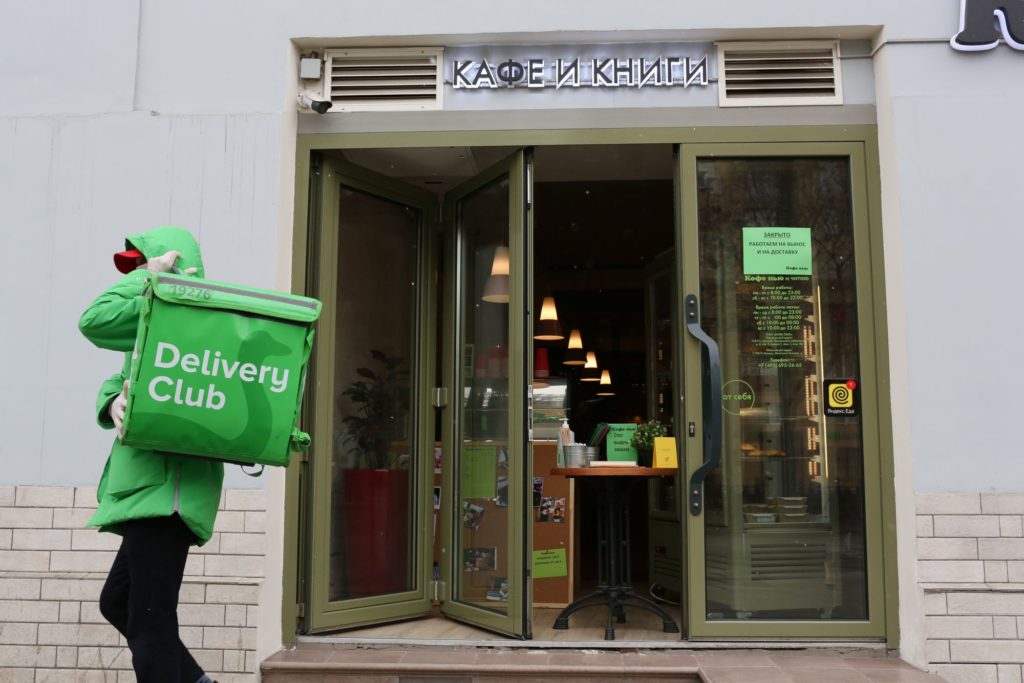
Yandex exchanged its news division and a blog site for VK’s Delivery Club, Russia’s biggest food and grocery delivery service, the company said in a statement on Tuesday. 

The deals come amid a major shift among Russian technology companies brought on by the war in Ukraine. A top aide of President Vladimir Putin is involved in negotiations over the fate of Yandex with its founder sidelined by European Union sanctions, Bloomberg reported this month. 

Yandex agreed in principle to sell the units to VK in April, as the news service was caught between the Kremlin’s increasingly harsh internet crackdown and a backlash in key foreign markets. Two top executives, including founder Arkady Volozh, have been forced to step down after being sanctioned by the EU since the start of the war.  

VK held Delivery Club, together with express grocery service Samokat and ride-hailing app CityMobil, in a joint venture with the sanctioned Russian lender Sberbank PJSC. VK signed binding documents to receive full control of Delivery Club and exit the joint venture, it said in a statement Tuesday. 

VK is run by the son of Sergei Kiriyenko, the Putin aide involved in negotiations over Yandex’s future. It is controlled by companies affiliated with Gazprom PJSC, the state-owned gas giant. 

Yandex said the strategic exit from its media business will let the company focus on its search, advertising and other businesses. It will keep the Delivery Club brand, which will become part of Yandex’s e-commerce, mobility and delivery segment. 

The transactions are subject to regulatory approval. 

More stories like this are available on bloomberg.com

©2022 Bloomberg L.P.

‘Flying’ Electric Boats to Get Battery Tech From EV Maker Polestar

(Bloomberg) — Electric-car maker Polestar Automotive Holding has agreed to share battery technology with Candela Speed Boat AB, a startup trying to electrify leisure boats and water taxis.

Polestar said Tuesday it struck a multi-year agreement to supply the Swedish company with batteries and charging systems for its electric speed boats.

Candela is one of several startups trying to replace combustion engine-powered watercraft with battery-powered boats. Its vessels use underwater wings, known as hydrofoils, to make them fly above the surface.

The deal with Polestar will help “speed up the mass market adoption of electric boats,” Candela Chief Executive Officer Gustav Hasselskog said in an interview, adding that the relationship will bolster the company’s access to batteries in case of shortages.

READ: Electric Boat Maker Unveils Urban Water Taxi Aimed at Venice

Polestar — which targets sales of 290,000 cars by mid-decade — is sourcing batteries from Asian suppliers LG Chem Ltd. and Contemporary Amperex Technology Co. The company in the longer term is planning to also use cells produced by Sweden’s Northvolt AB.

More stories like this are available on bloomberg.com

©2022 Bloomberg L.P.

China Lithium Prices Near Record as Power Cuts Squeeze Market

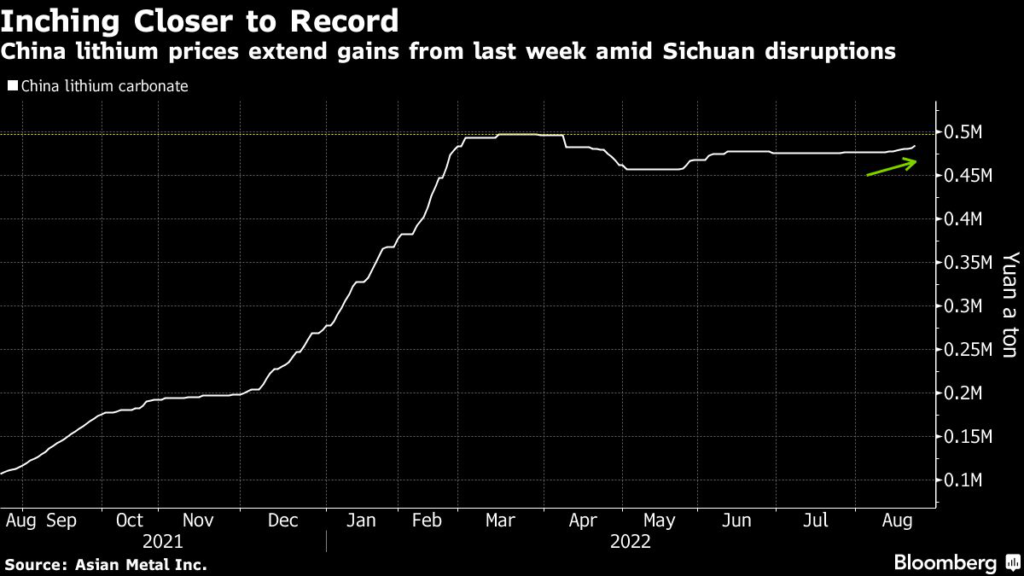
(Bloomberg) — Prices of lithium in China are close to a record high as a power crisis in the nation’s major hub for the vital electric-vehicle battery ingredient threatens an already-tight market.

Sichuan, home to more than a fifth of China’s lithium production, extended industrial power cuts this week amid the most intense heat wave in more than a half century. The supply disruptions in the province are set to add fuel to the battery metal’s stunning rally in the past year, with lithium carbonate prices on Monday reaching the highest level since April at 484,500 yuan ($70,610) a ton.

“We are estimating the lithium price momentum will last for a while, and the spot price for lithium carbonate will climb to 500,000 yuan per ton shortly,” said Susan Zou, an analyst at Rystad Energy. “Automakers and the battery manufacturers have to deal with this high cost.” 

Meanwhile, Leah Chen, an analyst at S&P Global Commodity Insights, said the power cuts could tip the market into a bigger imbalance.

The lithium sector, critical in the clean-energy transition, is one of the industries that’s most exposed to Sichuan’s electricity curtailments. The near-record prices may also have ripple effects for downstream players, with EV battery prices already expected to tick up this year for the first time in more than a decade, according to BloombergNEF.

“Should the power cuts be extended, then that could lead to more obvious supply concerns and possibly drive lithium prices higher,” Chen said.

Tianqi Lithium Corp., headquartered in Sichuan’s Chengdu with a production plant in Shehong city, said in a post on an online investor forum last week that it would strictly abide by the requirements of the local government and organize production in a “reasonable and orderly manner.” Chengxin Lithium Group Co. said on the same forum Monday that it would prepare for production resuming by adjusting its maintenance plan.

“If the lithium production disruption continues for the whole of August, with the low inventories at some lithium plants, the deliveries for committed orders for September might be impacted,” Rystad Energy’s Zou said. “Some cathode producers might be forced to scale back their production because they cannot get enough lithium on time. In the worst-case scenario, it may also affect the battery makers.”

More stories like this are available on bloomberg.com

©2022 Bloomberg L.P.
UK Security Review Clears Drahi’s BT Stake: The London Rush

(Bloomberg) — Here’s the key business news from London-listed companies this morning.

BT Group Plc: The UK government has cleared Altice Europe NV’s stake in the telecommunications company on national security grounds.

  • Secretary of State for Business, Energy and Industrial Strategy Kwasi Kwarteng  will take no further action on Altice’s decision to increase its holding in BT to 18% from 12.1%, the company said in a statement on Tuesday. 

Gatwick The London airport increased its traffic forecasts for the full year as a result of strong demand in the first half — despite the chaos that has plagued Europe’s travel hubs this summer.

  • In contrast to Heathrow, Gatwick decided not to continue to reduce passenger numbers past August, meaning it will now have more capacity for the busy October half-term period.

Mulberry Group Plc: Godfrey Davis, the British handbag maker’s chairman will step down from the board; he first joined the company as finance director in 1987. 

Abrdn Plc:  A year on from the asset manager’s eye-catching rebrand, Abrdn Plc’s blue-chip status hangs in the balance.

  • After a 37% drop in its share price this year, the firm is set to be demoted from the FTSE 100 index at the latest quarterly review, according to Bloomberg calculations. Indicative results are due to be announced by index compiler FTSE Russell after the close of trading today.

Outside The City

Tory leadership frontrunner Liz Truss is preparing to fast-track an emergency budget to help people cope with surging energy costs, a person familiar with the matter told Bloomberg.  She would be able to short-circuit the usual oversight from the Office for Budget Responsibility if she wanted to deliver action before the Sept. 22 recess, since the OBR usually needs 10 weeks to prepare its estimates.

In Case You Missed It 

Inflation could soar past 18%, forcing the Bank of England to raise rates as high as 7% — that’s according to a note from Citigroup’s UK economist. Benjamin Nabarro said the consumer prices index of inflation will peak at 18.6% in January, the highest level since 1976, the year the UK sought a bailout from the International Monetary Fund. That prediction is largely driven by rising energy prices, which consultancy Cornwall Insight Ltd forecast will soar to £3,554 a year in October. 

Meanwhile, the average two-year fixed-rate mortgage is now more than 4% in the UK, the first time since February 2013, according to data compiled by Moneyfacts Group Plc. Those rates are rising faster than the Bank of England is hiking its base rate.

And remote working has pushed central London’s office availability to the highest level in 15 years.

Finally, spare a thought for Britain’s nightclubs, who having survive extended pandemic closure now face rocketing energy bills and customers impoverished by the cost of living crisis. 

Looking Ahead

UK PMI data for August released later this morning will give us an insight into the likelihood the country will slip into a recession. Bloomberg Intelligence says UK composite PMI has proved “more resilient than measures of consumer sentiment in recent months,” despite its downward trend.

For a news fix when the day is done, sign up to The Readout with Allegra Stratton, to make sense of the day’s events.

More stories like this are available on bloomberg.com

©2022 Bloomberg L.P.
Close Bitnami banner
Bitnami

