
Bloomberg

PBOC Sticks to Limited Stimulus Even as China’s Outlook Darkens

(Bloomberg) — China’s property market crisis is testing whether central bank Governor Yi Gang can stick to his stimulus-lite strategy.

Over the past couple of weeks, Yi has cut key lending rates, announced special loans to struggling property developers via policy banks and urged state-owned lenders to extend more credit. Meantime, speculation of a cut to reserve requirement ratios grows. 

Even with the raft of recent moves, there’s still a focus on containing risks. That’s in line with Premier Li Keqiang and the State Council’s cautious policy mindset that states the country won’t “overdraw the future.”

It’s a “fine line that the PBOC has to walk,” says Hui Feng, co-author of “The Rise of the People’s Bank of China” and a senior lecturer at Griffith University. “Although growth has been lackluster, the central bank fears monetary stimulation would only lead to higher leverage in the economy with a higher cost than benefit.”

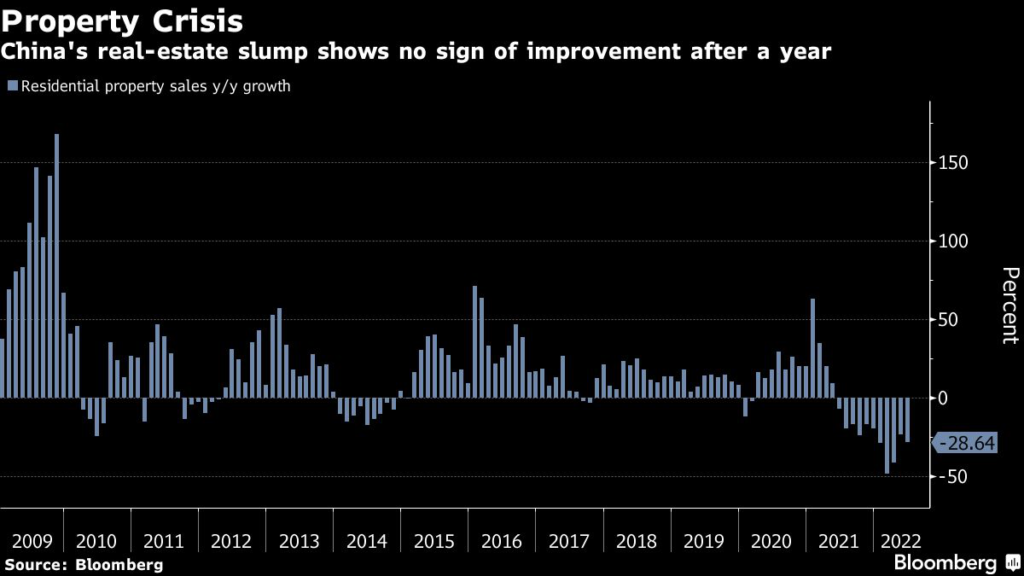
Economic challenges are piling up as China prepares for the 20th Party Congress, where President Xi Jinping is set to be endorsed for a precedent-defying third term. The property market is in a slump, Covid Zero restrictions are sapping consumer confidence, and the annual growth target will be missed by a wide margin for the first time since they started being set in the early 1990s. 

What Bloomberg’s Economists Say…

“Monetary easing alone may not be sufficient to revive demand, which has been shattered by the housing slump and Covid Zero restrictions. Restoring business and consumer confidence will probably require a more significant policy reorientation.”

— Eric Zhu, China economist

For the full report, click here

Yi has recently promised monetary policy will remain “accommodative” to support the economy, but there’s an implied limit to how far the PBOC will go. In the past, he has argued against quantitative easing and avoided deep interest rate cuts, preferring more targeted tools. 

Financial institutions, especially major state-owned banks, should increase loan issuance to the real economy, the PBOC said in a statement late Monday following a meeting chaired by Yi. 

He has also ramped up the provision of targeted liquidity to support priorities such as technology innovation and the elderly care sector. Such so-called structural tools now total 5.4 trillion yuan ($793 billion), from about 3 trillion yuan five years ago.

Tame Inflation

The fastest inflation in over four decades seen in the US and other Western economies — in contrast with tame domestic prices — is partially vindicating Yi’s targeted approach. 

China has “insisted not to overstimulate or print excessive amounts of money, and that has laid a solid foundation for maintaining stable prices — a hard-earned accomplishment,” the PBOC said in the latest monetary policy report this month. 

But right now, the PBOC’s cautious approach appears to be running into a wall when the economy’s demand side is so drastically weakened by restrictions to stop Covid infections and the downward spiral in the property sector. 

Companies are reluctant to expand investment under Covid-induced uncertainties and after a regulatory storm that upended industries including private tutoring and internet platforms. Defaults by property developers and an increase in stalled housing projects continue to plague the industry that once drove almost 40% of overall lending. 

The result is that cheaper money and ample credit supply has failed to lead to stronger borrowing, increasing the risk of a “liquidity trap,” where lower interest rates aren’t able to spur more credit demand and economic growth. 

New Development Phase

Yi’s monetary caution gels with President Xi’s assertion that China has entered a “new development phase,” where priorities including ensuring national security, narrowing income inequalities and maintaining social stability eclipse unfettered economic growth. 

Economic development needs to be greener, more balanced and propelled by technological innovation and structural reforms that result in greater productivity and efficiency, according to Xi, instead of being driven by unsustainable and dangerous debt binges fueled by cheap money.

Given Xi’s new imperatives, the PBOC is unlikely to embark on an outsize stimulus as it did in the wake of the global financial crisis in 2008 or again when a surprise yuan devaluation shook confidence in mid 2015. Such moves would undermine progress over the past five years in defusing a debt bomb that permeated sectors including the property industry, local government finances, shadow banking, consumer finance and big conglomerates. 

Indeed, even if Yi wanted to, he couldn’t take major easing measures unless Xi agreed. Unlike global peers that enjoy a high degree of independence from their governments, the PBOC needs to get the nod from the State Council before it makes big decisions on money supply and interest rates. 

Like almost every arm of government in China, there’s also a layer of Communist Party oversight, with Guo Shuqing, head of the banking and insurance regulator, the party chief of the PBOC. Yi, the deputy party chief, is responsible for the day-to-day operations.

State Control

While less independent than global peers, Yi in other ways wields more power because many parts of the economy are still not yet liberalized from the state’s control even after four decades of market reforms. That includes the vast $56 trillion banking sector, which is comprised mostly of state-led lenders and regional banks closely linked to local governments. 

The PBOC exerts great power over the pace and direction of bank lending, as well as the cross-border capital flow, through a so-called macro-prudential assessment system established over the past decade. The system aims to maintain financial stability and contain the accumulation of debt and “pro-cyclical risks.”  

Read More: Chinese Banks Are Inflating Their Loan Numbers

The central bank regularly monitors banks’ business metrics such as capital adequacy, leverage ratios and credit growth rates. It punishes and rewards banks based on the assessment result, approves banks’ annual loan quota, and gives banks the so-called window guidance on their operations when needed. 

The deleveraging campaign has moved the PBOC toward “quantitative measures and window guidance rather than price-based instruments,” according to Hui. “Space for liberal policies from the PBOC has been rather limited.”

The MPA system is now part of the PBOC’s “dual-pillar policy framework,” with the other component being the monetary policy mandate. A sweeping overhaul of financial regulatory agencies in 2018 also gave the central bank more power to rein in risks and cemented its status as a top financial regulator that coordinates various government bodies.

De-risking Campaign

Amid that regulatory overhaul, financing from shadow banking that takes place outside the traditional banking system has plummeted to 18 trillion yuan from a peak of 28 trillion yuan in 2018, according to PBOC data. The peer-to-peer lending industry has been nearly wiped out after a multi-year crackdown and regulation of internet finance has also increased, most notably with the shock last-minute suspension of Ant Group’s $35 billion initial public offering late in 2020.

The screws were also tightened on a clutch of conglomerates that engaged in aggressive borrowing and overseas expansion and controlled by powerful billionaires, such as Anbang Insurance Group, Dalian Wanda Group and Tomorrow Holding Co. Some of the firms and their subsidiaries were restructured and nationalized. 

Meanwhile, banks have been directed to boost their capital by selling more bonds since the PBOC seized the Bank of Baoshang in 2019 and allowed it to go bankrupt the next year. Such steps should help lenders deal with a potential spike in bad loans as the property slump drags on.

But de-risking comes with a price.

Bert Hofman, former China director at the World Bank who now heads the National University of Singapore’s East Asian Institute, says the PBOC’s three red line rules to rein in developers’ debt and aggressive expansion in late 2020 has contributed to the rapid deceleration of the industry.

“The three red line policy intended to reduce the risks in the real estate sector,” said Hofman. “But the default of some of the property developers in its wake and the subsequent reluctance of people to invest in housing is causing a major economic slowdown and risks further defaults and even banking trouble.”

Hofman also argues that the clampdown on fin-tech and e-commerce platforms has made life much harder for small firms that depended on them to sell goods and get financing. “The authorities have underestimated how important fin-tech and e-commerce was for small and medium enterprises and credit to those enterprises,” he said.

While capital controls and greater flexibility in the yuan give Yi scope to diverge from the global tightening wave, China isn’t immune from it. Recent moves to open up much of the onshore market to foreign investors means maintaining a loose monetary policy increases the attractiveness of US assets like Treasuries relative to Chinese government bonds, spurring market outflows and harming sentiment. 

No matter the international backdrop, Li Daokui, a former adviser to the PBOC and currently a professor at Tsinghua University in Beijing, says more stimulus will be needed if Covid and the restrictions to contain its spread continue to weigh on the economy. He sees scope to cut interest rates by another 30-50 basis points by June 2023. 

“Right now, monetary policy should do everything possible to avoid the financing chain in the housing market from breaking,” he said. 

More stories like this are available on bloomberg.com

©2022 Bloomberg L.P.
Chip Sales Set to Slow Further as Global Recession Fears Mount

(Bloomberg) — Chip sales are set to cool more than previously expected as the international economy struggles under the weight of rapid interest-rate increases and rising geopolitical risks, fueling fears of a global recession.

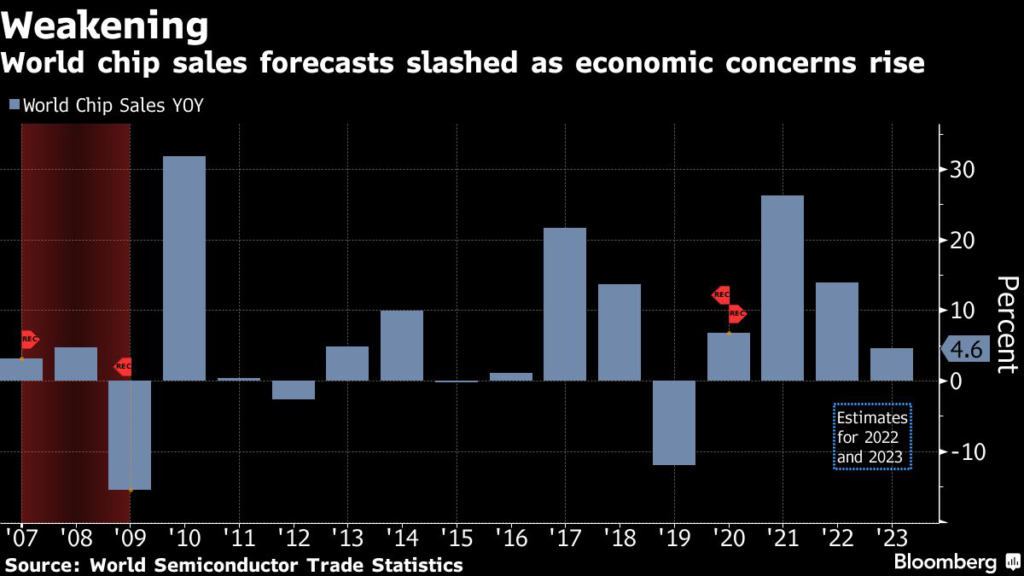
World Semiconductor Trade Statistics, a non-profit body that tracks shipments, lowered its market outlook to 13.9% growth this year from a previous 16.3%. In 2023, it sees chip sales rising just 4.6%, the weakest pace since 2019.

The market is still expected to surpass $600 billion this year, WSTS says. Next year’s forecast growth would be the weakest since a 12% drop in sales at the height of the U.S.-China trade war.

Chip sales are an important indicator of global economic activity as households and firms increasingly rely on digital devices and online services to consume and expand. President Joe Biden this month signed the so-called CHIPS and Science Act aimed at strengthening the US semiconductor industry as China races to expand its own chip-making capacity.

Japan will probably see the strongest sales growth at 5% next year, followed by the Americas at 4.8% and the Asia-Pacific at 4.7%, according to WSTS. Europe, where Russia’s war on Ukraine is reverberating across the continent’s economy, will likely post an expansion of just 3.2%.

The International Monetary Fund last month downgraded its global growth forecast and said 2023 may be tougher than this year. A Bloomberg Economics model sees a 100% probability of a US recession within the next 24 months.

Based in Morgan Hill, California, WSTS includes among its members Texas Instruments Inc., Samsung Electronics Co., Sony Semiconductor Solutions Corp and Yangzhou Yangjie Electronic Technology Co., according to its website.

More stories like this are available on bloomberg.com

©2022 Bloomberg L.P.

Instagram Is Testing a Copycat Version of the Popular BeReal App

(Bloomberg) — Meta Platforms Inc.’s Instagram appears to be copying another up-and-coming social media competitor: BeReal, the popular photo app that prompts users to take and post an image once a day at the same time as all their friends.

Instagram, Meta’s own photo- and video-sharing app, is testing a feature that looks almost identical to BeReal, according to a screenshot posted on Twitter by developer Alessandro Paluzzi. In the image, Instagram asks users to “Join IG Candid Challenges” and “everyday at a different time, get a notification to capture and share a photo in 2 minutes.” 

That’s the basic premise of BeReal. An Instagram spokesperson said the tool is an “internal prototype” that is “not testing externally.” A BeReal spokesman had no immediate comment.

BeReal, founded in 2020 and headquartered in Paris, has become popular with teenagers thanks to its push to get people to post at the same time. Snapping images at an unexpected time each day has also led to a less polished experience, because users aren’t spending time staging, editing or perfecting the images — a frequent criticism of the posts on Instagram.

Meta has a history of copying the features of upstart competitors, including Snapchat’s Stories product and TikTok’s short-form videos. BeReal has raised money from venture capital firms such as Andreessen Horowitz and Accel.

More stories like this are available on bloomberg.com

©2022 Bloomberg L.P.
Popular Manga App Seeks 2023 IPO in Tokyo at $6 Billion Value

(Bloomberg) — South Korean messaging giant Kakao Corp.’s manga business is pushing back plans to go public on the Tokyo Stock Exchange until next year, aiming for a valuation of $6 billion or more. 

Manga app operator Kakao Piccoma Corp. had previously planned an initial public offering for this December, but is delaying the process amid slumping tech valuations, according to people familiar with the matter. Piccoma was valued at about 847 billion yen ($6.2 billion) when it raised funds last year, and the company hopes to maintain that threshold when it goes public, one of the people said. Its IPO will likely take place during the first half, but plans remain flexible and hinge on market prices, the people said. 

Piccoma joins a growing pipeline of companies waiting to go public after a global stock market rout hammered tech firms with lofty multiples. Valuations for e-commerce giant Coupang Inc. — sometimes called the Amazon of South Korea — briefly soared to more than $86 billion last year following a $4.6 billion New York listing, only to plunge more than 60% from that peak. That’s become a cautionary tale for firms ranging from SoftBank Group Corp.’s chip architect Arm Ltd. to Kakao Entertainment Corp., which are both considering New York listings but have yet to decide on a timeline. 

Piccoma, whose site features popular Japanese-style comics, can be patient because it’s already turning a profit, according to one person. Lead managers include Nomura Holdings Inc., the people said.

“It’ll be hard to get the same valuation,” said Mitsushige Akino, a senior executive officer at Ichiyoshi Asset Management Co. Rising global interest rates and inflation will make it difficult for stocks to trade at last year’s lofty price-earnings ratios, he said. “The markets may recover, but the mechanism lifting valuations has changed.”

Piccoma plans to go public, but details of the IPO, including the timing, continue to be under review, a company representative said without elaborating.

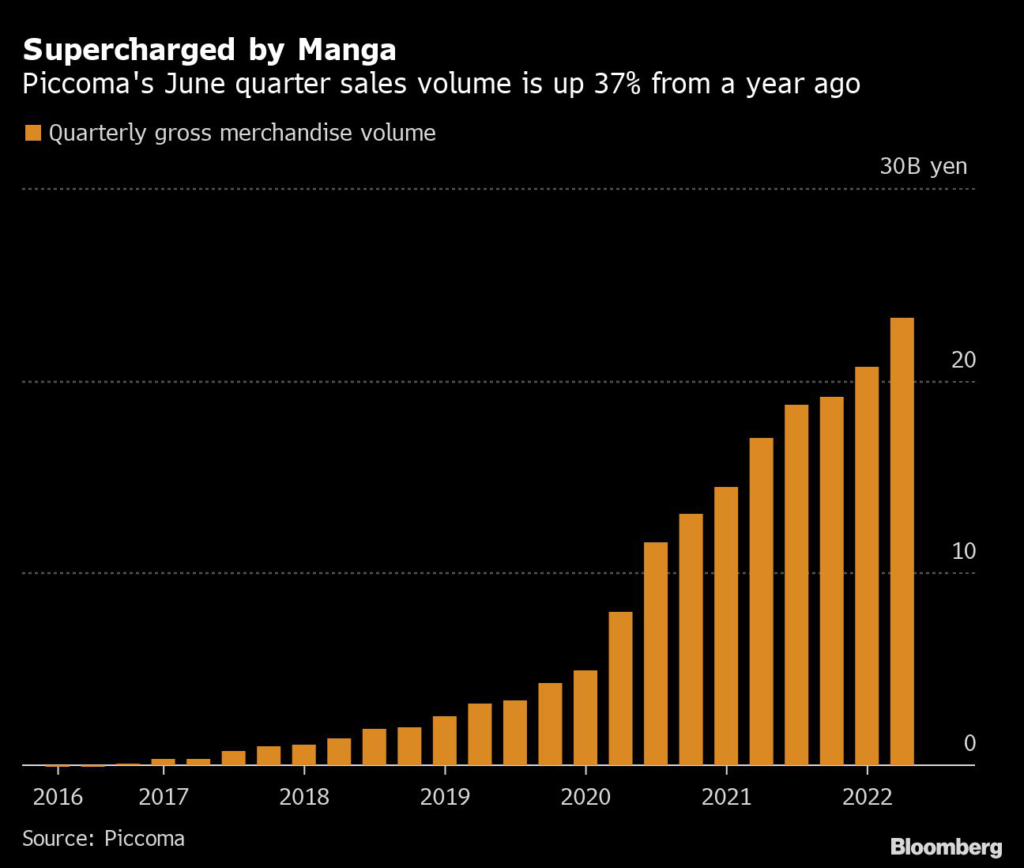
Owned 72.9% by Kakao and 18.2% by Kakao Entertainment, Piccoma is battling Line Corp., operator of Japan’s biggest messaging platform, to be the country’s most widely-used manga app. Piccoma’s monthly readership hit a June quarter high of 9.5 million, compared with about 2 million in August 2017. That helped it rank eighth globally among non-gaming apps by monthly sales in June, according to data tracker data.ai.  

The app offers the first few chapters of most cartoons for free. It charges users who want to keep on reading, while also offering the option to wait 24 hours before continuing a given cartoon without paying. The approach struck a chord with readers and helped Piccoma capture new users when it was trying to crack the Japanese market. 

A digital shift in Japan’s comics market has also fueled Piccoma’s growth. Digital manga sales climbed 20% in 2021 from the previous year, growing more than fourfold in seven years and accounting for more than 60% of the total $5 billion market, according to a report published by All Japan Magazine and Book Publisher’s and Editor’s Association.

Piccoma swung to a profit for the first time in 2020, based on filings made to Korean regulators. Its net income more than tripled to $39 million in 2021 on an 88% surge in sales. The company’s net income shrank to $2 million on a 27% rise in revenue for the first half of this year, however, as higher marketing costs hit profitability.

Piccoma raised 60 billion yen in May last year from investors including Anchor Equity Partners, and the startup hopes its profitability will attract more investors at its IPO, one person said. During investor pitches, some have compared Piccoma to other firms that generate viewership-based revenue, like Netflix Inc. Piccoma’s manga app has one advantage, because its revenue per user isn’t capped at a fixed monthly fee, but can rise based on the number of chapters read, according to the person. Still, even Netflix’s stock has plunged this year as subscriptions stalled. 

Piccoma’s Tokyo debut could also be a watershed moment for an increasing number of Korean startups attempting to make inroads overseas. 

The operator of South Korea’s biggest messaging app KakaoTalk, parent Kakao has struggled to crack markets in Asia and elsewhere as the sprawling group ran head-first into dominant messaging apps like WeChat and Line. Piccoma, however, is betting it can use its experience in Japan to expand elsewhere. The manga app launched its service in France this March to make a play for the European audience. 

“We plan to secure Piccoma’s place in the French market, and build a foundation for Kakao’s footing in global expansion,” Piccoma said in a release in July. 

More stories like this are available on bloomberg.com

©2022 Bloomberg L.P.

Tech Layoffs Hit California Revenue With 12% July Shortfall

(Bloomberg) — California collected 12% less in revenue than it expected in July, indicating that state coffers are taking a hit from a slowing economy and a cooldown in the once-booming technology industry.

Cash totaled $9.2 billion in the first month of the fiscal year, almost $1.3 billion below the state’s budget forecast, according to a bulletin from the California Department of Finance. The amount of personal income tax withheld from paychecks fell short of expectations — by 10% in July and 5.8% in June.

The revenue miss adds to signs around the country that state governments’ budgets, recently flush from stock-market gains and pandemic aid, may be curtailed by a decelerating economy. California’s dropoff in withholdings likely was tied to job cuts in tech, a traditionally high-wage sector, said H.D. Palmer, a spokesperson for the finance department.

Silicon Valley giants such as Apple Inc. and Alphabet Inc. are slowing hiring, while companies from Netflix Inc. to Lyft Inc. have fired workers as economic headwinds mount. Smaller tech employers have also been scaling back: According to Layoffs.fyi, a website tracking job cuts at startups and recently public companies, more than 37,000 positions were eliminated globally in the second quarter.

Read more on tech companies that have laid off workers 

Such job cuts can hit particularly hard in California, which is prone to booms and crippling deficits because of its dependence on high earners and financial markets. The state’s nonpartisan legislative adviser warned earlier this month that California is likely to see revenue from its three major tax sources fall short of forecasts during the current fiscal year.

“As we know, slight changes in income for high earners can have a magnified effect on revenues, up or down,” Palmer said in an email Monday. Tech job cuts are “likely being reflected in the recent withholding totals.”

Other parts of the country are having similar issues. New York state’s personal income tax is down 3.2% since the beginning of the April 1 fiscal year through July.

California has socked away billions to cover the hit of the next downturn. Lawmakers put $37.2 billion into its reserves in its latest spending plan. The state also plans to send $9.5 billion of tax rebates to residents in October.

Palmer noted that the state’s unemployment rate in July was at a record low of 3.9%.

“Overall, the employment picture is resilient,” he said. “We always caution folks, both in and out of government, not to make any long-term extrapolation on one month’s worth of cash data.”

(Updates with tech industry details in third paragraph)

More stories like this are available on bloomberg.com

©2022 Bloomberg L.P.

Usain Bolt Files for Trademarks to Protect His Victory Pose

(Bloomberg) — Track icon Usain Bolt is looking to sell clothing and fashion accessories under a logo that looks like the victory pose he made famous.

Bolt filed an application with the US Patent and Trademark Office on Aug. 17 for the logo in connection with products including jewelry, purses, sunglasses, shoes and sporting goods. It also includes restaurants and sports bars with services like VIP areas, catering and loyalty programs.

“The list is relatively extensive,” said Josh Gerben, a Washington-based trademark lawyer who tracks filings by athletes. “The logo could be licensed or he could make those products himself.”

Bolt previously applied for trademarks involving a similar logo 12 years ago, but those were abandoned after going unused early in his career.

A prolific endorsement figure throughout his career, Bolt has worked with brands ranging from Puma SE sportswear to Hublot SA watches to PepsiCo Inc.’s Gatorade drinks. He also has ownership stakes in businesses such as Champion Shave razors, Enertor insoles and esports organization Wylde. 

Bolt’s signature pose became internationally known in 2008 as the world’s fastest man dominated at the Olympics in Beijing. Over the years, the sprinter would strike it after setting world records and winning numerous gold medals, leaning back and gesturing to the sky. 

Or, as the filing puts it: “The silhouette of a man in a distinctive pose, with one arm bent and pointing to the head, and the other arm raised and pointing upward.”

More stories like this are available on bloomberg.com

©2022 Bloomberg L.P.
Rogers Asks Bondholders to Change Terms as Shaw Deal Delayed

(Bloomberg) — Rogers Communications Inc. is seeking approval from investors holding $9.35 billion of bonds to extend the deadline to complete its acquisition of Shaw Communications Inc.

Rogers has to repay the securities at 101 cents on the dollar if the C$20 billion ($15.3 billion) deal isn’t done by the end of the year. The Toronto-based cable and wireless firm wants to extend that to Dec. 31, 2023, to ensure it still has the money in place to close if the transaction drags into next year, according to a statement Monday. 

The deal has been delayed by Canada’s antitrust regulator, which has sued to block it, arguing that it will damage competition in a telecommunications sector that’s already dominated by a handful of large companies. Rogers and Shaw have agreed to sell most of Shaw’s wireless business to Quebecor Inc. to address those concerns, but the case appears headed to a hearing at the Competition Tribunal, Canada’s merger court. 

The companies have already agreed to change the deadline for the deal to Dec. 31 — with the option to extend it to Jan. 31, 2023, as long as financing remains in place. 

Read more: Rogers Rises on Strong Outlook, Shaw Deal Extension

The proposed change to the bonds applies to five series of U.S. dollar notes and three series of Canadian dollar notes, and requires the consent of a majority of holders.

Holders of the U.S. notes will be paid a consent fee ranging from $23.50 to $62.60 per $1,000 in face value as an initial consent fee. They can receive additional fees of $11.45 to $31 if the merger doesn’t close by Dec. 31 and Rogers isn’t forced to repay the notes at that time. 

Owners of the Canadian notes are eligible for similar fees. 

The consent solicitation expires at 5 p.m. on Aug 31. Bank of America, Royal Bank of Canada and Bank of Nova Scotia are organizing the transaction.

(Updates with additional information on deal delays and terms)

More stories like this are available on bloomberg.com

©2022 Bloomberg L.P.

Troubled Star Wars Video Game Remake Shifts to New Studio

(Bloomberg) — The highly anticipated remake of the video game Star Wars Knights of the Old Republic has a new developer after a bumpy ride.

The project, formerly in development at Austin, Texas-based Aspyr Media, is now being led by one of Saber Interactive’s Eastern European studios, according to a person familiar with the change who asked not to be identified because the details are private. Both developers are owned by the Swedish company Embracer Group AB, which obliquely referenced the pivot in a public statement last week. A representative for Embracer didn’t immediately have a comment.

The transition shuts down any lingering hope within Aspyr that it may be able to continue leading the project. Bosses at the studio, which had been developing the remake for more than two years, told staff last month that the game was “on pause” as the company tried to figure out what to do next, Bloomberg reported. The message left open the possibility that Aspyr could one day reclaim a leadership role, but rumors quickly swirled among employees that Saber was taking over. 

Last Thursday, Embracer said in a financial report that one of its big titles, known within the industry as a triple-A game, had switched developers but did not identify the game. “One of the Group’s AAA projects has transitioned to another studio within the Group,” the company wrote. “This was done to ensure the quality bar is where we need it to be for the title.” Some analysts correctly guessed, based on Bloomberg’s previous reporting, that the statement referred to the Star Wars remake.

Embracer intends to recreate the magic of the original Knights of the Old Republic, a role-playing game that came out in 2003 to great acclaim, and update it using modern technology. The game lets players create their own Jedi, wield light sabers and choose whether to follow the light or dark side of the Force, in a galaxy filled with complex characters and a rich story.

Remakes have become common in recent years, but it’s rare for a game to switch companies in the middle of development. Doing so almost always leads to major delays. The new developer must learn how to adapt to unfamiliar code and in most cases will revamp or at least modify previous decisions made for the project.

Embracer said it is not “expecting any material delays” due to the transition. But the game, announced during a PlayStation event last year, does not have a public release date and will likely take at least two more years to finish, people familiar with development said. Embracer’s stock tumbled on Monday after lukewarm reviews of an upcoming game, Saints Row, and is down 28% this year.

Still, some close to the project said they are optimistic this will lead to a better product. Decision makers at Embracer and at publishers Sony Group Corp. and Walt Disney Co., both of whom have financial interests in the game, were displeased with progress under Aspyr, which ultimately led to the transition.

More stories like this are available on bloomberg.com

©2022 Bloomberg L.P.

YouTube Bans Andrew Tate After Sexist Remarks, But He’s Still on Twitch

(Bloomberg) — A YouTube channel associated with Andrew Tate, an online influencer and self-described misogynist, was disabled Monday, as Google’s video website joins a growing list of social media platforms taking action against the personality in the last week.

The list of apps that previously banned Tate, a British-American former kickboxing champion who has been heavily criticized for his sexist commentary, includes Facebook, Instagram, TikTok and Twitter over violations of policies including those around hate speech or ideology. Notably, an account associated with Tate remains on one major social media platform: Amazon.com Inc.’s video livestreaming site Twitch.

Tate brands himself as a “success coach” for an online program called Hustler’s University. He has said publicly that female sexual assault victims “bear some responsibility” and suggested that men date women who are 18 to “imprint” on them. He has also described himself as “absolutely a misogynist.”

YouTube said on Monday that it terminated channels associated with Tate over “multiple violations” of its community guidelines and its terms of service, including its hate speech policy. “If a channel is terminated, the uploader is unable to use, own or create any other YouTube channels,” said Ivy Choi, a YouTube spokesperson. The company said it first took action against one of Tate’s channels in July because it had posted a video violating YouTube’s Covid-19 medical misinformation policies.

A spokesperson for Tate said, “There is a running contradiction in today’s society where men are encouraged to speak and be open/honest with how they feel but are generally met with a negative response to their truth.” The spokesperson added, “Banning Andrew Tate from these platforms might seem the answer, but it isn’t that simple. Removing Tate’s voice doesn’t allow for a kinder hate-free society.”

Tate’s inflammatory comments have attracted a large audience of both detractors and fans. Tate went viral on TikTok, where videos tagged #AndrewTate have been viewed 13.8 billion times. On Google, searches for the influencer’s name have soared since April. On YouTube, the newly banned account had 768,000 subscribers in August. There is at least one other YouTube account associated with Tate that still appears to be live. 

The channel on Twitch only has 50,000 followers, but he has appeared on channels with as many as 6.4 million followers. Last week, over 100,000 concurrent viewers watched Tate live with top Twitch personality Adin Ross, who streams video games and online crypto gambling. If Twitch did ban Tate, he would be unable to appear on other people’s channels.

“Every single time I do one of these Twitches, we get three, four, five, six thousand new students. Everything is going fantastic for us,” Tate said on Twitch in July. Bloomberg News was unable to confirm Tate’s claim.

Twitch didn’t immediately have a comment on Tate’s use of the site. Adin Ross didn’t immediately respond to a request for comment.

Hope Not Hate, a group based in Britain that organizes against far-right extremism, launched a petition in August calling for Tate to be banned from the major social networks. “The effect that Tate’s brand of vitriolic misogyny can have on the young male audience is deeply concerning,” the group said in its petition. “We also know that misogyny can be a gateway to other extreme and discriminatory views.”

(Updates with additional YouTube comment in the fourth paragraph.)

More stories like this are available on bloomberg.com

©2022 Bloomberg L.P.
Stocks Knocked Down as Torrid Rally Hits a Wall: Markets Wrap

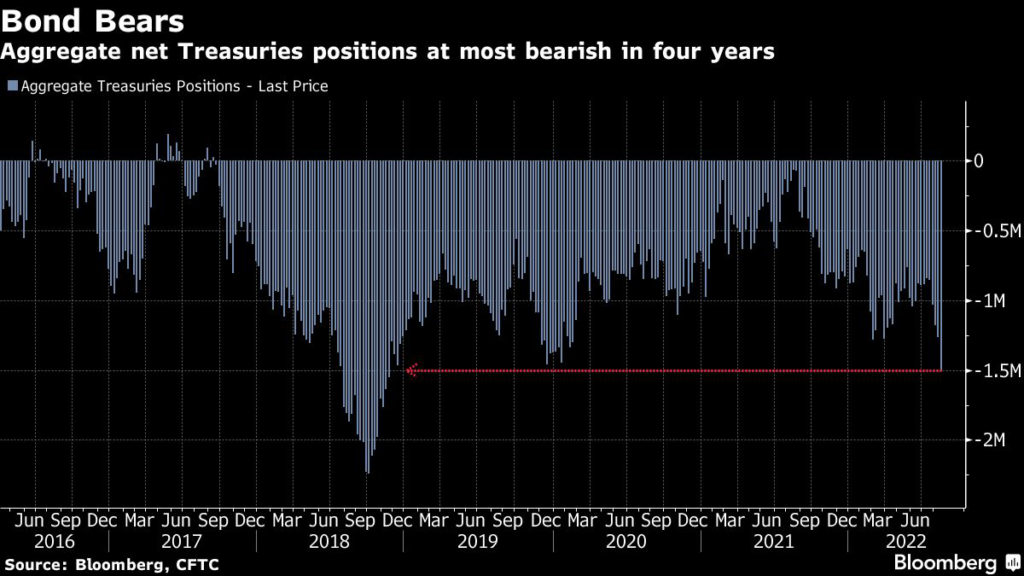
(Bloomberg) — A sobering tone took over Wall Street after a rally that added $7 trillion to the stock market, with traders bracing for hawkish rhetoric from Federal Reserve officials at the Jackson Hole retreat later this week.

Equities saw their worst rout in two months, following a surge that drove the S&P 500 to its best start to a third quarter since 1932. The Nasdaq 100 underperformed as Treasury 10-year yields topped 3%. The meme-stock frenzy continued to unravel, with other speculative corners of the market like Bitcoin and profitless tech firms also getting clobbered. The Cboe Volatility Index, or VIX, soared. As the dollar gained, the euro sank to an almost two-decade low.

The furious runup in US shares from June lows showed signs of fatigue as the earnings season wrapped up, with the threat of an economic recession still looming large amid warnings from Fed officials that the fight against inflation is far from over. That stance will likely be reinforced by Jerome Powell Friday at the prestigious event in Wyoming’s Grand Teton mountains, which has been used by Fed chairs as a venue for making key policy announcements.

“He may try to send a clear message that even if they have a slower pace of rate hikes, that won’t signal a lower peak rate or that they will be quick to cut rates,” wrote Ed Moya, senior market analyst at Oanda. “After this week, Wall Street should not be surprised if Fed fund futures start pricing in rate hikes for next year. This could be the week many return from vacation and double-down on their bear-market rally calls.”

In fact, while the recent surge in stocks has triggered chatter about a new bull run, history shows there may be more turbulence ahead. Looking back to the last six bear markets since the 1970s, four of them have experienced an average of six or seven short-lived up trends, according to Glenmede. The study also showed that the 17% surge from June lows was consistent with historical bear-market rallies.

“There may be further downside to the ongoing bear market, justifying an underweight to risk assets,” wrote Jason Pride, the firm’s chief investment officer of private wealth.

Investors are also waking up to the imminent acceleration of the Fed’s balance-sheet reduction. So-called quantitative tightening kicks into top gear next month, and will add to pressure on riskier assets which have benefited from ample liquidity. Strategists at Bank of America Corp. last week said that the winding down of the central bank’s balance sheet poses a risk to equity prices.

Read: Morgan Stanley’s Sheets Favors Cash as Bears Circle Equities

Meantime, hedge funds are rapidly positioning for higher rates in a key corner of the derivatives market. The group has collectively placed a big short across futures referencing the official successor to London interbank offered rate known as the Secured Overnight Financing Rate. This wager stands to benefit should Powell effectively rule out a dovish pivot this week.

The debate for most investors has shifted from a focus on the odds of a recession to how the Fed will impact markets, according to Lindsey Bell, chief money and markets strategist at Ally, who bets volatility will likely increase as investors look for catalysts.

“With real rates still rising and prospects for 2023 rate cuts fading in the bond market, stock valuations look extremely stretched, especially if as we suspect, policy-driven economic slowing will prove an obstacle to currently optimistic 2023 earnings estimates,” Lisa Shalett, chief investment officer at Morgan Stanley Wealth Management, said in a note. “Stocks are overbought. Sit it out for now.”

Stocks and bonds are set to tumble once more even though inflation has likely peaked, according to the latest MLIV Pulse survey, as rate hikes reawaken the great 2022 selloff. Ahead of the Jackson Hole symposium, 68% of respondents see the most destabilizing era of price pressures in decades eroding corporate margins and sending equities lower.

As investors wonder whether the selloff will get worse from here, Lori Calvasina at RBC Capital Markets says “it seems premature to call an end to the rebound just yet” even with stocks set up for “some choppiness” in the second half of 2022.

“Deeply depressed levels of investor sentiment, which continue to show signs of healing, have kept us out of the bearish camp,” she added.

Elsewhere, gold dropped for a sixth day as a stronger dollar and higher bond yields are bad for bullion as it pays no interest and is priced in the US currency. Oil clung to $90 at the conclusion of a volatile session after Saudi Arabian Energy Minister Prince Abdulaziz bin Salman said “extreme” volatility and lack of liquidity mean the futures market is increasingly disconnected from fundamentals and OPEC+ may be forced to cut production.

What to watch this week:

  • US new home sales, S&P Global PMIs, Tuesday
  • Minneapolis Fed President Neel Kashkari speaks at a Q&A session, Tuesday
  • US durable goods, MBA mortgage applications, pending home sales, Wednesday
  • US GDP, initial jobless claims, Thursday
  • Kansas City Fed hosts its annual economic policy symposium in Jackson Hole, Wyoming, Thursday
  • ECB’s July minutes, Thursday
  • Fed Chair Powell speaks at Jackson Hole, Friday
  • US personal income, PCE deflator, University of Michigan consumer sentiment, Friday

Some of the main moves in markets:

Stocks

  • The S&P 500 fell 2.1% as of 4 p.m. New York time
  • The Nasdaq 100 fell 2.7%
  • The Dow Jones Industrial Average fell 1.9%
  • The MSCI World index fell 1.8%

Currencies

  • The Bloomberg Dollar Spot Index rose 0.6%
  • The euro fell 0.9% to $0.9943
  • The British pound fell 0.5% to $1.1766
  • The Japanese yen fell 0.4% to 137.45 per dollar

Bonds

  • The yield on 10-year Treasuries advanced six basis points to 3.03%
  • Germany’s 10-year yield advanced eight basis points to 1.31%
  • Britain’s 10-year yield advanced 10 basis points to 2.51%

Commodities

  • West Texas Intermediate crude fell 0.6% to $90.23 a barrel
  • Gold futures fell 0.8% to $1,748.40 an ounce

More stories like this are available on bloomberg.com

©2022 Bloomberg L.P.

Close Bitnami banner
Bitnami
