
Bloomberg

Stalled Stock Rally Hits Fringes First as Speculative Bets Cool

(Bloomberg) — Cathie Wood’s flagship ETF, Bitcoin, meme stocks, profitless tech firms. The risk assets that powered this quarter’s $7 trillion rally all took a pounding Monday. 

The beat-down was part of a concerted stock and bond rout that saw the S&P 500 Index sink more than 2% to clinch its worst two-day rout since mid-June. The 10-year Treasury selloff pushed yields past 3% for the first time in a month. Volatility spiked higher, with Cboe’s VIX measure pushing toward 24, a level not seen in three weeks.

The proximate cause was a chorus of hawkish Federal Reserve officials days before Chair Jerome Powell is widely expected to reiterate the central bank’s intention to throttle the economy until inflation is under control. As analysts start advising investors to favor cash, the pullback in risk assets may cool concern that rallying stocks would prompt the Fed to be even more aggressive in its campaign.

“We had a risk-on, momentum-driven market from the middle of June to the end of July, and speculative assets do well in those types of environments,” said David Spika, president and chief investment officer of GuideStone Capital Management. “It doesn’t mean that there’s legitimate value there — it just means that money was chasing momentum.”

Innovation Ditched

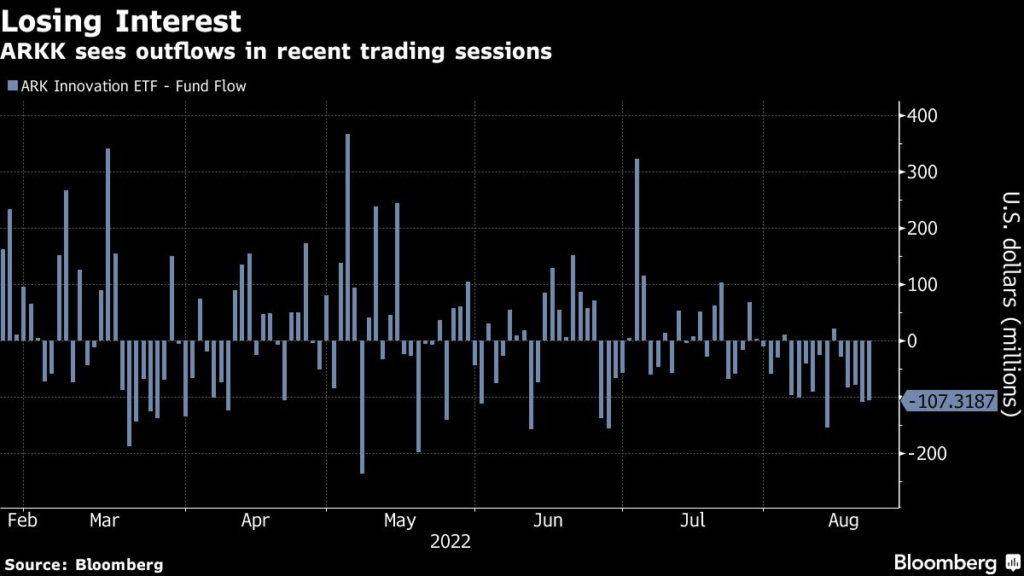
Cathie Wood’s Innovation exchange-traded fund (ticker ARKK) has seen outflows in five straight sessions, including 11 of the last 12. So far this year, the flagship ETF has seen inflows every month, except in June, though it has lost around half its value since 2022 started. ARKK slumped 2.4% Monday.

Crypto Selloff

Digital assets are being punished as investors unwind bets that the Fed might raise interest rates less than initially feared. Bitcoin broke above the $25,000 mark last week, but has since dropped toward $21,000. Meanwhile, an index of the 100 largest cryptocurrencies dropped as much as 3.1% on Monday, after losing nearly 12% last week.

Meme Frenzy Falls Flat

Bed Bath & Beyond Inc. tumbled 16%, adding to three-day rout of 60%, after a report some suppliers were restricting or halting shipments altogether after the company fell behind on payments. The pessimism rippled through other meme stocks, including GameStop Corp., which fell 5.5% Monday, and AMC Entertainment Holdings Inc., which sank 6.4%.

Tech Tumbles

A Goldman Sachs basket of non-profitable tech companies dropped 2.6% Monday and is trading at its lowest level since August 2. Tech companies with sky-high valuations based on the expectation of future profits suffer when investors expect higher rates and inflation to erode the value of those future earnings.

IPO Slowdown

Newly public companies have been particularly hard-hit by the Fed’s aggressive policy stance. The Renaissance IPO ETF (IPO) lost 8.9% last week, its largest weekly decline since May. The fund has dropped roughly 44% since the start of the year. 

The rout in speculative assets may vindicate bears who have been warning for six weeks that a sustained rally in stocks had no chance of persisting. They have long pointed to threats from China’s shutdowns, spiking energy prices in Europe and the potential for an overly aggressive Fed. 

“Global bond markets started selling off last week. Then there is today’s spike in European energy and power prices and concerns they will drive inflation through the winter,” Michael O’Rourke, chief market strategist at Jonestrading. “Despite the risk-off environment, inflation fears are prompting bond selling and pushing yields higher. As such, long-duration growth equities are under pressure.”

More stories like this are available on bloomberg.com

©2022 Bloomberg L.P.

Musk Subpoenas Ex-Twitter CEO Dorsey in Battle Over Buyout

(Bloomberg) — Elon Musk subpoenaed Jack Dorsey, co-founder of Twitter Inc. and his longtime friend, in his defense against the social media company’s lawsuit to make him complete his proposed $44 billion buyout.

Dorsey, who stepped down as Twitter’s chief executive officer last year, has been an energetic booster of Musk’s bid for the company, tweeting in April that Musk was the “singular solution I trust” to take over.

The subpoena follows a pair filed Friday for Kayvon Beykpour, former head of consumer product at Twitter, and Bruce Falck, formerly in charge of revenue product. The billionaire is rapidly marshaling documents and data to show that Twitter understated how much of its customer base is made up of spam and robot accounts. 

Read More: Twitter Must Give Musk Data, Documents From Ex-Product Head

Since the world’s richest person retreated from the purchase, dozens of people, banks and funds have been subpoenaed by both sides in the legal fight playing out in Delaware. The push to gather information and interview important figures in the deal comes ahead of an expedited schedule for the trial, slated to begin Oct. 17 and last five days.

Musk’s decision to subpoena Dorsey, who served two stints as CEO, is an interesting one given the duo’s history. The two executives, both big Bitcoin supporters, have been friendly for years. Dorsey has praised Musk, describing him as a favorite influential tweeter, and invited him to Twitter to discuss product ideas.

In a Rolling Stone interview in early 2019, Dorsey said he “loved” Musk and what he was trying to do with Tesla Inc. and SpaceX. Musk even appeared at Twitter’s companywide retreat in early 2020 to speak with employees by videochat — during which he complained about Twitter’s bot problem.

Read More: All the Banks, Billionaires and VCs Sucked Into Twitter v. Musk

More recently, the two have advocated for making Twitter’s software and content moderation decisions more transparent. After Musk became Twitter’s largest shareholder in late March, Dorsey was the first person at the company he called, according to a regulatory filing. Dorsey, who was still a Twitter director at the time, later encouraged Musk to join the board and spoke glowingly of him after the board agreed to sell Musk the company.

Earlier this month, the Tesla CEO accused Twitter of hiding the names of workers specifically responsible for evaluating the proportion of spam and robot accounts. Musk argues the company has failed to show that they make up fewer than 5% of its active users, as it has said in regulatory filings.

Twitter says it’s all a show to justify walking away from the deal.

Dorsey and Musk have their differences. Under Dorsey, Twitter permanently banned former president Donald Trump after the Capitol riot, although Dorsey delegated most of the moderation decisions to his legal deputy and later publicly questioned the ban. Musk has said he opposes “permanent bans” and would bring Trump back if he buys Twitter, although he hasn’t articulated a comprehensive content policy philosophy.

Dorsey stepped down as Twitter CEO to focus on Block Inc., his payments processing company.

Read More: Musk Says Twitter Is Hounding Him Over Every Chat About Buyout

Beykpour, the former head of consumer product, was the top product executive at Twitter for years before he was unexpectedly dismissed by new chief executive officer Parag Agrawal. It was his team that was most directly responsible for expanding Twitter’s user base — and it is the quality of that base Musk has questioned in seeking to escape from the acquisition.

Beykpour joined Twitter in 2015 when the company acquired his live video app, Periscope, and quickly climbed the ranks under Dorsey. He was pushing Twitter into new product areas, like live audio spaces and newsletters, before he was ousted.

The departures of Beykpour and Falck reflected Twitter’s state of limbo while it awaited a new owner, a state now intensified by the litigation. Meanwhile a hiring freeze and other cost-cutting efforts have left some employees unsure of whether the projects or teams they are working on will be prioritized under new leadership.

The case is Twitter v. Musk, 22-0613, Delaware Chancery Court (Wilmington).

Read More

  • What If Musk Is Ordered to Do Twitter Deal and He Just Says No?
  • Musk Seeks Dismissal of Twitter Investor Suit as ‘Hypothetical’

(Adds details, quotes and context starting in fifth paragraph.)

More stories like this are available on bloomberg.com

©2022 Bloomberg L.P.
Wall Street Bears Take Revenge After a $7 Trillion Rally

(Bloomberg) — A sober warning for Wall Street and beyond: The Federal Reserve is still on a collision course with financial markets.

Stocks and bonds are set to tumble anew even though inflation has likely peaked, according to the latest MLIV Pulse survey, as rate hikes reawaken the great 2022 selloff. Ahead of the Jackson Hole symposium later this week, 68% of respondents see the most destabilizing era of price pressures in decades eroding corporate margins and sending equities lower.

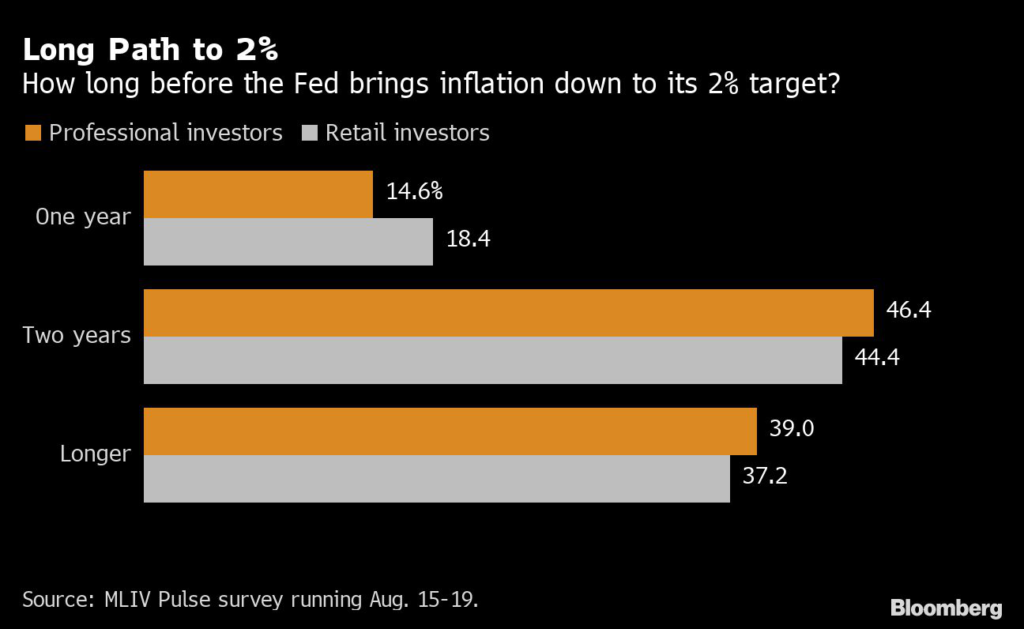
A majority of the more than 900 contributors, who include strategists and day traders, reckon inflation has topped out. Still, a whopping 84% say it may take two years or longer for the Jerome Powell-led central bank to bring it down to the official long-term target of 2%. In the meantime, American consumers will cut spending, and unemployment will climb over 4%.

All these bearish sentiments underscore the deep skepticism held by investors in the face of an unexpected $7 trillion equity rebound of late. While stocks fell last week, S&P 500 has still trimmed its 2022 loss to 13% versus the 23% decline through its mid-June nadir. 

“This is a bear-market trap,” Victoria Greene, founding partner at G Squared Private Wealth, said in an interview. “Inflation is the big, bad boogie man. Even if there really is a sustained decrease in inflation, it could take a while before prices actually come down significantly.”

The survey results spell trouble for dip buyers, who recently re-emerged after the horrendous first half — driven by bets on a less-hawkish monetary tightening cycle while a slew of quant funds have shifted to a bullish positioning. In turn, shares around the world have clawed back some of the worst losses while the 10-year Treasury yield has fallen back to around 3% from the peak near 3.5% earlier this year.

US equities saw their worst rout in two months Monday, following the surge that drove the S&P 500 to its best start to a third quarter since 1932.MLIV respondents, for their part, reckon bond prices are set to dip again over the next month, with Fed Chair Powell having an opportunity to renew hawkish market expectations at the gathering this week in Jackson Hole, Wyoming.

Fed funds futures showed traders are betting the central bank will stop hiking after raising the benchmark to 3.7% and will start cutting as early as May 2023. Yet even the doves are pushing back, with Minneapolis Fed President Neel Kashkari recommending a 4.4% rate by the end of next year. 

It’s hard to overstate why all this matters. A fast pace of monetary tightening, and the resulting economic fallout, is the biggest risk for money managers all over the world, with interest rates a key driver of corporate valuations. The bad news, per survey participants, is that inflation will deliver a meaningful blow to margins, pushing stocks lower. 

While inflation’s effect on profit margins is very much an open question, the majority of MLIV readers appear closer to the bearish spectrum of a heated Wall Street debate on where stocks are headed. As elevated prices persist, consumers are likely to buy less during the next six months, a majority of respondents say.

That’s in line with warnings from the world’s largest retailer, Walmart Inc., that soaring inflation is forcing shoppers to pay more for essentials at the expense of other discretionary items. A cutback in consumer spending would impose a clear drag on profits posted by S&P 500 companies, which are also grappling with higher wages, rising inventories and continued supply-chain problems in China.

While the S&P 500’s margins peaked a year ago, the trough may not come until the fourth quarter, according to Bloomberg Intelligence. Consensus estimates for net-income margins have fallen about a half percentage point for both the third and fourth quarters since the start of this earnings season, with communication services, health care and consumer sectors among the weakest groups, BI data show.

Pulse contributors also reckon unemployment is likely to rise above 4% but not higher than 6% — a worrisome level that’s higher than what policy makers are anticipating but lower than in previous severe economic downturns. That offers some comfort that any recession would be short lived, providing a dip-buying opportunity for risk assets.

“It’s rare for the Fed to aggressively tighten policy without causing market volatility,” said John Cunnison, chief investment officer at Baker Boyer Bank. “Stocks aren’t wildly cheap right now, but they’re not as expensive as they were six months ago, especially growth companies.”

For more market analysis, go to MLIV. Subscribe to MLIV surveys here.

(Updates S&P 500 returns, adds Monday stock move)

More stories like this are available on bloomberg.com

©2022 Bloomberg L.P.

Ford to Cut 3,000 Jobs to Fund Shift Toward Electric Vehicles

(Bloomberg) — Ford Motor Co. said it’s cutting 3,000 jobs this week in a move to boost profits as it seeks to fund the $50 billion it plans to spend on electric vehicles.

The cuts will come primarily in the US, while some positions also are being eliminated in Canada and India, a company spokesman said. The total includes 2,000 salaried workers and 1,000 contract personnel.

Most are coming from Ford’s operations that build traditional internal combustion engine vehicles, which Chief Executive Officer Jim Farley has said he wants to make the “the profit and cash engine for the entire enterprise.”

Read more: Ford Plans Up to 8,000 Job Cuts to Help Fund EV Investment

Ford plans to build 2 million electric vehicles a year by the end of 2026, up from less than 64,000 last year, as it seeks to catch EV leader Tesla Inc. To finance its ambitions, Farley has said he wants to make more money on traditional gasoline-fueled vehicles like the Bronco sport-utility vehicle. He has repeatedly said the company has too many workers.

“Building this future requires changing and reshaping virtually all aspects of the way we have operated for more than a century,” Farley and Executive Chairman Bill Ford wrote in a memo to employees Monday. “This is a difficult and emotional time. The people leaving the company this week are friends and coworkers and we want to thank them for all they have contributed.”

A spokesman didn’t rule out additional job cuts. Bloomberg previously reported Ford is considering eliminating as many as 8,000 jobs.

Ford shares fell as much as 6.1% and were down 4.7% to $15.13 at 1:25 p.m. in New York as investors digested the job-cut news and a separate $1.7 billion verdict against the automaker on Aug. 19. Ford said it is appealing.

(Updates with share price in the final paragraph. A previous version corrected the number of EVs Ford built last year.)

More stories like this are available on bloomberg.com

©2022 Bloomberg L.P.
Volkswagen Lines Up Tariff-Friendly Battery Supplies in Deal With Canada

(Bloomberg) — Volkswagen AG and Mercedes-Benz Group AG have sealed agreements with Canada to secure access to raw materials such as nickel, cobalt and lithium for battery production, according to people familiar with the accords.

The memorandums of understanding will be signed Tuesday in Toronto, with German Chancellor Olaf Scholz and Canadian Prime Minister Justin Trudeau in attendance, said the people, who asked not to be identified discussing confidential information.

Germany and Canada plan to work together in “areas such as critical raw materials,” Scholz said during a news conference with Trudeau on Monday in Montreal. “I’m very happy that among the many, many declarations which are being signed during our visit, there are also those planned by Volkswagen and Mercedes, for example, in which a closer cooperation in this area will be sealed.”

VW’s agreement is designed to shorten supply chains for its facilities in the US and avoid difficulties linked to tariffs and tax regulations, said one of the people. The move has partly been prompted by new rules that US President Joe Biden signed into law last week, the person added.

A spokesperson for VW said the carmaker and its dedicated unit for its battery business, called PowerCo, are working on ramping up their battery activities, “especially reliable and sustainable supply chains.”

“This holds true for the very promising North American market as well,” the spokesperson said by email. A spokesperson for Mercedes declined to comment.

The Biden administration’s Inflation Reduction Act allows consumers to continue getting as much as $7,500 in tax credits for electric vehicles if manufacturers meet new content requirements. Minerals must be extracted from or processed in countries the US has a free trade agreement with, and a large percentage of battery components need to be manufactured or assembled in North America.

Automakers including VW, Mercedes and Stellantis NV have embarked on ambitious plans to make batteries. VW is planning six facilities in Europe alone, while Mercedes has joined Stellantis in a 7 billion-euro ($7 billion) battery venture and is pursuing a total of eight facilities globally.

VW is also considering setting up an in-house battery cell manufacturing operation in North America, Johan De Nysschen, chief operating officer of Volkswagen of America, said in June.

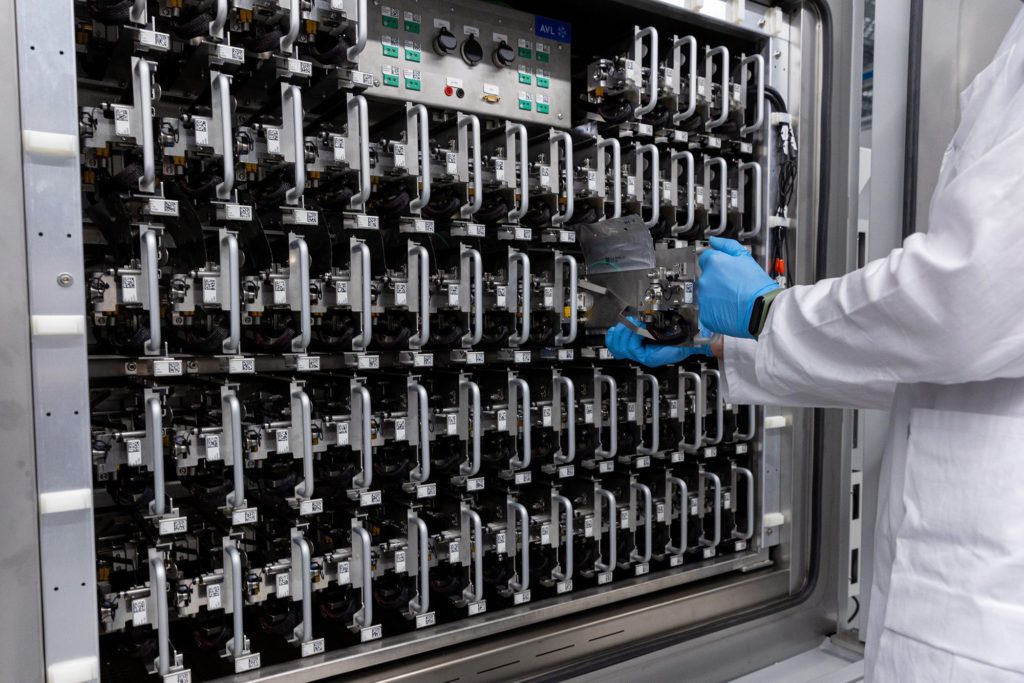
The goal would be to ease a coming battery shortage by supplementing suppliers with its own production, De Nysschen said in an interview at the company’s new battery testing lab in Chattanooga, Tennessee. The board was still weighing the idea, and no final decision had been made, he added.

A business delegation including VW Chief Executive Officer Herbert Diess is traveling with Scholz on his Canada trip, his first there since he took office at the end of last year. Diess, who will be replaced as CEO on Sept. 1, said last month that the company was looking at sites for a US battery facility that would supply packs to its auto plant in Chattanooga.

Scholz will hold several meetings with Trudeau as the Group of Seven and NATO partners move to deepen cooperation in areas including energy and security.

The German leader, who is also accompanied by Economy Minister Robert Habeck, wants to enlist Canada to help Europe’s biggest economy reduce its reliance on Russia for energy and raw materials.

Canada “has similar rich natural resources as Russia — with the difference that it is a reliable democracy,” Scholz told reporters during the flight over.

“This opens up new fields of cooperation,” he added. “We want to cooperate closely, especially when it comes to building a hydrogen economy.”

(Updates with Scholz comment in third paragraph.)

More stories like this are available on bloomberg.com

©2022 Bloomberg L.P.

Pfizer Files Application for Booster Against Latest Variants

(Bloomberg) — Pfizer Inc. and BioNTech SE asked the US to authorize a new Covid booster shot customized against the currently circulating Covid variants as governments race to protect their populations against the ever-mutating virus.

In a statement, the companies said they had “rapidly scaled production” for the new booster and would be able to ship doses of the new vaccine “immediately” upon emergency authorization. The new shot contains mRNA for the original Covid spike protein, as well as mRNA for the BA.4/BA.5 subvariants of omicron. Currently BA.5, a newer evolution of omicron, is by far the dominant variant circulating in the US. 

Pfizer’s new booster that’s up for authorization in the US hasn’t yet been tested in people in a clinical trial, though the company said it will start this month. It’s all part of a push to use mRNA technology, which allows for faster drug development, to respond more quickly to changes in the virus and better guard against future Covid surges. The virus has mutated so quickly, it has been hard for government and drug companies to keep up.

Both Pfizer and its rival Moderna Inc. had originally developed and tested boosters containing the original omicron strain. Last week the UK authorized an omicron-specific booster from Moderna that targets that variant, which emerged in the fall and caused waves of cases around the world.

As new omicron subvariants continued to emerge, US regulators in late June advised vaccine manufacturers to develop Covid-19 boosters that include components targeting the newer mutations.

The US Food and Drug Administration’s decision came after a panel of experts overwhelmingly voted in favor of updating the vaccine boosters in response to the evolving virus. That paved the way for manufacturers, including Pfizer and Moderna, to incorporate BA.4/BA.5 elements into booster doses.

Pfizer’s application to the FDA includes data from its human trials of the original omicron BA.1 booster, along with lab and manufacturing data from its bivalent vaccine targeting BA.4/BA.5. 

The US Food and Drug Administration didn’t immediately respond to a request for comment.

A conditional marketing authorization application for Pfizer’s new shot has also been initiated in Europe, the companies said. The shot is intended for use in individuals 12 and older, Pfizer said. 

(Updates with details of boosters starting in third paragraph.)

More stories like this are available on bloomberg.com

©2022 Bloomberg L.P.
Stocks Keep Getting Hit as 10-Year Yield Tops 3%: Markets Wrap

(Bloomberg) — A sobering tone took over Wall Street after a rally that added $7 trillion to the stock market, with traders bracing for hawkish rhetoric from Federal Reserve officials at the Jackson Hole retreat later this week.

Equities pushed toward their worst two-day rout since June, following a surge that drove the S&P 500 to its best start to a third quarter since 1932. Tech shares underperformed as Treasury 10-year yields topped 3% for the first time in a month. The Cboe Volatility Index, or VIX, soared. The move away from risky assets spurred further unraveling of the recent meme-stock frenzy. As the dollar rose, the euro succumbed to its lowest in two decades.

Jerome Powell’s speech on Friday will mark the highlight of the prestigious event in Wyoming’s Grand Teton mountains, which has been used by Fed chairs as a venue for making key policy announcements. He’s expected to reiterate the central bank’s resolve to keep raising rates to get inflation under control, but will probably stop short of signaling how big officials will go when they meet next month.

“He may try to send a clear message that even if they have a slower pace of rate hikes, that won’t signal a lower peak rate or that they will be quick to cut rates,” wrote Ed Moya, senior market analyst at Oanda. “After this week, Wall Street should not be surprised if Fed fund futures start pricing in rate hikes for next year. This could be the week many return from vacation and double-down on their bear-market rally calls.” 

Hedge funds are unleashing record bets that the Fed will stick to its tightening script — as they rapidly position for higher interest rates in a key corner of the derivatives market. The cohort have placed a big short across futures referencing the official successor to Libor known as the Secured Overnight Financing Rate — which stand to benefit should Powell effectively rule out a dovish pivot.

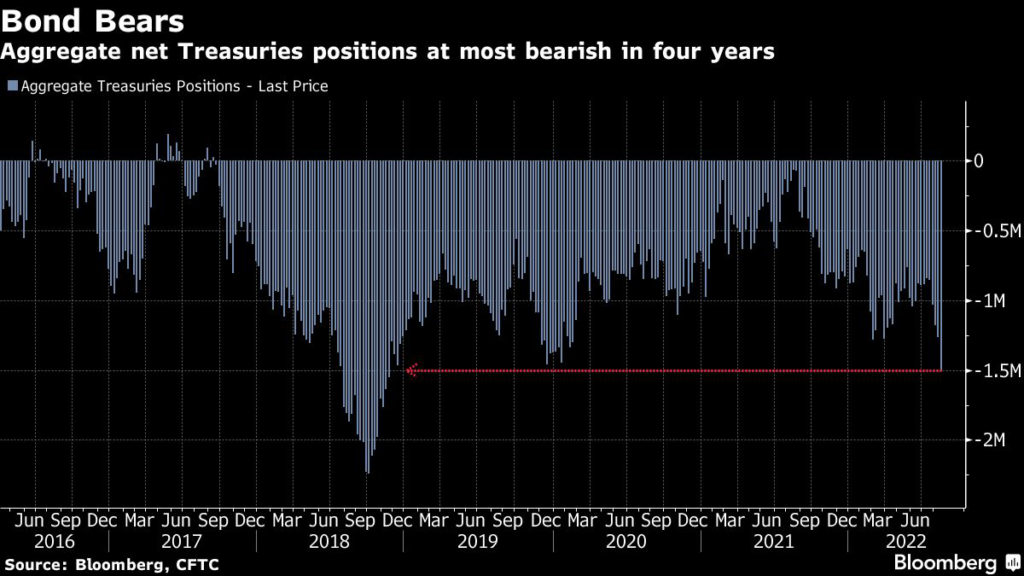
Meantime, bond bears are growing in confidence, taking heed of relentless messaging from Fed officials that the fight against inflation is nowhere near done. An aggregate gauge of net-short non-commercial positions across all Treasury maturities shows bearish bets have grown to the most since 2018, according to the latest data from the Commodity Futures Trading Commission.

Investors are also waking up to the looming acceleration of the Fed’s balance-sheet reduction. So-called quantitative tightening kicks into top gear next month, and will add to pressure on riskier assets which have benefited from ample liquidity. Strategists at Bank of America Corp. believe that the winding down of the central bank’s balance sheet could translate into a 7% hit to the S&P 500 next year, according to a note last week.

Read: Morgan Stanley’s Sheets Favors Cash as Bears Circle Equities

“With real rates still rising and prospects for 2023 rate cuts fading in the bond market, stock valuations look extremely stretched, especially if as we suspect, policy-driven economic slowing will prove an obstacle to currently optimistic 2023 earnings estimates,” Lisa Shalett, chief investment officer at Morgan Stanley Wealth Management, said in a note. “Stocks are overbought. Sit it out for now.”

Stocks and bonds are set to tumble once more even though inflation has likely peaked, according to the latest MLIV Pulse survey, as rate hikes reawaken the great 2022 selloff. Ahead of the Jackson Hole symposium, 68% of respondents see the most destabilizing era of price pressures in decades eroding corporate margins and sending equities lower.

As investors sought haven in the greenback, gold dropped for a sixth day. A stronger dollar and higher bond yields are bad for bullion as it pays no interest and is priced in the US currency. Oil slumped on the potential of more Iranian barrels entering the market alongside an expected slowdown in crude demand.

What to watch this week:

  • US new home sales, S&P Global PMIs, Tuesday
  • Minneapolis Fed President Neel Kashkari speaks at a Q&A session, Tuesday
  • US durable goods, MBA mortgage applications, pending home sales, Wednesday
  • US GDP, initial jobless claims, Thursday
  • Kansas City Fed hosts its annual economic policy symposium in Jackson Hole, Wyoming, Thursday
  • ECB’s July minutes, Thursday
  • Fed Chair Powell speaks at Jackson Hole, Friday
  • US personal income, PCE deflator, University of Michigan consumer sentiment, Friday

Some of the main moves in markets:

Stocks

  • The S&P 500 fell 1.6% as of 11:51 a.m. New York time
  • The Nasdaq 100 fell 2.1%
  • The Dow Jones Industrial Average fell 1.3%
  • The Stoxx Europe 600 fell 1%
  • The MSCI World index fell 1.5%

Currencies

  • The Bloomberg Dollar Spot Index rose 0.6%
  • The euro fell 1% to $0.9934
  • The British pound fell 0.7% to $1.1748
  • The Japanese yen fell 0.5% to 137.60 per dollar

Bonds

  • The yield on 10-year Treasuries advanced five basis points to 3.02%
  • Germany’s 10-year yield advanced seven basis points to 1.30%
  • Britain’s 10-year yield advanced 11 basis points to 2.52%

Commodities

  • West Texas Intermediate crude fell 0.9% to $89.92 a barrel
  • Gold futures fell 0.8% to $1,749.40 an ounce

More stories like this are available on bloomberg.com

©2022 Bloomberg L.P.
Pimco, Capital Group Say Low-Inflation Era Is Gone for Good

(Bloomberg) — Some of the world’s biggest bond investors say the market is wrong to expect central banks to score a long-term win in the war against inflation.

There’s little doubt that interest-rate hikes from policy makers in the US and Europe will pull consumer-price increases down from the fastest pace in decades by slowing economic growth or setting off recessions. 

But the retreat of inflation from its peak isn’t likely to mark a return to the price stability of the recent past because of stark shifts in the world economy, according to a broad group of investors and strategists at firms including Pacific Investment Management Co., Capital Group and Union Investment. 

During the period of expanding globalization, cheap commodities and low labor costs helped keep inflation at bay. Now, that’s starting to reverse. Oil and gas prices are elevated as nations sever ties with Russia over the Ukraine war. Businesses are weighing political tensions while rebuilding frayed supply chains. And tight labor markets are giving workers the power to push for higher pay.

That has money managers who oversee trillions of dollars bracing for inflation to hold well above the roughly 2% level targeted by major central banks. To guard against that risk, they have been buying inflation-protected bonds, boosting exposure to commodities and expanding cash holdings instead of plowing it directly into bonds, wagering that consumer-price increases won’t quickly pull back to levels seen in recent decades. 

“The last twenty years of the great moderation — that’s fully behind us now,” said Tiffany Wilding, North American economist at Pimco, which had about $1.8 trillion under management at the end of June. She anticipates a period of highly volatile inflation as the world adjusts to changes that will “lead to higher input costs in general that should result in a multi-year price level adjustment.”

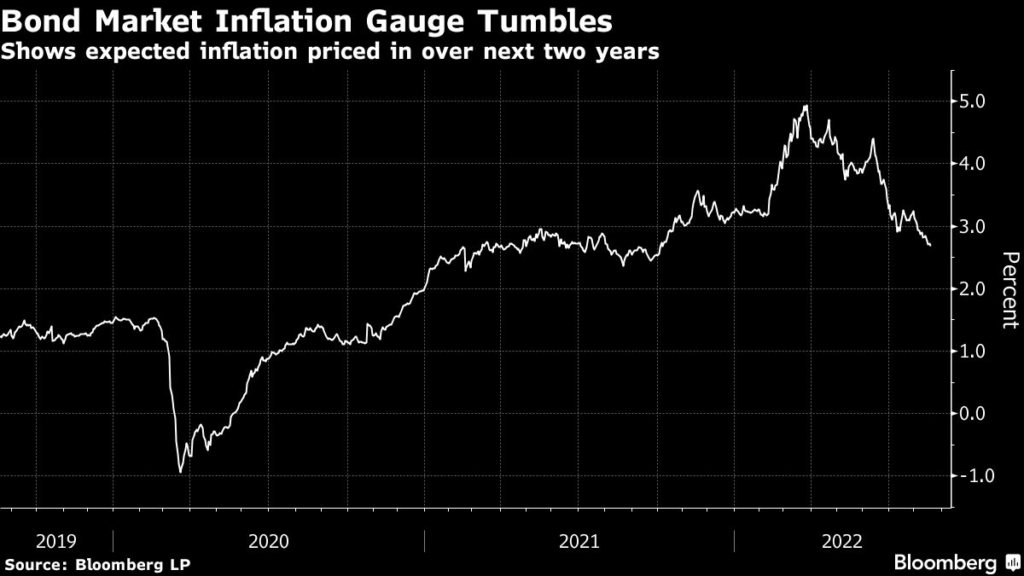
The views contrast with speculation that price pressures will ease so much that the Federal Reserve may start cutting interest rates next year to jump-start economic growth. While benchmark 10-year Treasury yields have risen recently to push slightly over 3%, that’s still nearly half a percentage point below the mid-June peak. And a bond-market proxy of US inflation expectations over the next two years has been cut nearly in half since March to about 2.7%, not all that far above the 1.9% average increase in a broad price gauge in the 20 years before the pandemic.

Both policy makers and markets have been surprised by how stubbornly high inflation has been, since it was initially thought to be a temporary side effect of the pandemic that would fade once economies reopened. On Wednesday, the UK reported that consumer prices increased at a faster-than-expected pace of 10.1% in July, the most since 1982. That surprised traders, who dumped 2-year government bonds, triggering a steep jump in yields. 

“The view in the market that central banks will be in a position to cut rates in a number of countries will be challenged in due course,” Ivailo Vesselinov, chief strategist at Emso Asset Management, who expects the yields on slightly longer dated bonds to jump as the realization that inflation will be more persistent sinks in.

No one expects current levels of inflation to last, making the debate about whether it has crested yet or not beside the point. The key question is what economies are facing over the next three to five years, when many investors are expecting repeated flare-ups in price pressures akin those during the geopolitical turmoil of the 1970s.

Among the major reasons is the expectation that trade tensions, high energy prices and a tight labor market that’s putting upward pressure on wages may not dissipate soon. In Europe, the challenge is all the greater given the region’s dependence on Russian energy supplies, while the ECB also has to keep in mind the implications of monetary policy for 19 disparate economies. 

Still, while policy makers across geographies have repeatedly emphasized that they will keep tightening policy until inflation is contained, it’s possible they could pivot in the face of a deep slowdown. Fed officials acknowledged there was a risk that they could tighten more than necessary to restore price stability in the minutes of the July 26-27 meeting. 

Fed Years Away From Hitting Inflation Target: MLIV Pulse Results

Union Investment’s Michael Herzum, the head of macro and strategy, sees a risk that the Fed will stop hiking rates prematurely, only to start doing so again once inflation roars back.

“Looking at growth and not just inflation is a very risky game because the structural trend we had since the mid-1980s — the disinflationary trend — is turning,” he said.

Flavio Carpenzano, investment director at Capital Group in London, said tight labor markets worldwide mean that the Fed has to induce a large recession and a higher unemployment rate to get inflation to go down sharply. 

His team seized on the July rally to cut holdings of US debt most sensitive to interest-rate hikes and see China as attractive from a fixed-income perspective because inflation there is less of a concern.

“We see the slowdown in inflation occurring at a much slower pace than what the market is expecting,” said Carpenzano, whose firm managed some $2.7 trillion at the end of last year. He said the market is off in pricing that the Fed will cut rates in mid-2023. “Inflation is by no means a solved puzzle and the Fed will continue to be vigilant.”

Another factor: companies are weighing increased political tensions as they rebuild supply chains roiled by the pandemic. That may weaken the power of a long-running disinflationary force: the moving of jobs to low-wage countries. In the US, President Joe Biden signed a $52 billion measure to spur semiconductor manufacturing in the country. His Treasury Secretary, Janet Yellen, has also promoted the concept of “friend-shoring,” or diversifying supply chains among allied countries to protect against disruption. 

“It will take years to rebuild the trade networks and supply chains,” said Glen Capelo, managing director at Mischler Financial. 

“Deglobalization is here to stay,” he said. “This will all be inflationary. And this structural inflation is something the Fed can’t fight with higher rates.” 

(Updates yield levels.)

More stories like this are available on bloomberg.com

©2022 Bloomberg L.P.

Pfizer Files Application for Shot Against Latest Omicron Strains

(Bloomberg) — Pfizer Inc. and BioNTech SE said they asked the US to authorize a new Covid booster shot customized against the BA.4 and BA.5 variants.

In a statement, the companies said they had “rapidly scaled production” for the new booster and would be able to ship doses of the bivalent vaccine “immediately” upon emergency authorization. The new bivalent vaccine contains mRNA encoding the original Covid spike protein, as well as mRNA for the spike protein of the BA.4/BA.5 subvariants, which are currently dominant. 

A conditional marketing authorization application has also been initiated in Europe, the companies said. The shot is intended for use in individuals 12 and older, Pfizer said. 

More stories like this are available on bloomberg.com

©2022 Bloomberg L.P.

Indian Ocean Off Somalia to Lose ‘High-Risk Area’ Designation as Piracy Dips

(Bloomberg) — The global shipping industry agreed to declassify the Indian Ocean coastline off Somalia as a “high-risk area” following years of successful counter-piracy operations.

The change was approved by marine groups including the International Chamber of Shipping and will be operational from January next year, they said in an emailed statement on Monday.

“No piracy attacks against merchant ships have occurred off Somalia since 2018,” according to the statement.

For more than a decade, pirates from Somalia launched hundreds of attacks on commercial vessels in East African waters, in some cases earning millions of dollars in ransom and forcing shipping companies to adopt security measures such as employing armed guards and installing barbed wire. The dangers were depicted in the 2013 Oscar-nominated movie Captain Phillips, starring Tom Hanks.

International navies and a European Union anti-piracy task force have in recent years managed to crack down on pirates by patrolling waters with armed vessels and using satellite imagery. The seas off West Africa have become more dangerous, with piracy having surged over the past decade.

More stories like this are available on bloomberg.com

©2022 Bloomberg L.P.

Close Bitnami banner
Bitnami
