Bloomberg

Twitter to Give Companies More Control Over Ads, Reuters Says

(Bloomberg) — Twitter Inc. will introduce new controls that allow companies to prevent their ads from appearing above or below tweets containing certain keywords, Reuters reported, an attempt to attract more advertisers back to the platform.

Since Elon Musk’s takeover of Twitter, a string of companies have suspended advertising on the social-media service, including General Mills Inc. and Pfizer Inc. Twitter told advertisers in an email on Thursday that the new tools will be rolled out as soon as next week, Reuters said.

Musk has been trying to bring back advertisers alienated by a reported increase in hate speech and other harmful content since he acquired the platform. Two House Democrats said this week they want Musk to outline what he’s doing in response.

Musk, who has said his goal is to make the social media platform a forum for free speech, has cut more than half of Twitter’s workforce and more have resigned, complicating the company’s efforts to police harmful speech on the site. He’s also restored many users who had been previously suspended for violating policies. He’s also claimed that hate speech has lost traction on Twitter.

A Twitter representative told advertisers it was considering bringing its content moderators in-house, to expand its non-English moderation operations, Reuters said. Twitter didn’t immediately respond to Reuters’ request for comment.

Earlier this week, Musk said Apple Inc. has “fully resumed” advertising on Twitter, further de-escalating a brewing war between two of the world’s most influential tech companies.

Read more: Musk’s Threats Toward Apple Jeopardize Ties With Top Advertiser

Twitter plans to start rolling out its Twitter Blue subscription service on Friday, Reuters said. It’ll cost $7 a month on the web and $11 a month on Apple devices, it said.

More stories like this are available on bloomberg.com

©2022 Bloomberg L.P.

Toshiba Rises After Report Bidder Closer to Securing Financing

(Bloomberg) — Toshiba Corp. climbed after Reuters reported that the company’s preferred bidder is closer to getting financing from banks.

Shares jumped as much as 4.5%, heading for the biggest gain since October, after the report said lenders have become more confident in the post-acquisition plans of the bidding group led by Japan Industrial Partners Inc.

The report, which cited people familiar with the matter, noted that banks haven’t decided how much financing each lender will take on. Toshiba, JIP and the banks declined to comment, Reuters said.

Toshiba has been exploring options for its future including going private. Bloomberg News reported last month that a potential buyout led by JIP was taking longer than anticipated as banks hadn’t yet decided whether to extend loans.

More stories like this are available on bloomberg.com

©2022 Bloomberg L.P.

SpaceX Rocket Launches With Rival OneWeb Satellites On Board

(Bloomberg) — SpaceX successfully launched 40 satellites for competing communications company OneWeb on Thursday.

It’s the first of three planned missions the unlikely collaborators are set to perform over the coming months despite their separate efforts to build megaconstellations that will beam broadband Internet coverage to Earth.

OneWeb, which is building an initial constellation of 648 satellites in low Earth Orbit, had originally contracted to launch all of the company’s satellites on Russian Soyuz rockets. But after Russia’s invasion of Ukraine in February, then-head of Russia’s state space corporation Roscosmos, Dmitry Rogozin, vowed not to launch the remaining satellites unless OneWeb promised not to use the spacecraft for military purposes. He further required that the British government divested its stake in the company. 

At the time, a Russian Soyuz rocket was on the launchpad in Kazakhstan preparing to launch the latest batch of OneWeb satellites. OneWeb and its stakeholders refused to agree to the demands. Ultimately, Roscosmos decided to roll back the rocket, a move that cost OneWeb $230 million and sent them searching for new launch providers.

“I was confident actually earlier this year that we would find a way to recommence launches,” Neil Masterson, OneWeb’s CEO, told Bloomberg. “And I thought that we would find a way to do something with SpaceX.”

OneWeb secured launch agreements with SpaceX, the Indian Space Research Organization (ISRO), and startup Relativity. Thursday’s launch, which took off at 5:27p.m. local time from Florida, brings OneWeb’s total satellites in orbit to 502, which gets the company to 80% coverage of the world, according to Masterson. OneWeb’s next two dedicated launches with SpaceX are planned through the spring of next year, in addition to another launch with ISRO. Masterson says those missions will get OneWeb close to its full constellation, giving the company global coverage. There will also be another rideshare mission with SpaceX that will include Iridium satellites.

The size of OneWeb’s constellation pales in comparison to that of SpaceX, which has launched more than 3,500 satellites into orbit so far. Both companies have started rolling out services to customers, with OneWeb providing coverage in Alaska, Canada, Greenland, and Britain. OneWeb also recently agreed to a $3.4 billion merger with Eutelsat, with plans to launch a second generation of less expensive, but more advanced satellites after the first constellation is complete.

Masterson acknowledges there will be some overlap between OneWeb’s customer base and SpaceX’s, but he sees the two constellations as different kinds of products. Terms of the deal between the two companies are confidential.

“It’s such a big market growing so quickly, there’s certainly room for the both of us, where we do compete. And in many cases, I think our services are highly complementary, actually,” Masterson said. 

More stories like this are available on bloomberg.com

©2022 Bloomberg L.P.

FTC Says Microsoft Plans to Keep Elder Scrolls VI Game Exclusively

(Bloomberg) — The Federal Trade Commission said that video game publisher ZeniMax Media’s highly anticipated Elder Scrolls VI will be exclusive to Microsoft Corp. products.

The revelation came in the FTC’s complaint to block Microsoft’s $69 billion acquisition of Activision Blizzard Inc., which cited the Xbox maker’s decision to make ZeniMax content exclusive after receiving European Commission approval for it’s 2020 purchase of ZeniMax as an example of past anticompetitive behavior. 

After the $7.5 billion transaction cleared, Microsoft announced its decision to make future Zenimax titles — including Starfield and Redfall, both slated to release in 2023 — exclusive to Xbox consoles, Windows PCs and Xbox Game Pass subscribers. 

At the time, Microsoft head of gaming Phil Spencer implied that Elder Scrolls VI, which will follow the critically-acclaimed Skyrim, would be exclusive to the Xbox ecosystem, but gamers were skeptical. Skyrim, the latest in the Elder Scrolls series has sold more than 30 million copies across most platforms, making it among the top-selling games of all time.  

Spencer told GQ after the acquisition, “It’s not about punishing any other platform, like I fundamentally believe all of the platforms can continue to grow,” he said. “But in order to be on Xbox, I want us to be able to bring the full complete package of what we have. And that would be true when I think about Elder Scrolls VI. That would be true when I think about any of our franchises.”

Microsoft had no immediate comment on Thursday. The shares gained 1.24% in New York on Thursday.


–With assistance from Dina Bass.

(updates with shares in final paragraph.)

More stories like this are available on bloomberg.com

©2022 Bloomberg L.P.

Trump Among Five Targets as Jan. 6 Panel Weighs Criminal Referrals

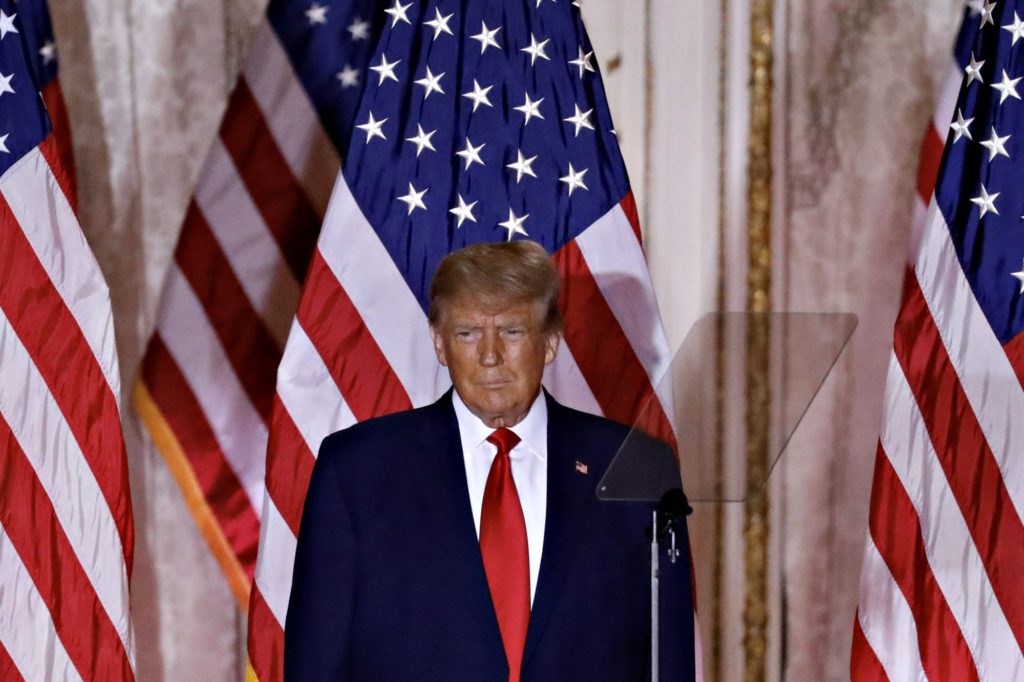
(Bloomberg) — The House Jan. 6 committee is considering criminal referrals against former President Donald Trump, his chief of staff Mark Meadows and at least three other key allies involved in his efforts to overturn the 2020 election, a person familiar with the matter said Thursday.

Those referrals are being suggested by a subcommittee of the panel and have not officially been approved by the full committee. They also include unofficial former Trump legal adviser John Eastman, Trump’s former lawyer and ex-New York mayor Rudy Giuliani, and former Justice Department official Jeffrey Clark.

The person, who asked not to be identified discussing information not yet made public by the panel, didn’t specify what criminal counts might be referred against Trump and the other four. It wasn’t clear whether others might be targeted for referrals. 

Representatives for each of the five men didn’t immediately reply to requests for comment. CNN earlier reported on the potential referrals.

Such referrals would be recommendations that aren’t legally binding on the Department of Justice or other agencies to follow through on.

Weekend Meeting

Representative Bennie Thompson, the Mississippi Democrat who chairs the committee, said members plans to meet virtually over the weekend and he expects decisions to be made then. 

Representative Jamie Raskin, a Maryland Democrat on the committee and on the subcommittee considering referrals, refused to reveal targets being considered. But, he told reporters at the US Capitol, “We want to make sure no one slips through the cracks.”

“We want to make sure that the key organizers and movers of this attack don’t escape the scrutiny of the justice system,” Raskin said. “I think anyone who engages in criminal actions needs to be held accountable for them and we’re going to spell that out.”

Thompson also declined to comment Thursday on whom the committee might recommend charges against. He also said that it’s considering action against fellow members of Congress, though not necessarily criminal referrals. 

That could include referrals to the ethics committee, or state bar associations or civil suits.

The panel is working to complete a final report on last year’s assault on the Capitol by Trump supporters, who were seeking to prevent the certification of Joe Biden’s victory in the 2020 presidential election. It tentatively plans to release the report on Dec. 21.

The committee has focused on Clark’s role during the end of the Trump administration within the Justice Department, in conjunction with efforts by Eastman, Giuliani and Meadows, to persuade Georgia and other states to use “fake electors” for Trump, instead of electors that provided Biden with victories.

There have been public indications the Justice Department is already well under way in its own scrutiny of Clark. His mobile phone and other electronic equipment were seized by federal agents in a June search of his home.

The committee claimed in a legal filing in March in federal court in Santa Ana, California, that “evidence and information available to the committee establishes a good-faith belief that Mr. Trump and others may have engaged in criminal and/or fraudulent acts” and that Eastman’s “legal assistance was used in furtherance of those activities.” 

Judge David O. Carter of the Central District of California later issued a finding in March that, “Based on the evidence, the Court finds it more likely than not that President Trump corruptly attempted to obstruct the Joint Session of Congress on January 6, 2021.”

He also found that Trump, Eastman and others “entered into an agreement to defraud the United States by interfering with the election certification process,” and that Trump and members of his campaign “engaged in common law fraud in connection with their efforts to overturn the 2020 election results.”

His findings were not binding.

The House also has previously voted to hold Meadows in criminal contempt of Congress for his refusal to adequately comply with a committee subpoena, and it referred the matter to the Department of Justice for prosecution. But the DOJ declined to do so.

(Updates with details throughout.)

More stories like this are available on bloomberg.com

©2022 Bloomberg L.P.

FTC Votes to File Suit to Block Microsoft’s $69 Billion Activision Deal

(Bloomberg) — The US Federal Trade Commission is seeking to block Microsoft Corp.’s $69 billion acquisition of Activision Blizzard Inc., saying the tie-up between the Xbox maker and popular gaming publisher would harm competition.

The commission voted 3-1 in favor of the complaint, which was filed in its in-house court. Regulators said Microsoft’s ownership of Activision could hurt other players in the $200 billion gaming market by limiting rivals’ access to the company’s biggest games. The transaction would turn Microsoft into the No. 3 gaming company, behind Tencent Holdings Ltd. and Sony Group Corp. 

“Microsoft has already shown that it can and will withhold content from its gaming rivals,” said Holly Vedova, director of the FTC’s Bureau of Competition. “Today we seek to stop Microsoft from gaining control over a leading independent game studio and using it to harm competition in multiple dynamic and fast-growing gaming markets.”

An FTC official, speaking anonymously to discuss the complaint, said the agency was concerned that Microsoft could deny access, delay availability or degrade the quality of Activision Blizzard’s most popular titles to rival platforms. Those concerns relate not only to consoles, but also to subscription services and cloud-based gaming, two markets still in development, the official said. 

Microsoft’s proposed Activision Blizzard deal is the company’s largest ever and one of the 30 biggest acquisitions of all time. The transaction would give Microsoft some of the most popular video game franchises, such as Call of Duty and World of Warcraft. The Xbox maker already owns the Halo franchise and Minecraft virtual-world-building game.

“We continue to believe that this deal will expand competition and create more opportunities for gamers and game developers,” said Microsoft President Brad Smith. He said the company is committed to addressing competition concerns and that it offered concessions to the FTC earlier this week. 

“We have complete confidence in our case and welcome the opportunity to present our case in court,” Smith added.

Activision shares fell 1.5% to $74.76 after falling as much as 3.9% earlier. Microsoft shares rose 1.2% to $247.40.

In a letter, Activision Blizzard Chief Executive Officer Bobby Kotick assured employees he is confident that the deal will close. 

“The allegations that this deal is anti-competitive doesn’t align with the facts, and we believe we’ll win this challenge,” Kotick said, adding that the combined company would be “good for players,” despite a regulatory environment that he says is “focused on ideology and misconceptions about the tech industry.”

The FTC scheduled its in-house trial to begin on August 2, 2023. In prior merger challenges in the agency’s in-house court, the judge issued an initial decision between seven and 12 months after the trial began, said Jennifer Rie, an analyst for Bloomberg Intelligence. That would likely put a decision by FTC Administrative Law Judge D. Michael Chappell in early 2024. After that, Microsoft or the FTC staff litigating the case can appeal his ruling to the agency’s commissioners.

Microsoft and Activision have said the deal will close by June 30, the end of Microsoft’s current fiscal year. The FTC would need to separately sue in federal court if it wants Microsoft to put off closing the deal until after the trial is over.

“With control of Activision’s content, Microsoft would have the ability and increased incentive to withhold or degrade Activision’s content in ways that substantially lessen competition — including competition on product quality, price, and innovation,” the agency said in its complaint. “This loss of competition would likely result in significant harm to consumers in multiple markets at a pivotal time for the industry.”

In its release announcing the lawsuit, the FTC cited Microsoft’s decision to make two upcoming titles by newly acquired unit Bethesda Softworks exclusive to Microsoft’s platforms despite assurances the company gave to EU regulators that it had no incentive to withhold games from rival consoles.

The lawsuit is part of an effort by FTC Chair Lina Khan to more aggressively police mergers, particularly those by the biggest tech platforms. Since President Joe Biden appointed her to helm the agency in June 2021, it has killed mergers between Lockheed Martin Corp. and Aerojet Rocketdyne Holdings Inc. as well as Nvidia Corp.’s bid to buy SoftBank Group Corp.’s Arm. The FTC heads to federal court Thursday in San Jose, California, in an effort to block Meta Platforms Inc. from buying a virtual reality startup. 

Although Brazilian antitrust officials cleared the Microsoft-Activision deal in October, other competition regulators, including the UK and the European Union, have also raised concerns. Those two bodies aren’t set to issue decisions on the deal until next year.

Microsoft on Tuesday announced a deal to bring Call of Duty to the Steam PC gaming platform and Nintendo Co. consoles. The company said it’s also offered a proposal that would keep Call of Duty on Sony’s PlayStation for the next 10 years, but the Japanese electronics giant has so far rebuffed efforts to work out a resolution. Sony has fiercely objected to the Activision acquisition, primarily because of concerns the US tech giant could make content like Call of Duty exclusive to its own gaming services.

“There’s been one game industry participant that’s really been raising all the objections, and that’s Sony, and they’ve been fairly public about the things that don’t meet their expectations,” Xbox chief Phil Spencer said in an interview Tuesday. “From where we sit, it’s clear they’re spending more time with the regulators than they are with us to try and get this deal done.”

Joost van Dreunen, a video games expert who teaches at New York University’s Stern School of Business, said antitrust authorities have become skeptical of pledges, particularly by the tech platforms, about future behavior. Van Dreunen provided comments on the deal to UK competition officials.

“I don’t think it’s ultimately enough for the FTC to go on,” van Dreunen said of Microsoft’s pledge.

The Redmond, Washington, tech giant sought to placate possible labor concerns about the merger by reaching an agreement with the Communications Workers of America, which also represents employees in the gaming industry. In the pact, Microsoft pledged to take a neutral approach if employees express interest in joining a union. 

The company also said it would stop using noncompete or confidentiality clauses to bar workers from talking about discrimination or harassment as part of a settlement or separation deal. The FTC has publicly raised concerns about the use of noncompetes and the impact of mergers on labor conditions.

(Updates with details on trial schedule from 11th paragraph.)

More stories like this are available on bloomberg.com

©2022 Bloomberg L.P.

Broadcom Forecast Signals Strong Corporate Tech Spending

(Bloomberg) — Chipmaker Broadcom Inc. gave an upbeat sales forecast for the current period, indicating that demand remains strong from corporate customers and the data center industry.

Revenue in the fiscal first quarter will be about $8.9 billion, Broadcom said in a statement Thursday, compared with an average analyst estimate of $8.8 billion. The company declined to give full-year guidance for fiscal 2023, citing economic conditions.

The shares rose as much as 3.6% to $550 in late trading after the earnings report was released. Though the stock was down 20% in 2022 through the close, that’s significantly better than the performance of most chip peers this year.

The forecast continues a run of Broadcom outperforming the broader chip industry. Chief Executive Officer Hock Tan’s choice of end markets — such as making key components for Apple Inc.’s iPhone and the chips used in Amazon.com Inc. data centers — has helped insulated the company from a sharp slowdown elsewhere. 

Broadcom, based in San Jose, California, also has branched out into enterprise software by acquiring security and mainframe capabilities. And it’s trying to extend that diversification with a $61 billion purchase of VMware Inc. in a transaction announced in May. During Broadcom’s earnings call, Tan said that the company is making progress with regulators and still expects the merger to close in fiscal 2023.

In the fourth quarter, which ended Oct. 30, Broadcom’s profit was $10.45 a share, excluding some items. Revenue rose to $8.93 billion. Analysts had predicted earnings of $10.25 a share and sales of $8.9 billion.

Broadcom’s report was more positive than that of rival Marvell Technology Inc., which raised concerns about slowing demand from data center owners and a weak Chinese market. 

Read more: Marvell sinks after forecast hints at widening slump

During Broadcom’s call, the company said it expects the wireless unit, which has Apple as the top customer, to grow by a low-single-digit percentage in the first quarter.

Tan has predicted that the chip market overall will decelerate to historical growth rates of about 5% or less. That’s well below more than 20% that the company achieved in 2021 and 2022, but in line with what analysts are predicting for Broadcom for 2023.

Tan said that the server storage unit would see revenue grow by more than 50%, but that the company is seeing a slowdown in its industrial segment. He added that softness will be mostly apparent in China, where product consumption has ebbed. He added, though, that it’s unclear if the Covid lockdowns in the region will have an impact beyond the first quarter.

(Updated with remarks from earnings call starting in fifth paragraph.)

More stories like this are available on bloomberg.com

©2022 Bloomberg L.P.

Top China Fund Bullish on State Firms as Valuations Improve

(Bloomberg) — A top-performing Chinese private fund is wagering that a recent surge in state-owned enterprises could continue in 2023, buoyed by a catchphrase coined by regulators that’s triggered optimism in the long-unloved cohort.  

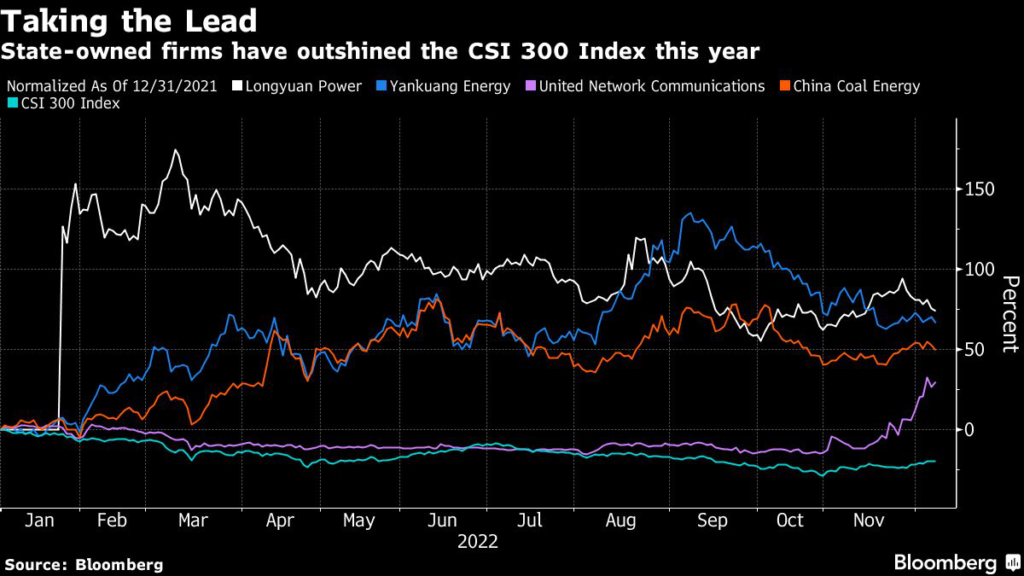
Investors have shunned SOEs for years, given their reputation for low efficiency and greater focus on social goals over profits. Their shares outperformed, however, during November’s rally thanks to a new slogan “valuation system with Chinese characteristics,” which spurred a debate on whether the cohort had been given unjust discounts.

China has a sprawling array of state-owned firms that it uses as a vehicle to implement policy changes, provide stability and build infrastructure. SOEs are among the nation’s biggest companies, with the central government overseeing a total of 98 including PetroChina Co. and Air China Ltd. 

The valuation gap between SOEs and the broader market should narrow after “appalling and unreasonable” declines, said Wang Wen, investing consultant at Shenzhen Ridou Investment Management Co. Regulators’ recent stance on such firms “is meant to undo prejudices and restore logic.” 

The firm’s flagship product, the Ridou Qianniu Value No.1 fund, is up 58% this year as of Dec. 2, beating 99 percent of its peers, according to fund tracker Shenzhen PaiPaiWang Investment & Management Co. It’s outperformed the benchmark CSI 300 Index, which dropped nearly 22% in the same period.

Wang, who offers stock picking advice to Ridou, said the 4 billion yuan ($572 million) asset manager is paying special attention to the slogan devised by China’s securities chief Yi Huiman last month.

“The phrase clearly shows the attitude from authorities, giving a timely direction for markets,” said Wang, who formerly worked for the government. “The surge is definitely more than just hype and could be a main theme going forward.”  

The catchphrase also chimes well with Ridou’s preference for firms with high dividends and low valuations. Its flagship fund owes its 2022 returns to bets on coal and telecommunication shares, sectors widely dominated by state-affiliated companies. 

Even after a recent buying frenzy that’s boosted the SSE 50 Index, a large-cap gauge heavy in financials, construction and utilities SOEs, Wang said valuations for the cohort could potentially increase by another 50%. 

Bank of China Ltd. is trading at just 0.5 times book value in Shanghai, while each share of China Communications Construction Co. is worth just over 60% underlying net assets.

Wang believes Yi’s SOE tout doesn’t represent a move away from market-oriented economics, but rather encourages value discovery. The Shanghai bourse recently issued guidelines aimed to help SOEs proactively communicate with investors, increase transparency and guide them in rolling out stock incentive programs. 

Regulators’ supportive messaging on the SOEs, which are market heavyweights, could lift broader equity gauges and benefit investors, Wang added. 

“There’s no time to waste. Investors need to get ready to embrace the good times that are already here, as negatives come to an end,” he said. “We don’t see any pending risks in either liquidity conditions or valuations right now.” 

–With assistance from Lin Zhu.

More stories like this are available on bloomberg.com

©2022 Bloomberg L.P.

FTX Bankruptcy Team Meets With Federal Prosecutors in NY

(Bloomberg) — FTX’s new CEO and bankruptcy lawyers met with Manhattan federal prosecutors investigating the cryptocurrency exchange’s collapse and allegations that it misused billions of dollars in customer funds, according to people familiar with the matter.

John J. Ray III, who was appointed FTX’s chief executive officer last month, met this week with the US attorney’s office for the Southern District of New York. Though details of the meeting weren’t immediately available, it suggests potential overlap between the criminal investigation and bankruptcy probe, which has unearthed FTX’s chaotic corporate governance under founder and former CEO Sam Bankman-Fried. Ray’s team has also raised concerns about the commingling of digital assets between FTX and sister trading house Alameda Research. 

Lawyers for FTX from Sullivan & Cromwell, including former Securities and Exchange Commission enforcement director Steve Peikin and former Manhattan federal prosecutor Nicole Friedlander, were also present at the meeting, the people said. 

A spokesman for the US attorney’s office didn’t respond to requests for comment. FTX declined to comment on the meeting.

Enron Expert

Bankman-Fried resigned before the exchange’s various units filed for bankruptcy protection on Nov. 11. Ray, a restructuring expert who oversaw the liquidation of Enron Corp., has been vocal in his criticism of the lack of controls at FTX. His team is sifting through the wreckage of the company to salvage cash, assets and cryptocurrency to potentially repay creditors and explain how it was left with $8 billion hole in its balance sheet.

Southern District prosecutors, who have a reputation for spearheading complex financial crime probes, have recently been sending voluntary production requests to crypto firms that traded heavily on FTX. Investigators want to know what FTX Group executives, including Bankman-Fried and Alameda CEO Caroline Ellison, told customers about how their funds would be handled. 

The New York Times reported on Wednesday that federal prosecutors are also examining whether Bankman-Fried engaged in market manipulation by orchestrating trades that led to the collapse of TerraUSD (UST) and its affiliated token Luna earlier this year.

Bankman-Fried hasn’t been accused of any crime. In recent media interviews, he has acknowledged managerial missteps at FTX but has claimed he wasn’t aware of any improper use or commingling of customer funds. “I didn’t try to commit fraud on anyone,” he said in an interview during the New York Times DealBook Summit last month.

Bankman-Fried has sought to cast blame on Alameda, which Ellison ran from Hong Kong. In the DealBook interview, he said he was surprised at the scale of margin trading at Alameda, though he added that it “points to another failure of oversight on my part.” 

Bankruptcy proceedings can often be a blessing for prosecutors, offering a source of financial records and potential victim accounts that can be time-consuming to gather otherwise. Prosecutions of executives over the collapses of both Enron and WorldCom followed bankruptcy filings.

–With assistance from Gillian Tan.

(Updates with FTX declining to comment.)

More stories like this are available on bloomberg.com

©2022 Bloomberg L.P.

Meta Says FTC Suit to Block VR Deal has ‘No Real Evidence’

(Bloomberg) — Meta Platforms Inc.’s lawyer said the US antitrust enforcers are pursuing “an aggressive effort to make law with no real evidence” in their suit to block the company from buying a virtual reality startup.

Opening arguments began Thursday in the Federal Trade Commission’s suit to stop Meta’s acquisition of Within Unlimited Inc. because the deal will tamp down future competition in the young VR space. The argument that Meta’s decision to buy —  instead of building its own offering — will lessen the number of potential rivals is one that’s rarely used by the regulator.

“If the FTC’s speculation about what a firm might do would be enough to block an acquisition, every vertical acquisition would be blocked,” Mark Hansen, Meta’s lawyer, argued Thursday before US District Judge Edward Davila in a San Jose, California, courtroom. Such an idea is outside the bounds of the powers Congress has awarded the agency, as well as prior legal precedent, he said.

If the judge halts the deal, Hansen said the move could have a chilling effect on acquisitions in which companies buy businesses they don’t already compete with, which is how Meta says it views this transaction.

“This is the ballgame, this is the case that will decide whether this deal goes forward or dies,” Hansen said.

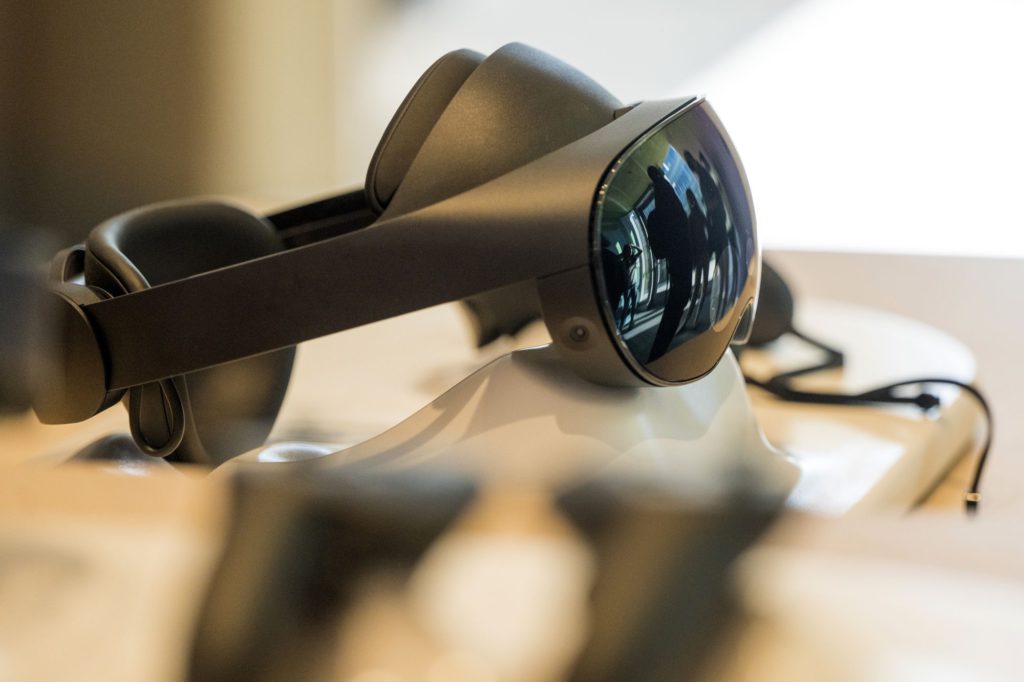
The eight-day hearing will be a major test of Meta’s virtual reality aspirations, which Chief Executive Officer Mark Zuckerberg has said is the future of the company. The effort would help Meta expand beyond social media and give it control over its own platform and app store through its Quest VR headsets. 

The stakes are also high for the FTC. The unique argument is an early test for FTC Chair Lina Khan and her more aggressive stance to antitrust enforcement. Meta announced last October its plan to acquire Within, the maker of the popular virtual reality fitness app Supernatural, for an undisclosed sum. The suit is the first time the FTC has preemptively challenged a deal by Meta, which has bought more than 100 smaller companies over the past decade. Tech companies and investors are closely watching the suit amid concerns the case may make startup acquisitions more difficult.

Separately, the agency said Thursday it would try to stop Microsoft Corp.’s proposed $69 billion acquisition of Activision Blizzard Inc., saying the deal between the Xbox maker and gaming publisher would harm competition.

The FTC, which led the opening statements on Thursday, said its move is an effective enforcement of antitrust laws and would avoid the need to wind down a merger at a later date when a monopoly is current and clear.

The agency expects to demonstrate that the acquisition “would eliminate” Meta’s efforts to build its own VR fitness app, FTC’s lawyer Abby Dennis said, essentially removing a potential rival from the industry. “The basic economic facts of the acquiring company’s overall size, resources, capability and motivation in respect to entry, and that objective evidence is abundant here,” Dennis said.

Dennis said the FTC plans to offer internal Meta presentations citing an effort to build a wholly owned fitness app with existing talent and headcount from acquired companies.

Meta’s CEO had been pushing the company to get into its own fitness party app and the company was in the middle of an exercise to decide between its options when word got around that Apple Inc. was “supposedly” considering an acquisition of Within and its Supernatural app, according to an internal message from Meta’s former gaming executive Michael Verdu to colleagues that the FTC presented as evidence. That news “accelerated everything,” the message said.

Meta’s Hansen contested the idea, saying internal conversations about building a dedicated virtual reality fitness app didn’t go further than a brainstorming exercise because it would’ve been too hard to do.

The FTC also previewed evidence of communication sent by Zuckerberg supporting the idea of a VR fitness partnership between Meta’s VR game Beat Saber and Peloton Interactive Inc., saying, “I’m bullish on fitness. A partnership with Peloton for Beat Saber sounds awesome! I’d love to see that happen.”

To make its case against the Meta-Within deal, the FTC is relying on court cases from the 1970s that antitrust laws can prohibit deals that have an impact on potential competition, said Rebecca Haw Allensworth, an antitrust professor at Vanderbilt Law School.

The FTC wants “to win but they also want to change the law,” said Allensworth. Invoking those old cases “is not desperation. They are trying to return to that.”

–With assistance from Leah Nylen.

More stories like this are available on bloomberg.com

©2022 Bloomberg L.P.

Close Bitnami banner
Bitnami