Bloomberg

Bitcoin Nurses Losses as Momentum Gauge Flashes Price Warning

(Bloomberg) — Bitcoin nursed a four-day drop of about 9%, held back by a bout of risk aversion in global markets on jitters over tightening Federal Reserve monetary policy.

The largest crypto fell as much as 2.7% to $20,906 on Monday, though was back around $21,300 as of 10:08 a.m. New York time. Ether slipped also, and smaller tokens like Avalanche and Cardano lost more than 5%.

Faith in the global equity rebound from June’s bear-market lows is starting to crack in part because of the Fed’s commitment to raising interest rates further and drain liquidity. US and European equities retreated on Monday, keeping the pressure on crypto given the correlation between the two asset classes. 

“Bitcoin’s fortunes, at least in the short to medium term, continue to be hitched to the wagon of other long-duration growth assets such as technology stocks,” Jamie Douglas Coutts, senior market structure analyst at Bloomberg Intelligence, wrote in a note.

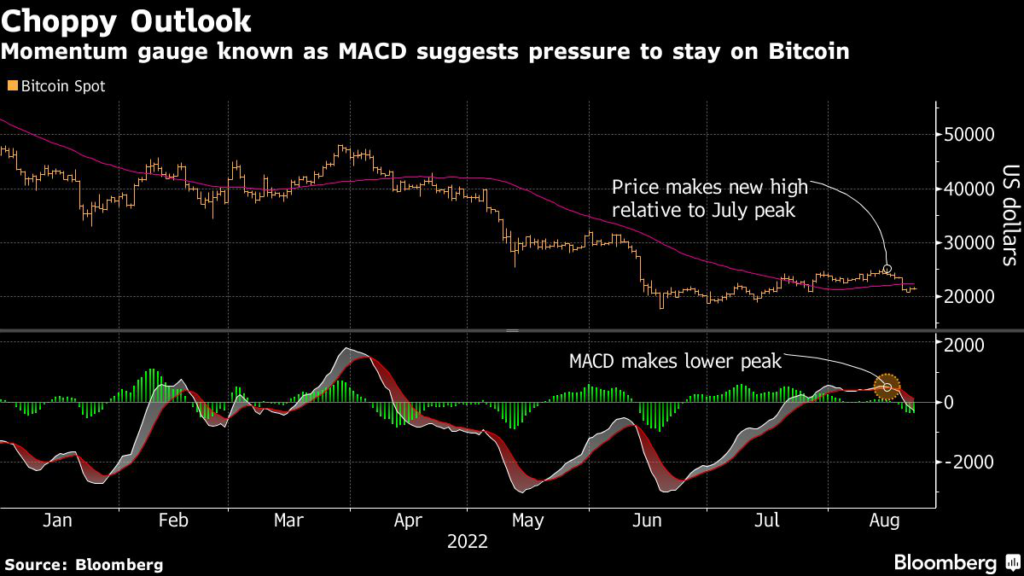
An indicator known as the moving average convergence divergence — MACD — also flashed a warning sign. The MACD has turned negative, which for some technical analysts is a sign Bitcoin may continue to come under pressure. The decline of the past few days has also taken Bitcoin and the MVIS CryptoCompare Digital Assets 100 Index below their 50-day moving averages.

Another headwind for Bitcoin may lie with the US dollar, a gauge of which rose to the highest level in more than a month.

“In Bitcoin’s short existence, it has had a relatively strong inverse relationship with the DXY” dollar index, said Sean Farrell, a digital-asset strategist at Fundstrat. “It has generally served as beta on risk assets.”

More stories like this are available on bloomberg.com

©2022 Bloomberg L.P.

UnitedHealth, Amazon Are Among Bidders for Signify

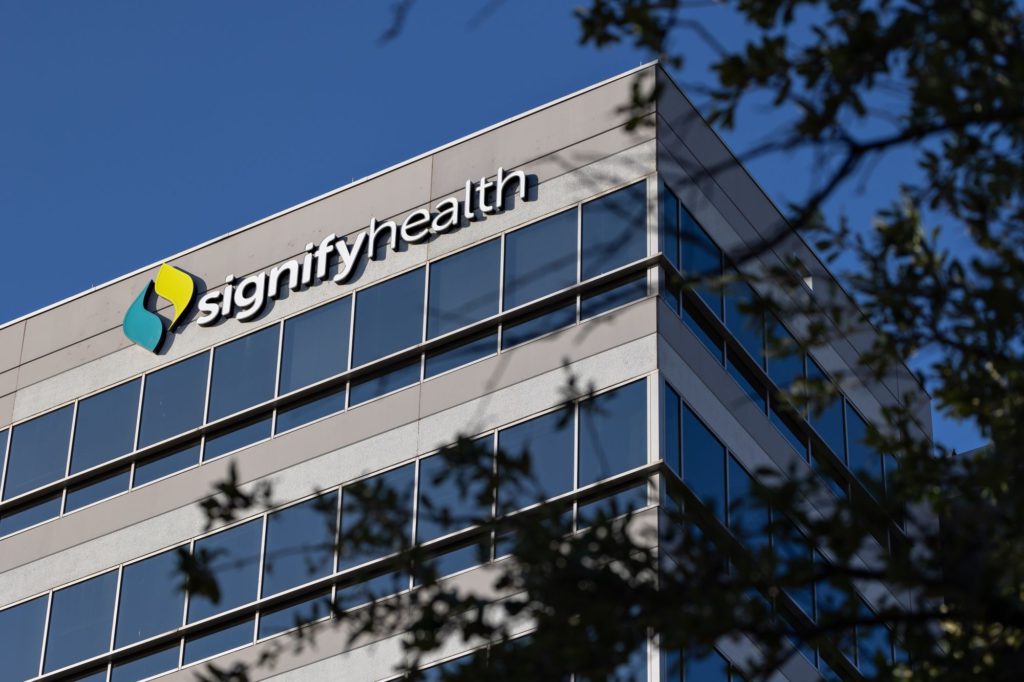
(Bloomberg) — Signify Health Inc. soared the most since its shares started trading last year as UnitedHealth Group Inc., Amazon.com Inc., CVS Health Corp. and Option Care Health Inc. competed to acquire the home-health technology and services provider, according to people familiar with the matter. 

UnitedHealth has submitted the highest bid in excess of $30 a share, while Amazon’s offer is close behind, the people said, asking not to be identified as the discussions are private. Signify is holding a board meeting Monday to discuss the bids, the people said.

Signify’s shares rose as much as 41% to $29.88 in New York, the most intraday since the company began trading in February 2021. The stock had climbed 6.7% through Friday after the Wall Street Journal reported earlier this month that CVS was mulling a bid for the company. The newspaper earlier also reported Amazon was among the bidders.

No plans are finalized, the bidders’ plans could still change, and Signify could opt to remain independent. Signify didn’t immediately respond to a request for comment sent on Sunday. Representative for CVS, Amazon and UnitedHealth declined to comment. Option Care didn’t immediately respond. 

Final bids are expected Sept. 6, but a deal could come earlier if any of the parties preempt the sales process, the people said. 

Diverse Buyers

It’s a diverse set of buyers circling Signify. Amazon is an e-commerce behemoth based in Seattle; UnitedHealth is a Minneapolis-based health-care conglomerate that insures nearly 46 million Americans; Rhode Island-based CVS is a retailer and insurer; and Option Care is an Illinois-based home health-care provider that’s partly owned by Walgreens. 

UnitedHealth and Amazon have so far offered to pay the highest amount for Signify but challenges remain.

Concerns about competition in technology and health care are mounting after Amazon recently agreed to acquire primary-care clinic company One Medical. Acquisitions by Amazon tend to get a hard look from US regulators.

UnitedHealth, meanwhile, is fighting in court to carry out its proposed acquisition of Change Healthcare Inc. after the Justice Department sued to block the deal, saying it would give the company access to sensitive information about rival health insurers. 

Through its software and services, Signify aims to help clients — payers like health plans, government programs and employers — shift to value-based payment plans. It’s backed by private equity firm New Mountain Capital, which formed the company in 2017, according to the firm’s website. 

Companies like Signify intend to improve care and reduce spending by treating patients in lower-cost settings and linking providers’ payments to patient outcomes. 

Other small providers of health-care technology rose after the news. Oak Street Health Inc. rose as much as 3.3%, Cano Health Inc. soared as much as 17% and Caremax Inc. jumped as much as 4.4%. 

(Adds share trading in third and final paragraphs)

More stories like this are available on bloomberg.com

©2022 Bloomberg L.P.

Zoom’s Post-Pandemic Slowdown Keeps Stock in Check

(Bloomberg) — The days of virtual happy hours are long past now that most of the world has moved on from Covid-19 lockdowns. Zoom Video Communications Inc. is still paying the price in its income statement and in the stock market. 

Analysts predict the video-conferencing company, which went public in 2019, will report its smallest-ever increase in quarterly revenue late Monday. And Zoom’s shares have missed the big rally in technology stocks since mid-June, dropping 7.8% versus a 17% surge for the Nasdaq 100 Index.

Zoom’s sales exploded during the pandemic as individuals and businesses flocked to video conferencing. Many consumers, though, stuck to the company’s free service, and many businesses that were willing to pay for the offering had, and still have, other options, such as Microsoft Corp.’s Teams. While Zoom is profitable, expectations for its sales growth may still be too high.

“Even if the company guided to more profitability in a more macro constrained environment, a more conservative top-line outlook could cause the name to trade off in the near term,” Meta Marshall, an analyst at Morgan Stanley, wrote in a research note. 

Investors are on edge about the second-quarter earnings. The options market implies they expect a 13% move in either direction for the stock after the report, according to data compiled by Bloomberg. 

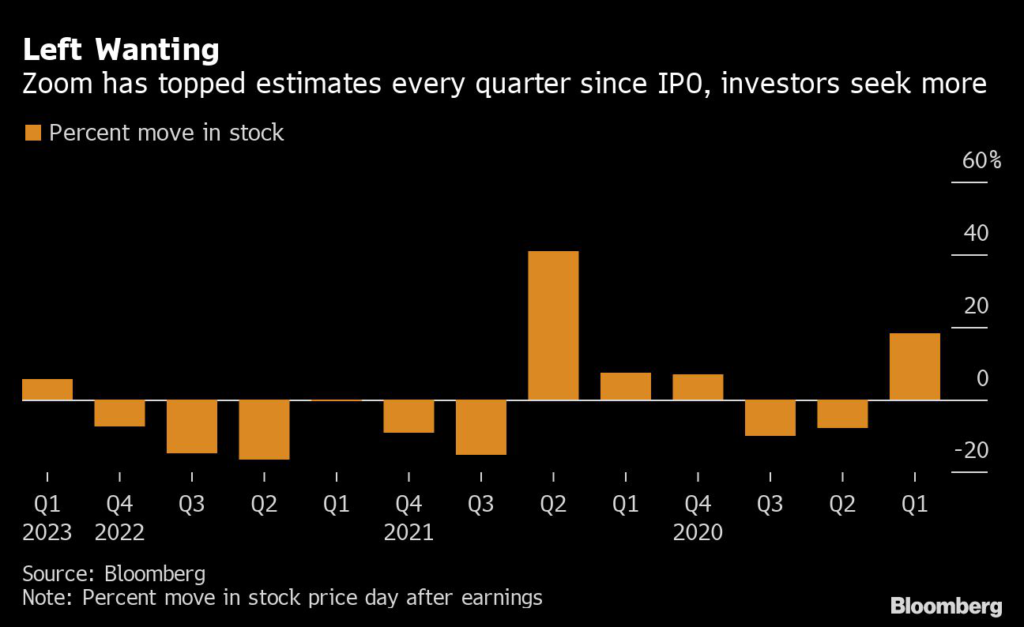
Since going public in 2019, the company has beaten revenue and profit estimates every single quarter, but its shares have fallen after six out of the last seven reports, as investors look to see how Zoom will fare in a slower-growth, post-pandemic environment. 

Analysts predict that sales increased 9% in the second quarter, down from 12% in the first. For this year and the next two, they estimate 11% to 13% growth, a far cry from the 300%-plus annual surge during the peak of the pandemic.   

Now that the hyper-growth days are over, Zoom is looking to gain market share among business clients, pitting itself directly against technology giant Microsoft and to a lesser extent Cisco Systems Inc.’s Webex and Salesforce Inc.’s Slack. 

Enterprise is “not easy business to win, when you think about Microsoft’s ability to package Teams into an Office 365 sale,” Bloomberg Intelligence analyst John Butler said. 

“Zoom has shifted its focus to the enterprise segment for growth, where I don’t think their strong brand name will help them as much as it did in the consumer online market,” Butler said. 

Analysts are split on the stock, with 14 recommending investors buy and 15 at hold. Citigroup Inc.’s Tyler Radke last week became the lone analyst to rate the stock a sell. 

He sees more competition from Microsoft Teams and also expects smaller mom-and-pop businesses to cut back on less critical expenditures as inflation squeezes their budgets.

“There’s so much competition here now,” said Dennis Dick, head of markets structure and a proprietary trader at Bright Trading. Everyone’s asking, “the earnings are OK here at Zoom, but are they sustainable?”

Tech Chart of the Day

Amazon.com Inc. is closing in on Alphabet Inc.’s market capitalization. The e-commerce giant slipped behind Google’s owner in July last year and now ranks fourth in size, behind Apple Inc., Microsoft Corp. and Alphabet. The weakening of the digital advertising industry has weighed on Alphabet — the largest online-ad company — at the same time as consumer-related stocks such as Amazon have led the market’s rebound from the low in June. 

Top Tech Stories

  • UnitedHealth Group Inc., Amazon.com Inc., CVS Health Corp.and Option Care Health Inc. are vying to acquire Signify Health Inc., a provider of technology and services for home health, according to people with knowledge of the matter.
  • Cineworld Group Plc, the world’s second-largest cinema operator, is considering a Chapter 11 bankruptcy filing in the US as it seeks to cut its $5 billion debt pile.
  • Pinduoduo Inc., one of China’s biggest e-commerce operators, is preparing to enter the North American market in its first cross-border expansion, according to people familiar with its plans.
  • Some of Asia’s biggest funds more than doubled their positions in Alibaba Group Holding Ltd. and Sea Ltd. in the second quarter after a year-long rout.
  • Vodafone Group Plc has agreed to sell its Hungarian unit in a deal valued at 1.8 billion euros ($1.8 billion) including debt as part of the British telecommunications company’s plan to simplify its sprawling business.
  • The billionaire founder of Paytm emerged unscathed in a crucial test of investor confidence, with a forceful majority of shareholders voting to keep him at the helm of the fintech pioneer that made one of the worst market debuts in Indian history.
  • Tesla Inc. will start charging $15,000 for the driver-assistance features it calls Full Self-Driving, raising the price of the controversial product for the second time this year. The current $12,000 price will be honored for orders made before Sept. 5.

(Updates headline and stock move in second paragraph.)

More stories like this are available on bloomberg.com

©2022 Bloomberg L.P.

Singtel Readies $300 Million Sale of Cyber Security Arm Trustwave, Sources Say

(Bloomberg) — Singapore Telecommunications Ltd. is moving forward with a planned sale of its cyber security business Trustwave Holdings Inc. that could raise about $200 million to $300 million, people familiar with the matter said.

The Singapore operator has been speaking with financial advisers as it prepares for a potential divestment of the Chicago-based unit, the people said, asking not to be identified because the matter is private. Trustwave could attract interest from other firms in the industry and investment funds, according to the people. 

Considerations are preliminary and Singtel could still decide to retain the asset, they said. A representative for Singtel declined to comment.

Singtel is streamlining its portfolio as it seeks to raise cash and focus on 5G operations as well as developing new growth engines including IT services and data centers. 

The company announced in May 2021 it was taking a $250 million non-cash impairment charge against its investment in Trustwave, and said had begun a strategic review of the business. Trustwave later divested SecureTrust, its payment card industry compliance business, for $80 million, according to a press release last October. Singtel acquired Trustwave in 2015 for $810 million.

The telecom company agreed to sell advertising platform Amobee in July to Tremor International Ltd. for total consideration of $239 million, according to a statement. It is also considering options including a potential stake sale in the fiber assets of its Australian subsidiary SingTel Optus Pty, Bloomberg News has reported. 

In October, Singtel sold a majority stake in a portfolio of Australian wireless tower assets to pension manager AustralianSuper Pty for about A$1.9 billion ($1.3 billion).

The valuations of both private and public tech assets slumped in recent months amid rising interest rates and fears over economic growth, prompting some investors to trim bets on digital companies. Shares in cyber security firm Crowdstrike Holdings Inc. have lost 22.5% in the last 12 months, while NortonLifeLock Inc. is down 9.4% in the same period.

(Updates with additional details on strategy from fourth paragraph)

More stories like this are available on bloomberg.com

©2022 Bloomberg L.P.

DeSantis Taps Donors Griffin, Tudor Jones in $142 Million Haul

(Bloomberg) — Republican Florida Governor Ron DeSantis has raised more money than Donald Trump since the former president left office, relying on deep-pocketed donors rather than the small-dollar contributors he’ll need if he seeks the White House in 2024.

DeSantis, running unopposed in Tuesday’s primary as he goes for a second term, has amassed $142 million from the start of 2021 through Aug. 5 this year from donors including the hedge fund billionaires Ken Griffin and Paul Tudor Jones. 

That tops the $136 million Trump collected over a slightly shorter period and dwarfs totals from former governor Charlie Crist and Agriculture Commissioner Nikki Fried, who are facing off in the Democratic primary for governor with two other candidates ahead of the Nov. 8 general election. 

Unlike Trump, who relies largely on a network of small-dollar donors to fund his post-presidential political operations, DeSantis has raised the bulk of his money from a small number of wealthy donors writing him giant checks. That gives him plenty of money for his re-election effort in Florida, where laws allow unlimited contributions.

But it also raises doubts about the level of grassroots support for DeSantis and suggests he’ll have to widen his fundraising base for any presidential bid because federal rules limit direct contributions to candidates to just $2,900 per donor. Polls show Trump is the overwhelming favorite for the GOP nomination if he runs again, with DeSantis a distant second but well ahead of other potential Republican candidates.

About 500 donors have given $50,000 or more to Friends of Ron DeSantis, his political action committee which under Florida law can accept donations in unlimited amounts, accounting for $88 million of his fundraising haul. His big donors come from finance and real estate, health care and construction and a wide range of other businesses, a Bloomberg analysis of Florida campaign finance filings shows.

By contrast, donors who made contributions of less than $200 accounted for $8 million, or just 6%, of his haul. Unlike Trump, who’s raised $74 million or 54% of his total from January 2021 through June 30 from small-dollar donors, DeSantis doesn’t send multiple, daily fundraising pitches to supporters. Recently his campaign went a month without sending a text message to potential donors who signed up to receive them.

His top 500 donors include 10 billionaires, including Citadel’s Griffin, who moved his hedge fund’s headquarters to Miami from Chicago 14 months after giving $5 million. Other contributors include Tudor Jones, the chief executive officer of Tudor Investment Corp., Home Depot Inc. co-founder Bernard Marcus and Thomas Peterffy, the chairman of Interactive Brokers Inc.

Among DeSantis’s contributors are about 100 individuals who also have been donors to Trump’s committees or super PACs that supported his two White House bids, campaign finance records show. DeSantis got $50,000 from Wilbur Ross, who served as Trump’s commerce secretary. Developer and Trump business partner Phil Ruffin gave DeSantis $100,000.

A spokeswoman for DeSantis’s campaign declined to comment on his fundraising.

Democrats are already criticizing DeSantis’s reliance on deep-pocketed donors. Fried’s campaign said in a statement that “billionaires only have one candidate for governor of Florida and it’s Ron DeSantis.”

A spokesman for Crist was equally incredulous. 

“Ron DeSantis has spent the last two years turning his back on Florida and cozying up to the donors he thinks will get him to the White House,” Samantha Ramirez said in a statement. “It’s no surprise he’s being bankrolled by conservative billionaires and special interests who prefer his culture warrior shtick to actually solving problems impacting working Floridians.”

Crist and Fried have argued in the closing days of their race about who’s better positioned to defeat DeSantis in November, but both trail the Florida governor in hypothetical polling match-ups. And the Democrats’ fundraising has paled in comparison, with Crist raising just $14 million through Aug. 5 while Fried has taken in only $7.4 million.

Many donors benefited from DeSantis’s policies allowing their businesses to operate with few additional restrictions through the coronavirus pandemic when other states were locking down. Restaurateurs ranging from owners of high-end establishments to fast-food joints, along with hoteliers, casinos and retail operators, gave $2.8 million, filings show.

Corporations also haven’t stopped giving to DeSantis after his fight earlier this year with Walt Disney Co., which objected to a law that limits school instruction about gender identity and sexual orientation, a measure critics call the “Don’t Say Gay” bill.

After DeSantis and the legislature responded with a bill in April that retaliated by putting the special tax district where Disney operates its Florida theme park into jeopardy, his PAC received $50,000 checks from health-care giant Humana Inc., cable provider Charter Communications Inc. and utility Teco Energy Inc., among others. Title insurer Fidelity National Financial Inc. gave $250,000.

But businesses have a complicated relationship with DeSantis. Many are grateful he lifted pandemic restrictions early while others resent being told what to do, according to Ben Wilcox, research director for Integrity Florida, a nonpartisan research institute and government watchdog.

DeSantis doesn’t need to seek small-dollar donors to fund his Florida re-election, said Aubrey Jewett, who teaches politics at the University of Central Florida in Orlando. But it might be perceived as a sign of weakness the longer he waits to tap that network, and relying on big checks could work against his image as a populist who’s willing to battle “woke” corporations, Jewett said.

But if DeSantis started a major small-dollar campaign across the US, it may fuel a narrative that he’s focused on the presidential contest instead of leading Florida, said Republican media strategist Adam Goodman. DeSantis should be able to build up a small-dollar donor base quickly if he has a convincing win in November’s contest, Goodman said.

More stories like this are available on bloomberg.com

©2022 Bloomberg L.P.

Online Pharmacy Zur Rose Is Weighing Options Including Sale

(Bloomberg) — Zur Rose Group AG, the Swiss online pharmacy, is exploring strategic options including a possible sale, according to people familiar with the matter. 

The Frauenfeld-based company has been working with advisers to look at alternatives ranging from a take-private to a private investment in public equity, the people said, asking not to be identified because the information is private. It has held talks in recent months with potential suitors including US buyout firms KKR & Co. and Hellman & Friedman, the people said.

Shares of Zur Rose briefly jumped into positive territory, surging as much as 7.7%, before turning negative again. They were down 1.1% at 2:25 p.m. Monday in Zurich, giving the company a market value of about 685 million Swiss francs ($715 million), as sentiment was hurt by several research analysts cutting their target prices earlier in the day.

Rival online pharmacy Shop Apotheke Europe NV also rallied, rising as much as 4.7% in Frankfurt before reversing the gains.

Zur Rose, the owner of sites including DocMorris, could also pursue other options to improve its balance sheet, the people said. A deal isn’t expected in the near future given current valuation levels and the state of the credit market, which makes it difficult for private equity firms to finance buyouts, the people said. 

Representatives for Zur Rose, H&F and KKR declined to comment.

Zur Rose, which gets most of its revenue from Germany and Switzerland, was founded in 1993 by a group of doctors and went public in 2017. The unprofitable company’s market capitalization soared during the coronavirus pandemic, reaching nearly 5.4 billion francs at one point. It runs online pharmacies, has a medical wholesale business in Switzerland and also operates a marketplace in southern Europe for consumer health and beauty products. 

Last week, Zur Rose released guidance that briefly gave a boost to its battered share price. The company forecast it will break even in 2023 on the basis of adjusted earnings before interest, taxes, depreciation and amortization and won’t need additional operating capital. 

Some analysts have also bet that Zur Rose will get a boost from the accelerated rollout of electronic prescriptions in Germany. The company currently has more than 11 million active customers across its core European markets, according to a release this month. 

Zur Rose is potentially attractive to private equity firms as it caters to the digitization of health care systems and could be expanded into new markets through acquisitions. In 2019, Zur Rose boosted its market share in Germany by acquiring the e-commerce operations of Medpex, the country’s third-largest online pharmacy. 

There’s even been speculation that Zur Rose could be attractive for tech companies like Amazon.com Inc. that have been expanding into health care. 

(Updates with share movement from third paragraph.)

More stories like this are available on bloomberg.com

©2022 Bloomberg L.P.
US Futures, Stocks Fall as Fed Outlook Takes Toll: Markets Wrap

(Bloomberg) — US equity futures retreated on Monday along with stocks in Europe as a risk-off mood took hold at the start of a key week for financial markets when central bankers gather at their annual Jackson Hole retreat.

Futures on the S&P 500 and Nasdaq 100 fell more than 1% each. The 10-year Treasury yield was little changed while two-year yields rose about five basis points, deepening the yield-curve inversion that’s seen as a harbinger of a recession. The dollar spot index climbed to a five-week high.

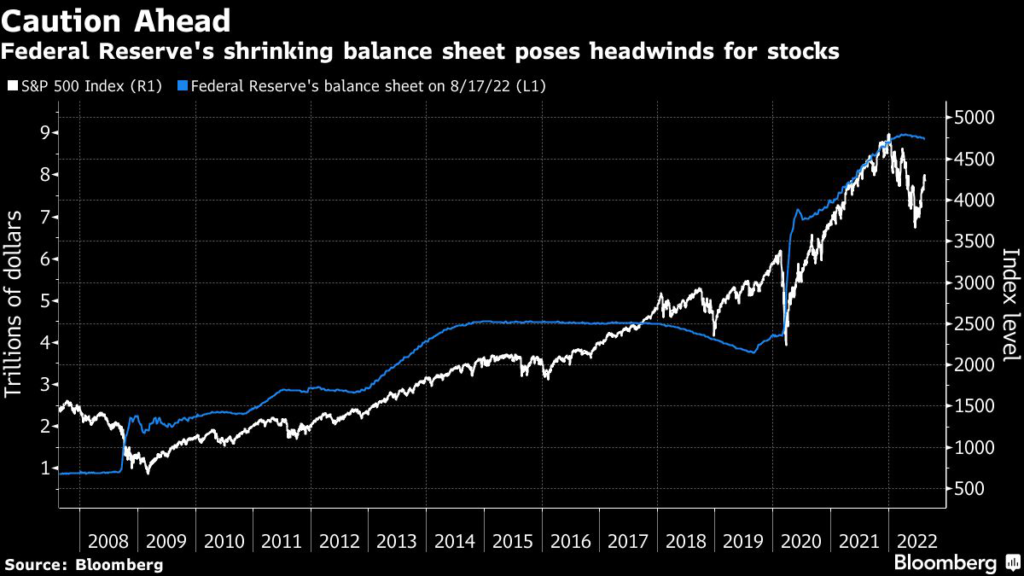
A jump in global shares from June’s bear-market lows, stoked by the market’s expectations for a pivot to slower rate hikes, is fizzling after repeated Federal Reserve policy makers warned that interest rates are going higher. The Jackson Hole symposium gives Fed Chair Jerome Powell a platform to reset those bets, which are vulnerable to the possibility of persistently elevated price pressures even as economic growth stumbles.

“The expectation is still that Powell will reaffirm what he and his colleagues have been saying in public recently,” said Craig Erlam, a senior market analyst at Oanda. “The risk is that he says something dovish — intentionally or otherwise — after investors position for the opposite and triggers another risk-on rally in the markets.”

Investors are also waking up to the looming acceleration of the Fed’s balance-sheet reduction. So-called quantitative tightening kicks into top gear next month, and will add to pressure on riskier assets which have benefited from ample liquidity.

The Stoxx Europe 600 index headed for its lowest closing level in more than three weeks, with carmakers and the tech sector among the leading decliners. MSCI Inc.’s Asia-Pacific share index fell for a third day with losses evident in most major markets except for some gains in China, where banks lowered lending rates and authorities stepped up support for the property market with additional loans.

The latest MLIV Pulse survey suggests stocks and bonds are set to tumble once more even though inflation has likely peaked: some 68% of respondents see the most destabilizing era of price pressures in decades eroding corporate margins and sending equities lower.

“It is likely central bankers, including Fed Chair Powell, will remain hawkish in dealing with inflation albeit with a bit of caution creeping in given the emerging economic downturn,” Shane Oliver, head of investment strategy at AMP Services Ltd., wrote in a note.

Meanwhile, natural-gas prices in Europe jumped as fears returned about a prolonged halt in supplies through a major pipeline, jeopardizing an already struggling economy.

The Chinese demand outlook is weighing on oil, which sank below $90 a barrel in New York before paring the decline. Traders are monitoring Iran nuclear talks that could lead to more supplies. Bitcoind stretched a four-day decline to about 10%

What to watch this week:

  • US new home sales, S&P Global PMIs, Tuesday
  • Fed’s Neel Kashkari speaks at Q&A session, Tuesday
  • US durable goods, MBA mortgage applications, pending home sales, Wednesday
  • US GDP, initial jobless claims. Thursday
  • Fed annual policy symposium in Jackson Hole, Wyoming, Thursday
  • ECB’s July minutes, Thursday
  • Fed Chair Powell speaks at Jackson Hole, Friday
  • US consumer income, PCE deflator, Friday

Some of the main moves in markets:

Stocks

  • Futures on the S&P 500 fell 1.2% as of 8:34 a.m. New York time
  • Futures on the Nasdaq 100 fell 1.5%
  • Futures on the Dow Jones Industrial Average fell 1%
  • The Stoxx Europe 600 fell 0.9%
  • The MSCI World index fell 0.3%

Currencies

  • The Bloomberg Dollar Spot Index rose 0.2%
  • The euro fell 0.3% to $1.0003
  • The British pound was little changed at $1.1820
  • The Japanese yen fell 0.1% to 137.12 per dollar

Bonds

  • The yield on 10-year Treasuries was little changed at 2.97%
  • Germany’s 10-year yield advanced four basis points to 1.27%
  • Britain’s 10-year yield advanced eight basis points to 2.49%

Commodities

  • West Texas Intermediate crude fell 0.5% to $90.28 a barrel
  • Gold futures fell 1.1% to $1,743.70 an ounce

More stories like this are available on bloomberg.com

©2022 Bloomberg L.P.
Electric Cars Have a Big Tire Conundrum

(Bloomberg) — The Lucid Air Dream Edition travels up to 520 miles on a charge, more than any electric vehicle on the market by a wide margin. If a buyer chooses the larger, 21-inch wheels, however, 39 of those miles vanish — a 7.5% range penalty. 

To be fair, the bigger shoes do look cool, and they’ll still take you nonstop from New York to Cleveland. But when it comes to wheels and tires — where the rubber literally meets the road on electric vehicle range — there’s an escalating battle between physics and aesthetics. More often than not, the latter is winning, as the people who buy EVs (and the people who make them) choose bigger, stickier, “spokier” options that prize looks and performance over efficiency. 

“Everything is about range, so the slipperier you make it, that’s great,” says Richard Scheer, exterior design director at Chevrolet. “But even in the EV world, people will trade off range for cool wheels.”

The physical recipe for an ultra-efficient tire is pretty simple: skinny (so it blocks less air), small circumference (so it takes less energy to turn), a compound that doesn’t stick overly much, and a hub cap that is mostly covered (to cut down on air turbulence inside the wheel). 

But auto executives and engineers must layer in a dizzyingly complex series of compromises when outfitting a car in reality. For every bit of size and/or stickiness, the vehicle sacrifices mileage and efficiency. That’s also true for gas-burning machines, but electric cars are typically far heavier than similar-sized internal-combustion cars, meaning their tires have to withstand more pressure and wear. They are also far quieter, so tire engineers agonize over noise — going so far as to pump acoustic foam into the rubber cavity.

“You get into a complicated balance,” said David Van Emburg, executive vice president of automotive original equipment global sales at Michelin.

In short, a tire built for range looks a lot like the one that comes standard on the Chevrolet Bolt — a Michelin Energy Saver on a 17-inch wheel with a swirly center of spokes — and nothing like the massive, knobby tires on the GMC Hummer EV that Scheer helped design. “Those are just cool wheels,” he explains. “We’re showing that when you get to EV, you can still have fun products.”

The North Star for tire efficiency is something called rolling resistance, which is exactly what it sounds like — a measure of how much the circle sticks to the ground (picture a bowling ball and a medicine ball racing across a gym floor). An increase in tire size can actually lower resistance, as it spreads the weight of the car more widely and “squishes” less, but supersizing presents another, often greater problem: The increased mass requires more energy to get going.

The BMW i4 M50, for example, a souped-up version of the marque’s newest electric sedan, travels 271 miles on a full charge with its standard 19-inch performance tires. On high-performance 20-inch wheels, however, it makes only 227 miles — a 16% handicap. Ford likewise concedes that its Mustang Mach-E would go slightly farther if it chose tires that didn’t corner as well, and its F-150 Lightning could stretch a few more miles on rubber less suited for off-road driving.

“Those big tread patterns squabble — they move around — and don’t return all the energy you give them,” says Chris Allard, chief engineer of Ford’s underbody systems engineering. “You’re making a conscious trade-off there.”

For now at least, the no-compromise strategy is what car buyers want, particularly as the EV market transitions from early adopters to the mass market. Across Lucid’s spectrum of models, customers generally opt for the bigger wheels, shortening their time between charges by up to 9%. Four out of five customers for Hyundai’s hot new Ioniq 5 opt for the larger wheel. Similarly, 40% of folks sliding into Volkswagen’s ID4 choose the 20-inch rims over the 19. At Polestar, only about one-third of buyers opt for the standard 19-inch wheel with a summer tire; the rest check the box for a 20-inch wheel that sacrifices about 5% of the car’s range.  

“It’s kind of a look,” says Polestar engineer Glenn Parker. “We’ve seen tires get bigger and bigger and bigger over the years. …And as a performance brand you can’t just say ‘What’s the most efficient tire we can put on the car?’” 

Tire longevity isn’t entirely out of drivers’ hands. Ford’s Allard says it’s important to pay attention to the tire monitoring gauge and keep tires filled to the right air pressure. “If you’re a cheap guy like me, you keep that screen up,” he says.

But Big Tire is also hustling to make larger, stickier tires stretch a little farther on the road. In the past 20 years, Michelin has managed to improve tire efficiency by 20% without sacrificing stickiness and performance, according to Emburg.  To get there, its engineers tinkered with tread patterns, the thickness and chemical composition of the rubber and the patterns of steel belts holding the whole package together. “I’ve been in the game 34 years and we’re still looking at major steps in technology,” he says. “We’ll optimize every part of the tire for its mission.”

Car companies are iterating, too. At the moment, the hub of the Polestar 2 wheel looks a little bit like a four-leaf clover, but it has been reworked for next year’s model. The new version has far less open space, with five triangles poking toward the center like pieces of aluminum pie. The result: an extra two or three miles of range, even on the 20-inch wheels.

More stories like this are available on bloomberg.com

©2022 Bloomberg L.P.
Wall Street, Crypto Giants Line Up to Back Startup Prime Broker

(Bloomberg) — Some of the world’s biggest trading houses and cryptocurrency firms are backing a small startup that aims to ease Wall Street’s entry into crypto trading by tackling counterparty risks and conflicts of interest. 

Hidden Road Partners, a prime brokerage focused on digital assets and foreign exchange, completed a $50 million funding round last month that included Citadel Securities, as well as the investment arms of cryptocurrency exchanges FTX Trading Ltd. and Coinbase Global Inc. Now it’s in discussions with hedge funds and many of the top 20 global banks about providing access to trade or hedge their crypto risks, executives at the firm said. 

The recent crypto meltdown has heightened the importance of managing counterparty risks, after influential crypto hedge fund Three Arrows Capital defaulted and crypto lenders and brokers such as Celsius Network Ltd. and Voyager Digital Ltd. filed for bankruptcy protection. Such credit risks could hamper traditional funds’ interests in trading directly with cryptocurrency firms. 

“The recent episode with crypto lenders has made it abundantly clear that the industry is in need of better real-time credit risk management,” said Ramnik Arora, general partner at FTX’s venture arm. “Hidden Road is making it easier for risk-conscious borrowers to access credit markets, reducing systemic risk for the ecosystem.”

For banks or other institutions that can’t hold digital assets directly, the firm allows them to post dollars as collateral in a “tri-party” setup with a custodian, and receive profits and losses in dollars. Clients can trade with exchanges as well as liquidity providers including Virtu Financial Inc., Optiver BV and Wintermute Trading Ltd. 

The startup is entering a crowded space where an increasing number of crypto platforms and brokers are vying for institutional traders. But unlike many others, Hidden Road said its pure-play structure would eliminate potential conflict of interests, such as front-running a customer’s trade to make a profit through a proprietary-trading unit. 

“Hidden Road does not trade,” Justin Chow, the firm’s head of digital assets, said in an interview, adding that it doesn’t make markets, doesn’t do over-the-counter deals and doesn’t do any venture capital. “And we do not sell our clients data, so we do not provide liquidity as a principle using our own capital and balance sheet.” 

While Hidden Road provides clearing and financing for customers’ trading activities, “the client has to execute those trades themselves,” Chow said. “We are working with our client, not against them.”

Top Executives

Founded in 2018 by Marc Asch, formerly with Steven Cohen’s hedge fund SAC Capital and Point72 Asset Management, Hidden Road started with foreign-exchange services and expanded into digital assets in October. Laine Litman, who was head of FICC and co-head of crypto at Virtu Financial, joined as president this year. Hidden Road, based in the British Virgin Islands and named after the street in Massachusetts where Asch grew up, has more than 80 employees globally including in New York, London and Singapore. 

The firm takes on counterparty risks on behalf of the client and the crypto exchange or market maker. That means if a counterparty defaults, the startup would be on the hook for completing the defaulted side of the trade. In exchange, Hidden Road’s prime-brokerage fee incorporates this aspect of credit risk.

Unlike a traditional bank, Hidden Road doesn’t carry a large balance sheet to lend to its clients. Instead, it raises capital from investors such as pension funds and pays them a return on capital, which it generates by providing financing to clients for their trading activities. Hidden Road itself mitigates risks by using a real-time system, which sets risk limits and requires portions of collateral upfront.

Hidden Road said it plans to enter futures and options clearing. The goal is to allow clients, such as hedge funds and prop-trading firms, to lower borrowing costs for trading strategies by netting credit risk and positions across asset classes.

With the crypto downturn, institutional investors are “clearly relieved with the fact that the market has given them an opportunity to breathe and to play catch-up with their research,” Chow said.

More stories like this are available on bloomberg.com

©2022 Bloomberg L.P.
Climate Disasters Risk Putting a Damper on Electric-Car Making

(Bloomberg) —

Automakers racing to make more electric vehicles have a problem: climate change is catching up with the industry.

On Monday, authorities in China’s Sichuan province — the source of about a fifth of the country’s lithium production — extended electricity cuts to some industrial users as the most intense heat wave in more than 60 years depletes reservoirs used for hydropower.

Volkswagen said last week its factory in the region was affected by the power shortage and that it expected a slight delay in deliveries to customers. Toyota and battery maker CATL have temporarily closed factories. Tesla and China’s SAIC Motor told authorities in Shanghai — roughly 2,000 kilometers (1,240 miles) to the east of Sichuan’s capital city of Chengdu — that they may have difficulty maintaining production if the power crunch continues to impact suppliers.

In Europe, a drought has threatened to make the Rhine river — a crucial waterway for German, Dutch and Swiss trade for centuries — impassable at a key waypoint. While rainfall over the weekend alleviated risk of disruption to diesel and coal shipments to power stations and industrial plants, Shell already cut production at Germany’s biggest oil-processing complex due to the issue. And in the German states of Brandenburg and Saxony, where Tesla and BMW operate car factories, authorities had to ask the military for help fighting several forest fires this summer.

Many carmakers list climate change as business risk factors. Tesla, for instance, warns that if climate-related disasters occur, its headquarters and production facilities “may be seriously damaged, or we may have to stop or delay production and shipment of our products.”

While manufacturers clearly realize climate change may hit their production networks, their actions don’t always line up with the severity of the threats. Companies continue to set up water-intensive manufacturing sites in regions where supply is increasingly scarce.

Tesla ran into opposition in Germany when building its factory in a region dealing with falling groundwater levels and prolonged droughts. Fremont, California, where Tesla has been producing electric cars for more than a decade, gets around 16 inches of rain per year, less than half the US average. The battery plant Tesla runs with Panasonic in Reno, Nevada, and Lucid Motors’ factory south of Phoenix are located in even drier regions.

Lucid, which is part-owned by Saudi Arabia’s sovereign wealth fund, plans to build an EV factory in the kingdom near the city of Jeddah, where temperatures can top 120 degrees Fahrenheit (49 degrees Celsius) in the summer.

Several carmakers including Tesla are equipping factories with renewable-energy generators and say they’re working to make their sites more resource-efficient, including by reducing water consumption. At its plant in Chennai, India, BMW collects rainwater in basins during the monsoon season, covering 60% to 90% of the plant’s annual water requirement. To further increase this share, more reservoirs for the retention of rainwater are under construction, a BMW spokesperson said.

While the surge in demand for EVs is poised to reduce carbon emissions from transport, it’s sparked a mining boom for battery metals, including lithium. The silvery-white metal generally comes from open-pit mines in Australia or from South America, where there are concerns about water waste and toxic materials released from massive evaporation pools. The raw materials are then shipped to Asia for processing. By the time the lithium ends up in European or American EVs, a lot of CO2 has been released into the atmosphere. There are efforts underway to mine lithium without emitting greenhouse gases, but those are still in their infancy.

Volkswagen has set up a facility in Germany to eventually reuse 90% of battery components. It was also an early backer of QuantumScape, the US-listed firm working on solid-state batteries, a potential alternative to widely used lithium-ion technology. The automaker is expected to sign an agreement with Canada to secure access to raw materials including nickel, cobalt and lithium for vehicle and battery production as part of Chancellor Olaf Scholz’s visit to the country this week.

VW said the Rhine’s low water levels haven’t impacted its production, and that its crisis management team has proven itself during extreme weather events and challenges including the Suez canal blockage and the war in Ukraine. The company has also set up a supplier management system to spot signs of disruptions early and work with parts makers to defuse them.

One thing is clear, a spokesperson said: new challenges within its supply chain can only be mastered together.

More stories like this are available on bloomberg.com

©2022 Bloomberg L.P.
Close Bitnami banner
Bitnami