Bloomberg

China’s Pinduoduo to Enter US Market in First International Step

(Bloomberg) — Pinduoduo Inc., one of China’s biggest e-commerce operators, is preparing to enter the North American market in its first cross-border expansion, according to people familiar with its plans.

The Shanghai-based company is looking for new growth avenues at a time when its domestic economy is sputtering, and will follow in the footsteps of successful international ventures like Shein and AliExpress. It’s currently preparing its merchant partners for the move, the people said, asking not to be named as the matter is not yet public.

The company didn’t immediately respond to an inquiry seeking comment.

US-traded PDD holds roughly a 13% share of Chinese online retail, according to industry intelligence firm EMarketer, and has in recent times curtailed its heavy investment in online groceries, which were seen as the most promising new outlet for growth in the country. As it adopts more cost-control measures, the US market offers an enticing outlet to use its existing infrastructure and merchant network internationally.

Despite a late arrival, PDD broke through in China’s highly competitive internet retail space by bringing in social e-commerce practices that have helped build an annual active user base of more than 880 million. It won over shoppers by creating a sort of WhatsApp-Groupon mashup, where consumers spot deals on products, like toys and fruits, and then recruit friends to buy at a discount.

The company has largely withstood macroeconomic headwinds this year and is projected to report 2.5% growth in revenue for the second quarter. Market leader Alibaba Group Holding Ltd., which runs AliExpress as its international arm, logged its first-ever sales contraction during the same period.

What’s Driving US-China Spat Over Audits, Delistings: QuickTake

Regulatory risks still loom large. PDD is one of the few remaining Chinese companies that have shares trading only in the US while tensions rise over audit practices. That’s led to speculation that PDD will eventually seek to list its stock in Hong Kong or another nearby exchange.

An earlier report by Late Post put the timing of a US app launch by PDD in September and said the company had reassigned senior executives and staff from other divisions to help lead its cross-border push.

More stories like this are available on bloomberg.com

©2022 Bloomberg L.P.

Paytm Billionaire CEO Wins Resounding Vote to Stay in Charge

(Bloomberg) — The billionaire founder of Paytm emerged unscathed in a crucial test of investor confidence, with a forceful majority of shareholders voting to keep him at the helm of the fintech pioneer that made one of the worst market debuts in Indian history.

An emphatic 99.67% of shareholders voted to maintain Vijay Shekhar Sharma as the managing director and chief executive officer, among the items decided on at the company’s annual general meeting. A proxy advisory firm last week recommended that shareholders replace the founder as managing director and CEO, citing concerns about his ability to reverse losses at the payments provider.

Shares of the company, listed on the bourse as One 97 Communications Ltd. rose as much as 3.6% in early trading in Mumbai on Monday.  


Sharma got a “resounding vote of confidence from shareholders for reappointment” as managing director and CEO, the company said in an exchange filing and a press statement on Sunday.  Each of seven resolutions, including one detailing Sharma’s remuneration, were passed with at least 94% of votes in favor.

Paytm, the poster boy for India’s tech startups, has lost more than 60% of its value since its high-profile initial public offering in November as it struggled to convince investors of its earnings potential. In an interview last month, 44-year-old Sharma said Paytm is set to become India’s first internet company to hit $1 billion in annual revenue and pledged a shift from growth toward profitability.

“Paytm and Vijay Shekhar are one thing, they are not different,” said Rahul Jain, an analyst with Dolat Capital Market Ltd. The fintech space in India is still an evolving business and the sector needs visionaries such as Sharma, Jain who has a Buy rating on the stock, added.

Institutional Investor Advisory Services India Ltd. last week said investors should vote against Sharma’s reappointment and that the board must bring in a professional to the role. On several occasions before the IPO Sharma talked publicly about the company turning profitable, and yet it hasn’t happened even at an operational level, the firm said.

Paytm counts Ant Group Co.’s Antfin (Netherlands) Holding BV., SoftBank Group Corp. and Canada Pension Plan Investment Board among its top shareholders. Of the dozen analysts covering the firm, six have a buy rating, while three have a hold and the remaining three recommend investors sell their shares.

Sharma’s remuneration is fixed for the next three years without any annual increment, the company said on Sunday. The founder had earlier said that his employee share incentives will vest after the company’s market value crosses the IPO level on a sustained basis. 

Shareholders also approved the reappointment of Ravi Adusumalli to the board, which the proxy adviser had recommended against, as well as the appointment of Madhur Deora as whole-time director and group chief financial officer.

(Updates share prices in third paragraph and analyst comment in sixth paragraph.)

More stories like this are available on bloomberg.com

©2022 Bloomberg L.P.

Stocks, US Futures Fall as Fed Outlook Takes Toll: Markets Wrap

(Bloomberg) — An Asian stock gauge retreated Monday along with US equity futures as the Federal Reserve’s commitment to tighter monetary settings to quell inflation restrained investor sentiment.

MSCI Inc.’s Asia-Pacific share index fell for a third day with losses evident in most major markets except for some gains in China, where a move by banks to trim lending rates aided property developers.

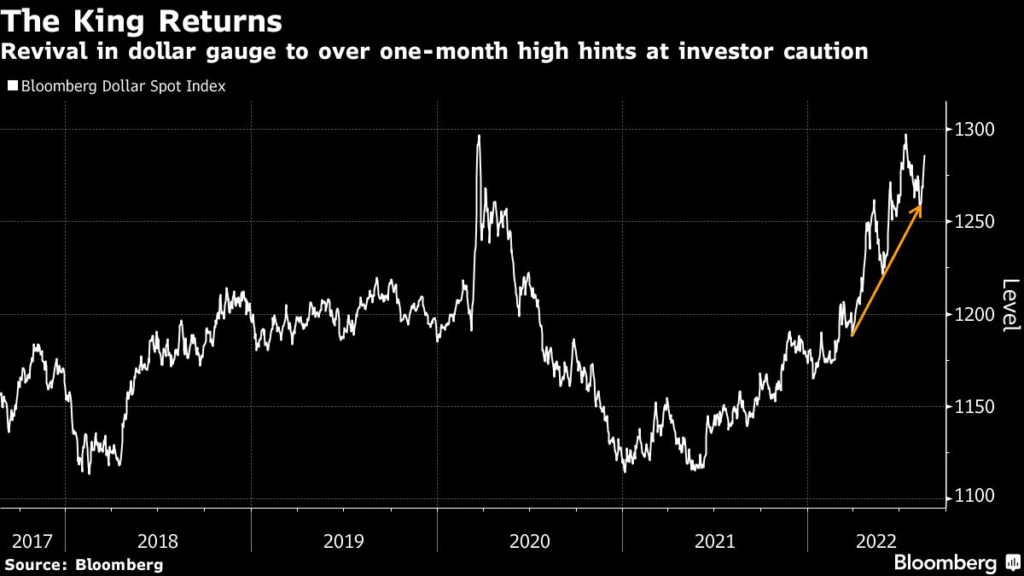
S&P 500, Nasdaq 100 and European contracts suffered declines of at least 0.5% and the dollar was at a more than one-month peak, signs of ongoing wariness.

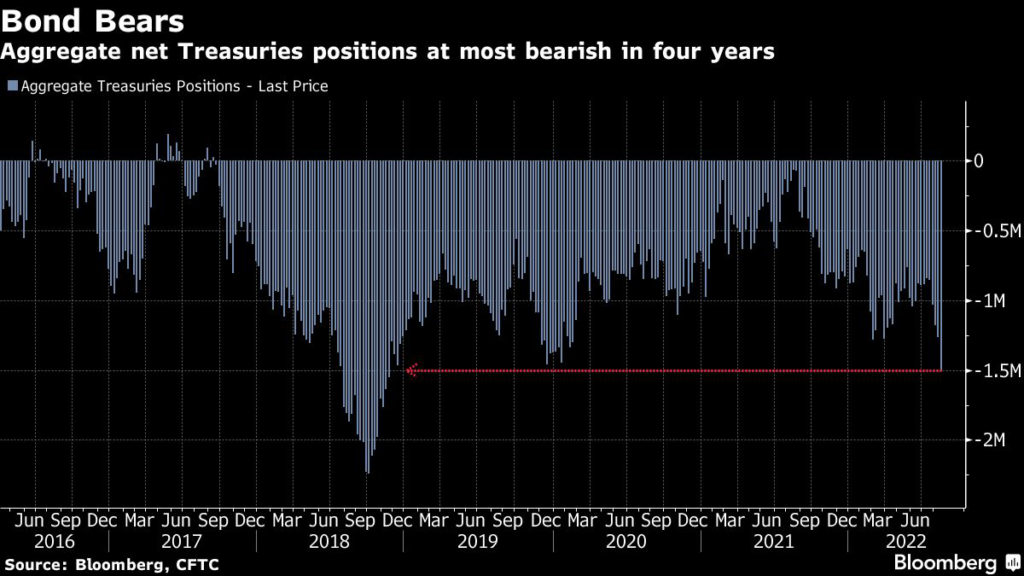
Bonds in Australia and New Zealand dropped and Treasuries either held or extended a selloff from Friday.

A jump in global shares from June’s bear-market lows has begun to cool, weighed down by repeated Fed warnings that interest rates are going higher. Troubling global economic developments, lately including power shortages in a Chinese industrial heartland, are also hanging over investors.

The latest MLIV Pulse survey suggests stocks and bonds are set to tumble once more even though inflation has likely peaked: some 68% of respondents see the most destabilizing era of price pressures in decades eroding corporate margins and sending equities lower.

Key for markets this week is the Fed’s symposium at Jackson Hole, Wyoming. The recent stock bounce has loosened financial conditions, which makes it harder to tackle inflation. 

‘Remain Hawkish’

The symposium gives Fed Chair Jerome Powell a platform to reset the market’s expectations for a pivot to slower rate hikes. The latter bets have helped to drive the recent equity rebound but are vulnerable to the possibility of persistently elevated price pressures even as economic growth stumbles.

“It is likely central bankers, including Fed Chair Powell, will remain hawkish in dealing with inflation albeit with a bit of caution creeping in given the emerging economic downturn,” Shane Oliver, head of investment strategy at AMP Services Ltd., wrote in a note.

In China, banks lowered the one-year and five-year loan prime rates on Monday in the slipstream of a decision by the nation’s central bank last week to cut a key policy rate.

China’s Challenges

The Chinese central bank “aims to do some kind of twist in order to supply more longer term credit to the market while at the same time making sure there is no flush liquidity in the interbank market and there is no speculation,” Jing Liu, HSBC chief economist for greater China, said on Bloomberg Television. 

The world’s second-largest economy faces mobility curbs amid rising Covid cases and continuing property-sector woes, aside from a power crunch in Sichuan province, a key manufacturing hub.

The Chinese demand outlook is weighing in oil, which sank below $90 a barrel. Traders are monitoring Iran nuclear talks that could lead to more supplies. 

What to watch this week:

  • US new home sales, S&P Global PMIs, Tuesday
  • Fed’s Neel Kashkari speaks at Q&A session, Tuesday
  • US durable goods, MBA mortgage applications, pending home sales, Wednesday
  • US GDP, initial jobless claims. Thursday
  • Fed annual policy symposium in Jackson Hole, Wyoming, Thursday
  • ECB’s July minutes, Thursday
  • Fed Chair Powell speaks at Jackson Hole, Friday
  • US consumer income, PCE deflator, Friday

Some of the main moves in markets:

Stocks

  • S&P 500 futures lost 0.5% as of 7 a.m. in London. The S&P 500 fell 1.3%
  • Nasdaq 100 futures shed 0.6%. The Nasdaq 100 fell 2%
  • Japan’s Topix index fell 0.1%
  • Australia’s S&P/ASX 200 index was 0.9% lower
  • South Korea’s Kospi index declined 1.2%
  • Hong Kong’s Hang Seng Index lost 0.2%
  • China’s Shanghai Composite Index added 0.5%
  • Euro Stoxx 50 futures fell 0.3%

Currencies

  • The Bloomberg Dollar Spot Index rose 0.1%
  • The euro was at $1.0037
  • The Japanese yen was at 137.24 per dollar, down 0.2%
  • The offshore yuan was at 6.8437 per dollar, down 0.1%

Bonds

  • The yield on 10-year Treasuries was steady at 2.97%
  • Australia’s 10-year yield rose 12 basis points to 3.53%

Commodities

  • West Texas Intermediate crude dropped 1.4% to $89.52 a barrel
  • Gold was at $1,744.35 an ounce

More stories like this are available on bloomberg.com

©2022 Bloomberg L.P.

Australia to Map Crypto Tokens as Part of Regulatory Ramp-Up

(Bloomberg) — Australia is beginning a review of cryptocurrency assets in the country to help better understand and regulate the industry.

Prime Minister Anthony Albanese’s government will make “token mapping” a priority this year to help identify which digital asset tokens are being used in Australia and how they should be regulated, Treasurer Jim Chalmers said in a statement on Monday, adding that a public consultation paper on the matter would be released soon.

Chalmers said the new Labor government would first look at gaps in Australia’s regulatory and licensing frameworks, as well as review organizational structures and examine custody obligations for third-party custodians of crypto assets. It would also look at additional consumer safeguards.

“With the increasingly widespread proliferation of crypto assets — to the extent that crypto advertisements can be seen plastered all over big sporting events — we need to make sure customers engaging with crypto are adequately informed and protected,” he said.

A report by an Australian parliamentary committee into the cryptocurrency industry in October 2021 said one of the major issues in regulating digital currencies was a lack of standard definitions and classifications by national and international regulators.

Australia Committee Outlines Measures to Boost Crypto Industry

The former government under Prime Minister Scott Morrison had been planning to outline a cryptocurrency framework by which to regulate and license the industry ahead of its election loss in May.

“The additional benefits of token mapping are many,” said Caroline Bowler, chief executive officer of BTC Markets, in a statement. “It will provide greater clarity to crypto investors; aid companies in developing their own blockchain-based innovations; provide guidance to digital currency exchanges; as well as assist regulators in shaping an appropriate regulatory regime.”

More stories like this are available on bloomberg.com

©2022 Bloomberg L.P.

Asia Hedge Funds Scoop Up Alibaba, Sea After Stock Rout

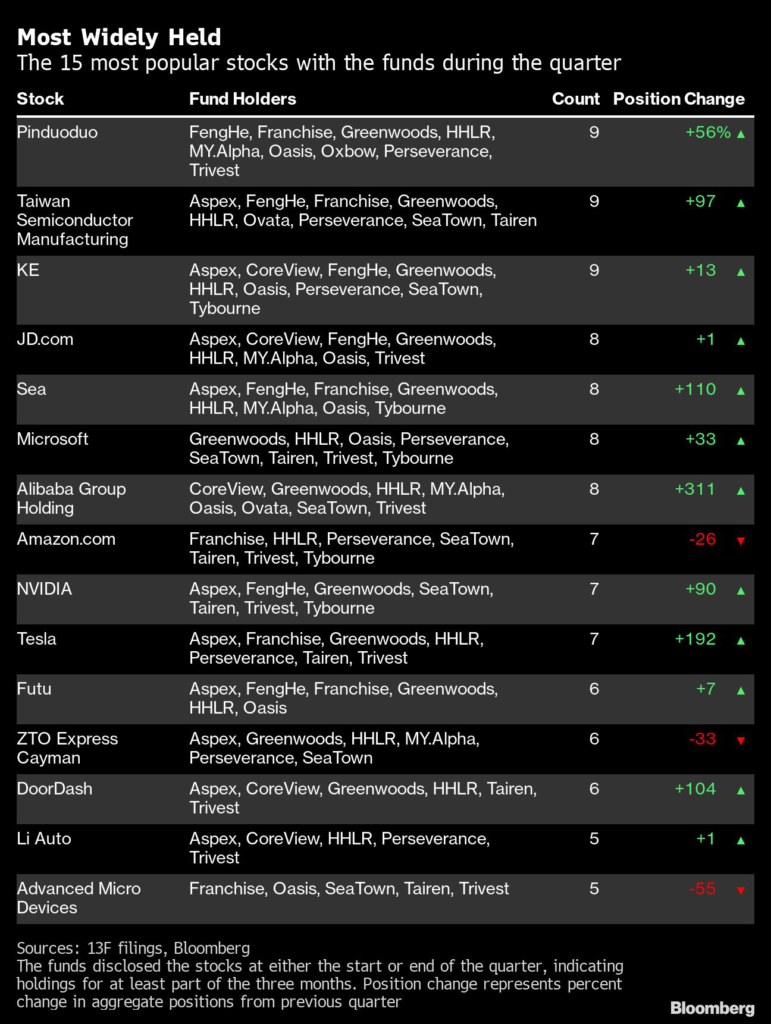
(Bloomberg) — Some of Asia’s biggest funds more than doubled their positions in Alibaba Group Holding Ltd. and Sea Ltd. in the second quarter after a yearlong rout. 

The number of Alibaba shares held by the Asia-focused funds increased 311% during the period, while that of Sea jumped by 110%. That’s based on the analysis of the 13F filings of 15 Asian asset managers — including hedge funds Aspex Management (HK) Ltd. and Oasis Management Co. — that had at least $200 million in quarter-end holdings. 

The choppy markets put Asia’s hedge funds to the test. A Nasdaq gauge with heavy exposure to Chinese technology firms has slumped nearly 67% since a February 2021 peak, as the regulatory crackdowns and geopolitical tensions spooked investors. 

The 13F filings, a quarterly report of US-listed holdings by money managers, provide a snapshot of the quarter-end positions of Asia’s largest funds, albeit offering less insight than for their their US peers that have more of their holdings in New York. 

A growing number of Chinese technology firms are now also listed in Asia, and the switch from US-listed to Asia-traded shares may explain some of the position changes. US-listed Asian companies tend to concentrate in the technology and health-care industries, meaning the filings may give a biased picture of the funds’ industry exposure. The filings also don’t reveal short-selling activities or timing of the trades.

The following charts give some overview of their quarter-end holdings.

Big Wagers:

E-commerce, delivery, solar energy companies, and electric vehicle makers made up the funds’ 20 largest combined holdings by market value at the end of June.

While JD.com Inc. topped the chart, Alibaba represented the biggest percentage increase in combined positions, measured in number of shares, from the previous quarter.

Alibaba’s US shares have slumped 72% since October 2020. Sea is down 82% from a high in October 2021.

The semiconductor trade is losing luster, with some of the Asian funds selling Advanced Micro Devices Inc., the second-largest maker of chips that run computers, Nvidia Corp., and Taiwan Semiconductor Manufacturing Co. 

The semiconductor industry is bracing for what could become the worst decline in a decade or more, due to a downturn in demand for consumer electronics. 

Hermes Li’s Hong Kong-based Aspex, which managed $8 billion earlier this year, went the other direction. His fund bought Nvidia and TSMC shares in the quarter, before TSMC raised its 2022 revenue forecast and said it would cut spending on expansion in mid-July.

Crowded Trades:

Meal and express delivery, semiconductors, e-commerce, electric vehicle and online brokerages were among the most crowded trades. 

Doubling Down:

Seven managers kept or added to their positions in Chinese online property platform operator KE Holdings Inc., whose US-traded shares jumped 45% in the quarter. 

Trimming Down:

Nvidia and TSMC were reduced by the biggest number of funds in the three months through June, joining Alphabet Inc. and Microsoft Corp. in the global tech rout. 

Some funds remained skeptical about the outlook of Chinese e-commerce companies, leading to cut backs in Alibaba and JD.com. 

Aspex, CoreView Capital Management Ltd., Oasis Management Co., Ovata Capital Management Ltd., Perseverance Asset Management declined to comment. 

HHLR Advisors Ltd., SeaTown Holdings, FengHe Fund Management, Franchise Capital Management Ltd., Greenwoods Asset Management Hong Kong Ltd., MY.Alpha Management HK Advisors Ltd., Oxbow Capital Management (HK) Ltd. didn’t respond to emails seeking comment. 

More stories like this are available on bloomberg.com

©2022 Bloomberg L.P.

Stocks Come Off Lows as Traders Weigh Fed Outlook: Markets Wrap

(Bloomberg) — An Asian stock gauge pared a slide Monday but remained in the red along with US equity futures as the Federal Reserve’s commitment to tighter monetary settings to quell inflation restrained investor sentiment.

MSCI Inc.’s Asia-Pacific share index dipped less than 0.5% with modest losses evident in most major markets except for a smattering of gains in China, which may have been boosted by a move by banks to trim lending rates.

S&P 500, Nasdaq 100 and European contracts suffered declines and a dollar gauge was at a more than one-month peak, signs of ongoing investor wariness.

Sovereign-bonds in Australia and New Zealand dropped and the US 10-year Treasury yield climbed to about 2.98%, extending a selloff from Friday.

A jump in global shares from June’s bear-market lows has begun to cool, weighed down by repeated Fed warnings that interest rates are going higher. Troubling global economic developments, lately including power shortages in a Chinese industrial heartland, are also hanging over investors.

The latest MLIV Pulse survey suggests stocks and bonds are set to tumble once more even though inflation has likely peaked: some 68% of respondents see the most destabilizing era of price pressures in decades eroding corporate margins and sending equities lower.

Key for markets this week is the Fed’s symposium at Jackson Hole, Wyoming. The recent stock bounce has loosened financial conditions, which makes it harder to tackle inflation. 

The symposium gives Fed Chair Jerome Powell a platform to reset the market’s expectations for a pivot to slower rate hikes. The latter bets have helped to drive the recent equity rebound but are vulnerable to the possibility of persistently elevated price pressures even as economic growth stumbles.

‘Remain Hawkish’

“It is likely central bankers, including Fed Chair Powell, will remain hawkish in dealing with inflation albeit with a bit of caution creeping in given the emerging economic downturn,” Shane Oliver, head of investment strategy at AMP Services Ltd., wrote in a note.

In China, banks lowered the one-year and five-year loan prime rates on Monday in the slipstream of a decision by the nation’s central bank last week to cut a key policy rate.

The world’s second-largest economy faces mobility curbs amid rising Covid cases and continuing property-sector woes, aside from a power crunch in Sichuan province, a key manufacturing hub.

The Chinese demand outlook is weighing in oil, which sank below $90 a barrel. Traders are monitoring Iran nuclear talks that could lead to more supplies. 

What to watch this week:

  • US new home sales, S&P Global PMIs, Tuesday
  • Fed’s Neel Kashkari speaks at Q&A session, Tuesday
  • US durable goods, MBA mortgage applications, pending home sales, Wednesday
  • US GDP, initial jobless claims. Thursday
  • Fed annual policy symposium in Jackson Hole, Wyoming, Thursday
  • ECB’s July minutes, Thursday
  • Fed Chair Powell speaks at Jackson Hole, Friday
  • US consumer income, PCE deflator, Friday

Some of the main moves in markets:

Stocks

  • S&P 500 futures lost 0.4% as of 11:41 a.m. in Tokyo. The S&P 500 fell 1.3%
  • Nasdaq 100 futures shed 0.5%. The Nasdaq 100 fell 2%
  • Japan’s Topix index fell 0.2%
  • Australia’s S&P/ASX 200 index was 0.8% lower
  • South Korea’s Kospi index declined 0.8%
  • Hong Kong’s Hang Seng Index was little changed
  • China’s Shanghai Composite Index added 0.4%
  • Euro Stoxx 50 futures fell 0.1%

Currencies

  • The Bloomberg Dollar Spot Index rose 0.1%
  • The euro was at $1.0032
  • The Japanese yen was at 137.29 per dollar, down 0.2%
  • The offshore yuan was at 6.8388 per dollar, down 0.1%

Bonds

  • The yield on 10-year Treasuries advanced one basis point to 2.98%
  • Australia’s 10-year yield rose 13 basis points to 3.54%

Commodities

  • West Texas Intermediate crude dropped 1.2% to $89.69 a barrel
  • Gold was at $1,747.72 an ounce

More stories like this are available on bloomberg.com

©2022 Bloomberg L.P.

Korea’s Exports Close to Stalling as Global Economy Cools

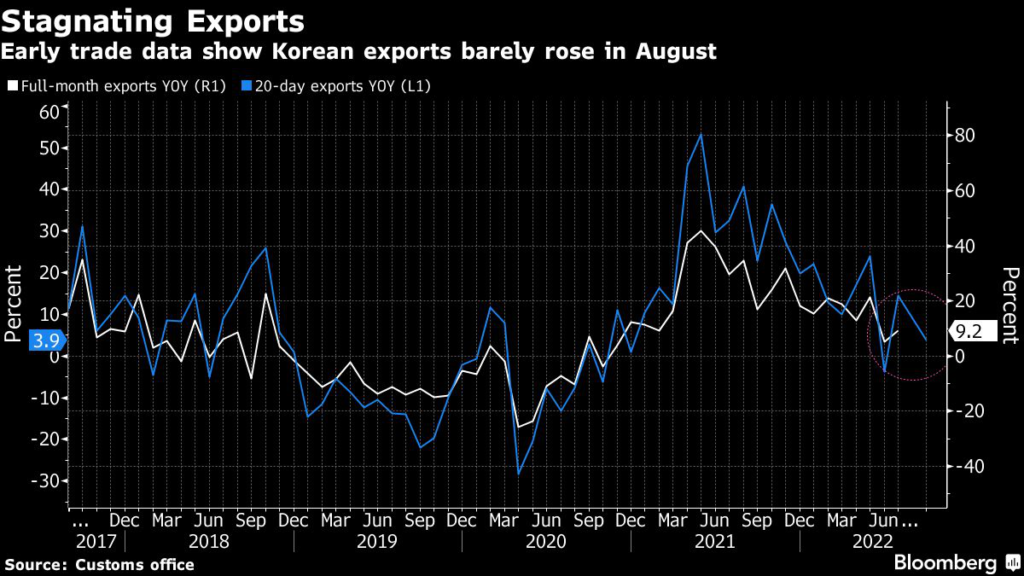
(Bloomberg) — South Korea’s early exports barely rose in August as geopolitical risks and central bank tightening weigh on the world economy.

Daily shipments increased 0.5% on average in the first 20 days of the month compared with a year earlier, the customs office said Monday. While total exports advanced 3.9%, chip sales declined 7.5% and shipments to China dropped 11.2%.

Korea’s exports have been under pressure from Russia’s war on Ukraine, Covid lockdowns and global interest-rate hikes. The recalibration of international activity following the end of the pandemic is also impacting on sales.

“Global factory operations are cooling,” said So Jaeyong, an economist at Shinhan Bank. “The global economy is coming down from its peak and bringing down along with it demand for semiconductors that did particularly well during the pandemic.”

Trade is key to South Korea’s economic growth as the nation relies heavily on exports. Overseas shipments also help underpin further policy tightening by the Bank of Korea as it seeks to shore up the currency and rein in inflation. The BOK meets to decide on rates on Thursday.

Korean exports serve as a key indicator of international economic activity with the nation’s companies embedded widely across global supply chains, including semiconductor and automobile makers.

Korea has been hit hard by elevated energy and commodity prices, driving up import costs and triggering a series of trade shortfalls this year. That’s raised the risk of the nation’s first annual trade deficit since 2008.

The trade deficit for the first 20 days of August amounted to $10.2 billion. That brings the total shortfall so far this year to $25.4 billion, according to the customs office.

(Adds details, economist’s comment, chart.)

More stories like this are available on bloomberg.com

©2022 Bloomberg L.P.

Bank Behind Fintech’s Rise Reels in Billions in Pandemic’s Wake

(Bloomberg) — One of the fastest growing banks in the US is on a mission to rewire the industry. It has also touched some nerves.

Cross River Bank began turning heads across the financial realm soon after Congress started unleashing $800 billion in emergency loans to help small businesses survive the pandemic. The little-known 14-year-old suburban New Jersey firm was soon arranging aid faster than almost every other bank. 

Cross River is the regulated bank behind a slew of fintech startups, ranging from online lenders to cryptocurrency venues. As tech ventures attracted borrowers, Cross River created the loans that generated roughly $1 billion in gross fees for handling US aid.

Two years on, the firm’s growth helped it win a more-than $3 billion valuation in a recent funding round. Some of those US-backed loans, meanwhile, are showing some signs of trouble. Forgiveness rates for the debts are unusually low, a potential indication that online borrowers might have abused the program and didn’t bother to follow through on paperwork to get debts canceled. Banks such as Cross River that the US encouraged to rush out pandemic aid haven’t been accused of wrongdoing.

It’s among a few concerns that have arisen in the past few years around the closely held company providing a swath of consumer financing, which is also packaged for sale to Wall Street investors. Since its founding on the brink of the financial crisis in mid-2008, Cross River has struck up partnerships with a who’s who of tech-fueled ventures challenging traditional banking — such as crypto giant Coinbase Global Inc., payments heavyweight Stripe Inc., and financing platforms Upstart Holdings Inc. and Affirm Holdings Inc. For a time, it also worked with Kabbage Inc.

Now Cross River is planning to use its pandemic-era earnings and the capital injection that followed to expand. As fintech ventures mature, they’re seeking to add services — transforming from apps that perform one or two functions into something more like diversified financial services firms. Cross River intends to help them branch out.

“A marketplace lender wants to become a payment company, and vice versa the payment companies want to become lenders,” said Cross River Chief Executive Officer Gilles Gade. “We want to be there for both of them.”

Some of Cross River’s activities have irked state authorities. It was among a group of firms that hashed out an accord with Colorado in 2020 after the state accused a pair of nonbank lenders of partnering with national banks such as Cross River to make loans with interest rates that local laws deemed too high. 

Disagreements over which firm is the “true lender” in such situations, and which laws apply, have been simmering in recent years. At the time of the accord, Cross River praised Colorado’s attorney general for creating a framework to resolve the issue. But the broader debate continues. When analysts at Moody’s Investors Service examined a $196 million issuance of securities backed by consumer loans from Cross River and another bank in June, they said investors should consider the possibility that authorities could revisit the true-lender issue.

“The social risk for this transaction is high,” wrote the report’s authors, Selven Veeraragoo and Pedro Sancholuz Ruda. “Marketplace lenders have attracted elevated levels of regulatory attention at the state and federal level,” and there’s still a chance that some of the loans could be deemed void or unenforceable, they said.

Lending Vacuum

Cross River’s rise presents an irony: One of the fastest-growing banks in America happens to embrace the idea that it’s a utility, a label scorned by many traditional lenders that have been trying to pitch themselves as tech platforms.

The bank focuses on structural issues in the financial system that Gade blames for neglecting some potential customers. Cross River’s name even refers to that mission, invoking the Jewish tenet of tikkun olam: providing a service to repair the world. “We’re trying to cross the spiritual river of banking by not trying to offer something that has been stuck in antiquity,” he said.

Another irony: Big banks keep accidentally helping the upstart along.

The venture started weeks before the collapse of Lehman Brothers Holdings Inc. ignited a global credit crisis. Big banks were groaning under the weight of their soured loans, and as they pulled back from consumer finance, that created a vacuum and an opportunity for online lending platforms. Many of those financial startups needed a commercial bank that they could plug into to underwrite their loans.

Over the years, Cross River notched rapid growth. And when the pandemic hit in 2020, traditional banks again ceded an advantage. The largest were initially slow to complete loans as they built systems to automate the process, leaving legions of small businesses clamoring for funds. Some branch staff began telling customers to try online lending platforms. Those funneled loan applicants through Cross River. In 2020, it ranked among the top three providers of the loans.

Leading up to the pandemic, Cross River made only a few million dollars a year on fees and interest from commercial and industrial loans, according to data filed with federal regulators. That changed rapidly once PPP aid started flowing. Between the second quarter of 2020 and the end of June, the bank made well over a half-billion dollars in revenue from commercial loans, the data show.

Forgiving Loans

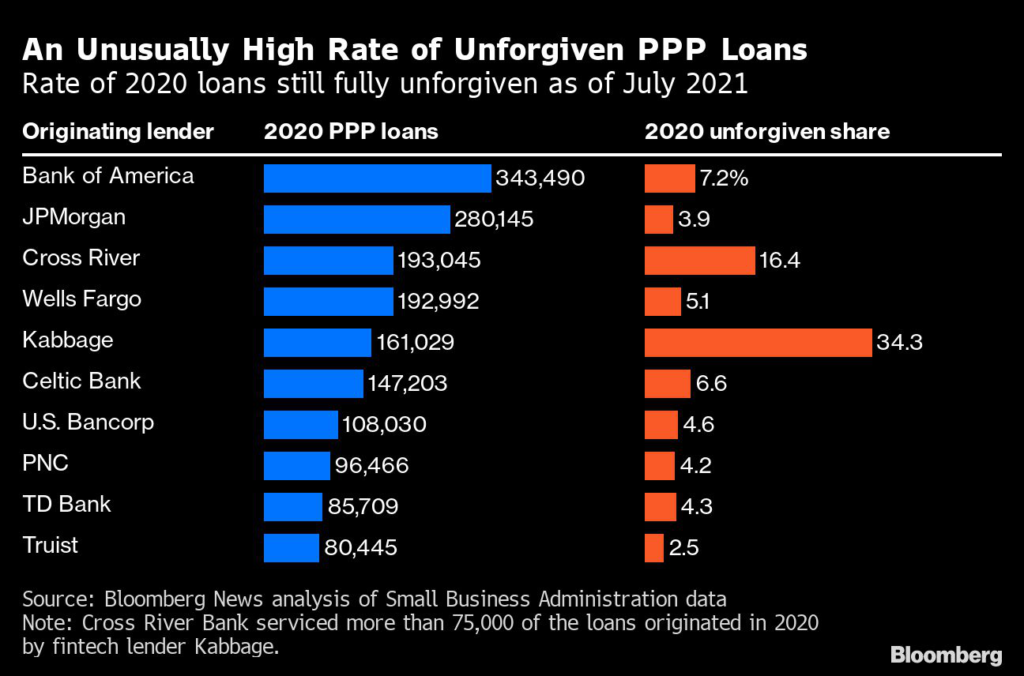
By the end of the relief program, Cross River had originated almost 480,000 loans from the Small Business Administration’s Paycheck Protection Program, a tally second only to Bank of America Corp.’s, the nation’s second-largest lender. The program allows for loans to be forgiven if borrowers later show they used the money to cover eligible costs.

Yet, forgiveness rates for loans originated by Cross River lag behind debts created by many competitors. That’s a worrisome sign, because legitimate borrowers are more likely to file the paperwork to avoid repayment. 

“Outstanding loan forgiveness applications are a potential indicator of fraud,” a February report from the office of SBA Inspector General Hannibal “Mike” Ware said. “Borrowers who fraudulently obtained a PPP loan are unlikely to apply for loan forgiveness.”

Of Cross River’s PPP loans in 2020, 16.4% were unforgiven as of July, versus 5% of loans across the program for that year. Forgiveness rates for Cross River’s 2021 loans have likewise trailed the broader landscape.

Cross River points out that such indicators flagged by watchdogs aren’t the same thing as actual evidence that borrowers engaged in fraud. Indeed, there are a variety of reasons why borrowers may decide not to seek forgiveness, including that they may not have spent money in ways that qualify for that step of the program. Or they may simply fail to follow through on the paperwork. 

Cross River notes that the hastily created US program succeeded in the goal of keeping businesses afloat. It also cites research showing fintech lenders were more effective in helping Black and Hispanic business owners.

The government has been expressing alarm over the number of loans that the broader program extended to people who lied on applications, often using stolen identities. The SBA’s watchdog said in May that it had detected 70,000 potentially fraudulent loans totaling over $4.6 billion. This month, President Joe Biden signed legislation that established a 10-year statute of limitation for fraud related both to the PPP program and the SBA’s Covid-19 Economic Injury Disaster Loan programs.

Yet lenders are generally shielded from recriminations. The SBA offered explicit guidance early in the pandemic indicating they were only responsible for performing “a good faith review” of calculations and documentation submitted by borrowers — a high bar for imposing liability.

“When it comes to the lenders, I think only the really egregious cases are going to be the ones where the government really goes after people,” said Elisha Kobre, a partner with law firm Bradley Arant Boult Cummings.

It’s unclear exactly how much Cross River’s growth in the past few years has benefited executives and founders with stakes in the company. A filing indicated the CEO had a roughly 7.9% fully diluted stake at the end of 2016. But the closely held firm doesn’t disclose his compensation, which at many banks includes stock, nor does it specify the dilutive impact of its fundraisings. 

Gade declined to comment on his net worth. “God runs my checkbook,” he said when pressed in an interview.

But after the latest funding round, he said, institutional investors hold about 30% of the firm, with the rest in the hands of “legacy” private investors.

More stories like this are available on bloomberg.com

©2022 Bloomberg L.P.

Ethereum Overhaul Risks Creating a New Class of Kingpins

(Bloomberg) — The much-anticipated upgrade of Ethereum will create new participants called builders in the blockchain ecosystem, a move that risks altering the power structure of what is arguably the most commercially important cryptocurrency network. 

Under the current system, networks of computers known as miners pluck transactions out of a special data pool, and arrange them into blocks that are added to the blockchain. The miners are being eliminated as part of a plan to reduce energy consumption. After the planned September upgrade known as the Merge, the builders will gather transactions into blocks, which they will then send to the validators. The validators will sign off on the order of the blocks that will form the upgraded blockchain. 

This seemingly geeky change, part of a portion of the software upgrade that is called MEV-Boost, could potentially make Ethereum more centralized, at least initially. While there are already more than 416,000 validators lined up to order transactions, there are only a handful of participants committed to serving as builders. The largest is Flashbots, which makes open-source software used by trading bots.

Flashbots is already the dominant way for miners to collect fees from traders by letting their transactions front-run and otherwise step around others. Other participants are considering becoming builders because of concern about Flashbots or similar entities having too much control if a major wallet starts sending all transactions to one builder.

“If wallets begin sending transactions directly to a handful of block builders, it kills decentralization,” said Uri Klarman, chief executive officer of BloXroute Labs, which has a network of servers that let traders send transactions to miners faster. About 40% of all the trading volume from decentralized finance apps, which let people trade, loan and borrow coins, is routed through the network, he said.

A powerful digital wallet like MetaMask, which gives users the ability to buy, sell and receive cryptocurrency, could become a “king maker,” Klarman said. MetaMask is the most popular non-custodial wallet, with 30 million users. 

A wallet service could favor one builder over all others and even decide to act as a builder, thus controlling the flow of transactions, Klarman said.

MetaMask is owned by the New York-based ConsenSys, which was founded by Ethereum co-founder Joseph Lubin. The software firm dismisses the concern. 

“We will never send all of MetaMask’s transactions to one specific builder or provider,” said Taylor Monahan, global product lead at MetaMask. “MetaMask’s value is derived from being a gateway to an exciting, vibrant, diverse and fair ecosystem. For that reason, MetaMask will always strive to make decisions that promote a healthy and decentralized Ethereum.”

The builder-validator role split was initially conceived as a way to increase Ethereum’s decentralization, and to take the power away from validators.

Still, having too few builders on the upgraded Ethereum chain raises potential issues. They could censor transactions from being included into blocks. Earlier this month, Flashbots blacklisted wallets associated with Tornado Cash, after the mixer protocol was sanctioned by the US Treasury Department. 

If there are very few builders, they can also command higher fees, with validators earning less. That could, in turn, lead to fewer validators choosing to get involved in supporting the network. To date, miners have earned about $240 million on the transaction-reorganization service, called MEV, according to Flashbots. The fees are expected to be a significant contributor to validators’ revenue as well.

Ether gained as much as 7% to $1,640 as of 11:55 a.m. in New York. It has dropped about 56% this year.

Builders can also capitalize on their users’ order flow. If a builder knows that a lot of users are placing orders for a particular token, they could buy a long position in it, for example. 

It’s like “Robinhood,  making money off order flow,” said Nathan Worsley, referencing the commission-free trading firm. Worsley and his partners, who make money off of transaction reorganizing liquidations and various complex trades, are considering becoming a builder, he said. 

Worsley isn’t alone in considering a change in focus because of the potential centralization risks and power shift.

“We’ll monitor the situation. If it gets closer to a centralized builder world, we’ll take action,” said Jonas Pfannschmidt at Blockdaemon, which runs validator nodes for clients.   

(Adds price information on Ether.)

More stories like this are available on bloomberg.com

©2022 Bloomberg L.P.

CEO of Israeli Spyware Company NSO Steps Down in Reorgnization

(Bloomberg) —

Israeli spyware company NSO Group’s chief executive officer is stepping down as the company restructures to focus on NATO-member countries, it said in a statement. 

Outgoing CEO and co-founder Shalev Hulio said in a press release that the company is preparing for “its next phase of growth.” The firm is also cutting 100 posts out of its 750-strong workforce, according to an official in the company who asked not to be identified because of the sensitivity of the subject.

NSO’s Pegasus software is sold to governments and law enforcement agencies, who use it to hack into mobile phones and covertly record emails, phone calls and text messages. Amnesty International, Citizen Lab and Forensic Architecture last year documented the use of the spyware in more than 60 cases to target dissidents and government critics in countries including Rwanda, Togo, Spain, the United Arab Emirates, Saudi Arabia, Mexico, Morocco and India. 

A shift in business to focus only on members of the North Atlantic Treaty Organization would exclude most of the countries cited in the report. 

“NSO will ensure that the company’s groundbreaking technologies are used for rightful and worthy purposes,” Chief Operating Officer Yaron Shohat, who will be leading the reorganization, said in a statement. 

Last year, the US added NSO to a list of entities banned from receiving exports from American companies, citing its role in developing and supplying spyware and hacking tools. 

NSO said last year that it refuses to sell its spyware to 55 countries, while 15% of potential Pegasus sales were rejected in the prior year due to human rights concerns.

More stories like this are available on bloomberg.com

©2022 Bloomberg L.P.

Close Bitnami banner
Bitnami