Bloomberg

Block ‘Slow Walking’ Cash App Probe, Consumer Watchdog Says

(Bloomberg Law) — The Consumer Financial Protection Bureau asked a federal judge to force Block Inc. to fully comply with a pair of investigative demands related to its Cash App payments tool.

The CFPB’s petition, filed Thursday, urged the US District Court for the Northern District of California to enforce a civil investigative demand. Block, the digital payments company led by CEO Jack Dorsey, has yet to provide all of the documents and data the CFPB requested in August 2020 and August 2021, the consumer finance industry regulator alleged in its petition.

The investigation is looking into Cash App’s handling of complaints and disputes. The San Francisco-based company disclosed the investigation in a March 2022 securities filing.

“The Bureau cannot sit back while its investigation is stymied by Block’s slow-walking,” the CFPB’s petition said.

Block is “disappointed” that the CFPB elected to file its petition despite the company’s “regular communication” and cooperation, a Block spokesperson said in an email.

“We have been waiting weeks for the CFPB to respond to our most recent communication, which outlined the scope of our prior responses, set-forth a proposed timeline for the remainder of the production of materials, and posed additional clarifying questions for the bureau,” the spokesperson said.

The CFPB didn’t immediately responded to a request for comment.

The CFPB said that it has met with Block’s counsel several times to go over the document and data requests and has agreed to both modify what it’s looking for and extend deadlines.

But Block still failed to provide documents related to six specific questions, the CFPB said in its petition.

Block has never filed a formal petition at the CFPB to modify or set aside the investigative demands, the bureau said. Such a petition would require a review by the CFPB of the demand.

The date set for full compliance for the 2020 investigative demand was Oct. 14, 2020, according to the petition. The 2021 demand’s compliance deadline was Dec. 5, 2021 following consultations with Block, it said.

Block has yet to provide any firm dates by which it will produce relevant documents and data, instead saying that it would “endeavor” or “hope” to provide responses to requests, the CFPB said.

In one instance, Block failed to propose production dates for documents, instead saying they were “to be determined” or “TBD,” the CFPB’s petition said.

That was a clear invitation for the CFPB to go to court to mandate document production, said Jenny Lee, a former CFPB enforcement attorney.

“Not engaging meaningfully in the meet and confers is an easy justification for the staff to pursue the lawsuit,” Lee, now a partner at ArentFox Schiff LLP, said.

To date, Block has only provided some 900 documents to both investigative demands, the CFPB said. Other firms that are subject to the CFPB’s investigation on this topic have produced “thousands or even tens of thousands of documents without undue delay,” the agency said.

The CFPB’s petition shows that companies will have to more completely engage with the bureau on investigative demands, rather than think they can get away with partial disclosures, Lee said.

“You can’t assume that any partial productions are going to score brownie points,” she said.

The case is CFPB v. Block Inc., N.D. Cal., No. 3:22-mc-80214, Petition to Enforce Civil Investigative Demand 8/18/22.

To contact the reporter on this story: Evan Weinberger in New York at eweinberger@bloomberglaw.com

To contact the editors responsible for this story: Maria Chutchian at mchutchian@bloombergindustry.com; Roger Yu at ryu@bloomberglaw.com

(Updated with Block’s comments in paragraphs 5 and 6 and additional reporting throughout)

More stories like this are available on bloomberg.com

©2022 Bloomberg L.P.

Block ‘Slow Walking’ Cash App Probe, Consumer Watchdog Says

(Bloomberg Law) — The Consumer Financial Protection Bureau asked a federal judge to force Block Inc. to fully comply with a pair of investigative demands related to its Cash App payments tool.

The CFPB’s petition, filed Thursday, urged the US District Court for the Northern District of California to enforce a civil investigative demand. Block, the digital payments company led by CEO Jack Dorsey, has yet to provide all of the documents and data the CFPB requested in August 2020 and August 2021, the consumer finance industry regulator alleged in its petition.

The investigation is looking into Cash App’s handling of complaints and disputes. The San Francisco-based company disclosed the investigation in a March 2022 securities filing.

“The Bureau cannot sit back while its investigation is stymied by Block’s slow-walking,” the CFPB’s petition said.

Block is “disappointed” that the CFPB elected to file its petition despite the company’s “regular communication” and cooperation, a Block spokesperson said in an email.

“We have been waiting weeks for the CFPB to respond to our most recent communication, which outlined the scope of our prior responses, set-forth a proposed timeline for the remainder of the production of materials, and posed additional clarifying questions for the bureau,” the spokesperson said.

The CFPB didn’t immediately responded to a request for comment.

The CFPB said that it has met with Block’s counsel several times to go over the document and data requests and has agreed to both modify what it’s looking for and extend deadlines.

But Block still failed to provide documents related to six specific questions, the CFPB said in its petition.

Block has never filed a formal petition at the CFPB to modify or set aside the investigative demands, the bureau said. Such a petition would require a review by the CFPB of the demand.

The date set for full compliance for the 2020 investigative demand was Oct. 14, 2020, according to the petition. The 2021 demand’s compliance deadline was Dec. 5, 2021 following consultations with Block, it said.

Block has yet to provide any firm dates by which it will produce relevant documents and data, instead saying that it would “endeavor” or “hope” to provide responses to requests, the CFPB said.

In one instance, Block failed to propose production dates for documents, instead saying they were “to be determined” or “TBD,” the CFPB’s petition said.

That was a clear invitation for the CFPB to go to court to mandate document production, said Jenny Lee, a former CFPB enforcement attorney.

“Not engaging meaningfully in the meet and confers is an easy justification for the staff to pursue the lawsuit,” Lee, now a partner at ArentFox Schiff LLP, said.

To date, Block has only provided some 900 documents to both investigative demands, the CFPB said. Other firms that are subject to the CFPB’s investigation on this topic have produced “thousands or even tens of thousands of documents without undue delay,” the agency said.

The CFPB’s petition shows that companies will have to more completely engage with the bureau on investigative demands, rather than think they can get away with partial disclosures, Lee said.

“You can’t assume that any partial productions are going to score brownie points,” she said.

The case is CFPB v. Block Inc., N.D. Cal., No. 3:22-mc-80214, Petition to Enforce Civil Investigative Demand 8/18/22.

To contact the reporter on this story: Evan Weinberger in New York at eweinberger@bloomberglaw.com

To contact the editors responsible for this story: Maria Chutchian at mchutchian@bloombergindustry.com; Roger Yu at ryu@bloomberglaw.com

(Updated with Block’s comments in paragraphs 5 and 6 and additional reporting throughout)

More stories like this are available on bloomberg.com

©2022 Bloomberg L.P.

Everyone Is Talking About ‘Quiet Quitting,’ But Is It a Good Idea?

(Bloomberg) — “Quiet quitting” has struck a nerve. It means more time for friends, family and personal pursuits, not to mention a side hustle. But the latest workplace trend has drawbacks. 

TikTok and Twitter are awash in explainer videos and endless interpretations. Despite what the name suggests, quiet quitting doesn’t mean turning in a resignation letter. Instead, it’s a stealth retreat from the hustle culture that dominated the pre-pandemic era of giving up everything in pursuit of ambition. Quiet quitting is the newly minted moniker for doing the bare minimum of the job description.

Should you quietly quit, too? Here’s why and why not:

Work-life balance:  Zaid Khan, 24, who created a popular quiet quitting video on TikTok, said he started exploring “work reform” and the subreddit r/AntiWork during the Covid-19 lockdown when his job became all-consuming.

“I realized no matter how much work I put in I’m not going to see the payoff that I’m expecting,” Khan, a software developer and musician, said in an interview. “Overworking only gets you so far in corporate America. And like a lot of us have experienced in the past few years, mental and physical health really takes a backseat to productivity in a lot of these structured corporate environments.”

@zaidleppelin

On quiet quitting #workreform

♬ original sound – ruby

According to a report released by the American Psychological Association in January, the kind of burnout and stress Khan encountered has hit all-time highs across industries during the pandemic.

Organizational psychologist Ben Granger, head of employee experience advisory services at survey firm Qualtrics, said that quiet quitting can be a way to protect mental and physical health in a toxic work environment. But staying in a miserable job and putting in the bare minimum means giving up the fulfillment that can come from a good one. 

For his part, Khan ended up quitting for real for a new manager who respects his work-life boundaries. “He tells me all the time, your health comes first,” he said. “If you ever need to take a day off or if you need to ever take need to take some time away — there’s so much more than work that we’re doing.” 

Passion projects: Antrell Vining, 25, has a day job as a project manager in the finance industry. As a side hustle after hours, he creates social media content about the tech industry and millennial and Gen Z work life. After dropping out of medical school to pursue a career in tech, he works to help others make similar career changes. With close to 30,000 followers on TikTok, Vining makes money offering career and resume consulting services and through partnerships with companies, he said. For him, quiet quitting means setting boundaries so he has the time and energy to pursue his passion project. 

In one video, which satirizes quiet quitting in action, he slams his laptop shut mid-Zoom meeting at 5 p.m. sharp.

@techbyantrell

Sorry not sorry #workfromhome #fyp #corporatebaddie #youngprofessional

♬ original sound – Sir Jiro

A streak of entrepreneurship coincided with the Covid-19 pandemic and a record 5.4 million new businesses were started in the US last year, according to Census data. 

“Nowadays, everyone is an entrepreneur of sorts and we would much rather put that extra energy into our own ventures outside of a 9-to-5,” Vining said by email. “Once 5 o’clock comes around, I take a breather and get to work on my own stuff or spend some well-deserved time with friends and family,” he said. “I like to make content that reminds people that they should do the same.”

It’s not for everyone: Of course, not everybody is comfortable with quiet quitting. There are many reasons people feel the need to maintain their job at all costs — whether it’s the health care, the steady paycheck or any of the other benefits that traditional corporate jobs afford. Putting that at risk can be too big a wager to make. 

Jha’nee Carter, 38, who calls herself the HR Queen on TikTok, said that quiet quitting has added risks for marginalized groups. “Can minorities afford to do this in corporate America? In my opinion, I’m going to say no,” Carter, a business coach and content creator, said in a video. 

Structural inequalities remain in many industries throughout the US: Gender and racial pay disparities, as well as a general dearth of diversity in c-suites, are well-documented. 

@_thehrqueen

Can quietly quitting destroy your career? #hrqueen #quietquitting #iquit #corporateamerica #mentorforu #youngprofessionals #hrlife #hrtok #careertips #careeradvice #careeradvicedaily #leadershipdevelopment #ReTokforNature

♬ Level Up – Kwe the Artist

“If you are quietly quitting and you’re not going above and beyond, unfortunately in corporate America minorities are held to a different standard,” she said. “We are looked at differently, there is unconscious bias still, and so we have to go above and beyond in order to be successful. We can’t risk being looked at as not performing, if we are not meeting those expectations, we are the first on the chopping block.”

Recession risk: Quiet quitting has gone viral at a time of deep uncertainty in the labor market. With a war for talent and more jobs than workers throughout the economy, employees have had the upper hand over their bosses. But a looming recession and layoffs at high-profile companies like Apple Inc., Peloton Interactive Inc. and Walmart Inc. indicate the balance of power could be tipping.

A new survey by consulting firm PwC found that half of respondents in the US  said they’re reducing headcount or plan to. A July report from Joblist, a job search platform, found that 60% of job seekers feel more urgency to find a new one now before economic conditions change. 

“Corporations are laying people off with a quickness,” Carter added in her video. “And so if you have decided to quietly quit, I really hope that you’re quietly having a recruiter look for another job for you.”

More stories like this are available on bloomberg.com

©2022 Bloomberg L.P.

Paramount Beats Amazon With $1.5 Billion Deal for Champions League Rights

(Bloomberg) — Paramount Global renewed its US media rights to Champions League football matches in a deal valued at more than $1.5 billion over six years, more than doubling the size of its previous contract in a sign of the sport’s growing popularity with Americans.

The owner of the CBS network and Paramount+ streaming service will air the annual tournament featuring Europe’s top football teams under a new agreement that runs from 2024 to 2030. Paramount will pay about $250 million per year, up from about $100 million a year under the prior deal, according to people familiar with the matter.

The Union of European Football Associations, or UEFA, had been seeking about $2 billion over six years for the English- and Spanish-language rights combined, but decided to hold off on selling Spanish rights because the streaming market for that audience is still in its early days, the people said. TelevisaUnivision Inc., which currently owns the Spanish-language rights, launched a new streaming service called Vix+ in July. Meanwhile, its rival, Telemundo, plans to start a content hub on Peacock, the streaming service owned by its parent, Comcast Corp.The new deal with Paramount validates the Champions League as one of the most valuable European football properties in US media and is further evidence of the soaring cost of sports rights. In November, Comcast Corp.’s NBC agreed to pay more than $2.5 billion over six years to renew the US rights to broadcast English Premier League matches. That was nearly triple the cost of its previous deal. Apple Inc. is paying a minimum guarantee of $250 million per year for Major League Soccer rights, almost triple the value under the previous agreement, according to Sports Business Journal. Paramount is betting the sport will continue to gain popularity in the US. The Champions League final between Real Madrid and Liverpool attracted 2.8 million viewers on its CBS network in May, the largest US audience ever for a final game broadcast on English-language television. It also was the largest streaming audience for a match on Paramount+.Before settling on Paramount, UEFA also had preliminary discussions for the Champions League rights in the US with Comcast’s NBC, Walt Disney Co.’s ESPN, Amazon.com Inc., Apple, Fox Corp., Warner Bros. Discovery Inc., Univision and DAZN, according to the people, who asked not to be identified because the talks were private. In the end, Paramount and Amazon made the two highest bids, the people said.

“UEFA has been a key driver for Paramount+ since our launch and we are thrilled to extend this successful partnership showcasing even more world-class soccer through the 2029-30 season, building on the incredible momentum we have created the past two years,” said Sean McManus, chairman of CBS Sports.

The Champions League is “the anchor that brings in soccer fans” to Paramount+, said Christopher Harris, publisher of World Soccer Talk, a website that covers soccer broadcasting in the US.

“If Paramount had lost the rights to Amazon, it would have been a devastating blow for Paramount+’s subscriber numbers,” Harris said.

For UEFA, it was a particularly good moment to negotiate a new contract. Not only are media companies willing to pay more for sports rights, the US is also hosting the World Cup in 2026, which is likely to generate more excitement around the sport.

The bidding process for the Champions League was run by Relevent Sports Group, which was co-founded by Miami Dolphins owner Stephen M. Ross. In February, Relevent won the rights to broker UEFA’s US media deals, beating out other agencies such as Octagon and Endeavor’s IMG by promising to sell the rights for at least $250 million a year.

“Relevent has been building fandom for European football in the US for over a decade and we are incredibly excited about what this means for the future of the sport,” Chief Executive Officer Daniel Sillman said in a statement.

(Updates with comments from World Soccer Talk in eighth paragraph and Relevent CEO in 12th.)

More stories like this are available on bloomberg.com

©2022 Bloomberg L.P.

Walmart, DoorDash Plan to End Four-Year Delivery Partnership

(Bloomberg) — Walmart Inc. and DoorDash Inc. are ending their four-year delivery partnership. 

“We have agreed to part ways,” Walmart said in an email Friday. “We’d like to thank DoorDash for their partnership and support of our customers the past several years.”

The retail giant said it would continue to work with “multiple providers to bring delivery to our customers.” Walmart said its platform for self-employed drivers, called Spark, has become its largest delivery provider, capable of serving 84% of US households with 7,000 pickup points. 

Walmart and DoorDash began working together in 2018 with a test in Atlanta. The decision to split up was reported earlier by Insider, which said DoorDash advised Walmart earlier this month that it would end the partnership in September, saying the deal “was no longer mutually beneficial.”

What Bloomberg Intelligence Says

“Online delivery companies like DoorDash and Uber have done well to expand in adjacent segments, yet the ending of DoorDash’s partnership with Walmart shows the challenge in driving scale while maintaining take rates. Basket sizes are bigger in grocery, and we believe take rates of high single digits to low teens could have been a point of contention in the alliance.”

–Mandeep Singh and Ashley Kim, technology analysts

Click here to read the research.

DoorDash will “focus on its long-term customer relationships,” according to the report. DoorDash has a separate grocery-delivery deal with Albertsons Cos., as well as deals with retail chains like Bed Bath & Beyond Inc. and Macy’s Inc. The San Francisco-based company also partnered with Meta Platforms Inc. this month to deliver items purchased from Facebook Marketplace.

“We’d like to thank Walmart for their partnership and are looking forward to continuing to build and provide support for merchants in the years ahead with our leading marketplace and platform offerings,” a spokesman said in a statement.

Walmart fell less than 1% to $138.13 at 12:46 p.m. in New York. DoorDash slid 3.3% to $64.52, similar to the declines posted by other gig-driver companies such as Lyft Inc. and Uber Technologies Inc. 

More stories like this are available on bloomberg.com

©2022 Bloomberg L.P.

What Slowdown? Lamborghini Has Orders Booked Out to Early 2024

(Bloomberg) — Central banks are making it costlier to borrow and prices of just about everything are going up. Lamborghini is holding up just fine.

The Sant’Agata Bolognese-based Italian manufacturer has booked orders all the way out to early 2024, covering about 18 months of production, Chief Executive Officer Stephan Winkelmann said Friday on Bloomberg Television.

“With high interest rates and high inflation, we’re still going strong,” Winkelmann said. “With the prices of energy skyrocketing, especially in Europe, we have not seen any slowdown yet.”

Read more: Lamborghini Dealers Are Keeping Warm Despite Crypto Winter

Lamborghini delivered 5,090 vehicles worldwide through June, up almost 5% from the same period last year and the best first half in the company’s history. While the Volkswagen AG-owned carmaker’s energy costs have more than doubled, prices are unlikely to go much higher next year, Winkelmann said.

More stories like this are available on bloomberg.com

©2022 Bloomberg L.P.

Twitch’s Gambling Boom Is Luring Gamers Into Crypto Casinos

(Bloomberg) — Enneric Chabot, 26, didn’t start gambling until he saw his favorite gamers doing it online. 

Three years ago, Chabot began regularly watching Felix “xQc” Lengyel, a former professional Overwatch player, as he competed in various video games on Amazon.com Inc.’s  livestreaming site Twitch for audiences of up to 25,000 viewers. In 2021, during some of his streams, Lengyel started playing something else—online blackjack. 

Chabot, who lives in Quebec and does accounting for a hospital, was intrigued. “I thought it was pretty entertaining,” he said. 

At one point, Chabot saw Lengyel post a promotional code for a site called Stake.com — which bills itself as a “leading online crypto casino.” On Stake, and sites like it, users can exchange money for cryptocurrencies, which they can then use to wager on various games of chance, including slots, blackjack  and roulette. Chabot redeemed the offer and dove into the slots scene on Stake. At first, he enjoyed making bets repeatedly for the equivalent of $1. Then things went downhill.

“I just started losing and losing,” Chabot recalled.

After a couple of months, Chabot says he drained his life savings of about $40,000. Then, he says, he took out two $20,000 bank loans and burned through that money too. Eventually, Chabot declared bankruptcy. 

While Chabot’s decision to keep betting was his own, he says watching the Twitch streamers festively gambling on the site “gave me a reason to go on Stake, like I was a part of what they were doing,” he told Bloomberg in an interview.

He’s not the only one to go all in. These days, “slots” is the seventh most popular content category on Twitch, ahead of the video game Fortnite. Many streamers are paid handsomely to take part in the activity. One popular streamer said he makes “much more” than $1 million a month as part of his sponsorship with Stake to crypto gamble in front of live audiences on Twitch. 

Earlier this year, several publications reported that, according to Lengyel, as of May 2022 he’d been able to generate $119 million in bets for Stake. Lengyel has subsequently said during livestreams that the $119 million figure was how much he had personally wagered in total on the site at the time. Bloomberg was unable to confirm the amount with Stake.

Stake, which says it operates under a gaming license in Curacao, is one of the top companies pouring sponsorship riches into the Twitch community. The location Stake gives as its registered address in Curacao appears to be a run-down shack on Google Earth.  The company says most of its staff is based in Europe.

Crypto gambling is illegal in the US, although it is permitted in other countries, according to Frank DiGiacomo,  an attorney who leads the gaming law group at Duane Morris LLP in Philadelphia. Canada has been welcoming to crypto operators, potentially contributing to why some streamers moved there.

It is still possible to place bets on Stake from the US using a virtual private network, which disguises the location of the user, and crypto currency, however.

A Stake spokesperson says it has implemented “stringent compliance processes” that prevent people using VPNs from depositing funds in countries where it is not allowed. Stake adds that it “uses a number of measures to address at risk gambling behavior,” including free gambling-blocking software for its users. “Stake takes its regulatory obligations extremely seriously and complies with all applicable laws.”

Gambling may not be a feature on Twitch forever. A Twitch spokesperson says the company is “currently in the midst of a deep-dive look into gambling behavior on Twitch.” Since Lengyel and others included links last year, the company has since decided not to allow sharing links or referral codes for  gambling companies, which the spokesperson says was done “to address scams and other harms associated with questionable gaming sites.”

“We take any potential harm to our community extremely seriously,” the spokesperson says. “While gambling content represents a very small fraction of the content streamed on Twitch, we monitor it closely to ensure our approach mitigates potential harm to our global community.” Resources for anyone suffering from a gambling addiction are available in Twitch’s Safety Center, the company says.

After taking a year long break, Lengyel, a Canadian who is among most popular Twitch celebrities with 11 million followers, is now once again gambling routinely on his Twitch streams. In late July, some 70,000 viewers watched him click a digital slot machine button over and over again. Part of the fun of watching is that the stakes tend to be absurdly high. During one recent stream, Lengyel  lost $164,000 in crypto within just 139 seconds. Lengyel did not respond to Bloomberg’s request for comment.

It’s not just gamers getting in on the action. In May, the rapper Drake, who is also Canadian, entered into a partnership with Stake to gamble live on Twitch under the username StakeDrake. Starting with a $9 million balance, Drake placed single roulette bets for between $300,000 to $1 million while 56,000 viewers looked on. The terms of Drake’s partnership with Stake were not made public. Spokespeople for the rapper did not respond to a request for comment.

All the celebrity endorsements and the sponsored streams appear to be working as intended, driving Twitch users to the crypto casinos. Vaibhav Kumar, a 25-year-old native of India, began crypto gambling in 2020 after seeing the girlfriend of his favorite League of Legends streamer making some bets live on Twitch. Now, he logs onto Stake four to five times a week, betting from  $20 to $200.

For a while, Kumar primarily watched streamers who were sponsored by Stake until, he says, it dawned on him that their losses were being counterbalanced by lucrative promotional deals.  By contrast, his own losses were offset by nothing. 

“Once the initial excitement of seeing someone play with such huge sums wore off, it was mostly off-putting and made me sick watching it,” he said. “It also gave viewers a false sense of winning and losing.”

“Sites are using celebrities and platforms that are geared toward younger people.”

For some young gamers, the on-ramp to the crypto casinos can be traced back several years to another form of betting that flourished among video game fans on Twitch and other sites—that is, gambling with virtual goods from the popular shooter game Counter-Strike: Global Offensive. As part of this vibrant, billion-dollar market, celebrity gamers were launching websites where users could play roulette by wagering digital weapons from the video game, some of which were worth hundreds or thousands of dollars. Kids under 18 had no problem getting in on the action. 

Jakub, who asked not to share his last name for fear of career repercussions, says that when he was 13 he went on one of the sites and won a $200 knife. He was too young to withdraw the money and promptly gambled it away. 

Eventually, the site he was using morphed into a crypto casino. When he was 16, Jakub saw a Twitch streamer promoting Stake and moved his online gambling habit there. Now, the resident of the Czech Republic says he logs onto Stake almost every day, gambling in series of $50 buy-ins. If he wins big, he buys computer parts or shoes. Mostly, he says, he loses to the tune of $1,000 to $1,500 a month.

Although crypto-gambling has been a heavy presence on Twitch for over a year, it’s now attracting more viewers—and more controversy—than ever.

Matthew “Mizkif” Rinaudo, another top Twitch personality, who became known through his entertaining World of Warcraft livestreams, says he has been offered $19 million per year to gamble live on Twitch in front of his enormous audience. Although Rinaudo has gambled on Twitch in the past, he now believes that it is morally questionable to do so. Last year, Rinaudo saw one of his fans, who was 14 at the time, gambling on a site that he’d promoted. 

“I stopped because I just felt genuinely bad,” Rinaudo told Bloomberg.  

Some top video-game streamers—including Lengyel, who has described himself as “addicted”— have shifted their gambling habit to the hours of the day when they are not performing in front of an audience. In May, he admitted that he had lost $1.8 million the prior month gambling. 

“I go out of the way to tell you not to do it,” he said during one livestream. “I do it because I can afford it, and I enjoy it, and I think it’s content.”

Another top streamer, Tyler “Trainwrecks” Niknam, said in January he’d lost $12.9 million gambling, according to Dexerto, a video game news site. Niknam did not respond to a request for comment.

For years, offshore gambling has been a thorn in the side of US regulators. In June, 28 members of Congress wrote a sternly worded letter to the Department of Justice asking for it to take action against offshore sports betting sites operating without approval in the US. Alex Costello, vice president of government relations for the American Gaming Association, a trade group for casinos, says lawmakers are focused on regulating and shuttering the largest illegal betting sites and crypto gambling doesn’t yet rank at the top of the list. Offshore casinos typically have sophisticated methods for obfuscating ownership, and that goes doubly for the crypto space, which lawmakers are still struggling to understand, she said.

Costello added that it’s troubling such “sites are using celebrities and platforms that are geared toward younger people,” to attract customers. About 75% of Twitch users are between the ages of 16 and 34.

About 6% and 9% of young people struggle with gambling compared to 1% of adults, according to the National Center for Responsible Gaming. In recent months, more than 2,300 people have signed a Change.org petition asking Twitch advertisers including Nvidia Corp. and PepsiCo Inc. to reconsider advertising on the platform in light of the gambling streams. The companies did not respond to requests for comment.

Streamers like Rinaudo believe it’s Twitch’s responsibility to stop providing a platform for promoting offshore crypto gambling sites. As long as Twitch allows it, he says, streamers are likely to keep accepting enormous sums of money to promoting sites like Stake.

“Streamers are going to gamble 12, 14, 16, 22 or 38 hours a day, because they’re getting paid to do it,” he said.  

(Corrects an error in ninth paragraph of Aug. 5 story to reflect what Lengyel says about the source of the $119 million wagered on Stake.)

More stories like this are available on bloomberg.com

©2022 Bloomberg L.P.

Bitcoin Drops Most in Two Months as Global Markets Turn Risk Off

(Bloomberg) — Cryptocurrencies suffered a sharp selloff as global markets retreated after US Federal Reserve officials reiterated their resolve to keep raising interest rates until inflation is contained. 

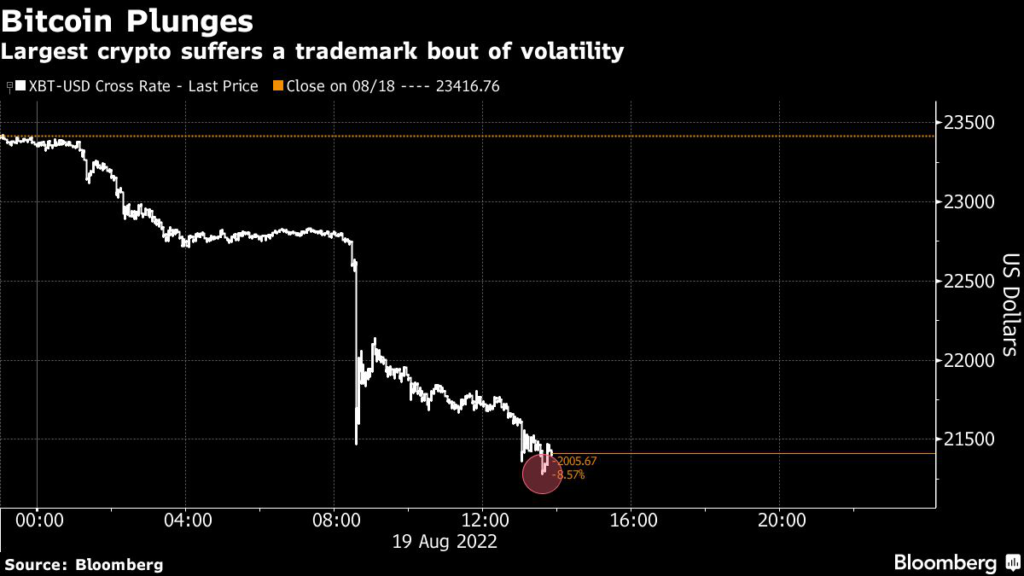
Bitcoin, the largest virtual coin by market capitalization, tumbled as much as 9.2% to $21,271, the biggest intraday drop since June 18. Ether and smaller tokens saw even sharper declines, with Avalanche, Cardano and Solana falling more than 10%. 

Digital assets are getting punished as investors unwind bets that the Fed might raise interest rates less than initially feared. Optimism about more favorable liquidity conditions drove a more than 40% rally in Bitcoin since June’s crypto market crash, while Ether more than doubled at one point. 

A big chunk of the day’s losses came all at once during Asia trading, when Bitcoin lost almost 5% of its value versus the dollar in roughly a minute just before 2:45 p.m. Singapore time. Such mini-crashes are rare but not unheard of in online currencies, where futures transactions often dominate price action and are subject to near-instantaneous liquidations by automated engines. 

About $220 million of crypto positions got liquidated in the span of an hour on Friday, with Bitcoin accounting for roughly half of that, according to data from Coinglass. 

“Bitcoin is a speculative asset and speculative assets don’t do well during tightening regimes, when the central bank is tightening and liquidity is becoming more scarce,” Jose Torres, senior economist at Interactive Brokers, said in an interview. “It does not surprise me that Bitcoin has erased a lot of its gains from recently reaching $25,000.”

Digital tokens slumped amid broad declines in equity markets, with the S&P 500 and the Euro Stoxx 50 each slipping about 1%. 

Altcoins Pummeled

The latest reversal in sentiment has hit altcoins, which tend to be more volatile than Bitcoin and Ether, especially hard. Solana tumbled as much as 14% on Friday, the biggest drop since June 13, and Cardano fell by a similar magnitude.  

Cryptocurrency prices have fallen sharply since May, when the collapse of stablecoin project Terra set off a wave of liquidations, bankruptcies and layoffs in the sector. Bitcoin’s price has rebounded since hitting a low of $17,599 on June 18, but remains down 54% this year.

The recovery is looking increasingly fragile as traders struggle to get a clear sense of the direction of Federal Reserve monetary policy. Two Fed officials, James Bullard and Esther George, on Thursday gave divergent signals on the size of the next interest-rate hike. However, both reiterated the need to keep raising borrowing costs. 

Fed Officials Offer Mixed Signals on Size of September Rate Hike

Attention now turns to the Fed’s annual symposium in Jackson Hole, Wyoming next week. There’s already speculation that Fed Chair Jerome Powell may lean against a recent loosening in financial conditions that’s driven financial markets higher in past weeks.

“I guess we’ll soon see just how much appetite there is for Bitcoin in these rather unusual market conditions,” Craig Erlam, senior market analyst at Oanda, said in an email.

(Updates with comment from economist in sixth paragraph.)

More stories like this are available on bloomberg.com

©2022 Bloomberg L.P.
Flare-Up in Ethiopia Tensions Dulls Hopes of Lasting Peace Deal

(Bloomberg) — Ethiopia’s government and rebels from the northern Tigray region accused each other violating a tenuous truce they agreed in March after more than 16 months of fighting, dampening hopes that a permanent peace accord is within reach. 

The conflict devastated millions of peoples’ lives and left most of Tigray without power and incommunicado, while souring Ethiopia’s reputation as one of Africa’s top investment destinations. The two sides’ leaders have yet to meet face to face, and ongoing animosity between them has impeded efforts to distribute aid and delayed reconstruction. 

About 89% of Tigrayan households are food insecure, a 6 percentage point increase since November 2021, the World Food Programme said in a report released on Friday. It also found that at least half of pregnant and lactating women in the region were acutely malnourished. While Ethiopian Prime Minister Abiy Ahmed has allowed some aid to enter the region, relief agencies say much more is needed. 

The Tigray region’s military command this week accused Ethiopian soldiers of bombarding its forces around the town of Dedebit in the western part of its territory earlier in the week. No casualties were reported.

The attack was “a deliberate act authorized at the highest level,” the command said in an Aug. 17 statement. It warned that force now appeared to be “the only viable route” for its annexed territory in Western Tigray to be liberated.

Western Tigray, a flat swathe of fertile farmland bordering Sudan, was seized by forces from the neighboring Amhara region soon after the civil war erupted in November 2020, forcing thousands of residents to flee. Regional forces and militiamen from Amhara backed Abiy in the war.

Billene Seyoum, Abiy’s spokeswoman, told reporters in Addis Ababa, the capital, on Thursday that a government panel has made a proposal for peace talks “within the coming weeks” with the aim of formulating a lasting settlement between the opposing sides, and that they must be held “without pre-conditions.” Services to Tigray could only be restored once requisite security and administrative arrangements have been made, she said. 

But Tigray’s government said it won’t participate in the talks until its control of Western Tigray is restored, and Getachew Reda, a senior official, said on Thursday that discussions must be preempted by the resumption of basic services to the region.

Billene meanwhile accused the Tigray forces of using humanitarian channels to accumulate weapons, and illegally acquiring foreign and local currency to fund a renewed military campaign. She didn’t address the Tigray region’s accusations that federal forces had staged renewed attacks. 

Conflict’s Roots

A standoff between the government and the Tigray People’s Liberation Front, which dominated the country’s ruling coalition from 1991 until Abiy took power in 2018, steadily heightened after the prime minister set about consolidating power under his newly formed Prosperity Party. Fighting erupted after Abiy ordered a military incursion into Tigray after accusing forces loyal to the TPLF of attacking a military base to steal weapons.

The renewed tensions have coincided with warnings about a deterioration of living conditions within Tigray. World Health Organization Director-General Tedros Ghebreyesus described the situation there as the “worst humanitarian crisis in the world,” with 6 million people still unable to access basic services, and he bemoaned the lack of attention being paid to it by the international community.

“Maybe the reason is the color of the skin of the people,” Tedros, a Tigrayan, told a virtual media briefing on Aug. 17. 

Selamawit Kassa, state minister of the Ethiopian government’s communication service, said Tedros’s comments fed into  an organized propaganda campaign run by the TPLF and paid lobbyists to “divert attention away from the government’s decision to resume peace talks.”

More stories like this are available on bloomberg.com

©2022 Bloomberg L.P.

US Earnings to Watch: Salesforce, Peloton, Zoom, Nvidia, Gap

(Bloomberg) — Better-than-expected US retail sales data and upbeat outlooks from Walmart and Target this week demonstrated the resilience of the American consumer amid hyperinflation and rising rates. Yet evolving shopping behaviors across the income spectrum, along with price markdowns from excess inventory, are contributing to the highest proportion of earnings misses for the consumer discretionary sector than elsewhere in the S&P 500 this season. Reports next week will give investors further insight into the second-half for retailers, chipmakers and software providers as the peak earnings period draws to a close.

  • To subscribe to earnings coverage across your portfolio or other earnings analysis, run NSUB EARNINGS.
  • Follow our TOPLive blogs for real-time coverage and analysis of results from Peloton.

Monday: Zoom Video (ZM US) will report after-market. The video conferencing provider is likely to see y/y revenue growth drop into the single digits for the first time since it went public, based on the company’s own forecast and consensus estimates, as a weakening economy and broader return-to-office trends cut into sales. Efforts to drive further gains in the post-Covid era, such as boosting enterprise sales and new offerings like Phone and WhiteBoard, may not be enough to sustain growth due to rising competition from Microsoft Teams and slowing IT budgets at smaller business clients, according to Citi analysts who downgraded its shares to sell this week.

Tuesday: Dick’s Sporting Goods (DKS US) will report before market opens. Investors will look for signals on whether the largest US sports equipment and apparel retailer can maintain its pandemic-era gains as consumers shift spending to essentials amid rising prices. Cowen analysts see an opportunity for management to raise the low end of its full-year adjusted EPS outlook after they gave a wide forecast range last quarter. Fears of financial risk are emerging on the credit front as its bonds have recently traded at a wider spread than other higher-grade peers, which Bloomberg Intelligence says may put its investment-grade status in jeopardy if expectations of margin pressure stemming from its product suppliers materialize.

  • JD.com (JD US) is due premarket. Investors may watch for commentary on whether the US-traded Chinese e-commerce company might follow in Alibaba’s footsteps and upgrade its secondary listing status in Hong Kong to a dual-primary listing. Doing so will help it gain direct access to mainland Chinese investors, as tech shares have struggled to attract global investors amid regulatory concerns that have resulted in Chinese state-owned giants from PetroChina to China Life Insurance withdrawing from US exchanges entirely. For the second quarter, analysts from Citi to Barclays to Jefferies expect the company to post largely stable margins on “disciplined” cost control. That’s even as y/y revenue growth in the period is expected to shrink to a record low due to weak Chinese shopping sentiment amid Covid lockdowns and economic uncertainty.

Wednesday: Salesforce (CRM US) reports after the closing bell. The second-quarter current remaining performance obligations growth — a closely watched indicator of near-term demand — may top the consensus estimate of 18%, Bloomberg Intelligence says, thanks to steady cloud spending. Yet, even as enterprise IT spending holds up well, macroeconomic uncertainty could slow gains in the marketing and commerce software segment, which is projected to post the slowest year-on-year revenue growth in at least seven years. 

  • ESG in focus: Investors will be on the lookout for an update on Salesforce’s Sustainability Cloud offering, particularly its carbon accounting tools in light of the US SEC’s proposed climate and greenhouse gas reporting requirements, according to Bloomberg Intelligence Senior ESG Analyst Rob Du Boff. “We talk a lot about the ESG risks and costs, but this is a clear case of a company with a huge business opportunity from ESG,” he adds.
  • Also Wednesday, Nvidia (NVDA US) will discuss its outlook on its earnings call after the closing bell. The maker of graphic chips that are a staple of high-end gaming computers earlier this month reported preliminary second-quarter revenue that fell short of expectations, as a slowdown in the gaming industry hurt top-line growth.

Thursday: Peloton (PTON US) is due before the bell. The fitness company has in past weeks taken drastic steps to trim costs, ranging from job cuts to price hikes to store closures, as well as suspending in-house production of its bikes and redesigning them for self-assembly. Analysts including Bloomberg Intelligence will now turn their attention to the fourth-quarter results, in addition to management’s free cash flow guidance. Consensus estimates are projecting a 27% year-on-year contraction in revenue — the steepest since Peloton shares began trading — and the slowest sequential growth in Connected Fitness subscribers, anticipating a mere 22,000 additions from the prior quarter. 

  • Gap (GPS US) will report after market close. The owner of the Old Navy and Banana Republic brands suffered a series of price target cuts from Wall Street analysts after ousting its CEO and warning investors of the negative impact from aggressive markdowns on its gross margin. The metric is now projected to come in at 36%, down from 43.3% a year ago, according to Bloomberg Consensus. Having trimmed its full-year earnings outlook in the last report, the apparel retailer could once again revise it as consensus estimate points to a median adjusted EPS of $0.11, well below its last-issued guidance of $0.30-$0.60. Operational challenges, on top of macro pressure, are threatening Gap’s results, Wells Fargo analysts say, adding that fundamentals are deteriorating far worse than anticipated.

More stories like this are available on bloomberg.com

©2022 Bloomberg L.P.

Close Bitnami banner
Bitnami