
Bloomberg

Value Trade Crumbles on Wall Street, Putting Quant Funds at Risk

(Bloomberg) — If Wall Street is right, the big revival in value investing in the post-lockdown era is in danger of falling apart all thanks to the resurgent bond market.

Strategists from JPMorgan Chase & Co. to Wells Fargo & Co. warn that the best days may now be over for cheap-looking stocks as investors dump the likes of oil producers and banks on the conviction that inflation has peaked. 

With traders wagering that an economic slowdown will cool historic price pressures, a long-short value trade has dropped 13% since the mid-June high point in bond yields. 

At the same time, companies touted for their above-average potential to expand profits, known as growth stocks, outperformed their value counterparts by the most in 22 years in July, MSCI indexes show, after Big Tech names from Apple Inc. to Amazon.com Inc. rebounded. 

And for the first time in two years, a majority of investors polled by Bank of America Corp. in early August said value will trail growth going forward — just months after the former was favored the most in more than a decade. 

“The macro trends are very favorable longer term for the growth style,” said Christopher Harvey, head of equity strategy at Wells Fargo in an interview. “Value typically performs better leaving a recession and into a recovery due to its balance sheet and operating leverage.”

All this skepticism is quite the turnaround for one of the hottest trades on Wall Street in post-lockdown markets — and defies reams of quantitative research that says the link between rates and value is far from consistent historically. 

No wonder systematic investors like Cliff Asness warn those snubbing the investing style in a knee-jerk response to falling yields are getting sucked into a “misleading” theory that there’s a simple — and direct — relationship between the two. 

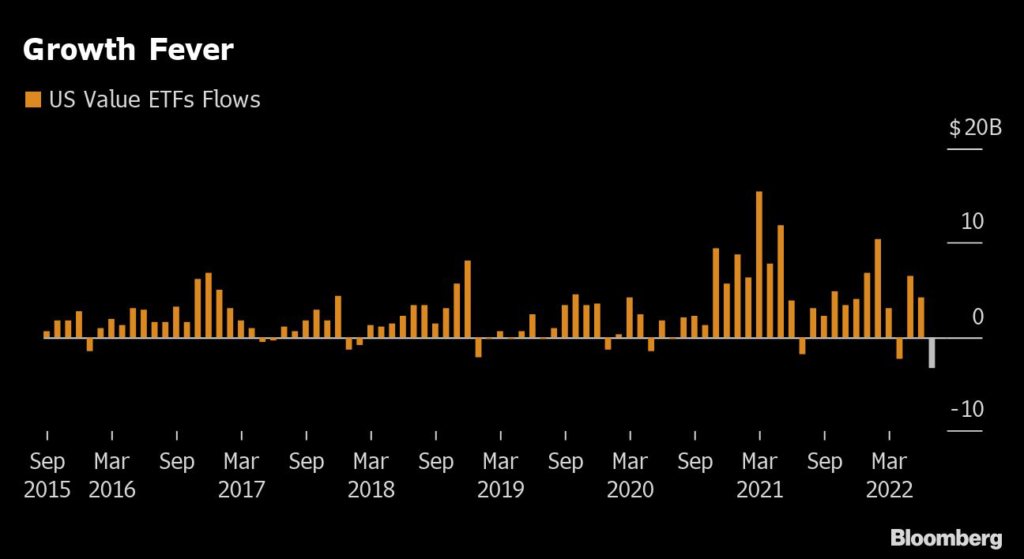
For now the skeptics have it, with $3.3 billion flowing out of US exchange-traded funds tracking value stocks in July, according to data compiled by Bloomberg Intelligence. Meanwhile, growth funds have added $5.4 billion in August, after a $3.8 billion haul last month. 

“Should one go back into value style? Not yet,” JPMorgan strategists led by Mislav Matejka wrote this week. “The key is the direction of long yields.” 

The conventional wisdom holds that value stocks like Exxon Mobil Corp. and Berkshire Hathaway Inc. tend to be more cyclical and offer near-term cash flows, while growth shares like tech are prized for their long-term prospects. Growth stocks are considered larger beneficiaries of falling bond yields because their valuations and expected cash flows are heavily influenced by interest-rate changes. 

But despite the fastest US monetary tightening since the 1980s, bond yields have fallen from their peaks — spurring a rotation out of cheap stocks. 

JPMorgan says the growth factor may keep winning as the latest data suggest the economy is slowing, but Societe Generale SA’s Andrew Lapthorne isn’t so sure.

“Not only are central banks not there to backstop markets as they have been in recent years, but growth stock profits are proving somewhat fragile as well,” the global head of quant strategy wrote in a recent note. 

Read more: Where the Amazon Fallacy Runs Into Growth Rebound: John Authers

One tell-tale sign that growth firms are more vulnerable to the current economic slowdown: The group in the S&P 500 is expected to see profits falling almost 1% this year, compared with an expansion of 10% for its value counterpart, analyst estimates compiled by Bloomberg Intelligence show. The weakness partly reflects the robust growth enjoyed by internet and software companies during the pandemic lockdowns, and helps explain why the style has been more volatile this year.

The value-versus-growth question is critical for quants, who have mounted a spirited comeback since 2021 in a market less obsessed with tech darlings amid historic inflation. 

In part thanks to a slant toward value equities, 60% of quants beat their benchmark in the first half of this year, compared with 39% of active funds, Nomura Holdings Inc. data show. Among hedge funds, they are up 6% this year, versus an average 4% loss in the industry, according to prime-brokerage data from Goldman Sachs Group Inc. through July. 

To the likes of Asness, co-founder of AQR Capital Management whose Equity Market Neutral Fund is up 13% this year, cheap stocks can still outperform wherever rates go. His calculations show there’s no consistent relationship between yields and value-growth over the long haul, echoing previous research from GMO LLC and Robeco.

“Long-term there is very little evidence that the return of the value factor is anything other than trivially correlated to changes in interest rates,” Asness wrote in a blog post last week.

More stories like this are available on bloomberg.com

©2022 Bloomberg L.P.
Big Tech Has a Message for Schumer: We Come Bearing Gifts

(Bloomberg) — As Senate Majority Leader Chuck Schumer decides whether to hold a vote on legislation aimed at forcing more competition on big tech firms, he’s become the beneficiary of a wave of personal donations from lobbyists for the internet giants.

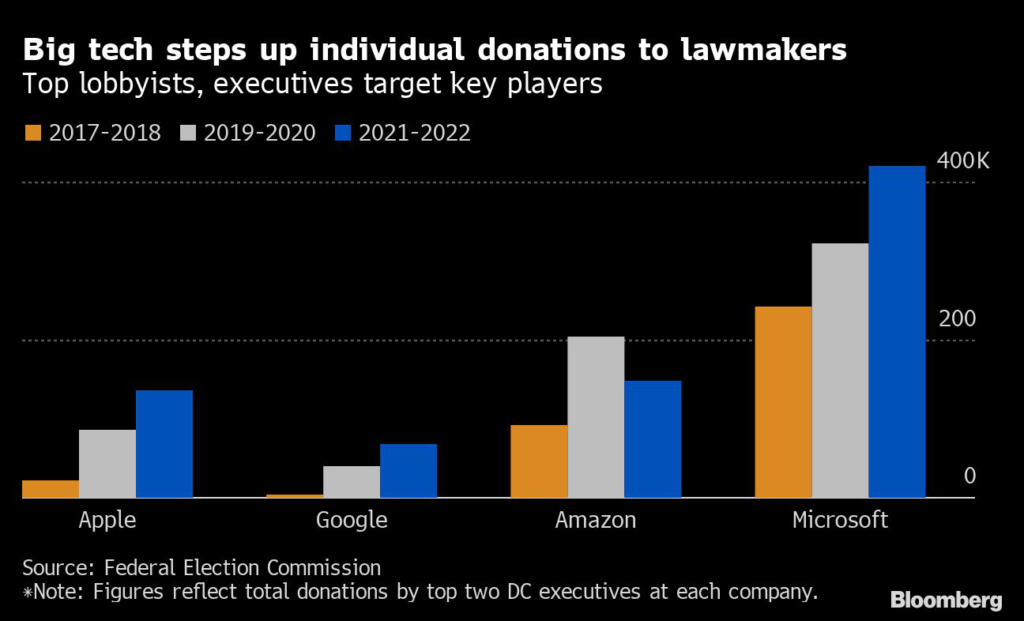
After receiving no money from any of the top lobbyists for Apple Inc., Amazon.com Inc. or Alphabet Inc. in the two previous election cycles going back to 2017, Schumer’s attracted some $30,000 in direct donations to his campaign from the lobbyists and executives of the companies opposed to a bill that would curb how the platforms operate. 

It’s a sign of stepped-up lobbying and donations by individuals as the power of the technology giants comes under scrutiny on Capitol Hill, a Bloomberg News review of giving shows. 

Congress is considering the American Choice and Innovation Online Act sponsored by Minnesota Democratic Senator Amy Klobuchar to prevent companies from using their platforms to disadvantage rivals. 

Klobuchar’s antitrust bill would be the most significant piece of legislation aimed at the tech giants to pass Congress after years of inaction. Despite bipartisan anger at the industry, lawmakers have been unable to pass significant regulation.

After delaying the vote, Schumer said he’s working with Klobuchar and others to gather the 60 needed votes to pass the legislation and plans to bring it to the floor in September. If it becomes law, the largest tech companies could be forced to change their business practices, potentially costing them billions of dollars.

With a decision looming, the industry’s lobbyists are reaching more deeply into their own pockets and targeting those who might be swayed against the bill.

Campaign finance laws limit individual contributions compared with the millions the companies spend on lobbying. Individual donations are capped at $2,900 to each lawmaker per election and $36,500 to national party committees. While money alone doesn’t determine votes, research has shown that giving money improves donors’ access to congressional offices.

PACs for the major tech companies excluding Apple, which doesn’t have a political action committee, have doled out roughly $4 million in campaign contributions since the beginning of 2021. Corporations use PACs to pool voluntary donations from executives, capped at $5,000 per year, and then contribute the money to candidates, other PACs and parties that align with their interests.

Apple’s stranglehold over the App Store

With Apple facing opposition to its iron-clad grip over its App Store, the company’s director of federal government affairs, Tim Powderly, tripled his campaign contributions from the previous election cycle, donating a total of $41,500 between 2021 and 2022. He targeted the campaigns of lawmakers who publicly voiced concerns about the tech bills, including Representative Zoe Lofgren and Senator Mike Lee. He also donated to Kevin McCarthy, an antitrust skeptic who could become the next House Speaker if the GOP retakes control, and Frank Pallone, the chair of the tech-focused House Energy and Commerce Committee.

Apple’s top policy executive Lisa Jackson, the former Environmental Protection Agency administrator who donates prolifically to Democrats, gave $36,500 to the Democratic Congressional Campaign Committee this year. A few months later, she was seen next to House Speaker Nancy Pelosi at a private fundraiser. Pelosi will decide whether the antitrust legislation will go to a vote in the House this fall.

Amazon’s general counsel maxed out on donations

David Zapolsky, general counsel of Amazon and a frequent bundler for Democrats, has given over $123,000 in political contributions, primarily focused on vulnerable Democrats in difficult races, most of whom haven’t taken a public stance on the antitrust legislation. He’s also maxed out individual donations to key senators who haven’t yet committed to vote for the antitrust bill: Senators Michael Bennet, Ron Wyden, Maggie Hassan and Catherine Cortez Masto. Hassan, Cortez Masto and Wyden each received thousands of dollars from Amazon’s PAC as well.

Powderly, Zapolsky and Google’s Chief Legal Officer Kent Walker also all maxed out contributions to Schumer. And last year, Amazon’s Chief Executive Officer, Andy Jassy, made his first donation to Senator Patty Murray, a Washington Democrat.

Amazon spokesman Alex Haurek said it’s “simply inaccurate to suggest” that Amazon executives make political contributions based on legislation potentially affecting the company.  

Google’s global head focused on GOP lawmakers

Karan Bhatia, global head of public policy and government affairs for Google, has donated about $28,500 this election cycle, aiming most of his funds toward GOP candidates. That’s a sharp increase from his roughly $16,000 in donations during the 2019-2020 election cycle.

Mark Isakowitz, Google’s vice president of government affairs and public policy, spent about $39,000 on lawmaker campaigns, donating to a number of GOP candidates. Isakowitz spent about $25,000 the previous election cycle. Both Isakowitz and Bhatia donated to South Dakota Republican Senator John Thune, who serves as the GOP’s minority whip and hasn’t said publicly whether he will vote for the legislation.

Microsoft says it’s not lobbying for or against

Microsoft Corp., the target of a Justice Department monopolization case in the late 90s, says it’s not lobbying for or against the antitrust bill. Instead, its executives are using it as an opportunity to deepen their ties with Congress and present the company as a “responsible” tech leader. They have spent even more than their counterparts, the Bloomberg analysis shows.

Microsoft lobbyist Fred Humphries was with House Minority Leader Kevin McCarthy of California at a January fundraiser hosted by Jeff Miller, a lobbyist who represents Amazon and Apple. Humphries gave $2,500 to McCarthy and $32,000 to the National Republican Campaign Committee this election cycle.

Humphries, vice president of US government affairs for Microsoft, has given $90,000 to lawmakers at the federal level, a boost from $75,000 during the last election cycle. Microsoft President Brad Smith has increased his spending to about $330,000 this election cycle, up from $248,000 in the 2019-2020 contests and $201,700 in the 2017-2018 election cycle.

The Microsoft executives also gave money to Schumer. Smith donated $5,800 to him last year and met with him this year. 

“Our executives have a history of political giving in their personal capacity to candidates on both sides of the aisle,” said Microsoft spokesperson Kate Frischmann.

Google declined to comment. Representatives from the senators’ offices and Apple didn’t respond to requests for comment. 

More stories like this are available on bloomberg.com

©2022 Bloomberg L.P.

Dodge Gives Drag Racers a Reason to Embrace Electric Muscle Cars

(Bloomberg) —

Tim Kuniskis, the head of Stellantis’s Dodge brand, has been running a non-stop marketing marathon that would test the endurance of the most seasoned auto executive.

First, the top evangelist for Challenger and Charger muscle cars briefed reporters at the company’s design dome in Auburn Hills, Michigan. Then he mingled with drag-racing YouTube stars ahead of a Dodge-sponsored weekend race. Then he was emcee for three nights in a row of product reveals, all building up to the moment of truth: Dodge’s unveiling of an all-electric muscle car, the Charger Daytona SRT.

Kuniskis says the growling, aerodynamic beast with an 800-volt battery closely resembles a production vehicle Dodge will bring to market in 2024. There’s a lot at stake in how the car plays with the brand’s core drag-racing fans, which is why Dodge has done its best to recreate the experience of revving a V-8 with the instant torque of a roughly 700-pound battery.

Electric vehicles provoke resentment for some drag racers, who view them as the spawn of regulators frowning on 800-plus-horsepower engines and the greenhouse gases they emit. There’s also the fear EVs threaten to take the human creativity out of the sport.

As one young drag racer at Dodge’s speed fest explained, someone will spend a bunch of money to build their car and tune it to peak performance, only for a Tesla Model S Plaid right off the showroom floor to beat them on the strip. What’s the point of customizing your hot rod when some jerk with $130,000 to drop can show you up?

Kuniskis is doing his best to fight against commoditization. While most EVs on the road today are single-speed, the Charger Daytona has a multi-speed transmission with electronic and mechanical shifting, so the driver can still feel like they’re physically connected to the car’s propulsion. He also wants to keep customization alive.

The BEV Charger will offer “slam” and “donut” modes that owners can unlock by buying components from the brand’s aftermarket parts unit. Dodge resurrected the unit, Direct Connection, earlier this year, partly to assure its fan base that it’ll continue to support their hobby long after the last gas-powered muscle car rolls off the line next year.

Of all the ingredients that make muscle cars stand out from the “nothingburger” sedans Kuniskis likes to mock, there are two things Dodge can’t mess up: power and sound. He won’t talk about the Daytona’s specs yet, but the company says it’ll be faster than its 700-plus horsepower Hellcat models.

“If they’re gonna jump into this electric game, they need to be the king of electricity. They need to come with the power,” said Herman Young, who runs a drag-racing YouTube channel called Demonology and attended the festivities this week in Pontiac, Michigan.

Young isn’t resisting the EV revolution — his wife drives a Model Y — but he’s wistful when he talks about how quiet EVs are, and what this will mean for the brotherhood of muscle.

“Humans, we equate speed with sound, and until we get used to making that adjustment, it’s going to take some of the excitement out of it,” he said. “Sound is power in the era we grew up.”

Kuniskis has an answer for that, too. Dodge engineers took the firing order of a V-8 engine and used it to create a sound that’s amplified with air pushed through a chambered exhaust system. The result is an electronic roar, sort of like a cybernetic jaguar, with a low-idling purr or high-pitched whine when the car shuts off.

“It’s opening as many questions as it’s answering, with all the sound and the multi-speed transmission,” said Stephanie Brinley, an analyst for S&P Global Mobility who attended Dodge’s events this week. “What it says most importantly is, ‘We will still be a muscle car, we will still give you that visceral reaction, we will be sure it triggers the emotions that the current car does.’”

More stories like this are available on bloomberg.com

©2022 Bloomberg L.P.
ESG Funds That Hoarded Tech Risk More Pain Yet, Amundi Says

(Bloomberg) — ESG funds’ longstanding devotion to tech ignores some basic principles of portfolio management and exposes investors to the risk of continued losses, according to the head of equities at Amundi SA.

There’s been “a lot of complacency,” said Kasper Elmgreen, who’s overseen stock allocations at Amundi since 2019. “Good ESG is not a replacement for bad fundamentals. You need both.”

ESG fund managers have had one of the worst starts to a year in recent memory, thanks in large part to their exposure to big tech. That’s after some of the largest environmental, social and governance funds spent years loading up on the sector, which proved a hugely lucrative bet during the pandemic. It quickly backfired, however, once central banks started yanking up interest rates to combat decades-high inflation. 

“The market went a little bit on autopilot, both on hailing the ESG credentials of tech, but also of basically ignoring gravity, ignoring fundamentals in terms of what these companies were worth and allowing them to trade at multiples that were unsustainable,” Elmgreen said. 

And even though “we’ve seen some of the hot air come out of the balloon,” the selloff probably isn’t finished, according to Elmgreen. “There’s still some excesses priced in,” he said.

Relative Weighting of 15 Large US ESG Funds


The MSCI World Information Technology Index has lost about 18% this year, dragging down returns in some of the biggest ESG investment funds. BlackRock Inc.’s iShares ESG Aware MSCI USA ETF (ESGU), the world’s largest ESG exchange-traded fund, lists Apple Inc., Microsoft and Amazon.com as its three top holdings. It’s fallen about 12% this year.

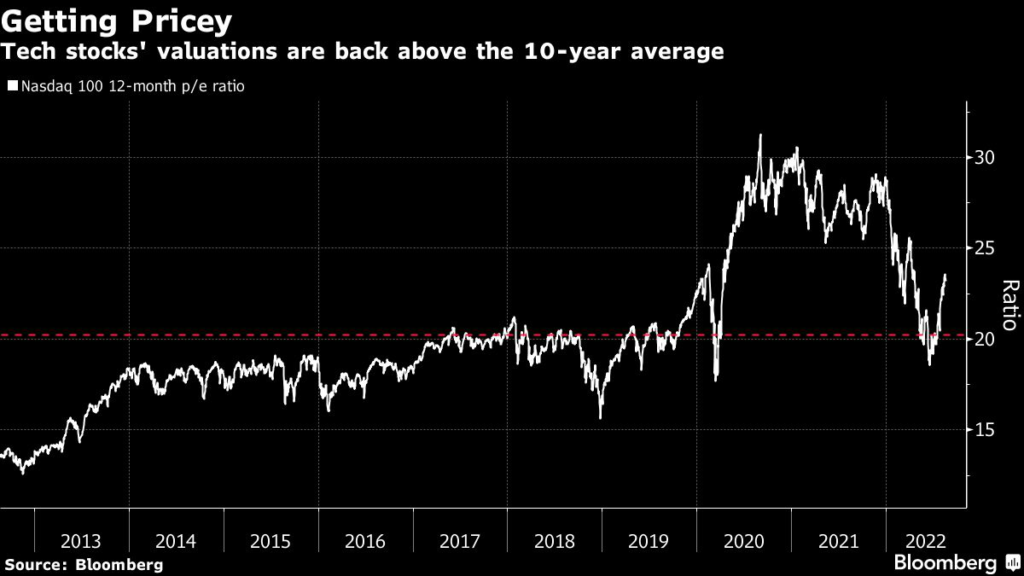
Those declines include the effect of a rebound that started in mid-June. In fact, the recent gains in technology stocks have lifted the Nasdaq 100’s valuation to 23.2 times forward earnings, above the average valuation of 20.2 times over the past decade. 

Elmgreen said most of the actively managed funds he oversees at Amundi are typically underweight tech. “There are some companies we find that offer opportunity,” he said, without elaborating. “But on average it’s an area where we just can’t get the math to work.”


Part of the ESG challenge facing tech is the extent to which hidden social risks are set to surface. That’s as ESG investors become more sensitive to issues such as workers’ rights and supply chains that may rely on human rights abuses, according to Elmgreen. The cost-of-living crisis has already triggered widespread strikes across Europe, demonstrating the risk to businesses of ignoring such social considerations.

“There’s a risk around labor practice,” both in relation to employees and supply chains, Elmgreen said. 

Amazon.com Inc. is among tech giants to have grappled with a rising number of unfair labor practice complaints from workers around the US, while federal investigators recently inspected several of the company’s warehouses as part of a probe into potential worker safety hazards. Such labor-rights movements have won the attention of US President Joe Biden, reflecting the changing political climate.

Workers’ rights have garnered greater attention this year after tight labor markets made it harder for companies to retain employees, forcing many to consider wage rises. Apple Inc. is responding by boosting its company-wide compensation budget, as it contends with efforts to unionize its stores across the US. 

Elmgreen said another potentially under-appreciated risk in tech is how efforts to regulate data protection will affect the industry. 

Such considerations, all of which fall under the “S” of “ESG,” are “risks that are perhaps less intuitive,” he said. 

(Adds latest tech market moves)

More stories like this are available on bloomberg.com

©2022 Bloomberg L.P.

Rare ESG Debt Format Endorsed as Key to Dodging Greenwashing

(Bloomberg) — A rarely-used financial product that makes it easier to monitor the performance of sustainable projects has been endorsed as a reliable way to avoid greenwashing in the $4 trillion ESG debt market.

The idea combines green debt, where proceeds are broadly used to fund environmental projects, with sustainability-linked bonds (SLBs), where the amount of interest an issuer pays depends on whether it meets specific sustainability goals. The Institute for Energy Economics and Financial Analysis, which advocates for a faster transition from fossil fuels, said on Thursday that a hybrid model — so-called green SLBs — can ease investors’ greenwashing concerns and become best practice for sustainable debt.

So far only a handful of green SLBs have found their way into the market, including one issued by Austrian electricity provider Verbund AG, and others by Japan’s Takamatsu Construction Group Co. and China’s Yunnan Provincial Energy. The expectation is that more issuers will experiment with the structure, allowing investors to fund environmentally-friendly projects while giving companies an incentive to improve their sustainability performance.

‘Natural Progression’

Currently, “there is very little in the green bond market to tether companies and governments to their promises [so] you could end up supporting an inherently non-green issuer,” said Karim Henide, a fixed-income portfolio manager at Record Currency Management, who has researched the hybrid structure. By comparison, green SLBs “are a panacea for the market, setting a gold standard for green debt architecture.”

The new style of bonds is poised to become more popular, but also faces hurdles. Strong demand for ordinary green debt, sales of which are proving more resilient than normal bonds, means that issuers aren’t rushing to incorporate tougher structures. It also costs more to track the use of a bond’s proceeds and a company’s progress against sustainability goals.

Green SLBs “are a natural progression of the market,” said Amrita Ahluwalia, a managing associate in Linklaters’ capital markets team. Arthur Krebbers, head of corporate climate and ESG capital markets at NatWest Markets Plc, added: “However, this is likely to remain a distinct niche as it entails significantly more upfront and ongoing time and resources to maintain.”

The need for novel instruments comes amid a boom in green debt issuance and a regulatory crackdown on firms overstating their sustainability credentials. Some bond issuers now are pondering the merits of such borrowing and European lawmakers have been prompted to design a standard for green bonds, the largest segment of the market. At the same time, there are fears that the targets associated with sustainability-linked debt — known as key performance indicators (KPIs) — lack ambition, leading market stalwarts to question their integrity.

Swaying doubters

Combining the features of both instruments could sway doubters. Investors can be assured SLBs won’t directly finance controversial activities as the proceeds would be ring-fenced. And green bond issuers would be held accountable through forward-looking commitments, easing the concern that much of the market is refinancing past projects. 

“Although still nascent, investors consider these hybrid instruments to provide the benefits of both worlds,” said Wai Ming Chang, an energy finance analyst on IEEFA’s debt markets team.

The structure might prove particularly useful if issuers want to incorporate social targets in green bond deals. For example, the UK’s sovereign green bonds won plaudits for tracking both the environmental and social benefits of the projects they finance. A hybrid structure could go a step further and contractually link a bond’s interest rate to the achievement of such social benefits, such as job creation, amid the transition to a low-carbon economy.

“You’ll probably see this as a new emerging area,” said Jason Taylor, the managing director for sustainability advisory and finance at National Bank of Canada, of the debt format. “As the world moves more into a just transition environment, where many countries have added the word ‘just’ to their Nationally Determined Contributions, adding social KPIs to a green bond aligns very well with that.”

(Adds information on green bond issuance in fifth paragraph. An earlier version of the story corrected Jason Taylor’s name in final paragraph.)

More stories like this are available on bloomberg.com

©2022 Bloomberg L.P.

Streaming TV Viewing Passed Cable Last Month in Industry First

(Bloomberg) — The amount of time US audiences spent watching online TV surpassed cable for the first time ever.

Subscribers to services like Netflix and Hulu accounted for 34.8% of all TV consumption in July, the research firm Nielsen said Thursday. That edged out cable TV at 34.4%. Broadcast was a distant 21.6%.

Audiences watched an average of 190.9 billion minutes per week of streamed content in July, Nielsen said. That passed the tally for April 2020, when people were stuck at home because of the pandemic. While consumers spent almost 23% more time streaming, cable and broadcast viewing slumped.

Netflix gained share thanks to hit such as “Stranger Things” and “The Umbrella Academy.”


More stories like this are available on bloomberg.com

©2022 Bloomberg L.P.

Tether Drops Cayman Islands Firm in BDO Italia Attestation Deal

(Bloomberg) — Tether Holdings Ltd. has signed an agreement with the Italian subsidiary of accountancy firm BDO LLP to issue quarterly attestations on the stablecoin operator’s reserves, shifting course as global regulators crack down on digital asset services.

Tether started working with BDO Italia, an independent subsidiary of the fifth largest accounting network globally, in July, the company said in a press statement on Thursday. Cayman Islands-based accounting firm MHA Cayman was Tether’s previous assurances partner. The issuer behind USDT, the world’s largest stablecoin with $67 billion in token circulation, is expected to publish an attestation on its second-quarter reserves later this week.

BDO did not respond to a request for comment about its partnership with Tether.

The change comes as regulators prepare to impose tougher rules on the stablecoin sector. Proposed legislation in the US, the UK, Japan and elsewhere is expected to require issuers like Tether to file detailed and more frequent reports on their reserves, apply for similar licenses to non-banks and do away with controversial reserve assets like commercial paper.

Read more: Crypto Rules Crackdown Looms for $150 Billion Stablecoin Market

USDT is one of several fiat-collateralized stablecoins, which use a reserve of cash and cash equivalents to support the peg of their token. Stablecoins are digital assets that seek to maintain a one-to-one redemption value with another, more stable currency, typically the US dollar.

Tether said it plans to transition toward issuing monthly reports on its reserves, rather than quarterly attestations, as well as a “complete audit” in due course. It did not say whether BDO Italia would be responsible for carrying out or approving those filings. Rivals such as Circle Internet Financial Ltd.’s USDC and Paxos Trust LLC’s PAX already file monthly reports on their reserves. 

Attestations and assurance reports are not the same as certified audits, in that they do not require a review of underlying data to confirm whether an issuer’s claims about its reserves are materially accurate. But the reports are closely watched by crypto participants and regulators alike, as they help instill confidence that such tokens will continue to be redeemable for fiat currency. 

Tether began filing quarterly attestations on its reserves following a settlement with the New York Attorney General in February 2021 over allegations that the issuer and its sister exchange Bitfinex lied about reserves and commingled client funds. The pair also received a fine of $42.5 million from the US Commodities and Futures Trading Commission last year for lying about reserves. 

More stories like this are available on bloomberg.com

©2022 Bloomberg L.P.
Patrick Mahomes Adds Super-Bowl Glow to NFTs After Crypto Crash

(Bloomberg) — Kansas City Chiefs quarterback Patrick Mahomes is getting behind NFT firm Dapper Labs Inc., making him one of the first major celebrities to endorse a crypto company after the industry’s dramatic crash.   

The Super Bowl champion will be the 2022 season’s face of Dapper’s “NFL ALL DAY,” a digital-video-highlight platform for nonfungible tokens, which is going live on Thursday. The company hopes Mahomes will drive fan engagement with in-product features and events, among other things, according to a press release. 

“I’m excited for fans to own their favorite Moments from the players and teams that they love, being able to connect directly with players — bridging that gap through ALL DAY is awesome,” Mahomes said. 

Dapper did not disclose the terms of the deal. The company also has other celebrity backers, including Michael Jordan and Kevin Durant. 

Mahomes’ entrance into the crypto sphere is notable not only because he’s a big name in football but also because the space is going through a rough patch that’s slowed the number of celebrity backings lately. He will be one of the first to lend his name to a crypto firm after digital-asset prices started to plummet earlier this year. One of soccer’s biggest stars, Cristiano Ronaldo, recently signed a deal with crypto exchange Binance, while Lionel Messi signed with fan token specialist Socios. 

A slew of celebrities aligned themselves with crypto companies over the last two years as prices skyrocketed. Matt Damon’s appearance in a crypto-exchange ad perhaps exemplified the trend most infamously — the actor was lambasted for promoting risky investments, and the price of Bitcoin has, since the start of the year, dropped some 50%. Those celebrities have mostly kept mum since the market started to cool. 

More stories like this are available on bloomberg.com

©2022 Bloomberg L.P.

Geely Doubles Down on EVs, Exports After Disappointing Earnings

(Bloomberg) — Chinese car maker Geely Automobile Holdings Ltd. plans to double down on its efforts to boost the sale of electric vehicles as well as bolster exports as it seeks to recover from disappointing first-half earnings that were pummeled by Covid lockdowns and supply chain snarls.

The shipments of new energy vehicles will account for more than 30% of the overall sales by the end of this year and continue the upward trend in 2023, company’s Group Chief Executive Gan Jiayue said in a media briefing Thursday. 

The Hangzhou-based automaker will also focus on stepping up its exports, especially in Europe, Middle East, Asia Pacific and Latin America, Gan said. Geely saw its exports surge by 64% in the latest half-yearly earnings reported earlier in the day, well above the industry average of 50%, he said.

The renewed thrust toward what Geely deems its growth engines comes after the company posted a disappointing first-half profit. Net income dropped 35% to 1.55 billion yuan ($228 million) in the six months ended June 30 from a year earlier, missing the average analyst estimate of 2.77 billion yuan. Revenue, however, increased 29% to 58.2 billion yuan, beating the estimated 53.2 billion yuan. 

For more details from the earnings report, click here

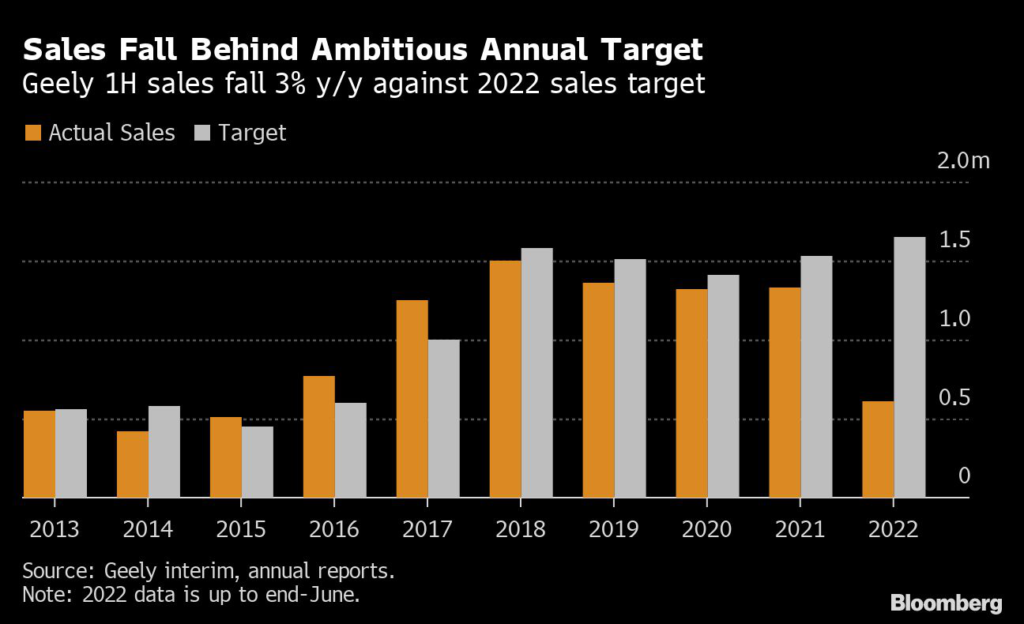
Geely, like many Chinese automakers, was hit by production outages and supply chain snarls caused by Shanghai’s two-month Covid lockdown. The automaker, controlled by Volvo Cars owner Li Shufu, delivered 613,842 vehicles in the first half, just over one-third of its initial annual target of 1.65 million. 

“The group’s sales performance in the first half of 2022 was below management’s expectations, primarily attributable to the disruption to production and sales caused by the pandemic prevention and controls in some cities in China and global shortage of chips,” the company said in a statement Thursday.

New-energy vehicles accounted for about one-fifth of first-half sales. A relative late-comer to the EV race, Geely, which used to have a comparable market size with BYD Co. before falling behind, is pushing hard to catch up. It has introduced standalone EV brands like Zeekr and last month unveiled an electric pickup truck marque, stepping into a sector with fairly low penetration in China.

BYD Aims to Conquer Global EV Market by Being Anything But Tesla

Although Zeekr only delivered a little over 19,000 units in the first six months, the company will stick to its annual target of 70,000 vehicles, An Conghui, company’s president said in the briefing. He added that the monthly orders continued to grow and the average sale price for Zeekr was around 335,000 yuan. 

“The order volumes are much higher than what we were able to deliver,” said An. 

Electric vehicles sales in China are forecast to hit a record 6 million this year as demand for cleaner cars surges, the China Passenger Car Association said earlier this month. They accounted for just over a quarter of all new car sales in July, the data showed. 

The company is also trying to smooth out supply chain disruptions and has signed direct purchase contracts with semiconductor manufacturers, Gan said. 

(Updates with management commentary in the first three paragraphs.)

More stories like this are available on bloomberg.com

©2022 Bloomberg L.P.

Anti-Abortion Group’s Data Trove Represents ‘Serious Concern’ Post Roe

(Bloomberg) — Heartbeat International, an Ohio-based nonprofit, has spent years collecting data on pregnant women to develop better ways to make sure women carry pregnancies to term and to persuade them from getting an abortion.Based in Columbus, it says that it provides support services to the world’s largest network of “pro-life pregnancy resource centers,” which are also known as crisis pregnancy centers. Such facilities often misrepresent that they provide options for reproductive health services and instead are focused on preventing abortions.

Heartbeat also offers a hotline and website for “abortion pill reversal,” a procedure that medical authorities say is unproven and potentially dangerous. Medication abortion is a two-pill course, and Heartbeat seeks to persuade women who contact them from taking the second pill. 

“For instance, we know that 75% of the people that reach out to us for abortion pill reversal do so within the first 24 hours of taking that first pill,” said Jor-El Godsey, the organization’s president. “That’s very important for us, to adjust our services to those who are calling in the future.”

In the aftermath of the Supreme Court’s decision to overturn Roe v. Wade, data about women seeking abortions — and health-care professionals and others who assist them — has become an explosive issue. Abortion is now banned in ten states, casting a spotlight on companies and organizations that store information about women inquiring about the procedure. For instance, a group of workers at Alphabet Inc., the  parent of Google, sent a petition asking that the company stop collecting data on users seeking information about abortion, the Wall Street Journal reported on Thursday.While Heartbeat’s policies on data collection have been in place for years, privacy and reproductive rights advocates are paying heightened attention to them now that Roe v. Wade was reversed. Heartbeat’s information — among the largest repositories of data on women who visit crisis pregnancy centers and attempt abortion reversal — could be used to build a case against these clients and their doctors, these advocates warn.Heartbeat’s information represents a “data honey pot,” said Johnny Lin, chief technology officer at Lockdown Privacy, a company that offers to block apps from tracking users. He worries that information about women who inquire about reversing an abortion pill would be valuable for prosecutors in states where the procedure is illegal. For instance, Heartbeat’s abortion pill reversal website includes a chatbot that encourages visitors to the website to share their name, whether they have had an abortion and when, and their location in order to direct them to someone in its network who can help with the reversal procedure. 

“It’s a more direct route to information on women who have begun an abortion,” Lin said.

But Heartbeat isn’t eager to hand over its files, Godsey said, adding that maintaining the confidentiality of women who contact Heartbeat and its affiliates is paramount.  The organization would “work to protect her confidentiality to the best of our ability,” he said.

Godsey also defended his organization’s collection and use of data on pregnant women, saying it was “just like the information being compiled by Planned Parenthood.”Melissa Nystrom, a spokesperson for Heartbeat, added that it was “well-known that anonymized data is routinely studied by businesses so that they can better serve their customers. Organizations on both sides of the debate do just that. It is perfectly legal and considered ethical.” A spokesperson for Planned Parenthood didn’t return messages seeking comment.The privacy policy for two of Heartbeat’s websites — one that refers women to crisis pregnancy centers and the other for abortion “reversals” — say the organization may turn over a person’s information in situations involving “illegal activities.” The information Heartbeat collects — from its abortion pill reversal site, its hotlines and some of the data from software used by crisis pregnancy centers  — isn’t covered by HIPAA, the US law that seeks to protect patient data, as it is not collected during insurance transactions by covered medical providers, Godsey said.Bloomberg found no indication that Heartbeat has turned over data to authorities since Roe was overturned. 

In 1971, Dr. John Hillabrand, a Toledo, Ohio obstetrician, and Lore Maier, a refugee from Nazi Germany, founded Alternatives to Abortion as a clearinghouse to track and share contact information among pregnancy help centers, maternity homes and adoption services. Its name was later changed to Heartbeat International. Its website describes it as a Christian organization whose policies and materials are “consistent with Biblical principles,” and it states that the group objects to birth control, same-sex marriage and sex before marriage.

Godsey said he got involved in the anti-abortion movement in the 1980s following a religious conversion and a girlfriend’s abortion. As Heartbeat’s president, he became aware of how data could be used to assist in the nonprofit’s mission in the 2000s, by tailoring pregnancy services so that affiliates could more effectively convince women to not get abortions. Many crisis pregnancy centers were using different client management software to organize appointments. The centers also stored information shared by clients, tracked donations and remained in contact with pregnant women, according to Godsey.  

Heartbeat decided to offer its own software, called Next Level client management services, to crisis pregnancy centers for up to $100 a month. The software collects includes names, addresses, email addresses, marital status, living arrangements, alcohol and drug use, medical history, pregnancy history and ultrasound photos, according to its website. The software also has a “client risk tracker” feature which keeps “staff up to speed on each individual woman’s anticipated risk level built into Next Level’s framework,” because “every client comes with a target on her back from the abortion industry.”

“We saw the need to basically get into that environment so that we could have clarity on what is happening in the movement,” Godsey said. “We wanted to combine the information so that we could more easily pursue some of the demographic research on clients and how centers were serving them and how we can improve.”

Godsey declined to say how many customers used the software.

In addition, Heartbeat says it has more than 1,000 healthcare professionals in its “abortion pill reversal” network that is accessible by phone, live chat, email and text.  The reversal involves convincing a woman to not take the second abortion pill, in addition to being administered the hormone progesterone to try to offset the effects of the first pill. The American College of Obstetricians and Gynecologists has warned that “medication abortion ‘reversal’ is not supported by science.” Godsey said he stands behind the safety of the treatment.

The website and hotline is widely advertised on social media platforms such as TikTok and in crisis pregnancy centers. The term ‘abortion reversal’ was coined by San Diego doctor George Delgado who authored two studies claiming that hundreds of patients who were given Progesterone after taking mifepristone, the first of two pills taken during a medical abortion, carried pregnancies to term. Delgado ran his own website and hotline to offer progesterone, staffed with a handful of volunteers. In 2018, Heartbeat took over Delgado’s network for $1, Godsey said, with the goal of scaling it to an international effort. Delgado didn’t return several messages seeking comment. A 2021 study published by The Alliance: State Advocates for Women’s Rights and Gender Equality, called “Designed to Deceive,” found that 35% of crisis pregnancy centers promoted abortion “reversals.” The centers have been criticized by academics, government officials and politicians for masquerading as medical centers for pregnant women when their goal is to convince women not to get abortions. California’s Department of Justice has described them as “organizations that seek to discourage people facing unintended pregnancies from accessing abortion care” and warned that centers “staffed by non-medical personnel are not required to keep your medical records private” in a bulletin published in June.Privacy experts have raised concerns about Heartbeat’s extensive data collection before. In 2019, UK-based Privacy International warned that Heartbeat International and affiliated organizations were using misleading claims to attract “abortion-minded” people and that it wasn’t clear how the data it was collecting is analyzed or shared.  A representative for Privacy International didn’t respond to messages seeking contact.Jenifer McKenna, the co-author of “Designed to Deceive” and program director at women’s rights group The Alliance, said “in short, Heartbeat’s websites and privacy policies both the Option Line and Abortion Pill Reversal websites, and the chat bot and privacy policy page they share, seem designed to obscure that Heartbeat International is even involved in those sites, let alone the organization collecting users’ personal data.” McKenna called Heartbeat’s data trove a “serious concern” in the wake of the Roe reversal, and more generally, the potential for weaponizing digital data against pregnant people a “profound threat.”Next Level software’s client tracker “seems designed to invade the digital privacy of pregnant people,” said Kimberly Kelly, associate professor of sociology at Mississippi State University.“They’re tracking people to see how long they are in their pregnancies and contact them until they have convinced them not to have an abortion,” she said.Several states have adopted “personhood” laws in which doctors or people who assist with an abortion may face prison time and fines. Not all have explicitly pardoned people seeking an abortion, which has raised concerns among legal experts who fear they could also be charged with a felony. 

With abortion now outlawed in some states, Godsey said he believes Heartbeat International and its affiliates are more needed than ever.  And while Heartbeat seeks to make abortion unnecessary and unthinkable, whether it is illegal — which may cause prosecutors to compel Heartbeat to turn over its records — is “another question,” he said.

“We are always mindful of what the law requires,” he said, but insisted, “We’re going to protect her confidentiality to the best of our ability.”  

(Updates with additional context in fifth paragraph)

More stories like this are available on bloomberg.com

©2022 Bloomberg L.P.

Close Bitnami banner
Bitnami