

Bloomberg

‘Zero-Waste’ Stores Are Helping Consumers Cut Back on Plastic

(Bloomberg) — Amber Haukedahl’s journey to zero-waste shopping started with a toothbrush. 

Four years ago, the conservation biologist from Minneapolis decided to cut down on her plastic consumption, investing in household alternatives like mesh produce bags, unpaper towels and bamboo cutlery. But when Haukedahl turned to buying a bamboo toothbrush, the only options she could find were on Amazon — an e-tailer whose packaging habits she says would have “totally defeated the purpose.”

So Haukedahl, then 33, decided to become the retailer she was looking for. In 2018, she launched Tare Market, an e-commerce outfit selling products like reusable cutlery, washable face rounds, and compostable dental floss in plastic-free packaging — and shipping them in upcycled boxes and compostable packing. A year later, Tare opened its first brick-and-mortar location in Minneapolis’ leafy lakeside Nokomis neighborhood, following a successful online crowdfunding campaign.

As the leader of workshops about how to live a zero-waste life, Haukedahl already knew plenty of potential customers. “People [are] like, ‘I really want to live this way, but I don’t have time to research all the best environmentally friendly products,’” she says.

Tare, which opened its second Minneapolis location in April, is one of a growing cohort of “zero-waste stores,” retailers that sell mostly in bulk or using compostable packaging, to customers toting reusable containers. Since 2015, hundreds of zero-waste stores have opened across the US, says Celia Ristow, who tracks the sector’s growth on her blog Litterless. California has Fillgood in Berkeley, the Re-up Refill Shop in Oakland and Homebody Refill in Sebastopol. Seattle has Scoop Marketplace and Mimi’s Zero Waste Market. Portland, Oregon, has Realm Refillery and Mama & Hapa’s Zero Waste Shop. New York City has The Filling Station and A Sustainable Village in Manhattan, plus Precycle in Brooklyn. Even Poland, Ohio — a town of fewer than 3,000 residents — has a zero-waste store called Sustaining Bliss. As more Americans find themselves existentially distressed by everything from trash gyres in the ocean to microplastics in our bloodstreams, many are spurning single-use plastics and bringing retailers like Tare increasingly in vogue.  

BYO Bins, Bags, and Boxes

For a shop that sells 135 bulk food items, Tare maintains a sleek and minimalist design. Instead of rows of individually packaged foodstuffs, the 1,000-square-foot store has dozens of bulk bins, where shoppers can fill their own containers — or grab a “donated” container — with everything from organic oatmeal to red lentils. Rather than plastic jugs of laundry detergent, dish soap and hand soap, Tare offers each from a dispenser, as it does beauty products like argan oil, jojoba oil and aloe vera. In between the bulk goods, the store’s shelves are artfully stacked with products like Marley’s Monsters flannel unpaper towels, toothpaste tablets, and, yes, bamboo toothbrushes. Packaging for all individually wrapped items is biodegradable.

Other than Ristow’s list on Litterless, there is no central tracking of zero-waste stores in the US. But there is growing evidence that consumers are demanding less packaging. Kaela Martins, senior manager of environmental programs at the Retail Industry Leaders Association, points to stores like REI, which eliminated the sealable plastic envelopes it had used for shipping individual items of clothing, as well as a partnership between CVS Health and venture firm Closed Loop Partners to test out reusable packaging options. Major supermarket chains in Europe and the US are making similar moves: Some Carrefour locations in France and Kroger locations in the US have signed up for TerraCycle’s Loop service, which provides and cleans reusable glass and metal containers for shoppers.

Jennifer Bartashus, a retail analyst with Bloomberg Intelligence, specifically points to the proliferation of package-free stores in Europe, where the trend has been gaining traction for a decade thanks in part to a long tradition of open-air markets. “There’s only a certain segment of customers that this format is going to resonate with,” Bartashus says. “But I think this type of store definitely has appeal.”

Consumer interest is even spurring a cottage industry of workshops to help entrepreneurs meet the demand. “I get emails every week from people who are interested in opening up a zero-waste store,” Haukedahl says. Since 2014, Berlin-based Original Unverpackt has been offering a 190-euro ($193) course on how to open a package-free store. In the US, Haukedahl points interested parties to Seattle’s Scoop Marketplace, whose educational branch offers a three-part free workshop on opening a zero-waste store, as well as a 10-module class for $3,500. Two years in, Scoop owner Stephanie Lentz says 45 people have taken the paid version.

Zero-Waste Limitations

By the time Brittany Snipes decided to start a zero-waste shop in Portland this year, there were models to look to. The 29-year-old entrepreneur and her boyfriend, 27-year-old Ryan Knowles, wanted to model their store, Realm Refillery, at least in part on two other plastic-free shops: Nada in Vancouver and the Refillery in Edinburgh. Both are full-service grocery stores with personal care sections, in addition to selling dry goods. 

Since opening in May, Snipes and Knowles say business has been swift. In addition to bulk dry goods, plus produce and bread from a beloved nearby bakery, Realm Refillery has a cold bar stocked with local favorites like Choi’s kimchi, Trazza hummus, and Fermenter’s vegan sauerkraut. An Oregon law bars customers from bringing in their own food containers, but for $2 apiece Realm customers can effectively rent glass jars in perpetuity. (Snipes and Knowles are also active in efforts to change the law.)

Startup costs aren’t the only obstacles for zero-waste retailers. Grocery stores are already a notoriously low-margin business, small stores have less purchasing power, and environmentally sensitive products tend to be more expensive as it is. That makes customer loyalty particularly important. 

“If you are frequenting a zero-waste store, you likely have a belief system you are backing with your shopping behavior and are willing to spend money to support that cause,” says Bloomberg’s Bartashus. She also posits that the higher costs for consumers might be offset by buying smaller quantities more frequently, as opposed to stockpiling packaged products. 

Diversification helps, too. Realm, for example, credits its success with selling home goods and personal care items. “Those profit margins are higher, so that’s helped us balance it out,” says Snipes, who is also planning to introduce grab-and-go food, another higher-margin offering. “We want to do empanadas, dumplings, frozen pizza — but have it in a double-lined paper sack,” she says.

Perhaps the biggest challenge for zero-waste stores, though, is living up to the spirit of their mission — which often means prioritizing solutions versus striving for perfection. Some zero-waste stores still sell individually wrapped items, albeit often in compostable packaging, and some customers might buy dozens of tote bags or reusable containers, which are all carbon-intensive. Fresher food can also (counterintuitively) lead to more food waste, though some stores are making efforts — like with food donations — to counteract this. Finally, even though the people who shop at zero-waste stores are eschewing plastic, most consumer products and many commercial food brands still rely on plastic packaging. Even the most climate-conscious shopper will find it difficult to avoid entirely.

Ask owners and advocates of zero-waste stores, though, and they’ll say that it’s more about starting to change behavior than presenting a cure-all. And there’s plenty of evidence that habits can be changed. “All across the country now, people have become acclimated to bringing their own bags,” says Bartashus. “So training them to bring a container may not be a difficult next step.”


More stories like this are available on bloomberg.com

©2022 Bloomberg L.P.

‘Enough Is Enough’ Pulls in UK Crowds as Rail Strike Begins

(Bloomberg) —

Organizers of a left-wing movement seeking to press the UK government into double-digit wage deals and cuts to energy bills say they’re closing in on a membership of 1 million following a launch rally in London.

The Enough is Enough campaign’s first meeting at the Clapham Grand theater, better known for hosting drag acts and club nights, was crammed to the venue’s 1,250-seat capacity, with hundreds more left outside, according to the labor unions behind the event.

The event late Wednesday came on the eve of the latest action by workers seeking pay hikes to match higher living costs as inflation soars.

Thousands of railway employees are striking across more than a dozen train operating companies and track and stations operator Network Rail Ltd. Thursday, with staff on the Tube and London buses poised to join in Friday. Felixstowe dockers will walk out for eight days from Sunday, while 115,000 Royal Mail Plc postal workers begin a series of walkouts on Aug. 26.

“We’ve had 400,000 people sign up for the campaign and by the end of the program tonight it will be 1 million,” Dave Ward, general secretary of the Communication Workers Union, said in an interview at the Enough is Enough launch. Ward, who represents Royal Mail employees, promised “rallies in every town and city across the UK.”

‘Anger Into Action’

Under the slogan “It’s time to turn anger into action” speakers pledged to ramp up activism over the surge in household costs. In addition to higher wages and slashed energy bills, the campaign is seeking an end to food poverty, “decent homes for all,” and higher taxes on the wealthy.

Margaret Burn, 58, of Finsbury Park, London, attended mostly to hear Mick Lynch, general secretary of the National Union of Rail, Maritime and Transport Workers and a high-profile figure who says he’d back a general strike.

“I feel like at last someone is talking about the things that I’m concerned about,” Burn said. “And they’re showing us a way to make a difference. They’re showing us a way that things can change.”

Corbyn Fans

Several attendees at the rally, which resembled a music gig with a bar, vegan hot dogs and hits from the early 2000s blasting out, said they were fans of former Labour leader Jeremy Corbyn, who suffered a crushing defeat at the last general election to Prime Minister Boris Johnson after advocating a raft of left-leaning polices.

Indre Vidziunaite, a 30-year-old software engineer living in east London, said she had less time for current leader Keir Starmer, who is leading in the polls, and was hoping that Enough is Enough would encourage the party to adopt stronger leftist policies.

Labour Member of Parliament Zarah Sultana spoke at the rally and said that none of the campaign’s demands — which include nationalizing energy firms — is particularly radical and that “every single one of them is wildly popular.” She added: “Someone tell the leadership of the Labour Party.”

The latest round of rail strikes by members of the RMT and Transport Salaried Staffs’ Association has seen trains across Britain canceled.

Rail Turmoil

A Network Rail spokesman said there’ll be no services at all on half the system on Thursday and Saturday, slightly less disruptive than during walkouts in July amid improved availability of staff in Scotland. On the remainder of the network, services have been reduced to only a fifth of the usual timetable.

The rail sector has been hit particularly hard by Britain’s so called summer of discontent, with drivers at the Aslef union also staging national strikes, as the government presses firms to modernize and trim costs in light of a drop in commuting following the coronavirus crisis.

The RMT’s Lynch said on Times Radio Breakfast that negotiations have so far failed to bridge differences, with “major problems in terms of what they want to do to the industry, which is to change it radically and change our people’s working lives.” He added that Transport Secretary Grant Shapps is blocking a deal and “needs to get out of the way.”

TSSA separately renewed calls for the railway to be brought back under public ownership Wednesday and said the current inflation-linked model for setting fares can no longer function as the Retail Price Index climbs. The Department for Transport has said January’s hikes will be lower, without specifying what they’ll be.

Buses, Tube

Thursday will also see a reduced service on the London Overground, Elizabeth Line and some London Underground subway routes. And on Friday, sandwiched between the mainline shutdowns, the whole of the Underground faces a one-day strike, just as bus drivers in the capital begin a two-day walkout.

Bus journeys in west and northwest London and parts of the counties of Hertfordshire and Surrey will be impacted, according to Transport for London.

Britain’s roads, already crowded with holidaymakers, are likely to suffer snarl-ups as a result of the strikes.

Traffic levels increased by 49% during June transport walkouts and by 36% last month, according to satellite-navigation software provider Waze. Bottlenecks are most likely on the M25 encircling London, the M60 around Manchester, the M5 linking the Midlands with the Southwest, and along the M6 that runs to the Scottish border.

(Updates with comments from rally attendees starting in seventh paragraph, Labour MP in 11th, RMT leader in 15th)

More stories like this are available on bloomberg.com

©2022 Bloomberg L.P.

Tiger Global Doubles Down on Investment in Indian Fintech Jar

(Bloomberg) — Global private equity investor Tiger Global Management doubled down on its investment in Indian micro-saving app, Jar, by leading a $22.6 million round which saw participation from a clutch of other investors, a partner at the fund said.

“By starting with digital gold, a well-understood and well-loved asset class in India, Jar’s savings app has quickly gained trust and traction with young earners interested in developing a saving and investment strategy,” Alex Cook, partner at Tiger Global, said. “We are impressed with the company’s rapid growth.”

The funding, through a primary issue of shares, values the one-year-old startup at $300 million, $100 million higher than when it raised $32 million in February 2022. Tiger injected funds into the company in that round also.

Jar, founded in January 2021 by two engineers, Misbah Ashraf and Nishchay AG, will use the fresh funds to expand into multiple financial services like facilitating lending, selling insurance products and advising people on investing in financial products from mutual funds to fixed deposits. It will also invest a part of the money in adding 50 more employees to its existing 80.

The company is seeing 20% average growth in users’ savings with over 9 million customer investing in the single asset of a gold-backed saving product with 220,000 daily transactions.

“We will soon apply for a shadow bank license to offer our lending products to our customers,” Nishchay said. “The work is in progress.”  


More stories like this are available on bloomberg.com

©2022 Bloomberg L.P.
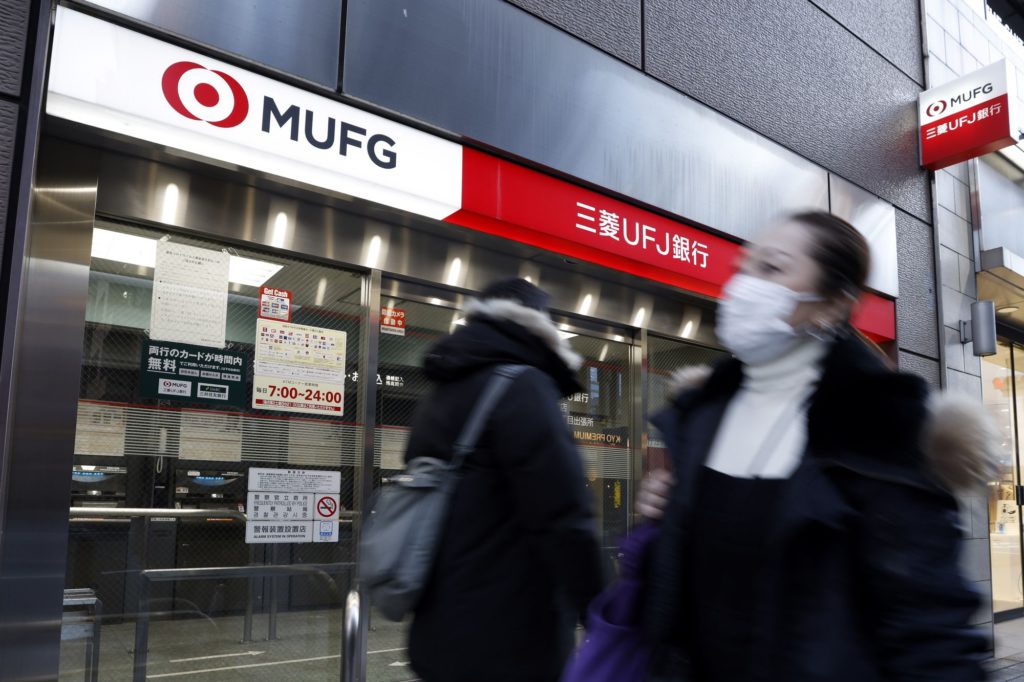
MUFG in Talks to Buy Two Home Credit Lending Units in Southeast Asia, Sources Say

(Bloomberg) — Mitsubishi UFJ Financial Group Inc. is in advanced talks to acquire consumer lender Home Credit’s assets in Indonesia and the Philippines, according to people familiar with the matter.

MUFG, as Japan’s biggest lender is known, has emerged as the likeliest buyer for the businesses after outbidding other rivals, the people said, asking not to be identified because the matter is private. The combined assets in both countries could be valued at about $500 million or more, the people said.

The parties are negotiating terms of a potential agreement which could be reached as early as next month, the people said. Talks could still face delays or even fall apart, and other bidders remain interested in certain assets, they said.

While Home Credit had sought to include other markets such as Vietnam and India in the transaction, most bidders were keen on a piecemeal deal, the people said.

Representatives for PPF Group NV and MUFG declined to comment.

Japanese lenders have been keen buyers of assets across Asia in recent years as they seek to expand in new markets amid low interest rates and sluggish growth at home. MUFG is considering a bid for PT Bank Pan Indonesia as the Japanese banking giant seeks to bolster its presence in Southeast Asia’s biggest economy, Bloomberg News has reported.

Home Credit, owned by late Czech billionaire Petr Kellner’s family, has been in discussions with advisers about options including partnerships and selling stakes in Southeast Asia and India to help raise cash for the group, Bloomberg News has reported. The owner has been seeking a valuation of $2 billion to $2.5 billion for the businesses in Indonesia, Vietnam, the Philippines and India, people familiar with the matter have said.

Read More: Billionaire Kellner Family Shifts Focus Back to Europe From Asia

Other Japanese banks including Mizuho Financial Group Inc. and Sumitomo Mitsui Financial Group Inc. and Southeast Asia’s ride-hailing and delivery giant Grab Holdings Ltd. had shown interest in acquiring the assets, the people have said.

Home Credit was founded in 1997 and has operations in nine countries across Asia, central and eastern Europe and the former Soviet Union. Kellner’s PPF Group is a holding company with interests spanning finance, telecommunications, manufacturing, media and biotechnology. He was 56 when he died in a helicopter crash last year. 

More stories like this are available on bloomberg.com

©2022 Bloomberg L.P.

An IRL Store for a Digital Blockchain

  • Listen to Bloomberg Crypto on the iHeartRadio App
  • Listen to Bloomberg Crypto on Apple Podcasts
  • Listen to Bloomberg Crypto on Spotify  

(Bloomberg) — Solana is one of the newer blockchains in crypto, and for a while was positioned by its fans as a challenger to the dominance of Ethereum. Like the Ethereum blockchain, Solana offers NFTs, smart contracts and its own token, SOL. Solana’s developers say their blockchain is a faster and cheaper alternative to existing tech.Solana’s critics, on the other hand, point to frequent outages, downtime, and outright hacks that have plagued the platform. A recent hack in August drained more than 7000 crypto wallets tied to the Solana blockchain.Despite these challenges, interest in Solana remains high. So high, in fact, that there’s now a real-life retail location at a mall in New York City dedicated to the blockchain. It’s called Solana Spaces. Bloomberg reporter Immanual John Milton went to the mall to check it out, and joins this episode to talk about what he found.

Follow us on Twitter @crypto, and subscribe to the Bloomberg Crypto Newsletter at https://bloom.bg/cryptonewsletter


More stories like this are available on bloomberg.com

©2022 Bloomberg L.P.
Swiss Watch Exports at Near-Record Levels as Industry Booms

(Bloomberg) — Swiss watch exports rose again in July, increasing to near record levels and notching their highest value in eight years as demand for pricey Rolex, Omega and Vacheron Constantin timepieces booms.

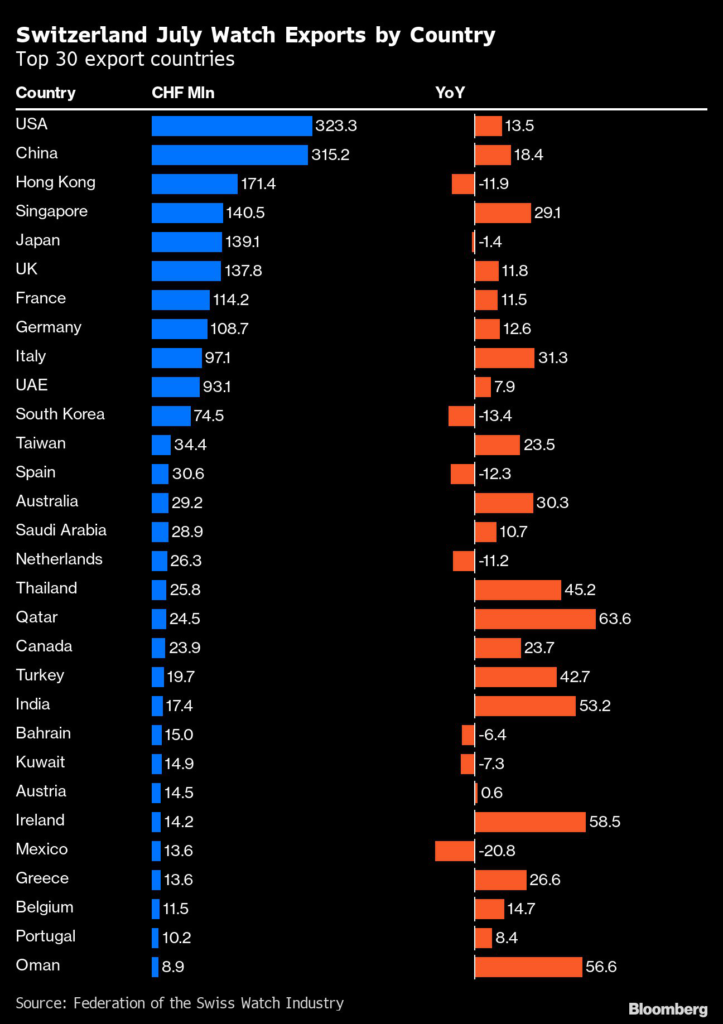
Exports rose 8.3% in July compared to the same month in 2021 to 2.2 billion Swiss francs ($2.3 billion), the Federation of the Swiss Watch Industry said Thursday.

That’s the highest value for exports of Swiss watches since a record performance in October 2014.

Demand for luxury watches has been soaring after many cash-flush consumers discovered Swiss brands from Rolex and Omega to Audemars Piguet and Patek Philippe while stuck at home during the pandemic.

Exports to the US increased 13.5% from the year before and it remained the biggest market for Swiss watch exports after overtaking China last year. 

Demand in China is recovering as Covid-19 lockdowns ease with exports rebounding during the period to hold its position as the second biggest market for Swiss watch exports. 

The export figures were “much better than expected,” said Jean-Philippe Bertschy, an analyst at Vontobel who was expecting a slight decrease.

While prices for luxury watches on the second hand market have been dropping, in part because of the cryptocurrency crash and falling equities, the July exports are “rather reassuring statistics from the Federation,” Bertschy said. 

The trend of high-end pieces driving the industry persisted with watches priced over 500 francs accounting for more than a third of volumes and 95% of value. 

Exports of watches priced between 200 francs and 500 francs plunged by 29.2% in value, continuing a downturn that began in early 2020.

Likely due in part to the success of Swatch Group’s Omega MoonSwatch collaboration, exports of watches priced at under 200 francs rose 5.3% by value, the sixth positive month of the year.

The Omega-Swatch MoonSwatch Is Reviving the Budget Brand

With the exception of Hong Kong, South Korea and Japan, Swiss watch exports in July to most major markets in Asia and Europe increased by double digit percentages. 

“The post-pandemic high-end demand wave continues,” Bernstein analyst Luca Solca said in emailed comments.

Solca cautioned that any slowdown in demand will be seen first through retailers as Swiss watches are primarily sold through wholesale channels and there is a lag between orders and deliveries. 

“If and when there is a slowdown – watch exports will not see it first,” Solca said. 

(Updates with analyst comments in paragraphs 7 and 13)

More stories like this are available on bloomberg.com

©2022 Bloomberg L.P.
Estonia Repels Cyber Attacks as Pro-Kremlin Group Takes Credit

(Bloomberg) — Estonia repulsed the largest wave of cyber attacks in over a decade as a pro-Kremlin hacking group retaliated to the government’s dismantling of a monument dedicated to Soviet World War II veterans.

“Estonia was subject to the most extensive cyber attacks it has faced since 2007,” Luukas Ilves, Undersecretary for Digital Transformation, said on Twitter on Thursday. “Attempted DDoS attacks targeted both public institutions and the private sector.” 

The attacks were ineffective, and apart for “some brief and minor exceptions, websites remained fully available throughout the day,” he said.

The pro-Kremlin hacking group Killnet claimed responsibility, having also targeted Estonia during a NATO-affiliated cyber-security exercise in April.

On Tuesday, authorities removed a T-34 tank from its pedestal in the city of Narva, a city on the border with Russia, after Prime Minister Kaja Kallas said Moscow was using Soviet monuments to foment hostility in the Baltic country. 

More stories like this are available on bloomberg.com

©2022 Bloomberg L.P.

Adyen Shares Slump as Travel Costs Hits First-Half Results

(Bloomberg) — Adyen NV’s shares fell the most in almost four years after reporting first-half results, as higher costs saw profit margins miss analyst estimates.

The payments firm’s EBITDA margin was 59% in the first half, Adyen said in a statement Thursday. That was 3 percentage points below consensus, impacted by hiring, the return of travel and event costs after the pandemic as well as a previously announced charity commitment.

Shares dropped as much as 14.5%, the most since September 2018, and were trading down 11% as of 9:48 a.m. in Amsterdam. Adyen’s stock had risen by about 50% since mid-June before the results.

The firm said — despite the cost — it would continue to prioritize in-person meetings and events.

“The speed and excitement that meeting each other in person brings has always been a crucial part of our success and our view on how to build the Adyen culture for the long term,” the firm said in a letter to shareholders. “Where possible, we will continue this approach.”

Higher Headcount

EBITDA, a measure of earnings, rose 31% to 356.3 million euros ($362 million) while operating expenses were up 47% to 277.7 million euros, the firm said. Headcount rose by 395 to total 2,575 at the end of June.

Net revenue was up 37% to 608.5 million euros in the period. Analysts expected about 615 million euros, according to the average of estimates compiled by Bloomberg. 

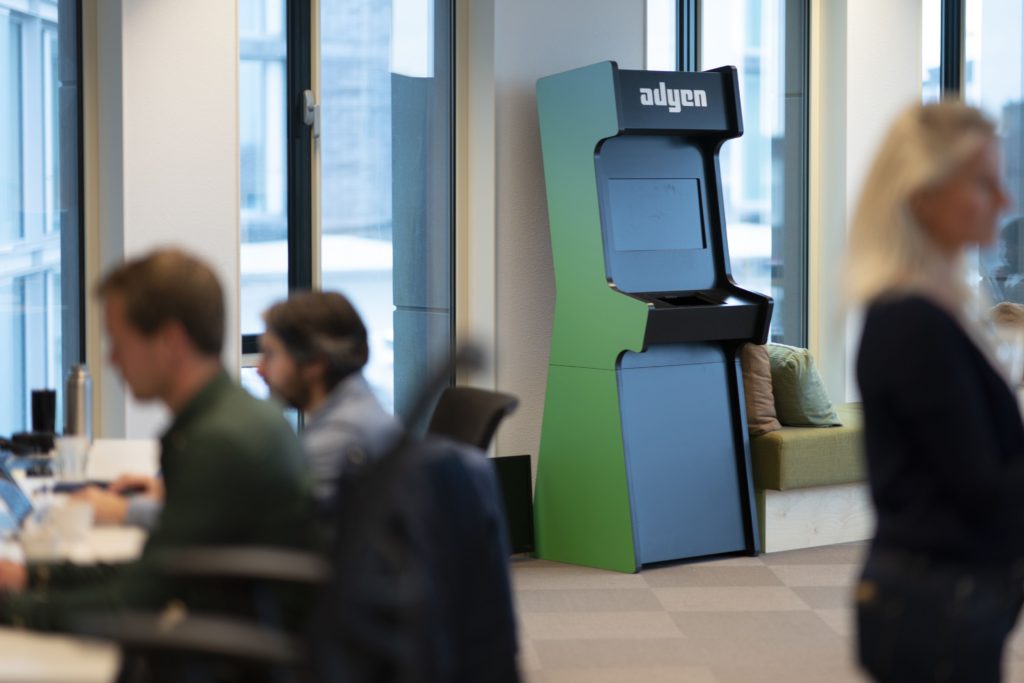
The Amsterdam-headquartered fintech announced it is investing “heavily” in unified commerce and platforms, which will see Adyen launch its own terminal range for global retailers including a product that enables businesses to run both a cash register and accept payments via smartphone.

“That’s where also our growth opportunity is because what we can do is go beyond just payments,” Chief Financial Officer Ingo Uytdehaage said in an interview. “We can offer banking as a service to the platforms.”

He added there was also demand for buy-now, pay-later payment options from retailers, with Adyen worked with some of the biggest firms in the industry.

What Bloomberg Intelligence Says: 

Adyen’s 1H Ebitda margin of 59% — a 3 percentage-point miss vs. consensus — is a key concern as the company cites the return of travel and event costs, as well as its 1% UN charity commitment. This suggests skepticism could increase over the 65% long-term goal, despite reiterated financial targets. Processed volume 60% growth, a 5% beat, is a small positive offset.

Jonathan Tyce, BI banking analyst 

Adyen, which handles transactions for companies such as Uber Technologies Inc, and McDonald’s Corp., continues to grow its presence in the US with the recent expansion of its mobile app partnership with McDonald’s to the region and plans to work with Apple Inc.

The firm continues to target margins on earnings before interest, taxes, depreciation and amortization above 65%. It also expects to grow net revenue at a rate between the mid-20s and low-30s in the medium term.

(Updates with details throughout)

More stories like this are available on bloomberg.com

©2022 Bloomberg L.P.

PwC Raises UK Partner Pay to £1 Million for First Time

(Bloomberg) —

PricewaterhouseCoopers partners in the UK were paid an average of £1 million ($1.2 million) for the first time thanks to a rebound in consulting activity and the sale of part of the business. 

The professional services company said on Thursday that its revenue in the UK and Middle East grew 12% to £5 billion in the year through June. This was helped by a 33% jump in revenue from consulting, which overtook audit to become the group’s biggest business area. 

The firm said it made its biggest investment in staff pay in a decade, with half of its 24,000 workers getting a pay rise of 9% or more. About 900 partners earned on average £920,000, up 12% on the previous year, with an additional £105,000 each from the sale of its global mobility and immigration business. The Financial Times reported the news earlier. 

“I don’t see the market slowing any time soon, but we can’t be complacent,” Kevin Ellis, chairman and senior partner of PwC in the UK and the Middle East, said in a statement. High inflation, which has topped 10% in the UK, along with high employment will affect all businesses, he added. 

“We’ve invested heavily to put us in the best position to deal with these challenges which will likely reduce partner profits next year,” he said. 

PwC said client demand was strong, particularly in finance and industrial manufacturing, while customers in all sectors were looking to move operations into cloud computing. It’s the first of the so-called big four accountancy groups to report its earnings, with Deloitte, EY and KPMG to follow.

More stories like this are available on bloomberg.com

©2022 Bloomberg L.P.

Renesas Said to Explore Sale of Military ‘Rad Hard’ Business

(Bloomberg) — Renesas Electronics Corp. is exploring the sale of a US unit with military applications, which could fetch as much as $1 billion, according to people familiar with the matter.

The Tokyo-based electronics maker is working with a financial adviser on the process, the people said, asking not to be identified because the matter is private. The asset is attracting interest from US chip companies, they added. The talks are early and Renesas’ plans could still change. 

The unit makes chips that are hardened against the effects of radiation, which are shortened to “rad hard” in industry parlance. Renesas acquired the business when it bought California-based Intersil in 2017 and advertises the components as designed for use in space and other harsh environment applications.

“Renesas is constantly considering various possibilities for further business growth, but nothing has been decided,” a company spokesperson said.

Renesas is a key chipmaker for the auto industry, counting local powerhouse manufacturers like Toyota Motor Corp. among its customers. Its shares, which erased losses after the report to remain unchanged Thursday, have gained 19% over the past year on a rise in semiconductor demand triggered by the pandemic. 

(Adds company comment in fourth paragraph)

More stories like this are available on bloomberg.com

©2022 Bloomberg L.P.

Close Bitnami banner
Bitnami