
Bloomberg

China’s Infrastructure Boom Gets Swamped by Property Woes

(Bloomberg) — China’s infrastructure stimulus is boosting economic activity but it’s not large enough to offset the hit to construction caused by the ongoing property slump, high-frequency data show.

Spending on areas such as water, roads, communications and healthcare facilities has been growing at double-digit rates for the past two months compared to last year, according to Goldman Sachs Group Inc. calculations based on official data released this week. That is up from almost zero growth last year, according to the official data.

The expansion is confirmed by satellite images of road construction projects in 13 provinces analyzed by Four Squares Technology Ltd. They estimate the area of roads under construction grew 6.3% in July from the previous year, a turnaround from earlier this year, when it was shrinking.

However, that isn’t doing enough to revive China’s vast construction sector. Four Squares’ data show the area of land covered by construction projects launched in July in the three-largest city regions — around Beijing, Shanghai and Guangzhou — fell 44% compared with a year ago. 

The total area of land covered by new and ongoing construction in those city regions fell 1% in July compared to a year earlier.

The reason is plunging property investment. A liquidity crisis among China’s property developers has led to a plunge in their new projects and put about 5% of existing apartment construction on hold, equivalent to an estimated 500 million square meters of floor space, sparking mortgage strikes by angry homebuyers. 

Read more: Sweeping Mortgage Boycott Changes the Face of Dissent in China

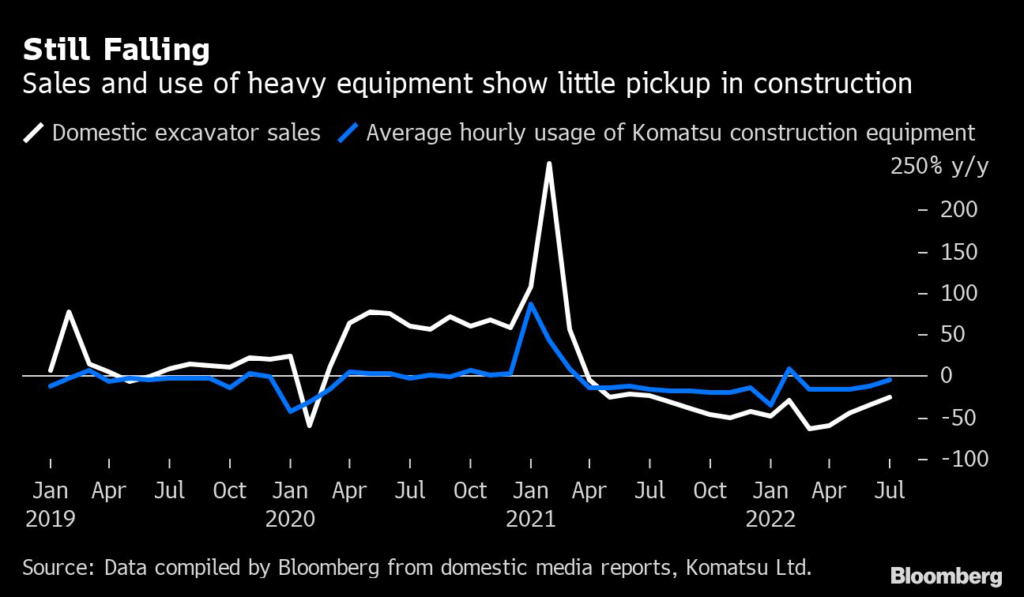
Construction activity is down nationwide as a result, with data from Japanese company Komatsu Ltd. showing heavy equipment was used less in July than in the same month last year. That drop was also seen in demand for industrial goods last month, with steel output falling to its lowest level since 2018 and cement production down 7% from the previous year.

With Beijing yet to announce a comprehensive plan to ease financial stress in the property sector, there appears to be little hope of an overall construction recovery. Excavator sales, a sign of construction industry expectations, fell 25% in July. 

China’s local governments have issued a record amount of special bonds mainly used to fund infrastructure investment and Beijing has called on state-owned policy banks to help steer funding to projects. 

The Securities Times said in a commentary Wednesday that infrastructure projects make up almost a fifth of China’s total outstanding local currency loans and will continue to be the main recipient of long-term loans to the corporate sector this year.

What Bloomberg Economics Says…

A pickup in China’s Covid-19 cases and the deepening housing slump are increasing pressure on consumption and pockets of production, high-frequency data show. The readings support our view that a recovery in the second half of the year could be a struggle.

David Qu, China economist

For the full report, click here.

Infrastructure investment is likely to accelerate further and ultimately grow 10%-13% this year, according to Le Xia, chief Asia economist at Banco Bilbao Vizcaya Argentaria SA. Given that infrastructure investment is around 15% of China’s total gross domestic product, that could drive 1.5%-2% of total real GDP growth, he estimates.

But a possible double-digit decline in property investment means that the overall contribution of investment — including in manufacturing facilities — to GDP could be less than last year’s of about 1.1%, he added.

China’s infrastructure investment this year has been concentrated in urban infrastructure, water utilities, telecommunications, power generation and healthcare facilities, according to official data, with transport spending growing more slowly. 

There are large regional disparities, with Hubei province recording a near 22% increase in fixed-asset infrastructure investment in the first half of the year, while lockdown-hit Shanghai saw that spending fall 38%.

More stories like this are available on bloomberg.com

©2022 Bloomberg L.P.
Japan’s Trade Gap Hits Record on Commodities Impact, Weak Yen

(Bloomberg) — Japan’s trade deficit hit a record high in July as the impact of soaring commodities and the yen’s 24-year low added to the headwinds for the nation’s economic recovery.

The trade deficit widened to 2.13 trillion yen ($15.9 billion) on a seasonally adjusted basis, the finance ministry reported Wednesday, extending the sequence of shortfalls to a 14th month. The trade balance has been in the red for the longest continuous streak since 2015. 

Imports gained 47.2% from a year ago, led by continued year-on-year gains in energy prices, while exports increased 19%, boosted by growing shipments of autos and chip-making equipment. Both figures beat forecasts. 

The record deficit bodes ill for Japan’s economic recovery as higher import bills especially for energy and food can cool domestic activity. While exports continued to recover, they also face slowdown concerns in the nation’s key trading partners such as the US and Europe, where governments are actively tamping down demand to contain rampant inflation. 

“Energy remains a dominant factor behind import gains, which is not necessarily good for growth,” said Koya Miyamae, an economist at SMBC Nikko Securities Inc. “Oil prices have been calming down somewhat, but energy costs can hit the brakes on economic activity if they keep rising.”

The yen’s drop to a 24-year low versus the dollar in July made imports more expensive while making exports cheaper. The trade data showed the average exchange rate was 136.05 yen to the dollar, 23.1% weaker than a year ago. The yen has rebounded recently as US inflation showed signs of peaking, limiting demand for the dollar. 

Due to its reliance on energy and food from overseas, Japan has seen import costs soar amid the war in Ukraine and supply snarls tied to China’s coronavirus lockdowns. Oil prices fell in July from the previous month as global economic slowdown worries offset supply concerns, but the outlook remains uncertain. Imports and exports in July both extended record highs in value while staying relatively unchanged by volume, highlighting the impact of inflation, especially on energy prices.

The report showed exports to the US rose 13.8% and those to Europe increased 31.6%. Shipments to China climbed 12.8%, for the biggest gain since February. 

“The end of China’s Covid lockdowns has driven up exports — that’s the biggest factor,” said Miyamae. “The recovery pace in exports is not strong enough to recoup all the losses, but it’s going in the right direction.”

What Bloomberg Economics Says…

“The bad news — the trade balance is increasingly to Japan’s disadvantage. Trading losses are weighing on corporate profits. A wider deficit will probably drag on GDP growth in the third quarter.”

–Economist, Yuki Masujima

To read the full report, click here

Separately, core machine orders, a leading indicator of capital investment, gained 0.9% in June from May, the Cabinet Office reported Wednesday. Economists had forecast a 1% rise. From a year ago, it increased 6.5%.

Japan’s economy regained its pre-pandemic size in the second quarter as a rebound in consumer spending drove gains. Still, given the uncertainties in the outlook the government plans to ramp up its support for the economy. 

Prime Minister Fumio Kishida has ordered additional measures to ease the impact of inflation, after polls showed his approval rating declined following his cabinet overhaul.

(Updates to add further details from the report, economist comments)

More stories like this are available on bloomberg.com

©2022 Bloomberg L.P.

Bankrupt Crypto Lender Celsius Considers Financing Proposals

(Bloomberg) — Celsius Network LLC has received multiple offers of fresh cash to help fund its restructuring process, a lawyer for the bankrupt crypto lender said Tuesday.

The company is weighing financing packages of “various shapes and sizes,” Joshua Sussberg of Kirkland & Ellis said on behalf of Celsius in a bankruptcy hearing Tuesday. Several more offers are expected, he said, without providing details about the existing proposals.

Celsius needs to raise additional money if it hopes to restructure or sell its business and avoid a liquidation. The company forecasts about $66.4 million of liquidity for August and expects that balance to turn negative in October, according to court papers. 

Celsius will meet the unsecured creditors committee next week and is working “expeditiously” on the path forward, it said in a tweet, adding the next hearing is expected on Sept. 1.  

The firm said the matters covered in the latest hearing included “our intention to see our customers capture any and all value associated with the recent rise of crypto.”

Bankruptcy loans, or debtor-in-possession financing packages, are obtained by most big companies in Chapter 11 bankruptcy to help fund operations while working on plans to repay creditors. Investors are often only willing to provide such a loan in exchange for a high-ranking claim to the insolvent company’s assets in the event of default. 

The bankruptcy is Celsius Network LLC, 22-10964, US Bankruptcy Court for the Southern District of New York (Manhattan).

(Updates with Celsius comments from the fourth paragraph)

More stories like this are available on bloomberg.com

©2022 Bloomberg L.P.

Bitcoin Miner Stronghold Gives Back 26,200 Rigs to Reduce Debt

(Bloomberg) — Bitcoin miner Stronghold Digital Mining Inc. said it reached agreements with lender New York Digital Investment Group and WhiteHawk Capital to eliminate over half its debt and add liquidity. The company will also restructure a convertible note. 

Stronghold will return around 26,200 Bitcoin mining machines to NYDIG, which will eliminate all of the $67.4 million outstanding debt from an original agreement, the Kennerdell, Pennsylvania-based miner said in a statement Tuesday. Stronghold received a commitment from WhiteHawk to restructure and expand its current equipment financing agreements, which reduces near-term payments and includes $20 million of additional borrowing capacity.

The company is the latest Bitcoin miner forced to pay down an outstanding debt with its mining machines as Bitcoin miners struggle to raise capital and repay loans backed by the token or their rigs after the collapse of cryptocurrency prices from record levels reached in November. 

“Liquidity is key for miners in a bear market,” said Matthew Kimmell, an analyst at CoinShares. “At current prices, miners are receiving less cash flow per Bitcoin sold compared to both last year and Q1 2022, while still potentially facing the same infrastructure, machine, and energy costs.” 

The convertible note restructuring will reduce the principal amount outstanding by $11.3 million in exchange for reducing the strike price on outstanding warrants from $2.50 to 1 cent, the company said. The amended terms also allow Stronghold, at its option, to fully extinguish the notes with equity over the next few quarters. 

NYDIG has been one of the major crypto-native lenders that fund Bitcoin miners’ expansion since the last bull run in 2021. Its parent company is the New York-based Stone Ridge Holdings. 

The lender also issues loans backed by Bitcoin mining machines. Up to $4 billion in such loans are coming under stress as the value of the machines drops with Bitcoin over the last several months. Bitcoin miners have been forced to sell coins since the crypto market crashed in the second quarter. 

Shares of Stronghold have dropped about 75% this year. 

More stories like this are available on bloomberg.com

©2022 Bloomberg L.P.
Avaya Lenders Tap Centerview, Alvarez as Advisers Amid Debt Battering

(Bloomberg) — A group of Avaya Holdings Corp. debt holders hired advisers to help navigate negotiations with the company after a rapid earnings decline, according to people with knowledge of the matter who asked not to be named discussing a private situation. 

Alvarez & Marsal Inc was tapped as a forensic accountant while Centerview Partners LLC will act as a financial adviser, the people said.

The group is made up of older first-lien leveraged loan and secured bond holders and is getting legal advice from Akin Gump Strauss Hauer & Feld, Bloomberg reported. The group told Goldman Sachs Group Inc. last week that they intend to call a default on Avaya if the company fails to file its quarterly results within a grace period that could end in mid-September. 

Telecommunications software company Avaya’s debt fell sharply in recent weeks after the company announced a significant earnings miss, a few weeks after it issued $600 million in new debt. The company now has “substantial doubt” about its ability to continue as a going concern, with revenue plunging and a large chunk of convertible debt maturing in less than a year, according to a statement on Aug. 9.

Representatives for Centerview and Avaya declined to comment. Representatives for Akin and Alvarez & Marsal didn’t immediately respond to requests for comment.

Lenders who helped provide a $350 million leveraged loan to Avaya in June are working with FTI Consulting Inc. and Glenn Agre Bergman & Fuentes to explore their options, and Avaya is getting advice from AlixPartners LLC, Evercore Inc. and long-time counsel Kirkland & Ellis, Bloomberg previously reported.

Avaya’s 6.125% bond due 2028 trades at around 41 cents on the dollar, while its convertible notes change hands for around 20 cents, according to people with knowledge of the situation. The company’s older loans reached a recent low of roughly 46 cents, while the new loan is quoted in the mid-50s, the people said.

(Updates to add forensic accountant hire in second paragraph, comments in fifth.)

More stories like this are available on bloomberg.com

©2022 Bloomberg L.P.

Amazon Labor Union Is Set to File for Election Near Albany

(Bloomberg) — Amazon.com Inc. workers have filed a petition to hold a union election at a company warehouse near Albany, New York.

The group, which is affiliated with the upstart Amazon Labor Union, on Tuesday asked the National Labor Relations Board for permission to hold a vote at the ALB1 facility, according to NLRB spokesperson Kayla Blado.

Under NLRB rules, workers must gather the support of at least 30% of their co-workers to call such a vote. Heather Goodall, lead organizer of the effort, declined to disclose how many signatures she and her colleagues had collected but said she was confident they’d met the threshold. Amazon didn’t immediately respond to a request for comment. 

Goodall, who has worked at the facility since February, said Amazon was an abusive, intimidating employer, and that she and her coworkers were seeking higher wages, among other improvements to working conditions. “We need to stand against that and say we are no longer going to tolerate this abuse,” she said, adding that she and other ALU members were planning to hold a press conference at an NLRB regional office in nearby Albany on Wednesday. 

The ALU won an historic victory at the New York City warehouse called JFK8 in April, only to lose a second election at a smaller facility across the street a few weeks later. At ALB1 in Schodack, near the state capital of Albany, Goodall and other organizers have been discussing unionizing with coworkers for months. She had contacted the International Brotherhood of Teamsters and Retail Wholesale and Department Store Union, before deciding in June that the group would join the Amazon Labor Union.

The Seattle-based company, which had managed to keep unions out of its US operations for more than a quarter-century, is fighting to get the JFK8 vote overturned. In a filing to the NLRB, Amazon said the agency repeatedly “failed to protect the integrity and neutrality of its procedures” by turning away voters. Both sides presented evidence before an NLRB official in Phoenix at hearings held in June and July. The labor board has yet to rule on Amazon’s objections. Unless Amazon can get the result tossed, it will have to start contract negotiations that potentially could hamper its ability to adjust work requirements and scheduling on the fly. ALU workers have said they’re seeking raises, as well as better benefits and working conditions. 

The ALU’s leadership, spending much of their time defending their gains in court, paused two other planned union drives and has relied on homegrown union campaigns, including Goodall’s and one at a facility in Kentucky, to expand beyond New York City.   

Meanwhile, the Retail, Wholesale and Department Store Union has accused Amazon of labor law violations during a do-over vote in April at a warehouse in Bessemer, Alabama. Amazon filed its own objections to the conduct of the vote, arguing that a mail-ballot election was inappropriate and that union representatives surveilled workers and offered to take their ballots, among other claims. 

Federal officials are slated to consider voter eligibility disputes and complaints about election conduct. The vote remains too close to call.

More stories like this are available on bloomberg.com

©2022 Bloomberg L.P.
Chipmakers Are Flashing More Warnings on the Global Economy

(Bloomberg) — Mounting concern over semiconductor demand is sending shudders through North Asia’s high-tech exporters, which historically serve as a bellwether for the international economy.

South Korean behemoths Samsung Electronics Co. and SK Hynix Inc. have signaled plans to dial back investment outlays, while across the East China Sea, the world’s biggest contract chipmaker Taiwan Semiconductor Manufacturing Co. indicated a similar expectation.

Fading tech demand highlights a darkening picture as Russia’s war on Ukraine and rising interest rates damp activity. The following charts look at the chip industry and its implications for the world economy.

In recent weeks, major chip manufacturers Micron Technology Inc. Nvidia Corp., Intel Corp. and Advanced Micro Devices Inc. have warned of weaker export orders. 

Gartner Inc. predicts an abrupt end to one of the industry’s biggest boom cycles. The research firm slashed its outlook for revenue growth to just 7.4% in 2022, down from 14% seen three months earlier. Gartner then sees it falling 2.5% in 2023.

Memory chips are among the most vulnerable segments in the $500 billion semiconductor market to global economic performance, and Samsung and SK Hyinx’ sales of dynamic random access memory, or DRAM, a chip that holds bits of data, are central to Korean trade.

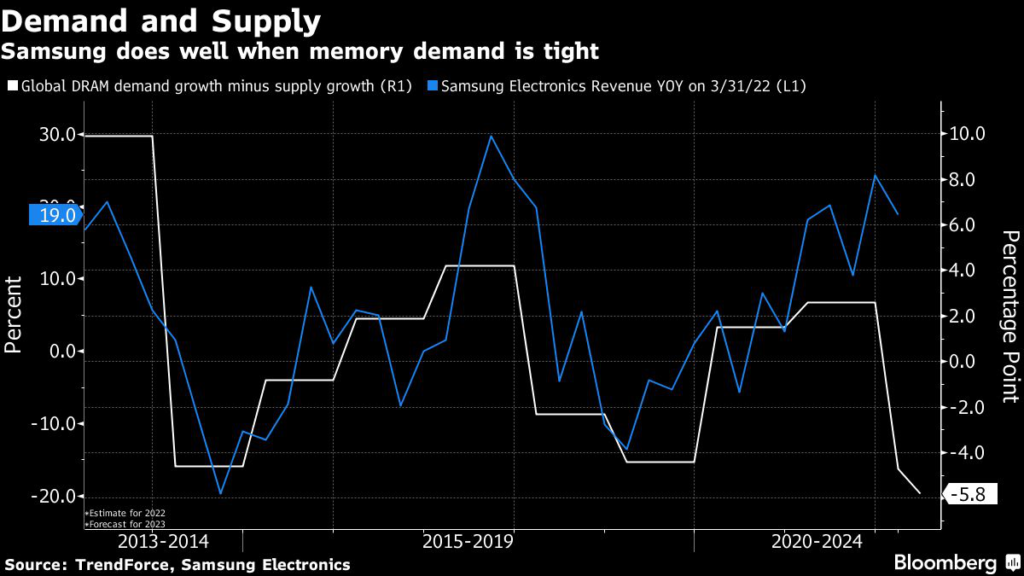
Next year, demand for DRAM is likely to rise 8.3%, the weakest bit growth on record, says tech researcher TrendForce Corp., which sees supply climbing 14.1%. Bit growth refers to the amount of memory produced and serves as a key barometer for global market demand.

South Korea’s exports are bolstered when demand outpaces supply in bit growth. But with supply likely to expand at almost twice the pace of demand next year, exports may be headed for a major downturn.

Signs are rising that trade is already starting to deteriorate. Korea’s technology exports slipped in July for the first time in more than two years, with memory chips leading the falls. Semiconductor inventories piled up in June at the fastest pace in more than six years.

Among potential victims will be Samsung, the world’s biggest memory-chip producer and a linchpin of Korea’s trade-reliant economy.

Samsung recorded rapid sales growth when demand was strong relative to supply. As the chip outlook turns gloomy, shares of Samsung have been declining this year, with occasional rebounds on better-than-expected profits.

Samsung and SK Hynix control roughly two thirds of the global memory market, meaning they have the power to narrow the gap between supply and demand. 

Memory is loosely tied to other types of semiconductors, built by firms such as TSMC that produces chips in iPhones, and Nvidia, whose graphics cards are used in everything from games to crypto mining and artificial intelligence. 

The Philadelphia Semiconductor Index, which includes these firms, has ebbed and flowed together with memory demand in recent years.

Korean exports have long correlated with global trade, meaning their decline will add to signs of trouble for a world economy facing headwinds from geopolitical risks to higher borrowing costs.

Micron Technology, the world’s third-largest memory maker, last week issued a warning about deteriorating demand, triggering a selloff in global chip stocks.

Korea’s stock market has been among leading indicators of the country’s trade performance, with investors dumping shares well before exports slump.

“The trend is important for Asia as its economic cycle is very dependent on tech exports,” said Alicia Garcia Herrero, chief economist for Asia Pacific at Natixis SA. “Fewer new orders and the large inventory pile-up mean Asia’s tech sector will see a long destocking cycle and a shrinking profit margin.”

The International Monetary Fund last month downgraded its global growth forecast and said 2023 may be tougher than this year. 

Deutsche Bank AG sees a U.S. recession starting in mid-2023 and Wells Fargo & Co. expects one in early 2023. A Bloomberg Economics model sees a 100% probability of a US recession within the next 24 months.

More stories like this are available on bloomberg.com

©2022 Bloomberg L.P.

Bed Bath & Beyond’s 75% Surge Extends Huge Rally, Defies Bears

(Bloomberg) — The 349% three-week surge by Bed Bath & Beyond Inc., which has helped reinvigorate a wave of meme stock buying, stands in the face of Wall Street banks sounding the alarm on the stock’s lofty valuations.

The buying spree extended Tuesday as the stock soared as much as 79%, before trimming gains to 29% and closing at $20.65 after a pair of trading halts. The stock was the most actively traded company as 385 million shares changed hands, more than 20-times the three month average, Bloomberg data show.

The rally has come even as at least three Wall Street banks downgraded the home-goods company and recommended investors sell the stock amid the “meme stock frenzy.” 

Susan Anderson at B Riley Securities earlier on Tuesday cut her rating to sell from neutral, and called the retailer’s $1.65 billion valuation “unrealistic.” Baird’s Justin Kleber downgraded shares last week, before the stock’s latest burst, warning the “fundamental risk/reward looks unattractive” with market share losses accelerating and the company burning cash.

None of that stopped the surge in buying from the retail trading crowd which has pushed $99 million into the stock since July 26, according to data compiled by Vanda. The net inflow includes a record $46 million on Monday when the stock spiked 24% to close at the highest since late April, the data show. 

Some investors are banking on the shares to rise further. Call options betting on the stock to trade above $45 by the end of the week, alongside other contracts betting on a rise to $80 by mid-January, were among the most active derivatives tied to the stock, according to data compiled by Bloomberg.

Meme Frenzy

Bed Bath & Beyond short sellers have been slammed to the tune of $662 million in mark-to-market paper losses this month, including a $218 million blow Tuesday, data from analytics firm S3 Partners show. The stock is “very squeezable” given the crowded short positions, and will likely be driven even higher as short sellers are forced to cover their bets, S3 Partners managing director of predictive analytics Ihor Dusaniwsky said by email.

Fellow meme stocks GameStop Corp. and AMC Entertainment Holdings Inc. also saw a burst in activity. The video-game retailer spiked as much as 15%, triggering a trading halt, as the movie-theater operator erased losses to rise 2.5%.

Bed Bath & Beyond was the most bought asset on Fidelity’s platform as buy orders more than doubled those for Tesla Inc. Its ticker was the most mentioned on Reddit’s WallStreetBets and was trending on popular chatroom StockTwits. Debt tied to the company also rose Tuesday, following the stock higher, and was among the top gainers in the high-yield market. 

Even after the surge, the stock remains down 61% from a January 2021 peak, and analysts see more losses on the horizon. The average 12-month price target of $4.49 implies a nearly 80% drop from current levels, Bloomberg data show. Two-thirds of analysts recommend investors sell shares, the largest number in at least a decade.

(Updates share movement, adds detail on gains for debt in penultimate paragraph.)

More stories like this are available on bloomberg.com

©2022 Bloomberg L.P.
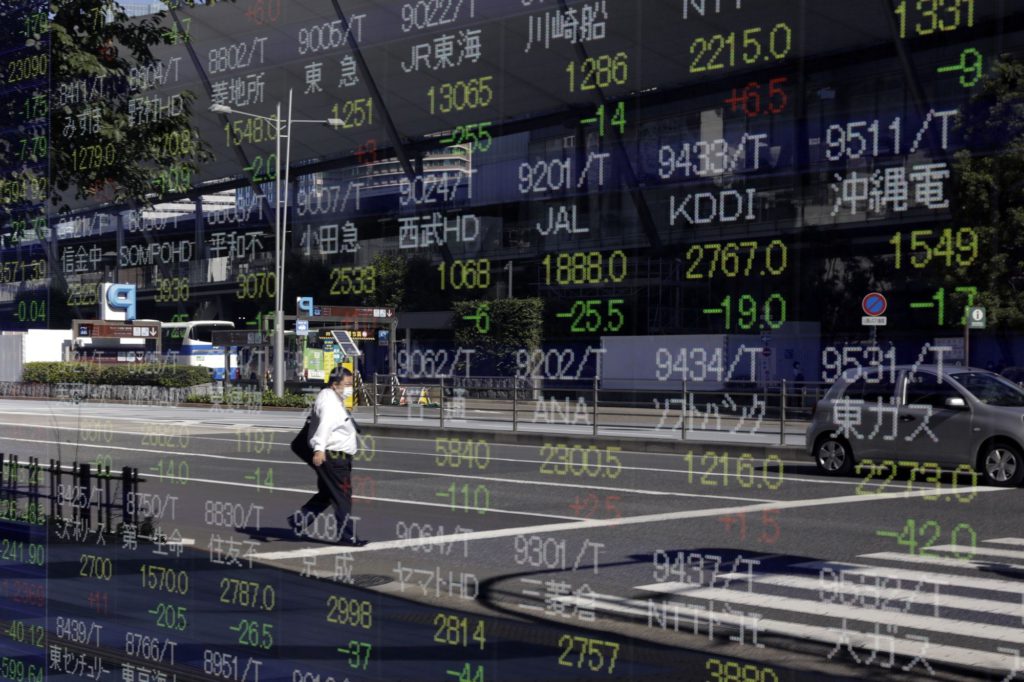
Stocks Shake Off Tech Slide as Dip Buyers Emerge: Markets Wrap

(Bloomberg) — US stocks closed higher following a sudden pullback in tech shares, with investors assessing the latest round of upbeat earnings against a backdrop of growing concerns over slowing growth and rising borrowing costs.

The S&P 500 managed to post modest gains in a roller-coaster session that included a sharp downturn after the index failed to push above its 200-day moving average. The tech-heavy Nasdaq-100 ended lower, while the Dow Jones Industrial Average kept its leadership role among major benchmarks, rallying 0.7%.

Equity markets seesawed in a session marked by steep losses and gains. Treasuries stayed lower, with short-dated yields, the most sensitive to interest-rate changes, up more than five basis points. 

Stocks started the day on the back foot as investors weighed the latest mixed economic data with the Federal Reserve on the path of hiking interest rates. Data Tuesday showed a bigger-than-expected drop in US home construction, while production at US factories increased in July for the first time in three months.

Stocks gained traction later as risk sentiment got a boost from Walmart Inc. exceeding Wall Street’s diminished profit expectations and modestly improving its full-year forecast, while Home Depot Inc. posted results that beat estimates even as the US housing market shows signs of cooling off. Those results helped spur gains in a swath of retailers, including the Target Corp. and Lowe’s Cos. ahead of their earnings due Wednesday.

“The move lower in the last hour is mostly technical — once the S&P 500 got to its 200-day moving average, the rally began to be exhausted and short sellers challenged the upward momentum,” Joe Gilbert, portfolio manager for Integrity Asset Management. “Realistically, at this level the market is range bound because there is still a fair amount of uncertainty as to how the Fed will perceive the most recent economic data in the prism of likely economic outcomes. The market is not confident enough to break out above this range with so many unknowns.”

Read more: BofA Survey Shows Investors No Longer ‘Apocalyptically’ Bearish

Reports Monday showing a sharp drop in New York state manufacturing along with the longest streak of declines since 2007 in homebuilder sentiment sparked optimism in equity markets that the Fed may slow interest-rate hikes. The S&P 500 has rallied 17% from its mid-June nadir, fueled in part by traders dialing back wagers on rate hikes and speculation that inflation has peaked. 

“We would caution investors against chasing this rally,” Mark Haefele, chief investment officer at UBS Global Wealth Management, said. “We expect renewed market volatility ahead, and we continue to recommend positioning portfolios for resilience under various scenarios. With inflation still high, we favor value stocks including global energy. And with the economic outlook uncertain, we think investors can consider defensive equity exposure via global healthcare or quality income stocks.”

Read more: The Market Is About to Get Inflation Wrong for the Second Time

Clues on how sensitive the Fed is to unfolding economic data may be known when the minutes of the last meeting of the Federal Open Market Committee is released on Wednesday. However, the big event investors are waiting for is the annual monetary policy symposium at Jackson Hole, Wyoming during Aug. 25-27. Traders are bracing for higher volatility until then.

More market commentary

  • “I like consumer discretionary,” Brad McMillan, chief investment officer at Commonwealth Financial Network, said on Bloomberg Radio. “As inflation goes down, consumer confidence is going to come back.” The Walmart data “is something that says, ‘yeah, that may be starting to happen.’ I think tech is also a good place going forward. Play on growth, play on the consumer.”
  • “The equity market drawdown has been primarily rates led, earnings weakness is next,” says Seema Shah, chief global strategist at Principal Global Investors, in a note. “A near-term bear market rally is possible as Fed rate expectations settle and inflation peaks. However, with margin pressures growing and demand weakening, earnings concerns are mounting so a sustained rebound is unlikely.”
  • “The idea of a soft landing is a bit of a fairy tale at this point given how extreme inflation levels are,” David Schassler, head of quantitative investment solutions at VanEck, said by phone. “Historically speaking, when the government’s been forced to fight inflation at these levels, bad things have happened.”

Here are some key events to watch this week:

  • Federal Reserve July minutes, Wednesday
  • New Zealand rate decision, Wednesday
  • UK CPI, US retail sales, Wednesday
  • Australia unemployment, Thursday
  • U.S. existing home sales, initial jobless claims, Conference Board leading index, Thursday
  • Fed’s Esther George, Neel Kashkari speak at separate events, Thursday

Some of the main moves in markets:

Stocks

  • The S&P 500 rose 0.2% as of 4 p.m. New York time
  • The Nasdaq 100 fell 0.2%
  • The Dow Jones Industrial Average rose 0.7%
  • The MSCI World index was little changed

Currencies

  • The Bloomberg Dollar Spot Index was little changed
  • The euro was little changed at $1.0170
  • The British pound rose 0.3% to $1.2095
  • The Japanese yen fell 0.6% to 134.18 per dollar

Bonds

  • The yield on 10-year Treasuries advanced three basis points to 2.81%
  • Germany’s 10-year yield advanced seven basis points to 0.97%
  • Britain’s 10-year yield advanced 11 basis points to 2.13%

Commodities

  • West Texas Intermediate crude fell 3.2% to $86.56 a barrel
  • Gold futures fell 0.4% to $1,790.80 an ounce

More stories like this are available on bloomberg.com

©2022 Bloomberg L.P.
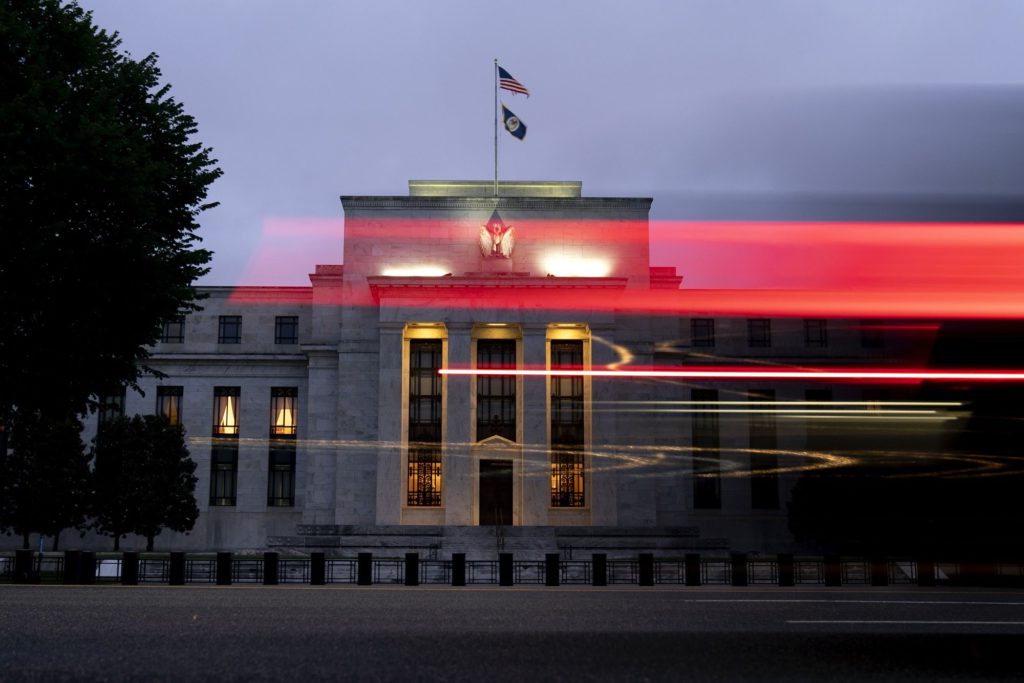
Fed Says Banks That Jump Into Crypto Must Do Legal Homework

(Bloomberg) — Regulators at the Federal Reserve have a blunt warning for banks looking to take advantage of new opportunities that involve cryptocurrencies: make sure they’re legal first.

The central bank on Tuesday released a supervisory letter recommending steps that lenders overseen by the Fed should take before getting involved in the digital-asset industry. As a starting point, the Fed said, firms should notify the regulator prior to engaging in crypto-related activities and ensure that they comply with rules.

Federal watchdogs have grown increasingly focused on making sure that crypto’s volatility doesn’t have negative impacts on the broader financial system. Meanwhile, traditional financial firms are seeking ways to grow in the fast-growing asset class.   

“The emerging crypto-asset sector presents potential opportunities to banking organizations, their customers, and the overall financial system; however, crypto-asset-related activities may also pose risks related to safety and soundness, consumer protection, and financial stability,” said the statement from Michael Gibson, director of the Fed’s division of supervision and regulation, and Eric Belsky, who leads the consumer and community affairs unit. 

Earlier this week, the Fed issued guidance for how it will evaluate applications from financial institutions to use the central bank’s accounts and payment services. A push for access by crypto firms has become a hot-button political issue in Washington.

(Updates with information on Fed guidelines released on Monday in final paragraph.)

More stories like this are available on bloomberg.com

©2022 Bloomberg L.P.

Close Bitnami banner
Bitnami
