Bloomberg

US Factory Output Increases for First Time in Three Months

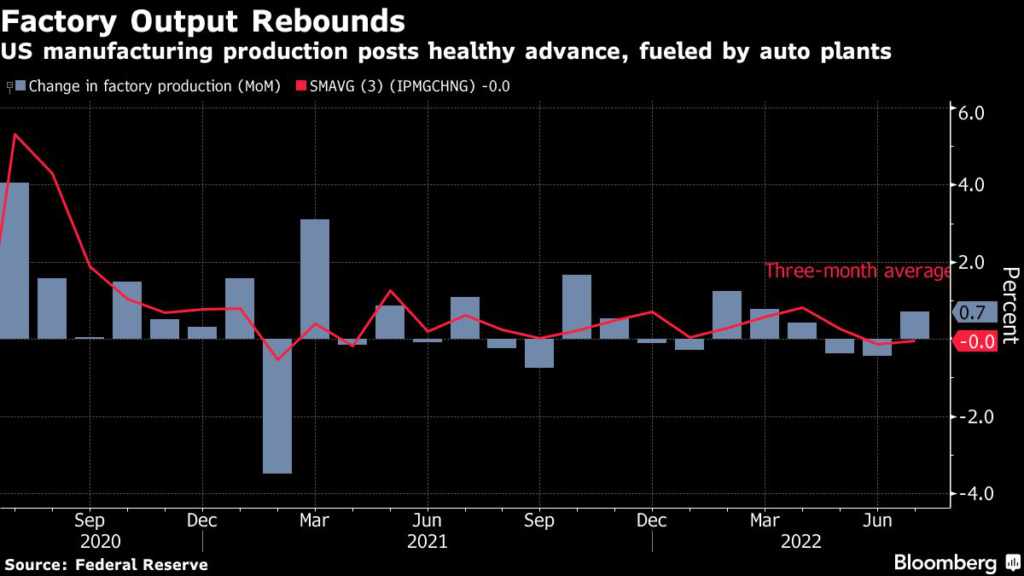
(Bloomberg) — Production at US factories increased in July for the first time in three months, propelled by a pickup in motor vehicle output that masked more mixed results in other categories.

The 0.7% increase in manufacturing production followed a revised 0.4% June decline, Federal Reserve data showed Tuesday. Including mining and utilities, total industrial output climbed 0.6% last month.

The median forecast in a Bloomberg survey of economists called for 0.3% increases in both factory output and total industrial production.

Despite firming last month, manufacturing has moderated and risks losing more momentum as businesses contend with an inventory overhang and an easing in domestic demand for goods. Recent factory surveys have illustrated a pullback in orders, while weaker export markets amid a strong US dollar represent another headwind.

A New York Fed survey on Monday showed manufacturing in the state suffered its second-largest monthly decline on record as bookings and shipments plunged. Separate regional data and national figures over the next week will help shed more light on the extent of the industry’s pullback.

Tuesday’s industrial production report showed output of motor vehicles rose 6.6%, the most in four months. An easing of bottlenecks on semiconductor supplies is affording automakers more room to increase output. 

Excluding autos, factory production increased 0.3% after falling in the prior two months. While the output of fabricated metals, wood products and aerospace equipment advanced in July, production of electrical equipment and appliances, primary metals and furniture declined.

Business equipment output rose 0.6%, the first increase in three months. Within production of consumer goods, a sharp rise in autos more than offset declines in home electronics, appliances and furniture.

The Fed’s report also showed capacity utilization at factories climbed to 79.8% from 79.3%.

Aside from manufacturing, utility output fell 0.8%. Mining rose 0.7%, the third straight monthly advance. Oil and gas well drilling increased 3.3%.

Do you think inflation in the US has peaked? This week’s MLIV Pulse survey takes a hard look at prices. Please follow this link to share your views.

(Adds graphic)

More stories like this are available on bloomberg.com

©2022 Bloomberg L.P.

No Negative Rates, Less Need for Cash: Euros Return to the ECB

(Bloomberg) — Sign up for the New Economy Daily newsletter, follow us @economics and subscribe to our podcast.

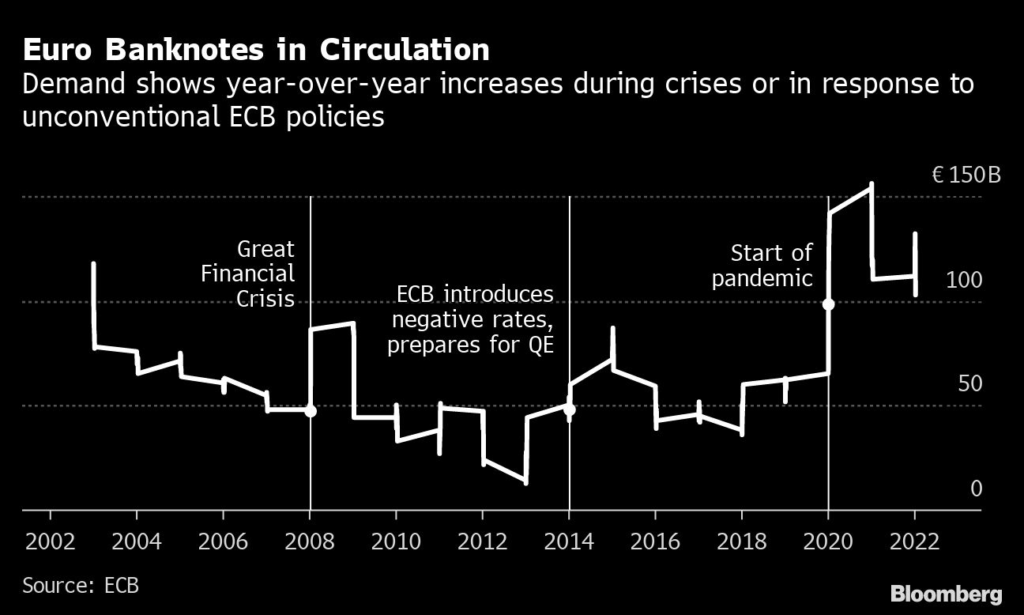
Demand for euro banknotes dwindled after the European Central Bank concluded an eight-year experiment with negative interest rates, suggesting households, businesses and banks are dissolving cash piles created to circumvent deposit charges.

Banknotes in circulation started falling in the week through July 22, when policy makers raised rates. Since then, notes worth 16.8 billion euros ($17.1 billion) have left the system — the biggest drop since early 2020.

While the ECB’s weekly financial statements show that declines in January are common after demand surges ahead of the Christmas holidays, they’re rare in the middle of the year. Banking associations in Germany, Europe’s largest economy, say the end of the ECB’s negative-rate policy may be one reason — though there’s no conclusive explanation for the trend.

“There has been an approximately 1% decline of euro banknotes in circulation (in value) during the past 30 days,” an ECB spokesperson said. “This can be attributed to banks returning higher denomination notes — mainly euro 500 and 200 — from the vaults to their central-bank accounts.”

The value of 500-euro notes in circulation fell by the most in three years in July, recording its third-largest drop since the ECB stopped production at the end of 2018 to prevent and rein in its use for criminal activities. The decline in 200-euro notes last month was the biggest on record.

Some 1.6 trillion euros are currently circulating, though only about a fifth is used for transactions within the 19-nation euro zone, according to ECB research last year. As much as 50% is physically stored by households, companies and banks, with the rest held outside the currency bloc.

When the ECB first introduced negative rates in 2014, banks initially absorbed the costs before attempting to circumvent or pass on the charge. More than 580 German lenders collected deposit fees from their customers as of May, according to consumer portal Biallo. That number dropped to 35 as of last week and should reach zero by October at the latest, it said.

That shift in policy may be tempting some consumers and businesses to run down the cash savings they’ve accumulated over the past years. Financial institutions that stocked up on banknotes might be doing the same: German reinsurer Munich Re experimented with storing euros in vaults in 2016, though the trend didn’t quite catch on. 

More stories like this are available on bloomberg.com

©2022 Bloomberg L.P.

European Wildfires Have Burned Areas Equal to One-Fifth of Belgium

(Bloomberg) — Drought and extremely high temperatures made worse by climate change across Europe have led to record levels of fire activity in the continent, with blazes burning through an area roughly equivalent to one-fifth of Belgium. 

Wildfires in the European Union have consumed 660,249 hectares (1,631,511 acres) of land for the year through August 13, according to data from the European Forest Fire Information System, which provides weekly updates on the fires. The area burnt this year is more than three times the average between 2006 and 2021.

The number of fires in the bloc is at its highest since at least 2006, with 2,300 recorded in mid-August—more than the total for any full year over the past 16 years. The combination of drought and a string of heat waves that have scorched Europe over the past few weeks has resulted in much of the continent remaining in high, extreme, or very extreme fire danger conditions for most of the summer, according to Europe’s Earth observation agency Copernicus. 

While it takes scientists time to determine whether a specific disaster like floods or a fire is directly linked to climate change, so-called attribution studies have determined that global warming made 10 times more likely the heat wave that brought 40-degree-Celsius temperatures for the first time in the UK. The same heat wave saw record temperatures across southwestern Europe.

Spain has been the country hit worst by fires, with 245,500 hectares burnt through mid-August, almost six times more than the average for this time of the year and more than the area burnt for any full year since at least 2006, according to the earliest publicly available data on the EFFIS website. Romania, France and Germany are also seeing unusual patterns of blazes this year. 

Carbon emissions from France’s fires, which are also contributing to the warming of the planet, are the highest since 2003, according to Copernicus, which uses satellites to track these emissions. Smoke from the blazes is also worsening air quality across the continent, while the high temperatures also resulted in extremely high ozone pollution, the agency said in a statement in July.

(Updates area for comparison in the first paragraph.)

More stories like this are available on bloomberg.com

©2022 Bloomberg L.P.

Fidelity, BlackRock Cut Fintech Giant Ant’s Valuation Lower

(Bloomberg) — Fintech giant Ant Group Co.’s valuation was trimmed again by global investors who bought private shares ahead of its suspended initial public offering.

Boston-based Fidelity Investments cut its estimate for Ant to $70 billion at the end of May, according to Bloomberg calculations based on filings. That’s down from $78 billion in June last year, and $235 billion just before Ant’s IPO was torpedoed by regulators in November 2020.

BlackRock Inc. lowered the value to $151 billion as of March from $174 billion, while T. Rowe Price Group Inc. trimmed it to $112 billion as of May, compared with $189 billion last year. 

The woes for Ant and its investors are adding up. The company’s profit fell 17% for the March quarter amid an ongoing yearslong regulatory overhaul. The $150 billion price tag marks an important threshold since investors including Warburg Pincus, Canada Pension Plan Investment Board, Silver Lake and Temasek Holdings Pte were said to have invested in Ant at that price four years ago. 

Ant declined to comment in an emailed statement. BlackRock and T. Rowe Price also declined to comment. Fidelity and Baillie Gifford didn’t immediately respond to a request for comment.  

The Hangzhou-based firm has been restructuring its operations to meet a list of demands from Chinese regulators over the past year, including beefing up capital, curbing consumer lending, and shuffling its management. Billionaire Jack Ma is considering ceding his control of 50.52% voting rights in the firm, people familiar have said. 

In a filing in July, Alibaba Group Holding Ltd. reiterated that Ma “intends to reduce and thereafter limit his direct and indirect economic interest in Ant Group over time” to a percentage that does not exceed 8.8%.

Ant Chairman Eric Jing said last year that the company would eventually go public, but as of June the company said it had no plans to initiate an IPO yet.

China’s campaign to rein in its tech businesses kicked off with snuffing out Ant’s planned $35 billion initial public offering. The crackdown snowballed into an assault on every corner of China’s technosphere as Beijing seeks to end the domination of a few heavyweights and create a more equitable distribution of wealth.

As part of the government-ordered restructuring, Ant has ramped up its capital base to 35 billion yuan ($5.2 billion). It’s building firewalls in an ecosystem that once allowed it to direct traffic from Alipay, with a billion users, to services like wealth management, consumer lending and delivery services. 

Consumer loans jointly made with banks have been split from Ant’s Jiebei and Huabei brands. Assets under management at its proprietary money-market fund Yu’ebao — once the world’s largest — dropped about 35% from a peak in March 2020 to 813 billion yuan as of June. 

Alibaba removed Ant executives from its important partnership committee, a group of people who can nominate the majority of the board. 

Ant has yet to apply for a financial holding company license to be regulated like a bank — a major move widely seen as an indication on whether it has satisfied Beijing’s requirements and that may set the stage for a resumption of its share sale. 

(Updates with details about Ant’s IPO in eighth graph. A previous verion of this story corrected the name of Baillie Gifford)

More stories like this are available on bloomberg.com

©2022 Bloomberg L.P.

Crypto Hacks Soar as North Korea Targets DeFi

(Bloomberg) — The value of funds lost to cryptocurrency hacks has soared this year as decentralized-finance protocols have become an easy target for attackers, a report from blockchain analysis firm Chainalysis showed.

Around $1.9 billion worth of digital tokens has been stolen in hacks this year through July, up 58% from the same period of 2021, according to Chainalysis.

“This trend doesn’t appear set to reverse any time soon, with a $190 million hack of cross-chain bridge Nomad and $5 million hack of several Solana wallets already occurring in the first week of August,” the report said. 

DeFi protocols, especially cross-chain bridges used to transfer tokens across blockchains, have emerged as one of crypto’s weakest links after several large hacks this year. Because such protocols rely on open-source code, criminals can easily find bugs or other vulnerabilities to exploit, Chainalysis said. 

“It’s possible that protocols’ incentives to reach the market and grow quickly lead to lapses in security best practices,” according to the report.

In one ominous sign, criminal crypto activity appears to be more resilient than the wider digital asset market to tumbling cryptocurrency prices. The number of transactions Chainalysis labeled as illicit fell 15% through July from a year earlier, while legitimate transactions dropped at more than double that pace, according to the report. 

Axie Infinity’s Ronin bridge lost about $600 million to hackers in March and Harmony’s Horizon bridge was drained of $100 million in June. 

DeFi protocols have also become a frequent target of state-sponsored hacking groups. North Korea-affiliated groups have stolen approximately $1 billion of cryptocurrency from DeFi protocols so far this year, Chainalysis estimates.

While hacks continue to be a major threat, Chainalysis noted that illicit activity in other areas of crypto has seen a significant drop. Crypto-related scams garnered $1.6 billion so far in 2022, 65% less than a year earlier, according to the report. Revenue on so-called darknet marketplaces is down 43% this year, mainly due to the crackdown on the Hydra marketplace in April.


More stories like this are available on bloomberg.com

©2022 Bloomberg L.P.

Masayoshi Son’s Rough Week Is Capped by Elliott Selling SoftBank

(Bloomberg) — In a stretch of difficult years, Masayoshi Son has had a particularly rough week. 

Just eight days after SoftBank Group Corp. reported a record loss for the last quarter, its shares fell after a report that hedge fund Elliott Management Corp. has sold off almost all of its position in the Japanese conglomerate. SoftBank’s stock is off almost 50% from its peak last year.

Elliott made the move earlier this year, when tech stocks including SoftBank’s were in the grip of an extended selloff, the Financial Times reported, citing people familiar with the trade. The exact size and timing of the sale were unknown, though the US-based activist investor also sold a substantial amount of shares at a profit last year, it added. Elliott had accumulated a stake of close to $3 billion in SoftBank by February 2020.

Elliott’s dumping of SoftBank shares comes as investors increasingly lose confidence in Son and his ability to close the valuation gap between the company and its portfolio holdings. SoftBank’s plan to cash in on its purchase of chip architect Arm Ltd. remains stalled amid a sluggish chip market.

“Rising uncertainty on platform company investments and Vision Fund management, and the lack of cash flow from other asset sales means the discount might be tough to narrow further,” said Travis Lundy, an analyst who publishes on SmartKarma.

A SoftBank spokesman declined to comment. An Elliott representative didn’t immediately respond to emails seeking comment.

One week ago, SoftBank reported a record $23 billion quarterly loss, which Son compared to a humiliating rout by a feudal lord. After marking down valuations throughout the Vision Fund’s portfolio spanning hundreds of companies, Son apologized for his hubris and over-confidence. With concerns raised over the conglomerate’s own financial stability, Son pledged to slash operating costs, lower headcount, and restrain himself from what he thought might be bargains in the startup world.

Fortress Investment Group, which SoftBank had acquired with much fanfare at more than $3 billion in 2017, was on the block, Son said. Just two days later, SoftBank announced it was letting go of a third of its prized stake in Chinese e-commerce giant Alibaba Group Holding Ltd. to shore up its finances. Son’s early investment in Alibaba in 2000 is one of venture capital’s legendary investments, and cemented Son’s claim as a visionary stock picker.

His losses go beyond the company too. The tech market swoon means the Japanese billionaire is personally down more than $4 billion on a series of side deals he set up to help boost his own compensation, Bloomberg News reported last week.

Shares in SoftBank fell 2.6% after the Elliott news, compared with the little-changed Topix index. Its shares are up 5.8% from the start of the year, supported by SoftBank’s promise to buy back up to 250 million shares for as much as 1 trillion yen. It has further said it would buy and cancel up to 400 billion yen worth of its own shares in the coming year.

More stories like this are available on bloomberg.com

©2022 Bloomberg L.P.

Tencent-Backed Giants Dive on $24 Billion Meituan Sale Talk

(Bloomberg) — Tencent Holdings Ltd.’s biggest investees plummeted after Reuters reported the social media giant intends to sell all or much of its $24 billion stake in food delivery giant Meituan to appease Beijing.

The social media giant has engaged financial advisors in recent months on ways to execute the sale of a roughly 17% stake, Reuters reported, citing sources with knowledge of the matter. Meituan slid more than 9% in Hong Kong, while video service Kuaishou Technology fell more than 4% and Bilibili Inc. dipped 2.5%. In New York, e-commerce player Pinduoduo Inc. slipped about 3%.

Beijing since late 2020 has worked to curb the influence of tech industry leaders from Tencent to Alibaba Group Holding Ltd. The two companies exert enormous sway over the Chinese internet economy through part-ownership of hundreds of startups and publicly traded firms. Tencent controlled 606 billion yuan ($89.2 billion) of listed company investments as of March.

The WeChat operator last year began disclosing plans to sell shares in investees such as e-commerce giant JD.com Inc. and Southeast Asia’s Sea Ltd. That in turn spurred speculation it would soon consider paring stakes in other firms such as Meituan and PDD.

“The real fundamental impact of such divestments are usually minimal because business relationships are retained, but there may be short-term pressure not just on Meituan’s share price but also on Tencent’s other investees across the tech industry in China and globally,” said Vey-Sern Ling, a managing director at Union Bancaire Privee.

Tencent is likely to report its first-ever quarterly revenue decline when it reports earnings Wednesday.

China’s social media and gaming behemoth is grappling with a deepening downturn in the world’s No. 2 economy, the product of a worsening property slump and arbitrary coronavirus lockdowns from Shanghai to Shenzhen. Arch-rival Alibaba this month also reported its first quarterly revenue drop on record, but the results were better than feared.

The country’s giant internet industry has made peace with a new era of sedate growth, shifting its focus to profitability over a market-grab after Beijing’s sweeping crackdown wiped more than $1 trillion off their combined market value in 2021.

Beijing remains a headache for Tencent. Although regulators resumed approving new games in April after a months-long hiatus intended to curb addiction, China’s premier developer has yet to win a nod for a single title this year. For now, Tencent is still counting on aging cash cows like Honor of Kings to spur growth for its most lucrative business, while it fights newer mobile hits like Genshin Impact and Diablo Immortal.

What Bloomberg Intelligence Says

The potential selldown of Tencent’s 19% stake in Meituan, as reported by Reuters on Aug. 16, may affect the range and prices of the payment, marketing and cloud services which Tencent provides to Meituan beyond 2023. For the next 16 months until then, Meituan looks likely to remain able to leverage on these services under a 2021-23 contract with Tencent. The selldown shouldn’t come as a surprise given earlier moves by Tencent to monetize its stakes in entities such as JD.com and Sea.

– Catherine Lim, analyst

Click here for the research.

It’s unclear from the Reuters report when Tencent might begin to actually unload stock in its investees. But investors are on edge after a selloff that’s wiped 26% off the Hang Seng Tech Index this year.

Tencent is likely to sell its Meituan stake through block trades, which typically take a day or two to complete, Reuters reported, citing sources. Representatives for the company declined to comment, while Meituan spokespeople didn’t immediately respond to requests for comment.

“If the report is true, the selling pressure on Meituan is enormous, as Tencent may exit all of its holdings via a block trade,” said Willer Chen, an analyst at Forsyth Barr Asia Ltd. “There could be more selling of its investees to ease the regulatory pressure.”

(Updates with PDD’s shares and chart from the second paragraph)

More stories like this are available on bloomberg.com

©2022 Bloomberg L.P.

Klarna Founder Turned ESG Purist Slams Obsession With Growth

(Bloomberg) — Niklas Adalberth, one of the founders of buy-now-pay-later firm Klarna Bank AB, has criticized the venture capital industry for what he says is a narrow focus on growth that doesn’t take into account the wider costs to society.

“When I was building Klarna there was no consideration whatsoever if they were net positive to people and the planet,” Adalberth, 40, said in an interview. “It was just growth, growth, growth. And this is how we have valued startups for decades now.”

He says that model needs to change to increase the share of venture capital financing allocated to fledgling companies that are measured against the United Nation’s Sustainable Development Goals. 

“Unfortunately only one to two percent of all assets go into impact,” he said. “We need 16 times the capital just to solve the SDGs.”

Adalberth made his name as a tech entrepreneur in Sweden after he, alongside friends Sebastian Siemiatkowski and Victor Jacobsson, founded Klarna in 2005. By 2021, it had grown into one of the world’s most successful startups valued at $45.6 billion. As of last month, however, Klarna’s valuation had plunged to just $6.7 billion. 

Like many tech companies, it suffered from the fallout of decades-high inflation and rising borrowing costs. But a business model that fed consumer indebtedness also proved a turn-off for investors increasingly alert to environmental, social and governance risks. 

Despite severe macro-economic challenges Klarna received strong backing from its existing investors in the last funding round, and several entities known for their long-term commitments made their first investments in the company, a spokesperson for Klarna said in emailed comments.

Startups can have an outcome that is “totally devastating to people and the planet,” Adalberth said. “That can be addictive computer games, giving credit to people who cannot afford to buy the product, or creating polarization via social media.”

After becoming rich on his Klarna stake, Adalberth said he needed “to do something that feels much more meaningful.” He eventually sold down more than 90% of his Klarna holding and in 2016 started the Norrsken Foundation, a nonprofit that includes an impact venture capital arm. 

Adalberth says one of the aims of the nonprofit is to ensure money goes to startups that take the environment and social justice into account. Norrsken has partnered with others including the Obama Foundation and Softbank Investment Advisers to create a top-100 list of the world’s most promising impact startups.

Klarna earlier this year added an option for consumers in nine countries to pay immediately at checkout following the launch of “pay now” in the US and UK in 2021. The company also lowered payment fees and removed revolving credit facilities without an end date for customers in Sweden, Norway and Finland.


(Adds comment from Klarna)

More stories like this are available on bloomberg.com

©2022 Bloomberg L.P.

Top Rolex Dealer in London Plans 8-Fold Expansion to Meet Booming Demand

(Bloomberg) — The UK’s leading Rolex dealer, Watches of Switzerland Group Plc, will relocate its flagship store to a much larger London location, underscoring its faith in strong demand for the storied Swiss brand.

Watches of Switzerland will move its current Rolex Boutique in London from a 900 square-feet (84 square meters) location on Bond Street to a new 7,200 square-feet space on nearby Old Bond Street in 2023, the company said in its first-quarter trading update Tuesday.

The new store won’t be the world’s largest Rolex boutique, however. That title goes to the Rolex megastore in a Dubai mall that occupies 850 square meters of retail space or almost 10,000 square feet.

Shares rose as much as 7% in early trading before paring gains.

Demand for Rolex watches surged during the pandemic partly due to cheap credit, while many wealthy people saw the value of their assets rise and sought ways to spend their cash. Most Rolex models fetch prices above retail on the secondary market and with demand outstripping supply, authorized dealers have had to resort to months or even years-long client waiting lists.

While secondary market prices for the most coveted models, including the Daytona chronograph, have started to decline in recent months amid the collapse in cryptocurrencies and plunging stock markets, most models still fetch valuations well above retail. 

Watches of Switzerland’s decision to relocate to a London store eight-times the size of its current boutique shows the company doesn’t expect demand for the 117-year-old brand, founded by Hans Wilsdorf, to decline significantly. 

“This new flagship will reflect the importance of the London market and the special relevance of London to the history of Rolex,” Brian Duffy, Watches of Switzerland’s chief executive officer, said in a statement. 

After founding Rolex in the UK in 1905, Wilsdorf moved the company to Geneva, Switzerland after the First World War. 

Duffy told analysts and investors on a conference call that the company is making the “significant investment” in the new location alongside “discussions about supply,” suggesting the company will need to secure more inventory from Rolex.

(Updates with comparison to Dubai store in third paragraph and CEO supply comment in last paragraph)

More stories like this are available on bloomberg.com

©2022 Bloomberg L.P.

Cheney and Palin Face Verdicts From Republican Voters on Tuesday

(Bloomberg Government) — Two of the most famous surnames in 21st century Republican politics are on ballots Tuesday.

Rep. Liz Cheney of Wyoming, formerly the third-ranking House Republican, is in danger of losing her seat to a primary challenger backed by Donald Trump after Cheney helped lead the investigation into Trump’s efforts to overturn his loss to Joe Biden in the 2020 presidential election.

Sarah Palin, the former Alaska governor and the 2008 Republican vice-presidential nominee, is running with Trump’s support in a special election to fill a vacancy in Alaska’s statewide congressional district, but is not assured of victory.

Alaska and Wyoming are two of the least-populous states and the only two states holding elections Tuesday, though they attracted outsized national attention because Cheney and Palin’s political careers are on the line. Both states also have a sole House district.

Here’s a look at races to watch:

Alaska

Senate (Trump won Alaska 53%-43%): Lisa Murkowski is the only Republican senator seeking re-election this year of the seven who voted to convict Trump over his role in the Jan. 6, 2021, attack on the Capitol.

She will likely advance to the Nov. 8 general election even if she receives fewer votes Tuesday than Trump-endorsed Kelly Tshibaka (R). That’s because Alaska voters in the 2020 election ended party primaries and adopted a nonpartisan “Top 4″ primary in which all candidates appear on one ballot and the top four finishers advance to the general election. In 2010, Murkowski lost the Republican primary but was re-elected that November as a write-in candidate.

Murkowski, a senator since 2002, and Tshibaka, who formerly led Alaska’s Department of Administration, are the only two candidates running well-funded campaigns and are all but guaranteed two of the four berths in the Nov. 8 election. Less clear is who will win the other two spots.

None of the other 17 candidates sharing Tuesday’s ballot with Murkowski and Tshibaka — three Democrats, six Republicans, and eight independents or members of other parties — raised more than $50,000 through July 27, Federal Election Commission reports show. The Alaska Democratic Party endorsed retired educator Patricia Chesbro, who probably will advance.

Murkowski’s ability to win a fourth full term may hinge on votes from Democrats and independents in the Nov. 8 election, which will be held under new ranked-choice voting rules that permit voters to rank candidates in order of preference instead of only choosing one.

House: Ranked-choice voting will be used in Tuesday’s special election to fill the vacancy created when Don Young (R) died in March after more than 49 years representing Alaska’s only congressional district.

Three candidates are on the ballot — Palin, businessman Nick Begich III (R), and former state Rep. Mary Peltola (D) — and none is likely to win the requisite majority of votes on the first ballot count.

Peltola is likely to finish first because she’s the only Democrat on the ballot, and Begich and Palin are both competing for Republican votes. Under ranked-choice voting rules, the second-place finisher would compete against the top vote-getter in a second round of ballot-counting. The third-place candidate would be eliminated, and people who voted for that candidate as their first choice would have their votes redistributed to their second choice.

The winner won’t be known until at least Aug. 31 — 15 days after the election, when Alaska election officials certify the results.

In Republican-leaning Alaska, Begich would be a clear favorite over Peltola in a second count of ballots, though Peltola may have a shot at upsetting Palin, who’s a polarizing political figure.

Begich began campaigning for the seat last October, when Young was planning to seek re-election. He’s a Republican from a family of Democratic officeholders: his uncle Mark Begich was a US senator from 2009 to 2015, and his grandfather Nick Begich was Alaska’s House member in October 1972 when a plane carrying him and then-House Majority Leader Hale Boggs (D-La.) disappeared while on a campaign flight in Alaska. Young was elected to fill the vacancy.

Begich’s supporters include Americans for Prosperity Action, a super PAC with libertarian leanings that’s funded in part by Koch Industries and paid for an extensive door-knocking and mail campaign. Bernadette Wilson, a senior adviser to the group, described Begich as a “policy champion” on issues including natural resource development.

The special election will be held at the same time as the regular primary for a full two-year term beginning in January. Palin, Begich, and Peltola are among the 22 candidates seeking the four Nov. 8 ballot spots along with Tara Sweeney (R), a former Trump Interior official who finished fifth in the special primary.

Palin placed first in that election, followed by Begich. The third-place finisher, independent Al Gross, withdrew after the special primary and urged his supporters to back Peltola, who placed fourth.

Wyoming

House (Trump won Wyoming 70%-27%): Cheney’s perilous political standing in the primary owes to her being the most conspicuous anti-Trump Republican officeholder who’s seeking re-election. She’s doing it in a state that gave Trump his greatest vote share in the 2020 election: 70%.

Read More: Cheney’s Pursuit of Trump Sets Up Likely Primary Loss and a Springboard

Trump’s preferred candidate is Harriet Hageman, a lawyer and former Republican National Committee member. Hageman led Cheney 57% to 28% in a University of Wyoming poll conducted July 25 to Aug. 6 of 562 likely primary voters. Hageman’s donors include House Republican Conference Chair Elise Stefanik (N.Y.), who ousted Cheney from that leadership post in May 2021, and Minority Leader Kevin McCarthy (Calif.).

Cheney, the vice chair of the Jan. 6 select committee that held multiple televised hearings, leaned into her role as the leading Republican antagonist to Trump. “If we do not condemn these lies, if we do not hold those responsible to account, we will be excusing this conduct and it will become a feature of all elections,” she said in a video her campaign released Aug. 11 and described as her closing message.

Read More: Liz Cheney Defies Trump’s Base With Ads Chiding 2020 Vote ‘Lies’

Cheney’s father, former Vice President Dick Cheney, in a TV ad described Trump as “a coward” and said there’s “never been an individual who was a greater threat to our republic.”

Liz Cheney’s high-profile role debunking Trump’s lies about the 2020 election overshadowed her conservative voting record over three House terms. Even as she became a pariah in her party, Cheney voted with Republicans and against Democratic bills on government spending, abortion, infrastructure, policing, immigration, and the environment.

Cheney did break with most Republicans earlier this summer to vote for a gun-safety package (Public Law 117-159), to codify same-sex marriage in federal law (H.R. 8404), and to support domestic semiconductor research and development (Public Law 117-167).

Cheney had $7.5 million in her campaign account as of July 27. She won’t have spent all or most of that by Tuesday’s election, though Cheney could use any leftover money on a future bid for political office.

Cheney’s defeat would mean that no more than two of the 10 House Republicans who voted to impeach Trump will return for the 118th Congress next January.

Only Dan Newhouse (Wash.) and David Valadao (Calif.) advanced in their primaries against weak opposition, and Valadao is at risk of losing his seat in November.

Jaime Herrera Beutler (Wash.), Peter Meijer (Mich.), and Tom Rice (S.C.) were ousted in the primaries. Anthony Gonzalez (Ohio), John Katko (N.Y.), Adam Kinzinger (Ill.), and Fred Upton (Mich.) aren’t seeking re-election.

To contact the reporter on this story: Greg Giroux in Washington at ggiroux@bgov.com

To contact the editors responsible for this story: Bennett Roth at broth@bgov.com; Kyle Trygstad at ktrygstad@bloombergindustry.com

More stories like this are available on bloomberg.com

©2022 Bloomberg L.P.

Close Bitnami banner
Bitnami