Bloomberg

Crypto Lender Hodlnaut Seeks Creditor Protection in Singapore

(Bloomberg) — Cryptocurrency lender Hodlnaut, which recently halted withdrawals, filed an application in Singapore to be placed under a form of creditor protection.

The move enables a temporary pause in legal claims and proceedings so that the company can focus on a recovery plan and rehabilitation, Hodlnaut said in a statement on its website Tuesday. It said it filed the application for the so-called judicial management with the Singapore High Court as of Aug. 13.

Hodlnaut said it’s working closely with lawyers to stabilize its financial situation, adding “not all your assets are gone” while acknowledging a “difficult financial situation.” 

The firm said it’s aiming to avoid a forced liquidation of assets, which would be “suboptimal” as it would require selling its clients’ cryptocurrencies at depressed prices.

The company didn’t provide a definite date to restart withdrawals. It’s exploring ways to let users tap into emergency exit liquidity, but said those are subject to approvals by various stakeholders.

Hodlnaut is just the latest crypto company to be roiled by this year’s rout in the digital-asset sector, which saw leveraged bets blow up and the $40 billion wipeout of the Terraform Labs ecosystem and related stablecoin.

Hodlnaut started up in 2019 and allowed investors to earn interest on their crypto by lending out their tokens. The firm said in February that it had more than $100 million in customer funds across over 1,000 users, up from $1 million a year earlier. 

Still, that’s relatively small compared with some others: collapsed lender Celsius amassed more than $20 billion in assets and in excess of 1.7 million users.

Hodlnaut said it would provide another update on Aug. 19 and that it has applied for Tam Chee Chong of Kairos Corporate Advisory Pte to be appointed as judicial manager.

More stories like this are available on bloomberg.com

©2022 Bloomberg L.P.

Asia Exports Slip Into Deeper Downturn as Tech Boom Goes ‘Plop’

(Bloomberg) — Asia’s export boom is showing signs of slipping into a deeper than expected downturn, HSBC Holdings Plc. and Nomura Holdings Inc. both warned in research notes published Tuesday.

The warnings from both lenders suggests the trade surge that powered Asia through the pandemic is at a turning point, matching signals that manufacturers have been sending through the year.

In a note titled: “Plop’ – What the latest electronics indicators signal for Asia,’ Frederic Neumann, chief Asia economist at HSBC warned that key indicators are showing a slump in new orders with demand for Asia made electronics clearly coming off the boil.

“Things are coming back down to earth – fast,” Neumann wrote. “True, the headline electronics PMIs, freshly released for July, don’t look quite so alarming at the surface. But dig deeper, and the stumble becomes apparent.”

At the same time, Nomura’s updated Asia export leading index warns the region’s shipments may have reached a critical inflection point.

The bank has changed up its index, also referred to as NELI, by dropping three of its indicators and replacing them with four new ones, for a total of nine, which are pointing to a deeper slowdown in trade. 

“Compared to our previous 2020 vintage model, our retooled NELI is warning of a deeper slump in Asian exports,” according to Rob Subbaraman, head of global markets research at Nomura.

The NELI indicators include:

  • Shanghai Shipping Exchange Freight Index, 2-month lead
  • China’s imports, 2-month lead
  • China’s imports from Asia, 3-month lead
  • Global semiconductor sales, 3-month lead
  • US manufacturing ISM, 2-month lead
  • EM manufacturing PMI, 3-month lead
  • China official manufacturing PMI, 3-month lead
  • South Korea’s semiconductor exports, 2-month lead
  • Philadelphia Semiconductor Index, 2-month lead

“Asian exports are often a bellwether of global growth and NELI’s pointing to a darkening outlook,” Subbaraman said.

More stories like this are available on bloomberg.com

©2022 Bloomberg L.P.

Buy-Now-Pay-Later Firms Switch From Gen Z Shoppers to Businesses

(Bloomberg) — Fresh from their shake-up of Gen Z’s shopping habits, buy-now-pay-later firms are now targeting business payments as the next sector ripe for disruption.

Startups such as Billie, Mondu, Tranch and Tillit are all offering BNPL solutions — which allow buyers to split their payments into instalments — to companies in an attempt to secure a slice of a $700 billion industry that gives companies short-term loans to help them manage their daily business.

The use of short-term credit, most notably via supply chain finance, has become a lifeblood to companies dealing with a range of issues from Covid 19-related lockdowns to rising input costs in an inflationary environment. With few tech entrants into the sector — and the spectacular failure of Greensill Capital — the industry remains dominated by established lenders such as Barclays Plc and HSBC Holdings Plc in the UK and Deutsche Bank AG in Germany. 

Pure-play BNPL firms have seen their valuations crash this year as rate rises across the world challenge the viability of their business models. But plenty say the ease of use such upstarts can bring to age-old credit products will prove a winning formula in this part of the market.

“These B2B BNPL companies can easily win over market share from slow-moving traditional banks,” said Lily Shaw, an early-stage investor at North American venture capital firm Omers Ventures, which is not currently invested in the sector but is actively looking at the space. “Banks’ risk profiles are set up in such a way that they can’t move fast enough.”

Berlin base

Billie and Mondu are approaching the model through a BNPL lens; offering small businesspeople a similar experience when buying office equipment as a fashionista would when buying a Gucci handbag using Klarna or Afterpay. 

“If a typical transaction on business-to-consumer BNPL is about 80-to-90 euros, our typical transactions are about 10 times that size,” said Aiga Senftleben, co-founder of Sequoia-backed Billie. The Berlin-based firm, which was valued at $640 million in its last funding round, works with banks as financing partners and operates currently in Germany, Austria and Sweden. 

Mondu co-founder Malte Huffman said that it is hoping to make inroads into the trade finance space, especially given that more and more business transactions are being conducted online. “We believe there’s a $200 billion market opportunity for B2B BNPL just in Europe and the US,” he said. 

In Germany alone, for example, there were 200 billion euros ($204 billion) of e-commerce business transactions completed in 2021, compared with 86.7 billion euros of business-to-consumer e-commerce, according to data by Statista, a research firm.

Growing Pains

Despite their stark valuation declines, BNPL companies such as Klarna, Afterpay Ltd. and Affirm Holdings Inc. have shaken up the e-commerce sector with customer-friendly apps and popularity with 18-24 year olds, forcing many traditional banks such as Natwest Group Plc to launch competing offers. 

The advantage these B2B BNPL startups have is that traditional banks may step back from this sector amid the deteriorating economic outlook, thereby reducing the competition, according to Jeff Tijssen, head of global fintech at consultancy Bain & Co.. 

“It does solve some important cashflow issues for businesses, and you have some big investors such as Sequoia and Klarna involved,” he said. “The slowdown in the economy will give them opportunities but could also have a negative impact. It’s still early days.” 

More stories like this are available on bloomberg.com

©2022 Bloomberg L.P.

Disney+ Raises Streaming Price by 38%, Offers Plans With Ads

(Bloomberg) — Walt Disney Co. shares surged almost 10% in early trading after the company reported better-than-expected subscriber growth for its streaming service and said it would raise the price of Disney+ by 38% to boost revenue. 

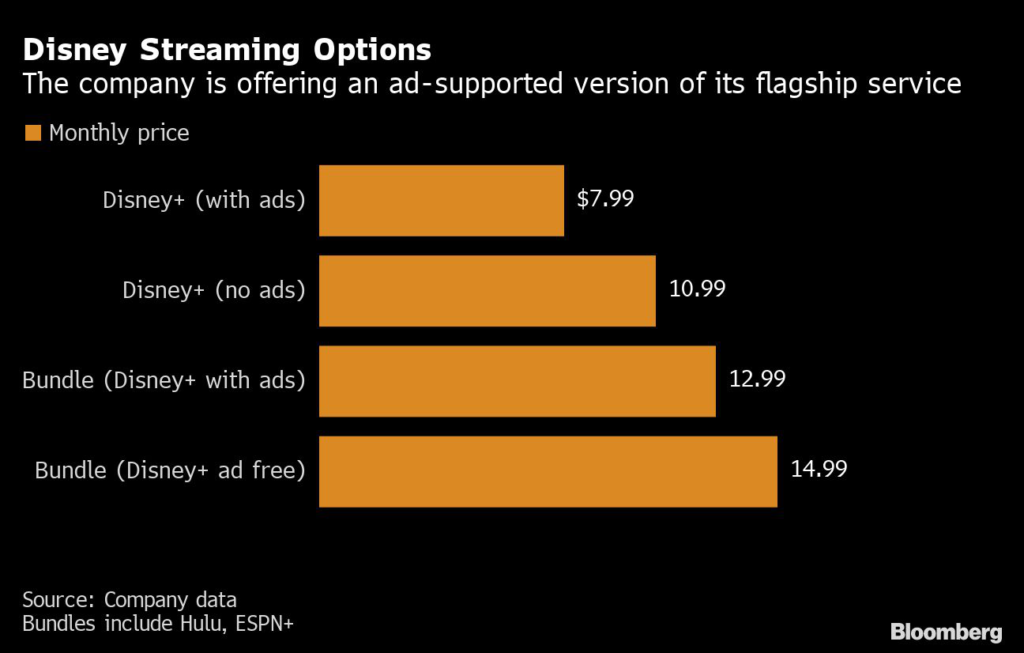
On Dec. 8, Disney will introduce an ad-supported version of the flagship streaming service and raise the price of the ad-free option to $11 a month, the entertainment giant said Wednesday. Prices for some packages that include Hulu and ESPN+ will also rise.

The price increases, subscriber gains and a strong third-quarter performance from Disney’s namesake theme parks may help reverse investor sentiment that sent the shares down 27% this year through Wednesday’s close. The company added 14.4 million new Disney+ subscribers in the quarter, beating analysts’ estimates of 9.8 million and bucking the downdraft that’s hit Netflix Inc.


While Disney “shares have underperformed, the business has continued to outperform,” analysts at Morgan Stanley wrote in a note following the results. 

Read More: Disney Rises After Strong Streaming, Parks Beat: Street Wrap

Disney shares climbed as high as $123.52 in early trading, a 9.9% gain. 

Still, many analysts have been skeptical that Disney could meet the ambitious fiscal 2024 target for up to 260 million subscribers that it set two years ago. Chief Financial Officer Christine McCarthy told investors on a call Wednesday that the company now expects between 135 million and 165 million “core” Disney+ customers and as many as 80 million customers for the Disney+ Hotstar product in India by the end of fiscal 2024, or a maximum of 245 million.

The world’s largest entertainment company, Disney is trying to stem losses in its direct-to-consumer business as it navigates a transition from traditional TV viewing to online options. Disney+, launched in November 2019, includes films and TV shows from the company’s vast library, as well as new series tied to company brands such as Marvel and “Star Wars.” The company has said it expects Disney+ to be profitable in fiscal 2024.

The introduction of an ad-supported tier is meant to boost subscribers and generate more revenue by giving customers options for how much they want to pay for the service. Disney said last month it sold $9 billion of ads for the upcoming TV season, with 40% of that going to its online offerings.

Current Disney+ subscribers will begin receiving the ad-supported version unless they agree to pay more for the commercial-free plan.

The Burbank, California-based company reported fiscal third-quarter sales and earnings that beat analysts’ expectations, driven in part by strong performance of its theme parks. Sales in the period ended July 2 jumped 26% to $21.5 billion, led by soaring park revenue and beating analysts’ expectations of $21 billion. Earnings jumped to $1.09 a share excluding some items, topping estimates of 96 cents.

Total Subscribers

With last quarter’s gain, the total number of Disney+ subscribers has climbed to 152.1 million. ESPN+ now has 22.8 million subscribers and Hulu, including live TV, has 46.2 million. Netflix had 220.7 million subscribers at the close of its latest quarter. 

Operating losses at the direct-to-consumer business, which includes the streaming services, more than tripled to $1.06 billion as the company continues to invest in new programming and expand to new territories. That was worse than the $697 million analysts expected. Disney expects to spend about $30 billion on programming in the current fiscal year, down about $3 billion from its original plans.

Ken Leon, director of equity research at CFRA, told Bloomberg TV that he remains concerned about losses in the company’s streaming services and its reliance on low-cost subscribers in India. The standouts for him were the company’s TV networks and its theme parks.

“This was a strong quarter, mostly from the traditional, established businesses,” Leon said.

Profit in its traditional TV business, which includes the ABC and ESPN networks, rose 13% to $2.47 billion, thanks to higher ad revenue and fees from cable distributors. Programming costs were flat to down.

Profit at the company’s theme parks, a star in recent months as consumers went on vacations again after two years of the pandemic, rose sixfold to $2.19 billion. US resorts were the main driver, while international parks lost money and consumer products delivered only a modest increase.

The company reported a 26% jump in sales for its film studio to $2.11 billion, but suffered a loss of $27 million as the strong performance of “Doctor Strange in the Multiverse of Madness” in theaters was offset by lower home-entertainment revenue.

(Updates trading in first and fifth paragraphs)

More stories like this are available on bloomberg.com

©2022 Bloomberg L.P.

Stock Futures Climb as Traders Assess Resolute Fed: Markets Wrap

(Bloomberg) — US stock futures rose, signaling an extension of the rally spurred by Wednesday’s softer-than-expected US inflation data, even as Federal Reserve officials remained resolute on the need for further interest-rate increases. 

S&P 500 contracts advanced 0.5% after the underlying gauge hit a three-month high in the previous session. Those on the Nasdaq 100 also added 0.5% after the tech heavy index pulled 20% above a June low. Walt Disney Co. jumped in premarket following a strong performance by its streaming service. Bumble Inc. slid as the dating app company cut its revenue forecast. 

US headline inflation was 8.5% in July, down from the 9.1% June print that was the largest in four decades. Fed officials were quick to stress more rate hikes are coming to counter price pressures and signaled investors should rethink expectations of cuts next year to shore up economic growth. 

“Despite the Fed’s unwavering rhetoric, this release has given investors hope that the pace of rate rises in the US will slow and that the fabled soft landing may be less elusive than feared,” said Lewis Grant, head of global equities at Federated Hermes. 

A dollar index slipped, adding to retreat a day earlier that was the biggest since the onset of the pandemic. Ten-year Treasury yields dropped after producer prices unexpectedly fell in July.

Europe’s Stoxx 600 Index struggled to hold on to gains. Drugmakers GSK Plc, Sanofi and Haleon Plc weighed on the market, slumping amid mounting concerns about litigation around recalled heartburn drug Zantac.

European Record

Crude oil rose as the International Energy Agency boosted its forecast for global demand growth this year as soaring natural gas prices and heat waves spur industry and power generators to switch their fuel to oil. OPEC, in contrast, said it expects global oil markets to tip into surplus this quarter.

European power prices climbed to fresh records on Thursday. Benchmark German power for next year increased as much as 4.5% to an all-time high of 446 euros a megawatt-hour. The French contract was up as much as 4.4%, rising above 600 euros. That’s more than $1,000 for the equivalent energy of a barrel of oil.

Bitcoin broke past $24,000 in a sign of the brighter sentiment in markets.

Market Surge After CPI Data Has Skeptics Issuing a Warning 

On the US monetary policy front, Minneapolis Fed President Neel Kashkari said he wants the Fed’s benchmark interest rate at 3.9% by the end of this year and at 4.4% by the end of 2023.

‘Unacceptably High’

Alluding to market pricing of the Fed’s policy path, Kashkari said it was not realistic to conclude that the Fed will start cutting rates early next year, when inflation is very likely to be well in excess of the 2% goal.

Chicago counterpart Charles Evans said inflation remains “unacceptably high” and that “we will be increasing rates the rest of this year and into next year.”

Swaps referencing the Fed’s September meeting brought a half-point rate increase back into play as opposed to a bigger move. A key portion of the Treasury yield curve remains deeply inverted, a pattern widely thought to signal the risk of a recession.

Investors Might Not Be So Forgiving Next Quarter: Earnings Watch

Respected for decades for combining decent returns and relatively low volatility, the 60/40 portfolio has generated a 11.5% loss so far this year. Is it time to put the strategy to rest entirely or does it just need a tweak? Have your say in the anonymous MLIV Pulse survey.

What to watch this week:

  • US PPI, initial jobless claims, Thursday
  • San Francisco Fed President Mary Daly is interviewed on Bloomberg Television, Thursday
  • Euro-area industrial production, Friday
  • US University of Michigan consumer sentiment, Friday

Some of the main moves in markets:

Stocks

  • Futures on the S&P 500 rose 0.5% as of 8:37 a.m. New York time
  • Futures on the Nasdaq 100 rose 0.5%
  • Futures on the Dow Jones Industrial Average rose 0.6%
  • The Stoxx Europe 600 was little changed
  • The MSCI World index rose 0.2%

Currencies

  • The Bloomberg Dollar Spot Index fell 0.2%
  • The euro rose 0.3% to $1.0329
  • The British pound was little changed at $1.2215
  • The Japanese yen rose 0.5% to 132.27 per dollar

Bonds

  • The yield on 10-year Treasuries declined three basis points to 2.75%
  • Germany’s 10-year yield was little changed at 0.88%
  • Britain’s 10-year yield advanced two basis points to 1.97%

Commodities

  • West Texas Intermediate crude rose 1.2% to $93.02 a barrel
  • Gold futures were little changed

More stories like this are available on bloomberg.com

©2022 Bloomberg L.P.

Crimea Base Blast Deals Blow to Russia’s War Machine in Ukraine

(Bloomberg) — Explosions at a Russian airbase in Crimea that Ukraine says destroyed nine fighter aircraft may indicate new Ukrainian offensive capabilities that complicate Kremlin efforts to support its invading forces, according to European intelligence officials and defense analysts.

“In just one day, the occupiers lost 10 combat aircraft, nine in Crimea and one more in the direction of Zaporizhzhia,” Ukrainian President Volodymyr Zelenskiy said in his nightly video address to the nation. More Russian armored vehicles, ammunition warehouses and logistics routes were also destroyed, and “the more losses the occupiers suffer, the sooner we will be able to liberate our land,” he said. 

The exact nature of Tuesday’s blasts remains unclear, as Russian officials blame safety lapses involving munitions and deny any Ukrainian role while officials in Kyiv hint at the involvement of their forces. Rumors have swirled online that Ukrainian special forces, partisans, drones or long-range rockets were responsible, which would represent a serious security failure at an important Russian air base some 200 kilometers (124 miles) behind the front lines, according to defense analysts. 

The destruction of combat aircraft at the Saky base follows an unexplained attack on the headquarters of Russia’s Black Sea Fleet in Crimea in July. The suspected Ukrainian assault will likely change Moscow’s view of Crimea as a secure base to support its invasion forces, especially if more strikes follow, the intelligence officials said.

That could force an already stretched Russian military to divert resources to protect areas previously seen as secure, just as Ukraine’s army is pressing to advance toward the southern city of Kherson seized by Moscow’s troops early in the war. A huge road and rail bridge connecting Crimea to Russia across the Kerch Strait represents an obvious target for Ukraine’s military to sever supply lines to an important staging post for the Kremlin’s forces. 

On Thursday, Belarus dismissed reports of explosions at an airbase close to the Ukrainian border that opposition activists say has been used by Russia’s military during the invasion. An equipment fire broke out at the Zyabrovka base late Wednesday and was extinguished, the state-run Belta news service reported, citing a Belarus Defense Ministry statement.  

Satellite imagery of the Crimea base showed apparently extensive damage to buildings and aircraft. Russian losses include at least four Su-30SM multirole aircraft and six Su-24M/MR strike and tactical reconnaissance aircraft, according to analysis of the images by Oryxspioenkop, a Dutch open-source intelligence defense analysis website.

The Crimea explosions most likely point to sabotage operations either by Ukrainian special forces or partisans, according to Ben Barry, a senior fellow for land warfare at the London-based International Institute for Strategic Studies. 

“If Russia wants to guard their airbases, that can only come at the expense of troops for the attack on Ukraine,” he said. “It potentially should reduce the number of Russian forces on the front line – whether that will be decisive or not, we cannot tell.”

Ukrainian officials haven’t directly claimed responsibility while suggesting in social media posts that their forces were behind the explosions. A top Zelenskiy aide warned the blasts were “just the beginning” of efforts to reclaim Crimea after Russian President Vladimir Putin annexed the Black Sea peninsula in 2014.

That makes the issue potentially even more sensitive for Putin, who has repeatedly declared Crimea to be an inalienable part of Russia, a claim rejected by the international community which regards it as Ukrainian territory.

UK Defence Secretary Ben Wallace dismissed Russia’s explanations for the blasts in an interview with the BBC, saying it was clear the explosions weren’t caused by someone dropping a cigarette. It would be legitimate to target Russian forces in Crimea because “Ukraine, under United Nations articles, is perfectly entitled to defend its territory and take what action it needs to against an invading force,” he said.

More stories like this are available on bloomberg.com

©2022 Bloomberg L.P.

Ether Reaches Two-Month High as Software Update Test Conducted

(Bloomberg) — Ether hit a more than two-month high as the planned software upgrade to the Ethereum blockchain underwent a major test, potentially paving the way for one of the most significant changes in the cryptocurrency sector.

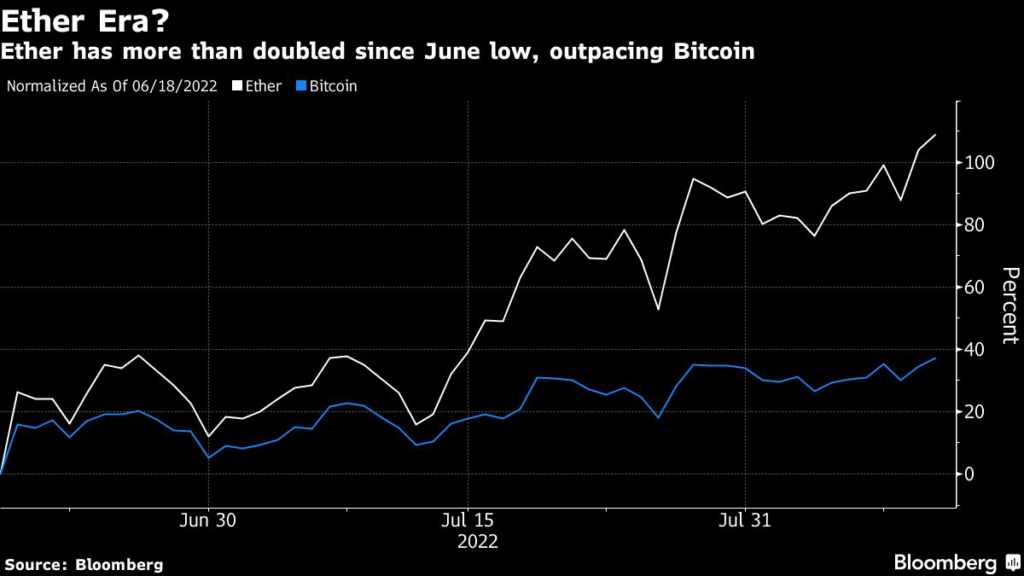
The token rose as much as 4.1% on Thursday and was trading at around $1,900 as of 7:49 a.m. in New York — more than double a June low below $900 and far outpacing the rebound in Bitcoin over the period. Ether had surged to a record of more than $4,800 in November.

Ether is the native coin of Ethereum — the most important commercial blockchain — and its ride higher atop the optimism surrounding the merge, as the planned network upgrade is known, has become emblematic of the nascent crypto rebound from this year’s painful rout.

The Goerli test conducted late Wednesday New York time was a kind of dress-rehearsal for switching the Ethereum network from proof-of-work to a more energy-efficient proof-of-stake system. The full shift is expected next month.

Ethereum co-founder Vitalik Buterin retweeted a post saying the test had activated proof-of-stake. In another tweet, Tim Beiko, a computer scientist who coordinates Ethereum developers, posted a screenshot suggesting the test of the planned merge had been successful. Kunal Goel, a research analyst at crypto intelligence firm Messari, also said the Goerli test had been passed.

The software upgrade has been in the works for years, and Ethereum’s dominant role as a commercial highway in crypto underlines the sensitivity of the change. 

The blockchain supports more than 3,400 active decentralized apps, allowing for everything from gaming to trading. Ether tokens have a $229 billion market value, according to CoinMarketCap.

Ethereum core developers may on Thursday set the date for when the blockchain undergoes the long-anticipated software update.

More stories like this are available on bloomberg.com

©2022 Bloomberg L.P.

Top China Chipmaker Defies US Sanctions With Earnings Beat

(Bloomberg) — Semiconductor Manufacturing International Corp.’s net income beat analysts’ estimates after advances in technology helped cushion the impact from US sanctions.

China’s largest chipmaker posted net income of $514.3 million in the second quarter, surpassing the $469.5 million average estimate, the company said in a statement. It reported revenue of $1.9 billion.

SMIC is among a raft of Chinese semiconductor manufacturers contending with steadily tightening US export restrictions as Washington tries to contain Beijing’s technological rise. That’s on top of rapidly crumbling global electronics demand, as consumers leave a pandemic-era boom behind.

In response, homegrown firms have attempted to develop alternatives to American silicon. The Shanghai-based contract chipmaker has succeeded in advancing its production technology two generations this year to 7-nanometers, though industry experts caution that may not be based on the same standards employed by far larger rivals like Taiwan Semiconductor Manufacturing Co.

SMIC said in a separate filing that Tudor Brown, the former president of Arm Ltd., has resigned from the board, confirming an earlier Bloomberg report. Zhao Haijun also resigned as an executive director, but will remain the role as co-CEO, according to the company.

Read more: US Quietly Tightens Grip on Exports of Chipmaking Gear to China

What Bloomberg Intelligence Says

Semiconductor Manufacturing International’s return on equity is on track to hit a new high in 2022 despite disruptions to production and capacity expansions due to stricter US export-licensing requirements and China’s Covid-19 lockdowns. The company’s chip foundries will run at high utilization rates over the next two years amid a rapid increase in local fabless chipmaker numbers and increasing silicon content in consumer appliances and automobiles. Its shift toward higher-margin specialty chips — less exposed to sanctions risk — may help to offset soaring depreciation and staff costs.

– Charles Shum, analyst

Click here for the research.

SMIC is at the vanguard of China’s long-term ambition to produce chips sophisticated enough to replace American-designed silicon, which comprise the majority of the country’s annual $155 billion in semiconductor consumption.

It remains a technological leader in a giant domestic industry now gripped by a series of corruption probes, as senior officials frustrated with the nation’s lack of progress in semiconductors begin to hold executives accountable. The outcome of the widening dragnet and its impact on local players remain unclear.

Read more: China Graft Probes Stem From Anger Over Failed Chip Plans 

US sanctions have played a central role in curbing the country’s chip ambitions. The Trump administration blacklisted SMIC about two years ago on national security concerns, citing the company’s ties with the Chinese military, an allegation the chipmaker has denied. Washington is now also pressing allies into the effort, so that key suppliers like the Netherlands’ ASML Holding NV and Japan’s Nikon Corp. join its technology blockade.  

SMIC has said that hurts its ability to develop more sophisticated technologies. The company’s capability is severely curbed by its lack of access for instance to ASML Holding NV’s extreme ultraviolet lithography systems, which are required to make the most advanced chips.

More fundamentally, it remains unclear how worsening demand for electronics, memory and even auto chips will impact SMIC’s business. Investors are growing increasingly skittish the notoriously cyclical industry is hurtling toward a prolonged slump after years of widespread shortages that led to heavy investments in capacity.

Read more: US Pushes for ASML to Stop Selling Chipmaking Gear to China

More stories like this are available on bloomberg.com

©2022 Bloomberg L.P.
Philippines to Stop Permits for New Virtual Asset Service Firms

(Bloomberg) — The Philippine central bank will close its regular application window for new virtual asset service provider licenses for three years beginning September, it said in a memorandum. 

The regulator said it “aims to strike a balance between promoting innovation in the financial sector and ensuring that associated risks remain within manageable levels.” 

Central bank-supervised institutions that want to expand offerings to virtual-asset services including safekeeping may still apply for a license, according to the memorandum dated August 10. The closing of the regular window will be reassessed based on market developments. 

On its website, the central bank lists 19 companies that offer services related to virtual assets, including cryptocurrency, as of end-June.

More stories like this are available on bloomberg.com

©2022 Bloomberg L.P.

Climate Tech’s Urban Clusters Might Not Emerge Where You Expect

(Bloomberg) —

Tomorrow, the US House of Representatives is expected to pass the Inflation Reduction Act. The bill, with its $369 billion for decarbonization, could change the landscape of US climate tech at a stroke — massively scaling up proven technologies like wind, solar and batteries while essentially creating new sectors for green hydrogen and carbon capture. 

Some of the economic activity that the IRA will generate is likely to map onto existing geographic clusters of economic activity. Venture capital flows into climate tech, for instance, look quite like VC in general. According to a report by Climate Tech VC, nearly a quarter of the 1,000-plus early-stage climate companies it tracks are located in California. 

Early-stage capital is not everything, though, particularly when technologies scale. And critically, success and scale will push technologies into new markets and with new industrial partners. Semiconductor firms describe the challenge of going from small-scale experimentation and prototyping to massive, high-quality manufacturing as going from “lab to fab.” Successful climate technologies will need to do something similar and must draw on clusters of sector expertise. 

The San Francisco Bay Area will remain a critically important cluster, given its financial and human capital, laboratories, international connections and access to large domestic markets. The region not only attracts people interested in climate, it has an increasingly large group of executives who are experienced with startups, high growth and global scale — experience that can be devoted to new challenges. 

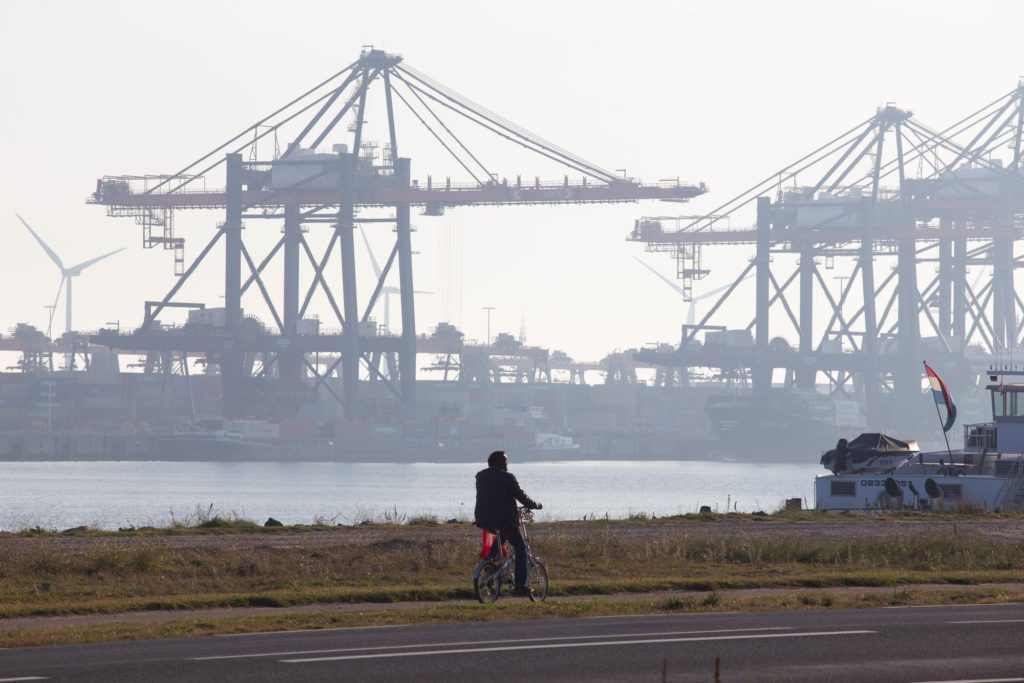
Singapore also seems like a natural fit. The Global Centre for Maritime Decarbonisation, a nonprofit founded last year with funding from the city-state’s port authority, is an instructive example. Last month, it began leading a consortium of 18 industry partners to test biofuels in marine shipping and the integrity of the supply chains that could help the use of such fuels to scale up. This effort requires the center to find financial, technical, regulatory and logistical partners. They will need to combine innovation with established safeguards that exist for good reasons. This is the sort of initiative that one could launch anywhere, but deploy in very few places.  

Rotterdam could lead in marine climate tech, as perhaps could the ports of Yokohama or Kawasaki in Japan. Houston, at the heart of the US hydrocarbon complex, has climate cluster potential, with great universities as well as being a port city. So does Calgary, a big hub for Canadian oil with strong academic and capital networks. 

Toulouse, France, home to Airbus, could host a cluster for decarbonizing aviation, but so too could Wichita, Kansas — an aerospace manufacturing center — or Los Angeles. 

There are a number of characteristics that new climate clusters will need to have, or at least be in proximity to: •    Deep and broad capital markets, from early-stage venture to pensions and sovereign wealth funds•    Business-friendly environments, willing to facilitate manufacturing and deployment•    A constructive legal and regulatory environment for starting companies and protecting intellectual property•    Ample human capital, including with technology-specific engineering and programming skills •    World-class research capabilities in the form of universities, national labs and corporate consortia 

There aren’t a lot of surprises in that list, so it’s worth adding some desirable climate-specific elements. These include: •    Favorable geology for long-term storage of carbon dioxide •    Ample land — this could be either high-value agricultural land for feedstocks or paradoxically, degraded land with little economic value outside of hosting manufacturing or energy production•    Favorable trade conditions for importing/exporting products •    Biomass, crops or other available feedstocks for making new net-zero-carbon materials •    Significant markets for selling clean power or green hydrogen

Mash these together, and I believe we will see some significant new tech/industrial climate clusters emerge. 

Finally, I think that climate’s new industrial clusters will both attract talent and gently test the limits of remote work. A startup can push code from anywhere, but you cannot build a reactor vessel or liquefy carbon dioxide remotely. That expertise is physical, collaborative and iterative, and will require teams to work together for long periods of time. I hope that tomorrow’s climate clusters will embody the best of today’s virtual working practices, while integrating the vast human capital that knows how to build and deploy in physical space. 

Nat Bullard is a senior contributor to BloombergNEF and Bloomberg Green. He is a venture partner at Voyager, an early-stage climate technology investor.

More stories like this are available on bloomberg.com

©2022 Bloomberg L.P.

Close Bitnami banner
Bitnami