
Bloomberg

Tencent-Backed China Health Information Unicorn Censored Online

(Bloomberg) — A Chinese health information provider valued at more than $1 billion by investors including IDG Capital and Tencent Holdings Ltd. has had at least five of its social media accounts frozen by what appears to be government censors.

Hangzhou Lianke Meixun Biomedical Technology Co., which is well-known in China for its DXY websites that fact check health claims and explain science to the public, had a handful of its Weibo social media accounts labeled as “violating regulations” and suspended. No further details were given. 

The move comes three months after DXY published an article saying that Lianhua Qingwen, a type of traditional Chinese medicine being promoted by the government for treating Covid-19, hasn’t been shown to prevent infections. It also questioned why the medicine was given priority for distribution over other essentials including food during the recent two-month lockdown in Shanghai. The post, which has since been removed, attracted considerable criticism from people online, some of whom saw it as an attack on traditional Chinese medicine.

China Tries to Win Global Acceptance for Traditional Covid Cures 

The Cyberspace Administration of China, the government body that polices the country’s heavily-regulated internet, didn’t immediately respond to questions faxed by Bloomberg News. Representatives for Tencent, WeChat’s parent company, and Weibo also didn’t reply to requests for comment. DXY didn’t respond to requests for further comment. 

The startup hit unicorn status in 2020 when its valuation exceeded $1 billion after a series E funding round of $500 million, led by IDG Capital, followed by Tencent and GL Ventures. 

The censored accounts have a combined 8.69 million followers and now carry notices that say they are prohibited from posting due to “violating relevant laws and regulations.” DXY’s accounts on other Chinese platforms such as WeChat haven’t been updated since Monday.

TCM Push

The article questioning Lianhua Qingwen came at a time when Beijing was pushing the use of traditional Chinese medicine, or TCM, for the treatment of Covid both at home and abroad. China has sent TCM specialists to Cambodia and is supporting clinical trials for TCM in Pakistan, both countries that rely heavily on Chinese aid. It was also distributed widely in Hong Kong free of charge to residents during the city’s omicron outbreak in the spring.

Lianhua Qingwen products generated sales of about 4.1 billion yuan ($622.8 million) in 2021 for its maker, Yiling Pharmaceutical Co., according to the company’s annual report. That’s down from $676 million in 2020, when sales soared 150% year-over-year. 

China has a track record of censoring criticism of TCM. In April, Wang Sicong, the son of real estate tycoon Wan Jianlin, had his Weibo account banned and then completely removed after he shared a video questioning Yiling Pharmaceutical’s claims about Lianhua Qingwen.

The post sent the drugmaker’s shares plunging, wiping out $2 billion in net worth from the company founder Wu Yiling and his family, according to the Bloomberg Billionaires Index. 

Wang, however, also criticized the lockdown in Shanghai, which could have drawn official ire. Chinese President Xi Jinping is resolutely committed to a Covid Zero policy that still seeks to wipe out the virus with lockdowns and other restrictions, and authorities have been quick to quell dissent against it.

More stories like this are available on bloomberg.com

©2022 Bloomberg L.P.
The Most Curious Nation About Crypto Is Nigeria, Study Shows

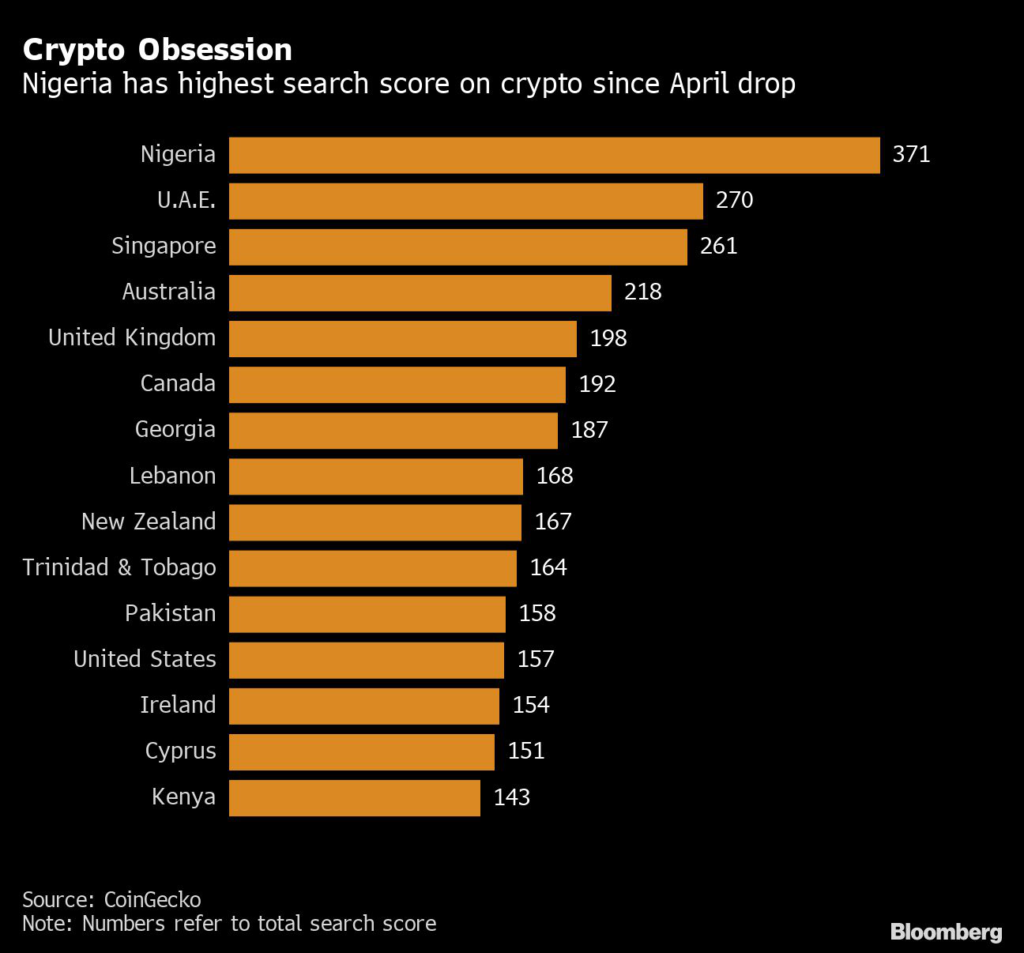
(Bloomberg) — Africa’s most-populous nation showed more interest in cryptocurrencies than any other country since the digital assets began to decline in April, according to a study by price tracker CoinGecko.

Nigeria scored 371 in the study that looked at Google Trends data for six searches such as “buy crypto” or “invest in crypto” that were then combined to give each English-speaking nation a total search ranking. The West African country was followed by the United Arab Emirates and Singapore. 

“This study provides interesting insight into which countries remain most interested in cryptocurrency in spite of market pullbacks,” CoinGecko’s co-founder Bobby Ong said in an emailed statement. “The countries at the top of this list appear to be keenest to buy the dip, and highlight their long-term outlook for cryptocurrencies.” 

The Nigerian stock exchange said in June it planned to start a blockchain-enabled platform next year to deepen trade and lure young investors to the market. That came after its central bank in early 2021 ordered commercial lenders to stop transactions or operations in cryptocurrencies, citing a threat to the financial system.

Singapore had the most searches on Ethereum, while Georgia sought information on Solana, according to CoinGecko. 

More stories like this are available on bloomberg.com

©2022 Bloomberg L.P.
Coinbase Disappoints With User Forecast, Revenue Miss

(Bloomberg) — Coinbase Global Inc. posted a record $1.1 billion second-quarter loss and lower-than-expected revenue as the largest US cryptocurrency exchange was battered by tumbling digital-asset prices. 

Shares of the company, which were first listed last April, dropped about 6% in US premarket trading. Coinbase has slumped 65% so far this year amid what has been labeled as the latest “crypto winter.”

Revenue declined by more than 60% to $808.3 million, missing the $854.8 million estimate from analysts polled by Bloomberg. Monthly transacting users dropped to 9 million in the second quarter, a 2% decline from prior quarter. Trading volume also missed estimates, with Bitcoin’s share of trading volume rising to 31% from 24%. Total assets on platform plunged 63% to $96 billion. 

“The current downturn came fast and furious,” the company said in a shareholder letter, adding that soft crypto market conditions are continuing into the third quarter. Core retail customers are “sitting on the sidelines” because of the downturn, Chief Operating Officer Emilie Choi said during a Bloomberg TV interview. 

“Investors had expected a pretty ugly quarter on trading revenue,” said Owen Lau, an analyst at Oppenheimer & Co. In crypto winter, “the big theme is the diversification continues,” such as through staking and interest income, he said. 

On full-year outlook, the company now expects 7 million to 9 million average monthly transacting users, narrowing the range from earlier forecast. That compares with the average analyst estimate of 8.7 million users.  

Coinbase’s lost in the three months ended June 30 included $446 million in impairment charges related to investments and ventures, making it the largest amount since it became a public company. Prices of many popular cryptocurrencies reached a more than 18-month low in June in the wake of the collapse of the Terra-Luna ecosystem and the bankruptcy of industry powerhouses such as Three Arrows Capital.

“Clearly we acknowledge these are stress market conditions,” Alesia Haas, chief financial officer, said during a conference call.   

Coinbase said in May, the Securities and Exchange Commission sent a voluntary request for information on its listings and listing process, and it does not yet know if this inquiry will become a formal investigation. It is under scrutiny by the SEC for potentially making unregistered securities available for trading, Bloomberg previously reported.

“We have a zero-tolerance policy on front-running,” Choi said in regard to the case involving alleged insider trading by a former Coinbase manager.

(Updates with pre-market trading in second paragraph.)

More stories like this are available on bloomberg.com

©2022 Bloomberg L.P.

Ant-Backed Dana Bags $250 Million From Sinar Mas, Alibaba

(Bloomberg) — Dana, one of Indonesia’s biggest digital wallet providers, has raised $250 million from local conglomerate Sinar Mas and Alibaba Group Holding Ltd.’s Lazada Group to expand in its home country.

The five-year-old company will use the funds to invest in new tech and roll out more financial services in one of the world’s fastest-growing fintech markets, Chief Executive Officer Vince Iswara told Bloomberg News. The value of digital payments in the country has already exceeded both credit and debit card transactions in Indonesia, according to Bank Indonesia data.

“We are going to keep investing in our technology, which has been our greatest strength and one of the biggest drivers of our growth and for financial services,” Iswara said in a video interview from Jakarta. 

Dana, which is part-owned by Jack Ma’s Ant Group Co., plans to offer lending, wealth management and insurance as it expands its portfolio, the CEO said. “We learn a lot from one of our investors,” he added. With this investment, the Jakarta-based startup also deepens its ties with Alibaba, which owns a third of Ant.

The funding comes as Chinese fintech giant Ant is working to expand across Southeast Asia, where it has local partners in Indonesia, Malaysia, the Philippines and Thailand. In June, the company also launched a digital bank in Singapore to provide fintech services to smaller enterprises.

Ant Unveils Singapore Digital Bank in Southeast Asian Push

Digital payments are a crucial way for internet companies to gain customers in Southeast Asia, a region of 650 million people where many have limited access to credit cards. Players are trying to bring users into their ecosystem with everyday mobile banking services before expanding to offer higher-margin financial products aimed at helping them move toward profitability. 

Southeast Asia Is World’s Fastest-Growing Mobile Wallet Market

Founded in 2017 and launched in 2018, Dana’s other shareholders include Ant and Indonesia’s media conglomerate PT Elang Mahkota Teknologi, better know as Emtek. The startup has over 115 million registered users in Indonesia. It is used by consumers and merchants to pay bills, transfer money and open a bank account and processes an average of 10 million transactions per day. It was the most downloaded finance app in Indonesia in 2021, according to data.ai. 

More stories like this are available on bloomberg.com

©2022 Bloomberg L.P.

Kohlberg Acquires Half Stake in USIC at $4.1 Billion Valuation

(Bloomberg) — Kohlberg & Co. is acquiring 50% of United States Infrastructure Corp. from investment firm Partners Group in a deal valuing the utility location service provider at $4.1 billion including debt.

The purchase of the stake by Kohlberg is being done alongside a new group of investors that includes funds managed by Neuberger Berman, according to a statement reviewed by Bloomberg News. Partners Group will retain a 50% investment in the overall business. 

Founded in 2008, USIC provides more than 1,300 clients with outsourced services for locating, identifying and marking underground utility infrastructure such as pipes and cables. It has a workforce of roughly 9,000 technicians who perform about 80 million so-called locates a year for cable, telecom, electric, gas, water and sewer lines. The Indianapolis-based company serves customers across the US and Canada.

Joel Schwartz, co-head of private equity services at Partners Group, said USIC’s scope and market share were “the core of what attracted” the firm to the asset. The business also stands to gain from federal legislation, he said.  

“The nature of this business is large and steady and growing,” Schwartz said in an interview. “I think that the business will benefit from the infrastructure bill, the telecom bill and the 5G rollout that’s going on. So there’s just a number of trends that should lead to a lot more volume in this sector.”

Partners Group acquired USIC in 2017. Since then, its earnings before interest, taxes, depreciation and amortization have grown by 77%, according to the statement. 

The Switzerland-based investment firm, with about $131 billion in assets under management, has seen a 3.2 return multiple on its original investment in USIC, according to people familiar with the matter who asked not to be identified because the information is private.

Kohlberg, based in Mount Kisco, New York, previously owned USIC. It created the company in 2008 through the merger of portfolio companies SM&P Utility Resources and Central Locating Services and sold it in 2010 to OMERS Private Equity, according to a statement at the time.

Partners Group was advised in the current transaction by Harris Williams, Bank of America Corp. and Ropes & Gray LLP. Goldman Sachs Group Inc., Houlihan Lokey Inc. and Paul, Weiss, Rifkind, Wharton & Garrison LLP represented Kohlberg.

More stories like this are available on bloomberg.com

©2022 Bloomberg L.P.

Rubik’s Cube Is Going Digital as Spin Master Buys Out Game Studio

(Bloomberg) — Spin Master Corp., the Canadian toymaker behind Rubik’s Cube and Etch a Sketch, agreed to acquire the Nordlight Games studio in a deal that will speed up the development of products for mobile phones and tablets.

The toy and entertainment company, also known for the Paw Patrol franchise, has been working with Nordlight to expand its digital games business since acquiring a minority stake in the Swedish studio last year, according to a statement Wednesday. The founders of Stockholm-based Nordlight helped create Candy Crush, one the most popular mobile phone games ever.

The companies didn’t disclose terms.

Max Rangel, chief executive officer of Toronto-based Spin Master, wants digital games to account for 20% of the company’s total sales, up from about 10% in the second quarter of 2022. The segment is rapidly growing, with revenue rising to $40.3 million in the first six months of the year, a 29% jump from a year earlier. 

Nordlight has been working on a digital Rubik’s Cube since last August. The toy, created in 1974, surged in popularity during the pandemic, and Spin Master focused on expanding its appeal after it bought Rubik’s Brand Ltd. in late 2020 for $50 million. Spin Master said buying Nordlight could also increase sales of its other toy and puzzle brands, including Air Hogs and Hatchimals.

More stories like this are available on bloomberg.com

©2022 Bloomberg L.P.
SoftBank Sees $34 Billion Gain From Selling Alibaba Shares

(Bloomberg) — SoftBank Group Corp. expects to post a gain of more than $34 billion from selling down its stake in Alibaba Group Holding Ltd., cashing in a chunk of its most storied investment to shore up finances as global markets deteriorate.

The Japanese investment giant’s board approved Wednesday the early physical settlement of prepaid forward contracts corresponding to about 242 million American Depositary Receipts. After the settlement, which will run from August to September, its stake in China’s e-commerce leader will fall to 14.6% from 23.7% as of the end of June.

Masayoshi Son has this year accelerated the sale of assets, speeding the transformation of his conglomerate into a pure investment house. Investors have long pressed SoftBank to cash in its shares in Alibaba, monetizing one of the most lucrative bets in venture capital history — and one that made Son’s reputation as a startup investor.

Read more: SoftBank CEO Pledges Sweeping Cost Cuts After $23.4 Billion Loss

SoftBank had previously raised a huge slug of capital by selling forward contracts on Alibaba, taking in $10.5 billion during the June quarter and another $6.8 billion through such contracts on and after July 1. 

Physically settling the contracts means SoftBank will relinquish its right to buy back the stock at some point. In the past, when SoftBank procured funds through its Alibaba stake, the company kept open the option to buy back the shares it released through the forward contracts. 

A rare moment when SoftBank committed to lowering its Alibaba holdings was in 2016, when it needed to finance its purchase of chip architect Arm Ltd.

Son is now paring other holdings as he turns his focus to the eventual initial public offering of the British chip design giant. SoftBank has begun talks to sell asset manager Fortress Investment Group, and is also selling part or all of its 9% stake in SoFi Technologies Inc.

(Updates with details from the release from the second paragraph)

More stories like this are available on bloomberg.com

©2022 Bloomberg L.P.

Philippine Telecom Companies Feud Over ‘Fraudulent’ Calls

(Bloomberg) — The Philippines’ two biggest telecommunications companies PLDT Inc. and Globe Telecom Inc. have separately accused new entrant DITO Telecommunity Corp. of “fraudulent” calls made through its network, heightening a public disagreement.

Globe, in a statement Tuesday, said it has asked the telecommunications regulator to require DITO to pay 622 million pesos ($11.2 million) in penalties over alleged violations of interconnect rules. Globe said DITO’s network supposedly allowed a daily average of 1,000 calls that were “identified as international in origin but masked as local calls.”

PLDT unit Smart Communications also made similar allegations, saying in a separate statement Tuesday that DITO “has failed to prevent its network from being misused for fraud.” Smart said it has incurred “huge monetary losses” as DITO SIM cards were supposedly “masking international calls as domestic.”

Responding to Globe’s and Smart’s allegations, DITO said in separate statements sent Wednesday that the calls were “made by third parties,” and that it’s “equally a victim of such calls.” It also said it has undertaken steps to minimize them.

Globe said in another statement Wednesday that it asked the telecommunications regulator to temporarily disconnect its interconnection trunk lines with DITO to prevent further breach. Globe also said DITO’s debt grows about 2.5 million pesos daily due to the alleged violation.

DITO earlier this week filed complaints against Globe and Smart before the antitrust body for “possible anti-competitive practice in their interconnection agreements.” Globe and Smart have separately said they continue to honor interconnection deals with DITO.

(Adds DITO’s comments on Smart, Globe statement from fourth paragraph.)

More stories like this are available on bloomberg.com

©2022 Bloomberg L.P.
Understanding NFTs: A Bored Ape Explainer

  • Listen to Bloomberg Crypto on the iHeartRadio App
  • Listen to Bloomberg Crypto on Apple Podcasts
  • Listen to Bloomberg Crypto on Spotify  

(Bloomberg) — At the height of NFT mania, everyone from athletes like Tom Brady to celebs like Justin Beiber seemed to be buying (or talking about) collections like Bored Ape Yacht Club. Nonfungible tokens aren’t just pictures of monkeys, though — they exist on the blockchain, and buying or selling them typically requires paying in some kind of cryptocurrency, often Ether. While the link between NFT prices and the those of tokens such as Ether or Solana is not always straightforward, it’s true that nonfungible tokens haven’t been entirely spared from the chill of the crypto winter. For more on NFTs, and how and whether they’re holding up these days, Bloomberg reporter Prarthana Prakash joins this episode.

Follow us on Twitter @crypto, and subscribe to the Bloomberg Crypto Newsletter at https://bloom.bg/cryptonewsletter 


More stories like this are available on bloomberg.com

©2022 Bloomberg L.P.

US Stock Futures Climb Before Key Inflation Report: Markets Wrap

(Bloomberg) — US equity futures edged higher on Wednesday before US inflation data that will shape investor expectations for further Federal Reserve interest-rate hikes.

S&P 500 contracts gained 0.3%, following a fourth session of declines in the underlying gauge Tuesday after Micron Technology Inc. became the latest chipmaker to warn of slowing demand. Nasdaq 100 futures rose 0.5%. Tesla Inc. climbed in premarket trading after Chief Executive Officer Elon Musk’s biggest share sale on record. Europe’s Stoxx 600 Index erased an early drop. 

Bonds steadied. The two-year Treasury rate exceeds the 10-year by almost 50 basis points. The inversion, around the deepest since 2000, is viewed as a sign of a looming recession under the Fed’s monetary-tightening campaign to curb inflation. 

A report Wednesday is expected to show headline US consumer-price inflation cooled but stayed elevated in July, while the core reading may have quickened on an annual basis. How the figures affect views on Fed tightening will be key for risk sentiment.

“Today’s inflation number could set the tone for the markets for the rest of the month,” said Craig Erlam, a senior market analyst at Oanda. “A lower-than-expected number could be a major tailwind for the markets while anything around or above the June reading could trigger a big risk reversal in the markets as the debate shifts to 75 or 100 basis points, with 50 left in the rearview mirror.”

A dollar gauge slipped, while crude oil traded around $90 a barrel, and both gold and Bitcoin edged lower.

Federal Reserve Bank of St. Louis President James Bullard said the US central bank will be prepared to hold interest rates “higher for longer” should inflation continue to surprise to the upside.

The Fed “will be driving those short rates higher,” said Gary Schlossberg, a global strategist for Wells Fargo Investment Institute, on Bloomberg Television. “We will be seeing a deepening inversion and a full inversion of the Treasury yield curve.”

China’s military said exercises held around Taiwan in response to US House Speaker Nancy Pelosi’s visit had concluded, while pledging to continue regular patrols near the island. 

Musk sold $6.9 billion of shares in Tesla, the billionaire’s biggest sale on record, saying he needed cash in case he is forced to go ahead with his aborted deal to buy Twitter Inc. Tesla rose 2.7% in premarket trading.

Respected for decades for combining decent returns and relatively low volatility, the 60/40 portfolio has generated a 11.5% loss so far this year. Is it time to put the strategy to rest entirely or does it just need a tweak? Have your say in the anonymous MLIV Pulse survey.

What to watch this week:

  • US CPI data, Wednesday
  • Chicago Fed President Charles Evans and his Minneapolis counterpart Neel Kashkari due to speak, Wednesday
  • US PPI, initial jobless claims, Thursday
  • San Francisco Fed President Mary Daly is interviewed on Bloomberg Television, Thursday
  • Euro-area industrial production, Friday
  • US University of Michigan consumer sentiment, Friday

Some of the main moves in markets:

Stocks

  • The Stoxx Europe 600 was little changed as of 9:51 a.m. London time
  • Futures on the S&P 500 rose 0.3%
  • Futures on the Nasdaq 100 rose 0.5%
  • Futures on the Dow Jones Industrial Average rose 0.3%
  • The MSCI Asia Pacific Index fell 0.8%
  • The MSCI Emerging Markets Index fell 1%

Currencies

  • The Bloomberg Dollar Spot Index fell 0.1%
  • The euro was little changed at $1.0221
  • The Japanese yen was little changed at 134.97 per dollar
  • The offshore yuan was little changed at 6.7611 per dollar
  • The British pound rose 0.1% to $1.2098

Bonds

  • The yield on 10-year Treasuries was little changed at 2.77%
  • Germany’s 10-year yield declined two basis points to 0.90%
  • Britain’s 10-year yield declined one basis point to 1.96%

Commodities

  • Brent crude fell 0.2% to $96.10 a barrel
  • Spot gold was little changed

More stories like this are available on bloomberg.com

©2022 Bloomberg L.P.

Close Bitnami banner
Bitnami