

Bloomberg

Musk Sells $6.9 Billion of Tesla to Avoid Twitter Fire Sale

(Bloomberg) — Elon Musk offloaded $6.9 billion worth of stock in Tesla Inc., saying he wanted to avoid a sudden sale in the event he’s forced to go ahead with his deal to acquire Twitter Inc.

Tesla’s chief executive officer sold about 7.92 million shares on Aug. 5, according to regulatory filings released after US markets closed Tuesday. Musk tweeted that he was done selling and would buy shares in the electric-car maker if the Twitter deal doesn’t close.

“In the (hopefully unlikely) event that Twitter forces this deal to close *and* some equity partners don’t come through, it is important to avoid an emergency sale of Tesla stock,” Musk wrote.

Tesla rose 3.4% to $879 before the start of regular trading Wednesday, while Twitter jumped 4.3% to $44.69.

Musk has now dumped about $32 billion worth of Tesla shares since November. The world’s richest person said less than four months ago he had no further stock sales planned and has attempted since then to terminate his $44 billion acquisition of Twitter. The social media company has sued to force Musk to go through with the deal, and a trial is scheduled for October.

“He is cashing up for Twitter,” said Charu Chanana, a strategist at Saxo Capital Markets Pte in Singapore, who believes Musk may be trying to take advantage of Tesla shares rebounding about 35% since late May. “The bear market rally has started to falter, and further repricing of Fed expectations could mean more pain for equities ahead, especially in tech.”

Investors had been skeptical that Musk, 51, was done offloading Tesla stock, with 68% of 1,562 respondents to an MLIV Pulse survey saying last month he was likely to sell more regardless of what happens with the Twitter deal.

“Musk said at the Tesla shareholder meeting that any weakness in the share price was a buying opportunity, and then 24 hours later started selling stock himself,” said Jim Dixon, a senior equity sales trader at Mirabaud Securities. It’s “very unlikely” Musk is done offloading the stock now, Dixon said.

Musk May Keep Selling Tesla, With or Without Twitter: MLIV Pulse

Tesla’s market fortunes have been tied to the Twitter deal since Musk made his surprise overtures in April. The carmaker’s shares initially slumped out of concerns the pursuit would distract him and over the risk associated with the margin loan he intended to take out against his Tesla stake. The stock rallied when Musk abandoned the borrowing plan and in the weeks after he said he wanted to terminate the transaction.

When Musk dropped plans to partially fund the Twitter purchase with a Tesla margin loan, it increased the size of the equity component of the deal to $33.5 billion. He’s previously announced having secured $7.1 billion of equity commitments from investors including billionaire Larry Ellison, Sequoia Capital and Binance.

Over the weekend, Musk tweeted that if Twitter provided its method of sampling accounts to determine the number of bots on its platform, “the deal should proceed on original terms.” 

The Twitter deal included a provision that if it fell apart, the party breaking the agreement would pay a termination fee of $1 billion under certain circumstances. Legal experts have debated whether the conflict over spam bots is enough to allow Musk to walk away from the deal.

Musk’s disposals of Tesla stock over the past 10 months started after he polled Twitter users on whether he should trim his stake. He still owns about 14.8% of the company and remains by far the largest stakeholder, according to data compiled by Bloomberg.

Commenting before Musk’s tweets clarifying the reason for the sale, Gene Munster, managing partner of Loup Ventures, said he put the odds the billionaire will end up buying Twitter at 75%. 

“I’m shocked,” Munster said. “This is going to be a headwind for Tesla in the near term. In the long term, all that matters is deliveries and gross margin.”

Musk’s $250.2 billion fortune is the world’s largest, according to the Bloomberg Billionaires Index, though his wealth has shrunk by about $20.1 billion this year as Tesla’s stock has declined.

The carmaker’s shareholders approved a three-for-one stock split last week, a move designed to attract an even larger number of retail investors. Tesla’s better-than-expected second-quarter earnings have been a tailwind, along with landmark US legislation that includes tax credits for electric-car purchases and loans to companies constructing plants that make clean vehicles.

(Updates with early trading in the fourth paragraph.)

More stories like this are available on bloomberg.com

©2022 Bloomberg L.P.

Biden Signs Chips Bill, Unleashing Funding for US Production

(Bloomberg) — President Joe Biden signed into law a broad competition bill Tuesday that includes about $52 billion to boost domestic semiconductor research and development, calling it a “once-in-a-generation investment in America itself.”

“We need to make these chips here in America to bring down everyday costs and create jobs,” said Biden at a signing ceremony for the CHIPS and Science Act on the White House South Lawn, joined by executives from US semiconductor firms and congressional leaders.

Biden said he had visited the US facility where Javelin missiles were made and said the bill would make the nation less reliant on other countries to provide the advanced chips needed for those weapons systems, as well as other products.

“Unfortunately, we produce zero percent of these advanced chips and China is trying to move way ahead of us to manufacture these sophisticated chips as well,” said Biden. 

“It’s no wonder the Chinese Communist Party actively lobbied US business against this bill. The United States must lead the world in the production of these advanced chips; this law will do exactly that.”

Chinese Foreign Ministry spokesman Wang Wenbin said the act showed “clear signs of protectionism” at a news briefing in Beijing on Wednesday. “This would disrupt international trade and distort global semiconductor supply chains,” he added. “China firmly opposes that.” 

Spurred by the bill, US semiconductor companies are planning billions of dollars in new investments. Ahead of the signing, the White House announced that Micron Technology Inc. will invest $40 billion in memory-chip manufacturing and that Qualcomm Inc. is partnering with GlobalFoundries, which has a facility in New York state, in a $4.2 billion agreement to manufacture chips. Micron on Tuesday said its investments would create up to 40,000 jobs in sectors including construction and manufacturing — well beyond the initial White House estimate of 8,000 — and it expects to receive funding through the semiconductor bill.

Legislative Wins

Micron Chief Executive Officer Sanjay Mehrotra attended the signing, along with Intel Corp. CEO Pat Gelsinger, Lockheed Martin Corp. CEO Jim Taiclet, HP Inc. CEO Enrique Lores and the CEO of Advanced Micro Devices Inc., Dr. Lisa Su.

The chips bill is one in a slew of legislative wins for the White House in recent weeks. Senate Democrats on Sunday passed a sweeping climate and spending bill — a slimmed down version of Biden’s Build Back Better agenda — after lawmakers also approved veterans health and gun-safety bills with bipartisan support. 

Biden was joined at the signing by Senate Majority Leader Chuck Schumer and House Speaker Nancy Pelosi.

The legislation first passed the Senate in June 2021 but lingered in the House for months, and it took more than one year to reconcile the two chambers’ versions. Some Senate Democrats had criticized the White House for not pushing the House and Pelosi to get the legislation over the finish line sooner.

Overseas Reliance

The chips bill is at the center of the Biden administration’s effort to reduce dependence on Asian suppliers like Taiwan and South Korea, whose homegrown companies are leading the market, and to address supply-chain disruptions and resulting price hikes for certain goods containing semiconductors.

Biden’s team and lawmakers have stressed the national security implications of the bill, saying it was vital to competing with and countering China.

A large chunk of the federal grant is expected to go to Intel, Taiwan Semiconductor Manufacturing Co. and South Korea’s Samsung Electronics Co., all of which are now building new chip fabrication facilities worth tens of billions of dollars in the US.

US to Stop TSMC, Intel From Adding Advanced Chip Fabs in China

The bill also includes important caveats sought by Republicans and China hawks: Companies that receive the funding have to promise not to increase their production of advanced chips in China. 

It was a condition made by lawmakers and the White House and was included in the measure over the objection of some chipmakers. Intel, in particular, was lobbying hard against the prohibitions. In late 2021, the American chipmaker wanted to increase production in China, but the plan was rejected by the Biden administration.

While China’s chipmaking champion Semiconductor Manufacturing International Corp. can make chips that are more advanced than 28 nanometers, its technology is still at least six years behind industry leader TSMC. 

Micron’s Mehrotra said earlier Tuesday that “today less than one in 50 chips, memory chips in the world, are produced in the US. With Micron’s commitment, it will enable us to produce one in 10 chips of the global memory consumption here in the US.”

The legislation “solidifies long term technology and manufacturing leadership of America,” Mehrotra said on Bloomberg Television.

(Updates with Chinese Foreign Ministry comments.)

More stories like this are available on bloomberg.com

©2022 Bloomberg L.P.

Deliveroo’s Loss Beats Estimates on Higher Fees, Ad Sales

(Bloomberg) — Deliveroo Plc’s loss widened less than analysts had estimated after the company generated sales from its new ad platform and increased average customer fees. 

The loss on adjusted earnings before interest, taxes, depreciation and amortization widened to about £68 million ($82.1 million) in the first half of the year, compared to a loss of £25.8 million a year earlier, the company said in a statement on Wednesday. That was better than the average analyst estimate for a loss of £73.3 million, according to a Bloomberg survey.

Deliveroo is looking for new ways to increase revenue and cut costs after delivery companies across the industry were hit with worse-than-expected slowdowns in order growth. Then in July, the London-based food delivery company slashed its projections for order growth this year after customers were hit with higher energy bills and inflation.

“How long this macro environment lasts for, I have no idea,” Chief Executive Officer Will Shu said in an interview. “What I’d say is the profitability gains are very apparent despite the top-line being weaker than we’d like. We’re taking market share gains in our key markets. The consumer value proposition has gotten much better.” 

Key Insights

  • Revenue rose to £1.01 billion in the period. That compares to the £985 million forecast by analysts in a Bloomberg survey.
  • The company reiterated its guidance for 4% to 12% gross transaction value growth for the year. That was down from a previous forecast of 15% to 25%.
  • Deliveroo proposed ending its operations in the Netherlands. The country accounted for 1% of GTV in the first half.
  • GTV for the half was £3.56 billion compared to an estimate of £3.67 billion.
  • Deliveroo has stepped up efforts to generating more cash, rolling out an advertising platform and outlining plans to reach break-even status in the next couple of years.
  • The company said it had discontinued its operation in Spain, announcing last year that the level of investment required to maintain a top competitive position was too great.
  • While macro concerns are likely to remain as a persistent theme, “it is encouraging to see the group making progress on its pathway to profitability,” Goodbody analyst David Brohan said.
  • Rival Just Eat Takeaway.com NV wrote down the value of its US-based Grubhub business by 3 billion euros ($3.1 billion), reported that orders slowed in the first half of the year, and said it would cut jobs in France.

Market Reaction

  • Shares rose 0.8% to 92 pence at 8:26 a.m. London time. The stock has declined 56% this year.
  • Deliveroo sold shares in an initial public offering in March of last year at 390 pence apiece.
  • Rivals including Just Eat and Delivery Hero SE have also seen shares decline this year, 65% and 52% respectively through Tuesday.

Get More

  • After $30 Billion Rout, Food Delivery Firms Face Growth Slowdown
  • Deliveroo Slashes Forecast After Consumers Cut Back Orders 
  • Just Eat Takeaway Records 3 Billion-Euro Hit on Grubhub 

(Updates with share price, Dutch exit plans)

More stories like this are available on bloomberg.com

©2022 Bloomberg L.P.
Chipmakers Tumble on Warnings of Worst Downturn in a Decade

(Bloomberg) — Semiconductors stocks tumbled after Micron Technology Inc. became the latest chipmaker to warn about slowing demand, triggering concern the industry is heading into a painful downturn. 

In the US, the Philadelphia semiconductor index sank 4.6% on Tuesday with all 30 members in the red, its biggest fall in about two months. In Asia, chip stocks from Taiwan Semiconductor Manufacturing Co. to Samsung Electronics Co., SK Hynix Inc. and Tokyo Electron Ltd. slumped. Investors are growing increasingly skittish the notoriously cyclical industry is hurtling toward a prolonged slump after years of widespread shortages that led to heavy investments in capacity.

“We continue to believe we are entering the worst semiconductor downturn in at least a decade, and possibly since 2001 given the expectation of a recession and inventory build,” Christopher Danely, a Citigroup Inc. analyst, said in a report. “We expect every company in our coverage universe and every end market to experience a correction.” 

The warning from Micron came after disappointing results from Nvidia Corp., Intel Corp. and Advanced Micro Devices Inc. Highlighting the speed with which demand is evaporating, Micron said orders have deteriorated since the company last gave an update just over a month ago. While the personal computer market had already been in a slump, the weakness in demand is now spreading widely.

“Compared to our last earnings call, we see further weakening in demand because of adjustments broadening outside of just consumers to other parts of the market including data centers, industrial and automotive,” Chief Executive Officer Sanjay Mehrotra said in an interview with Bloomberg Television.

Semiconductor stocks surged at the start of July, driven in part by expectations that endemic shortages will prop up demand even in the midst of an economic slowdown. But they became a major drag on the broader Nasdaq 100 Stock Index after a string of disappointing financial results and forecasts from chipmakers including Nvidia. The benchmark rallied nearly 20% from a June low before memory and hard disk drive maker Western Digital Corp. helped fuel a selloff in the wake of a weak sales forecast on Aug. 5. The Nasdaq 100 has fallen for three straight days since.

“It appears to be a challenging market for everyone after both Nvidia and Micron had to slash their outlooks,” said Edward Moya, senior market analyst with Oanda.

During the Covid pandemic, consumers stocked up on smartphones and computers as they worked and studied from home. Corporations poured money into technology too, especially data centers that could be used to enable remote workers.

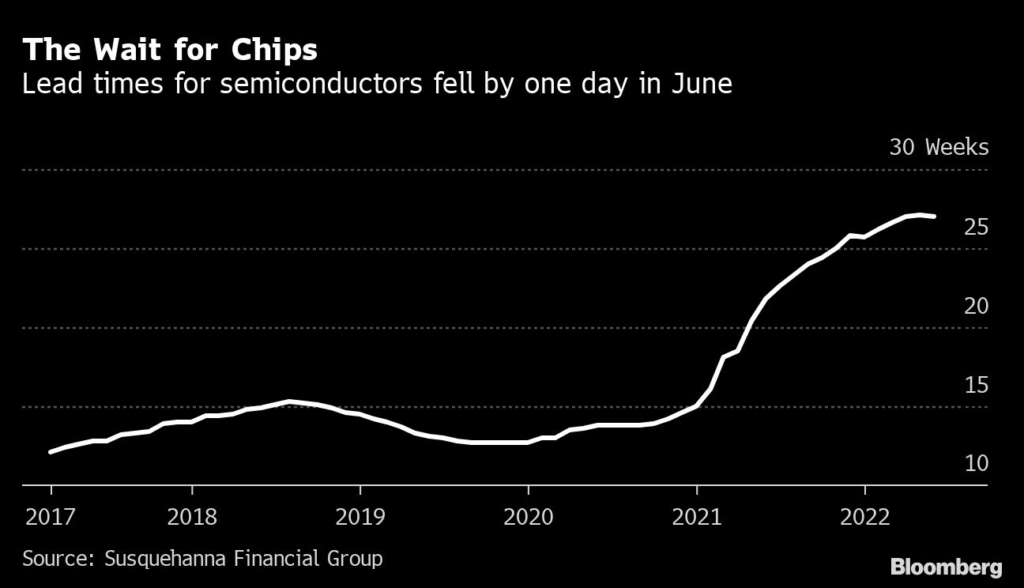
Chip shortages remain a factor. The average wait times for semiconductors soared to 27 weeks in June, with companies from Toyota Motor Corp. to Apple Inc. losing out on billions of dollars in sales because they couldn’t get enough chips. Before the pandemic, average lead times were typically less than 15 weeks. 

On Wednesday, TSMC reported a 50% surge in July revenue, underscoring major industry players were still benefiting from competition for supply.

Skeptics warned that customers could be double ordering chips, artificially inflating the perception of demand. But companies like TSMC poured money into capital expenditures, while governments from the US and Europe to China and Japan embraced subsidies to build up domestic production capabilities. The fears now are that such turbo-charged investments will lead to overcapacity and persistent losses.

“The whole chip sector boomed after the pandemic and now we are seeing a bit of backlash,” said Yasuo Imanaka, chief analyst at Rakuten Securities. “The demand boost for smartphones and PCs from remote working is clearly disappearing. And we should be wary of risks that inventory adjustments are not as mild as Micron and other companies were hoping for just a couple of months ago.”

On the same day as Micron’s warning, US President Joe Biden signed the Chips and Science Act, a $52 billion stimulus package designed to make it cheaper for companies to build domestic factories. 

Danely of Citigroup said it was particularly concerning to learn about automakers and other corporations cutting back.

“Micron is the first company to mention weakness in the automotive and industrial end markets, and we would note Micron has been a leading indicator in the downturn all year,” he wrote. “We reiterate our negative stance on semis and belief that every stock and every end market will correct.”

Not all companies are getting enough chips. Toyota said its ability to secure semiconductors will remain unpredictable, as it kept a conservative profit outlook for the current year.

Yang Yuanqing, chief executive officer at PC giant Lenovo Group Ltd., said during an earnings call Wednesday that supplies were still mixed.

“We see chip supply improvement since the second half of this year as we predicted in previous quarters, particularly for our PC and smartphone businesses,” he said. “But we still see some supply constraints in the low-end chips.”

Makers of equipment used in the production of chips were among the biggest decliners on Tuesday after Micron said it plans to reduce spending on new plants and equipment in response to a drop-off in orders. Lam Research Corp. fell 7.9%, while Applied Materials sank 7.6%.

Of the 10 worst performing stocks in the Nasdaq 100 this month, at least seven are chip stocks. Marvell Technology Inc. is down 7.9%, followed by Lam Research and NXP Semiconductors. The semiconductor index has fallen 27% this year, compared with a drop of 20% for the Nasdaq 100 and 14% for the S&P 500.

(Updates with chip stock moves and TSMC’s sales from the sixth paragraph)

More stories like this are available on bloomberg.com

©2022 Bloomberg L.P.

Honda Raises Profit Outlook as Weak Yen Makes Up for Cost Pressures

(Bloomberg) — Honda Motor Co. raised its full-year operating profit target, as a weaker yen helps to bolster income brought home and make up for rising material costs and supply chain constraints. The carmaker also unveiled a 100 billion yen ($741 million) buyback, for as much as 1.9% of its shares.

Profit for the year through March 2023 is forecast to reach 830 billion yen, the carmaker said in a statement Wednesday. That’s an upgrade from the outlook for 810 billion yen announced three months ago, and below the average analyst estimate of 909 billion yen. 

Honda, like other global auto manufacturers, have seen their profits erode over the past year due to rising material and logistics costs, as well as from China’s Covid-19 lockdowns and a persistent shortage of semiconductors. While that forced them to issue cautious outlooks at the start of the latest fiscal period, they are now seeing signs of improvement, as well as reaping the benefits from a weaker yen. The currency has dropped 15% versus the dollar this year, the most among major currencies. 

“The outlook remains unclear due to a shortage of semiconductors and the impact of inflation,” Executive Vice President and Chief Financial Officer Kohei Takeuchi said at a news briefing. Honda is sticking to outlook for 4.2 million vehicle sales for the current fiscal year, he added.

Takeuchi added that Honda is expecting semiconductor supplies to remain tight for the rest of the fiscal year, and that the manufacturer was increading stockpiles given recent geopolitical tension in the Taiwan Strait. 

Honda also raised its sales forecast for the current year to 16.8 trillion yen from 16.3 trillion yen. Even so, Honda said the outlook remains uncertain because of the semiconductor supply shortages and Covid-19 resurgence. Honda also raised its foreign-exchange assumption for the year to 125 yen to the dollar, up from the prior level of 120 yen to the dollar. 

For the quarter ended June, Honda reported operating profit of 222 billion on 3.8 trillion yen in revenue, topping analysts’ predictions for 200 billion yen and 3.7 trillion yen. The carmaker cited higher pricing, cost controls, fewer incentives and currency benefits for the profit result. 

The shares of Honda closed up 1.1% before the earnings announcement, leaving the stock up about 6% this year. 

(Updates with Honda CFO’s comments.)

More stories like this are available on bloomberg.com

©2022 Bloomberg L.P.

Ahold Delhaize Postpones IPO for Dutch Online Unit Bol.com

(Bloomberg) — Royal Ahold Delhaize NV raised its forecast for the year as it weathered soaring inflation, but pulled plans to publicly list its Dutch e-commerce unit Bol.com due to volatile equity market conditions.

The Stop & Shop owner said it now expects underlying earnings per share to grow at a mid-single-digit rate this fiscal year relative to 2021 as customers continue to head to its stores despite rising prices. It previously only expected to match 2021 growth levels. Ahold also raised its free cash flow guidance and said it still expects its adjusted operating margin to be at least 4% this year.

Shares rose as much as 6%, the biggest gain since Aug. 5 2020, and were trading up 5% as of 9.03 a.m. local time.

Although the retailer has pulled the initial public offering of its online Bol.com unit it could pursue the plan at a later date “when equity market conditions are more conducive,” according to comments published with its Wednesday earnings report. 

Bol.com was founded in 1999 as Europe’s first online bookstore. Ahold bought it in 2012 and it is now the largest online retail platform in the Benelux region and has expanded to selling general merchandise products. 

Ahold proposed a sub-IPO last year that would have offered a small stake in Bol.com on Euronext Amsterdam with the grocer retaining significant control in the long-term.

Tough market conditions recently led to file-sharing platform WeTransfer withdrawing plans to float in Amsterdam and Dutch consumer-electronics retailer Coolblue NV also scrapped a planned listing in the Dutch capital, citing uncertainty among investors.

“We’re absolutely convinced in Bol as a strong future-focused brand for us,” said Chief Financial Officer Natalie Knight in an interview. “We’ve got market share gains again in the quarter and we’re firmly committed to crystallizing the value of the brand but right now the market conditions just don’t support it.” 

She added the company has identified a “more flexible” investment plan to support Bol’s future growth and the unit will continue to grow faster than the market going forward.

For the group, Ahold reported adjusted operating profit for the second-quarter of 880 million euros, which was better than expected. Revenue from online orders rose to just over 2 billion euros in the quarter from 1.81 billion euros at the same time last year. 

Like many grocers battling the worst inflation in decades, Ahold has raised prices this year but according to Knight, price hikes across all of Ahold’s markets are lower than overall inflation rates.

The company’s margin was more “resilient” than expected, according to Bernstein analyst William Woods. Bernstein said the “strong set of results” and pulled IPO should be received positively, given the lower valuation as well as the grocer’s need to prioritize free cash flow along with buybacks.

(Updates with shares in the third paragraph and further details throughout)

More stories like this are available on bloomberg.com

©2022 Bloomberg L.P.
IPhone Maker Hon Hai Profit Beats, Easing Supply-Chain Fears

(Bloomberg) — Hon Hai Precision Industry Co., the maker of most of the world’s iPhones, posted a profit that beat estimates as demand for its cloud products helped it weather supply-chain snarls and sluggish smartphone demand.

Apple Inc.’s biggest assembly partner reported net income of NT$33.3 billion ($1.1 billion) for the quarter through June, against the average projection for NT$30.8 billion. Revenue totaled NT$1.5 trillion, Hon Hai reported previously.

Hon Hai has been navigating component shortages, patches of weakness in the economy and Covid-related logistics bottlenecks in China. In response, the company, which also makes Dell desktops and Sony PlayStations, has used its scale to negotiate with customers and suppliers. 

Apple logged strong quarterly results, particularly from the iPhone, despite lingering effects from the pandemic. While that reassured investors concerned about a slowdown, worrying signs remain, with Apple’s Mac, iPad and its wearables division posting sales declines from a year ago.

Given the potential for a downturn in consumer appetite for gadgets, the Taiwanese company has been expanding its revenue from corporate customers, logging solid sales in its cloud and network computing products in July.

What Bloomberg Intelligence Says:

The company’s server products may grow fast due to solid demand for migration to cloud computing. Its exposure to high-end IT products and operational resilience could expand its market share when entry-level demand wanes quickly and lockdowns in China impact supply chains.

-Steven Tseng, analyst

Click here for research

Hon Hai is also making a play to expand in electric vehicles. The world’s largest contract manufacturer has targeted 5% market share in EVs in 2025, helped by its acquisition of Lordstown Motors Corp.’s electric pickup trucks factory in Ohio. The two partners will announce a new vehicle project in the fourth quarter, Lordstown said last week. 

More stories like this are available on bloomberg.com

©2022 Bloomberg L.P.
iPhone Maker Foxconn Profit Beats, Easing Supply-Chain Fears

(Bloomberg) — Hon Hai Precision Industry Co., the maker of most of the world’s iPhones, posted a profit that beat estimates as demand for its cloud products helped it weather supply-chain snarls and sluggish smartphone demand.

Apple Inc.’s biggest assembly partner reported net income of NT$33.3 billion ($1.1 billion) for the quarter through June, against the average projection for NT$30.8 billion. Revenue totaled NT$1.5 trillion, Hon Hai reported previously.

Hon Hai has been navigating component shortages, patches of weakness in the economy and Covid-related logistics bottlenecks in China. In response, the company, which also makes Dell desktops and Sony PlayStations, has used its scale to negotiate with customers and suppliers. 

Apple logged strong quarterly results, particularly from the iPhone, despite lingering effects from the pandemic. While that reassured investors concerned about a slowdown, worrying signs remain, with Apple’s Mac, iPad and its wearables division posting sales declines from a year ago.

Given the potential for a downturn in consumer appetite for gadgets, the Taiwanese company has been expanding its revenue from corporate customers, logging solid sales in its cloud and network computing products in July.

What Bloomberg Intelligence Says:

The company’s server products may grow fast due to solid demand for migration to cloud computing. Its exposure to high-end IT products and operational resilience could expand its market share when entry-level demand wanes quickly and lockdowns in China impact supply chains.

-Steven Tseng, analyst

Click here for research

Hon Hai is also making a play to expand in electric vehicles. The world’s largest contract manufacturer has targeted 5% market share in EVs in 2025, helped by its acquisition of Lordstown Motors Corp.’s electric pickup trucks factory in Ohio. The two partners will announce a new vehicle project in the fourth quarter, Lordstown said last week. 

More stories like this are available on bloomberg.com

©2022 Bloomberg L.P.

Deliveroo Earnings Beat Estimates After Cutting Ad Costs

(Bloomberg) — Deliveroo Plc reported earnings that beat analysts’ estimates after the company said it would tighten its marketing budget and cut costs. 

Adjusted earnings before interest, taxes, depreciation and amortization was a loss of £68 million ($82.1 million) in the first half of the year, the company said in a statement on Wednesday. That compared to the average analyst estimate for a loss of £73.3 million, according to a Bloomberg survey.

In July, the London-based food delivery company had slashed its projections for sales growth this year. Delivery companies across the industry have been facing worse-than-expected slowdowns in order growth with higher energy bills and inflation eating away at customers’ incomes. 

“We have made good progress delivering on our profitability plan, despite increased consumer headwinds and slowing growth during the period,” Chief Executive Officer Will Shu said in the statement. “Underpinning our progress is a rigorous approach to capital allocation, ensuring that we invest behind the opportunities with the highest returns.”

Key Insights

  • Revenue rose to £1.01 billion in the period. That compares to the £985 million forecast by analysts in a Bloomberg survey.
  • The company reiterated its guidance for 4% to 12% gross transaction value growth for the year. That was down from a previous forecast of 15% to 25%.
  • Deliveroo has stepped up efforts to generating more cash, rolling out an advertising platform and outlining plans to reach break-even status in the next couple of years.
  • The company said it had discontinued its operation in Spain, announcing last year that the level of investment required to maintain a top competitive position was too great.
  • Rival Just Eat Takeaway.com NV wrote down the value of its US-based Grubhub business by 3 billion euros ($3.1 billion), reported that orders slowed in the first half of the year, and said it would cut jobs in France.

Market Reaction

  • The company fell 3.6% to 91.24 pence in London trading on Tuesday. The stock had declined 56% this year.
  • Deliveroo sold shares in an initial public offering in March of last year at 390 pence apiece.
  • Rivals including Just Eat and Delivery Hero SE have also seen shares decline this year, 65% and 52% respectively.

Get More

  • After $30 Billion Rout, Food Delivery Firms Face Growth Slowdown
  • Deliveroo Slashes Forecast After Consumers Cut Back Orders 
  • Just Eat Takeaway Records 3 Billion-Euro Hit on Grubhub 

More stories like this are available on bloomberg.com

©2022 Bloomberg L.P.

Stocks, Bonds Slip as Key US Inflation Data Loom: Markets Wrap

(Bloomberg) — Stocks and bonds declined on Wednesday amid caution ahead of US inflation data that will shape investor expectations for further Federal Reserve interest-rate hikes.

A gauge of Asian equities headed for a three-week low, with technology stocks the biggest drag. Chinese shares dropped as inflation accelerated in July to the highest level in two years.

US and European futures were in the red following a drop in the S&P 500 for a fourth session. Micron Technology Inc. became the latest chipmaker to warn about slowing demand, fanning economic concerns.

Treasury yields climbed, while a dollar gauge steadied. Crude oil dipped below $90 a barrel, and both gold and Bitcoin fell. 

The two-year Treasury rate exceeds the 10-year by nearly 50 basis points. The inversion, around deepest since 2000, is viewed as a sign of a looming recession under the Fed’s monetary-tightening campaign to curb inflation. 

A report Wednesday is expected to show headline US consumer-price inflation cooled but stayed elevated in July, while the core reading may have quickened on an annual basis. How the figures affect views on Fed tightening will be key for risk sentiment.

“The FOMC will need to make sure inflation moves back towards target sustainably before contemplating pausing its tightening cycle,” Carol Kong, a strategist at Commonwealth Bank of Australia, wrote in a note. “A strong inflation outcome today will likely reinforce the FOMC is still some way away from that point yet, and see markets readjust higher their expectations for US interest rates.”

Federal Reserve Bank of St. Louis President James Bullard said the US central bank will be prepared to hold interest rates “higher for longer” should inflation continue to surprise to the upside.

The Fed “will be driving those short rates higher,” said Gary Schlossberg, a global strategist for Wells Fargo Investment Institute, on Bloomberg Television. “We will be seeing a deepening inversion and a full inversion of the Treasury yield curve.”

Elsewhere, Elon Musk sold $6.9 billion of shares in Tesla Inc., the billionaire’s biggest sale on record, saying he needed cash in case he is forced to go ahead with his aborted deal to buy Twitter Inc.

Respected for decades for combining decent returns and relatively low volatility, the 60/40 portfolio has generated a 11.5% loss so far this year. Is it time to put the strategy to rest entirely or does it just need a tweak? Have your say in the anonymous MLIV Pulse survey.

What to watch this week:

  • US CPI data, Wednesday
  • Chicago Fed President Charles Evans and his Minneapolis counterpart Neel Kashkari due to speak, Wednesday
  • US PPI, initial jobless claims, Thursday
  • San Francisco Fed President Mary Daly is interviewed on Bloomberg Television, Thursday
  • Euro-area industrial production, Friday
  • US University of Michigan consumer sentiment, Friday

Some of the main moves in markets:

Stocks

  • S&P 500 futures were down 0.2% as of 7 a.m. in London. The S&P 500 fell 0.4%
  • Nasdaq 100 futures fell 0.3%. The Nasdaq 100 fell 1.2%
  • Japan’s Topix index lost 0.2%
  • South Korea’s Kospi index declined 1%
  • Hong Kong’s Hang Seng Index slid 2.4%
  • China’s Shanghai Composite Index fell 0.6%
  • Australia’s S&P/ASX 200 index was down 0.5%
  • Euro Stoxx 50 futures lost 0.3%

Currencies

  • The Bloomberg Dollar Spot Index was steady
  • The euro was at $1.0210
  • The Japanese yen was at 135.00 per dollar
  • The offshore yuan was at 6.7616 per dollar, down 0.1%

Bonds

  • The yield on 10-year Treasuries advanced two basis points to 2.80%
  • Australia’s 10-year yield climbed almost six basis points to 3.24%

Commodities

  • West Texas Intermediate crude was at $89.75 a barrel, down 0.9%
  • Gold was at $1,788.51 an ounce, down 0.3%

More stories like this are available on bloomberg.com

©2022 Bloomberg L.P.

Close Bitnami banner
Bitnami