

Bloomberg

CDPQ, Tiger Global Join $105 Million Round for Software Firm CleverTap

(Bloomberg) — CleverTap, a software platform that helps e-commerce and consumer firms communicate with their customers, raised $105 million in a round led by the Caisse de Depot et Placement du Quebec and including Tiger Global. 

CDPQ, Canada’s second-largest pension fund, is the biggest investor in the series D round at $75 million. India’s IIFL Asset Management and Sequoia Capital’s India unit are also investing in CleverTap, whose corporate name is WizRocket Inc.  

CleverTap works with large brands to increase customer retention and improve revenue. Founded in Mumbai in 2013, the company now has 1,200 clients including Canon, AirAsia, Toronto-Dominion Bank, Papa John’s and the English Premier League.  

“We will continue to invest in our product and engineering, but we will also invest in accelerating go-to-market globally,” Sunil Thomas, co-founder and executive chairman of CleverTap, said in an interview. Having the Caisse as a long-term investor “is going to be significantly important and critical.”

‘Very Sticky’

Martin Laguerre, the Quebec fund’s head of private equity, described CleverTap’s niche market as “growing and very sticky.” The firm’s software, aided by artificial intelligence, helps companies grab the attention of consumers though email and mobile-phone notifications, in-app messaging and other methods.  

“Our focused efforts in technology are really on the business-to-business software as a service model,” Laguerre said. “We think that it is very resilient in various economic times, in inflationary times, in stagflation times if we come to that.”

While companies used to spend heavily to generate more app downloads, Thomas explained that the trend has changed toward focusing on keeping users. “The more you can retain your existing customer, you actually tend to get a lot more value,” he said.

At the last funding round in 2019, CleverTap was valued at $385 million and that has now doubled. 

Technology is one of four sectors the Caisse focuses on in private equity. The recent bankruptcy of cryptocurrency lender Celsius Network LLC hit the fund’s reputation after it made a $150 million investment less than a year ago.  

Asked about the firm’s due diligence process, Laguerre said: “Vigilance is always there in terms of process, and the debates are robust and fair.”

More stories like this are available on bloomberg.com

©2022 Bloomberg L.P.

Micron’s Warning Adds to Evidence of Collapsing Chip Demand

(Bloomberg) — Micron Technology Inc., the leading US maker of memory semiconductors, became the latest chipmaker to declare that demand is falling off rapidly. It warned investors that revenue won’t meet projections, sending industry stocks tumbling.

The company said early Tuesday that fourth-quarter sales are expected to be at the low end of or below its previous guidance as customers reduce their stockpiles of unused chips. There will be “significant sequential declines in revenue and margins,” Micron said in a regulatory filing. Micron shares fell 3.7%, and the benchmark Philadelphia Stock Exchange Semiconductor Index dropped 4.6%. 

The Boise, Idaho-based company is the latest to reveal just how quickly demand for electronic components is declining, following a warning by Nvidia Corp. on Monday and weak reports by Intel Corp. and other chipmakers this earnings season. The majority of the pain is being felt by companies that make chips for personal computers. Consumer demand for those devices is drying up rapidly as pandemic lockdowns end and household budgets are hammered by inflation.

The prospects for the chip industry are dimming on a day that was supposed to herald a renaissance in semiconductor manufacturing in the US with President Joe Biden signing the the Chips and Science Act. That $52 billion stimulus package is designed to make it cheaper for companies to build domestic factories and help counteract the loss of the crucial skill set to Asia. Shortages during the pandemic inspired US and European politicians to prioritize the creation of additional plants locally to create a more robust supply chain.

Highlighting the speed with which demand is evaporating, Micron said orders deteriorated since the company last gave an update just over a month ago. Crucially, it’s not just PC makers that are cutting back.

“Compared to our last earnings call, we see further weakening in demand because of adjustments broadening outside of just consumers to other parts of the market including data centers, industrial and automotive,” Chief Executive Officer Sanjay Mehrotra said in an interview with Bloomberg Television.

Like Intel, Micron now plans to reduce its capital spending on new plants and equipment this year and projected capital expenditures will be “down meaningfully” from a year earlier. Both companies said they’re committed to their long-term expansion plans but are making short-term adjustments to protect profitability and avoid a glut. Micron said it will use grants from the law to invest $40 billion in US semiconductor manufacturing capacity by the end of the decade. The spending plan is part of the company’s previously announced $150 billion global investment goal, which it detailed last year.

The disclosures sent stocks of chipmaking gear falling. Applied Materials Inc., the largest maker of such equipment, dropped 7.6%. Lam Research Corp. fell 7.9%.

Micron previously said sales would be about $7.2 billion in its fiscal fourth quarter, far below the $9.14 billion average analyst estimate at the time, according to data compiled by Bloomberg. Consumers and businesses have been reining in spending amid fears that major world economies are headed for recession.

“Apart from inventory adjustments in the PC and smartphone market, which have weakened more, Micron is experiencing inventory adjustments and lower demand in other end-markets ranging from the cloud to autos,” Ambrish Srivastava, an analyst at BMO Capital Markets, wrote in a note to clients. “We have not heard a chip company speak to the latter.”

Not all chipmakers are suffering large declines. Companies with more diversified products are posting earnings that show greater resilience. Globalfounderies Inc., a provider of outsourced chipmaking, gave a more bullish outlook after reporting sales and profit that topped estimates. Revenue in its most recent quarter was $1.99 billion, slightly above Wall Street estimates. Sales in the current period will expand to about $2 billion, it said early Tuesday.

(Updates with closing share prices.)

More stories like this are available on bloomberg.com

©2022 Bloomberg L.P.
Tech Jitters Hit Stocks in Run-Up to Key CPI Print: Markets Wrap

(Bloomberg) — Stocks retreated as a downbeat outlook from another giant chipmaker added to recession fears, with many traders unwilling to make any risky bets before Wednesday’s pivotal inflation reading.

A rally in the S&P 500 from its June lows hit a wall amid a fourth straight day of losses. The Nasdaq 100 underperformed as Micron Technology Inc.’s warning showed more evidence of the collapsing demand for chips. All 30 companies in the Philadelphia Semiconductor Index fell. In late trading, Coinbase Global Inc., the largest US cryptocurrency exchange, sank on a disappointing revenue.

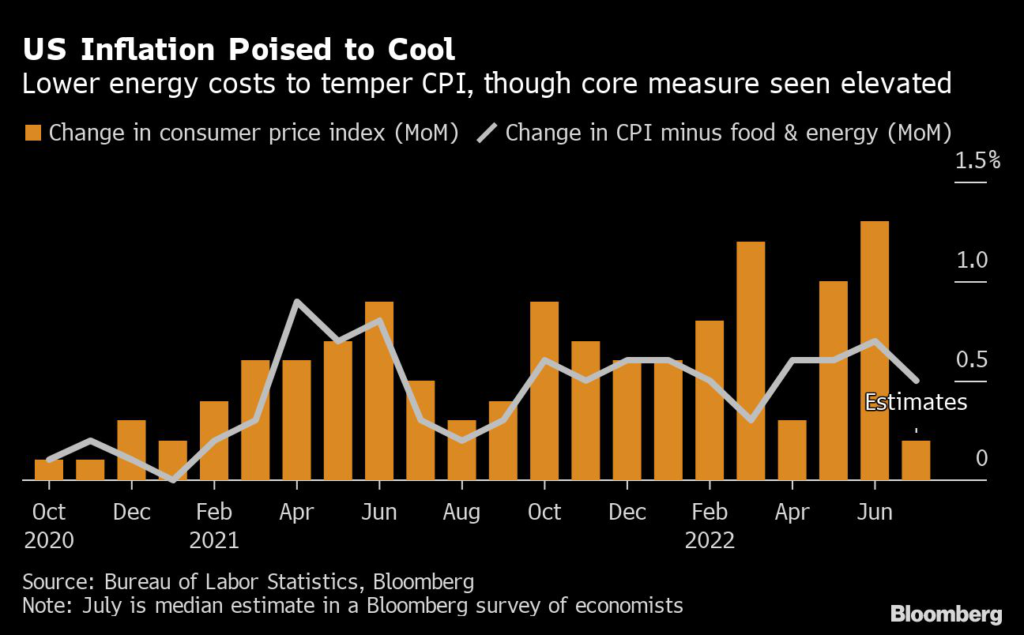
Investors turned more cautious ahead of July’s consumer-price index, which is forecast to cool a bit while still remaining at high levels. The report will come on the heels of recent jobs figures underscoring solid wage growth and US productivity data highlighting another surge in labor costs that could further complicate the Federal Reserve’s efforts to tame inflation.

“A hotter-than-anticipated CPI report will pressure markets this week. An in-line report could be taken in stride as investors have priced in a 75 basis point move by the Fed” in September, wrote Lindsey Bell, chief markets and money strategist for Ally. “Either way, we still have to get through another jobs report, more inflation data, and Jackson Hole before we get to the Fed’s September meeting. It could be a volatile several weeks ahead.”

Timing the peak in inflation isn’t easy, especially after June’s CPI print turned out to be hotter than expected, but being right in doing so has brought investors a hefty return.

Those buying the S&P 500 at major inflation peaks going back to 1940 have seen the index post an average rally of 16% in the next 12 months, according to data compiled by Leuthold Group. A big caveat is: the price-to-earnings ratio has averaged 12.7 in prior instances on a normalized basis, compared with above 20 now.

Read: Strategists Under the Same Roof Clash on S&P 500 Before CPI Data

Highly optimistic analyst recommendations are flashing a warning signal for stocks, according to Citigroup Inc. strategists led by Robert Buckland. An index of global sell-side ratings “is back to peak bullishness levels reached in 2000 and 2007, after which global equities halved,” they wrote.

Strategists from Morgan Stanley and Goldman Sachs Group Inc. have already warned that analysts’ expectations are unrealistic. Meanwhile, JPMorgan Chase & Co.’s Marko Kolanovic, one of Wall Street’s staunchest bulls, said investors should modestly trim stock holdings after equities outpaced other assets amid receding recession fears.

“Near the mid-June lows, we discussed that we would not be selling equities given markets were already pricing in a lot of bad news. However, with the strong equity rebound since then and our view that the near-term upside is capped, the risk/reward appears less favorable,” said Keith Lerner, chief market strategist at Truist Advisory Services.

Among other corporate highlights, the surge in meme shares like Bed Bath & Beyond Inc. and GameStop Corp. sputtered. Novavax Inc. plummeted as the drugmaker slashed its revenue forecast on disappointing demand for its Covid-19 vaccine that trailed competitors getting to market. Boeing Co. delivered 23 of its 737 Max jetliners and three freighters in July, down from 51 total commercial aircraft shipments in June.

Read: DOJ Poised to Sue Google Over Ad Market as Soon as September

Elsewhere, Bitcoin resumed its slump, ending a four-day winning streak as volatility continued to whipsaw the crypto world.

What to watch this week:

  • US CPI data, Wednesday
  • Chicago Fed President Charles Evans and his Minneapolis counterpart Neel Kashkari due to speak, Wednesday
  • US PPI, initial jobless claims, Thursday
  • San Francisco Fed President Mary Daly is interviewed on Bloomberg Television, Thursday
  • Euro-area industrial production, Friday
  • US University of Michigan consumer sentiment, Friday

Respected for decades for combining decent returns and relatively low volatility, the 60/40 portfolio has generated a 11.5% loss so far this year. Is it time to put the strategy to rest entirely or does it just need a tweak? Have your say in the anonymous MLIV Pulse survey.

Some of the main moves in markets:

Stocks

  • The S&P 500 fell 0.4% as of 4 p.m. New York time
  • The Nasdaq 100 fell 1.1%
  • The Dow Jones Industrial Average fell 0.2%
  • The MSCI World index fell 0.5%

Currencies

  • The Bloomberg Dollar Spot Index was little changed
  • The euro rose 0.1% to $1.0208
  • The British pound was little changed at $1.2073
  • The Japanese yen fell 0.1% to 135.13 per dollar

Bonds

  • The yield on 10-year Treasuries advanced three basis points to 2.79%
  • Germany’s 10-year yield advanced two basis points to 0.92%
  • Britain’s 10-year yield advanced two basis points to 1.97%

Commodities

  • West Texas Intermediate crude fell 0.1% to $90.63 a barrel
  • Gold futures rose 0.3% to $1,811.10 an ounce

More stories like this are available on bloomberg.com

©2022 Bloomberg L.P.
Former Twitter Employee Convicted of Spying for Saudi Arabia

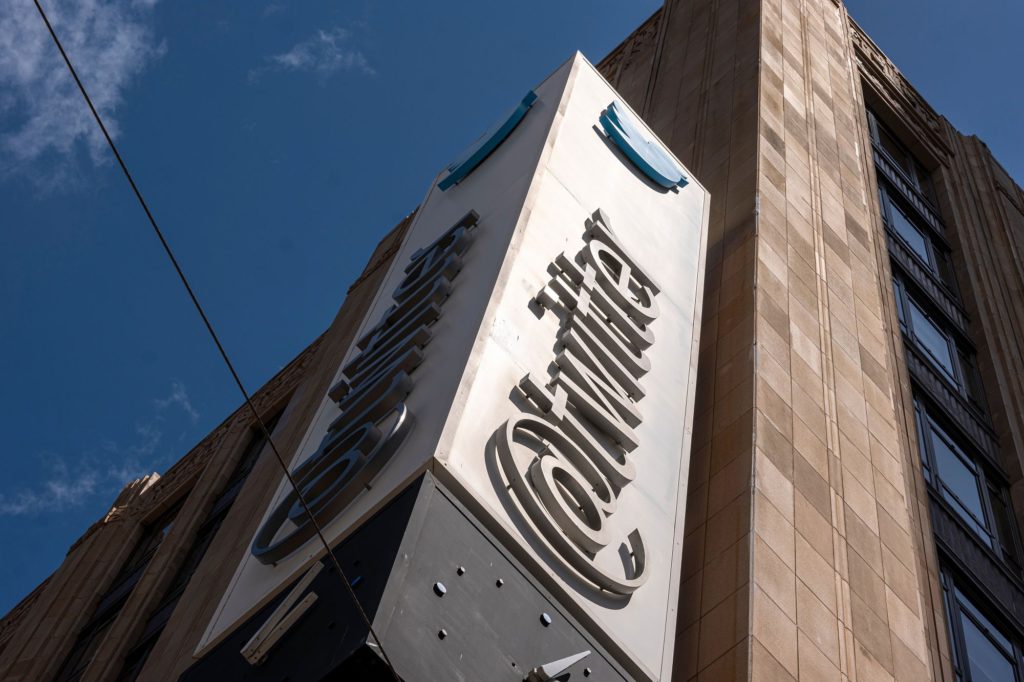
(Bloomberg) — A former Twitter Inc. employee was convicted of spying for Saudi Arabia by turning over personal information of platform users who’d used anonymous handles to criticize the Kingdom and its royal family.

Ahmad Abouammo, a US resident born in Egypt, was found guilty by a jury Tuesday of charges including acting as an agent for Saudi Arabia, money laundering, conspiracy to commit wire fraud and falsifying records, following a two-week trial in San Francisco federal court. He faces 10 to 20 years in prison when he’s sentenced. 

Abouammo, a media partnership manager for Twitter in 2015, maintained he was simply doing his job promoting the nascent social media network in the Middle East and North Africa. Prosecutors alleged his relationship with a top aide to Mohammed bin Salman, or MBS, now the de-facto ruler of Saudi Arabia, went much further — and darker — to help the Crown Prince silence his critics.

The jury was shown evidence that Abouammo received a Hublot watch and $300,000 in wire transfers — which the US said were bribes from the MBS aide, Bader Al- Asaker, in exchange for confidential Twitter account information on Saudi dissidents. 

The trial unfolded against the backdrop of President Joe Biden’s mid-July fist-bump with the Crown Prince in an attempt to warm relations with Saudi Arabia, which Biden once called a “pariah” nation after its agents murdered and dismembered Washington Post journalist Jamal Khashoggi in 2018.

Read More: Twitter Spy Trial Keeps Jury in Dark on Saudi Torture Claims 

Prosecutors were prohibited by a court ruling from telling jurors explicitly that the US and human rights organizations believe Saudi Arabia under MBS has secretly detained and tortured its critics. 

But they hinted at the brutal practices through an expert witness who testified about the changing politics and culture of Saudi Arabia, and through a woman who told jurors that her brother went silent in 2018 after he posted satirical criticism of the country on Twitter.

Angela Chuang, a federal public defender representing Abouammo, told jurors the case was a product of a botched investigation, and Twitter’s careless handling of its users’ data. The US allowed the real target of its investigation, Abouammo’s alleged co-conspirator, Ali Alzabarah, who worked at Twitter as an engineer, to flee to Saudi Arabia despite being under surveillance, Chuang said.

“Both the government and Twitter need a way to save face,” Chuang told the jury. The US let its primary suspect escape and Twitter threw Abouammo “under the bus,” she said. “This case is the best they could come up with?” she asked.

Abouammo and his lawyers declined to comment on the verdict. 

The case is US v. Abouammo, 19-cr-00621, U.S. District Court, Northern District of California (San Francisco).

(Updates with details of verdict)

More stories like this are available on bloomberg.com

©2022 Bloomberg L.P.

Roblox Drops After Game Platform’s Bookings Miss Estimates

(Bloomberg) — Roblox Corp. a video game platform aimed at preteens and teenagers, reported bookings that missed analysts’ estimates, becoming the latest gaming company to deliver disappointing results amid a post-pandemic industrywide slump. 

Bookings, which include revenue, deferred revenue and other adjustments, fell 4% to $639.9 million in the second quarter, the company said in a statement Tuesday. Analysts projected $657.2 million, according to data compiled by Bloomberg. The number of daily active users also fell short of expectations as the growth rate slowed. Roblox said it had an average of 52.2 million daily users, up 21% from a year ago but less than the 28% increase in the first quarter. Analysts were looking for 54 million.

The shares fell about 12% in extended trading after closing at $47.35 in New York. The stock has declined 65% from its November high of $134.72. 

Roblox joins a long list of gaming and gaming-related companies — from game publishers to console and PC makers — that have struggled to maintain the surge in growth seen during the pandemic. With the end of lockdowns, people have been spending less time playing games and rising prices means they’re also spending less money buying them or making in-game purchases. 

Gaming companies were long considered recession-proof, but that’s proving to no longer be true. During an economic downturn, such as the US is experiencing now, people normally have continued to consume entertainment, including video games. However, now that many games and gaming platforms, including Roblox, are free-to-play and don’t require an up-front payment, some gamers are opting out of unnecessary expenditures. Spending in the video game industry is expected to drop 8.7% this year, according to analytics firm NPD Group.

Activision Blizzard Inc., which is being bought by Microsoft Corp. for $69 billion, last week reported sales and earnings fell in the last quarter, while Electronic Arts Inc. gave a revenue forecast that missed estimates and Take-Two Interactive Software Inc. missed analysts’ estimates for annual profit.

Chief Executive Officer David Baszucki said Roblox doesn’t see the same concerns as other gaming companies because of its business model. “The market economy, although it is difficult for many people in America, has not affected us,” he said in an interview.

Enormously popular with children and teens, Roblox provides a platform for users to make and play games. While the market found reason to be disappointed in the results, Roblox said business is improving. People spent almost 4 billion hours on the platform in June and in July Roblox reported an all-time-high of 58.5 million daily active users. 

Roblox attributed the improvement to “certain product initiatives and better operational focus,” according to a letter to shareholders. Higher levels of bookings growth among 17-24 year olds, for example, is partially due to more “aged up” content. Other features such as voice chat and layered clothing are also contributing to growth, the company said. 

“We’re very proud that the majority of people playing on our platform play for free,” Baszucki said. “We see no real connection with inflation, or a recession, with the way our bookings continue to grow. We’re a freemium model and a minority of people are buying Robux every month,” he said referring to the platform’s currency.

Revenue in the second quarter increased 30% to $591.2 million, mostly from commissions on in-game transactions of items and virtual currency. 

The company’s net loss was $176.4 million, or a loss per share of 30 cents. Analysts had anticipated a loss of 25 cents.

More stories like this are available on bloomberg.com

©2022 Bloomberg L.P.
Lenders Spurned by Avaya Tap Advisers Amid Fresh Debt Plunge

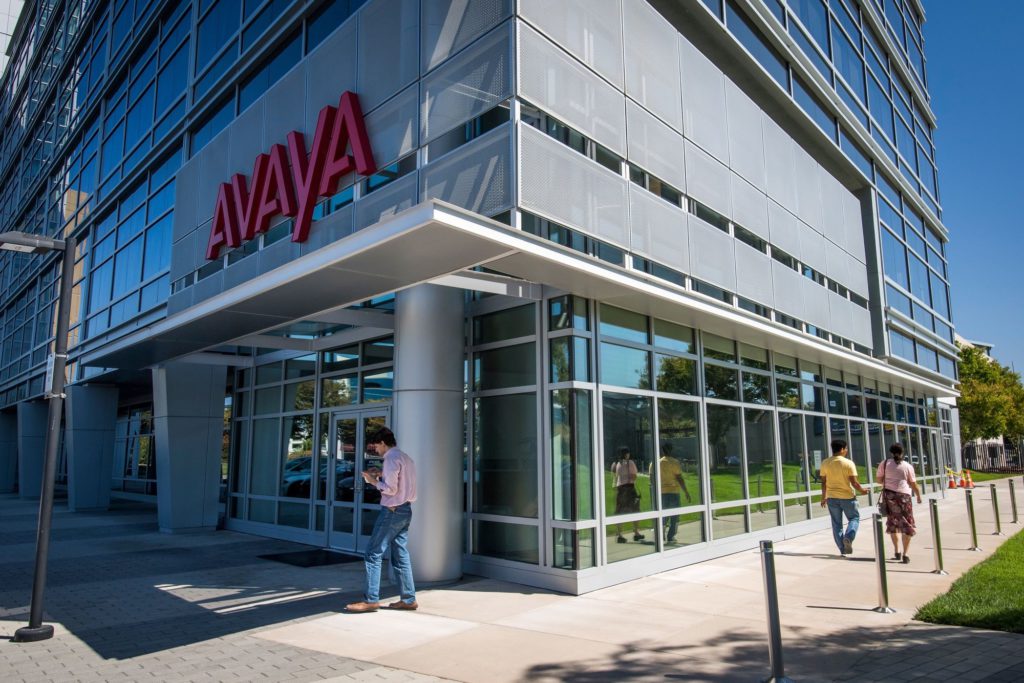
(Bloomberg) — Lenders who helped provide a $350 million leveraged loan to Avaya Holdings Corp. in June are working with FTI Consulting Inc. and Glenn Agre Bergman & Fuentes to explore their options following the company’s poor earnings and internal investigations, according to people with knowledge of the situation.

With revenue plunging and a large chunk of convertible debt maturing in less than a year, Avaya said it now has “substantial doubt” about its ability to continue as a going concern and has hired advisers to address the upcoming maturities, according to a statement on Tuesday. Avaya is getting advice from AlixPartners LLC, Evercore Inc. and long-time counsel Kirkland & Ellis, the people said. 

Representatives for Avaya, FTI, AlixPartners and Evercore declined to comment. Representatives for Glenn Agre and K&E didn’t respond to requests for comment. The Wall Street Journal earlier reported Kirkland’s hiring.

Avaya, which makes telecommunications software, sold a $350 million leveraged loan and a $250 million exchangeable note on June 24 to help refinance debt, then shocked investors when it forecasted a sharp drop in financial performance weeks later and fired its chief executive. Some holders of the company’s older loans and bonds, which earlier organized with Akin Gump Strauss Hauer & Feld, are concerned about Avaya and its bankers’ lack of disclosures when marketing the debt, and further financial deterioration at the company, the people said. 

Read more: Avaya, Goldman, JPMorgan Face Lender Ire After Loan’s Collapse

Financial results Avaya released Tuesday morning were in line with its earlier revisions, but the company revealed that it was facing deep financial strain. It’s delaying filing its quarterly financial statements amid ongoing internal investigations related to a whistleblower letter and its financial results for the quarter that ended June 30. 

Avaya’s shares plunged 46% on Tuesday to around 60 cents. Its 6.125% bond due 2028 was among the worst performers in the high-yield market, dropping 7.25 cents on the dollar to 49 cents, while its convertible bonds due 2023 fell by more than half. The company’s older loans are quoted in the low 50s, while the new loan is in the mid-60s, the people said.

More stories like this are available on bloomberg.com

©2022 Bloomberg L.P.

DOJ Is Preparing to Sue Google Over Ad Market as Soon as September

(Bloomberg) — The US Justice Department is preparing to sue Google as soon as next month, according to people familiar with the matter, capping years of work to build a case that the Alphabet Inc. unit illegally dominates the digital advertising market.

Lawyers with the DOJ’s antitrust division are questioning publishers in another round of interviews to refresh facts and glean additional details for the complaint, said three people familiar with the conversations who asked not to be named discussing an ongoing investigation. 

Some of the interviews have already taken place and others are scheduled in the coming weeks, two of the people said. They build on previous interrogations conducted during an earlier stage of the long-running investigation, the people said.

An ad tech complaint, which Bloomberg had reported was in the works last year, would mark the DOJ’s second case against Google following the government’s 2020 lawsuit alleging the tech titan dominates the online search market in violation of antitrust laws.

Still undecided is whether prosecutors will file the case in federal court in Washington, where the search case is pending, or in New York, where state attorneys general have their own antitrust case related to Google’s ad tech business, the people said.

The Justice Department declined to comment.

“Our advertising technologies help websites and apps fund their content, and enable small businesses to reach customers around the world,” said Google spokesperson Peter Schottenfels. “The enormous competition in online advertising has made online ads more relevant, reduced ad tech fees, and expanded options for publishers and advertisers.”

The DOJ’s ad tech probe is an example of the federal government’s push to rein in the largest US technology platforms after nearly a decade during which regulators took little to no action. The Federal Trade Commission has sued Meta Platforms Inc. seeking to force it to sell off Instagram and WhatsApp and is investigating Amazon.com Inc. over its control of online retail. 

Apple Inc. is also under investigation by the Justice Department related to its tight control over the App Store. These types of probes are difficult, taking years to prepare and resolve as they wend their way from investigation to litigation and appeals.

Federal scrutiny of Google’s digital advertising operations goes back to the Trump administration. Then-Attorney General William Barr sued the Mountain View, California-based company over its search business instead, alleging the company used exclusive distribution deals with wireless carriers and phone makers to lock out competition.

In December 2020, attorneys general for 16 states and Puerto Rico also sued Google for allegedly monopolizing the online digital advertising market. The suit alleges Google reached an illegal deal with Meta to manipulate the online auctions where advertisers and website publishers buy and sell ad space. Meta isn’t accused of wrongdoing in the states’ lawsuit, though regulators in the UK and Europe have opened a probe into both companies over the agreement, nicknamed Jedi Blue.

Google denies the allegations and has asked a federal judge to dismiss the states’ complaint. A hearing on that request is scheduled for later this month.

The search giant is the biggest player in the market for online display ads, which help fund news, sports and entertainment websites. The company owns tools that help websites sell ads, others that help advertisers buy space and the most widely used platform where online ad auctions take place.  

Google controlled about 28.6% of the $211.2 billion in U.S. digital ad spending last year, according to eMarketer, while Facebook made up 23.8% and Amazon 11.6%.

More stories like this are available on bloomberg.com

©2022 Bloomberg L.P.
CoinFlex Crypto Exchange Files for Restructuring in Seychelles

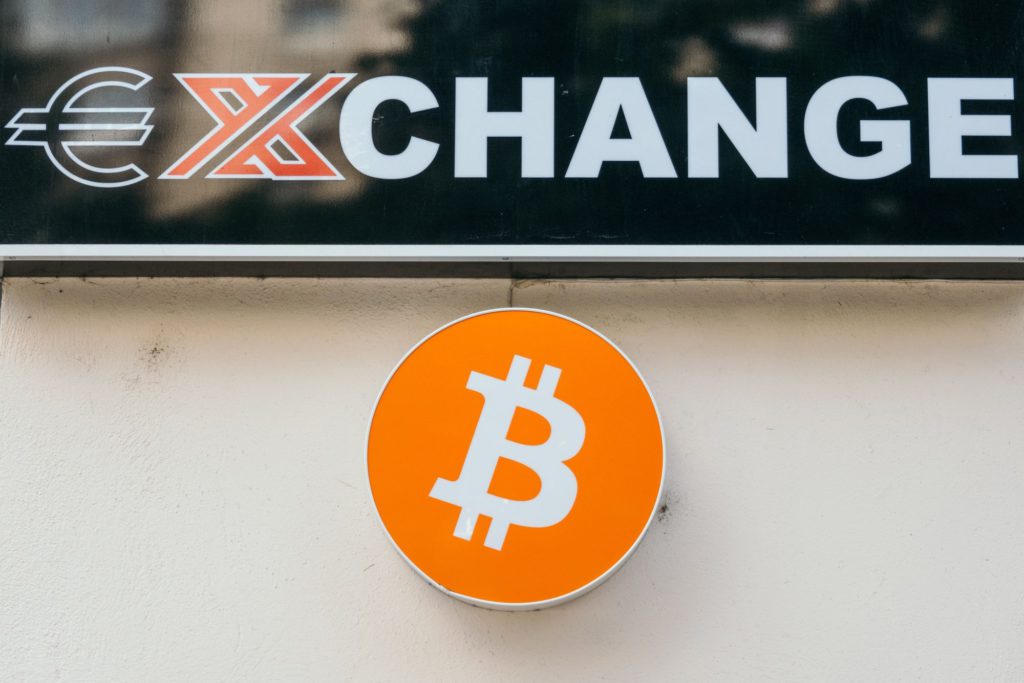
(Bloomberg) — Cryptocurrency exchange CoinFlex said it has filed for restructuring in a Seychelles court, as it seeks to resolve a shortfall due to a counterparty failing to make a margin call.

The company sent out a notice on its restructuring process in emails to customers on Tuesday. It will seek approval from depositors and court on a proposal to issue depositors with rvUSD tokens, equity, and locked FLEX Coin. 

“We look forward to welcoming a new group of shareholders to CoinFLEX and are glad to be in a jurisdiction where we can quickly resolve this situation and return maximum value to depositors,” Mark Lamb, chief executive officer of CoinFlex, told Bloomberg News.   

CoinFlex froze withdrawals in June after a counterparty, which it has identified as crypto investor Roger Ver, failed to pay a margin call. Ver, however, denied he defaulted on debt owed to CoinFlex. 

CoinFlex has since allowed limited withdrawals and cut “a significant number” of staff to lower costs. Lamb said the company will make more portions available for withdrawals as part of its restructuring process, pending on the vote result.   

More stories like this are available on bloomberg.com

©2022 Bloomberg L.P.
Bitcoin Slumps Again as Investors Await Inflation Report

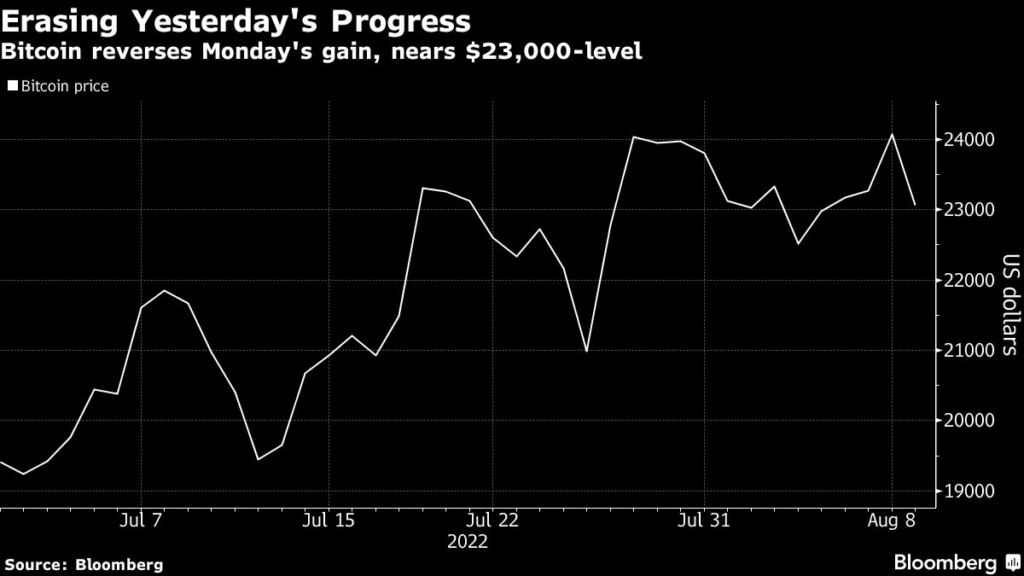
(Bloomberg) — Bitcoin slumps, erasing all of the prior session’s gains and ending a four-day winning streak as crypto investors brace for Wednesday’s inflation data.

The largest cryptocurrency by market value was down 4.2% to $23,067 at 2:57 p.m. in New York, the biggest one-day drop since June 26. Other cryptocurrencies didn’t fare much better, as Ether — Ethereum’s native token — sank below $1,700 on losses of around 6%, Cardano and Solana both took similar losses. 

The recent Bitcoin rally is stalling ahead of the upcoming consumer-price index report, which is forecast to show a slowdown in July, according to Ed Moya, a senior market analyst at Oanda.

“Inflation is what killed Bitcoin late last year and if pricing pressures are showing significant signs of easing, Bitcoin might be able to burst above its recent trading range,” Moya said.

Matt Maley, chief market strategist at Miller Tabak & Co., says of inflation is higher than expected, then cryptocurrencies should drop, but if it’s lower, then there could be more liquidity from a potential Federal Reserve pivot, he said.

“At least a part of what’s happening with Bitcoin and the other cryptocurrencies, in the last two years, has been determined by the level of liquidity in the system,” Maley said. 

“When the Fed was really pumping after the crisis, that helped the cryptocurrencies rally in an outsized way, more than they should have. Then of course, when they started to started hinting that they were going to take away some of that, it started to fall,” Maley added.

Despite Tuesday’s drop, Bitcoin has enjoyed a recent uptick after months of being beaten down, as it finally broke through several closely watched price levels. The bellwether crypto asset has been trading around $23,000 after posting its best month since October in July. 

Still, risk-off sentiment and investor caution abound in the market. Michael Novogratz, the billionaire who founded crypto financial services firm Galaxy Digital Holdings Ltd., said that he is doubtful of Bitcoin will break through the $30,000 level anytime soon in a Bloomberg TV interview on Monday. 

“I quite frankly would be happy if we’re in a $20,000, $22,000 or $30,000 range for a while,” Novogratz said. “We’re not seeing huge institutional flows, to be fair, but we’re not seeing anyone back away.”

Recent turmoil is not likely to ease investor worries as another exchange, Hodlnaut, halted withdrawals and the US Treasury Department slapped the Tornado Cash protocol with sanctions. Despite the recent gains, buffeted investors are staring at a year-to-date loss of around 50%. 

“The volatility is, and always has been, huge with any of these crypto investments,” Brian Nick, chief investment strategist at Nuveen, said in an interview.

(Adds commentary from Oanda and Miller Tabak, updates trading.)

More stories like this are available on bloomberg.com

©2022 Bloomberg L.P.

Tech Woes Shake Stocks Ahead of Pivotal CPI Data: Markets Wrap

(Bloomberg) — Stocks retreated as a downbeat outlook from another giant chipmaker added to recession fears, with many traders taking risk off the table before Wednesday’s key inflation data.

A rally that drove the S&P 500 up more than 10% from its June lows hit a wall amid a fourth straight day of losses. The Nasdaq 100 underperformed after Micron Technology Inc.’s warning provided more evidence of the collapsing demand for chips. All 30 companies in the Philadelphia Semiconductor Index fell, with the gauge down 5%. The surge in meme shares like Bed Bath & Beyond Inc. and GameStop Corp. sputtered.

Investors turned more cautious ahead of July’s consumer-price index, which is forecast to show a slowdown, but still worrisome inflation levels. The report will come on the heels of recent jobs figures underscoring solid wage growth and US productivity data highlighting another surge in labor costs that could further complicate the Federal Reserve’s efforts to tame prices.

“A hotter-than-anticipated CPI report will pressure markets this week. An in-line report could be taken in stride as investors have priced in a 75 basis point move by the Fed” in September, wrote Lindsey Bell, chief markets and money strategist for Ally. “Either way, we still have to get through another jobs report, more inflation data, and Jackson Hole before we get to the Fed’s September meeting. It could be a volatile several weeks ahead.”

Timing the peak in inflation isn’t easy, especially after June’s CPI print turned out to be hotter than expected, but being right in doing so has brought investors a hefty return. 

Those buying the S&P 500 at major inflation peaks going back to 1940 have seen the index post an average rally of 16% in the next 12 months, according to data compiled by Leuthold Group. A big caveat is: the price-to-earnings ratio has averaged 12.7 in prior instances on a normalized basis, compared with above 20 now.

Read: US Inflation Peak in Sight But Debate Rages Over What Comes Next

Highly optimistic analyst recommendations are flashing a warning signal for stocks, according to Citigroup Inc. strategists led by Robert Buckland. An index of global sell-side ratings “is back to peak bullishness levels reached in 2000 and 2007, after which global equities halved,” they wrote.

Strategists from Morgan Stanley and Goldman Sachs Group Inc. have already warned that analysts’ expectations are unrealistic. Meanwhile, JPMorgan Chase & Co.’s Marko Kolanovic, one of Wall Street’s staunchest bulls, said investors should modestly trim stock holdings after equities outpaced other assets amid receding recession fears.

“Near the mid-June lows, we discussed that we would not be selling equities given markets were already pricing in a lot of bad news. However, with the strong equity rebound since then and our view that the near-term upside is capped, the risk/reward appears less favorable,” said Keith Lerner, chief market strategist at Truist Advisory Services.

Among other corporate highlights, Novavax Inc. plummeted as the drugmaker slashed its revenue forecast on disappointing demand for its Covid-19 vaccine that trailed competitors getting to market. Boeing Co. delivered 23 of its 737 Max jetliners and three freighters in July, down from 51 total commercial aircraft shipments in June, according to data posted to its website Tuesday.

Elsewhere, Bitcoin resumed its slump, ending a four-day winning streak as volatility continued to whipsaw the crypto world.

Respected for decades for combining decent returns and relatively low volatility, the 60/40 portfolio has generated a 11.5% loss so far this year. Is it time to put the strategy to rest entirely or does it just need a tweak? Have your say in the anonymous MLIV Pulse survey.

What to watch this week:

  • US CPI data, Wednesday
  • Chicago Fed President Charles Evans and his Minneapolis counterpart Neel Kashkari due to speak, Wednesday
  • US PPI, initial jobless claims, Thursday
  • San Francisco Fed President Mary Daly is interviewed on Bloomberg Television, Thursday
  • Euro-area industrial production, Friday
  • US University of Michigan consumer sentiment, Friday

Some of the main moves in markets:

Stocks

  • The S&P 500 fell 0.7% as of 2:32 p.m. New York time
  • The Nasdaq 100 fell 1.4%
  • The Dow Jones Industrial Average fell 0.4%
  • The MSCI World index fell 0.7%

Currencies

  • The Bloomberg Dollar Spot Index was little changed
  • The euro was little changed at $1.0206
  • The British pound fell 0.1% to $1.2066
  • The Japanese yen fell 0.1% to 135.14 per dollar

Bonds

  • The yield on 10-year Treasuries advanced four basis points to 2.79%
  • Germany’s 10-year yield advanced two basis points to 0.92%
  • Britain’s 10-year yield advanced two basis points to 1.97%

Commodities

  • West Texas Intermediate crude fell 0.4% to $90.38 a barrel
  • Gold futures rose 0.3% to $1,810.50 an ounce

More stories like this are available on bloomberg.com

©2022 Bloomberg L.P.

Close Bitnami banner
Bitnami