
Bloomberg

Apple’s Chart-Topping Run Gets a Boost From Retail Investors

(Bloomberg) — Apple Inc. is back in a familiar role as market leader after a painful first half of the year that saw hundreds of billions of dollars in market value disappear, and individual investors are a big reason for the rally.

Since bottoming in mid-June, the iPhone maker’s shares have surged 27%, outpacing the S&P 500 Index and the Nasdaq 100 Index. That’s put Apple back on top as the world’s most valuable company and within sight of turning positive for the year. Apple is now down just 7.4% in 2022, compared with a drop of 20% for the Nasdaq 100. 

Apple shares benefited from a relief rally after its quarterly earnings were better than feared, and its ongoing buoyancy reflects Wall Street’s confidence in its ability to continue churning out big profits. Individual investors, who recently helped ignite rallies in speculative corners of the market, have flocked to the stock. 

“Retail investors have been strong buyers of Apple over the past couple of months, first attempting to buy the dip, then buying into the recent recovery,” said Lucas Mantle, a data scientist at Vanda Research, which tracks investor positioning. 

Apple has routinely ranked among the most purchased stocks among that cohort over the past month, according to data from Vanda Research. 

Despite concerns about a potential recession in the US and risks related to supply chains in China, Apple’s profit estimates have stayed steady while those for other megacap companies and the technology industry more broadly have shrunk. The average earnings-per-share estimate for Apple next year has fallen less than 1% over the past month, compared with a drop of about 4% for Microsoft Corp. and 7% for Amazon.com Inc., according to data compiled by Bloomberg.

Mom-and-pop traders are no doubt attracted to Apple’s massive cash flows that have allowed the company to return more than $80 billion to shareholders in the form of dividends and share repurchases in the first three quarters of this fiscal year.

The price for a piece of that cash geyser, however, doesn’t come cheaply. Apple is trading at 26 times profits projected over the next 12 months, well above the 10-year average at 17 times. By contrast, the S&P 500 is priced at about 17.5 times earnings. 

Apple, with a market value of $2.6 trillion surpassed oil giant Saudi Aramco again in July to become the world’s largest company. It’s 14% away from the $3 trillion valuation that seemed a nearly impossible milestone just a couple months ago.


Tech Chart of the Day 

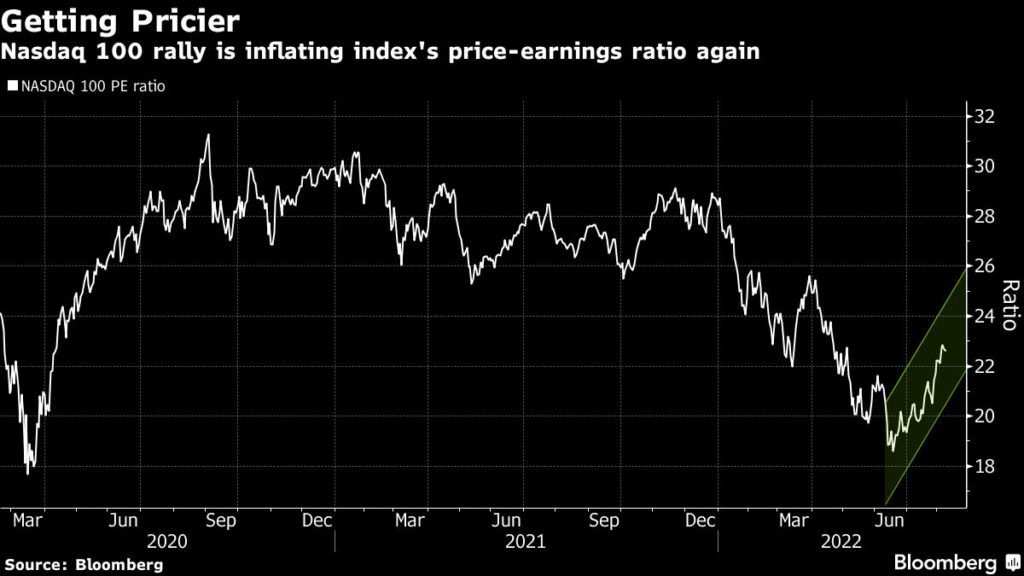
The Nasdaq 100 has rallied 17% from its June low as technology stocks stage a gradual rebound. The tech-heavy index now trades at about 23 times forward earnings, up from a 27-month low in June of 18.6. However, it still trades about 28% cheaper than its September 2020 high.   

Top Tech Stories

  • Chinese e-commerce giant Alibaba Group Holding Ltd. let go of 9,241 employees in the three months to June, according to the company’s latest filing.
  • Micron Technology Inc. said it will use “anticipated” government grants and credits to help it invest $40 billion by the end of the decade to build out US semiconductor manufacturing capacity.
    • US semiconductor firms are announcing billions in investments as President Joe Biden is set to sign a broad competition bill Tuesday that includes $52 billion in domestic semiconductor research and development.
  • Snap Inc. is introducing tools for parents or trusted adults to better supervise teen behavior on its popular disappearing photo and video app, Snapchat.
  • Cathie Wood said Ark Investment Management’s sale of some of its Coinbase Global Inc. holdings last month came after what the firm viewed as regulatory “uncertainty” in the cryptocurrency world.
  • China’s top leadership has grown increasingly frustrated with a years-long failure to develop semiconductors that can replace US circuitry, an embarrassment capped by a flurry of anti-graft probes into top industry officials and the $9 billion rescue of Tsinghua Unigroup.
  • ByteDance Ltd. has acquired one of China’s largest private hospital chains for about $1.5 billion, deepening a foray into health care via one of the largest domestic tech deals since Beijing’s internet crackdown.
  • Take-Two Interactive Software Inc. missed analysts’ estimates for annual profit after incorporating results from its purchase of mobile-game maker Zynga this year. The shares fell about 4% in extended trading.
  • Salesforce Inc. named Brian Millham as president and chief operating officer, elevating a 23-year veteran of the software company.


(Updates share performance throughout.)

More stories like this are available on bloomberg.com

©2022 Bloomberg L.P.
Software Company Avaya Probes Earnings, Casts ‘Substantial Doubt’ About Viability 

(Bloomberg) — Avaya Holdings Corp., the communication software company that riled lenders by slashing its earnings projections soon after borrowing $600 million in June, said it has hired advisers and is conducting an internal probe of its third-quarter financial results. 

With revenue plunging and a large chunk of convertible debt maturing in less than a year, Avaya said it now has “substantial doubt” about its ability to continue as a viable business, according to the company’s earnings statement on Tuesday.

The news sent the company’s shares tumbling 25%, leaving them down about 96% this year.

The doubts expressed by the company come after it sold a $350 million leveraged loan and a $250 million exchangeable note on June 24, both secured on a first-lien basis, to help refinance the older convertible notes maturing in June 2023. 

Read more: Avaya, Goldman, JPMorgan Face Lender Ire After Loan’s Collapse

But barely a month later, on July 28, Avaya said it was changing its chief executive officer and slashing its adjusted earnings forecast for the third quarter by more than 60% to between $50 million and $55 million. It also cut its revenue expectations by more than 16%. 

The scaled-back guidance pulled down the price of the company’s debt, which now trades at deeply distressed levels, indicating it is seen as having a high risk of default. Some new and existing first-lien lenders hired law firm Akin Gump Strauss Hauer & Feld to explore their options, Bloomberg previously reported. 

While the earnings reported Tuesday morning are in line with the previous revisions, Avaya indicated that the business is facing deep financial strain, saying it is engaging with its advisers to decide what to do about the 2023 convertible notes. Avaya is delaying filing its quarterly financial statements due to two ongoing internal investigations, according to the company’s statement.

Read more: Avaya Holdings 3Q Revenue Meets Estimates

The Audit Committee of the company’s board has started an internal investigation to review the circumstances surrounding the financial results for the quarter ended June 30. It’s also investigating the circumstances around a whistleblower letter, the contents of which the company didn’t disclose.

Avaya has engaged outside counsel to help with both investigations and also notified the US Securities and Exchange Commission and its external auditor, PricewaterhouseCoopers LLP, according to the statement.

Earnings call

The earnings call Tuesday morning lasted about 10 minutes after starting late and included no question and answer session.

The new CEO, Alan Masarek, former head of Vonage Holdings Corp., thanked investors for their patience and asked for time to demonstrate a “better future” for Avaya. 

“I understand very clearly there is disappointment, there is worry, there’s concern out there across effectively all of Avaya’s stakeholders,” he said. But it would be a mistake to look at the third-quarter results and “extrapolate that out and say this is the future of the company.”  

“I fundamentally believe that we can fundamentally improve the performance going forward,” Masarek said. “If I didn’t believe that, I wouldn’t have come here as CEO.” 

Investor anger

Investors in the June debt deal had expressed feelings of being blindsided by the company’s rapid reversal of fortunes and are questioning why this information wasn’t disclosed during the marketing process by either Avaya or the banks leading the transaction, Goldman Sachs Group Inc. and JPMorgan Chase & Co.

The $350 million loan was sold to a large group of investors in a broad syndication. That loan subsequently fell more than 20 cents on the dollar into the 60-70 cent range after Avaya revised its forecasts. The $250 million exchangeable notes were sold to a small group.

Since that transaction, Avaya repurchased about $129 million of the 2023 convertible notes, leaving about $221 million still outstanding, according to a July 14 filing.

On the call, CFO Kieran McGrath reiterated numbers released in the earnings statement, including that after accounting for the recent debt deal and repayment of part of the 2023 notes, Avaya holds cash and cash equivalents of $404 million with an additional $221 million of restricted cash held in escrow.

(Updates with opening share price.)

More stories like this are available on bloomberg.com

©2022 Bloomberg L.P.
Norwegian Bitcoin Miner Heads North to Escape Record Power Bills

(Bloomberg) — Soaring power prices are forcing a Bitcoin miner and data center operator in southern Norway to head north.

Kryptovault AS is moving operations north of the Arctic Circle, where electricity is much cheaper, Chief Executive Officer Kjetil Hove Pettersen said. Staying put would mean doubling a power bill that last year hit 202 million kroner ($21 million) and typically makes up more than 80% of the company’s operating expenses, he said. 

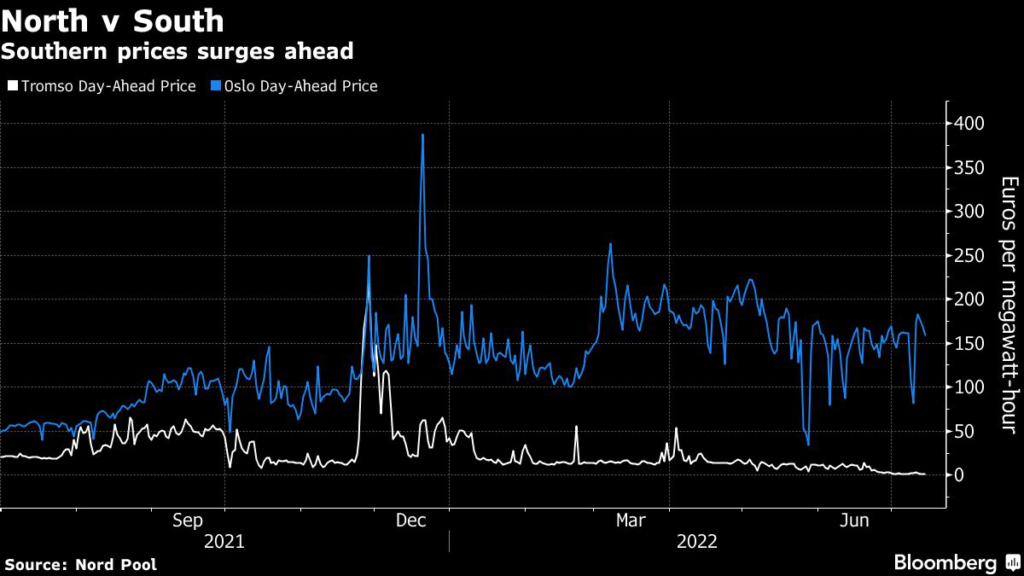
The energy crisis gripping Europe has been exacerbated in southern Norway as a dry spring depleted many giant reservoirs that are vital for local power generation. But it’s a different story in the country’s north, where there’s ample water and it’s hard to send flows to other regions. Prices in the most northern price zone where Krytovault will set up shop are a small fraction of those in the south.

“The relocation project will of course add other expenses and complications, however, with the current conditions it is an existential requirement to do this,” Pettersen said by email. He said power costs in the south are almost 160 times more than in the north.

The huge difference is due to bottlenecks between the regional price areas. While there’s plenty of water available in the north for power generation, there’s not enough cable capacity to shift supplies south where most of the consumption is. The shortage of water is such a big problem that the government is now considering curbs to electricity exports to safeguard domestic supplies. 

Hydro reservoirs in Norway’s most impacted area stand at 49.3%, compared with a median of 74.9% for the 2000-19 period. 

Norway Moves to Limit Power Exports in Blow to Europe

The amount saved by the move would depend on how much capacity the company is able to move and how quickly, as well as other unknown factors, Pettersen said. The company owns the mining machines and related infrastructure and pays for electricity, rent and other expenses, he said. While it earns money from mining, it doesn’t own or trade the actual cryptocurrency, he said. 

Kryptovault currently operates data centers at two locations in southern Norway, according to its website. The new site is at Stokmarknes in the north. 

Norway, like Sweden and Iceland, has lured crypto-currency miners with some of the cheapest electricity in the world. Its reliance on hydropower has provided an added factor for those seeking to cut their carbon footprint. 

Sweden Prefers Steel Over Bitcoin Miners as Power Gets Scarce

More stories like this are available on bloomberg.com

©2022 Bloomberg L.P.
Wall Street Pros Offer Crypto Holders a Backdoor Bankruptcy Exit

(Bloomberg) — Niche credit traders have a pitch for crypto holders locked out of their accounts at Voyager Digital Ltd. and Celsius Network LLC: Sell the rights to your coins at something like a 75% discount and let Wall Street worry about the rest. 

When crypto lenders Voyager and Celsius went bankrupt last month, they turned their customers into creditors. Those users cannot touch their coins and don’t know when they will get repaid, how much they might recoup or what form payouts could take.

Now, an oft-overlooked corner of the credit market is offering an escape hatch. Bankruptcy claims traders — firms that deal in the payables of insolvent enterprises — are already circling the busted crypto platforms, offering quick cash payouts to customers who don’t want to or can’t afford to wait. The downside: users may have to accept a steep discount to face-value. 

“Many creditors are still in a state of shock that Voyager and Celsius filed bankruptcy and they don’t have access to their coins,” said Vladimir Jelisavcic, manager and founder of Cherokee Acquisition, a firm that brokers bankruptcy claims. “There’s no real visibility about what the value of their accounts will be or when distributions might be made and many creditors simply want cash now.”

Cherokee traded a more-than $1 million Celsius claim on Friday, as well as three others ranging from about $10,000 to $73,000. The firm’s website, Claims Market, doesn’t report prices for specific trades but lists bids of about 25 cents on the dollar for Celsius transactions. Cherokee matches creditors with claims buyers, predominantly hedge funds, and sometimes holds the debt itself, Jelisavcic said.

Unusual Claims

Claims trading plays a role in almost every large bankruptcy. The market allows, for example, a failed retailer’s clothing suppliers to offload their receivables to investors at a discount. The investors then slog through insolvency proceedings in exchange for the prospect of a healthy return. 

The crypto bankruptcies are unusual because of who the platforms’ creditors are — overwhelmingly small, individual account holders — and the sheer number of them. Celsius had about 300,000 users with account balances of at least $100 as of July, while Voyager counts more than 3.5 million active users, according to court papers. 

Xclaim, another online market for bankruptcy claims, saw about 500 Celsius and Voyager creditors sign up through its website as of Monday, according to Andrew Glantz, director of business development and legal innovation at the company. No Voyager or Celsius claims have traded through the platform yet, but activity is expected to pick up as the cases proceed, he added. 

Purchase offers on Xclaim range from 10 cents to 90 cents on the dollar, depending on the nature of the debt and the platform it is tied to. Offers currently posted to the site were proposed by some of Xclaim’s registered buyers, which include 50 institutional investors, said Matthew Sedigh, Xclaim’s founder and chief executive officer.

“These cases are relatively novel,” said Sedigh, who worked in the restructuring industry as a financial adviser before founding Xclaim. “There is an uncertain timeline for an uncertain recovery — the opportunity to determine certainty is an opportunity that exists for all creditors.”

More stories like this are available on bloomberg.com

©2022 Bloomberg L.P.

US Says Chinese Firm Broke Export Rules in ZTE, Iran Contracts

(Bloomberg) — A US agency dealing with national security said Far East Cable Co. violated American export-control rules by signing contracts with Chinese networking giant ZTE Corp. and Iranian businesses to sell US-origin equipment to Iran. 

From September 2014 to January 2016, Far East Cable “served as a cutout” between ZTE — which was under investigation by the US for export-rule violations at the time — and Iranian telecommunications companies, the Department of Commerce’s Bureau of Industry and Security said in a statement Monday. 

Far East Cable’s actions are “part of an effort to conceal and obfuscate ZTE’s Iranian business from US investigators,” the BIS said in a July 29 letter to the company made available Monday. The agency is charging the cable maker with 18 violations of its export administration regulations. 

The Chinese cable maker was “facilitating ZTE shipments to Iran at the very time ZTE knew it was under investigation for the exact same conduct,” BIS Office of Export Enforcement Director John Sonderman said. The charges “should send a strong message to any company contemplating facilitating violations on behalf of another.”

In March 2017, ZTE pleaded guilty for its conduct related to these charges and broader violations of US export controls, and paid a combined penalty of $1.2 billion in criminal and administrative fines at the time.


More stories like this are available on bloomberg.com

©2022 Bloomberg L.P.
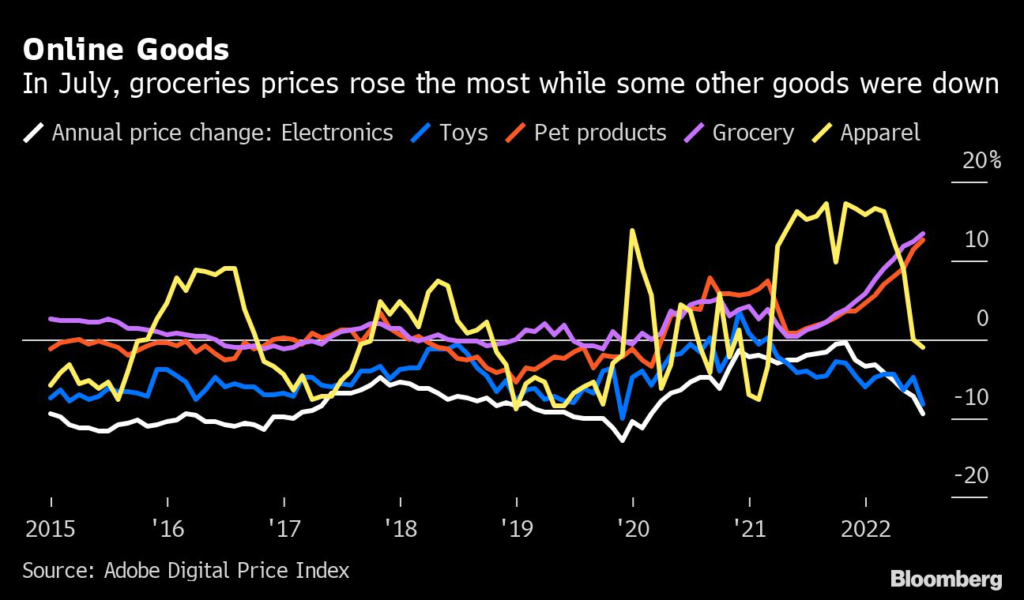
US Online Prices Post First Annual Drop in Over 2 Years as Pandemic Demand Cools

(Bloomberg) — Online prices in the US declined from a year earlier in July for the first time since 2020, as pandemic-era demand for consumer goods cools off. 

Prices dropped by 1% on an annual basis, according to the Adobe Digital Price Index, ending a run of 25 straight months of inflation in goods purchased online. Before the pandemic, online prices had been falling steadily for several years. 

“Wavering consumer confidence and a pullback in spending, coupled with oversupply for some retailers, is driving prices down in major online categories like electronics and apparel,” said Patrick Brown, vice president of growth marketing and insights at Adobe. “It provides a bit of relief for consumers.”

The pandemic led to a surge in online purchases of consumer goods that drove prices higher, as lockdowns restricted access to services like gyms or restaurant meals, and supply chains struggled to cope with the extra demand. While that boom may be cooling, the Federal Reserve is now concerned that inflation has spread from goods into services.  

Roughly 15% of retail spending in the US is via e-commerce, a share that’s risen since the arrival of Covid-19. Consumers spent $73.7 billion online last month, Adobe said.

The largest price drops in July were in the prices of electronic goods, which fell 9.3% from a year earlier, according to Adobe. Toy prices fell 8.2% and clothing by 1%.

Less encouraging for consumers was the acceleration in online food inflation, with prices rising a record 13.4% from from a year earlier, the largest increase in any category. 

The Adobe data is based on 1 trillion visits to retail sites and more than 100 million products across 18 categories. 

More stories like this are available on bloomberg.com

©2022 Bloomberg L.P.

Peak Car Is Just 14 Years Away After Over a Century of Growth

(Bloomberg) —

BloombergNEF just published its latest annual Light-Duty Vehicle Outlook. BNEF web clients can access the report here, and Bloomberg Terminal clients can find it here.

BNEF’s transport research tends to focus on decarbonization, including how drivetrains are changing. But another vital aspect to road transport emissions is just how many vehicles are on the road. Our view is that the vehicle fleet will continue to grow for at least another decade.

This latest report lays out a scenario for passenger road transport for the coming decades in which the global passenger vehicle fleet grows from 1.2 billion to a record of just over 1.5 billion in 2039. BNEF expects worldwide annual sales to peak in 2036, ending more than a century of growth.

Changes in the prime driving-age population is a powerful factor in the outlook. According to United Nations numbers, Europe’s working-age population will drop 11% by 2040, while Japan and South Korea’s will shrink more than 20%. China — the world’s largest auto market — will see its working-age population contract 14%. Over the same period, the share of the global population that is 69 years or older rises to 10% from 4%. These changes prevent our outlook for passenger vehicle usage from being higher.

Urbanization is another major driver in our outlook. Urbanization in India and other low-middle income markets like Brazil, Russia, Mexico, South Africa and Turkey mean that most urban dwellers, particularly those living in highly congested megacities, will find owning a passenger vehicle more costly or less convenient than owning a two-wheeler, using shared mobility services or taking public transit. This results in passenger vehicle sales in India, for example, approaching 8 million units by 2040, but never exceeding that number due to increased congestion in cities and higher sales of two-wheelers, which already account for most vehicles sold each year in the country.

The number of vehicles on the road also depends on who or what is behind the wheel. Per car, shared and self-driving vehicles travel more kilometers on average than private vehicles. In our outlook, shared and autonomous vehicles are a growing portion of the vehicle fleet, but are still heavily outnumbered by private vehicles.

This trend has a significant effect on the drivetrain mix, as shared and self-driving vehicles are far more likely to be electric. As of the end of last year, the private vehicle fleet was comprised of just over 1% EVs, far lower than compared with 6% of shared vehicles (e.g., ride-hailing, taxis and fleet-based car-sharing) and autonomous vehicles. However, private vehicles do make up 98.7% of the global passenger vehicle fleet and have 15 times the absolute number of EVs as shared and autonomous vehicles.

Policy measures will affect the rate with which shared vehicles electrify. Either with an eye on upcoming regulation or through a growing sense of what their customers want, all major ride-hailing companies now have programs in place to encourage drivers to purchase EVs. The majority have set specific targets for the full adoption of EVs on their platforms. While these companies don’t typically own the vehicles used on their platforms, they are testing the levers they can pull to encourage EV adoption.

Long-term outlooks such as this report deal with many factors which, when altered even slightly, can have a significant effect on the results. We’ll keep paying close attention to the near-term developments around vehicle sales, shared-vehicle business models and self-driving technology, as they will clearly impact the ability of the transport industry to decarbonize.

More stories like this are available on bloomberg.com

©2022 Bloomberg L.P.

Singapore Regulator Reiterates Crypto Dangers Amid Hodlnaut Woes

(Bloomberg) — Cryptocurrency investment is “highly hazardous” but meltdowns in the sector haven’t created financial-stability risks for Singapore, regulators in the city-state said after another digital-asset firm ran into trouble.

The Monetary Authority of Singapore has rescinded its in-principle approval for crypto lender Hodlnaut to obtain a license to provide digital payment token services under the Payment Services Act, an MAS spokesperson said in an emailed statement Tuesday. That came after Hodlnaut told MAS of its intention to withdraw its application amid its halt in customer withdrawals announced Monday. It had been one of the few firms granted in-principle approval by MAS under the Act.

“MAS has been continually reminding the general public that dealing in cryptocurrency is highly hazardous,” the regulator’s spokesperson said in response to an inquiry about Hodlnaut’s situation. “Not only are the values of cryptocurrencies extremely volatile, customers’ monies are not protected under the law.”

Entities that currently or previously have been affiliated with Singapore in some way have been at the epicenter of this year’s crypto meltdown. Bitcoin and Ether, the two biggest cryptocurrencies, are both down about 50% year-to-date. The Terra/Luna ecosystem suffered a massive collapse and hedge fund Three Arrows Capital is in liquidation. Lenders like Vauld and Babel Finance have halted customer withdrawals. Trading platform Zipmex also halted withdrawals, but it’s since partially unfrozen client funds.

In its statement, the MAS noted that PSA licensing involves regulation around money laundering and terrorism financing risks as well as technology risks, but that the firms are not subject to risk-based capital or liquidity requirements, nor are they required to safeguard customer money or digital tokens from insolvency risk. It said that’s similar to the approach taken in most jurisdictions. Still, the trouble in the sector hasn’t had broader implications for the island nation, it said.

“The turmoil in the cryptocurrency market has not posed financial stability risks in Singapore,” the MAS spokesperson said. “Spillover to the domestic financial system has been very limited as our key financial institutions do not have significant exposures to either distressed cryptocurrency firms or cryptocurrencies.”

More stories like this are available on bloomberg.com

©2022 Bloomberg L.P.

Biden to Sign Chips Bill as US Makers Unveil New Investments

(Bloomberg) — US semiconductor firms are announcing billions in investments as President Joe Biden is set to sign a broad competition bill Tuesday that includes $52 billion in domestic semiconductor research and development.

Micron Technology Inc. will invest $40 billion in memory chip manufacturing, according to the White House, and Qualcomm Inc. is partnering with GlobalFoundries, which has a facility in New York state, in a $4.2 billion agreement to manufacture chips.

Micron on Tuesday said their investments would create up to 40,000 jobs in both construction and manufacturing, well beyond the initial White House estimate of 8,000, and it expects to receive funding through the semiconducter bill.

Micron Chief Executive Officer Sanjay Mehrotra is among the expected attendees at the bill signing ceremony at the White House Rose Garden, along with Intel Corp. CEO Pat Gelsinger, Lockheed Martin Corp. CEO Jim Taiclet, HP Inc. CEO Enrique Lores and the CEO of Advanced Micro Devices Inc., Dr. Lisa Su.

The chips bill is the latest in a slew of legislative wins for the White House in recent weeks. Senate Democrats on Sunday passed a sweeping climate and spending bill — a slimmed down version of Biden’s Build Back Better agenda, after lawmakers also approved veterans health and gun-safety bills with bipartisan support.

The legislation, now called the CHIPS and Science Act, first passed the Senate in June 2021 but lingered in the House for months, and it took more than one year to reconcile the two chambers’ versions. Some Senate Democrats had criticized the White House for not pushing the House and Speaker Nancy Pelosi to get the legislation over the finish line sooner.

The chips bill is at the center of the Biden administration’s effort to reduce dependence on Asian nations like Taiwan and South Korea, whose homegrown companies are leading the market, and to address supply chain disruptions and resulting price hikes for certain goods containing semiconductors.

Biden’s team and lawmakers have stressed the national security implications of the bill, saying it was vital to competing with and countering China.

A large chunk of the federal grant is expected to go to Intel Corp., Taiwan Semiconductor Manufacturing Co. and South Korea’s Samsung Electronics Co., all of which are now building new chip fabrication facilities worth tens of billions in the US.

US to Stop TSMC, Intel From Adding Advanced Chip Fabs in China

The bill also includes important caveats sought by Republicans and China hawks: Companies that receive the funding have to promise not to increase their production of advanced chips in China. 

It was a condition made by lawmakers and the White House and was included in the measure over the objection of some chipmakers. Intel, in particular, was lobbying hard against the prohibitions. In late 2021, the American chipmaker wanted to increase production in China but the plan was rejected by the Biden administration.

While China’s chipmaking champion Semiconductor Manufacturing International Corp. can make chips that are more advanced than 28 nanometers, its technology is still at least six years behind industry leader TSMC. 

(Updates with new details from Micron on investments)

More stories like this are available on bloomberg.com

©2022 Bloomberg L.P.
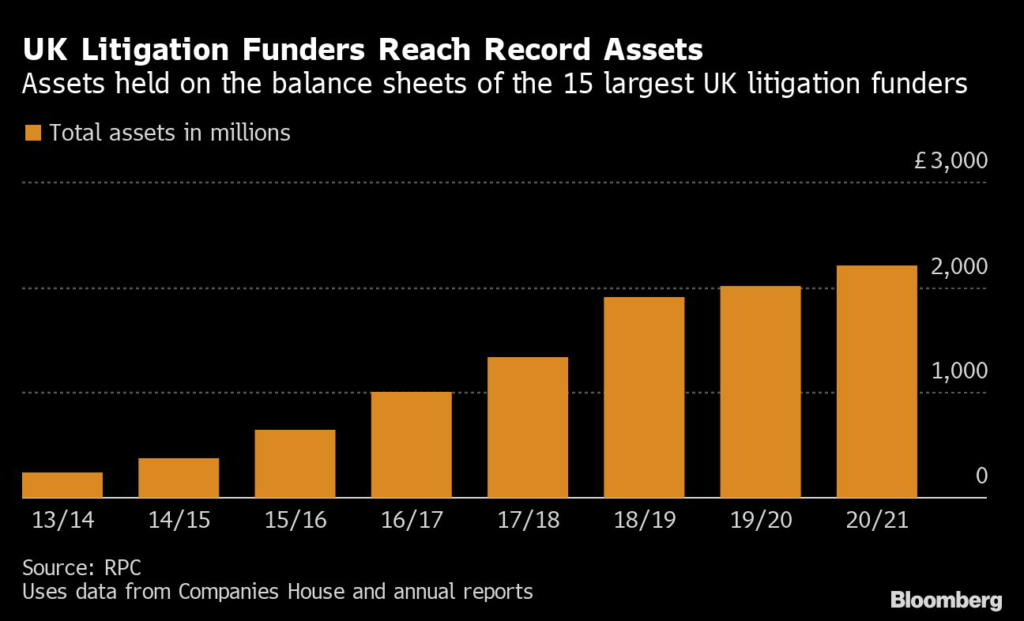
Litigation Funders Are Betting on a Rise in UK Class Actions

(Bloomberg) — Financiers are helping to fuel a rise in US-style class-action lawsuits in the UK courts, lured by the promise of big payouts.

The British litigation finance industry — which pays legal fees upfront and shares in any eventual payout — has almost doubled the size of its UK assets over the past three years, with as much as £2.2 billion ($2.7 billion) filling up balance sheets, according to data from law firm RPC. That war chest is being used to fund a growing number of lawsuits that are going after the likes of Apple Inc., Meta Platforms Inc. and BT Group Plc.  

Opt-out class action style lawsuits, where someone impacted doesn’t have to be aware of the case to be included, are being tipped as a good bet for investors as they offer the prospect of huge payouts if successful.

“Class actions have the potential for big rewards,” Charlotte Henschen, a lawyer at RPC, said. “Funders like class action type disputes because there is an opportunity for funders to get in at the beginning. It’s also an attractive group to represent for sheer reach and volume.”

The UK’s opt-out class action regime, known as collective proceedings, finally started to gain traction last year. Not a single claim was allowed to go ahead in the five years since it began in 2015, but 2021 saw four claims given the green light. There are now nine claims certified at the Competition Appeal Tribunal with many more waiting in the wings. 

The system currently only allows claims related to competition law and this year has seen cases filed over a power cable cartel and Meta’s alleged misuse of personal data. 

Two of the largest cases, a foreign exchange spot trading cartel and a truck cartel, are now pulling in as much as £50 million ($59.1 million) in funding when measured with potential funding for adverse costs, according to a report by consultancy Brattle.

“If funding didn’t exist tomorrow the CAT would be empty and there would be no cases being pursued there,” said Susan Dunn, founder of Harbour Litigation Funding and the chair of industry body The Association of Litigation Funders.

But the relationship between the funders and the people who run the cases hasn’t been without tension. 

Walter Merricks, the representative of the UK’s largest opt-out class action against Mastercard, ran into difficulty when Burford Capital Ltd dropped out of funding his case after it was denied certification by the CAT in 2017. It later found a new investor, Innsworth, and appealed to both the Court of Appeal and the Supreme Court — which it won. 

A spokesman for Burford said it did not comment on the decision-making over its investments.

How much the funders can win for these sorts of claims will vary, with agreements dependent on the size and budget with rates usually increasing over time. 

“A reasonable assumption is that a funder will charge 30% to 40% of the proceeds in return for its non-recourse funding, which will be completely lost if the case is not successful,” Harbour’s Dunn said. 

(Updates with estimates on how much funders can make from successful cases in the last paragraph)

More stories like this are available on bloomberg.com

©2022 Bloomberg L.P.

Close Bitnami banner
Bitnami
