Bloomberg

Alibaba Reduced Workforce by Nearly 10,000 in Three Months

(Bloomberg) — Chinese e-commerce giant Alibaba Group Holding Ltd. let go of 9,241 employees in the three months to June, according to the company’s latest filing.

The Hangzhou-based firm reported it had just over 245,000 employees at the end of the most recent reporting quarter, cutting back during a period that marked its first ever contraction in revenue. Alibaba also reduced its workforce in the first three months of the year by 4,375, mirroring widespread moves among global tech companies to rein in spending at a time of rising inflation, materials costs and political tensions.

US firms like Apple Inc., Alphabet Inc. and Meta Platforms Inc. have cooled recruiting while Alibaba’s closest analog, Amazon.com Inc., has shed about 100,000 jobs. SoftBank Group Corp., Alibaba’s biggest shareholder and among the world’s most lavish venture capital spenders, promised this week to implement sweeping cost-cutting measures that would significantly affect headcount.

Robinhood Cuts Jobs, Joining Netflix and Amazon in Tech Slowdown

Once the most valuable company in China, Alibaba has seen its market value tumble after Beijing launched its sweeping crackdown on the private sector more than a year ago. The government forced its finance affiliate, Ant Group Co., to call off what would have been the world’s largest initial public offering in 2020, and then launched reforms that have undercut Alibaba’s business model.

Abroad, the US added Alibaba to a growing roster of companies facing removal from US stock exchanges because of Beijing’s refusal to permit American officials to review their auditors’ work. The company is seeking a primary listing in Hong Kong that would enable it to tap more mainland investors, while also maintaining its listing status on the New York Stock Exchange.

More stories like this are available on bloomberg.com

©2022 Bloomberg L.P.

ByteDance Pays $1.5 Billion for China Hospital Chain in Health Foray

(Bloomberg) — ByteDance Ltd. has acquired one of China’s largest private hospital chains for about $1.5 billion, deepening a foray into health care via one of the largest domestic tech deals since Beijing’s internet crackdown.

TikTok’s Chinese owner paid about 10 billion yuan to take full ownership of Amcare Healthcare, which runs women’s and children’s hospitals in cities from Beijing to Shenzhen, according to a person familiar with the matter, asking to not be identified discussing private information. Two ByteDance subsidiaries now own a combined 100% stake of Amcare, according to corporate registry tracker Qichacha. 

ByteDance’s health-care app Xiaohe competes with Alibaba Health Information Technology Ltd. and Ping An Healthcare and Technology Co. in online consultations, hospital appointments and wellness services, a burgeoning $89 billion sector boosted by nationwide measures to curb the pandemic. 

The social media giant better known for creating addictive content apps joins fellow tech giants from Apple Inc. to Amazon.com Inc. that are exploring ways to digitize and disrupt the traditional health care industry. The deal is also one of the largest to emerge from the Chinese tech industry since regulators began curbing “disorderly capital expansion” in late 2020, discouraging the sorts of big-ticket acquisitions that Alibaba Group Holding Ltd. and Tencent Holdings Ltd. used in previous years to get into and dominate new markets.

Representatives for Amcare didn’t respond to requests for comment on the acquisition, which was first reported by financial media outlet Caixin. A spokesperson for Xiaohe confirmed ByteDance’s acquisition, but declined to comment on the size of the deal.

Read more: Amazon to Buy One Medical for $3.49 Billion in All-Cash Deal

Founded in 2006 in Beijing, Amcare operates seven women’s and children’s hospitals, two integrated clinics and five postpartum centers across China, according to the company’s website. In 2020, it obtained a government license for in-vitro fertilization operations by acquiring a Beijing hospital. Prior to ByteDance’s takeover, its investors included Hillhouse Capital, China Renaissance and Warburg Pincus, according to Qichacha.

A hit app factory known for its addictive news and short-video platforms, ByteDance has over the years expanded beyond its core online entertainment business, albeit with mixed success. While still the world’s most valuable startup, its market cap has shrunk alongside a brutal global tech selloff and it may be seeking growth in new areas.

Read more: ByteDance Valuation Drops Below $300 Billion in Private Deals

Its investments span sectors from education and cleaning robots to hotpot and coffee chains. At the start of this year, the Beijing-based startup downsized its investment arm after regulators threatened to smother the flurry of deals that tech behemoths cut annually.

More stories like this are available on bloomberg.com

©2022 Bloomberg L.P.

Snap Adds New Tools for Parents to Monitor Teens Using Snapchat

(Bloomberg) — Snap Inc. is introducing tools for parents or trusted adults to better supervise teen behavior on its popular disappearing photo and video app, Snapchat.

The new tool, called Family Center, lets parents or designated adults over the age of 25 to view their teen’s friends, see who they’ve messaged in the past week and anonymously report abusive accounts. Guardians can’t see snaps, chats or time spent by the teen on Snapchat.

Parents can send teens an invite to Family Center, which they can either accept or reject. The tools will be available Tuesday in the US, UK, Canada, Australia and New Zealand, and will roll out to all other markets by the fall, a spokesperson said. 

Snap has been working on the tools for more than a year, taking input from researchers and online safety experts, as well as running focus groups with teens and parents, the company said. Ultimately, the design is meant to mimic the oversight a parent or caregiver may have in real life: Knowing who a teen is spending time with so they can intervene when necessary, without being privy to the content of conversations.

Snap makes Snapchat, an app popular with young people for sending private messages and posting ephemeral updates. The company has said it reaches more than three-quarters of 13- to 34-year-olds in 20 countries.

Social media platforms have come under scrutiny from regulators and the public about apps’ impact on young people. Meta Platforms Inc.’s Instagram added similar tools and the ability to track how much time teens spend on the app after a whistle-blower testified last year that the company had prioritized profit over the well-being of users, especially teens.

More stories like this are available on bloomberg.com

©2022 Bloomberg L.P.

SoftBank Pledges Sweeping Cost Cuts After $23.4 Billion Loss

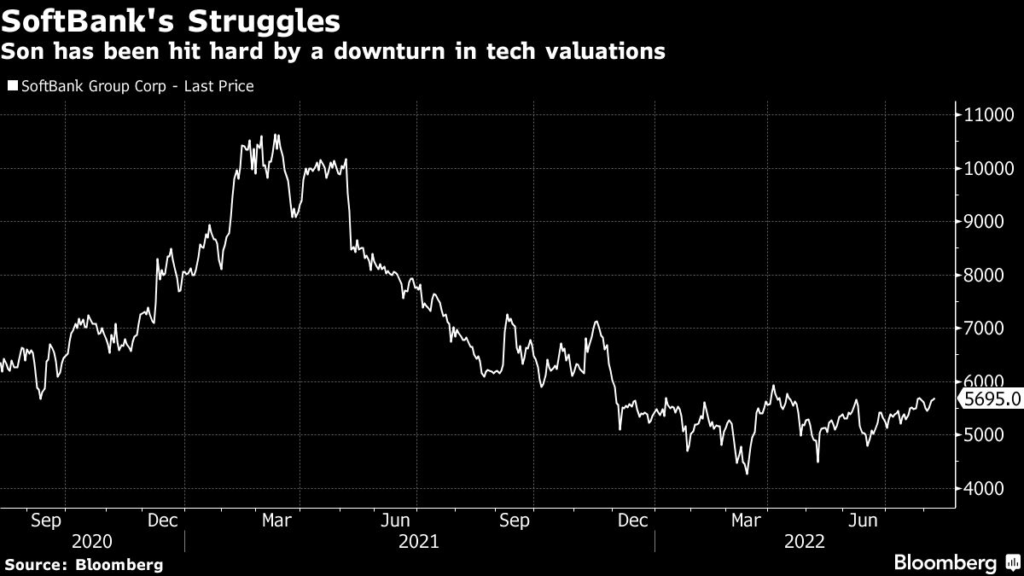
(Bloomberg) — SoftBank Group Corp.’s Masayoshi Son said he plans widespread cost cutting at his Japanese conglomerate and its Vision Fund investment arm after a record $23.4 billion loss on plunging portfolio valuations and foreign currency losses. Shares dropped.

The Tokyo-based company lost the vast majority of that money — $17.3 billion — in the Vision Fund, as it marked down the value of holdings such as Coupang Inc., SenseTime Group Ltd. and DoorDash Inc. SoftBank also reported a $6.1 billion foreign exchange loss because of the weaker yen.

The 64-year-old struck a darkly somber tone after the results Monday, taking responsibility for buying into startups at the height of the market and pledging to slash expenses to get back on track. Son said he will review “everything” for potential cuts without any “sacred cows.” SoftBank will scrutinize senior and junior employees in both front and back offices to an extent never experienced before.

“The loss is the biggest in our corporate history and we take it very seriously,” Son said during a press conference in Tokyo. “We have to resort to big cost-cutting efforts at Vision Fund. The cost cutting efforts will have to include a reduction in head count – something I’ve made up my mind to do.”

SoftBank shares fell as much as 8.1% in Tokyo on Tuesday, their biggest intraday slump since April. 

Son detailed extensive problems and missteps in his portfolio, unusual for a self-made billionaire who tends to emphasize the positive. He said SoftBank had marked down 284 companies in its portfolio in the latest quarter, while only 35 went up in value. The markdowns included publicly traded portfolio companies, but also hundreds of private companies whose estimated values had dropped because of weak performance or lower comparisons. 

A quarter earlier, SoftBank still had profits of about 3 trillion yen ($22 billion) in its investment arm, which includes the first and second Vision Funds as well as Latin American funds. As of June, essentially all of those profits had disappeared. 

“We really believed we could do it and we had our heads in the clouds,” Son said. “Of course, the market was bad, there was a war, and there was the coronavirus. We can point to a lot of reasons, but these are all excuses. We have to self-reflect about the fact that if we’d been more selective and had invested more properly, it wouldn’t come to this.”

Asked about what lessons he has learned from the experience, Son said, “There are too many to count.”

With the first Vision Fund, Son said he was trying for home runs and struck out with companies like WeWork Inc. In Vision Fund 2, he tried a more modest approach of getting on base, but valuations were too high. Now, he will sharply scale back. “We’re currently strictly suppressing new investments,” he said.

SoftBank approved about $600 million in investments in the June quarter, compared with $20.6 billion a year earlier.

“With SVF losses expanding and no sign of a turnaround, management’s balance sheet-focused strategy is becoming clearer,” Citigroup analysts Mitsunobu Tsuruo and Tailai Qiu wrote in a report.

SoftBank raised a huge slug of capital by selling forward contracts on Alibaba Group Holding Ltd., the Chinese e-commerce company that made Son’s reputation as a startup investor. He took in $10.5 billion during the June quarter and then procured another $6.8 billion through such contracts on and after July 1. 

Son also said SoftBank has begun talks to sell asset manager Fortress Investment Group, confirming a Bloomberg News report. The Japanese company bought Fortress for $3.3 billion in 2017, but it had to cede day-to-day control of the company to win US approval of the deal. 

“They have to sell what they can, and invest only in the good ones,” said Mitsushige Akino, a senior executive officer at Ichiyoshi Asset Management Co. in Tokyo. “It’s clear they’re still facing headwinds.”

SoftBank is also selling part or all of its 9% stake in SoFi Technologies Inc., according to a Monday filing with the US Securities and Exchange Commission.

To bolster SoftBank’s share price, Son unveiled a fresh program to buy back as much as 400 billion yen of its own stock. The company has turned to such repurchases repeatedly in recent years, including a 1 trillion yen program announced in November.

SoftBank’s Vision Fund, the world’s largest technology investment vehicle, holds large stakes in hundreds of unlisted technology startups. But low valuations have been draining SoftBank’s ability to turn public listings of its portfolio companies into liquidity to fuel further big bets. 

SoftBank said the Vision Fund losses included 293.4 billion yen for Coupang, 235.9 billion yen for SenseTime and 220.7 billion yen for DoorDash. It was also hit by drops at AutoStore Holdings and WeWork. SoftBank exited its holding in Uber Technologies Inc., the US ride-hailing giant that was supposed to be a star in its portfolio. 

SoftBank and Son are now trying to wait out the technology slump so that they can extract a return on their $32 billion purchase of chip designer unit Arm Ltd. The CEO is planning an initial public offering for Arm next year and has said he aims to make the offering the biggest-ever for a chip company.

Son is facing perhaps the steepest challenges of his career and he is taking more of the responsibility on his own shoulders. Chief Operating Officer Marcelo Claure left earlier this year, while former Chief Strategy Officer Katsunori Sago resigned in 2021.

Rajeev Misra, long-time head of the Vision Fund, is stepping away from most of his responsibilities and will start his own investment fund. Son said he will take over as chief executive of the second Vision Fund. 

Son, known for his eccentric presentations, began the press conference by showing an illustration of Tokugawa Ieyasu, one of the heroic figures in Japanese history. The image, however, shows the warrior after a defeat in battle, grim and dejected. Son said he was going to look at the image of the shogun-to-be to force himself to learn from his mistakes.

“I’m sorry what we shared today was depressing,” he said near the end of the event. “I wanted to be honest and transparent.”

(Updates with shares from the first paragraph)

More stories like this are available on bloomberg.com

©2022 Bloomberg L.P.

China Corruption Probes Stem From Anger Over Failed Chip Plans

(Bloomberg) — China’s top leadership has grown increasingly frustrated with a years-long failure to develop semiconductors that can replace US circuitry, an embarrassment capped by a flurry of anti-graft probes into top industry officials and the $9 billion rescue of Tsinghua Unigroup.

Senior officials are angry at how tens of billions of dollars funneled into the industry over the past decade haven’t produced the sorts of breakthroughs that emerged from previous national-level scientific endeavors, according to people familiar with top government officials’ thinking. Washington, which has steadily ratcheted up restraints on China, has been able to strong-arm Beijing and successfully contain its technological ambitions, they said, asking not to be identified revealing sensitive deliberations.

The investigations have sent shockwaves through a semiconductor industry long accustomed to top-level support. Xi Jinping’s government had allocated more than $100 billion to build up a domestic semiconductor sector so the country could break its dependence on the West. A key area of scrutiny is the National Integrated Circuit Industry Investment Fund — known within the industry as Big Fund — which had become Beijing’s primary vehicle for doling out capital to the country’s chipmakers.

“If you’re going to be putting tens of billions of dollars in an industry, regardless of whether it’s a high technology one or just like building trains and airports, you’re going to have illicit dealings going on,” said Jordan Schneider, a senior analyst at Rhodium Group and host of the China Talk podcast.

The government is investigating the head of the Big Fund, Ding Wenwu, who had once warned it was “unrealistic” to cut corners in developing chip technologies. Founded in 2014, the fund drew about $45 billion in capital and backed scores of companies, including Semiconductor Manufacturing International Corp. and Yangtze Memory Technologies Co. The fund operated mostly behind the scenes and kept investment standards away from public view, which some analysts said undercut accountability.

Beijing’s frustration comes as Washington is slapping ever-tighter restrictions on China, adding to potential vulnerability for the Communist Party. The US is increasingly limiting the kind of chip-making equipment that American companies can export to Chinese customers, while enlisting allied countries so that key suppliers like the Netherlands’ ASML Holding NV and Japan’s Nikon Corp. join its technology blockade.  

This year, various government agencies began reviewing contingency plans for strategically important industries, in the event of stricter US sanctions, the people said. When senior officials examined the report on the chip sector last month, it became clear advances in the field may have been overstated and that many investments had failed to bear fruit, the people said.

That ran contrary to a long-held belief that Beijing need only throw enough money at the problem. Xi has repeatedly urged breakthroughs in key technologies as the world faces “great changes not seen in a century.” The effort took on urgency during the Trump administration, which launched sanctions that proved effective at crippling Chinese giants including Huawei Technologies Co. Mastering advanced chipmaking was regarded as the pinnacle of that initiative in China, which in 2020 accorded the same priority to that goal as developing the atomic bomb decades ago.

The State Council Information Office didn’t respond to faxed inquiries. Unigroup representatives didn’t respond to requests for comment.

Despite years of effort, China hasn’t made much progress in narrowing — let alone closing — the gap with the West. Chip-making machinery is still dominated by Dutch firm ASML, despite the efforts of state science institutions and firms like Naura Technology Group Co. to design rival lithography machines. Japanese firms still control the supply of photoresists, a key chemical. Though tech giants such as Huawei drove intense research of local alternatives to US hardware, the country still relies on imports to meet the majority of its $155 billion in annual chip needs.

Critics of Beijing’s top-down policies have pointed out the enormous inefficiency that can result from freely doling out subsidies. Local media have reported about companies with scant experience winning incentives or grants for pursuing research. Powerful local interests have chased government money by championing projects in hopes of securing subsidies and, at times, political prestige. About 15,700 new semiconductor companies registered from January to May 2021, three times the number from the same period the previous year, according to an analysis by the South China Morning Post.

China can point to some success. SMIC has made headway against foreign competitors — though industry experts say its advances may be overstated. The country also vastly increased memory chip capacity through Yangtze Memory and Changxin Memory Technologies Inc.

Local chipmakers have also been able to go public. The most recent is Shenzhen Longsys Electronics Co., a Big Fund-backed memory chipmaker, that fetched $365 million from IPO in Shenzhen last week. 

Still, Beijing’s frustration began to boil over in late 2021, when the Biden administration showed few signs of letting up on his predecessor’s campaign against China, and it became evident Unigroup — the standard-bearer for state-backed semiconductor innovation — was beginning to fail. 

The roster of investigations into chip industry figures now reads like a who’s-who of China’s semiconductor pantheon. And the dragnet is expected to widen as investigations proceed, the people said.

In November, authorities announced probes into two executives linked to an investment firm that managed capital for the Big Fund. Last month, Ding, the fund’s chief, was also revealed to be under scrutiny. Several more people have been implicated, including former Unigroup Chairman Zhao Weiguo and his co-president Diao Shijing.

In addition, graftbusters last month announced an investigation into Minister of Industry and Information Technology Xiao Yaqing, the most senior sitting cabinet member to face a disciplinary probe in almost four years. His probe is not directly related to the Big Fund, one of the people said.

Many of the chip-related investigations involve Tsinghua Unigroup, the Beijing-based giant Zhao led that was forced into a 60-billion-yuan ($8.9 billion) takeover to get out from under a mountain of debt. It began unraveling in 2021 after Beijing tightened lending nationwide, forcing the company into court receivership. When bidders for the company emerged, Zhao called their proposed takeover a “crime.”

It’s not known whether Ding’s investigation is related to Unigroup. The Big Fund was involved in several projects Zhao spearheaded, including Yangtze Memory and Shanghai-based mobile communication chip giant Unisoc, according to company registration information. Unigroup also became a minority shareholder of the Big Fund under Ding’s watch.

Read more: Chinese Chip Mogul Says $9 Billion Rescue Turning Into ‘a Crime’

Probes of Zhao and Diao — a former MIIT official — were directly linked to alleged misconduct during their time at the chip giant, said another person, asking not to be named discussing a sensitive matter. Zhao and Ding didn’t pick up calls seeking comment. The Big Fund wasn’t immediately available for comment.

Zhao was among the more highly regarded executives in China’s vast semiconductor arena. He made his name via several high-profile investments using state-backed capital, which expanded Unigroup’s reach into areas from mobile processors and memory to servers. His $23 billion bid for Micron Technology Inc. in 2015 was blocked by the US government at the eleventh hour.

He went on to build the $30 billion Yangtze Memory in Wuhan, which now competes directly with Micron. But the 55-year-old was ousted after a consortium led by JAC Capital took over his company this year.

Schneider of Rhodium Group said this series of chip probes have been unusually aggressive, perhaps because the industry is so critical to Xi’s strategic ambitions. In the past, China would cut off funding if there were signs of serious troubles, but semiconductors are the foundation of a robust tech sector. 

“Xi talks about the industry as needing to provide the Chinese people with full self-reliance,” he said.

More stories like this are available on bloomberg.com

©2022 Bloomberg L.P.

Thai Central Bank to Get More Powers in Crypto Law Overhaul

(Bloomberg) — Thailand plans to overhaul its digital rules to confer more powers on the central bank and tighten the oversight of platforms offering cryptocurrencies and other tokens after a recent market rout left retail investors reeling from losses.

The planned amendments to the regulations will “bring the central bank to be part of it,” Finance Minister Arkhom Termpittayapaisith said in an interview. The Securities & Exchange Commission, which currently has the sole mandate to supervise the industry under the rules passed in 2018, has been asked to take the lead on the overhaul, he said.

The move to tighten the rules comes after Thai authorities were criticized for not acting promptly to protect investors at Zipmex (Thailand) Ltd., a licensed cryptocurrency exchange that briefly suspended coin withdrawals. While the platform has since lifted most of the freeze on transactions, it has has filed for a moratorium in Singapore for protection from creditors against any lawsuits and to buy time for raising funds.

“Right now, the central bank has no room to enter into the regulatory framework except for notifying that cryptos are not a legal means of payment for goods and services,” Arkhom said Monday. “So the framework is not clear enough to regulate the industry.”

Almost $2 trillion has been wiped off the global crypto market since a peak in November last year in an implosion exacerbated by rising interest rates. Leveraged funds and lending platforms blew up along the way, exposing regulatory gaps that officials worldwide are now rushing to plug.

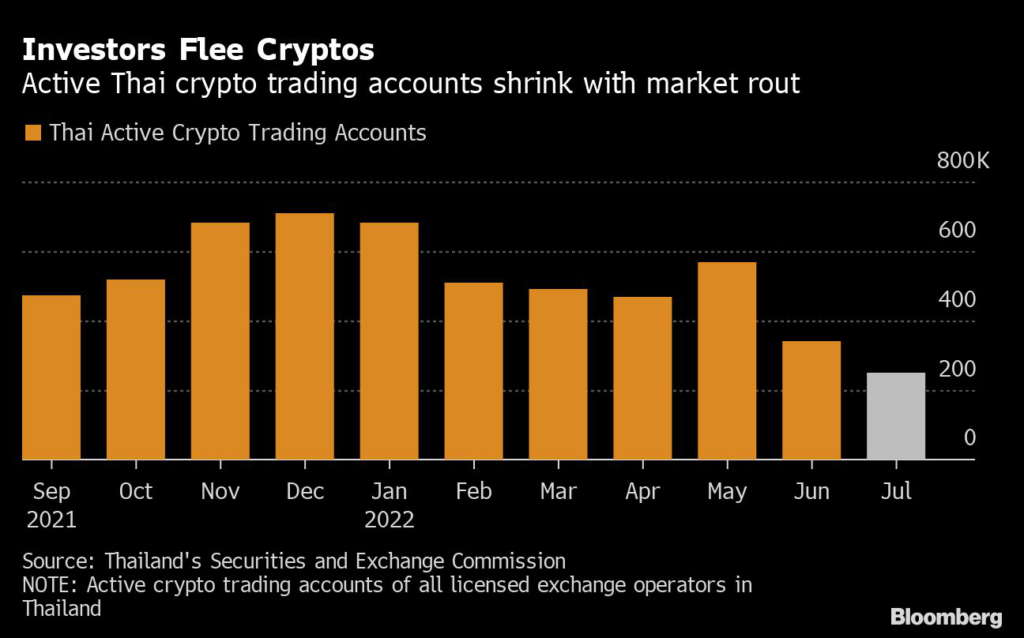
In Thailand, the number of active trading accounts shrank to about 230,000 from a peak of almost 700,000 in December, official data show.

Thailand’s largest crypto exchange, Bitkub Online Co., and its chief executive were fined by the SEC in June for creating “artificial trading volume” on the platform. The company and five officials were also fined for breaching guidelines in listing the company’s own digital coins. 

While the Bank of Thailand Governor Sethaput Suthiwartnarueput has said the authority wants to draw “red-lines” on cryptos, it is set to test a central bank digital currency by the end of the year in a pilot project. But it has no plans yet to issue a retail CBDC, it said last week. 

Arkhom said tighter crypto regulations will not be aimed at throttling innovation and technology but to ensure investors have greater protection.

“For the stock exchange, you have the paper to prove you are the owners. In the digital world, you have nothing except for the consent that you put at the bottom, which people never read,” Arkhom said. “We are trying to protect investors as well as keeping the players in the industry in the fair terms.”

(Updates with more background in fifth paragraph.)

More stories like this are available on bloomberg.com

©2022 Bloomberg L.P.

China Forecast to Sell a Record 6 Million Electric Cars in 2022

(Bloomberg) — Electric vehicles sales in China are forecast to hit a record 6 million this year as demand for cleaner cars surges.   

The China Passenger Car Association raised its estimate from 5.5 million, after releasing data showing deliveries of new-energy vehicles more than doubled in July to around 486,000 units — accounting for 26.7% of the new auto market. Overall passenger vehicle sales rose 20% from a year earlier to 1.84 million units, the PCA said Tuesday.  

The increased forecast represents a doubling from last year’s 2.99 million NEV sales, underscoring the dramatic growth in demand for cleaner cars in China, and the challenge for legacy automakers to adapt in a market that is rapidly going green. 

The increased forecast of 6 million is still “relatively cautious,” the PCA in a statement, adding it could be further increased at the start of the fourth quarter.   

Tesla Inc. delivered 28,217 cars, with 8,461 going to the local market and 19,756 exported, mostly to Europe and Asia. The sharp drop of 64% from June was mainly caused by production shutdowns to upgrade its Shanghai factory as part of a plan to double annual capacity to 1 million vehicles.  

BYD Co., which earlier this year ended production of cars powered only by fossil fuels, earlier reported monthly sales of 162,530 units — both pure electric vehicles and plug-in hybrids. 

While Tesla and BYD dominate EV sales, smaller startups are also making inroads as demand for clean cars surges. Eight-year-old Hozon New Energy Automobile Co., which started by targeting customers outside big cities with budget cars, delivered 14,037 vehicles last month, including 1,382 to overseas markets. Leapmotor Technologies Ltd., which competes in the same price range as Hozon, shipped a record 12,044 cars. 

Both outperformed bigger names Xpeng Inc., Li Auto Inc., and Nio Inc., although the three US-listed companies all delivered more than 10,000 cars last month. 

The central and local governments have also taken steps to help the auto industry recover from Covid lockdowns and restrictions that crushed sales earlier this year. In May, the central government cut purchase taxes on some low-emission passenger vehicles by 50%, while municipal governments have pitched in with subsidies and incentives to entice buyers. 

Read more: Not a Single Car Was Sold in Shanghai in April

Despite sporadic outbreaks of Covid-19 in parts of the country, overall auto production and supply chains have largely recovered. Passenger-vehicle sales may resume double-digit growth this half, after falling for four consecutive quarters because of supply chain constraints, Bloomberg Intelligence analyst Steve Man said in a recent note. 

More stories like this are available on bloomberg.com

©2022 Bloomberg L.P.

Google Search Outage Affects Tens of Thousands of Users

(Bloomberg) — Alphabet Inc.’s Google search and website temporarily stopped working for some users, setting off confusion and a torrent of memes about what to do without the world’s most popular online engine.

User reports of issues with the service began inundating Downdetector, an outage-tracking service focused on the US, from around 9 p.m. New York time on Monday and numbered more than 40,000 an hour later. Problems loading the Google website and performing searches were also observed in Taiwan and Japan, though the services appeared to be intermittently available.

Google’s signature product is known for its ubiquity and reliability and service disruptions of this kind are rare. The most common causes of such failures are back-end web infrastructure, such as those experienced by Fastly and Amazon Web Services last year.

The service appeared to be mostly restored at just before 10 p.m. New York time. 

There was an electrical incident at a Google facility in Iowa on Monday, sending three people to a nearby hospital, according to local media reports. It’s not clear whether the episode is related to the service outage.

A representative for Alphabet provided the following statement:

“We are aware of an electrical incident that took place today at Google’s data center in Council Bluffs, Iowa, injuring three people onsite who are now being treated. The health and safety of all workers is our absolute top priority, and we are working closely with partners and local authorities to thoroughly investigate the situation and provide assistance as needed.”

More stories like this are available on bloomberg.com

©2022 Bloomberg L.P.

Taiwan Says China Economic Ties Make More Sanctions Unlikely

(Bloomberg) — China’s economic measures against Taiwan are unlikely to have a major impact on trade between the two economies given how closely they’re intertwined, a finance ministry official said.

The electronics industries in both economies are “highly dependent on each other,” and Taiwan is China’s biggest source of imported integrated circuits, Beatrice Tsai, the ministry’s chief statistician, told reporters in Taipei Monday. 

Beijing-Taipei tensions worsened last week, with China firing missiles over Taiwan and slapping trade curbs on some agricultural goods and construction materials following US House Speaker Nancy Pelosi’s visit to the island.

“We expect very little chance of China imposing stricter economic sanctions on Taiwanese businesses due to our highly reliant economic relations,” said Tsai.

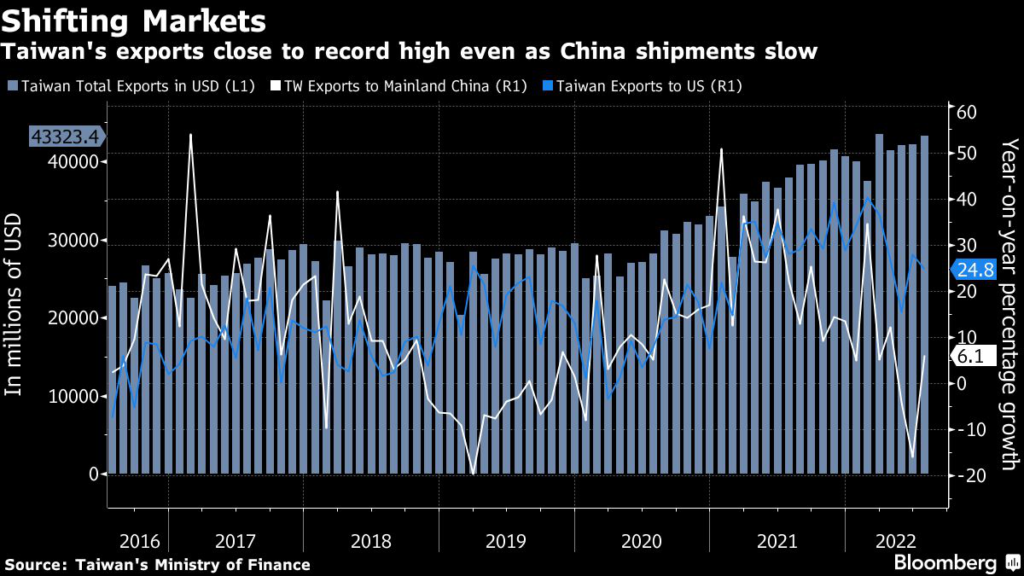
Taiwan on Monday reported stronger-than-expected trade data, with export growth rising 14.2% in July from a year ago. That was faster than the most bullish estimate in a Bloomberg survey of economists, and drove total shipments to $43.3 billion, the second-highest amount on record. 

Export growth to China has been sluggish this year as Beijing contends with Covid outbreaks and lockdowns. Shipments to China and Hong Kong increased just 3% year-on-year in July after contracting in June, compared with double-digit growth earlier in 2022. By contrast, shipments to the US surged 24.8% last month. 

Even so, China and Hong Kong combined remain by far Taiwan’s largest export market. Shipments totaled more than $16 billion in July, compared with nearly $7 billion in total exports to the US. 

Economists have said the risk for Taiwan would depend on whether Beijing widened restrictions to cover the manufacturing sector and semiconductors. Agricultural exports from Taiwan to China accounted for only 0.6% of total exports last year, according to DBS Group Holdings Ltd.

The import bans announced thus far “are manageable for overall trade,” Adrienne Lui, an economist at Citigroup Inc., wrote in a research note. “But given the fluid geopolitical situation, there remain risks to other key export items to China” that enjoy no tariffs.

Shipping Route

Another main concern was whether a series of military drills surrounding Taiwan would have a significant impact on the shipping industry. By Monday, however, shipping in the Taiwan Strait showed signs of returning to normal. 

Tsai said Monday the developing situation across the strait was difficult to predict. She pointed out, though, that exports were largely unaffected the last time Beijing significantly ramped up pressure on Taiwan in 1995 and 1996, even as financial markets and consumer confidence took a hit.  

Barring any major disruption to shipping lanes or new trade measures from China, Tsai said Taiwan’s total exports are likely to rise between 8% and 12% in August.

Taiwan is also having to contend with a slowdown in the global economy, which will likely weigh on demand for its electronics products. Momentum in Taiwan’s tech sector demand will likely moderate in the second half of the year as work-from-home tech demand eases, said Grace Ng, an economist at JP Morgan Chase Bank NA.

“There are some worrying signs on general global demand conditions,” Ng wrote in a research note. “In particular, recent loss of momentum in Taiwan’s tech exports seems rather concerning, as the level of tech exports appears to have peaked” in the first quarter. 

Exports of electronic product parts rose 15.6% from a year ago, the slowest rate of growth so far in 2022. On a month-on-month basis, semiconductor exports fell 1.8%.

(Updates with comments from economists.)

More stories like this are available on bloomberg.com

©2022 Bloomberg L.P.
Zipmex to Ease Bitcoin, Ether Withdrawals This Week

(Bloomberg) — Asia crypto exchange Zipmex Pte will allow users to partially withdraw Bitcoin and Ether from their trading accounts starting later this week, providing some relief to those caught by the recent meltdown in the digital asset market.  

Zipmex, which halted withdrawals in July due to a liquidity crunch after its exposure to troubled Babel Finance went bad, will let users withdraw their Ether from August 11 and Bitcoin from August 16 from Zipmex’s Z Wallet, subject to a cap on the number of coins, according to the company’s spokesperson. 

Read: Zipmex Seeks $50 Million After Freezing Crypto Withdrawals

The move comes after Zipmex recently started to unlock some altcoins. The firm eased the full withdrawals of Solana’s SOL, Ripple’s XRP and Cardano’s ADA starting last week. These steps follow Thailand’s Securities & Exchange Commission order to Zipmex’s Thai unit to lift a freeze on some digital coins. 

With the latest step, around 60% of users will get all their five tokens that are being released under this allowance, the spokesperson said.

The crypto exchange, that also operates in Singapore, Indonesia and Australia, is one of several crypto firms hit by a $2 trillion meltdown in the market that has forced many players to halt withdrawals and some to file for bankruptcy.

Zipmex has filed for a moratorium in Singapore for protection from creditors against any lawsuits and to buy time for raising funds. The court hearing for moratorium is due on August 15 in the city-state.

(Updates second paragraph to elaborate on terms of withdrawal. In an earlier version, company corrected to clarify what users will get back in fourth paragraph.)

More stories like this are available on bloomberg.com

©2022 Bloomberg L.P.
Close Bitnami banner
Bitnami