

Bloomberg

Tighter Bank Rules Give Dubai Crypto Shops New Allure

(Bloomberg) — Sign up for our Middle East newsletter and follow us @middleeast for news on the region.

In the lobby of a Dubai skyscraper, a doorman fields queries about an increasingly popular crypto shop, directing clients to office 501, down a grubby corridor on the fifth floor. 

Inside, staff are busy operating Coinsfera, an over-the-counter exchange that’s emerging as a favorite for Russians, Iranians and others who struggle to transfer money through banks due to Western sanctions or local restrictions, according to bankers, lawyers and crypto executives familiar with the matter.

The OTC structure allows customers to buy crypto assets back home with local currency and sell them for hard cash in Dubai. At Coinsfera, the process takes minutes and involves checking an identity document and answering few questions, according to customers and staff. 

Clients include ordinary folks dabbling in crypto or navigating capital controls and restrictions that don’t target them but can complicate banking. Sanctioned Russians have, however, flown to Dubai for big OTC transactions, three of the people said. 

Scrutiny

Since there are no international sanctions on Russia and the UAE has not imposed its own penalties on the country or on Russian individuals sanctioned elsewhere, neither Coinsfera nor other OTC shops are prohibited from doing such business.

Because trades are cash-based and not reported publicly, it’s unclear how much money is being moved using crypto as a conduit or what proportion of it might pique the interest of regulators. 

Yet the OTC trade is adding to international scrutiny over potentially illicit money flows through the United Arab Emirates, which was given a gray-list designation by the Paris-based Financial Action Task Force in March.

A spokesperson said Coinsfera has offices in Istanbul and Dubai and screens potential clients fully, checking identification and following procedures aimed at combating illicit flows. The firm said it doesn’t engage with citizens of Iran or any other sanctioned countries.

The company also helps clients buy and sell real estate and luxury watches using digital currency and had faced no issues with clients or from authorities, the spokesperson said in an emailed response to questions. 

A spokesperson for the UAE executive office responsible for combating money laundering and terrorist financing (AML/CFT) said a framework governing virtual assets was being finalized, warning that any firm or individual that doesn’t comply risks being prosecuted, fined or having their licenses revoked. 

Dubai government spokespeople didn’t respond to a request for comment. 

Crypto Hub

The rise of OTC shops — Coinsfera is one of dozens — coincides with Dubai’s declared push to transform itself into a global crypto hub. The UAE’s business capital has attracted more than 1,000 blockchain firms in the past year, from major exchanges like Binance and FTX to the embattled hedge fund Three Arrows Capital.

The Collapse of Three Arrows Capital Became a Crypto Contagion

Unlike centralized exchanges, where trades can be tracked on the blockchain, OTC transactions are often conducted through offline crypto storage systems, or “cold wallets,” so there’s no public order book, allowing clients to buy and offload assets without much of a paper trail. 

The shops make their money by charging commission much like the traditional currency exchange kiosks found at airports and tourist hotspots. Coinsfera charges a 3% commission in Istanbul, and said it operates as a proprietary crypto trader in Dubai.

Karin Veri, a Dubai-based entrepreneur from Saint Petersburg who invests in the stablecoin Tether, said she visits Coinsfera monthly. 

“It’s all very fast,” she said. “When friends and family come to visit, it’s an easy way to get cash out in just a few minutes.” 

The company’s Dubai branch is also a favorite online, boasting a perfect 5.0 rating on Google with more than 600 reviews.

“In theory, Western officials should be unhappy with a gray-listed country with inadequate oversight going full force to expand crypto offerings,” said Jodi Vittori, a professor at Georgetown University who studies the nexus of financial flows and US national security.

Russian Money

Years before the world turned its attention to Russian money flows to Dubai, it was already established as a back door for sanctioned countries like Iran to access Western markets. 

Since Vladimir Putin’s Feb. 24 invasion of Ukraine, it’s emerged along with Turkey as a destination for funds being moved out of Russia or Western nations that are freezing Russian assets and scrutinizing transactions.  

It’s an extension of Dubai’s role as a tax-free magnet for wealthy businesspeople looking to protect their assets by buying high-end property. 

The US Treasury Department has sanctioned several Dubai-based trading entities over their links to Russia and Iran in recent months, but has not targeted its crypto firms. 

In June, Deputy Treasury Secretary Wally Adeyemo visited the UAE and Turkey, relaying the Biden administration’s concerns about potential Russian sanctions evasion including via virtual assets, people familiar with the matter said. A UAE delegation followed that up days later with a trip to Washington, according the state news agency WAM. 

Russian Yachts and Money Are Going Where US Influence Has Waned 

A US Treasury spokesperson said it was imperative for financial institutions, including virtual asset providers, to comply with international financial regulations. The US Treasury has ways to target those facilitating sanctions evasion, the spokesperson said. 

A UAE government official said the country was “committed to working closely with international partners to combat the cross-border threats of illicit activity in the crypto industry and uphold the integrity of the financial system.” 

More Competition

Many such crypto shops are based in Dubai’s Jumeirah Lakes Towers, the high-rise development where Coinsfera operates within the Dubai Multi Commodities Centre free zone. 

Coinsfera’s website says it’s been operating in several countries since 2015.

Turkey’s trade registry shows Coinsfera was established three years ago by Geray Gerayli, an Azerbaijani citizen, as a joint stock company. It lists Gerayli as the firm’s only manager. 

Efforts to reach Gerayli through his company email address and his colleagues at Coinsfera were unsuccessful.

In Dubai, a DMCC corporate register simply lists the parent company: A to Z Globe DMCC. That’s the name outside the Coinsfera office. 

A DMCC spokesperson said the free zone works with regulators to ensure “our jurisdiction provides a robust operating environment.”

With the rapid growth of crypto in Dubai, Coinsfera regularly adds to its niche services.

A company advertisement in May said it could serve “citizens of different nations – Russia, Europe, Canada and Nigeria – where there is high crypto activity” and support clients “in search of expensive luxury villas.” 

(Corrects story first published on Aug. 1 to reflect Coinsfera has different business models in Istanbul and Dubai in 14th paragraph, and to add additional Coinsfera comment in 8th paragraph)

More stories like this are available on bloomberg.com

©2022 Bloomberg L.P.

Bankrupt Crypto Broker Voyager Plans to Resume Cash Withdrawals

(Bloomberg) — Crypto platform Voyager Digital LLC, which filed for bankruptcy protection last month, said it expects to resume user access to the app for cash withdrawals next week. 

The withdrawal is anticipated to start Aug. 11 for dollars holdings only, the company said in a blog post Friday. The announcement came after the court approved its proposal to restore access to cash held for customers at Metropolitan Commercial Bank. Customers can file claims against Voyager for their crypto holdings by a deadline of Oct. 3, it said. 

Voyager, which halted trading, deposits and withdrawals on July 1, was one of the crypto platforms hit by the woes of Three Arrows Capital Ltd., the beleaguered crypto hedge fund that was ordered for liquidation. The company is simultaneously pursuing a standalone restructuring process and a potential sale. 

Crypto billionaire Sam Bankman-Fried last month offered to buy Voyager’s assets in cash at market value and provide customers an option to receive their share of claims by opening a new account at FTX. Voyager rejected the offer, calling it a low-ball liquidation bid. An attorney for Voyager said in court Thursday that the company has already received multiple bids for its assets in excess of the offer from FTX and Alameda.   

More stories like this are available on bloomberg.com

©2022 Bloomberg L.P.
Wealthy Americans Escape Tax Hikes in Bill But Would Face Beefed-Up IRS

(Bloomberg) — Wealthy Americans dodged getting hit by tax increases in the Democrats’ economic package, but they likely will face a much better-funded Internal Revenue Service equipped with new auditors and technology to uncover tax avoidance.

Top-earning Americans should be prepared for audit levels they haven’t seen in decades as the agency prepares to train an expanded workforce that specializes in complex financial dealings, including cryptocurrencies and offshore investments.

The tax and climate bill that the Senate is poised to pass as soon as this weekend includes $80 billion for the IRS over the next decade, a massive influx of cash for the agency that has faced budget cuts and declines in customer service and audit levels over the past decade. Democrats supporting the bill hope the bill will reverse those slides.

The non-partisan Congressional Budget Office projects that the $80 billion investment will yield an additional $204 billion in tax collection over the next decade. But other estimates, including some internal Treasury figures, suggest it could be much higher. 

Treasury has projected that the additional IRS enforcement could be almost twice what CBO predicts — about $400 billion over 10 years. Academic research has also found that higher audit rates increase tax revenue in two ways, directly from the money collected from tax return examinations, as well as higher voluntarily compliance after a taxpayer is audited and from others who fear higher risk of IRS scrutiny.

Higher Estimate

Lawrence Summers, who served as Treasury Secretary under former President Bill Clinton, said the CBO’s figures are too conservative and that the IRS could collect far more from high-earning Americans and corporations.

“If this program is really implemented, instead of the $200 billion that the CBO estimates, I think the benefit could be $500 billion or even possibly, if they do a great job, $1 trillion,” he said in a interview with Bloomberg Television last week. “So I’m pretty optimistic about the fiscal potential here if the administration really steps up.”

The IRS has a lot of ground to make up on audits. The agency scaled back audits of all taxpayers between 2010 and 2019, with the total audit rate falling to 0.25% from 0.9%. The largest drop has been among those reporting $5 million or more, who have a 2.35% chance of being audited, down from more than 16% a decade ago, according to a May watchdog report from the Government Accountability Office. 

“The IRS has proven time and time again that it can step up to some of these measures or goals,” said Eric Hylton, a former IRS official in the agency’s small business division who now is the director of compliance at alliantgroup. “If they’re saying $204 billion, I do think the IRS will be able to exceed that with the IT modernization, and the appropriate personnel and funding.”

More than half of the $80 billion, which is slated to be given to the IRS in chunks over the next decade, in the bill is designated for enforcement, including hiring and training new auditors, about one-third is for operations support, and the remaining money is to upgrade computer systems and improve taxpayer services.

It may take several years before the IRS starts to see results from the additional money. The CBO estimates that only $3 billion of the $204 billion will be collected next year, compared to more than 10 times that at the end of the decade. That’s largely because it can take years to train auditors, select cases and resolve audits.

IRS Commissioner Chuck Rettig said in a letter to Congress on Thursday that the agency has fewer auditors in the field at any time since World War II, underscoring the need for the additional money. Rettig told a House panel earlier this year that his agency is “outgunned” in examinations of large companies that have teams of corporate accountants and lawyers.

The IRS funding has faced loud criticism from Republicans in Congress who say pumping more funds into the agency will do harm to taxpayers. Republicans say the additional money will harass taxpayers who haven’t knowingly done anything wrong, despite assurances to the contrary from Rettig.

Senator Rob Portman, an Ohio Republican, told reporters Wednesday that he believes the IRS needs more money, but that the money should be directed to taxpayers services and technology not to bring greater scrutiny to taxpayers.

The Senate plans to begin voting on the legislation on Saturday and it could be voted out of the chamber before the end of the weekend. The House still needs to approve the bill before it can go to President Joe Biden’s desk to become law.

More stories like this are available on bloomberg.com

©2022 Bloomberg L.P.

US Companies Are Lining Up to Sell Bonds Again as Yields Fall

(Bloomberg) — Blue chip and junk-rated companies are lining up to borrow again in US debt markets as recession fears wane and yields drop.   

Investment-grade companies sold more than $56 billion of bonds in the US this week, the busiest week for sales since March and about double the volume that dealers had forecast late last week. Social media behemoth Meta Platforms Inc. took advantage of the relatively strong demand to sell its first ever corporate bond deal, offering $10 billion of securities.

In the US junk-bond market, two companies sold a total of $2 billion of bonds on Thursday, more than was sold in the entire month of July. Both sales, from cable company Charter Communications Inc. and wealth manager Advisor Group Holdings Inc., found strong enough demand to increase the size of the offerings. 

Companies are selling after their borrowing costs have dropped over the last month. The average yield on a high-grade corporate bond was 4.33% at the end of Thursday, close to the lowest since early June. For junk bonds, that figure was 7.55%, also the lowest in weeks. Leveraged loan prices are the at highest level since mid June. 

Investors are increasingly hopeful that the US will avoid recession. A report on Friday showed that the unemployment rate fell to 3.5% in July, the lowest in five decades. Equity, credit and rate markets have assigned a 40% probability to a US recession, down from 50% in June, according to a report earlier this week by JPMorgan Chase & Co. 

While a strong labor market can help support consumer spending, which amounts to about two-thirds of the US economy, a healthy employment market also gives the Federal Reserve license to keep tightening rates to tame inflation. Higher rates can hurt companies by lifting their borrowing costs. 

“People are very hungry to call the bottom and go back to making money again,” said Noel Hebert, Bloomberg Intelligence director of credit research. But it’s “hard to price for growth post recession when we haven’t even done a recession yet.” Hebert views the rally as short lived. 

There are limits to the new issuance bonanza. Leveraged loan volume is still relatively light, with a few big deals expected for September. And dealers expect high-grade bond sales to be more like $20 billion to $25 billion next week. 

But for now money is flowing back into corporate bond funds. Investors poured $1.22 billion into investment-grade funds for the period ended Aug. 3, according to Refinitiv Lipper data, ending a record streak of 18 weeks of withdrawals amounting to $74 billion. Junk bonds posted back-to-back weeks of inflows totaling about $7.8 billion. 

Elsewhere in credit markets:

Americas

A $600 million leveraged loan deal to help fund investment firm H.I.G. Capital’s buyout of Terra Millennium Corp., an outsourcing industrial maintenance services company, is due Friday.

  • The loan, originally due June 28, is now offered at 600 basis points over SOFR with a discounted price of 91 cents on the dollar compared with 500bps and 93 to 94 cents initially.
  • Hipgnosis Song Management is counting on chart-topping hits from the likes of Justin Timberlake, Nelly Furtado and Leonard Cohen to entice investors to its first ever music royalty-backed bond offering
  • For deal updates, click here for the New Issue Monitor
  • For more, click here for the Credit Daybook Americas

EMEA

The deadline for holders of Ukraine’s GDP warrants to vote on the sovereign’s debt-freeze proposal passes on Friday. 

  • Bondholders of power company NPC Ukrenergo and road operator Ukravtodor are expected to vote on the firms’ consent solicitation offers on Friday as well
  • The number of UK companies at risk of collapse rose by more than a third in the second quarter as surging inflation continued to erode margins
  • Solvay SA, a Belgian chemicals firm, will pay off 377.5 million euros ($386 million) of debt from its balance sheet three months early, as it braces for “turbulent times.”

Asia

Chinese high-yield dollar bonds fell to the brink of March’s record low this week, highlighting the ongoing contrast with onshore notes whose spreads remain near their tightest levels in years. 

  • Among the most-notable decliners in the offshore market was Sino-Ocean, a state-linked developer whose bonds hit fresh all-time lows punctuated by some record drops Thursday

More stories like this are available on bloomberg.com

©2022 Bloomberg L.P.
Uber, Lyft Eye Record Weekly Run as Riders, Risk Appetite Return

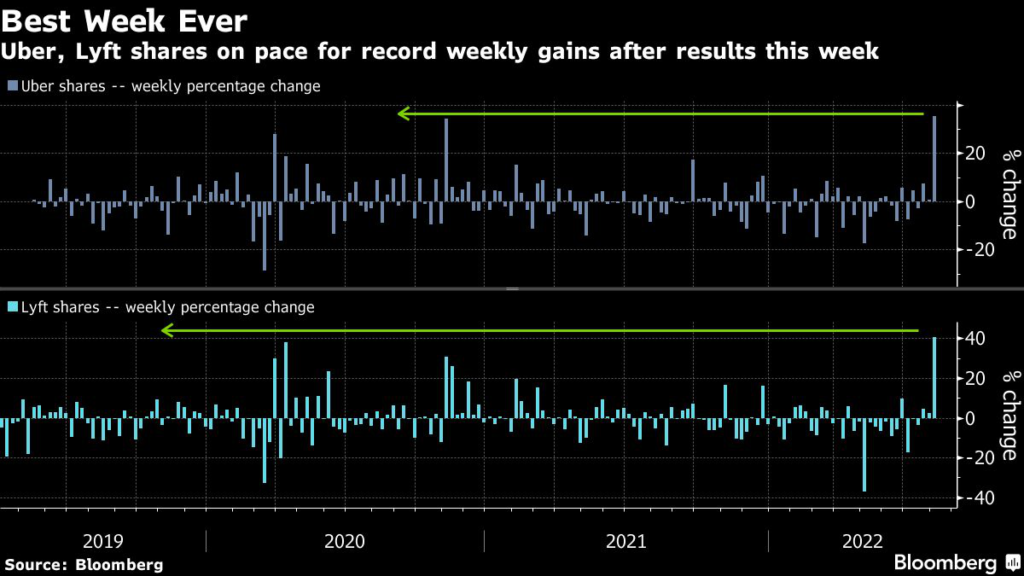
(Bloomberg) — A brisk rally in the shares of Uber Technologies Inc. and Lyft Inc. has put the ride-hailing companies on pace for their biggest weekly gains since they went public in 2019, bringing much-needed relief for investors after a dire year.

Uber shares are up 35% this week, while Lyft has advanced 41%. Both companies impressed investors this week with strong quarterly results that showed they’re set to benefit from robust demand as people slowly return to pre-pandemic travel and commute routines.

“Uber and Lyft’s success speaks to the reopening process that is happening this summer with pent-up demand for getting out and about,” said Arthur Hogan, chief market strategist at B. Riley Wealth.

A broader recovery in the US markets, especially in hard-hit technology and growth stocks, is also driving some of the gains. The Nasdaq Composite Index is poised to gain for a third straight week, something it hasn’t done in four months. Granted, it slumped Friday as stronger-than-forecast US labor data boosted bets on aggressive Federal Reserve interest-rate hikes to combat soaring inflation.

The two companies are riding the latest rebound in risk appetite, after a steep erosion in market valuation made their shares look like a bargain relative to pre-pandemic levels. The week’s advance pared this year’s loss in Uber shares to 24%, while Lyft is still down 54%.

“There is a bit of a bounce back happening as investors get more comfortable with taking on risk, but these companies are proving the risk associated with their business has moderated as consumer and driver demand pick up,” said Ally Financial’s Lindsey Bell. 

The big caveat is that the businesses are unprofitable and market sentiment continues to be cautious. 

“Neither Uber nor Lyft makes money yet and it’s going to be a long time before they make a lot of money,” said Matt Maley, chief market strategist at Miller Tabak & Co. “Therefore, I question whether these are stocks that people should be chasing.” 

If their latest quarterly results are a reflection of a bottoming of the negative consumer sentiment seen in recent months, Maley recommends going after “the consumer stocks that actually make money.”

More stories like this are available on bloomberg.com

©2022 Bloomberg L.P.
China Is Moving to Tighten Label Rules on Goods From Taiwan

(Bloomberg) — China is moving to tighten the enforcement of existing rules on imports from Taiwan, according to people familiar with the matter, as tensions rise in the aftermath of US House Speaker Nancy Pelosi’s visit to the island. 

Products labeled as originated from the R.O.C., or the “Republic of China,” won’t be allowed entry to the mainland China market, the people said, asking not to be identified discussing sensitive matters. Beijing objects to Taiwan’s use of “Republic of China” as its official designation because it considers the self-governing democracy part of its territory.

One of the people said China’s labeling rules for Taiwanese imports were first announced in 2015 but had not been strictly enforced until this week. That risk is that products are confiscated unless companies change their labeling to comply with the regulations, the person said, although they expected the overall impact to be modest for now as firms were likely to adjust their packaging quickly.

An official from Taiwan’s Ministry of Economic Affairs said while there is a growing of number of companies flagging the labeling issue to the island’s authorities this week, the government is not aware of any Taiwanese exports confiscated by the Chinese customs related to it. A call to the main line of China’s customs office was unanswered outside of regular business hours.

China this week suspended some fish and fruit imports from Taiwan, citing excessive pesticide residue detected on products since last year and some frozen fish packages that tested positive for coronavirus in June. Exports of natural sand, used in construction, were also banned. 

Alongside trade measures, China dramatically increased its military presence near Taiwan with a series of drills and missile tests after Pelosi defied Beijing’s protests and became the highest-ranking US official in a quarter century to visit the island. On Friday, China sanctioned Pelosi and her immediate family, and cut off defense talks with the US, further ramping up tensions in the region. 

Taiwan’s agricultural exports accounted for only 0.6% of total shipments last year, according to DBS Group Holdings Ltd., and China’s sand sales to the island amounted to just over $1 million last year, suggesting the trade bans imposed so far are likely to have only a marginal impact on Taiwan’s economy. 

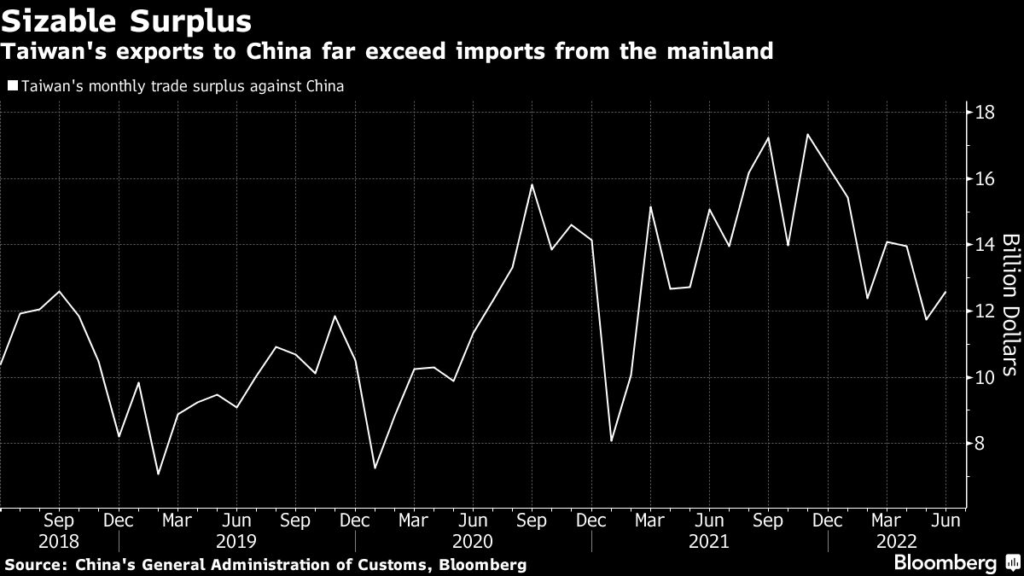
Still, China is Taiwan’s largest trading partner, with bilateral trade rising 26% on year to $328.3 billion in 2021. Taiwan held a sizable surplus against China, with exports from the island exceeding imports by $172 billion, according to Chinese customs data. While Beijing could leverage that advantage by sanctioning exporters, China also relies on Taiwan for semiconductor supplies.

Nikkei Asia reported earlier Friday that shipments to Apple Inc. supplier Pegatron Corp.’s campus in Suzhou in southern China were disrupted as they were being checked for potential violation of the labeling regulations. The company said their operations remain normal and there have been no production halts or shipment disruptions.

More stories like this are available on bloomberg.com

©2022 Bloomberg L.P.

UAE to Invest $1 Billion in Pakistan From Gas to Logistics

(Bloomberg) — The United Arab Emirates is planning to invest $1 billion in Pakistani companies spanning various sectors, state-run news agency WAM reported Friday. 

The investments will cover fields including gas, energy infrastructure, renewable energy, health care, biotechnology, agricultural technology, logistics, digital communications, e-commerce and financial services, WAM said.

Read: Saudi to Extend Oil Loan to Pakistan, Discussing Dollar Deposits

Pakistan has been under fiscal strain this year, turning to the International Monetary Fund for help. Saudi Arabia has already said it will extend an oil-loan facility to the South Asian country and was considering rolling over dollar deposits as Pakistan looks to rein in one of Asia’s highest inflation rates and stave off a current-account crisis. 

The IMF is seeking assurance from Persian Gulf nations hoping they will follow through with funding commitments before approving a loan to Pakistan, Bloomberg reported earlier. Both Fitch Ratings and Moody’s Investors Service cut the outlook on Pakistan’s credit rating this year. 

Read More: Fitch, Moody’s Expect Pakistan to Get $1.2 Billion From IMF

More stories like this are available on bloomberg.com

©2022 Bloomberg L.P.

Greek Spy Chief Quits Over ‘Mishandled’ Phone Tapping Operation

(Bloomberg) — Greece’s top spy has stepped down amid allegations that a journalist and an opposition politician had their mobile phones targeted by spying software.

Panagiotis Kontoleon, the head of the national intelligence service, resigned Friday following a “mishandling of legal surveillance operations,” according to an emailed statement from the office of Prime Minister Kyriakos Mitsotakis. Kontoleon told a parliamentary committee that his agency had spied on a journalist, Reuters reported this week, citing two sources who it said were present at the meeting.

Adding to the turmoil in Athens, Grigoris Dimitriadis, the general secretary of Mitsotakis’s office and the premier’s nephew, quit earlier in the day. Neither Dimitriadis nor the government provided a reason for the decision.

A type of malware called Predator was deployed against Nikos Androulakis, the leader of Greece’s opposition socialist Pasok party, and journalist Thanasis Koukakis, according to forensic analysis by digital rights group Citizen Lab and the European Parliament respectively.

A report from Google’s Threat Analysis Group published in May suggested that the software is routinely used by “government-backed actors” in nations including Greece, Egypt, Indonesia and Spain.

Spanish Prime Minister Pedro Sanchez’s phone was hacked last year using similar Pegasus spying software and data was stolen from the device, his administration said in May.

Androulakis filed a complaint last week with the prosecutor saying that someone had tried to tap his mobile phone and intercept personal data. Koukakis has alleged that his smartphone was infected with surveillance software, prompting a separate investigation by a prosecutor.

More stories like this are available on bloomberg.com

©2022 Bloomberg L.P.
Amazon to Buy Roomba-Maker IRobot for $1.65 Billion

(Bloomberg) — Amazon.com Inc. said it would buy IRobot Corp., maker of the Roomba vacuum, for $1.65 billion as the e-commerce giant continues its push into internet-connected home devices and robotics. 

Amazon will pay $61 a share in cash for the Bedford, Massachusetts-based company, according to a statement on Friday. The offer, valued at $1.7 billion including debt, represents a premium of 22% based on iRobot’s last closing price before the announcement. Colin Angle will remain as chief executive officer of IRobot.

The deal arrives just two weeks after Amazon said it was buying up a chain of doctor’s offices and suggests Amazon is forging ahead with acquisitions despite growing scrutiny of Amazon’s market power from antitrust regulators in the US and Europe.

Seattle-based Amazon has come a long way as a hardware player since a failed foray into smartphones a few years ago, working diligently to place the Alexa voice software and Echo smart speakers at the center of the burgeoning market for smart-home gadgets. Spoken Alexa commands can already control many other devices, from smart ovens to light bulbs and Roomba vacuums. The partnership between Amazon and IRobot extended beyond devices, too: IRobot runs some of its software on Amazon Web Services servers.

IRobot gives Amazon a household-name in home cleaning gadgets that may give it a leg up over its own designs. Last fall Amazon debuted a household robot that was supposed to usher in—or at least point to—a Jetsons-like future. Called the Astro, the three-wheeled device would eventually sell for about $1,450. But Astro, still in a limited rollout, hasn’t made a splash with consumers.

IRobot saw sales increase over the pandemic, as families who were housebound sought shortcuts to keep their homes clean. But like many pandemic-era darlings, iRobot has seen demand wane. It reported second-quarter revenue of $255.4 million on Friday, short of analysts’ expectations for $301 million. The company has also been battling JS Global Lifestyle Co. in a patent infringement case against its SharkNinja vacuums and hybrid vacuum-moppers. IRobot portrays itself as an American success story with a “passion for innovation” that’s been undercut by SharkNinja incorporating those inventions into its Chinese-made knockoffs.

IRobot says its Roomba vacuum and Braava floor mops “can map the floor of a home, sense changes in the floor type being cleaned, spot clean, avoid objects and cliffs (such as stairs), and intelligently approach a base station to recharge, among other innovative features.”

Amazon shares were little changed on Friday in New York. IRobot shares, which were down 24% this year through Thursday, surged almost 20%.

Amazon prefers to develop new technology internally, but its devices unit has been quick in recent years to pull the trigger on acquisitions that give the company a stake in a hot or adjacent market. Amazon grabbed a leading position in video doorbells with its 2018 deal to buy Ring, and acquired WiFi hub maker Eero the next year.

“I’m excited to work with the iRobot team to invent in ways that make customers’ lives easier and more enjoyable,” said Dave Limp, senior vice president of Amazon Devices.

Some close watchers of the company have speculated that antitrust scrutiny might nudge Amazon Chief Executive Officer Andy Jassy to take a pause on large deals. IRobot would be the fourth-largest acquisition by Amazon, ranking behind its acquisition of Whole Foods for $13.7 billion in 2017, the $8.5 billion purchase of movie studio MGM in March and last month’s agreement to buy 1Life Healthcare for $3.49 billion. The string of deals suggests the company seems to be doing business as usual.

The Biden administration is ramping up scrutiny of deals by technology giants. The US Federal Trade Commission has been looking at Amazon since 2019 over antitrust concerns with its retail business and cloud computing services. Lina Khan, who became chair of the agency last year, had made a name for herself with a groundbreaking legal paper into Amazon’s potential antitrust violations and has taken a personal interest in the probe. The FTC is ramping up that investigation under Khan, shaking up the investigative team, re-interviewing potential witnesses and asking about Amazon’s recent acquisition of MGM Studios, Bloomberg has reported.

Seeking to assuage concerns that Amazon would use the deal to muscle out iRobot rivals, an Amazon spokesperson said Friday that the company would continue to supply retailers with iRobot products and sell competing devices on Amazon’s retail websites. Following Amazon’s other big deal for a self-driving robots — the 2012 acquisition of industrial bot builder Kiva Systems — the company stopped selling the devices to other companies, using them exclusively to supply Amazon’s own warehouses.

The spokesperson also said Amazon had no plans to cut off other voice assistants from iRobot’s line of products. Roomba owners today can issue commands to their vacuums from software made by Amazon rivals Alphabet Inc. and Apple Inc.

Goldman Sachs Group Inc. advised Amazon and Qatalyst Partners advised iRobot.

(Updates Amazon shares. A previous version of the story corrected the spelling of Qatalyst Partners in final paragraph.)

More stories like this are available on bloomberg.com

©2022 Bloomberg L.P.

Twilio Shares Stumble as Investors Fear a Demand Slowdown

(Bloomberg) — Twilio Inc. shares fell the most in more than nine months on Friday after the maker of customer communication and marketing software gave a forecast for the current quarter that fell just short of estimates, signaling concerns that companies may pull back spending for business tools amid an uncertain economy.

Revenue will increase about 31% to $970 million in the period ending in September, the company said Thursday in a statement. Analysts, on average, estimated $975.6 million. Twilio projected a loss, excluding some items, of as much as 43 cents a share, compared with analysts’ estimate of a loss of 11 cents, according to data compiled by Bloomberg.

“We have not seen broad-based impacts to our business yet because of the macro economy,” Chief Executive Officer Jeff Lawson said in an interview. “We’re preparing ourselves for a variety of outcomes that could come, but we are cautiously optimistic.”

While best known for powering business-to-consumer messaging such delivery notifications, Twilio is betting on an expansion into the wider market for customer service tools and trying to compete more forcefully with Salesforce Inc. and Adobe Inc. Recent acquisitions include identity verifier Boku Identity Inc., toll-free messaging service Zipwhip and customer data provider Segment. Lawson said that even with economic uncertainty, the company stands by its forecast for full-year 2023 profitability on an operating basis.

Shares fell as much as 18%, the most since October, to $80.12 Friday morning in New York. The pandemic darling has slipped 68% this year compared with a 23% drop in the iShares Expanded Tech-Software Sector ETF.

Second-quarter revenue increased 41% to $943.4 million. Analysts, on average, estimated $918.2 million. Twilio reported a loss, excluding some items, of 11 cents a share, compared with an estimate of a loss of 20 cents.

The company will have to show more traction toward its 2023 profitability target to get appreciated by investors, wrote Morgan Stanley’s Meta Marshall after the results, adding that the quarter delivered a “mixed message.”

While topline growth surpassed expectations, two indicators of customer demand missed analysts’ projections. The company added a net 7,000 new customers, short of the 7,313 expected, while the dollar-based net expansion rate, which indicates growth among existing customers, was 123%. Analysts estimated a rate of 127.3%.

The company is seeing “slightly longer sales cycles” in a few areas, Lawson said, particularly in subscription services versus consumption-based offerings. While some demand softness has been seen from customers in industries like cryptocurrency, it didn’t have a material impact on sales, Elena Donio, president of revenue, said in remarks prepared for a conference call. She added there has been increased demand from financial services and IT companies.

Twilio has recently slowed hiring, except for “some key areas,” and closed several offices, Chief Operating Officer Khozema Shipchandler said in the prepared remarks. At the end of June, the company had 8,510 employees.

Twilio recently increased prices in North America for its flagship customer texting service, which may improve results in the second half of the year, particularly since US midterm elections will drive demand for political messaging services, wrote JPMorgan’s Mark Murphy in a research note ahead of results.

Many corporations with significant overseas exposure have seen growth curtailed by a surging US dollar. Lawson said that Twilio, which makes about a third of its sales outside the US, has bucked the trend, and currency fluctuations haven’t affected profitability due to the company’s hedging program.

(Updates with comments from CEO interview beginning in the third paragraph.)

More stories like this are available on bloomberg.com

©2022 Bloomberg L.P.

Close Bitnami banner
Bitnami