
Bloomberg

Biden Bill Compels Barra to Put GM Before Business Roundtable

(Bloomberg Businessweek) —

The landmark legislation President Joe Biden is counting on to motivate Americans to vote for Democrats in the upcoming midterm election has put Mary Barra in a somewhat awkward spot.

Significant support for automakers making the switch to electric vehicles and major changes to corporate taxation have pitted the automaker Barra leads against the powerful Washington lobby group she chairs. Fortunately for General Motors and unfortunately for the Business Roundtable, the bill would be such a boon to EVs that coming out clearly in favor of the Inflation Reduction Act was an easy decision.

Barra joined several other CEOs and labor leaders who met virtually with Biden on Thursday and endorsed the bill that would fund clean-energy investments by closing corporate-tax loopholes and making big corporations pay more. On the surface, at least, it appears GM and other automakers supporting the measure are accepting the plan’s 15% floor on their tax rate in exchange for federal help converting their plants, future models and sales to EVs. The bill would revive the $7,500 tax credit for GM, Toyota and Tesla and introduce a new $4,000 perk for consumers purchasing a cleaner used car. Other incentives include tax credits for domestic mineral production and EV battery manufacturing.

The tax portion is less welcome for big corporations, which explains why the Business Roundtable has vocally opposed the bill. GM and Ford are among companies that pay little in federal tax and could end up paying more. GM reported a tax expense of $20 million on almost $10 billion of income last year, and paid less than $100 million in years prior. Ford paid $102 million on almost $18 billion of income in 2021.

Both companies take advantage of legal and legitimate credit systems and loopholes. For GM, paying the full 15% minimum corporate tax on the $9.5 billion they made in the US would come to $1.4 billion.

As the bill stands, though, the 15% minimum tax isn’t actually a minimum. Companies can still pay below that because they would be allowed credits for research-and-development spending, defined benefit pension plans, past operating losses and foreign tax credits, according to Garrett Watson, senior policy analyst at the Tax Foundation, a Washington think tank. Corporate taxes likely will go up for many companies, he said, just not as much as the plan’s headline might suggest.

For GM, a potentially higher tax bill probably would be more than offset by a lot of perks. The company could certainly use EV tax credits to get back on equal footing with automakers that haven’t reached the 200,000-vehicle cap that GM, Tesla and Toyota have, which triggers the phase-out of current incentives. Next year, Barra will roll out electric versions of the Chevrolet Silverado pickup and Equinox and Blazer SUVs that could benefit from support from Uncle Sam.

What remains to be seen is how many models, if any, will be eligible for these credits right away. Automakers will need to hit certain benchmarks for how much of the materials and components in their batteries are sourced locally, or at least not from China and other countries of concern. Carmakers are pressing Congress to ease up on those requirements.

If the bill passes — crucially, Arizona Senator Kyrsten Sinema is now on board — automakers may end up racing to bring more of their battery supply chain to America, which is exactly what Biden wants. Barra said during Thursday’s roundtable that while “some of the goals cannot be achieved overnight,” GM is confident the significant investments it’s making “will establish the US as a global leader today and in the future.”

More stories like this are available on bloomberg.com

©2022 Bloomberg L.P.
Trapped H2O Investors Inherit Stake in Troubled Taxi App

(Bloomberg) — Investors who have been trying for two years to reclaim money trapped in H2O Asset Management have had a new problematic investment dumped on their books: a ride-hailing app whose valuation has tumbled 75%.

German entrepreneur Lars Windhorst — as part of an ongoing attempt to repay money owed to the money manager — in January agreed to hand over notes linked to London-based hailing app Gett, according to a letter published on the firm’s website last week. H2O clients are owed about 1 billion euros ($1 billion) from assets that were frozen by the French regulator. 

Back in January the Gett notes, which pay out if the company goes public, were valued at $106 million because the company was about to list through an already announced deal with a Special Purpose Acquisition Company, or SPAC. But that deal has since been shelved and the company’s valuation slashed to around $250 million from more than $1 billion.

The note adds to complications for investors still waiting for H2O’s outsize bet on Windhorst to come good. In 2019 the money manager saw billions leave its suite of funds after a Financial Times article detailed the scale of investments in companies linked to the entrepreneur. A year later the money manager was forced to freeze the funds by the French Market Regulator, reopening them only after sidepocketing the Windhorst notes. 

A spokesperson for Windhorst’s investment firm Tennor Holding declined to comment. An H2O spokesperson confirmed broad details of the Gett investment and said the firm has been fully engaged, with the help of advisers, in the search for solutions to dispose of the assets held within the sidepocketed funds.

Russia Exposure

Gett has expanded rapidly since it was founded by Moscow-born Israeli entrepeneur Dave Waiser in 2011. It drew backing from Volkswagen AG and billionaire Len Blavatnik’s investment firm Access Industries. Windhorst took an undisclosed minority stake in the business when he contributed to a funding round, according to a person familiar with the matter. 

The aborted SPAC deal, backed by Rosecliff Venture Management LLC, would have valued the company at around $1 billion. The firm was initially set up as a ride-hailing app, but now offers an aggregation service using existing ground transportation platforms. 

In March this year the firm announced it was not going to follow through on the SPAC deal and that it would exit its Russian business, one of its three main markets. Waiser, who had been chief executive officer, moved on and was replaced by Matteo De Renzi. 

A spokesperson for Access declined to comment. Representatives for Gett and VNV didn’t respond to requests for comment. 

Evergreen

Windhorst had initially attempted to pay back H2O through a company called Evergreen. To help fund the potential deal, Evergreen issued a bond, sold in part to high-profile German investors, including fashion retail magnate Friedrich Knapp and health care entrepreneur Ulrich Marseille.

The buy back, which was intended to take place in several steps, stumbled as the French regulator ordered H2O to freeze redemptions from some of its funds because of valuation difficulties, while Windhorst was also unable to arrange sufficient financing.

Read more: H2O’s Crastes Faces Solo Future for London Fund Manager He Built

Tennor then reached another deal with H2O to restructure the outstanding bonds instead of buying them back. The new transaction includes the issuance of 1.45 billion euros of notes due next year to retire debt linked to companies owned by Tennor, according to a statement from Windhorst to business partners and clients last year. 

Tennor was declared insolvent in the Netherlands in 2021, a ruling later reversed on appeal. At the end of 2021 H2O wrote down those notes by around 40% and acknowledged how little had been paid back so far and the Dutch court decision. H2O is aiming to begin repaying clients inside the sidepockets later this year, according to the letter sent to clients last week. 

(Updates with additional comment from H2O in fifth and last paragraph)

More stories like this are available on bloomberg.com

©2022 Bloomberg L.P.

Lambo Dealers Are Keeping Warm Despite Crypto Winter

(Bloomberg) — Many crypto buyers have been consumed by a single, persistent question as they’ve watched the prices of coins rise and fall over the past few years: When Lambo?

Lambo is shorthand for Lamborghini, the luxury vehicle that’s the ultimate symbol of success when it comes to getting rich off of digital currencies, and the focus of thousands of “wen Lambo?” memes. Along with high-end watches and other traditional displays of wealth, the supercars have for years been a fixture at Bitcoin conferences and on the Instagram feeds of crypto influencers. 

The recent crash in the price of crypto has flooded second-hand markets with other luxury goods, including Patek Philippe and Rolex watches. Lamborghinis, however, are doing just fine. The strong demand for supercars suggests most owners inhabit a rarified stratum of trophy seekers, those who are so wealthy that they’re essentially undisturbed by changes in the market.

Peter Saddington is one of them. He became famous in the crypto car community after he bought a Lamborghini in 2017 for 45 Bitcoin, equivalent to more than $200,000 at the time. He had bought the Bitcoin for just $115 in 2011, back when the cryptocurrency was worth less than $3. The move helped popularize purchasing luxe cars in crypto. Today, even after the crash, the 45 Bitcoin he spent would be worth $1 million.

Saddington said many of his friends in the industry are still in the market for luxury cars. Big price shifts are par for the course in digital currencies and shouldn’t get in the way of luxury car purchases, said Saddington, now an investor in crypto projects.

Over video chat, Saddington showed off a sleek, black Mercedes he bought in April using money he earned from Bitcoin mining. He said he has no plans to sell his original Bitcoin Lamborghini: “It’s in the other garage.”

AutoCoinCars, an online platform founded in 2018 that lets buyers purchase luxury cars with digital money, has seen sales on its platform double to $12 million in the past year, a rate that’s holding steady, said Chief Operating Officer Luke Willmott.

The company often registers more luxury vehicle sales during times of market turmoil, Willmott said. Part of the reason for that, he believes, is because Lamborghinis tend to be less volatile than digital currencies. “People are spending because they want to exit out of their crypto and get into physical assets,” he said. “That will allow them to then have this asset that doesn’t depreciate like how their crypto asset will depreciate.”

Indeed, in a cruel twist of the markets, Lamborghinis have recently held their value better than cryptocurrencies. The prices of Bitcoin and Ether have plunged by more than 50% since November, and platforms and lenders like Celsius Network and Voyager Digital have recently gone bankrupt. Meanwhile, the price of a used Lambo has held about steady over the last year, according to CarGurus.com.

Lamborghini sales last year were higher than ever and are on pace to exceed that record this year, according to financial disclosures last week from the parent company Volkswagen AG. Part of the reason sales have held up so well is that supplies are low and waitlists are long. O’Gara Coach Co., a high-end Southern California auto dealership with an option to purchase cars in crypto, hasn’t seen any change in Lamborghini sales since the market tumult set in. A spokesman said the dealership’s Lamborghini waiting list is more than a year and a half long.

The allure for cryptocurrency speculators is similar to what drives just about any wealthy person to spend so much on a small automobile. “If you want a really fast car, you can get something else for a lot cheaper. If you get a yacht, you can take your family on vacation,” said SHL0MS, a pseudonymous nonfungible token artist. A Lamborghini “purely exists to flaunt wealth,” said SHL0MS, who in February exploded a Lamborghini Huracan on camera in an effort to mock crypto industry excess. (The resulting NFTs sold for $2.2 million.)

Most people hurt by the crypto crash never made enough to buy a Lamborghini in the first place, but there are some who got in over their heads. CJ Wilson, a retired professional baseball player who owns several luxury auto dealerships in Fresno, California, said he’s seen more people in recent weeks trying to sell their vehicles. The previous bull market may have lured some traders into a false sense of security, Wilson said: “People get suckered into this narrative that things go up only.”

More stories like this are available on bloomberg.com

©2022 Bloomberg L.P.

Rush to Build More Chips Puts Environmental Progress in Peril

(Bloomberg) — The CHIPS and Science Act, which President Joe Biden is poised to sign into law next week, was pitched as a once-in-a-lifetime chance to revitalize the US semiconductor industry and counter Asia’s manufacturing power. 

What went less discussed was the legislation’s environmental impact. The bill is poised to pump $52 billion into an industry that devours energy and produces toxic waste — at a time when a global surge in chip demand is already turning companies into bigger polluters. 

With both the US and Europe racing to rebuild their chipmaking infrastructure, environmental concerns are taking a back seat, said Pauline Weil, a researcher at Brussels-based economic think tank Bruegel.

“Countries are really not thinking about this,” she said. “It’s offering on a plate billions of subsidies with very little strings attached, and the strings are not attached to the environment.”

The European Union is proposing some $43 billion for its own chips legislation, subsidizing a building boom by the world’s largest chipmakers. New projects from Intel Corp., Samsung Electronics Co. and Taiwan Semiconductor Manufacturing Co. are poised to sprout up in Germany, Ohio and Arizona.

An examination of the companies’ corporate responsibility reports shows that their power and water use is already on the rise. That’s not surprising in a growing industry, but chipmakers like Intel have vowed to slash their emissions and water consumption. Keeping hazardous waste out of landfills is another challenge. The rush to add new manufacturing will only make that harder. 

Some projections indicate the industry will double in size over the next decade, meaning efforts to mitigate that footprint need to accelerate. Absent pressure from governments, it will largely depend on the chipmakers themselves how much of that expansion translates into environmental damage.

Making semiconductors is a messy, expensive business that’s getting more difficult as it butts up against the laws of physics. Chipmakers run giant factories that operate 24 hours a day, seven days a week, trying to carve out a return on the billions of dollars required to equip them before they become obsolete. The machinery typically has a useful life of less than a decade.

The process requires a lot of energy, water and toxic chemicals. And though the largest chipmakers have made environmental progress — their use of renewable energy in the US is one highlight — the companies concede that they they have work to do.

Take Samsung, the world’s largest chipmaker by revenue. The South Korean company’s overseas semiconductor sites — in the US, Europe and China — already operate wholly on renewable energy. But it’s still working on developing sustainable energy sources in other parts of the world, including in South Korea, where its biggest factories are located. All told, only about 16% of its energy use was from renewable sources in 2021, up from 13% in 2020.

TSMC similarly powers its overseas operations using clean electricity. But at home in Taiwan, where the majority of its plants are, the total is less than 10%.

“We know it is very important to drive renewable energy in Taiwan,” said spokeswoman Nina Kao. “Taiwan is a really small island with limited resources.”

Intel is doing better, partially because it has access to greener energy near its sites in Oregon, Arizona and New Mexico. The company got 80% of its electricity from renewable sources in 2021, up from 71% in the prior year.

Still, its total energy use — partially due to the additional complexity of new manufacturing technology — went up 9.4% in the period to 11.61 billion kilowatt hours. That’s about twice what the city of San Francisco uses in a year. 

Intel can point to progress over the longer run. Its emission of two categories of greenhouse gases is down 19% from where it was in 2000, according to its most recent corporate responsibility report, when the output totaled more than 4 million metric tons of carbon dioxide. But since dropping to less than 2 million tons around 2010, the emissions are on the rise again and ended 2021 at 3.37 million tons. Again, the growing complexity of making chips has forced the amount back up, Intel said.

The company’s goal is now to reduce emissions to “net zero” by 2040. According to Todd Brady, Intel’s chief sustainability officer, the industry deserves credit for pursuing a science-based approach to solving problems such as emissions and waste — rather than simply using cash to buy offsetting credits. But in some areas, the easy work has been done. The struggle now is to reduce that impact to nothing. 

“You shouldn’t let us off the hook,” he said.

Intel aims to be “net positive” in water use by 2030, meaning it will use less than it produces. TSMC has pledged to be net zero emissions by 2050, and Samsung is pushing a new set of standards and guidelines that it says more accurately reflect the impact of the chip industry.

Then there’s the issue of waste. Chipmakers say they’ve made significant progress on keeping potentially dangerous materials out of landfills. In some cases, they’ve figured out ways to reuse or recycle substances such as sulfuric acid and metals that are key to the chip production process. But more production means there will be more waste to process, and that could strain recycling systems.

For now, the trends are heading in the right direction. Intel generated 344 metric tons of waste in 2021, down from 414 the prior year, and only sent 5% of that to landfills. TSMC, meanwhile, has dumped less than 1% of its waste for 12 consecutive years. Samsung reported a 96% waste-recycling level, with its chip division sending zero to landfills last year — a first.

The industry also argues that chips themselves have made the world a greener place. A chip-heavy Nest thermostat, for instance, can keep consumers from wasting electricity. But that argument is a double-edged sword, said Christopher Knittel, a professor of applied economics at the Massachusetts Institute of Technology. 

“If you’re going to take credit for the Nest thermostat, how much blame should you take for the 12-miles-per-gallon muscle car your part was in?” he said.

The chip industry emits roughly 100 million tons of carbon dioxide per year — a level equivalent to the country of Belgium — and it’s going to be hard to bring that down, said Peter Spiller, a partner at McKinsey & Co. focused on sustainability. 

“But at least players have recognized this,” he said. “They’ve set very ambitious targets for themselves.”

More stories like this are available on bloomberg.com

©2022 Bloomberg L.P.
Chipmakers’ $52 Billion US Bonanza Imperils Environmental Gains

(Bloomberg) — The CHIPS and Science Act, which President Joe Biden is poised to sign into law next week, was pitched as a once-in-a-lifetime chance to revitalize the US semiconductor industry and counter Asia’s manufacturing power. 

What went less discussed was the legislation’s environmental impact. The bill is poised to pump $52 billion into an industry that devours energy and produces toxic waste — at a time when a global surge in chip demand is already turning companies into bigger polluters. 

With both the US and Europe racing to rebuild their chipmaking infrastructure, environmental concerns are taking a back seat, said Pauline Weil, a researcher at Brussels-based economic think tank Bruegel.

“Countries are really not thinking about this,” she said. “It’s offering on a plate billions of subsidies with very little strings attached, and the strings are not attached to the environment.”

The European Union is proposing some $43 billion for its own chips legislation, subsidizing a building boom by the world’s largest chipmakers. New projects from Intel Corp., Samsung Electronics Co. and Taiwan Semiconductor Manufacturing Co. are poised to sprout up in Germany, Ohio and Arizona.

An examination of the companies’ corporate responsibility reports shows that their power and water use is already on the rise. That’s not surprising in a growing industry, but chipmakers like Intel have vowed to slash their emissions and water consumption. Keeping hazardous waste out of landfills is another challenge. The rush to add new manufacturing will only make that harder. 

Some projections indicate the industry will double in size over the next decade, meaning efforts to mitigate that footprint need to accelerate. Absent pressure from governments, it will largely depend on the chipmakers themselves how much of that expansion translates into environmental damage.

Making semiconductors is a messy, expensive business that’s getting more difficult as it butts up against the laws of physics. Chipmakers run giant factories that operate 24 hours a day, seven days a week, trying to carve out a return on the billions of dollars required to equip them before they become obsolete. The machinery typically has a useful life of less than a decade.

The process requires a lot of energy, water and toxic chemicals. And though the largest chipmakers have made environmental progress — their use of renewable energy in the US is one highlight — the companies concede that they they have work to do.

Take Samsung, the world’s largest chipmaker by revenue. The South Korean company’s overseas semiconductor sites — in the US, Europe and China — already operate wholly on renewable energy. But it’s still working on developing sustainable energy sources in other parts of the world, including in South Korea, where its biggest factories are located. All told, only about 16% of its energy use was from renewable sources in 2021, up from 13% in 2020.

TSMC similarly powers its overseas operations using clean electricity. But at home in Taiwan, where the majority of its plants are, the total is less than 10%.

“We know it is very important to drive renewable energy in Taiwan,” said spokeswoman Nina Kao. “Taiwan is a really small island with limited resources.”

Intel is doing better, partially because it has access to greener energy near its sites in Oregon, Arizona and New Mexico. The company got 80% of its electricity from renewable sources in 2021, up from 71% in the prior year.

Still, its total energy use — partially due to the additional complexity of new manufacturing technology — went up 9.4% in the period to 11.61 billion kilowatt hours. That’s about twice what the city of San Francisco uses in a year. 

Intel can point to progress over the longer run. Its emission of two categories of greenhouse gases is down 19% from where it was in 2000, according to its most recent corporate responsibility report, when the output totaled more than 4 million metric tons of carbon dioxide. But since dropping to less than 2 million tons around 2010, the emissions are on the rise again and ended 2021 at 3.37 million tons. Again, the growing complexity of making chips has forced the amount back up, Intel said.

The company’s goal is now to reduce emissions to “net zero” by 2040. According to Todd Brady, Intel’s chief sustainability officer, the industry deserves credit for pursuing a science-based approach to solving problems such as emissions and waste — rather than simply using cash to buy offsetting credits. But in some areas, the easy work has been done. The struggle now is to reduce that impact to nothing. 

“You shouldn’t let us off the hook,” he said.

Intel aims to be “net positive” in water use by 2030, meaning it will use less than it produces. TSMC has pledged to be net zero emissions by 2050, and Samsung is pushing a new set of standards and guidelines that it says more accurately reflect the impact of the chip industry.

Then there’s the issue of waste. Chipmakers say they’ve made significant progress on keeping potentially dangerous materials out of landfills. In some cases, they’ve figured out ways to reuse or recycle substances such as sulfuric acid and metals that are key to the chip production process. But more production means there will be more waste to process, and that could strain recycling systems.

For now, the trends are heading in the right direction. Intel generated 344 metric tons of waste in 2021, down from 414 the prior year, and only sent 5% of that to landfills. TSMC, meanwhile, has dumped less than 1% of its waste for 12 consecutive years. Samsung reported a 96% waste-recycling level, with its chip division sending zero to landfills last year — a first.

The industry also argues that chips themselves have made the world a greener place. A chip-heavy Nest thermostat, for instance, can keep consumers from wasting electricity. But that argument is a double-edged sword, said Christopher Knittel, a professor of applied economics at the Massachusetts Institute of Technology. 

“If you’re going to take credit for the Nest thermostat, how much blame should you take for the 12-miles-per-gallon muscle car your part was in?” he said.

The chip industry emits roughly 100 million tons of carbon dioxide per year — a level equivalent to the country of Belgium — and it’s going to be hard to bring that down, said Peter Spiller, a partner at McKinsey & Co. focused on sustainability. 

“But at least players have recognized this,” he said. “They’ve set very ambitious targets for themselves.”

More stories like this are available on bloomberg.com

©2022 Bloomberg L.P.
Musk Sees Inflation Easing, Citing Tesla’s Costs Coming Down

(Bloomberg) — Elon Musk, chief executive officer of Tesla Inc. and the world’s richest person, said he sees signs the global economy is “past peak inflation.”

Speaking at the electric-vehicle maker’s annual shareholder meeting, Musk said Tesla’s commodity and component costs are trending downward over the next six months. He also reiterated that he expects a mild recession that could last 18 months.

“The trend is down, which suggests we are past peak inflation,” Musk said at Tesla’s Austin headquarters and factory. “I think inflation is going to drop rapidly” at some point in the future, he said.

Central banks have embarked on a path of policy-tightening as inflation pressures consumers and corporate bottom lines. In the US, consumer prices increased by 9.1% in June from a year earlier, and Federal Reserve officials say the price gains have yet to slow. The next print on inflation comes Aug. 10.

“We sort of have some insight in to where prices are headed over time,” Musk said, citing Tesla’s need to buy raw materials often months in advance of when they’re used.

“The interesting thing that we are seeing now is that most of our commodities, most of the things that go in to a Tesla — not all, but more than half — the prices are trending down in six months.”

Tesla shares slipped 0.8% to $918.70 as of 6:30 a.m. Friday in New York, before the start of regular trading.

While Tesla has a global purview on input costs and consumer health, Musk cautioned that making macroeconomic prognostications is “a recipe for disaster” and said his comments amounted to a “guess” and “total speculation.” The CEO also warned that trends could change.

Reservation holders and future customers of Tesla’s upcoming Cybertruck may still be affected by inflation, Musk suggested. The “Blade Runner”-inspired pickup was unveiled in November 2019, and “a lot has changed” since then, he said. At the time the company started taking reservations, Musk announced a $39,900 starting price.

“The specs and the pricing will be different,” Musk said. “I hate to give a little bit of bad news. But there is no way to have anticipated the inflation we have seen and various issues.”

(Updates with early trading in the seventh paragraph.)

More stories like this are available on bloomberg.com

©2022 Bloomberg L.P.
Stocks Dip as Traders Brace for US Jobs Report: Markets Wrap

(Bloomberg) — Stocks in Europe and US equity futures struggled for direction as investors brace for the monthly US jobs report that’s likely to enliven the recession debate. The dollar rebounded from two days of declines.

The Stoxx Europe 600 Index dipped, weighed by energy and media firms. Contracts on the Nasdaq 100 and S&P 500 erased an earlier advance to trade flat, with the Nasdaq stopping just short of a 20% rebound from its June low that would meet the technical definition of a bull market. 

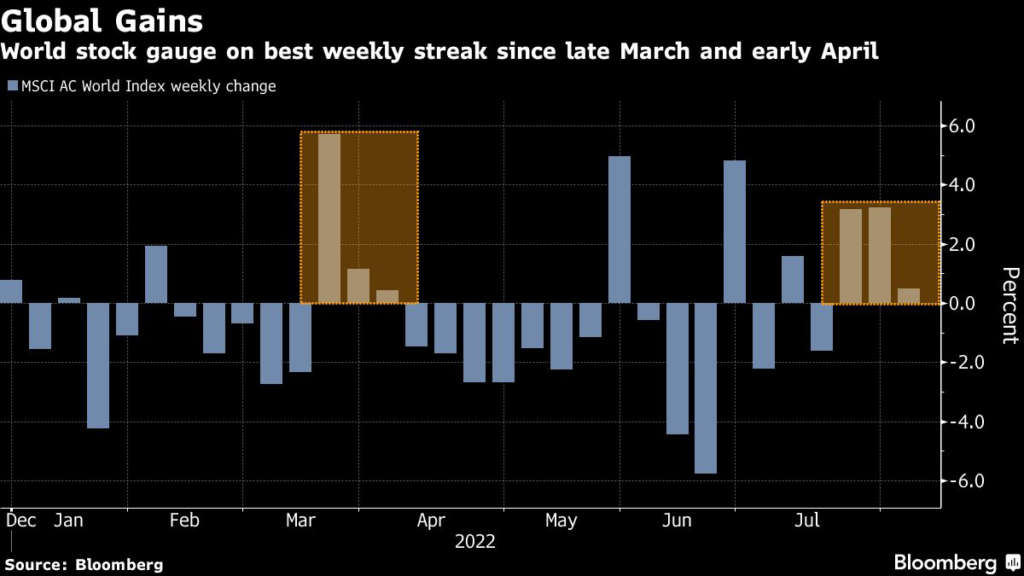
A global equity index is set for a third weekly advance and near a two-month peak in a recovery from bear-market lows, helped by resilient US company profits. The durability of the bounce remains in doubt as central banks around the world speed up rate hikes and risk economic downturns. 

That’s even as the inversion between two-year and 10-year yields remains near the deepest since 2000, harkening imminent recession. 

A stock rally is being fed by speculation that runaway inflation may have peaked and the Fed can temper interest-rate increases. With US payrolls Friday data a closely-monitored Fed indicator, an above-expectation reading could provoke a negative reaction by traders because it would be seen as emboldening the US central bank to press on with outsized hikes.

Hiring likely softened in July but the labor market remains consistent with an expanding rather than recessionary economy and the Fed will persevere, according to Bloomberg Economics.

“The equity market in the last month has managed to turn both hawkish and dovish data into a reason for cheer, which obviously is rather self-serving and unsustainable in the medium term,” said James Athey, investment director at Abrdn. “I would continue to be a seller of equity strength given my view that the path for the economy most certainly remains down.”  

The 10-year Treasury yield was steady at about 2.69% after sinking from an 11-year high of almost 3.5%. That’s driven a move back into defensive shares, especially tech stocks, that typically benefit from ebbing duration risk.

This week’s MLIV Pulse survey is asking about your outlook for corporate bonds, mergers and acquisitions and health of US corporate balance sheets through the end of the year. It takes one minute to participate in the MLIV Pulse survey, so please click here to get involved anonymously. 

What to watch this week:

  • US employment report for July, Friday

Some of the main moves in markets:

Stocks

  • The Stoxx Europe 600 fell 0.2% as of 10:44 a.m. London time
  • Futures on the S&P 500 were little changed
  • Futures on the Nasdaq 100 were little changed
  • Futures on the Dow Jones Industrial Average were little changed
  • The MSCI Asia Pacific Index rose 0.8%
  • The MSCI Emerging Markets Index rose 0.8%

Currencies

  • The Bloomberg Dollar Spot Index rose 0.1%
  • The euro fell 0.2% to $1.0225
  • The Japanese yen fell 0.2% to 133.15 per dollar
  • The offshore yuan was little changed at 6.7553 per dollar
  • The British pound fell 0.3% to $1.2129

Bonds

  • The yield on 10-year Treasuries was little changed at 2.69%
  • Germany’s 10-year yield advanced two basis points to 0.82%
  • Britain’s 10-year yield advanced two basis points to 1.91%

Commodities

  • Brent crude was little changed
  • Spot gold fell 0.3% to $1,786.75 an ounce

More stories like this are available on bloomberg.com

©2022 Bloomberg L.P.
DoorDash Soars as Robust Delivery Demand Drives Sales Beat

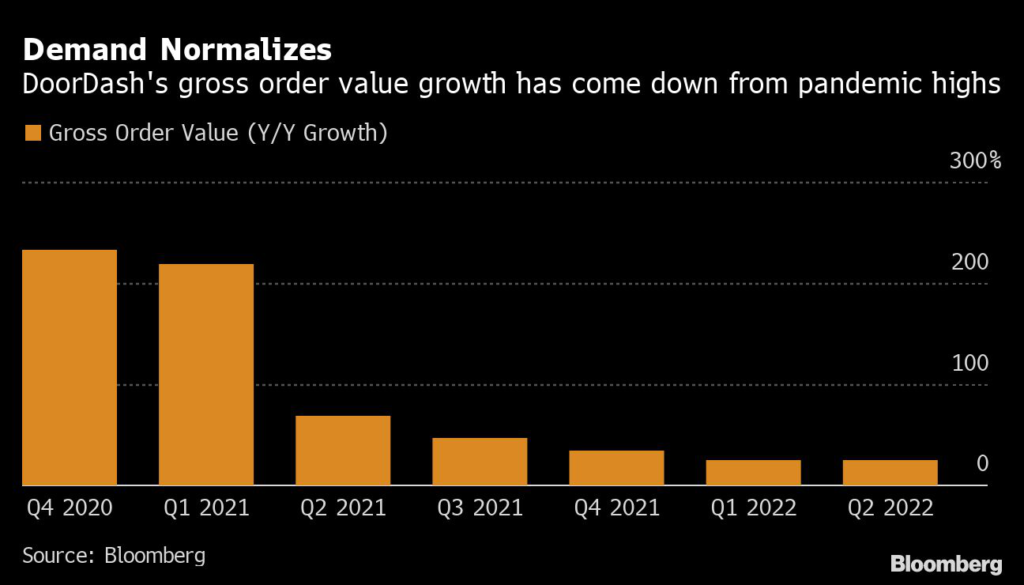
(Bloomberg) — DoorDash Inc. soared after the company reported revenue that beat analysts’ expectations, boosted by a record number of orders, showing customers’ appetite for takeout isn’t waning despite rising inflation. 

Shares rose as much as 13% in premarket trading.

Revenue rose 30% in the second quarter to $1.6 billion, the San Francisco-based company said Thursday in a statement. That was better than analysts’ average projection of $1.52 billion, according to data compiled by Bloomberg. 

“Our results speak to the strength in our business and resilience in our platform,” Vice President Ravi Inukonda said in an interview. 

Customers placed 426 million orders in the three months ending June 30, jumping 23% from a year earlier. The value of those orders grew 25% to $13.1 billion, beating Wall Street’s expectations for $12.7 billion. The results are the first to combine financials from Helsinki-based Wolt since its acquisition by DoorDash in November. The all-stock deal, which was worth about $8 billion at the time of its announcement, closed in June.

The positive results defied concerns that rising inflation would discourage consumers from discretionary services like food-delivery. Inukonda said DoorDash was not seeing an impact to consumer spending on the platform citing “healthy” order frequency from a record number of users.

Helped by pandemic lockdowns and an early foothold in the suburbs, DoorDash quickly established itself as the dominant meal-delivery service in the US at the height of Covid-19. Since then, its market share has continued to grow, now comprising 59% of US food delivery sales as of May, according to Bloomberg Second Measure. DoorDash has parlayed that success to expand into other services like convenience-store items, groceries and alcohol. 

DoorDash reported adjusted earnings before interest, tax, depreciation and amortization of $103 million, exceeding analyst expectations of $55.1 million. While figures for each category aren’t disclosed, DoorDash said it expects convenience deliveries to become profitable by the end of the year.

Competition to deliver everything from food to prescriptions and pet supplies has intensified with DoorDash and rivals like Uber Technologies Inc., Instacart Inc. and Grubhub launching subscription services as a way to keep customers ordering from their apps longer and in larger quantities. DoorDash’s DashPass subscriptions reached an all-time high with more than 10 million members, representing nearly half of its roughly 25 million monthly active users.

Unlike its gig economy peers including Uber, Lyft Inc. and Instacart, DoorDash has said it’s not considering layoffs and has no plans to slow hiring. That approach has proved costly. DoorDash reported a net loss of $263 million, or 72 cents share, more than double its loss from a year ago. DoorDash said the increase is attributed to a stock-based compensation for retention as well as from absorbing employees from Wolt.

The company projected gross order value of $13 billion to $13.5 billion in the current quarter and adjusted earnings before interest, tax, depreciation and amortization of $25 million to $75 million.

DoorDash also forecast full-year adjusted Ebitda of $200 million to $500 million. The company said its outlook “anticipates a softer consumer spending environment in the second half of 2022 than what we experienced in the first half.” 

(Updates with shares and full year guidance in last paragraph.)

More stories like this are available on bloomberg.com

©2022 Bloomberg L.P.
Bitcoin Retakes $23,000 as Crypto Rallies Before US Jobs Report

(Bloomberg) — Bitcoin rose as global stocks neared a two-month high and in advance of the US payrolls report.

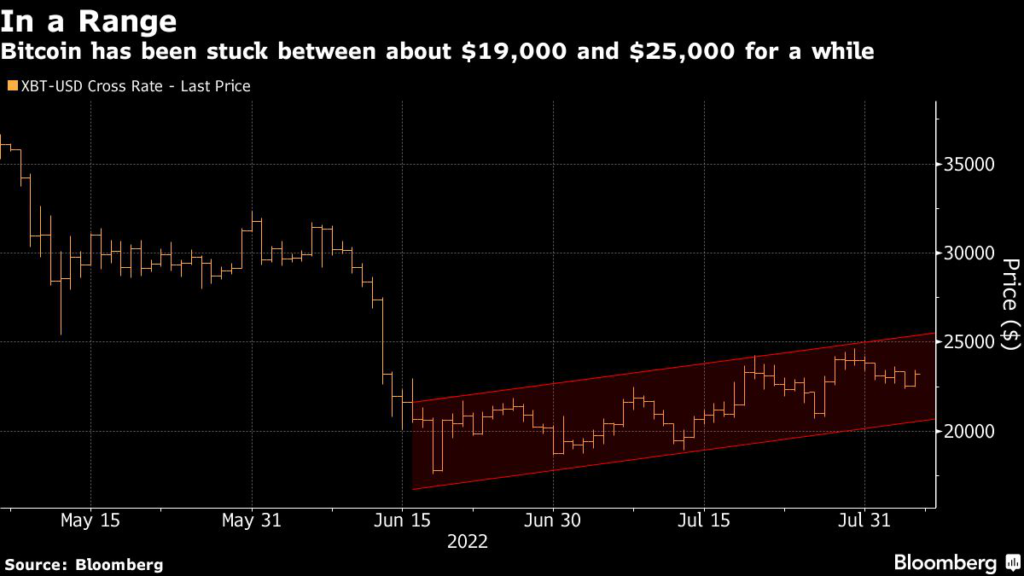
The largest cryptocurrency rose as much as 4% to $23,422 on Friday, staying within the range of around $19,000 to $25,000 that’s held it since mid-June. Ether was up as much as 5.4% to $1,678. 

“The majors continue to trade in a upwards range with a lack of any strong catalysts that would be needed for a breakout,” Genesis strategists Noelle Acheson and Marc Chan wrote in a note Thursday. “Bitcoin is currently trading in the middle of the June-August flag.”

Other coins also rose, with Polkadot and Aave gaining more than 5%.

Cryptographies have traded in tandem with risk assets for months, seeing high correlations with the NASDAQ 100 in particular. They’ve struggled as expectations for Federal Reserve rate hikes increased amid stubbornly high inflation, but have climbed off their worst levels of the past few months. 

The monthly US payrolls report might be worth paying attention to, in particular. For the past six reports, Bitcoin has responded to downside miss with a gain and an upside beat with a decline, in the 30 minutes after the data release.

“An increase with Fed rate hike expectations has capped how high Bitcoin can go for now, but as long as traders remain confident that the peak in Treasury yields remains in place, Bitcoin may have bottomed already,” said Edward Moya. “A choppy consolidation might be in Bitcoin’s future until we see a couple more inflation and nonfarm payroll reports.”

More stories like this are available on bloomberg.com

©2022 Bloomberg L.P.

Who, What, When Why and How to Regulate Crypto in the US

  • Listen to Bloomberg Crypto on the iHeartRadio App
  • Listen to Bloomberg Crypto on Apple Podcasts
  • Listen to Bloomberg Crypto on Spotify  

(Bloomberg) — With every additional bankruptcy filing or accusation of insider trading in crypto, regulators seem to turn up the heat ever so slightly when it comes to their focus on the digital-asset industry. But who is planning on doing the regulating? What would that even look like? And what does it mean that regulators themselves don’t seem to entirely agree? 

Joining this episode to bring us up to speed on what’s happening with US crypto regulation are Bloomberg reporters Allyson Versprille  and Alex Nguyễn. Welcome. 

Follow us on Twitter @crypto, and subscribe to the Bloomberg Crypto Newsletter at https://bloom.bg/cryptonewsletter

More stories like this are available on bloomberg.com

©2022 Bloomberg L.P.

Close Bitnami banner
Bitnami