Bloomberg

China Says it Successfully Launched Reusable Spacecraft

(Bloomberg) — China successfully launched an experimental reusable spacecraft Friday to test technologies that will help provide support for activities in space, state media reported. 

The spacecraft was launched on a Long March-2F carrier rocket from Jiuquan Satellite Launch Center in Inner Mongolia and will return to a scheduled landing site after a period of in-orbit operation, Xinhua News Agency said. 

China has been expanding its space exploration efforts, including constructing its own space station. US officials criticized China last weekend after remnants of a rocket fell to Earth over the Indian Ocean, saying there was a lack of information-sharing about the trajectory of the debris. 

More stories like this are available on bloomberg.com

©2022 Bloomberg L.P.

SpaceX Rocket Launches South Korea’s First Mission to the Moon

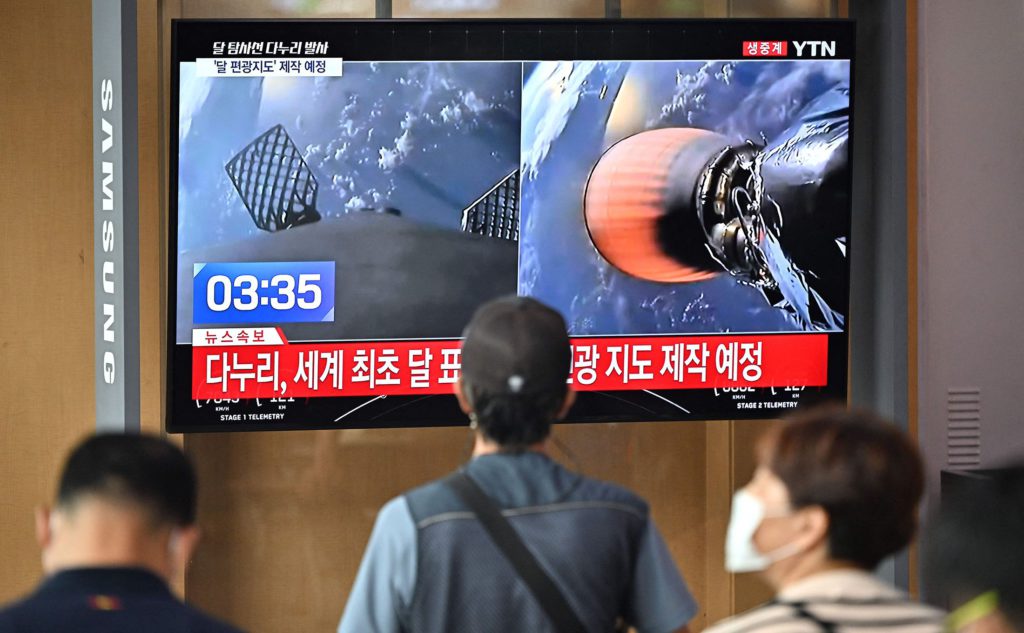
(Bloomberg) — South Korea successfully launched its first home-developed lunar orbiter Friday, becoming the seventh country to join the already competitive race to send spacecrafts to the moon.

The Korea Pathfinder Lunar Orbiter, developed by Korea Aerospace Research Institute, lifted off from Florida’s Cape Canaveral Space Force Station at 7:07 p.m. local time and successfully separated from SpaceX’s 549-ton Falcon 9 rocket around 45 minutes later, live broadcast of the launch showed.

Dubbed Danuri, which means moon and enjoy in Korean, the lunar orbiter successfully established communication with NASA’s space center in Canberra 92 minutes after liftoff and successfully entered into planned trajectory. 

“It is a very significant milestone in the history of Korean space exploration,” Sang-Ryool Lee, president of KARI said in a pre-recorded video. “If we are more determined and committed to technology development for space travel, we will be able to reach Mars, asteroids, and so on in the near future.”

It will travel for four and a half months before entering lunar orbit late December to begin its mission in January using six lunar payloads, vice science minister Oh Tae-Seog said in a briefing. KPLO is on a year-long mission, but the period may be extended. 

Danuri’s missions include searching for possible landing sites as well as conducting a wireless internet test by streaming a video of K-Pop group BTS’s hit song “Dynamite”, according to South Korea’s Electronics and Telecommunications Research Institute.

The launch comes after South Korea launched its own fully developed rocket Nuri in June that placed a test satellite into Earth’s orbit. The country aims to allocate funds in the coming years to send an uncrewed spaceship to the moon by 2031. 

The mission marks a new stage in cooperation between the Korean and US space programs. The spacecraft is carrying NASA’s ShadowCam, a camera co-developed by Arizona State University and Malin Space Science Systems, an imaging company based in San Diego. ShadowCam will collect images of permanently shadowed regions, helping the search for evidence of ice deposits, according to a NASA statement.

This month is shaping up to be a busy one for NASA’s lunar plans. The agency has set an Aug. 29 launch date for Artemis I, an uncrewed spacecraft that will be the first in a series of missions intended to return astronauts to the moon for the first time since the Apollo program.

(Updates with details throughout, vice science minister briefing)

More stories like this are available on bloomberg.com

©2022 Bloomberg L.P.

Alibaba Sales Better Than Feared Despite Economic Turmoil

(Bloomberg) — Alibaba Group Holding Ltd. posted better results than many investors feared, avoiding a sharp sales contraction while signaling an improvement in Chinese consumer sentiment in recent months.

Its shares slid about 2% in Hong Kong, shedding part of the 5.2% gained on Thursday before the results. Revenue shrank for the first time on record in the June quarter, albeit by a fractional amount that was less than analysts projected. The contraction marked an official end to a decade of sizzling growth for China’s internet giants, which began to wind down in 2021 when regulators slapped curbs on a range of sectors from e-commerce to social media.

China’s e-commerce leader reported revenue of 205.6 billion yuan ($30.4 billion) in the June quarter, enough to beat projections for 204 billion yuan. Net income fell 50% to 22.7 billion yuan, even after Alibaba trimmed losses at newer businesses like local services and the cloud.

Alibaba is still grappling with the fallout from nationwide Covid-related lockdowns and a near-economic contraction in China. Smaller rival JD.com Inc., which escaped the worst of Beijing’s crackdown, is overtaking Alibaba in sales growth, while up-and-coming competitors from ByteDance Ltd. to Pinduoduo Inc. are drawing users away. Still, consumption began recovering from June and quickened in July, Chief Executive Officer Daniel Zhang said.

“The results signal resilience in the face of regulatory fears and domestic economic headwinds,” said Rohan Reddy, director of research at Global X Management Co. “Chinese tech stocks still have room for recovery with valuations at attractively cheap levels and an easing policy environment continuing for the foreseeable future. But there is still a dose of caution, as investors get a little spooked from time to time.”

Read more: Jack Ma’s Ant See Profit Fall 17% After Regulatory Setback

Alibaba Jumps Amid Core Commerce Unit Profit Beat: Street Wrap

Alibaba is also managing a series of run-ins with regulators. These range from antitrust fines to tax evasion probes, but have culminated in China’s largest recorded cybersecurity breach, which experts linked to Alibaba’s cloud business. That division grew sales 10% in the quarter, the slowest pace on record. 

Abroad, the US added Alibaba to a growing roster of companies facing removal from US stock exchanges, because of Beijing’s refusal to permit American officials to review their auditors’ work. The company is seeking a primary listing in Hong Kong that would enable it to tap more mainland investors, while also maintaining its listing status on the New York Stock Exchange. 

Once the most valuable company in China, Alibaba has seen its market value tumble after Beijing launched its sweeping crackdown on the private sector more than a year ago. The government forced Alibaba’s finance affiliate, Ant Group Co., to call off what would have been the world’s largest initial public offering in 2020, and then launched reforms that have undercut Alibaba’s business model.

Following a ferocious crackdown on the country’s most prominent billionaires, Alibaba’s co-founder Jack Ma has made significant concessions to appease Beijing. Last week, Ant said in a filing that Ma will cede control over the fintech arm and reduce his Ant shareholding over time to a percentage that does not exceed 8.8%. He currently holds 50.52% voting rights in Ant.

The move, likely to reduce some of Alibaba and Ant’s regulatory headwinds, has weighed on Alibaba shares, on fears that a leadership change could further delay Ant’s initial public offering. Ma’s retreat also raises questions about his internet empire just as China enters a period of unprecedented uncertainty.

“It has been a choppy few months for Alibaba, like two steps forward, one step back,” said David Waddell, CEO and chief investment strategist at Waddell & Associates. “The report is a confirmation that there’s a value here for investors who are patient.”

What Bloomberg Intelligence Says

Alibaba’s shift to providing more cost-efficient e-commerce services for existing users in mainland China could ease price competition among major companies such as JD.com, Meituan and Pinduoduo into 2023. The company may streamline services and scale back expansionary moves for newer businesses, such as those related to grocery and food deliveries, to reduce cost burdens should revenue rise less than 6% above 2021’s level through December. 

– Catherine Lim and Tiffany Tam, analysts

Click here for the research.

Revenue from Alibaba’s core China commerce division slid 1% during the quarter — the first contraction on record.

In response to slowing growth, Alibaba said in May it will take a “more disciplined” approach to spending and scale back expenses in areas that aren’t generating long-term value. This shift — in line with Beijing’s incentives — marks a major shift from the aggressive and wide-ranging market-share grab that characterized the e-commerce giant in the past.

Adjusted earnings per ADS of 11.73 yuan beat estimates for 10.33 yuan, reflecting those efforts.

“Starting in July, we are seeing a gradual recovery of business performance compared to June, especially in the relatively more impacted categories in the past few months such as fashion and electronics,” Zhang told analysts on a conference call.

Alibaba has also turned increasingly outward, building Southeast Asian arm Lazada, Trendyol in Turkey and Daraz around South Asia into important units of the company. It has outlined a long-term goal of quintupling Lazada’s gross merchandise value, the sum of transactions across its platforms, to $100 billion.

“While Alibaba has indicated that it will be focusing on costs, I think the magnitude of its leverage still surprised the market,” said Vey-Sern Ling, an analyst with Union Bancaire Privée. “There will be positive read-through for the rest of China internet companies who will have similar cost focus, especially given the new regulatory environment.”

(Updates with share action from the second paragraph)

More stories like this are available on bloomberg.com

©2022 Bloomberg L.P.

Global Stocks Near Two-Month High; Crude Oil Rises: Markets Wrap

(Bloomberg) — Stocks in Asia climbed along with US equity futures on Friday, helped by gains in technology shares, and oil snapped a slide as investor sentiment steadied after another turbulent week.

An Asian equity index rose 0.9%, while S&P 500, Nasdaq 100 and European contracts posted modest gains. Taiwan recouped losses fueled by US House Speaker Nancy Pelosi’s visit, a jump that may have helped the wider mood.

The 10-year Treasury yield was steady at about 2.69% and the dollar edged up. The inversion between two-year and 10-year yields remained near the deepest since 2000, indicating worries about a recession as monetary policy tightens. 

Cleveland Federal Reserve Bank President Loretta Mester reiterated Thursday the US central bank’s determination to quell inflation. Interest-rate hikes are fanning economic angst and sapping assets like oil, which snapped a slide but remained below $90 a barrel at levels last seen before Russia invaded Ukraine.

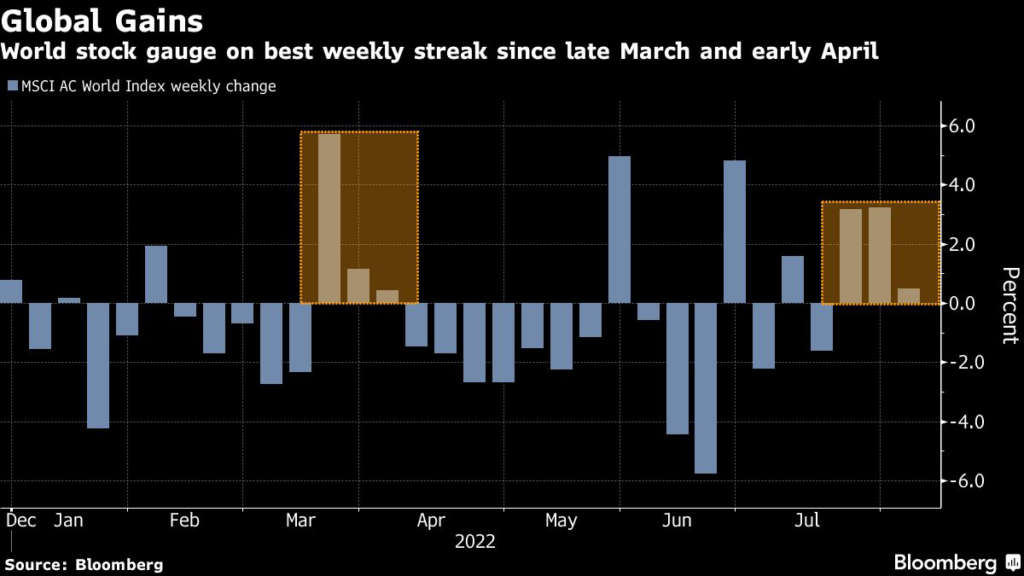
A global equity index is set for a third weekly advance and near a two-month peak in a recovery from bear-market lows, helped by resilient US company profits. The durability of the bounce remains in doubt as borrowing costs go up.

“It’s a little too early to say the risk is off the table,” Carol Schleif, deputy chief investment officer at BMO Family Office, said on Bloomberg Television. “Significant slowing” is starting to come in parts of the US economy, she said.

US payrolls Friday are the next key data point for markets. Hiring likely softened in July but the labor market remains consistent with an expanding rather than recessionary economy and the Fed will press on with rate hikes, according to Anna Wong, chief U.S. economist for Bloomberg Economics.

Separately, Democrats agreed on a revised version of their tax and climate bill, adding a new 1% excise tax on stock buybacks.

Investors are also monitoring the aftermath of Pelosi’s visit to Taiwan. China, which regards the self-ruled island as part of its territory, reportedly fired missiles over Taiwan during military drills — a major escalation if confirmed.

In India, the central bank delivered its third straight rate increase since May in an effort to curb inflation and support the rupee. Bond yields and the currency rose. Elsewhere, cryptocurrencies staged a rally, lifting Bitcoin toward $23,500.

This week’s MLIV Pulse survey is asking about your outlook for corporate bonds, mergers and acquisitions and health of US corporate balance sheets through the end of the year. It takes one minute to participate in the MLIV Pulse survey, so please click here to get involved anonymously. 

What to watch this week:

  • US employment report for July, Friday

Some of the main moves in markets:

Stocks

  • S&P 500 futures rose 0.2% as of 7:02 a.m. in London. The S&P 500 fell 0.1%
  • Nasdaq 100 futures added 0.2%. The Nasdaq 100 rose 0.4%
  • Japan’s Topix index increased 0.9%
  • South Korea’s Kospi added 0.8%
  • Hong Kong’s Hang Seng index was up 0.2%
  • China’s Shanghai Composite index climbed 0.7%
  • Australia’s S&P/ASX 200 index rose 0.6%
  • Euro Stoxx 50 futures climbed 0.2%

Currencies

  • The Bloomberg Dollar Spot Index increased 0.1%
  • The euro was at $1.0227, down 0.2%
  • The Japanese yen was at 133.33 per dollar, down 0.3%
  • The offshore yuan was at 6.7510 per dollar

Bonds

  • The yield on 10-year Treasuries was steady at about 2.69%
  • Australia’s 10-year bond yield dropped four basis points to 3.10%

Commodities

  • West Texas Intermediate crude was at $89.02 a barrel, up 0.5%
  • Gold was at $1,791.24 an ounce

More stories like this are available on bloomberg.com

©2022 Bloomberg L.P.

Bank of Thailand Plans Retail CBDC Pilot Test by End of Year

(Bloomberg) — The Bank of Thailand is planning to advance its development of a retail central bank digital currency to a pilot phase by the end of the year, as the country assesses how the technology would work in its financial system.

The BOT doesn’t yet have plans to issue a retail CBDC, it said in a statement, explaining that “the issuance requires thorough consideration of benefits and associated risks for the financial system.” The pilot is part of a study to assess the suitability of technology and design, and will be conducted under a limited scale with selected participants.

Read more: Why Central Banks Got Serious About Digital Money: QuickTake

The BOT project will assess both the system’s efficiency and safety including the technological design, and programmability, the statement said. This phase of testing will adopt technology developed by Giesecke+Devrient and is expected to begin at year-end and last until mid-2023.

A retail CBDC is a digital form of banknote, and holding it is equivalent to holding banknotes, which are effectively risk-free. The International Monetary Fund says some 100 countries are at varying stages of exploring CBDCs.

In the pilot, the retail CBDC will be used in conducting cash-like activities, such as paying for goods and services, within limited areas and among about 10,000 retail users selected by the BOT, along with Bank of Ayudhya, Siam Commercial Bank and 2C2P (Thailand), the statement said.

More stories like this are available on bloomberg.com

©2022 Bloomberg L.P.
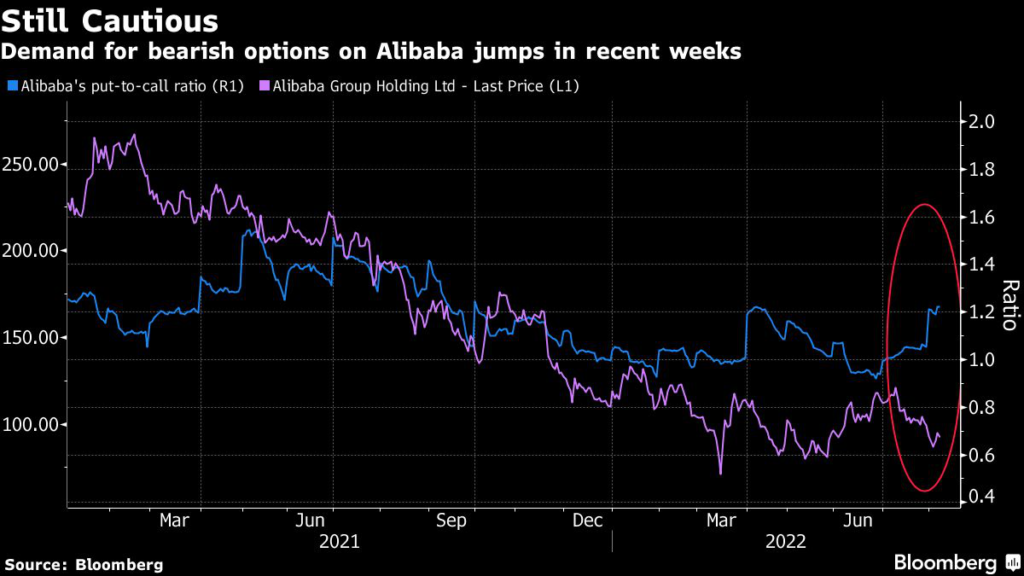
Alibaba’s Rising Bear Options Show Traders Are Still Cautious

(Bloomberg) — Alibaba Group Holding Ltd.’s better-than-feared sales figures haven’t persuaded options traders that the worst is over for the stock.

The put-to-call ratio derived from open interest jumped to about 1.2 times on Friday, the highest in about 10 months, suggesting bearish views on the Chinese e-commerce giant are holding sway. Put options benefit investors when shares drop below a pre-determined level, acting as an insurance against losses.

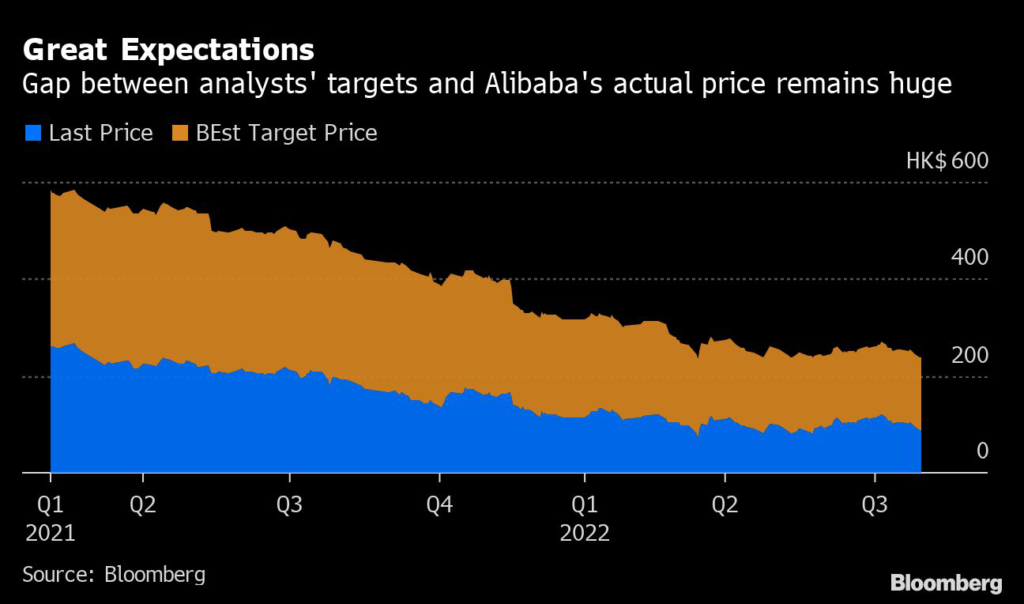
Alibaba’s shares fell as much as 3.3% in Hong Kong on Friday, snapping a two-day rally of 9%. The company’s first-ever revenue drop came in smaller than expected, as its cost-cutting measures began bearing fruit, but some analysts remain concerned that lingering macro uncertainties may weigh on the shares. 

The shares are down more than 20% this year in Hong Kong, having retreated again after rebounding from a low in March as investors awaited earnings to gauge the impact of Beijing’s regulatory crackdown and Covid disruptions. 

Bank of America analysts warned there is “limited visibility on consumption in coming months,” even as they reiterated their buy rating on the stock. 

One of the most active options contracts Friday was set to benefit investors if the shares drop below HK$80 by the end of December, Bloomberg data show. The current price is around HK$92.75.  

To be sure, some call options are also very active, including one that benefits buyers if shares rise beyond HK$100 by the end of August, according to the data. 

More stories like this are available on bloomberg.com

©2022 Bloomberg L.P.
Crypto Bridge Nomad Offers 10% Bounty After $190 Million Hack

(Bloomberg) — Cryptocurrency company Nomad is offering a bounty to recoup funds spirited away in a $190 million hack that again highlighted security vulnerabilities in the digital-token sector.

Anyone returning at least 90% of stolen tokens will be viewed as a so-called white-hat hacker that seeks to spotlight vulnerabilities rather than make malicious gains, according to a statement from Nomad. The remaining 10% would effectively become the reward.  

“We will not prosecute white hats,” Pranay Mohan, chief executive officer of Nomad, said in the statement. “But we will continue to work with our partners, intelligence firms, and law enforcement to pursue all other malicious actors to the fullest extent under the law.”

Nomad is a bridge protocol, a tool for transferring tokens across blockchains to make different networks interoperable. Bridges have become one of the crypto sector’s weak points after numerous hacks — some $2 billion worth of tokens have been swiped from them in 2022, consultancy Chainalysis estimates.

Nomad has recovered around $20 million of the $190 million so far, based on data from Etherscan, a platform for analyzing the Ethereum blockchain, as well as the bridge provider’s estimates.

Nomad said it is working with crypto forensics specialist TRM Labs and law enforcement to identify hackers. Nomad has also partnered with crypto platform Anchorage Digital to accept and safeguard retrievable funds.

The attack on Nomad emerged earlier this week. The crypto industry suffered another black eye soon after when hackers targeted the Solana ecosystem Wednesday, with thousands of wallets affected.

More stories like this are available on bloomberg.com

©2022 Bloomberg L.P.
South Korea Leader Snubs Pelosi Over Holiday, Adding to His Woes

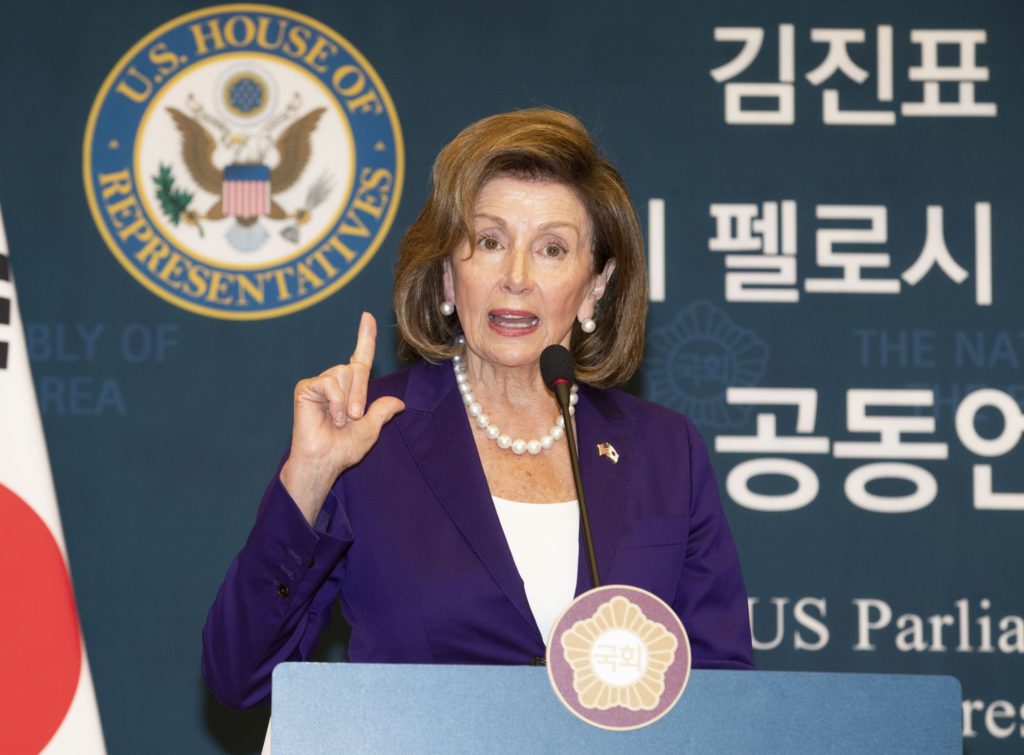
(Bloomberg) — After US House Speaker Nancy Pelosi captivated the world’s attention with a groundbreaking trip to Taiwan, she received far less fanfare on her next stop. 

South Korean President Yoon Suk Yeol, who has seen his approval rating drop to near historic depths just three months after taking office, didn’t see it necessary to greet Pelosi in person — opting for a phone call instead.

“President Yoon’s vacation schedule and Speaker Pelosi’s visit to the Republic of Korea overlapped, and we did not rearrange our schedule,” his office said in a statement. 

Yoon was the only leader not to meet Pelosi in person during her high-stakes Asia trip, which included becoming the highest-level US official to visit Taiwan in 25 years, as well as the first sitting House speaker to visit South Korea in about 20 years.

Although Yoon has pledged to rebuild security ties with the country’s long-standing American ally and take a tough line with China, his popularity has swiftly fallen in recent weeks over numerous missteps. Putting off a meeting with one of the most powerful US politicians risks adding to the self-inflicted damage that has dogged his government since it took power in May.

“The optics look very bad,” said Duyeon Kim, an adjunct senior fellow in Seoul at the Center for a New American Security. “It could raise serious questions in Washington about Yoon’s ability to walk the talk about being a self-proclaimed globally pivotal state, a strong team player on Team Democracy, and being able to stand up to China to protect its own national interest.” 

Every other South Korean president has met Pelosi since she first became speaker in 2007, and President Roh Moo-hyun met her in 2006 during a visit to Washington. She is the first sitting House speaker to arrive in South Korea since Dennis Hastert in 2002. Pelosi met Japanese Prime Minister Fumio Kishida on Friday in Tokyo in the final leg on her trip. 

During her brief stop in South Korea, Pelosi and her congressional delegation met lawmakers at parliament in Seoul, where they agreed to work to end North Korea’s pursuit of nuclear weapons. The US and South Korea have warned that Kim Jong Un’s regime may soon conduct its first nuclear test since 2017, as he modernizes an arsenal of weapons designed to deliver atomic warheads to the US mainland and its allies in Asia.

Pelosi also went to the Panmunjom truce village in the Demilitarized Zone that divides the Koreas. The place where soldiers from the two sides stare down each other is a symbol of military tensions that have simmered since the US came to South Korea’s defense in 1950 after North Korea invaded and started the Korean War. 

Yoon Young-chan, a lawmaker for the opposition Democratic Party who served as a press secretary to Yoon’s predecessor, former President Moon Jae-in, said the decision not to meet the US House speaker “may send a wrong message to our ally.”

“It would be hard to convince both Washington and our people that he is simply not seeing Pelosi as it overlapped with his holiday schedule,” Yoon Young-chan added. The president’s office said he was watching a play the night Pelosi arrived.

Since winning a presidential election in March decided by the closest margin in the country’s history, Yoon has seen his support erode. Several major decisions have proved unpopular and touched off waves of criticism, including relocating the presidential office, announcing plans to shut the Gender Equality Ministry, giving his government more power over police and lowering the age children begin school by a year.

Yoon’s support rate hit a record low of 24% in a weekly tracking poll released Friday by Gallup Korea, with the approval numbers of his administration ranking among the lowest for any president at the same point in their term since South Korea became a full democracy in 1987. Although there is ample time to reverse course in his single, five-year term that started in May, the former prosecutor’s early stumbles have raised questions about whether he can make the transition to running a government. 

Yoon has won praise from the Biden administration for bringing changes to South Korea’s security posture. That has helped the US as it looks to build alliances among partners for a united front against Russia over its invasion of Ukraine, push back against an assertive China and try to end North Korea’s atomic ambitions.

His government has also raised South Korea’s stature in international groupings such as NATO, and brought back joint military exercises with the US that had been scaled down or halted under former President Donald Trump to facilitate his nuclear negotiations with North Korea.

But Yoon’s government has waffled on joining the Biden administration’s proposed groupings such as the so-called Chip 4 alliance to safeguard the supply of semiconductors, which are vital for modern technologies and future ones like artificial intelligence. South Korean chipmakers such as SK Hynix Inc. and Samsung Electronics Co. Ltd. could be hamstrung by moves that cause a backlash from China, where the companies have production bases for memory chips. 

While having neither Yoon or his foreign minister meet Pelosi may be seen as a “diplomatic discourtesy,” it won’t cause any major damage to the alliance between South Korea and the US, according to Yang Seung-ham, a professor emeritus of political science at Yonsei University in Seoul.

“At a time when Pelosi has created controversy in Taiwan, the presidential office may have wanted to distance itself from any political conflict,” Yang said. “She is still the number three in the US, after all, and it wouldn’t have hurt Yoon to greet her in person.”

(Updates with latest poll numbers.)

More stories like this are available on bloomberg.com

©2022 Bloomberg L.P.

Stocks in Asia, US Futures Rise as Oil Snaps Slide: Markets Wrap

(Bloomberg) — Stocks in Asia climbed along with US equity futures on Friday, helped by gains in technology shares and as investors took some comfort from corporate earnings.

MSCI Inc.’s Asia-Pacific equity index added about 0.5%, with Japan, China and Hong Kong in the green. S&P 500, Nasdaq 100 and European contracts made modest gains after the S&P 500 ended little changed. The dollar edged up.

Treasuries were steady, leaving the 10-year yield at about 2.68%. The inversion between two-year and 10-year yields remained around the deepest since 2000, indicating worries about a recession amid tightening monetary policy.

Cleveland Federal Reserve Bank President Loretta Mester on Thursday reiterated the US central bank’s determination to quell price pressures. The Bank of England earlier unleashed its biggest interest-rate hike in 27 years and warned of a prolonged economic contraction.

Tighter policy is fanning economic angst and sapping assets like oil, which snapped a slide but remained below $90 at levels last seen before Russia’s war in Ukraine.

A global equity index is set for a third weekly advance in a recovery from bear-market lows, helped by resilient company profits in the US. The durability of the bounce remains in doubt because of central bank rate rises to tackle punishing inflation.

“It’s a little too early to say the risk is off the table,” Carol Schleif, deputy chief investment officer at BMO Family Office, said on Bloomberg Television. “Significant slowing” is starting to come in parts of the US economy, she said.

US payrolls Friday are the next key data point for markets. Hiring likely softened in July but the labor market remains consistent with an expanding rather than recessionary economy and the Fed will press on with rate hikes, according to Anna Wong, chief U.S. economist for Bloomberg Economics.

Investors are also continuing to monitor the aftermath of US House Speaker Nancy Pelosi’s visit to Taiwan. China, which regards the self-ruled island as part of its territory, reportedly fired missiles over Taiwan during military drills on Thursday. If confirmed, that would mark a major escalation.

This week’s MLIV Pulse survey is asking about your outlook for corporate bonds, mergers and acquisitions and health of US corporate balance sheets through the end of the year. It takes one minute to participate in the MLIV Pulse survey, so please click here to get involved anonymously. 

What to watch this week:

  • US employment report for July, Friday

Some of the main moves in markets:

Stocks

  • S&P 500 futures rose 0.3% as of 10:58 a.m. in Tokyo. The S&P 500 fell 0.1%
  • Nasdaq 100 futures added 0.3%. The Nasdaq 100 rose 0.4%
  • Japan’s Topix index increased 0.6%
  • South Korea’s Kospi added 0.8%
  • Hong Kong’s Hang Seng index was steady
  • China’s Shanghai Composite index climbed 0.2%
  • Australia’s S&P/ASX 200 index rose 0.4%
  • Euro Stoxx 50 futures climbed 0.2%

Currencies

  • The Bloomberg Dollar Spot Index increased 0.1%
  • The euro was at $1.0233, down 0.1%
  • The Japanese yen was at 133.24 per dollar, down 0.3%
  • The offshore yuan was at 6.7522 per dollar

Bonds

  • The yield on 10-year Treasuries declined one basis point to 2.68%
  • Australia’s 10-year bond yield dropped five basis points to 3.09%

Commodities

  • West Texas Intermediate crude was at $88.97 a barrel, up 0.5%
  • Gold was at $1,790.21 an ounce

More stories like this are available on bloomberg.com

©2022 Bloomberg L.P.
South Korea Launches Its First Lunar Orbiter Atop SpaceX Rocket

(Bloomberg) — South Korea launched its first home-developed lunar orbiter Friday, becoming the seventh country to join the already competitive race to send spacecrafts to the moon.

The Korea Pathfinder Lunar Orbiter, developed by Korea Aerospace Research Institute, lifted off from Florida’s Cape Canaveral Space Force Station at 7:07 p.m. local time and successfully separated from SpaceX’s 549-ton Falcon 9 rocket around 45 minutes later, live broadcast of the launch showed.

Dubbed Danuri, which means moon and enjoy in Korean, the lunar orbiter is set to establish communication with the ground station before entering its planned trajectory 5-6 hours after the launch.  

It will travel for four and a half months before entering lunar orbit to begin its mission in December, according to a statement from the science ministry.

Danuri’s missions include searching for possible landing sites as well as conducting a test space wireless Internet connect by playing BTS’s hit song “Dynamite” from the moon. 

“It is a very significant milestone in the history of Korean space exploration,” Sang-Ryool Lee, president of KARI said in a pre-recorded video. “If we are more determined and committed to technology development for space travel, we will be able to reach mars, asteroids, and so on in the near future.”

The launch comes after South Korea launched its own fully developed rocket Nuri in June that placed a test satellite into the earth’s orbit. The country aims to eventually send an unmanned spaceship to the moon by 2030. 

More stories like this are available on bloomberg.com

©2022 Bloomberg L.P.

Close Bitnami banner
Bitnami