Bloomberg

Musk Says Inflation Is ‘Past Peak’ as Parts Costs Trend Down

(Bloomberg) — Elon Musk, chief executive officer of Tesla Inc. and the world’s richest person, said he sees signs that the global economy has gone “past peak inflation.”

Speaking at the electric-vehicle maker’s annual shareholder meeting, Musk said the company’s commodity and component costs are trending downward over the next six months. He also reiterated prior comments that he expects a mild recession to hit that could last 18 months.

“The trend is down, which suggests we are past peak inflation,” Musk said at Tesla’s Austin headquarters and factory. “I think inflation is going to drop rapidly” at some point in the future, he said.

Global central banks have embarked on a path of policy-tightening as inflation pressures consumers and corporate bottom lines. In the US, consumer prices increased by 9.1% in June from a year earlier, and Federal Reserve officials say the price gains have yet to slow. The next print on inflation comes Aug. 10.

“We sort of have some insight in to where prices are headed over time,” Musk said, citing the company’s need to buy raw materials often months in advance of when they will be used.

“The interesting thing that we are seeing now is that most of our commodities, most of the things that go in to a Tesla —  not all, but more than half — the prices are trending down in six months,” he added.

While Tesla has a global purview on input costs and consumer health, Musk warned on stage that making “macroeconomic prognostications is a recipe for disaster” and said his comments were a “guess” and “total speculation.” The CEO also warned that the trend could change.

Reservation holders and future customers of the upcoming futuristic Cybertruck may fall victim to the impacts of inflation, Musk suggested. The ‘Blade Runner’-inspired pickup was unveiled in 2019 and “a lot has changed” since then, he said. At the time the company started taking reservations, the most basic model was being discussed as a $39,900 vehicle.

“The specs and the pricing will be different,” Musk said. “I hate to give a little bit of bad news. But there is no way to have anticipated the inflation we have seen and various issues.” 

(Updated with additional Musk comments throughout and reference to Cybertruck)

More stories like this are available on bloomberg.com

©2022 Bloomberg L.P.

China Tech Stocks May Open Higher After Alibaba Revenue Beat

(Bloomberg) — Hong Kong-listed Chinese tech stocks may get a boost after mainland firms traded in the US rallied in the wake of Alibaba Group Holding Ltd.’s better-than-expected revenue despite China’s ongoing economic woes.

JD.com Inc. and Pinduoduo Inc. gained more than 3.2% and Baidu Inc. was up 2.5%. US-listed Alibaba shares rose for a fourth consecutive day, paring earlier gains to close 1.8% higher. The Nasdaq Golden Dragon Index advanced 2.3% in its biggest one-day climb in about a month.

“The company mentioned the business recovery in June which should help other e-commerce players like JD.com and Pinduoduo,” said Henry Guo, an analyst at M Science LLC. “Investors had low expectations on China ADRs before this print but Alibaba reports suggest likely business upsides to expectations for those companies.”

Chinese tech stocks have been through a tumultuous ride for more than a year amid regulatory crackdowns and a series of bruising lockdowns that dampened consumption, and more recently, rising geopolitical tensions. While some analysts have been optimistic about earnings results, with others holding on to their bullish calls on the nation’s stocks, traders have been offloading them with the Nasdaq Golden Dragon China Index down about 18% this year after an 11% decline in July. Still, the benchmark has climbed 41% from a March low.

READ: Alibaba Revenue Beat Puts Focus on China Tech Peers: Street Wrap

Now, Alibaba’s sales beat may be a welcome sign for investors even as the stock continues to face a litany of other headwinds, including a struggling Chinese economy and regulatory concerns from authorities in both Beijing and Washington. Last week, the company was added to the US Securities and Exchange Commission’s list of stocks that are at risk of being delisted from American exchanges. That came just days after Alibaba said it would be seeking a primary listing in Hong Kong.

“It is an encouraging start to the earnings season for China tech,” said Bloomberg Intelligence analyst Marvin Chen. “Investors will be looking for guidance that the worst is behind us, and for tech that means from an economic and regulatory perspective.”

All eyes will be on quarterly results due from other Chinese tech giants like Baidu, JD.com and Pinduoduo, which are expected to release their numbers later this month. Baidu’s shares have dropped about 6% this year, while JD.com and Pinduoduo fell 7.3% and 12.1%, respectively.

More stories like this are available on bloomberg.com

©2022 Bloomberg L.P.

Musk Says Twitter Played ‘Hide-and-Seek’ as He Sought Info

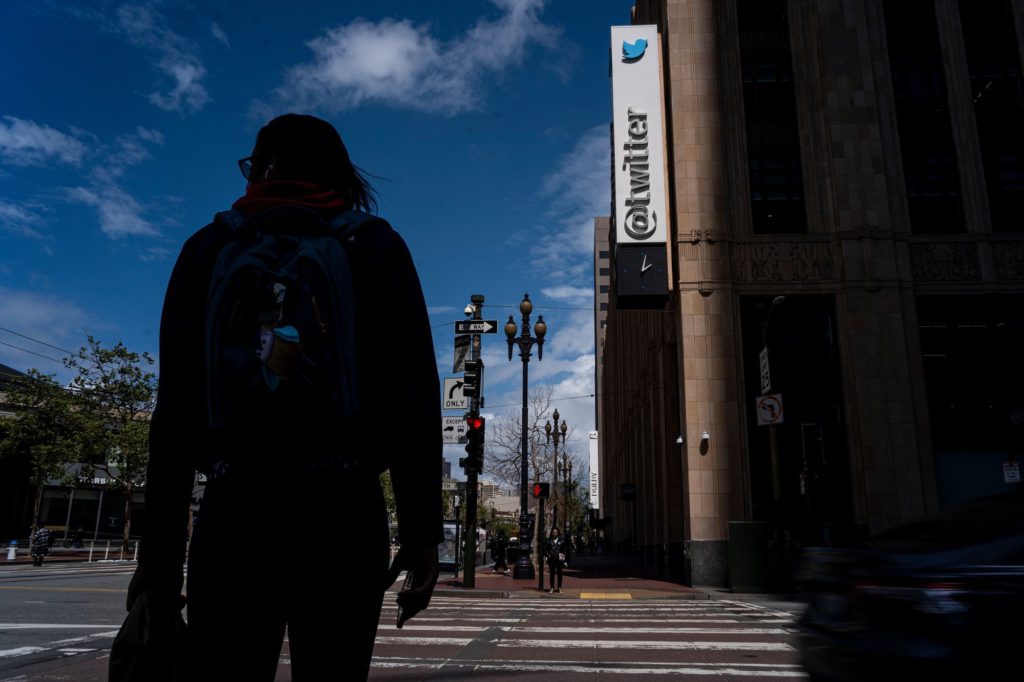
(Bloomberg) — Elon Musk said Twitter Inc. misrepresented the size of its user base to distort its value and then “played a months-long game of hide-and-seek” as he sought more information to complete the $44 billion purchase of the company. 

Musk’s arguments for abandoning the deal were revealed in counterclaims filed under seal in a Delaware court last week. Twitter misled investors and the US Securities and Exchange Commission, Musk says, and the company was “frantically closing the gates on information in a desperate bid to prevent the Musk Parties from uncovering its fraud,” according to the filing reviewed by Bloomberg. 

Twitter responded by saying that the idea that Musk, backed by a team of lawyers and financial advisers, was “hoodwinked” into signing the purchase agreement was “as implausible and contrary to fact as it sounds.” In a 127-page reply, the company said Musk created a story “to escape a merger agreement that Musk no longer found attractive once the stock market — and along with it, his massive personal wealth — declined in value.” 

The exchanges are the latest volleys in the acrimonious legal fight between the social-media platform and the world’s richest person. A judge in Delaware has set a 5-day trial in October over the merger, after Twitter filed suit to force Musk to go through with the deal. 

Read More: Twitter Hits Back at Musk, Suing to Force $44 Billion Buyout (2)

In his counterclaim, Musk is described as “an avid Twitter user who believes in free speech and open debate, and he appreciates Twitter’s role as the world’s town hall.” But fake and spam accounts were a “key issue” for Twitter and the company wasn’t doing enough to identify them. 

According to preliminary expert estimates by Musk’s side, “in early July fully one-third of visible accounts” — those that publicly tweet, re-tweet or like tweets — “may have been false or spam accounts.”

Further, Musk says Twitter’s disclosures show that the actual number of monetizable daily active users, or mDAU as the industry calls it, is 65 million less than the 238 million Twitter has represented. According to Musk, Twitter also misrepresents how many of those users view advertising, the company’s main source of revenue. By his estimate, fewer than 16 million users see the majority of ads and should be counted as “monetizable.” 

Twitter wasn’t forthcoming with information, according to the filing. “As a long bull market was coming to a close, and the tide was going out, Twitter knew that providing the Musk Parties the information they were requesting would reveal that Twitter had been swimming naked.”

Musk is asking the judge to declare Twitter in breach of contract. 

Read More: Twitter Subpoenas Ken Griffin Amid Hunt for Musk’s Deal Backers

Twitter said its “disclosures regarding mDAU are accurate” and that “Musk’s counterclaims seek to distort them through selective omission and misleading bolding.” 

The company said Musk’s claim that he has the right to walk away from the deal if it were “miscounting” the number of false accounts is “incorrect” and that the facts and terms of the merger agreement show that. 

Musk also didn’t ask Twitter for information to verify the number of false or spam accounts before he agreed to the deal, the company said. Instead, he “forwent all due diligence — giving Twitter twenty-four hours to accept his take-it-or-leave-it offer before he would present it directly to Twitter’s stockholders.”

The case is Twitter v. Musk, 22-0613, Delaware Chancery Court (Wilmington).

More stories like this are available on bloomberg.com

©2022 Bloomberg L.P.

Penguin CEO Defends Schuster Deal in Market Shaped by Amazon

(Bloomberg) — Markus Dohle, chief executive officer of the biggest publisher, Penguin Random House, bemoaned his company’s declining market share in book sales as he testified in support of a $2.18 billion merger with Simon & Schuster. 

Dohle told the judge at an antitrust trial in federal court in Washington that about half the books sold in the US last year came from publishers outside of the biggest five companies. He testified on Thursday that the shift to e-commerce platforms such as Amazon has “leveled the playing field” between the big and small players. 

His comments came after he faced questioning from Justice Department attorney John Read, who displayed an internal company document that described the biggest five publishers as an “oligopoly” structure. 

The document was prepared for a board meeting Dohle attended where a possible purchase of Simon & Schuster was discussed. Dohle testified that he disagreed with the oligopoly characterization and didn’t remember whether it was discussed. “It was a very short board meeting,” he said. 

The trial, which is expected to last three weeks, comes as the Biden administration tries to crack down on consolidation across industries. The US claims that Penguin’s purchase of Simon & Schuster, the nation’s fourth-largest publisher, will compress guaranteed payments to authors, known as advances, leading to fewer choices for consumers. 

The DOJ has alleged that the combination will concentrate power among four publishing houses instead of five. The publishers have argued that the merger will, instead, increase competition and payments to authors. 

The government has focused its case on how the largest publishers have cornered the market in buying books from authors and has argued that the merger would give the combined company almost half of the market for buying anticipated top-selling books. The defense shifted the focus on Thursday to Penguin’s smaller slice of the market for selling books. 

Daniel Petrocelli, attorney for Penguin and its parent, referred to a presentation from December 2019 that showed Penguin’s share of retail book sales sliding from 25% to 21% since the 2013 merger between Penguin and Random House. 

In his testimony, Dohle expressed frustration with Penguin’s failure to keep up with industry growth and said the merger would help the company make back its share. He testified that e-commerce platforms level the playing field because they rely on algorithms that decide which books are “discoverable.”

Read More: Penguin Rival Backs US in Antitrust Suit to Block Schuster Buy

While being questioned by Read, Dohle testified that his company uses data scientists and pays Amazon to improve placement. 

Read also asked about the types of books that were included in were included in the calculation of Penguin’s market share. The data included Bibles, magic trick books, coloring books, calendars, diaries, dictionaries, encyclopedias, puzzles, sudoko, journals and study aides. Dohle said that Penguin publishes books in some of those categories. 

Read asked if Penguin ever thought about lowering retail prices to stem its sliding share. Dohle responded that he didn’t think that would ever resolve the problem.

The government lawyer also asked whether Dohle believed Penguin didn’t grow because the book business was mismanaged. He pulled up text messages from Dohle to subordinates where he said that the company “screwed” up on the product side after the merger between Penguin and Random House.

Dohle explained that those text messages displayed his frustration about the company’s development and that his advice wasn’t heeded on how to organize the company. He agreed that the business consists of too many layers of management in acquiring books.

“We haven’t been able to acquire and publish enough of the books that readers want to buy,” said Dohle. He said he thought the company could become more aggressive and nimble on the content side.

During his cross-examination, Dohle described subscription models for books as the biggest threat to the publishing world. He said if consumers can get access to all books in a digital format by paying $9.99 a month that will have a “tectonic” impact on revenues for the industry as well as author pay. 

At one point, Dohle was questioned about his commitment to have Penguin and Simon & Schuster keep competing after the merger even when they are the last bidders. The CEO testified that he made that pledge in response to concern from the agent community over the deal. 

Petrocelli asked what would happen if Dohle reneged.

“I think it would damage our business,” he said. “Agents and authors would not appreciate it and feel betrayed.” 

US District Judge Florence Pan said she doesn’t think agents would stopping working with Penguin if it reneged because it’s a high bidder. 

The trial, which started Monday, has already elicited testimony from best-selling horror author Stephen King, and Jonathan Karp, Simon & Schuster’s CEO. 

King, known for numerous best-sellers such “IT” and “Carrie,” spoke out against consolidation and warned of the impact it could have on the livelihood of authors. Karp argued that Penguin and Simon & Schuster rarely go head to head with each other — in response to a government lawyer’s reference to examples of the two companies bidding each other up to win books.

Pan, who was nominated this year by President Joe Biden to the appeals court in Washington, is hearing the case without a jury. 

More stories like this are available on bloomberg.com

©2022 Bloomberg L.P.

Tesla Investors Clear 3-for-1 Stock Split as Shares Rebound

(Bloomberg) — Tesla Inc. shareholders approved a three-for-one stock split on Thursday as the electric-vehicle maker seeks to attract an even larger number of retail investors amid a furious rally since late May. 

The split will bring Tesla’s shares down to the $300 range, but the Austin, Texas based-company did not immediately specify as of when it will take effect. Tesla had first announced its plan on March 28 via a tweet. 

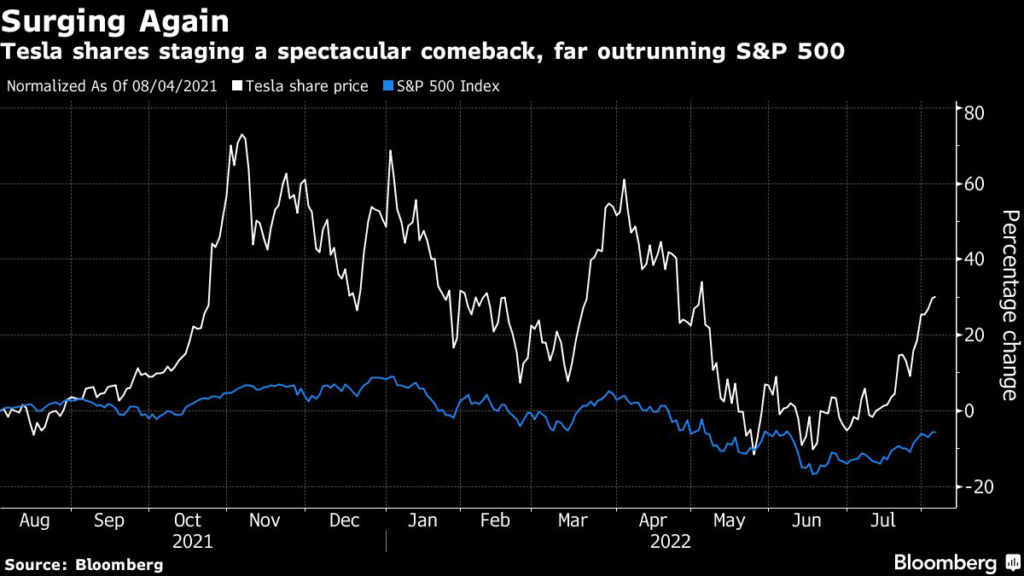
The four-month lag between announcement and vote is proving to be beneficial: A rally in growth stocks has brought the Nasdaq 100 Index up nearly 20% from a June low, with Tesla outperforming both the tech-heavy index and the broad S&P 500 Index with a gain of nearly 50% from a late-May low.

Tesla rose 0.3% in postmarket trading to $928.55 as of 6:34 p.m. in New York. The stock has been on an upswing over the past month, rising 37% since the end of June as of Thursday’s close.

“Tesla’s stock split timing looks impeccable,” Roth Capital Partners analyst Craig Irwin said, noting the shareholder vote is coming at a time when the “market seems to be heading in the right direction.”

Tesla’s recent rebound — it posted a 32% gain in July for its best month since October — comes on the back of resilient second-quarter results and a bit of a lift from the climate change bill from the Biden Administration, which aims to boost the use of clean energy through a series of tax incentives.

Related: Tesla Investors Fail to Back Pair of Company-Supported Proposals

Most of the risks that weighed on the company earlier this year still linger, with supply-chain disruptions far from sorted, tensions between the US and China rising, and Elon Musk involved in a potentially lengthy and costly legal dispute with Twitter Inc. Moreover, recent high profile stock splits have failed to give a meaningful boost to other giants including Alphabet Inc. and Amazon.com this year.

Read more: Alphabet Stock Split Lands With a Thud in Worry-Filled Market

For Tesla, this will be the second share-split in less than two years. The company had a five-for-one stock split in 2020, prompting a 60% surge in the share price from the day of the announcement to the execution date. The company already has a fairly strong retail investor following, often making it the stock with the most buy orders on Fidelity’s retail trading platform. 

Even though stock splits do not impact the business model of a company, they bring in a sense of affordability by lowering the price of the shares, especially for mom-and-pop investors, market watchers say. 

“Owning the whole share can be less complicated and more empowering, and these companies know that,” said Callie Cox, eToro US investment analyst. “There’s clearly an underlying desire in this market for any company to make its stock as accessible as possible. And so far, investors have responded to that.”

More stories like this are available on bloomberg.com

©2022 Bloomberg L.P.

Block’s Payments Volume Misses Estimates on Bitcoin Rout

(Bloomberg) — Block Inc., the digital-payments firm run by Jack Dorsey, reported weaker-than-expected gross payment volume, a measure of the total amount of payments processed using Block’s products. Shares slid more than 7% in late trading.

Block, formerly called Square, reported $52.5 billion in transactions, missing the $53.47 billion estimate.

Gross profit for the quarter, the company’s profit before subtracting costs like marketing and product development, was $1.47 billion, in line with analysts’ estimates. Cash App, the app for sending money between individuals and buying stocks or Bitcoin, accounted for roughly 48% of that gross profit. The service now has 47 million active accounts, up from 45 million in the first quarter.  

Revenue was better than expected, but still declined in the second quarter due in part to a drop in Bitcoin-related transactions on Cash App. Revenue collected through Bitcoin transactions was $1.79 billion, down 34%. Cash App revenue was also down 21% as a result, though sales would have grown if Bitcoin-related revenue was excluded, Chief Financial Officer Amrita Ahuja said. 

The company has warned that Bitcoin revenue is a poor measure of its business health given the currency’s wild price fluctuations. It’s also not a big profit engine — gross profit from Bitcoin sales is only about 2% of Bitcoin revenue. 

Dorsey has made Bitcoin a key priority at the company, and Block previously purchased more than $200 million in Bitcoin to keep on its balance sheet. The price of the digital currency has fallen by over 50% since the beginning of the year, leading Block to report a $36 million Bitcoin impairment loss in the second quarter. 

Square slipped as much as 7.3% to $83.17, after closing at $89.70. The stock has declined 44% so far this year.

On Tuesday, another company that is betting big on Bitcoin, MicroStrategy Inc., took a $917.8 million impairment loss related to the decline in the value of the coins it holds. Bitcoin and other major cryptocurrencies lost about $2 trillion in value since the downturn in the digital currency market began.

(Updates with bitcoin impairment costs)

More stories like this are available on bloomberg.com

©2022 Bloomberg L.P.

Expedia Quarterly Revenue Tops Estimates in Strong Start to Summer

(Bloomberg) — Expedia Group Inc. reported second-quarter revenue that topped analysts’ estimates, suggesting a solid start to the busiest travel season as voyagers shake off two years of Covid-19 restrictions. The shares jumped about 6% in extended trading after the report.

Sales rose 51% from a year ago to $3.2 billion, beating the average analyst estimate of $2.99 billion. Gross bookings, which represent the total value of transactions booked, adjusted for cancellations and refunds, rose 26% to $26.1 billion, in line with analysts’ estimate. 

“Despite the disruptions during the summer travel season and an uncertain macroeconomic backdrop, travel demand has remained strong,” Chief Executive Officer Peter Kern said in a statement.  

Kern’s peers at Airbnb Inc. and Booking Holdings Inc. have also remained optimistic about travel demand, despite some creeping signs that the industry’s challenges this summer have started to take a toll. Airbnb and Booking both reported strong second-quarter results earlier this week and their executives expressed confidence that third-quarter revenue will be even better, but they also showed slowing growth in room nights booked in the summer months.

On a conference call with analysts, Chief Financial Officer Eric Hart said Expedia is also seeing a tapering from the fast rates of growth it saw in April and May. The Seattle-based company expects lodging bookings in the third quarter to be ahead of where they were in 2019, and more of the same for the rest of the year.

Despite consumers’ fierce determination to travel, this season has thrown several hiccups into the best-laid plans. Long lines at airports, thousands of canceled flights and lost luggage have contributed to travel chaos. Airbnb said it saw more cancellations than it was expecting in the second quarter due to the scrapped flights. 

Expedia saw “some choppiness” in bookings in July due to service disruptions in North America and Europe, Kern said. Those normalized in the second half of the month and have reverted to 2019 levels. “There’s been a lot of noise and a lot of cancellations and we think that’s responsible for a lot of it,” he said on the call with analysts. “We feel like it was more temporary than anything.”

The hospitality industry has remained upbeat, too. Hilton Worldwide Holdings Inc. is raising its earnings forecast through the rest of the year, suggesting that inflation fears aren’t limiting vacation planning. And Airbnb said higher average daily rates will offset the softness in bookings. 

Expedia reported 82.5 million room nights booked in the second quarter, compared with analysts’ estimates of 87.5 million.


The strength of the US dollar, which has gained substantially against most major currencies, has hampered results at technology companies ranging from Microsoft Corp. to Airbnb. But Expedia is less exposed to currency fluctuations than its peers because only about a quarter of its revenue comes from overseas. 

Expedia, which offers flight, hotel and rental car accommodations, benefited from its short-term rental business Vrbo during the pandemic, as workers took advantage of remote-work opportunities and fled to vacation homes. Vrbo focuses on whole residences and doesn’t have as much market share in cities, which are dominated by Airbnb. 

The company has undergone two years of restructuring to try to make it more nimble, selling off corporate travel arm Egencia and launching a new e-commerce platform in a bid to build out its business-to-business segment. A new platform, Open World, allows partners of all sizes to use Expedia’s technology to book rental cars or employ fraud detection.  

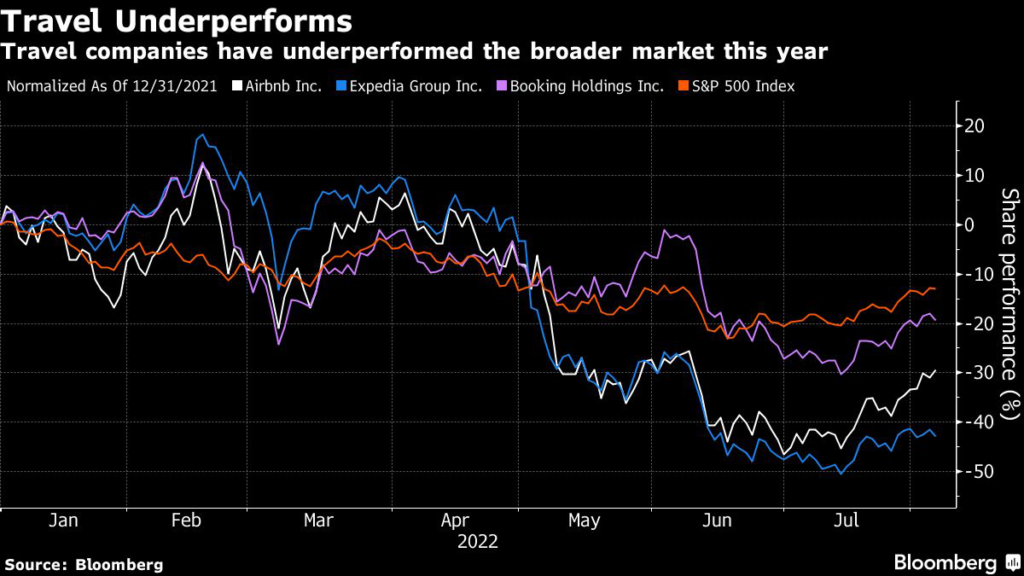
Expedia’s shares have fallen 43% this year, compared with a 30% decline for Airbnb and 19% for Booking.

(Updates with executive comments on current quarter.)

More stories like this are available on bloomberg.com

©2022 Bloomberg L.P.

Meta Makes Bond-Market Debut With $10 Billion Jumbo Deal

(Bloomberg) — Meta Platforms Inc., one of the few S&P 500 companies without debt, sold $10 billion in its first ever corporate bond deal as its cash flow and stock price fall.  

The social media giant’s bond deal sold in four parts, according to a person with knowledge of the matter. The longest portion of the offering, a 40-year security, yields 1.65 percentage points above Treasuries, said the person, who asked not to be identified as the details are private, after initial discussions of 1.75 to 1.8 percentage points. Orders reached more than $30 billion at the peak early in the afternoon in New York, according to a person familiar with the demand.

The company’s stance on borrowing may have shifted with the state of its business. Meta just posted its first year-over-year quarterly revenue decline, citing uncertainty in the digital advertising market, which has driven its growth for years.

The parent of Facebook and Instagram is concerned that young people are abandoning its platform for ByteDance Ltd.’s TikTok. And it has big, expensive ambitions to build a whole new version of the internet in the Metaverse, an immersive virtual reality world where Chief Executive Officer Mark Zuckerberg imagines we will communicate, work and shop in the future. 

Share Buybacks

Proceeds from the bond sale can be used for purposes including capital expenditures, stock repurchases, and acquisitions or investments. The company may be more likely to use the money to significantly bolster its share buybacks, and hire and retain talented employees, rather than boost spending on Metaverse investments, according to Bloomberg Intelligence analysts Mandeep Singh and Ashley Kim.  

Meta has been using cash to repurchase stock, including $5.1 billion in the second quarter of this year, and had $24.3 billion available for buybacks as of June 30, according to its earnings release last week. Its stock price has more than halved from its high in September to $168.80 as of market close on Wednesday, making the repurchases cheaper. And even with issuing a mega deal, leverage would remain below 1x, based on 2022 consensus Ebitda, BI analyst Robert Schiffman wrote in a note.

Its stockpile of cash has dropped $23.6 billion from a year earlier, according to data compiled by Bloomberg. That’s among the biggest cash losses for non-financial S&P 500 corporations during the period. 

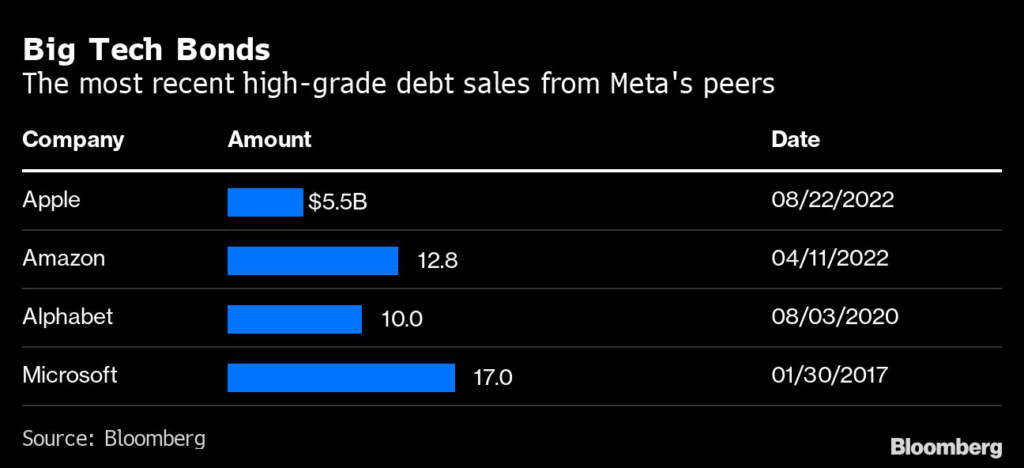
Many of Meta’s large peers in the technology industry have borrowed heavily at low rates despite large cash piles. Including Meta, there are just 18 companies in the S&P 500 without outstanding short or long-term debt, excluding lease liabilities, as of the most recent quarter, according to data compiled by Bloomberg.  

Over the past month, other tech companies including Apple Inc. and Intel Corp. have ridden the rally in credit markets to sell debt. The companies are taking advantage of yields that have been drifting lower after surging all year, offering a moment of relative stability in the market.

S&P Global Ratings has assigned Meta a AA- investment-grade rating, while Moody’s Investors Service gave the tech giant an A1 rating, the equivalent of one step lower.

“The A1 issuer rating is based on Meta’s strong credit profile which reflects the leading global position of its platform brands in social networking, supported by its extensive user base,” Moody’s said in a report. 

Morgan Stanley, JPMorgan Chase & Co., Bank of America Corp. and Barclays Plc managed the bond sale on Thursday. Meta and the banks did a series of fixed-income investor calls Wednesday to market the deal. 

(Updates with final pricing.)

More stories like this are available on bloomberg.com

©2022 Bloomberg L.P.

US Stocks Little Changed as Traders Parse Earnings: Markets Wrap

(Bloomberg) — US stocks wavered on Thursday as traders parsed various corporate earnings against a backdrop of aggressive interest-rate hikes by global central banks. The US yield curve remained inverted as recession fears persisted.

The S&P 500 ended the session little changed after fluctuating throughout the day. The Nasdaq 100 closed up higher for the second straight day after swinging between modest gains and losses. 

While the tech-heavy index was buoyed by Amazon.com Inc. and Advanced Micro Devices Inc. later in the session, it was also dragged down by Fortinet Inc. after the firm trimmed its service-revenue forecast. Eli Lilly & Co., which dropped after missing Wall Street expectations for second-quarter revenue, weighed on the S&P 500 Index. Thin liquidity in the summer also tends to amplify market moves. 

Treasury yields wobbled throughout the session, with the 10-year rate around 2.66% after pushing past 2.80% on Wednesday.

A flurry of economic data that released this week assuaged fears of a downturn while hinting at stabilizing growth. But the bond market, especially the persistently inverted Treasury yield curve, is flashing warnings on the economy amid a global wave of monetary tightening. All eyes will be on the US jobs report on Friday for further clues about the Federal Reserve’s path of rate hikes. 

“There’s an intense tug-of-war happening in the economy and markets,” said Dan Suzuki, deputy chief investment officer at Richard Bernstein Advisors. “On one side, you have a narrative that reasonable growth is going to support continued inflation pressure and keep the Fed hiking. The other narrative is that slowing growth is going to ease inflation and allow the Fed to stop hiking.”

On Thursday, Cleveland Fed President Loretta Mester reiterated the central bank’s promise to bring down inflation by raising interest rates. Her counterparts, this week, have also been backing this hawkish stance, forcing markets to recalibrate after initially expecting a dovish pivot Fed Chair Jerome Powell hinted at last week.

Read More: Bet Bucking Herd on Fed Pays $12.6 Million Windfall in a Week

US-China tension also remains among the uncertainties clouding the outlook. China likely fired missiles over Taiwan during military drills on Thursday, Japan said, part of Beijing’s biggest cross-strait exercises in decades after US House Speaker Nancy Pelosi visited the self-ruled island. 

Read More: China Stokes Tensions as Missiles Reportedly Overfly Taiwan

West Texas Intermediate stayed below $90 a barrel, a level last seen in the weeks leading up to Russia’s invasion of Ukraine. Gold advanced and Bitcoin fell.

Read More: US Recession Odds Are Falling Fast, JPMorgan Trading Model Shows

Earnings continued to trickle in after markets closed. Lyft Inc. reporting record earnings as the firm saw a “material improvement” in driver shortage while Zillow Group Inc. provided a third-quarter outlook below what analysts were expecting. 

This week’s MLIV Pulse survey is asking about your outlook for corporate bonds, mergers and acquisitions and health of US corporate balance sheets through the end of the year. It takes one minute to participate in the MLIV Pulse survey, so please click here to get involved anonymously. 

What to watch this week:

  • US employment report for July, Friday

Some of the main moves in markets:

Stocks

  • The S&P 500 was little changed as of 4 p.m. New York time
  • The Nasdaq 100 rose 0.4%
  • The Dow Jones Industrial Average fell 0.3%
  • The MSCI World index rose 0.9%

Currencies

  • The Bloomberg Dollar Spot Index fell 0.4%
  • The euro rose 0.8% to $1.0246
  • The British pound rose 0.2% to $1.2170
  • The Japanese yen rose 0.7% to 132.88 per dollar

Bonds

  • The yield on 10-year Treasuries declined five basis points to 2.66%
  • Germany’s 10-year yield declined seven basis points to 0.80%
  • Britain’s 10-year yield declined two basis points to 1.89%

Commodities

  • West Texas Intermediate crude fell 2.6% to $88.33 a barrel
  • Gold futures rose 1.9% to $1,810.30 an ounce

More stories like this are available on bloomberg.com

©2022 Bloomberg L.P.

SoftBank Talent Drain Worsens, Adding Pressure on Son to Deliver

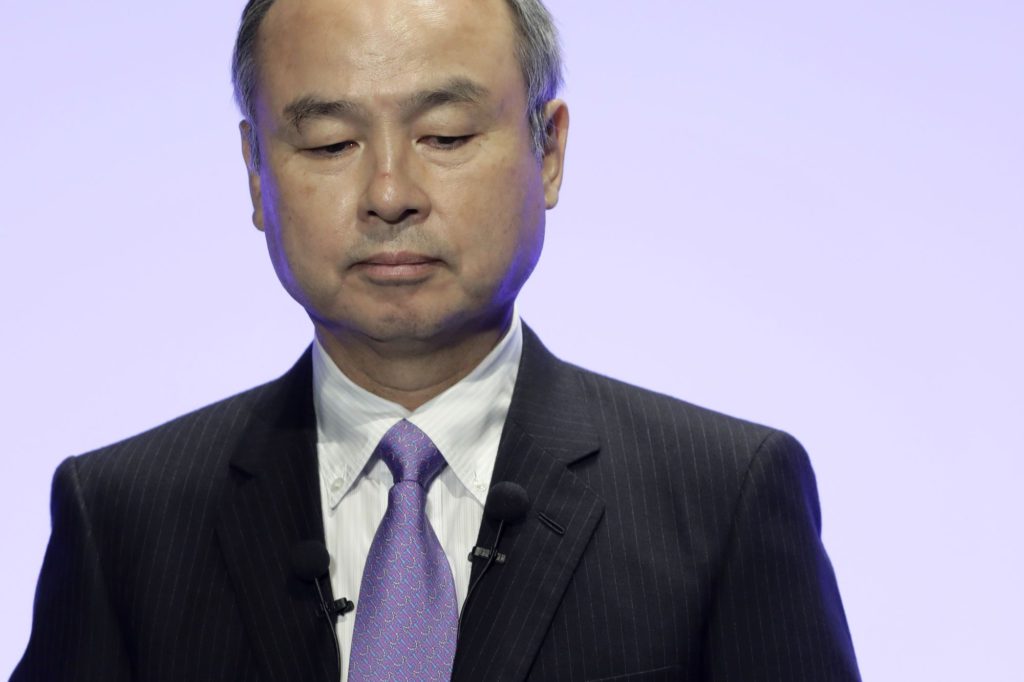
(Bloomberg) — Masayoshi Son is losing a growing number of top executives at SoftBank Group Corp., putting more responsibility on the founder’s shoulders just as the outlook for the Japanese conglomerate turns increasingly ominous.

Two more managing partners at the company’s Vision Fund, Yanni Pipilis and Munish Varma, are leaving, Bloomberg News reported last week, bringing the number of top level departures from the world’s largest investment fund to at least 10 since March of 2020. Rajeev Misra, the long-time head of the Vision Fund, is giving up most of his titles and responsibilities as he starts his own investment fund. Chief Operating Officer Marcelo Claure left earlier this year, while Chief Strategy Officer Katsunori Sago, who had been on SoftBank’s board with Misra and Claure, resigned in 2021. 

That leaves Son increasingly on his own as he plots a new course for the company he founded four decades ago. The 64-year-old is shifting focus away from the Vision Fund after steep losses and toward fresh opportunities, particularly the UK chip firm Arm Ltd., according to people familiar with the matter. Son is planning to reposition the chip designer and cut costs to boost profits in order to increase its appeal as he prepares to take it public next year, said the people, asking not to be identified because the discussions are private. 

Son has struggled to retain executives ever since he began remaking his telecom conglomerate into an investment holding company five years ago. As he set up the original $100 billion Vision Fund in 2017, he declined to provide the kind of profit sharing or deal-by-deal “carry” that venture capital firms give partners to compensate for big winners. Losses at the Vision Fund in recent years have aggravated the problem, leaving little overall profit to entice top performers.

“Masa gets all the glory, the team behind him gets breadcrumbs” said David Gibson, senior research analyst at MST Financial Services.  

SoftBank Group declined to comment. 

There hasn’t been much glory for anyone since Son repositioned his telecom conglomerate into the world’s biggest technology investor. It’s suffered missteps at portfolio companies like WeWork and Greensill, as well as a broad downturn in technology stocks that hit holdings such as Alibaba Group Holding Ltd. and Coupang Inc. 

The internal rate of return for the first Vision Fund’s limited partners was 11% through March of this year, compared with an average of about 38% for the industry, according to the investment data firm Preqin. The second Vision Fund’s IRR is 0%, compared with an average of 45%.

“They had too much money and not enough discipline,” says Steven Kaplan, co-founder of the entrepreneurship program at the University of Chicago Booth School of Business.

SoftBank is essentially back where it started in 2017. Its stock has averaged a 5.2% return over the last five years, far short of Japan’s benchmark Nikkei 225 at 9% and the Nasdaq’s 16% gain. 

SoftBank is scheduled to report earning Aug. 8 and it may report another loss after the 2.1 trillion yen in red ink from the last fiscal quarter, according to Bloomberg Intelligence analysts Marvin Lo and Chris Muckensturm.

SoftBank has raised as much as $22 billion in cash through the sale of prepaid forward contracts using Alibaba shares, the Financial Times reported, citing filings it has seen. SoftBank has used such derivatives to boost cash since at least 2016, though the amount would be up from the $13.17 billion SoftBank disclosed in its earnings report published in May. 

While top executives in Japan earn modest paychecks by global standards, the finance industry’s stars are among the highest paid in the world. Venture capital firms often allocate 20% of their profits to partners, which can mean tens of millions of dollars apiece. 

Son’s own compensation was 100 million yen in the most recent fiscal year, a mere $733,000. Misra earned $8.4 million in the most recent year for which his compensation was disclosed, among the highest in Japan but far below successful venture investors.

SoftBank’s board members have warned the company isn’t doing enough to compete for talent. 

“The best venture firms have little turnover because they understand the importance of retaining rainmakers, or excellent deal makers,” Lip-Bu Tan, founder of venture capital firm Walden International, wrote in his June departure letter when he stepped down as external board director at SoftBank.

Instead of boosting official renumeration, SoftBank has offered up side deals for executives to enrich themselves, according to the people and company disclosures. These included huge loans to senior staff that often carried little downside for the borrowers.

Misra, for example, borrowed $463.5 million from SoftBank to invest in T-Mobile US Inc., the telecom firm that bought SoftBank’s Sprint Corp. in 2020. Claure also borrowed $515 million, according to company filings. Both men made significant profits from their T-Mobile stakes. Misra paid back the loans in early 2022, according to company filings.

Much of this attitude comes from the top. Son took a personal stake of 33% in a SoftBank vehicle to bet on risking tech stocks, only to lose money as the investments soured. He also set aside 17% of the second Vision Fund equity to compensate senior executives, including himself.

An existing $1.5 billion compensation pot for Vision Fund staff made its first payments last year, but the cash came too late to keep most of the fund’s key staff, the people said. The pay structure for the second Vision Fund — dependent on performance —  was finalized in early 2022.

Other recent departures include two of three managing partners at the Latin America Fund and Silicon Valley veteran Deep Nishar, who helped oversee SoftBank investments into Grofers, Improbable and Mapbox. Michel Combes, who took over as the head of SoftBank Group International after Claure’s departure, left after only five months. Ronald Fisher, a long-time lieutenant of Son’s, stepped down from his role leading the Vision Fund’s US arm. 

The departures will make it tougher for SoftBank to recover, especially in the tough market of today, said Amir Anvarzadeh of at Asymmetric Advisors. 

“Not a great atmosphere as you can imagine,” he said. “Now they will be fully focused on the disastrous investments rather than picking new ones.”

Son used to liken SoftBank meetings to a zoo where he would get beaten up by the others, attributing the company’s decision-making success to its unruly debates. But few remain among SoftBank’s senior staff or on its board to meaningfully challenge Son.

External board members including Alibaba co-founder Jack Ma, Fast Retailing Co. founder Tadashi Yanai and Nidec Corp. founder Shigenobu Nagamori all have left in recent years. Yanai and Nagamori publicly disagreed with Son’s decisions. The company’s first female director Yuko Kawamoto resigned from the board last year after clashing with Son over governance issues. 

Son “still needs people to provide safeguards, give him advice and make him even more successful,” Walden’s Tan wrote in his departure letter. “Poor choices made too quickly can have negative consequences for the company.”

More stories like this are available on bloomberg.com

©2022 Bloomberg L.P.

Close Bitnami banner
Bitnami