
Bloomberg

Cooling Semiconductor Sales Heighten Fears of a Global Recession

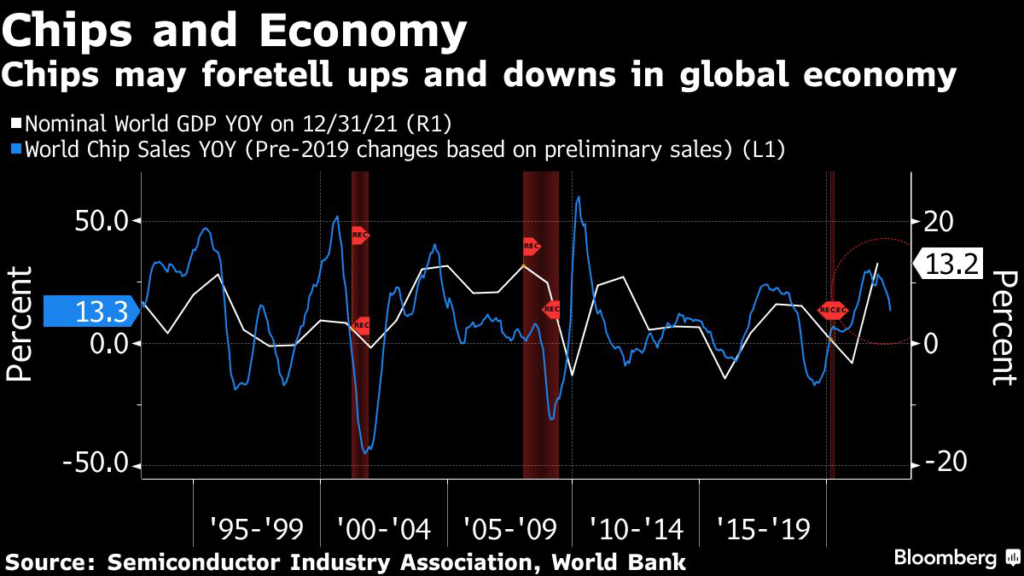
(Bloomberg) — World chip sales growth has decelerated for six straight months — yet another sign the global economy is straining under the weight of rising interest rates and mounting geopolitical risks.

Semiconductor sales rose 13.3% in June from a year earlier, down from 18% in May, data from the global peak industry body showed. The current slowdown is the longest since the US-China trade war in 2018.

The three-month moving average in chip sales has correlated with the global economy’s performance in recent decades. The latest weakness comes as concern about a worldwide recession has prompted chipmakers like Samsung Electronics Co. to consider winding back investment plans.

Semiconductors are key components in a world that’s increasingly reliant on digital products and services, particularly during the pandemic when a lot of work and schooling was conducted remotely.

Chip sales started to cool as central banks began scrambling to raise interest rates to combat spiraling inflation and Russia’s war on Ukraine and prolonged Covid lockdowns in China prompted a rapid reversal in the international outlook. 

A Bloomberg Economics global tracker shows the prospects for the world economy have deteriorated rapidly this year, coinciding with chip sales beginning to slow.

Signs of an international downturn are also observed in trade data from South Korea, the world’s biggest producer of memory chips. Growth in chip exports eased to 2.1% in July from 10.7% in June, the fourth straight monthly slowing. In June, semiconductor stockpiles rose by the most in more than six years.

It’s a similar story in Taiwan, which is another key player in electronics supply chains. Latest data indicate manufacturing on the island contracted in June and July, while production and demand slumped, with new export orders registering the biggest fall.

The weakening momentum in these two canaries in the global coal mine is partly due to a slowing economy in China, which continues to impose lockdowns under its Zero-Covid policy. China’s factory activity unexpectedly contracted in July and property sales continue to shrink. 

In the US, gross domestic product has fallen for two straight quarters, though the National Bureau of Economic Research refuses to call it a recession. In Europe, factory activity plunged in June, further darkening the outlook for both the continent and the wider world.

Nonetheless, the International Monetary Fund still sees a global expansion this year, and slowing chip sales don’t automatically indicate a recession is imminent. 

But they offer a glimpse into the health of an international economy that relies heavily on the tiny components to manufacture everything from cars to smartphones to computers.

The peak world body — the Washington-based Semiconductor Industry Association — says it represents 99% of the US chip industry by revenue and almost two-thirds of non-US chip firms. The sales it releases are compiled by World Semiconductor Trade Statistics.

More stories like this are available on bloomberg.com

©2022 Bloomberg L.P.

Coinbase’s BlackRock Pact Cements Crypto Status, Hits Shorts

(Bloomberg) — The crypto winter that has dogged Coinbase Global Inc. for nearly nine months might finally be showing signs of thawing.

Shares of the largest US cryptocurrency exchange gained 10% on Thursday, after earlier surging as much as 44%, following its announcement that it was partnering with BlackRock Inc. to help institutional investors manage and trade Bitcoin. The rally was its third straight day of gains and set it up for a record weekly jump.

For Coinbase investors, the news is a much-needed signal that its status as a giant in the crypto sector remains rock solid. To be sure, shares are still deeply in the red this year, down more than 64%.

“After this validation, it is possible that Coinbase will be able to partner with more traditional financial industries,” said Owen Lau, an analyst at Oppenheimer & Co. “It shows that even with the size of BlackRock, they are going to partner with a crypto-native company, rather than building their own capabilities.”

READ: BlackRock Teams Up With Coinbase in Crypto Market Expansion (1)

The sudden surge added almost $2 billion in value to the company’s market capitalization, nearly bringing it back above $20 billion for the first time since mid-May. While that’s more than double the size of rival Robinhood Markets Inc., it’s a far cry from the peak valuation near $75 billion from November, when Bitcoin was trading at a record high.

The company has faced a wave of headwinds in recent months as its trading volumes dwindled amid a plunge in the price of Bitcoin and other digital tokens. It’s also facing a probe from the US Securities and Exchange Commission into whether it improperly lets US customers trade assets that should have been registered as securities.

Short sellers, meanwhile, are taking a beating as the stock extends its sharp rebound from July. While shorts are still up more than $800 million this year in mark-to-market profits, those returns are 40% lower than they were prior to Thursday’s jump, according to S3 Partners’ managing director of predictive analytics Ihor Dusaniwsky. “We expect continued short covering in Coinbase as BlackRock’s announced partnership puts a python-like squeeze on short sellers,” he said.

Shares sank more than 21% on July 26 after funds controlled by Cathie Wood sold roughly $1.4 million of stock in the company holdings, worth about $75 million at the time. 

Thursday’s move is also notable because it comes on a day when prices of Bitcoin, Ether and other popular digital assets were all lower. The stock has mostly maintained a tight correlation to the world’s largest cryptocurrency since it began trading last year.

Other cryptocurrency-related stocks were also higher following the BlackRock deal, with firms including Marathon Digital Holdings Inc. and Silvergate Capital Corp. rising at least 1%.

“This is much-needed positive news for crypto traders and should provide some optimism for the longer-term health of the cryptoverse,” said Ed Moya, senior market analyst at Oanda. “Calls that crypto is dead have been overdone.”

(Adds chart, updates with closing prices throughout.)

More stories like this are available on bloomberg.com

©2022 Bloomberg L.P.

Blizzard, NetEase Scrap Warcraft Mobile Game After Financing Dispute

(Bloomberg) — Activision Blizzard Inc. and NetEase Inc. have torpedoed a World of Warcraft smartphone game that had been in development for three years, raising questions about one of the industry’s most lucrative business relationships.

NetEase has disbanded a team of more than 100 developers tasked with creating content for the title, only some of whom were offered internal transfers, people familiar with the matter said. The two companies disagreed over terms and ultimately called a halt to the project, which had been kept under wraps, a person familiar with the deal said, asking to not be identified discussing private information.

The day after this story was published, a spokesperson for Activision said there had not been a financial disagreement between the two companies. “We continue to have an extremely successful relationship with NetEase, and it is entirely untrue to suggest that there have been financial disputes,” the spokesperson said in a statement. A spokesperson for NetEase declined to comment.

The decision casts uncertainty over Blizzard’s partnership with China’s No. 2 gaming giant, which affords the US studio a valuable window into the world’s biggest mobile market. Hangzhou-based NetEase publishes World of Warcraft and other Blizzard franchises in the country and is also a co-creator of the recently released Diablo Immortal, which is on track to become a commercial success despite criticism about its in-game purchases. 

The now-canceled title, code-named Neptune, was envisioned as a massively multiplayer online role-playing game set in the same universe as World of Warcraft. It wouldn’t be a direct translation of the popular online game but a spinoff, set during a different time period.

NetEase’s shares slid as much as 3.1% in Hong Kong on Wednesday, while the Hang Seng Tech Index climbed 1.8%.

Read more about Activision Blizzard’s earnings 

Activision Blizzard’s foray into mobile was one of the driving factors behind Microsoft Corp.’s $69 billion acquisition of the US gaming powerhouse, which has faced allegations of sexism. In May, the Blizzard subsidiary unveiled an upcoming mobile game set in the Warcraft universe — a strategy title called Warcraft Arclight Rumble that resembles Supercell Oy’s popular Clash Royale. 

Yet Blizzard’s mobile initiatives have not all been successful. The company also canceled another Warcraft-based project, an augmented-reality game similar to Pokémon GO, Bloomberg News has reported. That game, code-named Orbis, had been in development for more than four years.

World of Warcraft was released in 2004 and remains one of the biggest cash cows for Activision Blizzard and NetEase, which has been the game’s Chinese distributor since 2009. Its next expansion, Dragonflight, is planned for release later this year.

Chinese game developers have shown themselves adept at making global mobile hits such as PUBG Mobile, AFK Arena and Genshin Impact. Tencent Holdings Ltd., NetEase’s much bigger rival, has adapted the Call of Duty franchise for mobile in partnership with the main Activision division of the corporation.

(Updates with Activision comment in the third paragraph)

More stories like this are available on bloomberg.com

©2022 Bloomberg L.P.

Lightspeed’s CEO Calls Its Commerce Platform ‘Recession-Proof’

(Bloomberg) — Lightspeed Commerce Inc’s top boss is predicting an almost 40% jump in sales this year, leaving the technology firm well-placed to weather a recession. Investors seem a little less optimistic.

“We’re going to do $760 million this year,” Jean-Paul Chauvet said in an interview with Bloomberg. That revenue figure would be almost 40% higher than the previous fiscal year. “While the rest of the world is lowering their guidance, we’re very confident we’re going to be hitting our guidance.”

Lightspeed shares fell more than 13% Thursday, after posting earnings that were slightly better than analysts expected.

The Montreal-based firm provides cloud-based point-of-sale software, but doesn’t consider itself a pure e-commerce company since 90% of its gross merchandise value comes from physical retailers and restaurants. Its platform offers in-store and online payment processing, accounting and multichannel management solutions. Revenues come from subscriptions, transactions and hardware.

Many e-commerce companies did well during the early part of the pandemic as consumers turned to online shopping. At the same time, Lightspeed’s bricks-and-mortar customers were hit by store closures. Despite this, the company still managed to “show very strong growth,” according to its CEO. He says a 10% decline in the retail and hospitality industry induced by an economic downturn would not compare to the stress caused by Covid.

With a recession potentially looming, Chauvet says Lightspeed offers an opportunity for merchants to do more with less in bad macroeconomic conditions. “The only way you can overcome having less people and still running your business is by adopting technologies like ours. That automates a lot of all the manual processes inside of the stores.”

While tech companies such as Shopify Inc. recently lowered forecasts and announced layoffs, Lightspeed is looking to fill 300 jobs worldwide. 

A return to in-person shopping and dining “should serve as a meaningful tailwind going forward,” Raimo Lenschow, a software equity analyst with Barclays wrote in report after the results. “Given this expected growth, shares seem undervalued to us at around four times the current year 2023 sales, and hence we maintain our overweight rating,” he wrote.

Breaking Even

Shares of Lightspeed have never recovered from a short seller report published by Spruce Point Capital Management in September 2021, despite the fact that 16 out of 18 analysts now recommend buying stock. “A report full of inaccuracies,” Chauvet said, repeating comments he has previously made about the report.

For a 14th time since its first initial public offering on the Toronto Stock Exchange in 2019, Lightspeed beat revenue estimates during the first quarter of fiscal 2023, with sales of $173.9 million, up 50% year-over-year and slightly ahead of forecasts. While it posted a $100.8 million net loss, Chauvet insists on “removing the noise” and taking into account recent mergers and acquisition-related costs and share-based compensation.

The company posted an adjusted loss, before interest, taxes, depreciation and amortization, of $15.6 million in the quarter, a little less than analysts expected, and expects to post a full-year adjusted loss of $35 million to $40 million. “That number, we have committed for next fiscal year to not be negative anymore,” he said.

Read more: Lightspeed Founder Dasilva Steps Down; Chauvet Rises to CEO

“Lightspeed guidance is conservative,” National Bank analyst Richard Tse said in a report titled: “Beyond the Headlines. “We continue to believe Lightspeed is an early-stage growth name that’s gaining momentum (market share) through a combination of complementary organic and acquisition measures.”

Business to Business

During the quarter, Lightspeed focused on launching its B2B network, following the acquisition of the wholesale e-commerce platform NuORDER. The goal is to connect brands and retailers in fashion, outdoor and sporting goods.

“When you look at how retailers orders from their suppliers, it’s all broken,” Chauvet said. “It’s Excel sheets, pen and paper, no visibility, distribution networks that are wrong, and that’s what we want to solve.”

Lightspeed intends to invest heavily in automating the retail supply chain this year and next year and expects good results in 2025 with its omni-channel commerce platform, he said.

More stories like this are available on bloomberg.com

©2022 Bloomberg L.P.
Australia Stock Exchange’s Blockchain Project Hits Another Snag

(Bloomberg Law) — The Australian Stock Exchange’s plan to replace its main trading applications with a blockchain-based system has hit another snag, and the market operator’s new CEO is bringing in consulting giant Accenture to study the project.

“ASX and Digital Asset, our application software provider, have identified that more development is required than previously anticipated to meet ASX’s scalability and resilience requirements for the application,” the exchange, known as ASX, said in a statement Wednesday.

It now says it doesn’t expect the changeover, already delayed twice this year, to go live “before late 2024.”

  • The project to replace the exchange’s aging CHESS clearing and settlement system with distributed ledger technology ranks among the highest-profile blockchain projects in finance.
  • Accenture will “bring external expertise to assess the remaining work required to complete delivery of the application,” ASX said. The findings of the consulting firm’s independent review will be released to the public, it said.
  • The announcement came after Helen Lofthouse took over from Dominic Stevens as ASX’s managing director and CEO on Aug. 1. “In bringing a fresh set of eyes, Helen is seeking an independent assessment of the new application and the remaining deliverables, and supports a process that will strengthen stakeholder confidence,” the statement said.

To contact the reporter on this story: David Jolly in Washington D.C. at djolly@bloombergindustry.com

To contact the editors responsible for this story: Meg Shreve at mshreve@bloombergindustry.com; Alex Clearfield at aclearfield@bloombergindustry.com

More stories like this are available on bloomberg.com

©2022 Bloomberg L.P.

Plastiq to Merge With Colonnade SPAC in $480 Million Deal

(Bloomberg) — Payments provider Plastiq Inc. has agreed to go public via a merger with Joseph Sambuco’s blank-check firm.

Plastiq’s tie-up with Colonnade Acquisition Corp. II will create a company with a value of about $480 million, including debt, according to a statement Thursday.

Founded in 2012, Plastiq offers payments services to small and midsize businesses. The company, whose backers include Kleiner Perkins, B Capital Group and Khosla Ventures, is forecasting revenue of $75 million for this year. 

Eliot Buchanan, Plastiq’s founder and chief executive officer, will continue to lead the company along with existing management. 

Buchanan said in an interview that the firm had met Colonnade executives over a year ago when Plastiq was approached by several SPACs. Though Plastiq continued to stay private for the year to ride out the high valuation wave, Buchanan remained in talks with Sambuco.

“It’s not their first SPAC, which is helpful,” Buchanan said. “The other thing is just their belief and commitment to price the deal in the right way, and the right way doesn’t mean the most.”

Plastiq’s last disclosed valuation was in late 2019 at around $495 million. The company hopes to continue rolling out its software as a service products after going public, Buchanan said.

Colonnade Acquisition Corp. II listed in March 2021. The special purpose acquisition company is led by Sambuco, a former Lazard Ltd. real estate specialist who went on to found Colonnade Properties.

(Updates with CEO’s comments in fifth paragraph.)

More stories like this are available on bloomberg.com

©2022 Bloomberg L.P.
Equifax May Face Class-Action Suit After Credit-Score Glitch

(Bloomberg) — Equifax Inc., the second-biggest global credit bureau, was hit with a proposed class-action lawsuit after a report that it provided inaccurate credit scores on millions of US consumers looking for loans.

The suit, filed Wednesday in federal court in Atlanta, alleges violations of the Fair Credit Reporting Act. It seeks financial damages and a court order requiring Equifax to notify all customers who were impacted by the score-reporting glitch, which the Wall Street Journal reported Aug. 2.

“We believe that many of the people impacted — some of whom may still be unaware of what happened — suffered severe financial consequences,” John Morgan and John Yanchunis, the attorneys who filed the suit, said a statement.

Erroneous scores were sent from mid-March through early April, and disclosures of the errors began in May, the Wall Street Journal reported. Equifax blamed a computer error that has since been rectified.

Equifax, in a statement Thursday, said the three-week “technology coding issue” was fixed on April 6. The company said its analysis showed that during that period there was “no shift in the majority of scores” for consumers seeking credit. 

“For those consumers that did experience a score shift, initial analysis indicates that only a small number of them may have received a different credit decision,” according to the statement. “While the score may have shifted, a score shift does not necessarily mean that a consumer’s credit decision was negatively impacted.” 

The lead plaintiff in the suit is a Florida woman who alleges she was forced to take a less-favorable auto loan in April as a result of an inaccurate credit score. The suit claims she’s now paying about $150 a month extra.

Bloomberg Intelligence analyst Nathan Dean reported the fallout from the glitch may be limited.

Read More: Equifax Says Consumer Credit Scores Changed by Computer Error

The case is Nydia Jenkins v. Equifax, 1:22-cv-03072, US District Court, Northern District of Georgia (Atlanta).

(Updates with Equifax comment.)

More stories like this are available on bloomberg.com

©2022 Bloomberg L.P.
Tumultuous Era for TIPS Accommodates More Electronic Cash Flows

(Bloomberg) — The stark reversal of fortune for Treasury Inflation-Protected Securities this year is playing out in a much more automated trading landscape than when inflation was low, according to Tradeweb Markets Inc.

The past year’s surge in demand for inflation protection wrought changes in the market that should persist even if the Federal Reserve succeeds in restoring price stability, the firm argues in a blog post.

While TIPS liquidity “still notably lags” compared with nominal Treasuries, “significant investments in infrastructure by TIPS liquidity providers over the last several years” are making a measurable difference, Tradeweb says. The company operates a leading electronic trading platform for US government bonds.

In particular:

  • In the request-for-quote (RFQ) trading protocol, dealer response times of under a second have increased to around 70% from around 50% in mid-2021, the approximate level since early 2020, “a clear sign of auto-quoting,” Tradeweb says
  • On the customer side, there’s been an increase in auto-execution trades suggesting “that the market is getting comfortable enough with TIPS liquidity to ‘set it and forget it’ through automation”
    • Percentage of tickets executed via Tradeweb’s automated-execution engine AiEX exceeds 20%, up from closer to 10% in 2020
  • Number of trades by institutional clients on Tradeweb platform more than doubled over 2016-2021, “with notable growth happening this year”
  • TIPS market growth is also driving liquidity improvements, Tradeweb says; issuance increased 29% between 2016 and 2021, and New York Fed’s primary dealer statistics show average daily volumes up 34% over the same period

At the same time, the broader Treasury market is experiencing liquidity erosion associated with Fed policy shifts, and TIPS are subject to some of the same dynamics.

TIPS — which pay interest at lower rates than regular Treasury securities on principal that’s indexed to the US Consumer Price Index, making holders indifferent to inflation — remain a much smaller market, equal to less than 8% of Treasury debt outstanding. 

The return of inflation in the US last year — and its unexpected failure to abate — pulled money into the asset class. As a proxy, shares outstanding in the main exchange-traded fund for TIPS nearly doubled from April 2020 to January 2022. 

At the same time, the Fed’s purchases of Treasuries from March 2020 to March 2022 increased its TIPS holdings by $256 billion, exceeding the $195 billion of net issuance over the same period.

The steep ramp-up in demand from two price-insensitive buyers — ETFs and the Fed — was a big change for the TIPS market, which wasn’t accustomed to a lot of passive investment, and volumes surged.

Now, with the Fed hiking rates to rein in price increases that have sent headline CPI to the highest levels since early 1980s, inflation expectations have begun to fade, and the iShares TIPS Bond ETF has shrunk by nearly 15%.

Meanwhile, the central bank ended its purchases of Treasuries in March, and the US government continues to increase the supply of TIPS while shrinking the sizes of its nominal coupon sales.

(Adds TIPS market dynamics during pandemic era following bullets.)

More stories like this are available on bloomberg.com

©2022 Bloomberg L.P.

Stocks Waver on Fedspeak, Disappointing Earnings: Markets Wrap

(Bloomberg) — US stocks wavered on Thursday after a fresh batch of corporate earnings missed estimates amid a backdrop of aggressive interest-rate hikes by global central banks. The US yield curve remained inverted as recession fears persisted.

The S&P 500 fluctuated throughout the session as thin liquidity in the summer amplified market moves. The Nasdaq 100 swung between modest gains and losses. Both indexes were dragged down by the slump in Apple Inc. and Fortinet Inc.’s shares. The latter fell after trimming its service-revenue forecast. Eli Lilly & Co., which dropped after missing Wall Street expectations for second-quarter revenue, also weighed heavily on the S&P 500 Index.

Treasury yields wobbled, with the 10-year rate around 2.68% after pushing past 2.80% on Wednesday. US initial jobless claims rose slightly and are holding near the highest level since November, data showed Thursday.

A flurry of economic data that released this week assuaged fears of a downturn while hinting at stabilizing growth. But the bond market, especially the persistently inverted Treasury yield curve, is flashing warnings on the economy amid a global wave of monetary tightening. All eyes will be on the US jobs report on Friday for further clues about the Federal Reserve’s path of rate hikes. 

“There’s an intense tug-of-war happening in the economy and markets,” said Dan Suzuki, deputy chief investment officer at Richard Bernstein Advisors. “On one side, you have a narrative that reasonable growth is going to support continued inflation pressure and keep the Fed hiking. The other narrative is that slowing growth is going to ease inflation and allow the Fed to stop hiking.”

On Thursday, Cleveland Fed President Loretta Mester reiterated the central bank’s promise to bring down inflation by raising interest rates. Her counterparts, this week, have also been backing this hawkish stance, forcing markets to recalibrate after initially expecting a dovish pivot Fed Chair Jerome Powell hinted at last week.

US-China tension also remains among the uncertainties clouding the outlook. China likely fired missiles over Taiwan during military drills on Thursday, Japan said, part of Beijing’s biggest cross-strait exercises in decades after US House Speaker Nancy Pelosi visited the self-ruled island. 

West Texas Intermediate dropped below $90 a barrel, a level last seen in the weeks leading up to Russia’s invasion of Ukraine. Gold advanced and Bitcoin fell.

This week’s MLIV Pulse survey is asking about your outlook for corporate bonds, mergers and acquisitions and health of US corporate balance sheets through the end of the year. It takes one minute to participate in the MLIV Pulse survey, so please click here to get involved anonymously. 

What to watch this week:

  • US employment report for July, Friday

Some of the main moves in markets:

Stocks

  • The S&P 500 was little changed as of 2:32 p.m. New York time
  • The Nasdaq 100 rose 0.3%
  • The Dow Jones Industrial Average fell 0.2%
  • The MSCI World index rose 0.9%

Currencies

  • The Bloomberg Dollar Spot Index fell 0.5%
  • The euro rose 0.8% to $1.0247
  • The British pound rose 0.2% to $1.2171
  • The Japanese yen rose 0.6% to 133.04 per dollar

Bonds

  • The yield on 10-year Treasuries declined two basis points to 2.68%
  • Germany’s 10-year yield declined seven basis points to 0.80%
  • Britain’s 10-year yield declined two basis points to 1.89%

Commodities

  • West Texas Intermediate crude fell 2.1% to $88.72 a barrel
  • Gold futures rose 2% to $1,811.30 an ounce

More stories like this are available on bloomberg.com

©2022 Bloomberg L.P.

Electric Cars’ Surging Prices Mean Fewer Buyers Can Use Tax Credit

(Bloomberg) — Vehicle-price caps included in a push by US Senate Democrats to expand a popular consumer incentive for electric cars could put pressure on automakers to lower costs of upcoming plug-in models. 

A breakthrough deal between Senators Chuck Schumer and Joe Manchin would allow carmakers to keep offering up to $7,500 in tax credits for the purchase of new “clean cars.” The problem comes with Congress’s plan to restrict eligibility for the credits to EVs priced no higher $55,000 for new cars and $80,000 for pickups and SUVs — one way to ensure the benefit goes to consumers who need them most, instead of the wealthiest. 

Limits that may have seemed more reasonable a year ago look tight now that inflation and supply-chain disruptions have already pushed average EV prices beyond the range. To get the maximum benefit, automakers are going to have to expedite plans to build cheaper models, industry watchers say.

“EVs thus far have been purchased by the most affluent consumers and mostly expensive models,” said Michelle Krebs, executive analyst at Cox Automotive, which conducts market research for dealers. “To proliferate EVs, they need to cost less and be accessible to more consumers, either by price and/or incentives. In the future, automakers are promising less expensive EVs.”

The average transaction price of a new electric car was $66,997 in June, soaring almost 14% from a year earlier, according to Kelley Blue Book. The industrywide average that includes both traditional vehicles and EVs jumped 13%, to $48,043, in the same period.

Options Add Cost

Base models of the two most popular EVs in the US market would easily meet the eligibility limits set for the tax credits. Tesla Inc.’s Model Y SUV, which is currently the top-selling EV in the US, starts at $65,990. The best-selling electric sedan, Tesla’s Model 3, starts at $46,990. But many buyers prefer souped-up versions, prices of which could exceed the proposed limits.

Vehicle price isn’t the only limitation on the tax credits. Under the proposed legislation, a new-vehicle buyer’s eligibility would be capped at income levels of $150,000 for a single filing taxpayer and $300,000 for joint filers. For used-car purchases, the income caps would be $75,000 and $150,000 depending on filing status. 

The incentive also is contingent on new conditions that carmakers say will be hard for them to comply with right away: eligible EVs will need to be built with minerals that are extracted or processed in a country with which the US has a free trade agreement. and their batteries must include a large percentage of parts manufactured or assembled in North America. 

Read more: Carmakers blitz Congress to fix credit they can’t use

Some automakers who manufacture higher-end EVs, such as electric car maker Rivian Automotive LLC, are lobbying to extend the transition time before new limits on vehicle price and income for buyers take effect.

“As currently drafted, this legislation will pull the rug out from consumers considering purchase of an American-made electric vehicle,” Rivian said in a statement. The automaker markets an electric pickup and electric SUV with respective starting prices of $67,500 and $72,500 — meaning both could easily cross the limit once options are added.

Limits ‘Reasonable’

John Bozzella, chief executive officer of the Alliance for Automotive Innovation, said the idea of a price cap is reasonable though the proposed limits would make a “significant number” of EVs ineligible. He said carmakers are working to introduce more affordable EVs now that battery technology is improving. The battery and mineral requirements, however, should be phased in, he said. 

“We see significant entries coming at every price point that will provide an opportunity for Americans at every income level” to experience EVs, said Bozzella, whose alliance represents companies such as Ford Motor Co., General Motors Co., Stellantis NV, Honda Motor Co. and Toyota Motor Corp. “Average transaction prices are high right now, but that’s partly due to supply chain issues.”

Price has been the No. 1 obstacle to EV adoption cited by consumers in Cox Automotive’s research, Krebs said. “It had risen more as an obstacle since our study a couple years earlier.”

(Updates with chart and detail on Auto Alliance position on price caps starting in paragraph 11)

More stories like this are available on bloomberg.com

©2022 Bloomberg L.P.

Close Bitnami banner
Bitnami
