
Bloomberg

Dish Nears Launch of Mobile Carrier to Take on AT&T, Verizon

(Bloomberg) — Dish Network Corp. is another step closer to launching its new nationwide wireless service — Boost Infinite — after opening online customer sign-ups on Thursday. 

The company is taking the sign-ups on a new website that lets potential subscribers register for more information. It’s the latest move in what’s been a challenging transition from satellite-TV provider to 5G wireless company — a shift that accelerated when Dish acquired the prepaid mobile service Boost from T-Mobile US Inc. in 2020.

The company’s plan to take online sign-ups was earlier reported by Bloomberg, and the launch date of the website was moved up from Aug. 8 after the article was published.

Though Dish has already begun rolling out 5G in more than 120 cities, including Las Vegas and Albuquerque, New Mexico, the service was offered as a beta test. The new website signals that the company is closer to a true consumer launch. Even so, the sign-up page doesn’t let customers actually subscribe just yet — that’s scheduled to occur “fairly soon,” a person with knowledge of the plans said. 

The idea is to become a fourth national wireless carrier — alongside Verizon Communications Inc., T-Mobile and AT&T Inc. — but with lower prices. Boost Infinite is expected to target regular monthly customers who are looking for a cheaper alternative to the national brands. Dish hasn’t announced any pricing for the service yet.

Dish executives on an earnings call Wednesday provided few details about the launch of Boost Infinite, beyond saying that the service would be a challenger to the big three of the wireless industry.

“We have to be scrappier and more innovative and much more entrepreneurial,” Dish Chairman and co-founder Charlie Ergen said on the call. “I think you’ll see Boost and and Boost Infinite come up with creative things in the marketplace.”

After months of technical delays hampering its network expansion, Dish unveiled what was billed as the nation’s first cloud-based 5G wireless service in May. The trial service, located in Las Vegas, was called Project Genesis and offered unlimited data, text and calling for $30 a month. 

After acquiring Boost from T-Mobile two years ago, Dish struck network sharing agreements with the carrier and AT&T, helping it offer mobile service across the US. 

Ergen said in May that the cloud-based wireless network will attract as many as 40 million subscribers and lift Dish’s annual revenue above $30 billion. In June, Dish said that it had met a US deadline to have its 5G network available to at least 20% of the population. 

Dish holds a stockpile of wireless airwave licenses and is building what it refers to as a more nimble, software-run network that it can outperform those operated today by the three major US carriers.

Plans for the new monthly 5G service were disclosed a year ago by Stephen Stokols, chief executive officer of Dish’s Boost Mobile unit. Dish says it will undercut the competition through “disruptive” pricing, a potentially well-timed move as larger rivals are raising rates and fees.  

One early drawback to the Boost Infinite service is that, for now, subscribers will need to buy a $900 Motorola Edge+ phone to get connected to Dish’s new network. More phones that are compatible with the system are expected in the third quarter, Dish told analysts Wednesday.

(Updates with company launching sign-ups early after Bloomberg article was published.)

More stories like this are available on bloomberg.com

©2022 Bloomberg L.P.

CME Unveils Plans for Bitcoin and Ether Futures Tied to Euro

(Bloomberg) — One of the world’s largest derivatives exchange owners is forging ahead into the cryptocurrency market with two new futures offerings.

CME Group Inc. will introduce Bitcoin and Ether Euro futures on Aug. 29, the company announced Thursday in a press release. They arrive as the crypto market falters. Bitcoin is down about 50% so far this year, while the second largest crypto Ether is down 56%.

Futures contracts, tradeable derivative agreements, helps investors tap into volatile markets like crypto and allows traders to hedge their cash positions in digital currency. 

“Ongoing uncertainty in cryptocurrency markets, along with the robust growth and deep liquidity of our existing Bitcoin and Ether futures, is creating increased demand for risk management solutions by institutional investors outside the US,” Tim McCourt, global head of equity and FX products at CME, said in a statement. 

The current crypto derivative market holds massive volumes dwarfing spot trading. Binance, the world’s largest crypto exchange where derivatives trading takes place, had volumes of over $51 million in the last 24 hours, according to CoinMarketCap data.

“Euro-denominated cryptocurrencies are the second highest traded fiat behind the US dollar,” McCourt said. “Year-to-date, the EMEA region represents 28% of total Bitcoin and Ether futures contracts traded, up more than 5% versus 2021.”  

Bitcoin derivative products often create more volatility in the crypto market, as futures contracts can intensify price increases and decreases. For instance, when Bitcoin plunged as much as 30% one day in May 2021, leveraged-up positions in futures and options were wiped out, with the expected consequence of amplifying the selloff as they had boosted the rally earlier.

CME’s latest futures products will be sized at five Bitcoin and 50 Ether per contract, which will be settled by cash using the daily CME CF Bitcoin-Euro Reference Rate and CME CF Ether-Euro Reference Rate, respectively, according to the company. Both are pending regulatory review.

The crypto futures market is dominated by CME Group and Cboe Global Markets Inc., which announced plans to enter the Bitcoin futures market in early 2017 before CME.

More stories like this are available on bloomberg.com

©2022 Bloomberg L.P.

Venture Financing Gets Another Female CEO With Panich at SCB 10X

(Bloomberg) — Mukaya Panich has been named chief executive officer at SCB 10X, the digital technology investment and venture capital arm of Thailand’s SCB X, making her one of the few women to take a top position in the field.

Panich joined SCB 10X in early 2020 as chief venture and investment officer and will continue to hold those titles along with CEO, according to a statement from the company Thursday. Pailin Vichakul, SCB 10X’s partner and head of strategic planning has been promoted to chief operating officer and will report directly to Panich, according to the statement.

The venture-investing field is seeing increased gender diversity, but numbers of women are still low. About 15.4% of general partners in the US were women as of Sept. 30, according to a report from Pitchbook, though that’s up from 12% as of November 2019.

Under Panich, SCB 10X will continue to focus on venture capital and venture building in areas like blockchain, decentralized finance, Web3, the metaverse and Deep Tech, the company said in the statement. 

“We would like to bring blockchain and crypto to connect with real-world use cases and want to continue to find ways to integrate DeFi” with traditional finance,” Panich said in a message Thursday.

More stories like this are available on bloomberg.com

©2022 Bloomberg L.P.

BlackRock Teams Up With Coinbase in Crypto Market Expansion

(Bloomberg) — BlackRock Inc. is partnering with Coinbase Global Inc. to make it easier for institutional investors to manage and trade Bitcoin, taking the world’s largest asset manager into a cryptocurrency market hammered by plunging prices and government investigations.

Coinbase surged 15% to $92.61 at 1:20 p.m. in New York. The partnership with BlackRock provides some relief for the biggest US crypto-trading platform, whose stock had lost more than two-thirds of its value this year through Wednesday.

Top BlackRock clients will be able to use its Aladdin investment-management system to oversee their exposure to Bitcoin along with other portfolio assets such as stocks and bonds, and to facilitate financing and trading on Coinbase’s exchange, according to a statement Thursday. The focus of the partnership with Coinbase, the biggest US crypto-trading platform, “will initially be on Bitcoin,” BlackRock said.

BlackRock’s move deepens the involvement of Wall Street’s traditional financial players in crypto and related technologies, even after this year’s meltdown in such assets. Bitcoin has lost about half of its value in 2022, while the collapse of the Terra ecosystem and hedge fund Three Arrows Capital have raised questions about the resilience of the market and prompted increased regulatory scrutiny. 

Read more: Terra Co-Founder’s Home Raided as Korea Widens Crypto Probe

Coinbase is facing a probe by the US Securities and Exchange Commission into whether the company let Americans trade digital assets that should have been registered as securities. BlackRock chose to partner with Coinbase because of its scale in the market and role in providing trading, custody services, prime brokerage and reporting capabilities. The services will be available for clients of both companies.

The regulatory risks from the partnership are manageable because it’s starting with Bitcoin, which has clearer regulatory status in Washington than other digital assets, said Oppenheimer & Co. analyst Owen Lau, who has the equivalent of a buy rating on Coinbase shares.

The partnership is “a validation of the future of blockchain and digital assets and also a validation of Coinbase’s reputation,” Lau said in a phone interview. “It’s a big plus for the industry and also for Coinbase.”

See also: Coinbase’s BlackRock Pact Reinforces Crypto Status, Burns Shorts

The announcement shows sophisticated investors are growing more comfortable with the crypto market. 

“Our institutional clients are increasingly interested in gaining exposure to digital-asset markets and are focused on how to efficiently manage the operational life cycle of these assets,” Joseph Chalom, BlackRock’s global head of strategic ecosystem partnerships, said in the statement.

Institutional investors accounted for about three-quarters of the $309 billion in trading volume on Coinbase in the first quarter, the company disclosed in May. Coinbase clients include hedge funds, corporate treasuries and asset managers.

“The Coinbase partnership between BlackRock and Aladdin is an exciting milestone for our firm,” Brett Tejpaul, head of Coinbase Institutional, and Greg Tusar, vice president of institutional product, said in a separate statement. “We are committed to pushing the industry forward and creating new access points as institutional crypto adoption continues to rapidly accelerate.”

For BlackRock, the partnership is the next step in a wider strategy to expand into digital assets. Chief Executive Officer Larry Fink said in March that the firm was studying the growing importance of digital assets and stablecoins and how they can be used to help clients. The following month, the company joined a group of investors in Circle Internet Financial, the issuer of USD Coin, and said it would seek to serve as a primary manager of the stablecoin’s cash reserves.

(Updates share price in second paragraph, Oppenheimer analyst starting in sixth.)

More stories like this are available on bloomberg.com

©2022 Bloomberg L.P.

Nikola Sales Gain Despite Battery Crunch Pressuring Deliveries

(Bloomberg) — Nikola Corp. reported its first meaningful revenue but said deliveries of battery-electric trucks this year will be at the lower end of guidance on poor battery supply.

Sales in the second quarter were $18.1 million, the Phoenix-based company said Thursday in a statement, beating analysts’ expectations. Nikola also reported a narrower-than-expected loss of 25 cents a share.

While Nikola reaffirmed its big-rig delivery forecast for the year, the company is “more likely” to be near the bottom of the range of 300 to 500, Chief Financial Officer Kim Brady said on a conference call with analysts. Nikola built 50 battery-electric semis in the quarter, the low end of its prior guidance of as many as 60. It also delivered 48 to dealers, missing its own forecast. 

Nikola’s shares rose 3.6% at 12:51 p.m. in New York. The stock declined 24% this year through Wednesday’s close, but has recovered in recent weeks from a June low of $4.72.

The startup sees itself as a leader in clean-energy heavy vehicles in a high-potential field for zero emissions trucks that includes other aspirants such as Tesla Inc. and legacy players like Volvo AB. At the same time, Nikola has been trying to repair its reputation after paying a $125 million penalty to US regulators for allegedly misleading investors and dealing with the delayed launch of a battery-electric truck.

Nikola expects production to ramp meaningfully in the second half of the year, Brady said. Nikola aims to deliver between 65 and 75 trucks this quarter. The company would need to increase deliveries to around 200 in the final quarter of the year to hit the lower end of the guidance range. Production is being inhibited by delayed supply of batteries from existing supplier Romeo Power, which Nikola announced it would buy earlier this week.

Read more: Nikola Buys Battery Maker Romeo at 11% of SPAC Valuation 

The company also announced the location of three hydrogen-fueling stations in California, a launch market for its fuel-cell powered trucks. The sites are in Colton, Ontario and a location servicing the Port of Long Beach. Nikola has long held plans to build a nationwide series of stations for FCEV semis. However, it’s encountered multiple hurdles in breaking ground and confirming sites, despite agreements with corporate partners. 

Nikola ended the quarter with $529.2 million of cash and restricted cash on its balance sheet. The company also has the ability to call on $312.5 million from an equity-line-of-credit agreement it has with Tumim Stone Capital.

Capital Raise

On Tuesday, shareholders approved the issuance of new shares to potentially allow the company to raise capital. That vote had been postponed several times as retail investors, which are a sizeable slice of the investor base, failed to submit their proxy votes.

The startup began generating its own funds after initiating production of trucks it could actually sell in March, with revenue from those vehicles now showing up in the company’s earnings statement.

Trevor Milton, Nikola’s founder and former executive chairman, goes on trial next month to face charges of allegedly making false and misleading statements about the company’s technological capability and business prospects when he was at the helm. He resigned from Nikola in 2020 and was subpoenaed as part of an investigation by the Department of Justice. 

More stories like this are available on bloomberg.com

©2022 Bloomberg L.P.
Fake Rubio Letter Part of Pro-China Campaign, Report Says

(Bloomberg) — Multiple news websites and social media accounts that claim to be independent have links to a Chinese public relations firm, according to the security firm Mandiant Inc. Some of them have allegedly published fabricated content, including a fake letter from a US senator.

Mandiant said it detected 72 news sites and several social media accounts that are part of an propaganda effort intended to “disseminate content strategically aligned with the political interests of the People’s Republic of China.” The campaign focused on political enemies of the Chinese government, the Xinjiang region and criticism of the U.S., the report said.

The websites, which present themselves as U.S. news outlets, were built using Chinese code, according to the report. Mandiant announced in March that it is being acquired by Google, a deal that is expected to close by the end of the year.

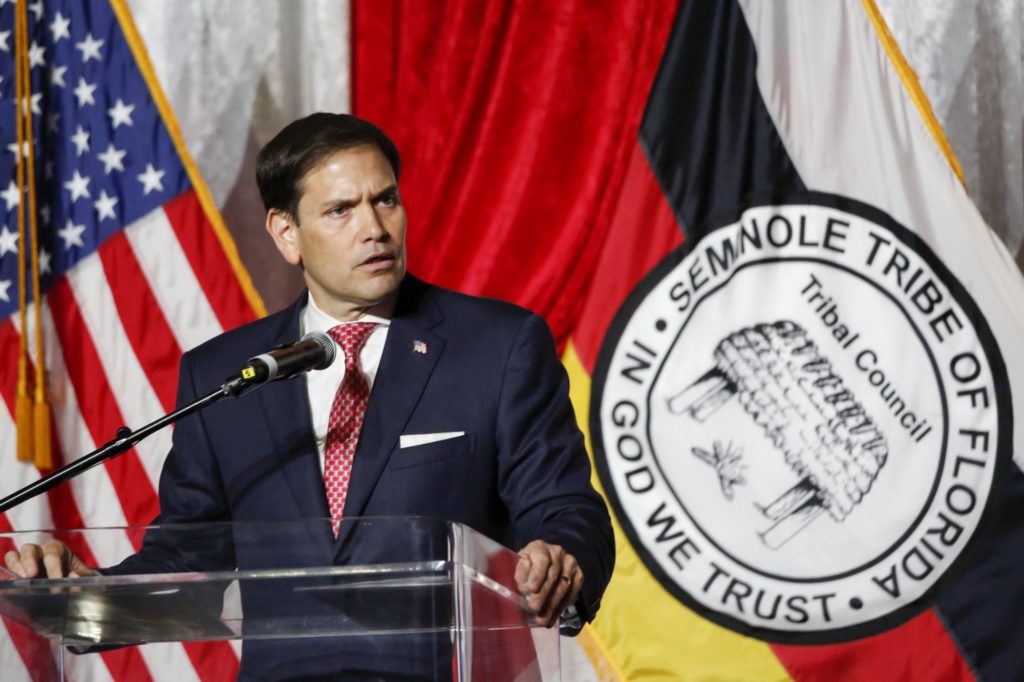
In one instance, a Twitter account linked to the campaign posted a fabricated letter purporting to come from the office of US Senator Marco Rubio, the Republican from Florida. It was addressed to Adrian Zenz, a prominent critic of the Chinese government’s systematic imprisonment of Uyghurs in Xinjiang. The letter falsely claimed that Zenz received financial support from Rubio and right-wing political operative Steve Bannon.

The Chinese Embassy in the US didn’t respond to a request for comment. 

“I am not surprised that I was targeted by China once again,” Rubio said, in a statement provided to Bloomberg News. “It is important to expose these networks. Even sloppy efforts can cause confusion, and you can be certain the Chinese Communist Party will continue to slander its opponents in increasingly sophisticated ways.”

Zenz said the letter was bogus. “Attacking my motivation has been a primary strategy of the Chinese state because they cannot successfully attack my research, which is almost entirely based on their own documentation,” he said, in a message to Bloomberg.

The campaign, which Mandiant dubbed HaiEnergy, wasn’t particularly successful, failing “to generate substantial engagement outside of the inauthentic amplification that we have identified,” the researchers said. What makes this campaign stand out among past information operations linked to China is the involvement of a public relations firm, Mandiant said. The report didn’t directly link any of the inauthentic activity to the Chinese government.

The public relations firm, Shanghai Haixun Technology Co., hosted the domains used in the campaign, according to Mandiant, though researchers couldn’t determine if the Chinese firm was aware of the full extent of the propaganda effort. On its website, Haixun offers content creation for “positive energy” geared toward English-speaking audiences. It purports to offer content creation in over 40 different languages.

A representative for Haixun said Mandiant’s claims were “nonsense” and that the campaign described in the cybersecurity firm’s report didn’t exist. Haixun was just a media distribution platform that worked with Chinese companies, the representative said when reached by phone. 

China’s government has repeatedly denied claims it was behind cybersecurity attacks, saying the US was a bigger violators.

“We do know now that the private sector is involved to some extent in this game,” said John Hultquist, vice president of intelligence analysis at Mandiant. “Even though right now this isn’t the most effective program, they’re clearly invested in it, and I think that the geopolitical realities are such that we have to keep a close eye on it.”

By leveraging a public relations firm to publish inauthentic articles and social media posts, Hultquist said, it gives the perpetrators the ability to obscure their responsibility. “I think more and more players are going to rely on firms like this to do these types of operations,” he said.

(Updates with comment from Adrian Zenz in seventh paragraph.)

More stories like this are available on bloomberg.com

©2022 Bloomberg L.P.

Schibsted Prepares Sale of Loan Marketplace Lendo

(Bloomberg) — Schibsted ASA, the largest Scandinavian media group, is preparing to kick off a sale of its Lendo fintech business, people with knowledge of the matter said. 

Schibsted is working with Citigroup Inc. to gauge interest in Lendo, operator of Sweden’s biggest loan-comparison website, following a strategic review of the business, the people said. It plans to start formally soliciting bids after the summer, according to the people, who asked not to be identified because the information is private. 

Lendo’s marketplace allows visitors to shop for everything from consumer and business loans to credit cards and mortgages. It started in Sweden in 2007 and expanded into other Nordic countries as well as southern Europe. The business may fetch as much as 450 million euros ($458 million) in a sale, the people said. 

Schibsted’s A shares jumped as much as 6.7% on Thursday, the biggest intraday gain in more than four months. They were up 5.6% at the close Thursday in Oslo.

The sales process is kicking off in the face of market volatility and tightening credit conditions, which are crimping mergers and acquisitions volumes more broadly. Lendo could attract interest from industry players as well as private equity funds, the people said. Technology-focused buyout firm Silver Lake agreed in June to buy Facile.it, Italy’s largest price-comparison website, from a consortium including EQT AB. 

Schibsted controls some of the top newspapers in Norway and Sweden including Aftenposten, Verdens Gang and Svenska Dagbladet. Its portfolio also includes a number of digital marketplaces as well as a significant stake in Adevinta ASA, the $9.7 billion online classifieds business. 

An outright sale of Lendo “would be an encouraging development, given question marks over its synergies with the company’s core business,” Tom Ward, an analyst at Bloomberg Intelligence, wrote in a research note Thursday. 

A deal valued at 450 million euros would represent about 24 times the unit’s earnings before interest, taxes, depreciation and amortization, he said. Any divestment could provide a significant windfall that would comfortably bring Schibsted’s debt ratio into the lower half of the company’s target range, according to Ward. 

“A move of this kind could open up capacity for bolt-on M&A to bolster the key marketplace arm,” Ward added. 

A spokesperson for Schibsted said the company has been running a strategic review of Lendo to maximize its potential, and it’s progressing according to plan. Schibsted expects “to have more visibility on the outcome by the end of the year,” the spokesperson said, declining to comment further. A representative for Citigroup declined to comment. 

(Updates with share movement in fourth paragraph, analyst comments from seventh paragraph.)

More stories like this are available on bloomberg.com

©2022 Bloomberg L.P.
Bitcoin Gains Spur Miners to Turn On Rigs in Midst of Heat Wave

(Bloomberg) — A rise in the price of Bitcoin has prompted some miners of the cryptocurrency to switch on more rigs over the last two weeks even with much of the US still caught in a heat wave that boosted demand for electricity. 

The mining difficulty rate, which indicates the amount of computing power of the banks of computers used to generate Bitcoin, rose by 1.7% in the last two-weeks, according to blockchain network data released Thursday. The previous bi-weekly adjustment rate dropped to its lowest since nearly a year ago as miners turned off rigs. Electricity is one of the biggest expenses for miners.

While many Bitcoin miners shuttered operations as electricity prices soared amid the heat wave, the rebound in Bitcoin prices over the period boosted mining revenue and prompted more miners to turn back on their machines. Bitcoin has risen 6.2% to around $22,930 since July 7.

“The Bitcoin price increase has led to increased profitability for miners and some miners who were pushed offline in June and July have likely plugged in their machines again,” said Jaran Mellerud, crypto-mining analyst at research firm Arcane Crypto.

Bitcoin miners have flocked to the southern states such as Texas and Georgia, where they typically benefit from lower priced energy and looser regulations. A record heat wave in Texas in early July resulted in a power crunch that pushed nearly all industrial scale mining companies to shut down their rigs in the state.   

The large miners in Texas halted their mining operations due to the high electricity prices, also driven by the fallout from the Russian invasion of Ukraine. 

Some of the miners are also participating in demand response programs with the state power operator known as the Electric Reliability Council of Texas, in which they voluntarily curtail energy consumption during peak hours and can get compensated later. Riot Blockchain Inc. said Wednesday that it earned about $9.5 million in credits last month from shutting down its Bitcoin mining rigs at a Texas facility. 

“In July, many American miners unplugged their machines as part of their participation in demand response programs,” Mellerud said. This led to a considerable drop in Bitcoin’s computing power in that month, he said.

More stories like this are available on bloomberg.com

©2022 Bloomberg L.P.
Coinbase’s BlackRock Pact Reinforces Crypto Status, Burns Shorts

(Bloomberg) — The crypto winter that has dogged Coinbase Global Inc. for nearly nine months might finally be showing signs of thawing.

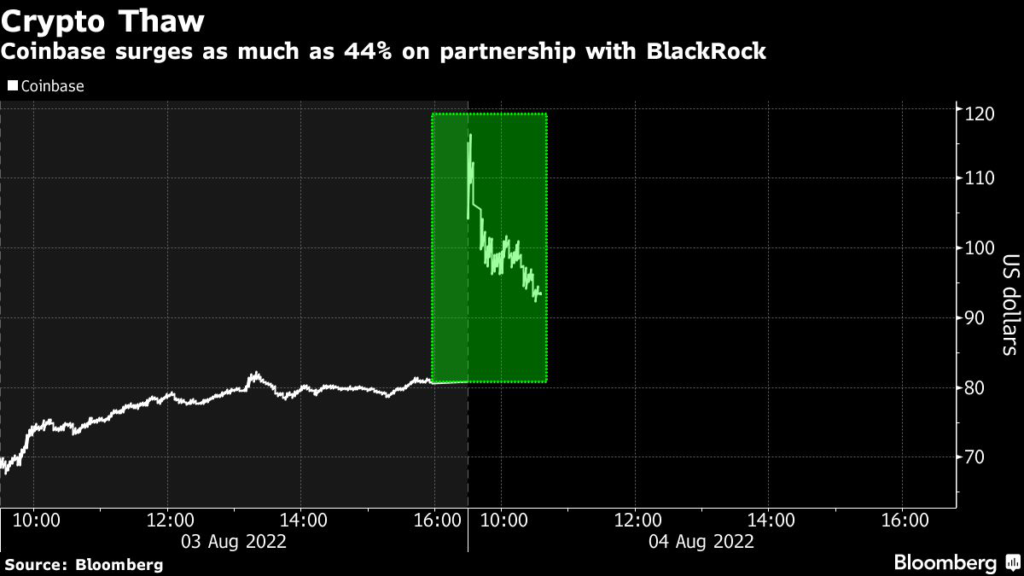
Shares of the largest US cryptocurrency exchange surged as much as 44% on Thursday, the most intraday since its 2021 direct listing, after announcing a partnership with BlackRock Inc. to help institutional investors manage and trade Bitcoin. The rally puts the stock on track for a third straight day of gains and sets it up for a record weekly rally.

For Coinbase investors, the news is a much-needed signal that its status as a giant in the crypto sector remains rock solid. To be sure, shares are still deeply in the red this year, down more than 60%.

“After this validation, it is possible that Coinbase will be able to partner with more traditional financial industries,” said Owen Lau, an analyst at Oppenheimer & Co. “It shows that even with the size of BlackRock, they are going to partner with a crypto-native company, rather than building their own capabilities.”

READ: BlackRock Teams Up With Coinbase in Crypto Market Expansion (1)

The sudden surge added $6 billion in value to the company’s market capitalization, bringing it back above $20 billion for the first time since mid-May. While that’s more than double the size of rival Robinhood Markets Inc., it’s a far cry from the peak valuation near $75 billion from Novmeber, when Bitcoin was trading at a record high.

The company has faced a wave of headwinds in recent months as its trading volumes dwindled amid a plunge in the price of Bitcoin and other digital tokens. It’s also facing a probe from the US Securities and Exchange Commission into whether it improperly lets US customers trade assets that should have been registered as securities.

Short sellers, meanwhile, are taking a beating as the stock extends its sharp rebound from July. While shorts are still up more than $800 million this year in mark-to-market profits, those returns are 40% lower than they were prior to Thursday’s jump, according to S3 Partners’ managing director of predictive analytics Ihor Dusaniwsky. “We expect continued short covering in Coinbase as BlackRock’s announced partnership puts a python-like squeeze on short sellers,” he said.

Shares sank more than 21% on July 26 after funds controlled by Cathie Wood sold roughly $1.4 million of stock in the company holdings, worth about $75 million at the time. 

Thursday’s move is also notable because it comes on a day when prices of Bitcoin, Ether and other popular digital assets are all lower. The stock has maintained a tight correlation to the world’s largest cryptocurrency since it began trading last year.

Other cryptocurrency-related stocks were also higher following the BlackRock deal, with firms including Marathon Digital, Riot Blockchain and Silvergate Capital all rising at least 5%.

“This is much-needed positive news for crypto traders and should provide some optimism for the longer-term health of the cryptoverse,” said Ed Moya, senior market analyst at Oanda. “Calls that crypto is dead have been overdone.”

More stories like this are available on bloomberg.com

©2022 Bloomberg L.P.

Revolut Bulks Up Its Crypto Business With Hiring Push

(Bloomberg) — Revolut Ltd. plans to increase its crypto headcount by 20% across Europe, the UK and US over the next six months, a bright spot in the current digital-assets industry downturn and a rare sign of growth against the backdrop of a wider slowdown in hiring by tech firms.

The London-based fintech firm is currently advertising for 13 crypto-focused roles, including in compliance and financial crime prevention, as well as software engineers and professionals with crypto experience working in legal fields. The startup has already hired 43 crypto staff this year, tripling the team’s total headcount since July 2021. The company has more than 230 open positions across all its teams.

“We see crypto as a long-term play and remain bullish on the crypto industry”, Emil Urmanshin, Revolut’s crypto general manager said, adding that the business currently accounts for about 5% to 10% of Revolut’s revenue globally. 

Revolut’s push comes during a sustained slump in cryptocurrency prices, which has led to bankruptcies and layoffs across the sector. Coinbase Global Inc. slashed 1,100 jobs or about 18% of the workforce in June as the “crypto winter” set in. The job eliminations follow similar reductions across the sector, including at Bitpanda, Crypto.com, Gemini Trust Co. and BlockFi Inc. There have also been hiring slow downs in big tech, including at Apple Inc.. Alphabet Inc.’s Google unit and Twitter inc. 

Crypto Expansion

The hiring will help Revolut, one of Europe’s most well-known fintech startups, continue to expand its cryptocurrency offerings. The financial “superapp” announced on Wednesday that it was adding 22 new tokens to its platform, bringing the total number of virtual currencies available to more than 80. Metaverse coin APE and two decentralized-finance tokens are among digital assets now available.

Launched in 2015, Revolut became popular with consumers in Europe for its easy-to-use app and connected debit card that allows users to spend different currencies at the interbank exchange rate with little or no fees. It has since expanded its range of products to include business checking accounts, stock trading, pet insurance, and travel. 

While Revolut’s flagship foreign exchange service took a hit during the Covid-19 outbreak, due to travel restrictions and lower spending, the company’s stock and crypto trading has boomed. 

The number of UK customers buying cryptocurrencies increased by more than 290% between July 2020 and July 2021, while the number of transactions they made increased by over 800%, according to Revolut. Since lockdowns have lifted, the number of UK customers buying cryptocurrencies grew at a slower pace, increasing 30% between July 2021 and July 2022. The number of transactions during that period increased by over 50%,. the firm said.  

“Although there has been turmoil, interest in crypto assets has increased and we still have more customers trading crypto than during July 2021,” Urmanshin said.  

Revolut, which has attracted more than 20 million customers since its launch, is the only crypto-asset firm left on the UK Financial Conduct Authority temporary register. The other 11 that were offered extensions have either been approved, rejected or have withdrawn from the list. Revolut is also still waiting for the FCA to give the final green light to its full banking license, a process that has already taken more than a year-and-a-half. 

More stories like this are available on bloomberg.com

©2022 Bloomberg L.P.

Close Bitnami banner
Bitnami