
Bloomberg

Credit Agricole’s Investment Bank Drives Earnings Beat

(Bloomberg) — Credit Agricole SA’s corporate and investment bank helped the group soar above expectations in the second quarter after traders made double-digit gains during heightened volatility.

The Paris-based bank said revenue at its CIB unit rose by more than a quarter to almost 2 billion euros ($2 billion), making it the busiest quarter on record. Underlying revenue from financing activities increased 12.8% despite a global slowdown in deals after Russia’s invasion of Ukraine. The group also set aside far less than predicted for struggling loans, even as inflation spiked across Europe. 

“This very opaque and very uncertain context has in no way limited” Credit Agricole’s development, Chief Executive Officer Philippe Brassac said in a conference with reporters.

Last June, Credit Agricole adopted a cautious stance in its new medium-term financial objectives, amid Russia’s war and its impact on global inflation and growth. The bank said Thursday it was on track for its goals. It also has growth ambitions in Europe, as it eyes insurance operations in Italy and banking assets in Poland.

Credit Agricole shares were trading up 3% at 9.39 euros at 9:27 a.m. in Paris Thursday, paring losses this year to 25.1%.

While Credit Agricole’s markets unit is smaller than some of its peers, its traders more than measured up to other global banks as clients sought to protect themselves from asset price swings and resurgent inflation. The bank’s markets arm reported sales up 32% from a year earlier as fixed income, currencies and commodities income rose 36.9% “in the context of high volatility and clients’ hedging needs.”

Revenue from financing activities rose 12.8% to 765 million euros, which the bank credited to growth in its international trade and transaction services, as well as favorable currency movements. Credit Agricole has weathered a quarter where Wall Street banks saw corporate banking revenue more than halve due to wary clients avoiding risky moves.

While the market volatility helped lift the investment banking revenue this quarter, the unit’s performance is also supported by significant financing activities, Chief Financial Officer Jerome Grivet said in an interview with Bloomberg TV on Thursday. 

“I’m not pretending that we’re going to have the same level of results and the same level of revenues next quarter, but clearly the trend on which we are is sustainable,” Grivet said in the interview.

The lender set aside 203 million euros to cover potentially souring loans, smaller than last year despite the unsettled outlook and about a third of what analysts anticipated. Brassac told reporters the bank did not need to book much more provisions after taking a larger one earlier in the year.

This more upbeat stance came as rising interest rates boosted the bank’s retail operations. Its international unit, a key driver of growth for Brassac, saw its revenue gain 1.4% to 812 million euros, above analyst expectations. In France, the bank’s retail unit LCL saw its income jump 8.7% to 1.01 billion euros, also above the average estimate. 

Italian Growth

The bank, which acquired Credito Valtellinese SpA last year, has further ambitions in Italy. Credit Agricole bought a 9.2% stake in Banco BPM SpA earlier this year, and is now looking to acquire a stake in the Italian lender’s insurance business. On Wednesday, Banco BPM said it would aim to conclude its search for possible partnerships in bancassurance by the end of the year. 

While the CFO declined to comment on ongoing discussions, he said the bank is well placed to make the best possible offer thanks to its experience in distributing insurance products through its retail network.

Deputy CEO Xavier Musca said he didn’t have “any particular worry” about the Italian economy. “Italy enjoys this year a growth rate that remains relatively robust,” he said in a call with reporters. While rising gas prices and an election loom, Musca pointed to Italy’s commitment to European Union budget rules and the region’s solidarity in the face of the war as reasons to be optimistic. 

The turbulent markets of the past quarter have had one downside for the bank. Amundi SA, Credit Agricole’s investment arm, last week posted surprise inflows, though its assets under management fell 4.8% compared to the previous quarter to 1.93 trillion euros because of adverse market and foreign exchange effects. 

(Udates with share movements in fifth paragraph and CFO comments from eighth paragraph.)

More stories like this are available on bloomberg.com

©2022 Bloomberg L.P.
Crypto Has No Place in Private Banking for Now, Pictet Says

(Bloomberg) — Pictet Group, the Swiss wealth manager, is cautioning against crypto investments amid the recent industry turmoil.

“Crypto will be an asset class that we cannot ignore, but today I don’t think there is a place for private bankers and for private bank portfolios,” Tee Fong Seng, chief executive officer at the Geneva-based firm’s Asia wealth management arm, said on a panel at the Bloomberg Asia Wealth Summit in Singapore on Thursday. 

The crypto industry has seen a meltdown this year amid crashing valuations, the failure of hedge fund Three Arrows Capital and other companies, and numerous attacks by hackers. Between Bitcoin’s November peak and late June, $2 trillion was wiped from the combined market value of crypto assets. 

Banking giants shunned crypto for years — JPMorgan Chase & Co. Chief Executive Officer Jamie Dimon famously called Bitcoin a “fraud” in 2017. 

But with the asset’s surge in the past three years, some started changing their stance. Most recently, Julius Baer Group Ltd. said it is working on offering services in digital assets to its wealthy clients, while Fidelity Investments is preparing to launch a product that will allow Bitcoin investments in workplace retirement accounts. Citigroup Inc. and Morgan Stanley have also begun helping rich clients bet on crypto. 

Read a QuickTake on why another ‘crypto winter’ is a test

Still, trading tokens remained challenging. 

“If you look at the volatility for the last two years, you can make a lot of money, you can lose a lot of money,” Tee said, while adding that Pictet has a team monitoring the market. “The question is, when do we bring the clients into the picture?”

Veteran investor Jim Rogers is among those wary of diving in.

“My wife invested in crypto of all things,” Rogers told another panel at the wealth summit. “I don’t invest in them because the bulls say there’s going to be money. My answer to that is if and when all our money is on the computer, it’s going to be government money.”

Web3 Interest

Not all have been deterred. Venture capital funds and institutions are getting more interested in the crypto space, said Nanda Ivens, chief marketing officer at Indonesian digital trading platform Tokocrypto. As an example, he cited Indonesian crypto fund Cydonia Capital recently raising $100 million.  

“There is a lot of interest for Web3 projects, especially when there are positive, good deal flows coming through those Web3 venture capital funds,” Ivens, who advised Cydonia, said at the summit in reference to a potential decentralized internet. 

Others speaking at the gathering weren’t optimistic about prospects for the digital assets over coming months, despite a recent rally.

“I am pretty bearish,” said Rich Teo, co-founder and CEO of Paxos Asia, a blockchain infrastructure provider. “I think there will be more deleveraging of crypto.”

(Updates to add comments from eighth paragraph onward)

More stories like this are available on bloomberg.com

©2022 Bloomberg L.P.
High Street Rebound Spurs Next’s Profit Outlook: The London Rush

(Bloomberg) — Here’s the key business news from London-listed companies this morning.

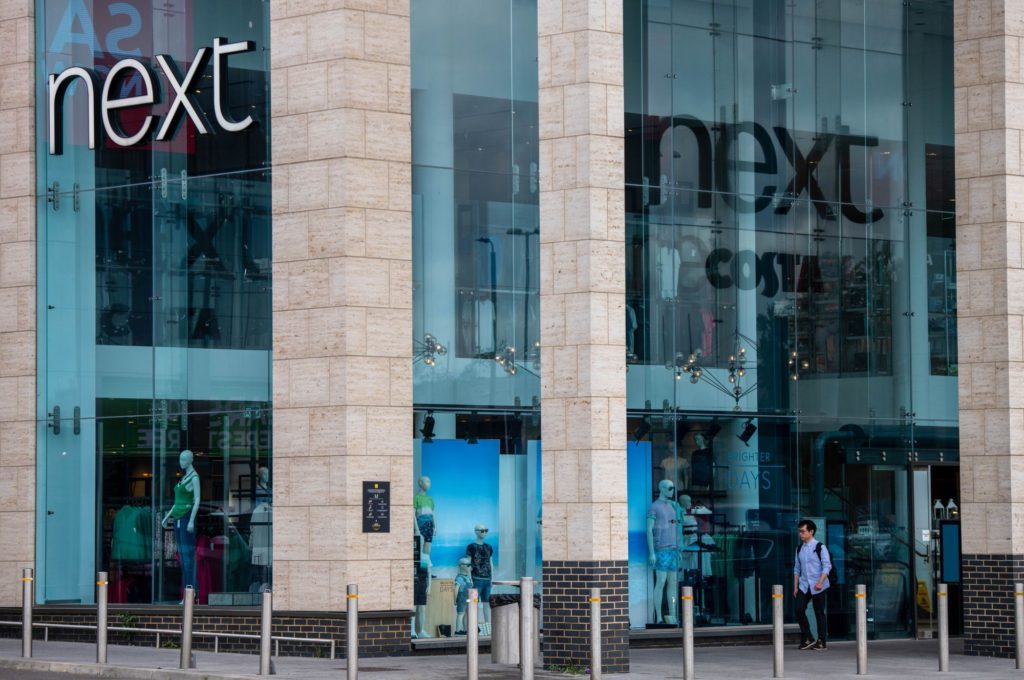
Next Plc: The lifestyle brand has boosted its profit outlook for this year, as retail store sales recovered from their slump while online sales growth stalled.

  • The company said this is probably just a temporary reversal of pandemic-era trends and inflation could dampen consumer demand
  • The resurgence in retail sales in the quarter was partly down to warmer weather reinvigorating demand for formalwear, especially with a strong pipeline of delayed weddings, while many competitor stores closing down over the past three years also benefited the chain’s high street locations

Glencore Plc: The mining giant posted what it said was an “exceptional financial performance” in the first-half of the year, prompting it to pay out an additional $4.45 billion to shareholders in dividends and share buybacks.

  • Surging coal, oil and gas prices helped boost the world’s top coal shipper’s earnings, while volatility and market dislocations in the wake of Russia’s invasion of Ukraine also benefitted its trading business

Mediclinic  International Plc: The hospital operator has agreed a takeover deal with  Remgro Limited and a subsidiary of  MSC Mediterranean Shipping Company SA valuing the company at about £3.7 billion.

  • That deal is at 504 pence per share, improving on the company’s proposed offer in June at 463 pence per share, which was rejected by Mediclinic’s board as “significantly” undervaluing the company

Outside The City

Liz Truss bounced back from a policy U-turn to regain the momentum in the Tory leadership race, buoyed by a fresh major endorsement and strong polling figures.

That’s as the UK could be on the brink of a housing revolution to rival Margaret Thatcher’s council house sell-off in the 1980s — which may prove just as divisive.

In Case You Missed It 

Here are some neighbourhoods in the world’s sweltering cities — including London — that actually managed to curb this summer’s heat. 

And speaking of cool spots: these are the nine best places to eat and drink at the Edinburgh Fringe this month. 

Looking Ahead

It’s Bank of England rate decision day today. At noon, the Monetary Policy Committee will announce whether they’ll raise its benchmark lending rate again — and by how much. The market expects a 50 basis point hike. Focus will also be on the details of the bank’s so-called active quantitative tightening, where they plan to sell gilts, shrinking its trillion-dollar balance sheet.

On Friday, advertising conglomerate WPP Plc is due to report results. Bloomberg Intelligence’s Matthew Bloxham says strong sales figures from the company’s rivals suggest WPP will probably hit its own revenue goals. The second half of the year might be tougher with economic headwinds potentially dampening clients’ campaign spending.

For a news fix when the day is done, sign up to The Readout with Allegra Stratton, to make sense of the day’s events.

More stories like this are available on bloomberg.com

©2022 Bloomberg L.P.
Angry Europeans Lower ECB’s Google Rating Amid Soaring Inflation

(Bloomberg) — Sign up for the New Economy Daily newsletter, follow us @economics and subscribe to our podcast.

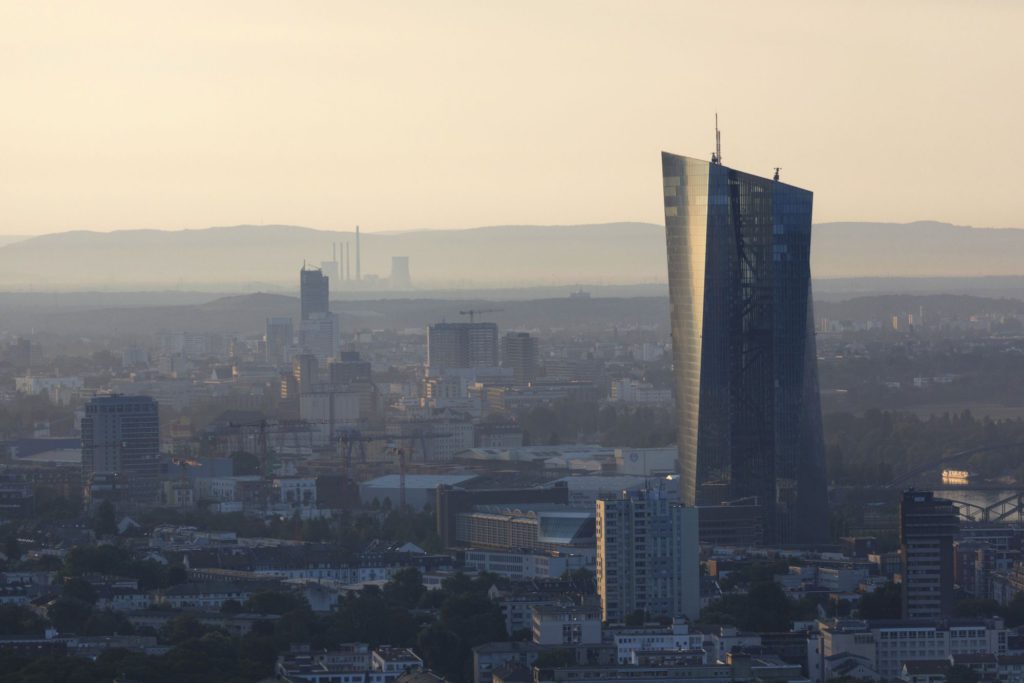
Critics of the European Central Bank have found a new way to vent their frustration, with a stream of poor ratings thrown at the Google Maps listing of its Frankfurt headquarters. 

While such reviews on the search engine often focus on a building’s architecture or facilities, about half of the hundred or so left in the 10th anniversary year of its completion are complaints on the policies of President Christine Lagarde and her colleagues. 

As a result, average ratings on Google Maps for the 45-story green-glass ECB tower have fallen significantly. Its entry has also attracted more reviews in the first seven months of 2022 alone than in any previous year.

Such frustration follows a surge in inflation that reached a euro-era record of 8.9% in July, the same month the ECB lifted borrowing costs for the first time in over a decade. The hesitation of officials to raise rates while global peers tightened has prompted criticism particularly in its home country of Germany.  

One reviewer, Christoph H., posted a week ago that the ECB “is only focused on government financing through the back door.” A post by someone called Ludwig Berg a few days beforehand criticized politicians’ appointment of Lagarde, in view of “galloping inflation.” Reviews were posted in numerous languages, though many of the more critical ones were written in German.

A more comprehensive measure of sentiment has also fallen. A Eurobarometer survey early this year found fewer euro-area respondents expressing trust in the ECB compared to a previous poll.

When the central bank’s building in the east of Frankfurt was completed in September 2012, then-Executive Board member Joerg Asmussen said he hoped it would “be viewed by the people of Frankfurt, and beyond, as an enrichment of Frankfurt’s skyline and the landscape of Europe.”

While some Google reviewers may struggle to agree, there is some comfort for ECB officials. Their former headquarters in the city center, which is next to a large euro sculpture often featured in tourist selfies and is currently used by euro-area bank supervisors, appears to enjoy greater appreciation. 

The so-called Eurotower’s average rating of 4.3 stars is higher than the 3.7 points awarded to the newer building.

More stories like this are available on bloomberg.com

©2022 Bloomberg L.P.
Toyota Shares Drop After Sticking to Conservative Profit Outlook

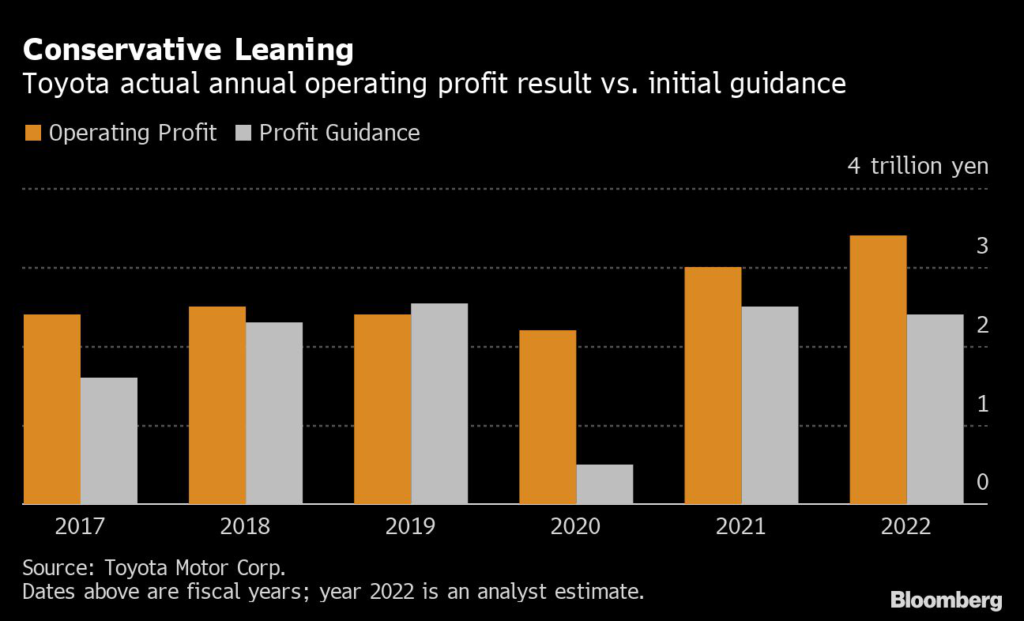
(Bloomberg) — Toyota Motor Corp. kept its profit outlook for the current year, surprising investors who expected an upgrade and underscoring the carmaker’s concerns over its ability to produce vehicles amid parts shortages, rising material costs and pandemic disruptions in China, even as a weaker yen boosts income in its home currency.

Toyota shares fell 3% after the world’s biggest automaker kept its forecast for operating profit of 2.4 trillion yen ($18 billion) for the fiscal year through March, short of analysts average projection of 3.3 trillion yen. The result also fell short of estimates in the April-June quarter, at 579 billion yen versus the prediction for 808 billion yen in profit.

Semiconductor shortages, higher raw material costs and Covid-19-related curbs in China have caused turmoil at auto assembly lines across the globe. Even though the yen has weakened, Toyota executives said there are still “many uncertainties ahead,” such as downward pressure on the economy and potential interest rate hikes in other economies. “We are not confident enough to raise guidance.” 

Even so, the carmaker is sticking to its plan to assemble 9.7 million vehicles for the year. 

“They didn’t reach market estimates, it just wasn’t enough and disappointing,” said Seiji Sugiura, an analyst at Tokai Tokyo Research. “They saw no benefits from the weaker yen, they didn’t make more cars and cost measures didn’t seem to have much of an impact.”

While the weaker currency helped to boost reported income by 195 billion yen, that was outweighed by soaring material prices, which had a negative impact of 315 billion yen, according to Toyota. 

Three months ago, Toyota said it would implement an “intentional pause” in output during the April-June quarter to be more “in line with recent realities.” Lockdowns in Shanghai and a water supply shortage in Aichi prefecture also disrupted production over recent months.

“It’s Toyota’s style to have a conservative outlook, but unless there are surprises in the coming quarters, it’s likely that we’ll see upgraded views,” said Tatsuo Yoshida, a Bloomberg Intelligence analyst. The results show that Toyota is being proactive in making sure that its suppliers remain operationally and financially sound by absorbing many of the cost increases, he added.

Toyota updated its foreign exchange assumption to 130 yen to the dollar from 115 yen. While the prior outlook accounted for the gap between Toyota’s and analysts’ profit views, the conservative forecast suggests that Toyota still sees production challenges in the months ahead. In total, operating profit for the fiscal year will get a 670 billion yen boost from the weaker currency, Toyota said.

Quarterly sales was 8.5 trillion yen, exceeding analysts’ projection for 8.2 trillion yen. The full-year revenue outlook was upgraded to 34.5 trillion yen from 33 trillion yen. Analysts are predicting full fiscal year sales of 35.2 trillion yen.

“Securing parts such as semiconductors will continue to be unpredictable, but we will strive to achieve production that exceeds our forecast by working closely with our suppliers,” Toyota said in presentation materials.

(Updates with company, analysts’ comments.)

More stories like this are available on bloomberg.com

©2022 Bloomberg L.P.
Stock Gains Cool in Asia as US Equity Futures Dip: Markets Wrap

(Bloomberg) — A rally in stocks cooled in Asia on Thursday as investors assessed the corporate profit outlook, while wagers on further Federal Reserve interest-rate hikes supported Treasury yields.

MSCI Inc.’s Asia-Pacific share gauge added about 0.5%, helped by a climb in Chinese tech companies propelled by Alibaba Group Holding Ltd. ahead of its quarterly results. The region’s performance trailed a jump of more than 1.5% in the S&P 500. US futures dipped while European contracts edged up.

Earnings, surprise US service-sector growth and easing jitters over US-China ties propelled Wall Street equities on Wednesday. But a global wave of monetary tightening also hangs over the outlook.

The Bank of England later Thursday is expected to join some 70 other institutions around the world in delivering a half-point rate rise. Federal Reserve officials, meanwhile, again signaled they will do what’s required to cool high inflation even if that raises the risk of recession. 

Treasuries slipped, taking the US 10-year yield to 2.72%, while an inversion in a key part of the yield curve points to an economic slowdown. Oil hovered near $91 a barrel, hampered by demand worries. Gold advanced and Bitcoin oscillated near $23,000.  

Global stocks have now rebounded some 9% from a June low, reducing year-to-date losses to about 15%. The big debate is whether that points to complacency given the bond market is flashing a warning on economic risks.

“The volatility is not over and a lot of data is still out there, it’s still going to matter,” Ann Miletti, head of active equity at Allspring Global Investments, said on Bloomberg Television. “I would still focus on quality here because there is a lot of choppiness to come, a lot of answers we still need.”

US-China tension remains among the uncertainties. Taiwan braced for the Chinese military to start firing in exercises being held around the island in response to US House Speaker Nancy Pelosi’s visit.

This week’s MLIV Pulse survey is asking about your outlook for corporate bonds, mergers and acquisitions and health of US corporate balance sheets through the end of the year. It takes one minute to participate in the MLIV Pulse survey, so please click here to get involved anonymously. 

What to watch this week:

  • BOE rate decision, Thursday
  • US initial jobless claims, trade, Thursday
  • Cleveland Fed President Loretta Mester due to speak, Thursday
  • US employment report for July, Friday

Some of the main moves in markets:

Stocks

  • S&P 500 futures were down 0.1% as of 7:01 a.m. in London. The S&P 500 rose 1.6%
  • Nasdaq 100 futures fell 0.3%. The Nasdaq 100 rose 2.7%
  • Japan’s Topix index was steady
  • South Korea’s Kospi index rose 0.5%
  • Hong Kong’s Hang Seng index added 1.7%
  • China’s Shanghai Composite index rose 0.4%
  • Australia’s S&P/ASX 200 index was steady
  • Euro Stoxx 50 futures increased 0.2%

Currencies

  • The Bloomberg Dollar Spot Index was steady
  • The euro was at $1.0163
  • The Japanese yen was at 134.13 per dollar, down 0.2%
  • The offshore yuan was at 6.7599 per dollar

Bonds

  • The yield on 10-year Treasuries rose two basis points to 2.72%
  • Australia’s 10-year yield rose seven basis points to 3.14%

Commodities

  • West Texas Intermediate crude was at $90.56 a barrel, down 0.1%
  • Gold was at $1,770.51 an ounce, up 0.3%

More stories like this are available on bloomberg.com

©2022 Bloomberg L.P.
Crypto Has No Place in Private Banking Right Now, Pictet Says

(Bloomberg) — Pictet Group, the Swiss wealth manager, is cautioning against crypto investments amid the recent industry turmoil.

“Crypto will be an asset class that we cannot ignore, but today I don’t think there is a place for private bankers and for private bank portfolios,” Tee Fong Seng, chief executive officer at the Geneva-based firm’s Asia wealth management arm, said on a panel at the Bloomberg Asia Wealth Summit in Singapore on Thursday. 

The crypto industry has seen a meltdown this year amid crashing valuations, the failure of hedge fund Three Arrows Capital and other companies, and numerous attacks by hackers. Between Bitcoin’s November peak and late June, $2 trillion was wiped from the combined market value of crypto assets. 

Read: Why Another ‘Crypto Winter’ Is Test for Digital Money: QuickTake

Banking giants shunned crypto for years — JPMorgan Chase & Co. Chief Executive Officer Jamie Dimon famously called Bitcoin a “fraud” in 2017. 

But with the asset’s surge in the past three years, some started changing their stance. Most recently, Julius Baer Group Ltd. said it is working on offering services in digital assets to its wealthy clients, while Fidelity Investments is preparing to launch a product that will allow Bitcoin investments in workplace retirement accounts. Citigroup Inc. and Morgan Stanley have also begun helping rich clients bet on crypto. 

Still, trading tokens remained challenging for many.

“If you look at the volatility for the last two years, you can make a lot of money, you can lose a lot of money,” Tee said, while adding that Pictet has a team monitoring the market. “The question is, when do we bring the clients into the picture?”

More stories like this are available on bloomberg.com

©2022 Bloomberg L.P.
Ripples From Pelosi May Take Time to Impact Markets

(Bloomberg) — From an accelerated decoupling of the world’s two largest economies to a discussion on whether China might weaponize its vast holding of Treasuries, investors are outlining how US House Speaker Nancy Pelosi’s Taiwan trip may ripple across global markets. 

Haven assets whipsawed as concerns about the level of military response from China dissipated and Treasuries sold off on hawkish comments from Federal Reserve officials. The yen saw an abrupt turnaround, sinking more than 1% Tuesday after its strongest four-day run since 2020 but climbing again Wednesday. Most stocks and equity futures struggled for traction.

Pelosi’s visit has fanned fresh jitters among investors already spooked by the threat of a global slowdown amid surging inflation. Some strategists warned of dismissing China’s initial response too early — military exercises and some Taiwan trade restrictions — with markets vulnerable to any hint of a worsening of Sino-American relations. 

“This issue will linger far longer than the market’s attention span will allow,” said Michael Every, global strategist at Rabobank. “Yet geostrategists are largely united in the view that we are still worryingly close to a potential Fourth Taiwan Strait Crisis.”

China and Treasuries 

Investors were still parsing headlines and market moves Wednesday for clues as to how China could retaliate. The dizzying surge in Treasury yields overnight triggered discussions whether Beijing might weaponize its near $1 trillion pile of US government bonds. Chinese defense stocks rose while Taiwanese shipping and tourism shares retreated.

Volatility Hits Markets With Geopolitics Adding to Set of Risks

“Given the magnitude of the selloff, it was only a matter of time before speculation that China was using its significant Treasury holdings in retaliation for Pelosi’s visit,” said Ian Lyngen, a strategist at BMO Capital Markets. “In the event this is the case (which we doubt), the bearishness should be limited as the near-term flow influences are overshadowed by the negative impact on the global macro outlook.”

Others such as Huang Huiming, a fund manager at Nanjing Jing Heng Investment Management Co., are bracing for the start of “salami tactics” by Beijing — a piecemeal approach to divide and conquer an opposition — and how this could impact already choked up supply chains. 

“Looking closely at the exercise zones, this is the nearest to the island ever and encircles it — all military operations are at first disguised as drills,” said Huang. “We might be concerned if the drills become longer and more intense to impact supply chains, but there is no sign of that happening now.”

Pelosi to Meet Taiwan Leader as China Opens Military Drills

Faster Decoupling

While some investors are looking to sell the rumor, buy the news for now on Pelosi’s visit, others are mapping out a longer-run macro view of how this could prove to be a seminal moment in Asia-Pacific history and potentially alter asset-allocation in the region. Taiwan is a critical global supplier of semiconductors and other high-tech goods. 

There are risks of a longer-term economic decoupling between the world’s two largest economies with a slew of potential impacts including fresh stress on supply chains worsening inflation. Beijing has already announced the beginnings of an economic response, halting natural sand exports to Taiwan and stopping imports of fruit and fish. 

“The official return of the US influence in Asia-Pacific will inevitably accelerate US-China decoupling,” said Xiadong Bao, a fund manager at Edmond de Rothschild Asset Management in Paris. “Given it’s an evolving event, investors should brace for a test of nerves which may implicate high market volatility in the near-term.”

Caution Prevails

When everything looks this uncertain, sometimes the biggest trades include buying the traditional safe havens of the world — Treasuries and the dollar.

That’s the view of Jessica Amir at Saxo Capital Markets who reckons the latest tensions are only going to further fray investors’ nerves, spurring safer assets to outperform. 

“Right now we think the tone has been set for equities for August and the rest of the year. Geopolitical tensions will rise,” said Amir. “We also see the return to safe havens, and the dollar to see increased buying.”

It’s an outlook shared by AMP Capital Markets’ Chief Economist Shane Oliver, who sees gains for Treasuries to gold should the visit spark actual conflict. “Longer-term it signals a further escalation in cold war tensions between the West and China/Russia which means higher risk premiums,” he said.

Sentiment to Recover

In Zurich, fund manager Jian Shi Cortesi sees parallels in market outcomes between Newt Gingrich’s trip to Taiwan in 1997 and Pelosi’s today. Back then, the Hang Seng Index and Taiwan’s bourse both fell before the visits, but rebounded strongly afterwards. This time around, investors saw similar weakness for China, Hong Kong and Taiwan stocks prior to Pelosi’s trip. 

China’s military exercises near Taiwan island “may still keep investors on their toes,” said the investment director at GAM Investment Management. “Market sentiment will recover once the military exercise ends.”

(Corrects title in fourth paragraph in story published Aug. 3.)

More stories like this are available on bloomberg.com

©2022 Bloomberg L.P.

Stocks Rise in Asia as Alibaba Leads Tech Rebound: Markets Wrap

(Bloomberg) — Asian stocks rose Thursday, as Alibaba Group Holding Ltd. led Chinese tech companies higher ahead of its quarterly results. Bets on further Federal Reserve interest-rate hikes supported Treasury yields.

A global share gauge pushed toward the highest level since early June, after a US rally triggered by earnings and robust economic data. US futures fluctuated as traders weighed how much further the revival in equities from bear-market lows can go. The dollar was little changed. 

Investors Wednesday warmed to earnings and buyback announcements from Moderna Inc. and PayPal Holdings Inc. as well as surprise US service-sector growth. Almost 75% of US firms have so far beaten earnings estimates. Jitters over US-China ties faded after House Speaker Nancy Pelosi departed Taiwan.

Federal Reserve officials again signaled they will do what’s required to cool high inflation with rate increases even if that raises the risk of recession. Oil edged higher amid signs of slowing demand in a US inventory report. Gold advanced and Bitcoin fell.  

Global stocks have now rebounded some 10% from a June low, reducing year-to-date losses to about 15%. The big debate is whether that points to complacency given the bond market is flashing a warning of an economic slowdown.

“The volatility is not over and a lot of data is still out there, it’s still going to matter,” Ann Miletti, head of active equity at Allspring Global Investments, said on Bloomberg Television. “I would still focus on quality here because there is a lot of choppiness to come, a lot of answers we still need.”

Taiwan tension remains among the uncertainties. China is due to kick off military drills starting noon local time to illustrate its ability to surround the island in a show of force following Pelosi’s trip.

Later in Europe, the UK is set to add to a global wave of monetary tightening that’s putting the brakes on the world economy. The Bank of England is expected to join some 70 other institutions around the world in delivering a half-point increase in borrowing costs.

This week’s MLIV Pulse survey is asking about your outlook for corporate bonds, mergers and acquisitions and health of US corporate balance sheets through the end of the year. It takes one minute to participate in the MLIV Pulse survey, so please click here to get involved anonymously. 

What to watch this week:

  • BOE rate decision, Thursday
  • US initial jobless claims, trade, Thursday
  • Cleveland Fed President Loretta Mester due to speak, Thursday
  • US employment report for July, Friday

Some of the main moves in markets:

Stocks

  • S&P 500 futures were down 0.1% as of 12:00 p.m. in Tokyo. The S&P 500 rose 1.6%
  • Nasdaq 100 futures fell 0.1%. The Nasdaq 100 rose 2.7%
  • Japan’s Topix index was down 0.1%
  • South Korea’s Kospi index rose 0.3%
  • Hong Kong’s Hang Seng index added 1.9%
  • China’s Shanghai Composite index rose 0.5%
  • Australia’s S&P/ASX 200 index increased 0.2%
  • Euro Stoxx 50 futures increased 0.1%

Currencies

  • The Bloomberg Dollar Spot Index was steady
  • The euro was at $1.0165
  • The Japanese yen was at 133.77 per dollar, up 0.1%
  • The offshore yuan was at 6.7605 per dollar

Bonds

  • The yield on 10-year Treasuries rose one basis point to 2.72%
  • Australia’s 10-year yield rose five basis points to 3.13%

Commodities

  • West Texas Intermediate crude was at $91.05 a barrel, up 0.4%
  • Gold was at $1,767.99 an ounce, up 0.3%

More stories like this are available on bloomberg.com

©2022 Bloomberg L.P.

Alibaba Jumps as Much as 6.5% Amid Tech Rally Ahead of Earnings

(Bloomberg) — Alibaba Group Holding Ltd. led Chinese tech stocks higher on Thursday as investors repositioned ahead of its quarterly results, though caution remained about a number of potential roadblocks ahead.

Shares of the e-commerce giant gained as much as 6.5% in Hong Kong, among the best performers on the Hang Seng Tech Index, which advanced as much as 3.4%. The stock is on track for a second day of gains after a visit to Taiwan by US House Speaker Nancy Pelosi sent broader markets tumbling this week. 

Strategists Fear Pelosi Trip to Have Deeper Global-Market Impact

The rebound across tech comes as investors have started to add back exposure after pricing in too much risk earlier, according to Vey-Sern Ling, managing director at Union Bancaire Privee in Singapore. An overnight rally in Chinese ADRs also provided a boost, he added.

Investors will be laser focused on Alibaba’s forward guidance when the firm reports after hours, particularly after harsh Covid lockdowns in China during the second quarter put a drag on growth. Concerns about a slowing economy, an ongoing regulatory crackdown and heightened Sino-American tensions also complicates that outlook.

Even with the two-day rebound, Alibaba is still down more than 20% this year in Hong Kong, tracking the Hang Seng Tech Index. SoftBank Group Corp. has raised as much as $22 billion in cash through the sale of forward contracts using Alibaba shares, the Financial Times reported, which would add to selling pressure down the road if SoftBank opts against buying back the Alibaba shares.

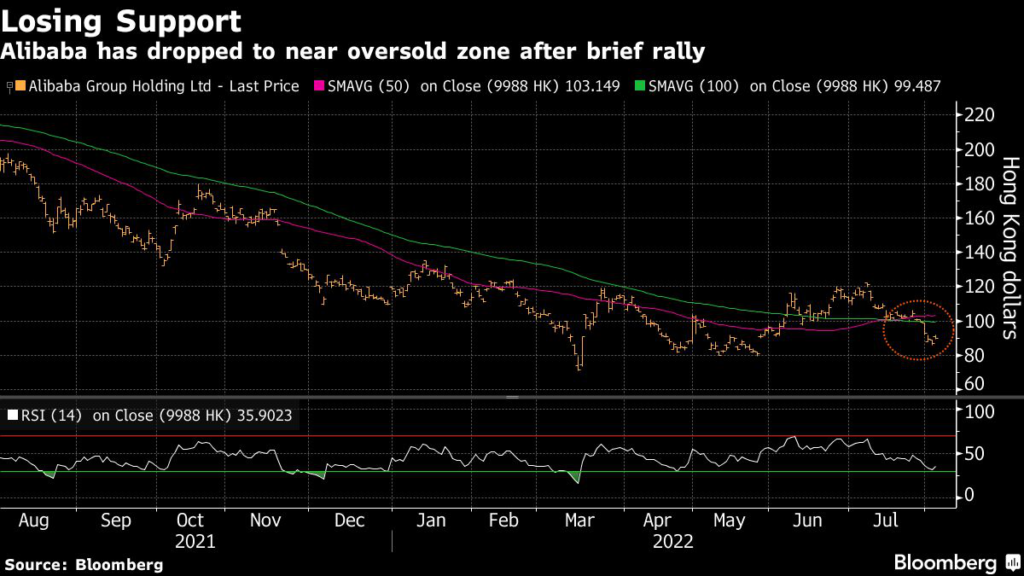
Here are three charts showing the hurdles ahead for Alibaba’s stock: 

Analysts expect Alibaba’s April-June sales to fall 0.9% from a year earlier, marking its first-ever quarterly revenue contraction. Some analysts are also focusing on cost-cutting measures and investment spending plans in the company’s results.

Daiwa Capital Markets sees a larger sales reduction, as core commerce may “take a hit from supply chain disruptions in April-May,” analysts including John Choi wrote in note last month. 

Alibaba’s more than 21% slump from a July high has put the stock near technically oversold territory. Shares have fallen below both 50-day and 100-day moving averages, which had been providing some support. A fresh regulatory penalty on past deals, a reported probe on data leaks and a soft macro economy have sent the stock tumbling. News that co-founder Jack Ma was planning to cede control of Ant Group also created uncertainty. 


Investors are trying to gauge how much Alibaba’s businesses can recover in the coming quarters after China started easing quarantine rules and vowed to support the economy. Geopolitical tensions and global recession worries have stalled a recent uptick in analysts’ profit projections, sending the company’s 12-month forward earnings estimate back toward 2019 levels.

(Updates with more background)

More stories like this are available on bloomberg.com

©2022 Bloomberg L.P.

Close Bitnami banner
Bitnami