
Bloomberg

Meta Explores a Potential Bond Sale, Its First Ever

(Bloomberg) — Facebook parent Meta Platforms Inc. has asked banks to hold investor meetings for a potential bond sale, the company’s first. 

Meta has asked Morgan Stanley, JPMorgan Chase & Co., Bank of America Corp., and Barclays Plc to arrange a series of fixed-income investor calls Wednesday, according to a person familiar with the matter. A senior unsecured debt offering may follow, the person said. 

Unlike many of its large-cap technology peers which have borrowed heavily at low rates despite large cash piles, Meta has sat out of the bond market until this point. It is one of just 18 companies in the S&P 500 without outstanding short or long-term debt, excluding lease liabilities, as of the most recent quarter, according to data compiled by Bloomberg. 

“Meta could build a new capital structure that includes its first-ever bonds, issuing well over $10 billion to potentially benefit holders of both equity and debt, following weak first half results, and over a 50% drop in its equity value,” said Bloomberg Intelligence analyst Robert Schiffman. “Increased capital spending focused on the metaverse, along with rising share buybacks, could be supported with tens of billions of low-cost debt theoretically as 2022 free cash flow contracts.”

Meta currently has capacity to issue as much as $50 billion of debt, according to BI. Meta had roughly $40.5 billion of cash and equivalents on hand as of June 30. The company’s shares are down 52% year-to-date amid increased competition from TikTok, economic concern and investor angst over Chief Executive Officer Mark Zuckerberg’s pivot to the so-called metaverse. 

S&P Global Ratings assigned Meta a AA- investment-grade rating Wednesday, while Moody’s Investors Service gave the tech giant an A1 rating, one tier lower.

“The A1 issuer rating is based on Meta’s strong credit profile which reflects the leading global position of its platform brands in social networking, supported by its extensive user base,” Moody’s said in a report. 

The company has been using cash to repurchase stock, including $5.1 billion in the second quarter of this year. Meta had $24.3 billion available for buybacks as of June 30, according to its earnings release last week.

“We still have a substantial amount remaining in the buyback program and we expect to continue to have buybacks as part of our capital allocation strategy going forward,” Meta executive David Wehner said on a call with analysts on July 27.

Meta shares rose 5% to $168.14 as of 12:08 p.m. in New York on Wednesday.

(Updates with background on Meta stock repurchases, share price move Wednesday in the last paragraphs)

More stories like this are available on bloomberg.com

©2022 Bloomberg L.P.
Portuguese Crypto Exchanges Dealt a Blow as Banks Close Accounts

(Bloomberg) — Some of Portugal’s biggest banks are closing the accounts of digital-currency exchanges, a move that could deal a blow to one of Europe’s most crypto-friendly destinations. 

Banco Comercial Portugues, Portugal’s biggest listed bank, and Banco Santander, shut down all of Lisbon-based CriptoLoja’s accounts last week, said Pedro Borges, the exchange’s co-founder and chief executive officer. The move took place after two smaller banks in Portugal also closed the company’s accounts. The lenders didn’t provide an official explanation, he said.

At least two other crypto exchanges in Portugal have also been hit by bank account closures this year. Crypto firm Mind the Coin has been unable to open an account for months after all of its accounts in Portugal were shuttered earlier this year, said Pedro Guimaraes, the company’s founder. Rival Luso Digital Assets also had some of its accounts shut down in Portugal this year, Chief Product Officer Ricardo Filipe said.

Cryptocurrency companies globally have long struggled to open and maintain bank accounts, with large lenders citing concerns about the sector’s anti-money laundering and know-your-customer standards. 

Banco Comercial said in an emailed statement that its duty is to inform the competent authorities whenever it sees “suspicious transactions,” which may also determine the termination of banking relationships with certain entities. A Banco Santander representative said the lender acts in “accordance with its perception of risk” and that any decision to maintain an account depends on “several factors.” 

“We now have to rely on using accounts outside Portugal to run the exchange,” said Borges, whose company last year was the first to receive a license from the central bank to operate in Portugal. CriptoLoja always informed authorities of suspicious operations, he said. 

“All the compliance and reporting procedures have been followed,” he said.

While it is unclear if any other crypto companies have had their accounts closed this year, the moves affect three out of the five virtual coin exchanges with a central bank license and could signal a toughening environment for Portugal’s digital-assets sector. The southern European nation became a haven for crypto enthusiasts during the Covid-19 pandemic becasue of its zero-percent taxes on digital-currency gains, affordable living costs and mild temperatures all-year round. 

Also read: Crypto Refugees Fleeing Ukraine Find a Haven in Portugal

“While there is no official explanation, some banks just tell us they don’t want to work with crypto companies,” said Guimaraes. “It’s almost impossible to start a crypto business in Portugal right now.”

Portuguese state-owned Caixa Geral de Depositos and Lisbon-based BiG are also among lenders in Portugal rejecting or closing down crypto exchange accounts, Jornal de Negocios reported earlier on Wednesday. 

More stories like this are available on bloomberg.com

©2022 Bloomberg L.P.

Volcano Erupts in Iceland After Several Earthquakes in Last Few Days

(Bloomberg) — Iceland was hit by a volcanic eruption in a peninsula near the capital city Reykjavik following recent seismic activity in the area.

A fissure eruption was reported to have begun in an uninhabited area around 19 miles (30 kilometers) from the capital on Wednesday, according to Iceland’s meteorological office. While the main airport, Keflavik, was briefly put on alert in line with standard practice during volcanic events, no flights were cancelled and the airport continues to operate.

No lives or infrastructure are in danger at present, according to the Department of Civil Protection and Emergency Management. Authorities plan to inspect the area from a helicopter.

“Lava is coming from a crack in the ground,” Einar Hjorleifsson, natural hazard specialist at the met office, said by phone. “This is a fissure eruption and we expect it to have little effect on air traffic.”

The volcanic activity is taking place on the Reykjanes peninsula, the same area where a six-month eruption began in early 2021, the first in that location in almost 800 years. Grindavik, a fishing town of about 3,600 people, is nearby. 

In a fissure eruption, magma flows rather than explodes. The rupture is about 300 meters (1,000 feet) long and sits on the northern edge of the lava that emerged in the previous eruption.

The shares of Icelandair hf advanced as much as 4.3% and Fly Play hf rose 1.8% as investors bet the carriers could benefit from increased tourism into the country.

One of the most disruptive volcanic eruptions in Iceland’s recent history occurred in 2010, when Eyjafjallajokull in the southern part of the country released a plume of ash so vast that it grounded air traffic across Europe for weeks, resulting in the cancellation of 100,000 flights and affecting over 10 million people. Unlike southern Iceland, the Reykjanes peninsula is not known to have volcanoes capable of producing large, explosive eruptions.

Iceland, which has 30 volcanic systems and more than 600 hot springs, is one of the most geologically active places on earth, due to its position on the mid-Atlantic ridge where the North American and Eurasian tectonic plates meet.

Satellite data indicates “that the magma flow was double what was observed in the last eruption,” Hjorleifsson at the met office said. “What that means in terms of the size of the eruption is unclear at this point.”

(Updates with airline shares in seventh paragraph)

More stories like this are available on bloomberg.com

©2022 Bloomberg L.P.
Bitcoin Miner Made Millions in Credits by Shutting Rigs During Texas Heat

(Bloomberg) — Riot Blockchain Inc. earned about $9.5 million in credits last month from shutting down its Bitcoin mining rigs at a Texas facility while the region weathered a historic heat wave. 

The amount will be credited against the company’s power usage. The value of the credit is equal to around 439 Bitcoin. Riot also mined 318 coins during the month, according to the company’s monthly production and operations update.

The publicly traded miner has a 750-megawatt facility and is building another one-gigawatt site in the Lone Star State. The sites are two of the largest mining farms in the world. Nearly all industrial scale miners shut down their rigs in Texas while the state experienced a severe power crunch during the record heat wave in early July. 

While the power crunch sent electricity prices soaring and made Bitcoin mining operations unprofitable, some large-scale miners such as Riot were able to sell electricity purchased earlier at a lower price back to the grid with a premium. 

Low Bitcoin prices and the energy price hikes due to Russia’s invasion of Ukraine and heat waves have significantly compressed miners’ revenue in recent months. Some miners are selling tokens to maintain cash flow and fund expansion programs planned during the last bull run. 

Power purchase agreements have made it easier for some miners to weather the downturn, Gregory Lewis, an analyst at BTIG, wrote in a research note. 

Riot is participating in the 4 Coincident Peak program from the state power operator known as the Electric Reliability Council of Texas. Riot’s 750-megawatt Whinstone Facility in Rockdale, Texas, is curtailing consumption when called during the four summer months of peak energy demand. 

The company sold 275 mined coins for about $5.6 million in July. The 318 Bitcoin mined represents a decrease of 28% in production compared to the prior month, according to the update.

Shares of Riot gained as much as 8.4% to $8.40. The stock has dropped about 63% this year.

(Adds share price.)

More stories like this are available on bloomberg.com

©2022 Bloomberg L.P.
Telecom Italia Plans to Raise 2022 Profit Outlook

(Bloomberg) — Telecom Italia SpA raised its 2022 profit forecast after the Italian telecommunications company reduced costs and stabilized sales in the second quarter. 

The former phone monopoly improved its earnings forecast for the rest of the year in a statement on Wednesday that confirmed an earlier Bloomberg News report. 

The company reduced operating costs in the first half by about 200 million euros ($203 million), reaching about 70% of its goal for the year, Telecom Italia said in the statement.  

Telecom Italia is working to accelerate a turnaround plan that would see it give up control of its network, the firm’s most valuable asset. Last month, the board told Chief Executive Officer Pietro Labriola to cede control of the grid and cut more than 30 billion euros in gross debt by breaking the phone carrier into several units and finding new partners. 

Earnings before interest, taxes, depreciation and amortization will drop by a percentage in the “high single digits” this year compared to an earlier prediction of a decline in the “low teens.” Ebitda excluding leases will fall by a percentage in the “low teens” from  an earlier forecast of a “mid to high teens” decline, the company said in the statement. 

Telecom Italia reported organic Ebitda for the second quarter declined 8.5% to 1.56 billion euros, compared to the average analyst estimate of 1.59 billion euros. Total organic revenue in the quarter declined slightly to 3.91 billion euros.

Revenue for Telecom Italia’s enterprise unit increased about 9% in the first half because of growth in cloud services. Sales from the cloud business rose more than 60% compared with the same period a year earlier. 


More stories like this are available on bloomberg.com

©2022 Bloomberg L.P.
Push to Give Derivatives Regulator More Sway Over Crypto Trading Gains Steam

(Bloomberg) — A push in Washington to transform the US derivatives regulator into a top crypto watchdog is gaining steam with a Senate bill that would give the Commodity Futures Trading Commission sweeping new powers to oversee the asset class. 

The CFTC, whose purview is now mostly limited to crypto derivatives, would get the ability to police trading in the largest digital assets under the plan introduced Wednesday by Democrat Debbie Stabenow and Republican John Boozman. The legislation backed by the two top members of the Senate Agriculture Committee carries particular heft because their panel oversees the regulator. Senators Cory Booker, a New Jersey Democrat, and John Thune, a South Dakota Republican, are also original cosponsors of the bill. 

“One in five Americans have used or traded digital assets — but these markets lack the transparency and accountability that they expect from our financial system. Too often, this puts Americans’ hard-earned money at risk,” Stabenow said in a statement. “That’s why we are closing regulatory gaps and requiring that these markets operate under straightforward rules that protect customers and keep our financial system safe.”

Stabenow and Boozman said Wednesday on a call with reporters that they want to advance their bill through the agriculture committee as soon as possible, potentially as early as September. 

Crypto executives have been pressing for the CFTC to get more power as they resist Securities and Exchange Commission Chair Gary Gensler’s assertions that many digital coins are securities under the SEC’s purview. Industry trade groups, including the Blockchain Association and the Crypto Council for Innovation, put out statements in support of the senators’ efforts.  

The new proposal would give the derivatives regulator direct oversight of tokens that qualify as “digital commodities,” which according to a summary of the plan include Bitcoin and Ether — the two largest digital assets.

Rostin Behnam, the chairman of the CFTC, has said his agency is well-positioned to take on a greater role. The agency has also been working with lawmakers crafting the plan, which is just one of a spate of crypto bills. To become law, it would require multiple votes in the Senate and a version would also need to pass the US House.

In addition to new powers, the senators’ bill would direct the CFTC to undertake a number of studies. 

The regulator would have to write a report on energy consumption and sources used to create and trade digital commodities, and publish the findings on its website. Democrats have increasingly raised concerns about the amount of electricity used in crypto mining and how it might exacerbate climate change. 

The regulator would also have to study the racial, ethnic, and gender demographics of customers participating in digital-asset markets to inform rulemaking, outreach efforts, and other related activities. 


The “digital commodity” label would certainly be welcomed by crypto enthusiasts who have been desperately trying to avoid assets getting hit by the security tag, which carries a range of strict investor-protection requirements at the SEC. 

Concerns that the SEC will assert more jurisdiction have been rising since last month when the agency took the unusual step of identifying nine assets that it considered to be securities as part of an insider trading case.

The senators’ plan would have the CFTC impose a series of new oversight measures. The requirements would preempt state rules, according to the overview of the bill. 

Digital-commodity platforms, including brokers, custodians, dealers, and trading facilities, would have to register with the CFTC. “Associated persons” of dealers and brokers working with those assets would also have to meet registration requirements.

At the same time, the bill would require the CFTC to put in place customer-protection rules. Platforms would have to disclose major conflicts of interest and trading risks, as well as face marketing and advertising standards. 

(Adds detail on timing for potential committee markup in fourth paragraph; prior version updated with quote from Senator Stabenow.)

More stories like this are available on bloomberg.com

©2022 Bloomberg L.P.

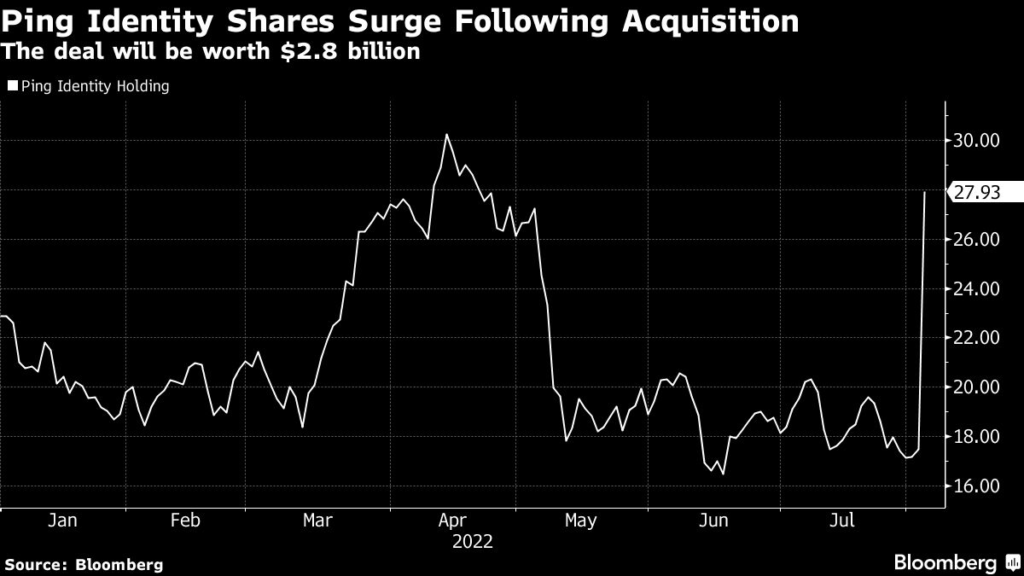
Ping Identity Surges After Thoma Bravo Deal Announced

(Bloomberg) — Private equity firm Thoma Bravo LLC will acquire the intelligence solutions company Ping Identity Holding Corp. for $2.8 billion, according to a statement released on Wednesday. Thoma Bravo will pay $28.50 per share in an all-cash transaction, a 63% premium over Ping Identity’s closing stock price on Tuesday.

The deal, approved unanimously by Ping Identity’s board, is set to close by the end of 2022. 

“This compelling transaction is a testament to Ping Identity’s leading enterprise identity solutions, our talented team and our outstanding customers and partners,” said Ping Identity’s Chief Executive Officer Andre Durand in a statement. Ping Identity, which is based in Denver, will become a closely held company.

Investment firm Vista Equity Partners, which owns roughly 9.7% of Ping Identity’s shares, has agreed to vote its shares in favor of the transaction with Thoma Bravo, according to the statement. 

Ping Identity’s shares rallied nearly 60% after the acquisition was announced. The company also reported second-quarter earnings, saying revenue fell 8.7% to $72 million, missing analysts’ estimates. The adjusted loss per share was 34 cents, compared to an 11 cent profit a year earlier.  


More stories like this are available on bloomberg.com

©2022 Bloomberg L.P.
Jefferies Hires Credit Suisse Fintech Banker David Goldstein

(Bloomberg) — Financial technology investment banker David Goldstein is leaving Credit Suisse Group AG for Jefferies Financial Group Inc., according to people familiar with the matter. 

He will join Jefferies as a vice chairman and fintech banker, said one of the people, all of whom asked to not be identified because the matter isn’t public. His departure comes as Credit Suisse doles out retention packages to hold onto talent amid management changes and a string of quarterly losses.

Representatives for Credit Suisse and Jefferies declined to comment.  

Financial technology bankers have been in high demand amid steady M&A activity among payments companies, financial data providers and market structure players. Jefferies has also been in hiring mode, recently hiring a banker from Moelis & Co. to build out its presence in Dallas, Bloomberg News reported last week. 

Goldstein joined Credit Suisse in 2005 and worked at Citigroup Inc. before that, according to Financial industry Regulatory Authority data. He’s worked on transactions for companies including WageWorks Inc., TDCX Inc. and International Money Express Inc., securities filings show. 

Read more: Credit Suisse Offers Retention Pay to Stem Tide of Defections

More stories like this are available on bloomberg.com

©2022 Bloomberg L.P.

Goldman, JPMorgan Subpoenaed by Elon Musk in Twitter Fight

(Bloomberg) — Elon Musk subpoenaed records from Twitter Inc.’s advisers Goldman Sachs Group Inc. and JPMorgan Chase & Co. to gather information on how they helped steer the social-media platform during its deal negotiations with the billionaire.

Musk’s lawyers want the banks to turn over “documents and communications” about their discussions about the proposed merger and analysis of Twitter’s financial conditions, according to filings made public Wednesday in Delaware Chancery Court. The subpoenas also demand information about any talks “with or about other potential purchasers of Twitter” besides Musk.

Both sides are seeking information to make their case ahead of the Oct. 17 trial in Twitter’s suit seeking to force Musk to complete the $44 billion acquisition. He claims he canceled the deal because Twitter failed to provide him with information about the number of spam and bot accounts on the platform. Twitter says his bot complaints were a pretext for him to walk away.

Twitter already sought documents from Musk adviser Morgan Stanley and other banks that offered to finance the acquisition, as well as several investors who backed the deal. The company has since unleashed a torrent of additional subpoenas, including of Tesla Inc. and SpaceX. Musk’s companies were asked to turn over any documents about the Twitter deal, including communications with their boss.

A unit of crypto-currency exchange Binance was also subpoenaed by Twitter. Binance put $500 million into Musk’s $7.1 billion equity raise for the deal in May. Twitter’s lawyers want to know about investment terms and the billionaire’s efforts to syndicate the package, according to court filings. 

Twitter also sought information from Musk’s lawyers at Skadden, Arps, Slate, Meagher & Flom and McDermott Will & Emery. 

The case is Twitter v. Musk, 22-0613, Delaware Chancery Court (Wilmington).

(Updates with other parties subpoenaed in case, background.)

More stories like this are available on bloomberg.com

©2022 Bloomberg L.P.

Robinhood Shares Surge After Online Brokerage Cut 23% of Staff

(Bloomberg) — Robinhood Markets Inc. shares surged Wednesday, a day after the struggling online brokerage dismissed almost a quarter of its staff and posted its sixth straight quarterly loss. 

The stock climbed 13% to $10.42 at 10:49 a.m. in New York and earlier rose as much as 17%, the biggest intraday advance in more than a month. It’s still down 73% since Robinhood’s initial public offering in July 2021.

On Wednesday, the company said second-quarter revenue tumbled 44% from a year earlier to $318 million, with monthly active users dropping to 14 million at the end of June, a decline of about 7 million from the middle of 2021. The firm posted a $295 million loss in the period.

A pandemic-fueled boom in retail trading helped propel Robinhood to last year’s IPO, but its popularity has waned significantly since then amid surging inflation, recession fears and sharp declines in stock and cryptocurrency markets. 

Read more: Robinhood Slashes 23% of Its Workforce in Sweeping Overhaul 

The latest round of job cuts were the second this year for Menlo Park, California-based Robinhood. It dismissed 9% of its workforce in April.


More stories like this are available on bloomberg.com

©2022 Bloomberg L.P.

Close Bitnami banner
Bitnami