Bloomberg

Semtech Agrees to Buy Sierra Wireless at $1.2 Billion Value

(Bloomberg) — Semiconductor maker Semtech Corp. is acquiring Sierra Wireless Inc. in all-cash transaction valuing the Canadian company at $1.2 billion including debt.

Semtech said in a statement Tuesday that it’s paying $31 a share for Sierra Wireless, a premium of about 25% to Friday’s closing price before Bloomberg News reported the merger talks. The deal is expected to roughly double Semtech’s annual revenue, according to the statement.

Sierra Wireless fell 5.2% to $28.15 in New York trading Tuesday, giving the company a market value of about $1.1 billion. The shares rose to about $30.25 after the close of regular trading.

Semtech also rose in late trading Tuesday after earlier falling 5.4% to $55.34 earlier for a market value of about $3.5 billion. 

Semiconductors have been an area of busy dealmaking in recent years despite the long regulatory reviews the transactions often face. MaxLinear Inc., a maker of chips for broadband communications, agreed in May to acquire Silicon Motion Technology Corp. Last week, the US House of Representatives delivered a boost to the domestic chip manufacturing, sending legislation for $52 billion in grants and incentives to President Joe Biden to sign.

Camarillo, California-based Semtech provides analog and mixed-signal chips, including wireless connectivity, power management and products used in video broadcast equipment. 

Based outside Vancouver in Richmond, British Columbia, Sierra Wireless makes so-called Internet of Things technology, a set of components designed to equip electronic systems with internet connections. Semtech has been making inroads into this area and a takeover of Sierra would complement its Internet of Things business.

“We believe the next era of technology growth is the full digitization of our industrial world — the internet of everything,” Semtech Chief Executive Officer Mohan Maheswaran said in the statement. “Our vision is to build a simple, horizontal platform with the goal of accelerating this transformation and to bring about a smarter and more sustainable planet.”

JPMorgan Chase & Co. served as Semtech’s financial adviser, while Sierra Wireless was advised by Qatalyst Partners and BMO Capital Markets, according to the statement.

(Updates with statement in second paragraph.)

More stories like this are available on bloomberg.com

©2022 Bloomberg L.P.

Nikola Overcomes Founder’s Opposition to Approve New Shares

(Bloomberg) — Nikola Corp. shareholders approved a measure to issue new shares to potentially raise capital, a move that founder and former chair Trevor Milton had opposed.

The clean-energy trucking startup will be able to expand its authorized outstanding share count to 800 million from 600 million after a majority voted in favor of the proposal, the clean-energy trucking startup said Tuesday in a statement. Nikola had postponed the vote for two months to wrangle the majority of outstanding shares it needed to win, pressing its case with retail investors who may not normally pay much attention to proxy votes.

Nikola investors representing 211 million shares voted for the measure, which Nikola said was represented about two-thirds of votes cast. 

Milton remains Nikola’s single largest shareholder with more than 11% of the stock. He effectively controls about 20%, or almost 90 million shares, through common stock he holds directly and an investment vehicle he co-owns. Bloomberg reported in June that he had opposed the share authorization.

Milton will go on trial in September to face charges of misleading investors by overstating the company’s technological capability and business prospects when he was running the company. He resigned from Nikola in 2020 and was subpoenaed as part of an investigation by the Department of Justice. 

More stories like this are available on bloomberg.com

©2022 Bloomberg L.P.

MicroStrategy’s Saylor Drops CEO Role as Company Posts $1 Billion Loss

(Bloomberg) — MicroStrategy Inc. co-founder Michael Saylor gave up his chief executive officer title and said he’ll focus more on Bitcoin after the enterprise-software maker reported a loss of more than $1 billion related to the second-quarter plunge in the price of the cryptocurrency. 

Saylor, who founded the Tysons Corner, Virginia-based company in 1989, will continue to serve as executive chairman as retains its Bitcoin buying strategy. MicroStrategy President Phong Le will take on the chief executive role. The company also filed with the Securities and Exchange Commission to register 450,000 shares.

“As global adoption of digital assets accelerates, this is becoming an ever more expansive job and I am comfortable increasing the scope of my advocacy efforts knowing that the execution of the MicroStrategy business plan rests in the capable hands of Phong,” Saylor said on a conference call after results were released.

MicroStrategy took a $917.8 million impairment charge related to the decline in the value of the Bitcoin it holds. Bitcoin tumbled 59% in the quarter, and traded about 45% lower than the price at the end of the year-earlier period.         

Revenue dropped to $122.1 million. Analysts polled by Bloomberg expected revenue of $123.25 million in the second quarter. Net quarterly loss of $1.062 billion compared with a loss of $299.3 million in the same quarter of last year. The quarterly loss is almost exactly twice the company’s revenue in the last 12 months.

“MicroStrategy’s original strategy and consulting business needs full-time attention,” said Henry  Elder, head of decentralized finance at Wave Financial. “Now Michael can focus on what he does best, promoting Bitcoin. And the company can focus on making more money to buy more Bitcoin. They are basically doubling down.” 

As of June 30, the carrying value of the company’s 129,699 Bitcoins was $1.988 billion, the company said, reflecting the cumulative impairment loss of $1.989 billion. The cumulative amount is now more than Bitcoin on the company’s balance sheet.

MicroStrategy began investing in Bitcoin in the summer of 2020, after Saylor said he saw it as a hedge against inflation. The company’s shares surged that year by more than 170% as the value of the Bitcoin jumped. 

Shares of MicroStrategy fell about 2% in post-market trading. The stock is down about 50% this year, on par with Bitcoin’s slide.

(Adds comment from conference call in the third paragraph.)

More stories like this are available on bloomberg.com

©2022 Bloomberg L.P.

Airbnb Slumps After Bookings Missed Analyst Estimates

(Bloomberg) — Airbnb Inc. shares slid after the company missed estimates on bookings, highlighting investors’ and analysts’ high expectations for companies in the travel sector after a long Covid slump.  

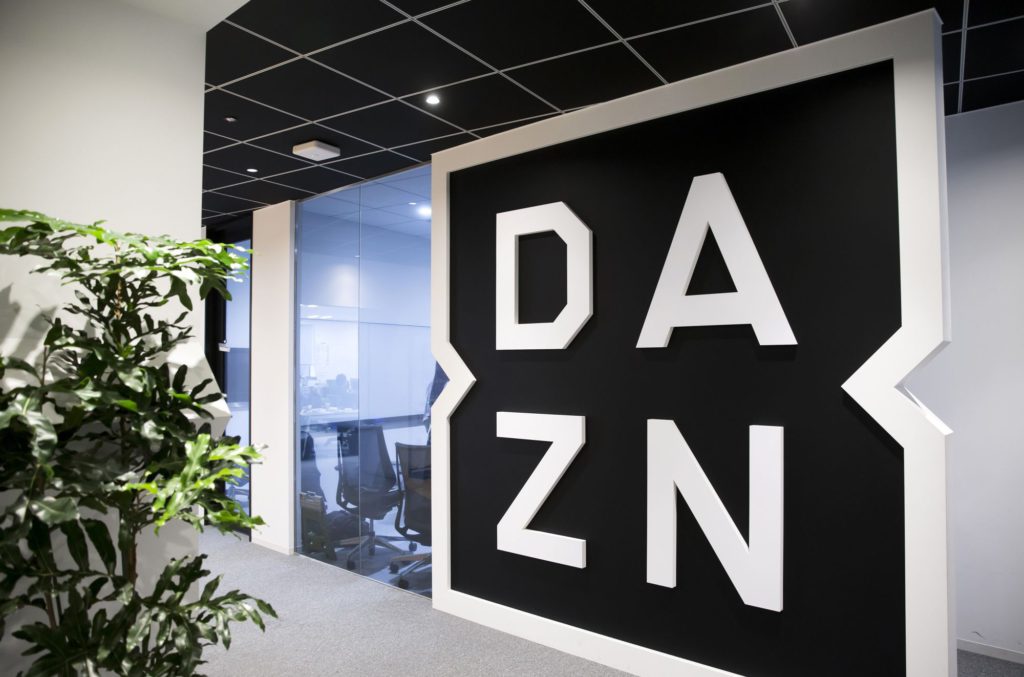
The San Francisco-based home-rental company said Tuesday that nights and experiences booked in the second quarter rose 25% to 103.7 million, missing an analyst estimate of 106 million. The company is expecting similar growth in the third quarter, but that rate falls below analysts’ estimates of close to 109 million. Second-quarter sales rose 58% from a year earlier to $2.1 billion, matching the average projection. 

Though Airbnb has been reporting a boom in activity from consumers demanding to get away, investors have been punishing the company, sending the stock down about 30% this year. A $2 billion buyback, its first ever, will offset dilution from an employee stock program. Though the company gave a forecast for a record third quarter, it has refused to use the windfall of demand to introduce a change of investment strategy amid the backdrop of a slowing world economy.

“During the height of the pandemic, we made many difficult choices to reduce our spending, making us a leaner and more focused company,” Airbnb said in a letter to shareholders. “We’ve kept this discipline ever since, allowing our hiring and investment plans to remain unchanged since the beginning of the year. Airbnb is well positioned for whatever lies ahead.”

The shares fell about 8% in extended trading after closing at $116.34 in New York. The stock has dropped 30% this year. 

Travel industry results in the current reporting period had started well after Visa Inc. said last week that cross-border transactions rose 28% in the fiscal third quarter, beating analyst estimates. After Airbnb, Booking Holdings Inc. will report Wednesday and Expedia Group Inc. on Thursday. Both are also grappling with waning investor sentiment — Booking is down 18% this year, and Expedia has dropped about 43%.

Airbnb Chief Executive Officer Brian Chesky and other industry executives have been expecting travel demand to surpass 2019 levels, overcoming strains from new Covid variants, an inflation pickup and Russia’s invasion of Ukraine. The platform has realized that expectation — the $379 million of net income is the highest ever for a second quarter.

Airbnb expects $2.78 billion to $2.88 billion of sales in the period ending in September, with the low end of that range matching the average in a Bloomberg survey of analysts. Airbnb recorded its highest-ever daily revenue on July 4, indicating demand continued in the current quarter.

The company reported earnings per share of 56 cents, a swing from last year’s 11 cent loss. The plan to buy back as much as $2 billion of Class A stock allows transactions to be made at management’s discretion and through a variety of methods, including open market purchases, and can be terminated at any time. 

Gross bookings, the total value of transactions on the platform, totaled $17 billion in the second quarter, just topping the analyst estimate of $16.9 billion. Long-term stays were the fastest growing category, gaining almost 90% from three years ago, suggesting the pandemic boon is getting extended as people able to work from anywhere continue to seek longer-term stays in remote locations. 

The enthusiasm for travel has given hosts pricing power, with daily rates averaging $164 in the second quarter, 40% more than three years ago. Airbnb expects a slight pickup in average daily rates on an annual basis in the third quarter to drive an increase in the value of gross bookings. 

Airbnb said its expectation for a revenue pickup in the current quarter includes “a significant headwind from foreign exchange fluctuations relative to last year.” The strength of the greenback has been a theme for US tech giants, with Microsoft Corp. and Netflix Inc. among the companies reporting a hit to revenue. Roughly half of Airbnb’s sales comes from abroad, Booking does close to 90% of its business overseas, and Expedia’s share is around 25%. Investors have worried about slowing economic growth, but Airbnb executives are confident that the platform offers affordable options for all travelers. 

“We don’t know what the economy is going to bring, but we do know that Airbnb is resilient to almost any kind of economic shock,” Dave Stephenson, Airbnb’s chief financial officer, said on a conference call after the results. “We’re going to continue to grow. We’re growing headcount at high single-digit percentage rates, but that is going to be able to support us for the very longterm. We’re going to remain very focused and disciplined in our investments.”

Severe disruption in the airline industry may also weigh on future travel. United Airlines Holdings Inc. and Delta Air Lines Inc. are among carriers cutting back flights to deal with staff shortages, surging fuel costs and a flood of passengers cramming themselves onto planes now that Covid travel restrictions have eased.  

(Updates with third-quarter estimates in second paragraph and CFO comments in 12th paragraph.)

More stories like this are available on bloomberg.com

©2022 Bloomberg L.P.

AMD Gives Lackluster Forecast as PC Slump Hurts Sales

(Bloomberg) — Advanced Micro Devices Inc., the second-biggest maker of personal-computer processors, gave a lukewarm sales forecast for the third quarter, indicating that market-share gains against Intel Corp. won’t make up for a decline in PC demand. 

Revenue in the period will be about $6.7 billion, AMD said in a statement Tuesday, compared with an average analyst estimate of $6.81 billion. The chipmaker’s shares fell more than 5% in extended trading following the announcement.

Under Chief Executive Officer Lisa Su, AMD has been taking market share from Intel and benefiting from demand for its new, powerful server chips. But Tuesday’s outlook showed that the company isn’t insulated from the slowing PC industry, which is still the biggest market for its products. That business is now expected to decline more steeply than the company had projected, Su said on a call with analysts. 

“We are being more conservative in our PC guidance,” she said. “We continue to see strong demand in the data canter, in our embedded business, in game consoles.”


AMD is now even more pessimistic about PC demand than Intel or market forecasters. The business will decline in the “mid-teen” percentage range, Su said on the conference call. Three months ago, she said the company was expecting shipments in the PC market to drop in the high-single-digit percentage range in 2022.

Last week, Intel downgraded its outlook for the market to a contraction of about 10%. And research firm Gartner Inc. has predicted that PC shipments will shrink 13% in 2022 after two years of growth. Chip revenue from that market will fall 5.4%. 

While AMD may be falling short of lofty estimates, its larger rival Intel is faring even worse. That company — once the envy of the chip industry — has suffered rapidly declining revenue in its biggest business and reported a loss in the second quarter. Su predicted that AMD will continue to win share with products it has coming to market this quarter and in the final three months of 2022.

Investors also have been concerned that chipmakers will be left with costly stockpiles of unused chips as orders dry up. AMD’s inventory in the second quarter increased by a third from where it was at the end of 2021, reaching $2.6 billion, though acquisitions contributed to the bulk of the increase. 

The company’s shares closed at $99.29 Tuesday in New York, down 31% this year — part of a broader pullback for chip stocks.

AMD has predicted sales would grow about 60% this year, and it stuck by that outlook Tuesday, saying that revenue will be $26.3 billion, plus or minus $300 million. Data-center growth will lead that increase. AMD is finding new customers for server chips, which form the heart of machines that run the internet and corporate networks.

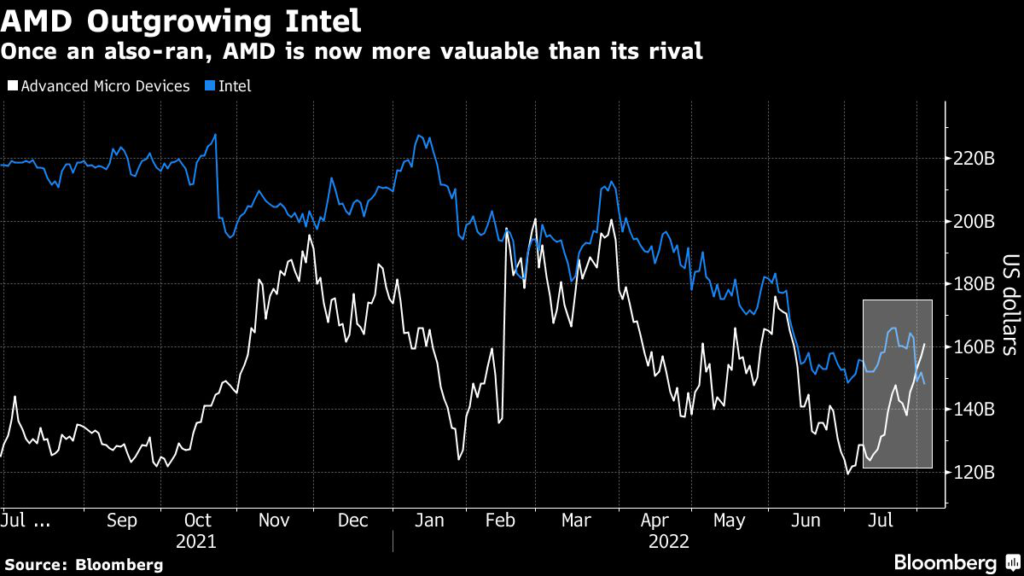
Investors had rewarded AMD’s gains against Intel. The chipmaker’s market value passed that of its longtime rival this year, standing currently at $160.9 billion. Compare that with 2016, two years after Su was promoted to the CEO job, when AMD had a market capitalization of less than $3 billion. Intel’s value at the time was $160 billion.

Some of AMD’s rapid increase in size comes from its acquisition of programmable chipmaker Xilinx Inc., completed earlier this year.

With Tuesday’s report, AMD is breaking down its revenue in a new way, giving investors a clearer picture of how much of its revenue comes from chips used in data centers. It’s dividing up the rest of its sales up between PCs and products used in computer gaming, graphics chips and components of game consoles.

The company’s data center unit delivered revenue growth of 83% in the second quarter, with sales of $1.5 billion. Its operating income more than doubled. The client unit — PC chips — posted growth of 25% to $2.2 billion. That division’s operating income was $676 million, up 26% from the same period a year earlier.

Overall revenue jumped 70% to $6.55 billion. That yielded a profit of $1.05 a share, minus certain items. Those numbers compare with average analyst estimates of $6.53 billion in revenue and $1.05 a share in profit.

(Updates with CEO comments starting in fourth paragraph.)

More stories like this are available on bloomberg.com

©2022 Bloomberg L.P.

Equifax Says Consumer Credit Scores Changed in Computer Error

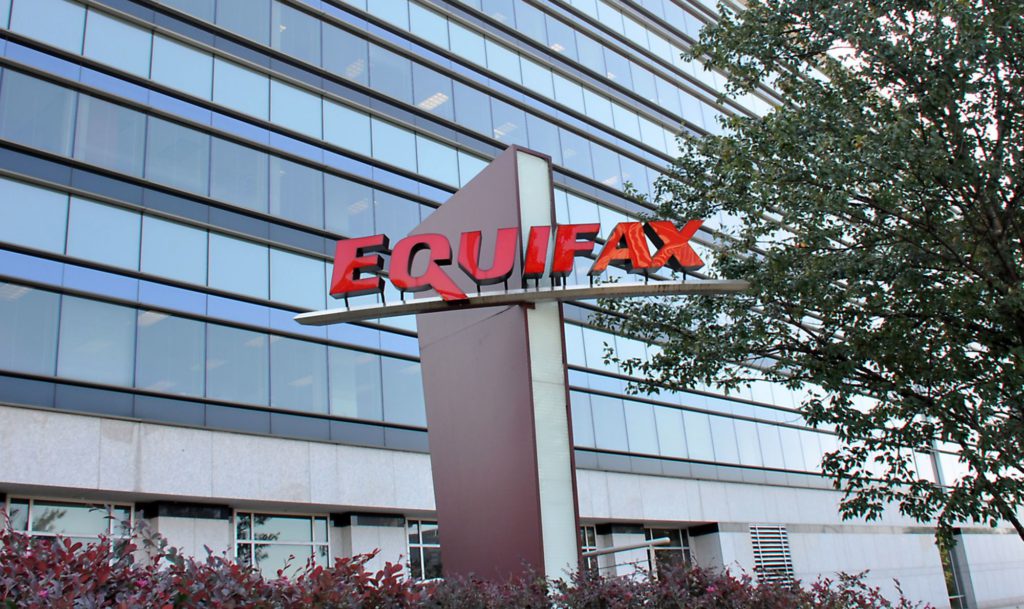
(Bloomberg) — Equifax Inc. said some consumer credit scores were changed because of a computer error that has since been rectified.

A server “coding issue” led to the inaccurate scores, the consumer credit-reporting firm said Tuesday in a statement posted on the web. The Atlanta-based firm didn’t say how many consumers were affected.

“There was no shift in the vast majority of scores during the three-week time frame of the issue,” the company said. “For those consumers that did experience a score shift, initial analysis indicates that only a small number of them may have received a different credit decision.” 

The Wall Street Journal reported earlier that Equifax provided inaccurate credit scores on millions of US consumers looking for loans, citing bank executives and people familiar with the matter it didn’t identify. 

Erroneous scores were sent from mid-March through early April, and disclosures of the errors began in May, the newspaper reported. The scores covered consumers applying for auto loans, mortgages and credit cards to banks and non-bank lenders including JPMorgan Chase & Co., Wells Fargo & Co. and Ally Financial Inc., according to the report. 

Shares of the company fell 2.1% to $206.31 in regular New York trading.

The issue follows a cyberattack at Equifax, which maintains credit reports on US consumers and sells them to lenders, that it disclosed in September 2017. Hackers accessed data including Social Security numbers, driver’s license numbers and addresses, it said at the time.

More stories like this are available on bloomberg.com

©2022 Bloomberg L.P.

Match Drops After Sales Forecast Falls Short on Slow Growth

(Bloomberg) — Match Group Inc. gave a forecast for revenue in the current quarter that fell far short of analysts’ estimates with growth stymied by continuing fallout from Covid-19 and a strong dollar weighing on overseas sales. The shares fell more than 20% in extending trading.

Sales will be $790 million to $800 million in the quarter ending in September, said the Dallas-based company, which is parent to dating apps including Tinder, OkCupid and Hinge. Analysts, on average, estimated $883.6 million, according to data compiled by Bloomberg. The company said currency fluctuations would have an 8 percentage point effect on revenue.

“Although the overall market opportunity remains substantial, the current environment is presenting some unique trends related to consumer behavior,” Chief Executive Officer Bernard Kim said Tuesday in a letter to shareholders. “While people have generally moved past lockdowns and entered a more normal way of life, their willingness to try online dating products for the first time hasn’t yet returned to pre-pandemic levels.”

Match has faced multiple challenges this year, including a senior leadership change, a legal battle with Alphabet Inc. over the Google Play Store, lagging growth due to Covid-19 restrictions and currency fluctuations hurting overseas revenue. Kim replaced Shar Dubey as CEO after she stepped down at the end of May. Dubey served various roles at Match over 16 years, leaving shortly after the company missed first-quarter revenue estimates and announced a round of share buybacks. 

Match also announced Tuesday that Renate Nyborg was leaving as chief executive officer at Tinder, the largest unit and the most popular dating app in the US. The company is searching for a permanent replacement, Kim said.

“We need some time for the new Tinder team to improve execution and see how they deliver on their product road map,” Kim said in the letter. “We’re optimistic that the changes we’ve made at Tinder will lead to improved product execution and velocity, monetization wins and enhanced user growth.”

Direct revenue from Tinder increased 13% in the quarter, Match said. But the company intends to pull back on “Tinder Coins,” an in-app virtual currency used to provide benefits to users and encourage more spending. “We also intend to do more thinking about virtual goods to ensure that they can be a real driver for Tinder’s next leg of growth and help us unlock the untapped power” of the platform, Kim said.

Match has been expanding its presence abroad too, with Hinge’s launch in Germany and the acquisition last year of South Korean video conferencing company, Hyperconnect. The company expects Hinge to contribute $300 million in revenue this year, which is about a 50% increase from 2021. The app will launch elsewhere in Europe and in India in the upcoming quarters, Match said.

“The largest untapped market opportunity for us is in APAC,” Kim said, adding that payer growth in the region should be fueled by Hyperconnect.

Still, Match said it’s seeing “weakness” in its live streaming business and a rise in Covid cases has blunted momentum particularly in Japan.

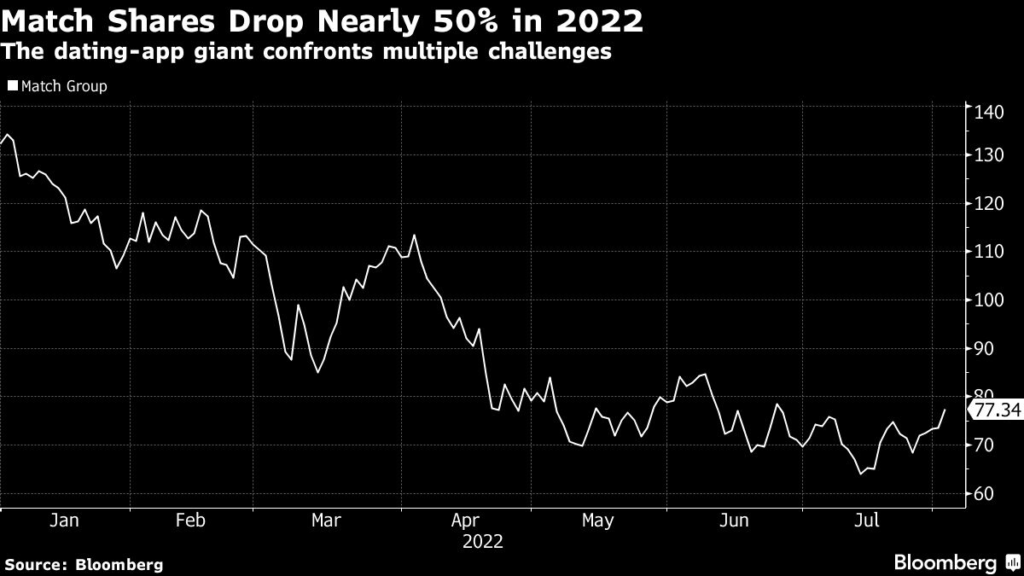
The shares fell to a low of $58.03 in extended trading after closing at $76.71 in New York. The stock has plunged 42% this year, compared with a 6.3% gain for rival Bumble Inc.

Companies including Microsoft Corp. and Netflix Inc. have cited currency fluctuations for reduced revenue. Match said that it has seen a $74 million revenue headwind to date. 

In the second quarter, Match reported revenue increased 12% to $795 million, compared with the average analyst estimate of $804.1 million. Paying users grew 10% to 16.4 million, falling short of the 16.5 million average estimate. 

Match reported a net loss of $32.4 million, or a loss of 11 cents a share, compared with net income of $140.5 million, or 46 cents a share, in the period a year earlier. 

(Updates with details on Tinder in the seventh paragraph.)

More stories like this are available on bloomberg.com

©2022 Bloomberg L.P.
Pelosi’s Taiwan Trip Spurs Chinese Battery Giant to Pause Plant Debut

(Bloomberg) — A giant Chinese supplier of electric-vehicle batteries decided to push back announcing a multibillion-dollar North American plant to supply Tesla Inc. and Ford Motor Co. due to tensions raised by House Speaker Nancy Pelosi’s trip to Taiwan, according to people familiar with the matter.

Contemporary Amperex Technology Co. Ltd., the world’s biggest maker of batteries for electric vehicles, has been considering at least two locations in Mexico near the Texas border, as well as sites in the US, for the plant. China’s CATL has been in an advanced stage of site selection and negotiating incentives, in anticipation of announcing its selection in the coming weeks.

CATL now plans to wait until September or October to make the announcement, the people familiar with the process said Tuesday, asking not to be identified as the information isn’t public. The concern is that an announcement could stoke tensions at a sensitive time in US-China ties amid the controversial Pelosi visit to Taiwan, they said.

Related: Pelosi Lands in Taiwan as China Plans Drills Encircling Island

A representative for CATL didn’t respond to requests for comment. Tesla also didn’t respond to requests for comment. Ford declined to comment.

Shares of Tesla pared an intraday climb as high as 3.6% to close up 1.1% at $901.76 in New York. Ford fell into negative territory after midday gains, declining 1.2% to $15.16.

Pelosi landed in Taipei, Taiwan’s capital, on Tuesday evening local time in the face of threats and opposition from China, which regards Taiwan as part of its territory. Pelosi’s trip makes her the highest-ranking US politician to visit the island in 25 years, and Chinese officials have called it “provocative.”

CATL’s headquarters are in Fujian, across the Taiwan Strait from the island. China has announced military exercises will take place around the island this week in response to Pelosi’s visit to Taipei.

Bloomberg News reported last month that CATL is considering Ciudad Juarez, in the state of Chihuahua, and Saltillo, in Coahuila, and that the company is contemplating an investment of as much $5 billion in the project. Sites in the US and Mexico are still under active consideration, and there’s no intention to walk away from the plan, the people said.

CATL is also weighing the need to establish a North America site alongside the potential impact of a US legislative package being brokered between Democratic senators Chuck Schumer and Joe Manchin, the people said.

Read more: New US Climate Deal Could Make EVs, Energy Bills Cheaper

A key piece of that legislation requires EV makers to source a portion of battery minerals from — or processed in — a country with which the US has a free trade agreement, in order for their vehicles to qualify for consumer incentives. The US-Mexico-Canada Agreement went into effect in July 2020.

(Updates with closing Ford and Tesla shares in fifth paragraph.)

More stories like this are available on bloomberg.com

©2022 Bloomberg L.P.
DAZN Nears Football-Broadcast Deal With Sky in Italy

(Bloomberg) — Online sports broadcaster DAZN Group Ltd. is in advanced talks with rival Comcast Corp.’s Sky about a distribution partnership for Italy’s top football league, Serie A, according to people familiar with the matter.

DAZN, which last year won a deal valued at 2.5 billion euros (then $3 billion) to become the exclusive domestic broadcaster of Serie A, now plans to share broadcast rights with Sky Italia, the people said, asking not to be mentioned since the discussions aren’t public. A final agreement hasn’t been reached though a deal could be announced as soon as this week, the people said. Financial terms weren’t available.

Before DAZN won the Serie A rights auction for Italy in 2021, Sky had been the main domestic broadcaster for Italy’s top football tournament for about two decades.

The possible accord is part of a renegotiated agreement that also involves Telecom Italia SpA, the people said. In early 2021, under the tenure of then Chief Executive Officer Luigi Gubitosi, Telecom Italia reached an agreement with DAZN to provide distribution and technological support as well as financing of about 1 billion euros for its bid to broadcast the next three seasons of Serie A.

The deal didn’t reach the targets that Telecom Italia had set, and the phone carrier needed to book 548 million euros in non-recurring provisions.

Telecom Italia’s board could approve the new deal with DAZN in a board meeting on Wednesday, the people added. The phone carrier will report earnings on the same day.

Representatives for DAZN and Sky Italia weren’t available after normal business hours. A spokesman for Telecom Italia declined to comment.

More stories like this are available on bloomberg.com

©2022 Bloomberg L.P.
Treasuries Sink as Fed Pivot Seems Less Likely: Markets Wrap

(Bloomberg) — US Treasuries sank and stocks dropped after Federal Reserve officials signaled the central bank is still intent on raising rates until inflation is under control.

Treasury yields rose across the curve, with 10-year rates climbing as much as 20 basis points to 2.77%. The yen, which was on track for its fifth daily gain, fell as the dollar snapped four days of losses amid a sudden turnaround in risk sentiment. 

The S&P 500 dropped for the second straight day as Nancy Pelosi’s arrival in Taiwan prompted China to announce missile tests, even as she said her visit did not alter longstanding US policy in the region. The Nasdaq 100 also ended the day down.

Both indexes swung between gains and losses on Tuesday as markets remained on edge with geopolitical tensions simmering and fresh commentary from Fed officials making it apparent that a policy pivot was less likely. 

Read More: Volatility Hits Markets With Geopolitics Adding to Set of Risks

Stocks started August on the back foot after posting their best month since 2020 in July. Investors have been keeping an eye out for hawkish comments from Fed officials about the need for higher rates to restrain elevated inflation. While San Francisco Fed President Mary Daly said on Tuesday that the Fed is “nowhere near” done with its efforts to tamp down on inflation, Chicago Fed President Charles Evans said he expects the pace of rate hikes will start to slow later in the year. 

“The Fed is not likely to announce they’re letting up on the brakes at this point,” said Ellen Gaske, economist at PGIM Fixed Income. “They are still seeing inflation numbers that have not started to recede.”

Cleveland Fed President Loretta Mester echoed this, saying that she wants to see “very compelling evidence” that month-to-month price increases are moderating before declaring that central bank has been successful in curbing inflation.

Fresh economic data has also kept investors on their toes. Recent data showed that US job openings in June fell to a nine-month low, a sign of moderating demand for labor as economic pressures mount. The job market has been a bright spot in an economy otherwise losing momentum and possibly heading toward a recession.

Pelosi’s trip has created a fresh pressure point for investors already dealing with the prospects of a US recession, worldwide rate hikes and inflation that risks becoming entrenched as Russia’s war in Ukraine exacerbates food shortages.

“The Taiwan story fits into the broader risk-off theme,” said Mark McCormick, global head of FX strategy at TD Securities. “It raises concerns about global growth issues, especially if geopolitical tensions and knock-effects exacerbate inflationary concerns. In turn, that forces central banks to keep fighting inflation in spite of the clear deceleration of global growth.”

Read More: Pelosi to Meet Taiwan Chief as China Opens Military Drills

Earnings

Corporate earnings continued to roll in on Tuesday, with higher prices threatening to erode margins. Caterpillar Inc. slumped after a slowdown in China weakened its business. That weighed on the Dow Jones Industrial Average, which was lower for the day. Shares of Uber Technologies Inc. surged the most since 2020 during the trading session after the firm reported second-quarter revenue that beat the average analyst estimate.

With earnings trickling in after the markets closed, Starbucks Corp. rose in extended trading after its net revenue came in slightly above expectations. Meanwhile, Advanced Micro Devices Inc., the second-biggest maker of computer processors, fell after giving a lukewarm forecast for the third quarter.

This week’s MLIV Pulse survey is asking about your outlook for corporate bonds, mergers and acquisitions and health of US corporate balance sheets through the end of the year. It takes one minute to participate in the MLIV Pulse survey, so please click here to get involved anonymously. 

What to watch this week:

  • St. Louis Fed President James Bullard is due to speak, Tuesday
  • OPEC+ meeting on output, Wednesday
  • US factory orders, durable goods, ISM services, Wednesday
  • BOE rate decision, Thursday
  • US initial jobless claims, trade, Thursday
  • Cleveland Fed President Loretta Mester due to speak, Thursday
  • US employment report for July, Friday

Some of the main moves in markets:

Stocks

  • Futures on the S&P 500 fell 0.6% as of 4:58 p.m. New York time
  • Futures on the Dow Jones Industrial Average fell 1.1%
  • The MSCI World index rose 0.1%

Currencies

  • The Bloomberg Dollar Spot Index rose 0.8%
  • The euro fell 0.9% to $1.0166
  • The British pound fell 0.7% to $1.2162
  • The Japanese yen fell 1.2% to 133.15 per dollar

Bonds

  • The yield on 10-year Treasuries advanced 17 basis points to 2.75%
  • Germany’s 10-year yield advanced four basis points to 0.82%
  • Britain’s 10-year yield advanced six basis points to 1.87%

Commodities

  • West Texas Intermediate crude fell 0.2% to $93.74 a barrel
  • Gold futures fell 0.5% to $1,779.50 an ounce

More stories like this are available on bloomberg.com

©2022 Bloomberg L.P.
Close Bitnami banner
Bitnami