
Bloomberg

Alibaba and Tencent Face End of an Era as Sales Start to Shrink

(Bloomberg) — For almost a decade, Alibaba Group Holding Ltd. and Tencent Holdings Ltd. embodied China’s economic miracle, sustaining a dizzying pace of growth and approaching trillion-dollar valuations with splashy forays into every corner of the internet. 

That spectacular run could officially end Thursday, when the e-commerce powerhouse that Jack Ma founded is expected to record its first-ever decline in quarterly revenue — one of the few major Chinese internet corporations to do so, ever. Fellow billionaire Pony Ma’s Tencent, the social media powerhouse, could follow suit days later.

The milestones are a reminder for investors that, after a government crackdown that wiped more than $1 trillion off their combined market value in 2021, Alibaba and its longtime arch-rival are shadows of their former selves. Like the rest of the country, they’re grappling not just with an uncertain regime but also Covid Zero and a consumer crisis that’s testing the stability of the world’s No. 2 economy.

“It should not be surprising that the second quarter of 2022 will be one of the worst quarters since the pandemic for China earnings given the lockdowns, and tech is no exception,” said Bloomberg Intelligence analyst Marvin Chen. “Tech has also faced additional regulatory headwinds on growth prospects, which is a more structural and longer-term trend.”

The speed and ferocity with which Beijing clamped down on online commerce, car-sharing, food delivery and gaming irrevocably reset growth expectations for the industry last year. But Alibaba has taken a harder hit than many of its peers.

There was the tax evasion probe into celebrity livestreamer Viya, who once singlehandedly moved $1.2 billion of goods during Alibaba’s Nov. 11 online bonanza. Then, the nation’s technology watchdog suspended ties with its cloud business for late disclosure of a major software vulnerability, spooking potential clients. 

In June, “Lipstick King” Li Jiaqi became the second major personality to vanish from Alibaba’s Taobao after apparently offending censors. And just last month, cybersecurity experts linked Alicloud to China’s largest cybersecurity breach — a leak of records on a billion residents from Shanghai’s police database. 

All that transpired as China narrowly escaped economic contraction in the second quarter, when rolling Covid lockdowns depressed spending on everything from online content to apparel and electronics.

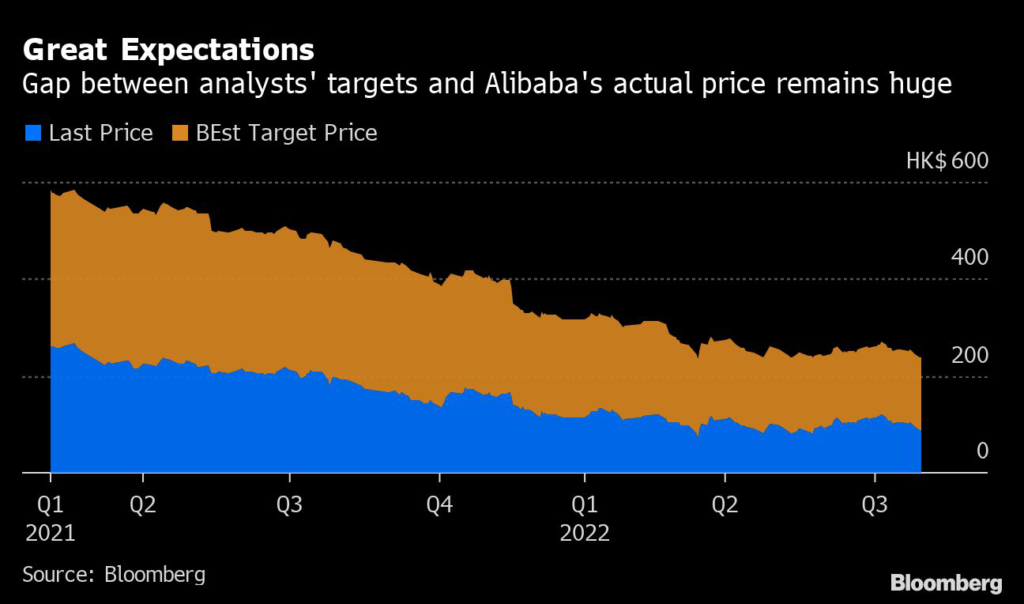
Once candidates to join the likes of Apple Inc. and Amazon.com Inc. in a select club of companies with trillion-dollar valuations, China’s largest internet companies are now struggling to keep up with even the most staid utilities. Analysts from Susquehanna to Deutsche Bank have scrambled to slash their targets as the Hangzhou-based Alibaba continued to plumb new lows.

“It used to be the case where investors bought Alibaba and Tencent shares hoping their dominant positions in e-commerce, social and gaming would create synergy with their newer businesses and vast swathes of portfolio firms,” said Ke Yan, a Singapore-based analyst with DZT Research. “But that’s a long-lost cause since the government tightening.”

Alibaba reports earnings Thursday. Its revenue is projected to slip 1.2% to 203.4 billion yuan ($30.1 billion) for the three months ended June.

Prospects at Tencent aren’t much better. Although regulators resumed approving new games in April after a months-long hiatus intended to curb addiction, the country’s premier developer has yet to win a nod for a single title this year. That’s one reason analysts predict Tencent’s revenue will fall 1.7% in the April to June period.

Read more: Tencent, Alibaba Look Like Utilities After $1 Trillion Drubbing

Market sentiment toward Chinese tech stocks swung wildly in recent weeks, reflecting a persistent struggle to juggle a torrent of negative signals with expectations that Beijing is finally easing up on its crackdown.

Alibaba rose as much as 6.5% on July 26 after announcing its decision to apply for a primary listing in Hong Kong that paves the way for millions of mainland investors to directly buy the stock. It surrendered those gains within days as investors assessed the implications of co-founder Ma ceding control of Ant. Compounding matters, Alibaba became the latest to join a growing roster of Chinese firms that face removal from US bourses because of Beijing’s refusal to permit American officials to review their auditors’ work. 

The rest of China’s tech universe isn’t faring that well, either. Search leader Baidu Inc. is also projected to report a 5.6% revenue slide in the June quarter. JD.com Inc., food delivery giant Meituan and streaming service Kuaishou Technology are forecast to expand at their slowest pace in years. 

Chinese tech executives have warned investors repeatedly to prepare for a new reality of sedate growth, but the downbeat projections paint a gloomier picture than many feared. As Covid lockdowns paralyze business activities in cities from Shanghai to Shenyang, China’s once-reliable economic engine has lost steam. 

Retail sales grew 3.1% in June, versus 12% a year earlier. For Alibaba, that translated into expectations that revenue from its bread-and-butter China Commerce division would grow barely 1% — its worst quarter on record. 

Even Alibaba’s cloud division is flagging. Its revenue is projected to expand 14.3% during the April to June period, but that’s the second-lowest number in about six years.

“The worst should be behind us as the economy picks up pace and lockdowns ease, but it may be a bumpy recovery depending on the Covid situation,” Chen said. “For tech, top-line sales growth may pick up from here, but earnings may be more volatile depending on cost-cutting measures and investments made over the past year.”

Why a Primary Listing in Hong Kong Matters for Alibaba, BiliBili

More stories like this are available on bloomberg.com

©2022 Bloomberg L.P.
Volatility Hits Markets With Geopolitics Adding to Set of Risks

(Bloomberg) — Global financial markets whipsawed as risk sentiment remained fragile, with US House Speaker Nancy Pelosi’s Taiwan trip adding to the list of investor worries ranging from a restrictive Federal Reserve policy to the specter of an economic recession.

In a session of many reversals, the S&P 500 ended lower after several attempts to stay in the green. A gauge of US-listed Chinese shares halted a three-day slide. Ten-year US yields jumped to 2.75%, following an earlier plunge that drove them to around 2.5%. The Japanese yen and gold erased gains. The offshore yuan advanced.

“It’s going to be volatile,” said Ellen Gaske, economist at PGIM Fixed Income. “Geopolitical risks are obviously elevated on a more persistent basis here. So I think that imparts a degree of volatility to markets, and that’s on top of the volatility in rates markets that we are already seeing because of the Fed being on the move, and because it is uncertain how far the Fed will actually have to go from here.”

Pelosi Trip Spurs China Battery Giant to Pause Plant Debut

Pelosi became the highest-ranking American politician to visit Taiwan in 25 years, prompting China to announce missile tests and military drills encircling the island. She plans to hold a joint press briefing with President Tsai Ing-wen at 10:53 a.m. on Wednesday, Taiwan’s Foreign Ministry said in a statement.

Pelosi’s trip is creating a fresh pressure point for investors already dealing with the prospects of a US recession, worldwide rate hikes and surging inflation. Analysts have warned about the tailrisk of a conflict between the world’s two largest economies that wreaks havoc on global markets.

“China will show her displeasure by ratcheting up retaliatory actions, but it won’t get out of hand given its economy is weak,” said Rajeev De Mello, a global macro portfolio manager at GAMA Asset Management in Geneva.

While the White House has sought to dial back rising tensions by insisting there is no change in its position toward Taiwan, which China considers as part of its territory, Beijing has called Pelosi’s visit a “dangerous gamble” with grave consequences.

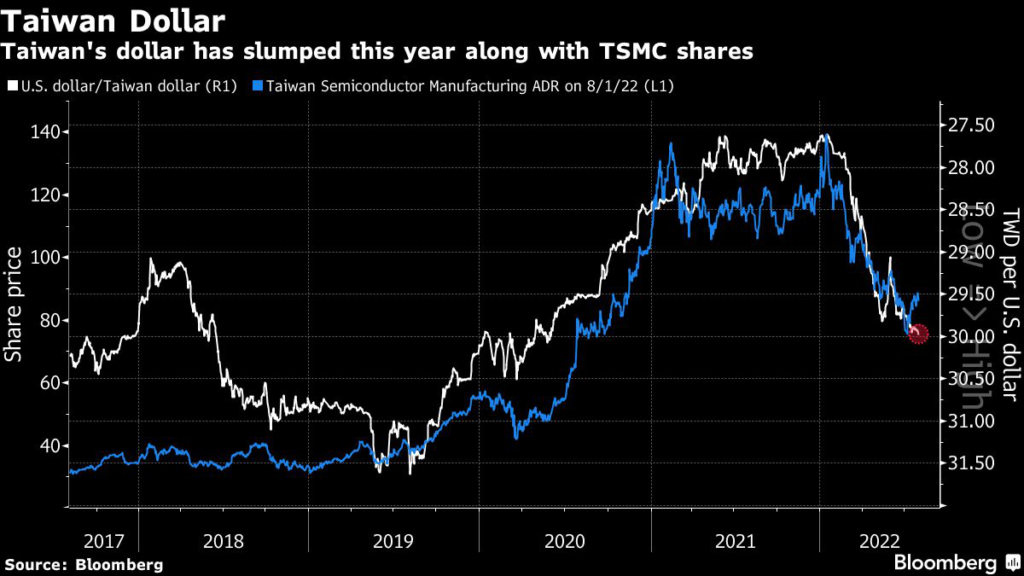
The Taiwan dollar hit its lowest since May 2020, while paring the drop on signs that local banks were selling the greenback to meet the needs of foreign funds.

Equity markets in China and Hong Kong were the worst performers in Asia as security analysts outlined potential military responses from Beijing. 

American depositary receipts of Taiwan Semiconductor Manufacturing Co. and Baidu Inc. retreated, while those of Alibaba Group Holding Ltd. posted a 2.5% gain.

Some analysts warn the impact of Pelosi’s visit will hasten the deterioration in US-China ties. 

The concern is that the trip and China’s reaction to it worsens the longer-term relationship on trade, and plays out in markets over weeks or more, with implications for Treasuries, according to BMO Capital Markets strategists Ian Lyngen and Benjamin Jeffery. Yields on the 10-year benchmark may drop below 2.5% this week, they wrote in a report.

“The expectation is that China’s reaction will mostly be confined to some signaling actions, instead of something really hurting their economy, and therefore at this stage, we view the market’s reaction has so far been relatively mild,” Becky Liu, head of China macro strategy at Standard Chartered Bank Plc, told Bloomberg Radio. “We just need to be concerned about the medium-to long-term implications.”

Still, investors may need to prepare for a drawn-out reaction in financial markets, something which could underpin haven assets like Treasuries.

“Pelosi’s visit carries with it the presumption of a limited time frame for a tradable response; an assumption that we’ll characterize as misplaced,” BMO’s Lyngen and Jeffery wrote in their note. “Any response could be weeks away or further and for this reason we anticipate that the geopolitical backdrop will once again contribute to the bullish underpinnings for the US rates market.”

(Updates market moves throughout. A previous version of this story corrected the spelling of BMO strategist Ian Lyngen.)

More stories like this are available on bloomberg.com

©2022 Bloomberg L.P.
Uber Surges Most Since 2020 as Demand Eases Worries on Inflation

(Bloomberg) — Uber Technologies Inc. soared the most since 2020, buoyed by revenue that beat analysts’ estimates as customers kept hailing rides and ordering takeout food in the face of quickening US inflation.

“The business is really hitting on all cylinders,” Chief Executive Officer Dara Khosrowshahi said Tuesday in an interview on Bloomberg Television. He pointed to Uber’s record gross bookings and revenue, which more than doubled to $8.1 billion in the second quarter, and said the dual mission in carrying people and making deliveries would set it apart from peers in the event of an economic downturn.

Khosrowshahi’s optimistic tone stood out in a turbulent time for technology companies, as inflation stokes fears of a pullback in consumer spending for services like food-delivery and rides. Uber Eats revenue grew 25% from a year ago and Khosrowshahi said a key focus for the company the remainder of this year will be increasing profitability in the delivery segment.

“Both the US and international are growing at a rate of 40 plus percent which is super healthy,” Khosrowshahi said. “We are big believers in delivery and the focus here is, really, profitability.”

Uber shares gained 19% in New York, closing at $29.25. That brings the stock’s losses for the year to 30%. 

The number of new drivers on the platform increased during the second quarter and wait times and surge pricing will improve further as driver supply comes back into balance with customer demand, Khosrowshahi said.

In the three months ended June 30, Uber reported gross bookings, which encompass ride hailing, food delivery and freight, increased 33% to an all-time high of $29.1 billion. Adjusted earnings before interest, tax, depreciation and amortization rose $873 million to $364 million, far exceeding expectations. 

Uber reported 122 million people used the platform monthly, surpassing the 120.5 million analysts expected. Its global driver and courier base grew 31% from last year to almost 5 million.

Khosrowshahi said in May the company is “recession resistant,” but it has still taken steps to keep costs in check, by treating “hiring as a privilege.” Lyft also said it plans to significantly slow hiring and cut expenses. 

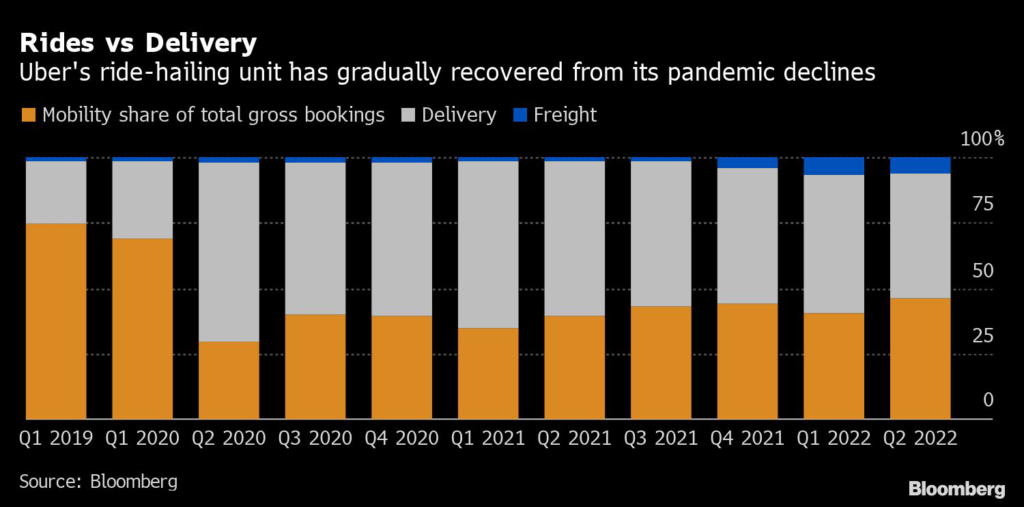
A key advantage against rival Lyft is Uber’s food-delivery business Uber Eats, which boomed during the pandemic just as ride-hailing demand cratered. Uber’s delivery arm, including restaurant, grocery items and alcohol, saw bookings increase 7% from a year ago to $13.9 billion. Khosrowshahi cautioned that delivery bookings are expected to be “roughly flat” in the current period compared to the second quarter. Still, Uber is making more money from delivery than ever, in part because of contributions from its higher-margin advertising business.

Uber projected gross bookings of $29 billion to $30 billion in the third quarter and adjusted earnings before interest, tax, depreciation and amortization of $440 million to $470 million. That beat expectations of $391.6 million. 

In the second quarter, Uber recorded a net loss of $2.6 billion, or $1.33 a share, due to unrealized losses from stakes in Grab Holdings Ltd., Aurora Innovation Inc and Zomato Ltd. 

More stories like this are available on bloomberg.com

©2022 Bloomberg L.P.
Record Crop of TV Shows in 2022 Will Be the Peak, FX Chief Says

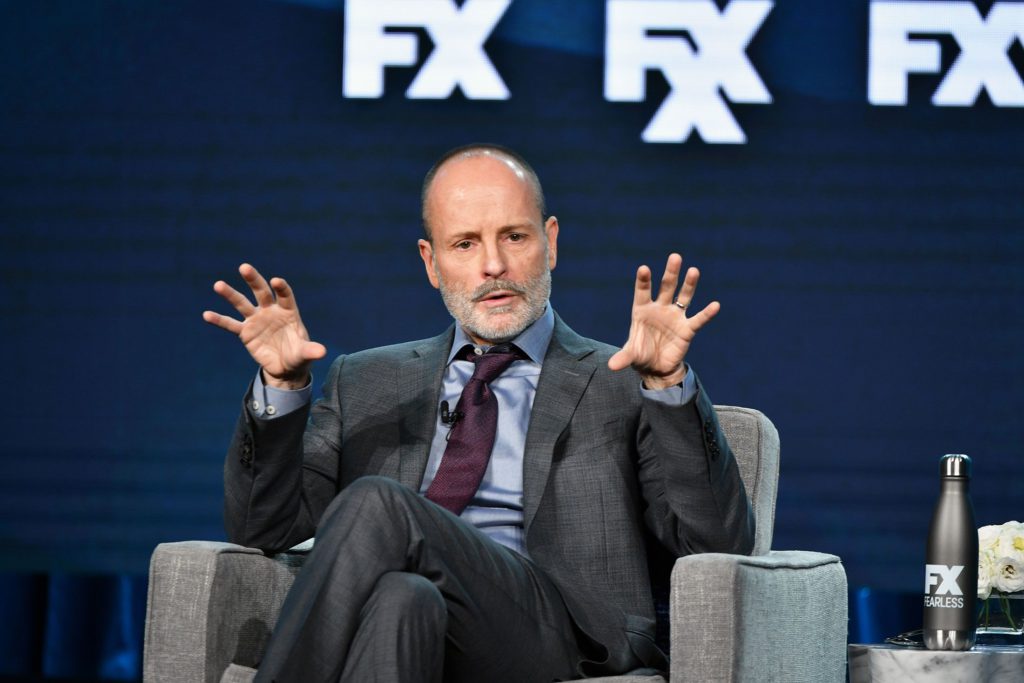
(Bloomberg) — The number of scripted TV series will peak in 2022, according to a prediction from John Landgraf, the chairman of Walt Disney Co.’s FX division, who was behind numerous popular series, including “American Crime Story.”  

There were 357 scripted TV series on cable, streaming and broadcast services through June, a 16% increase from the same period in 2021, Landgraf told reporters at the Television Critics Association on Tuesday. He expects that figure to fall next year.

Media companies have said they are reevaluating their spending after companies, such as Comcast Corp. and Warner Bros. Discovery Inc., engaged in a costly battle to build up their streaming streaming services. In April, Netflix Inc. reported a shocking drop in subscribers, causing Wall Street to focus on profitability over churning out a high volume of expensive new shows in a quest for growth.

“This year will be the high watermark,” he said. “It will mark the peak of the peak-TV era.”

Landgraf, who was also responsible for the hit show “Sons of Anarchy,” has been wrong before. He previously said TV production would top out in 2018 or 2019. But last year the industry made a record 559 scripted shows, according to FX data.

Landgraf partly attributed the inaccurate forecast to the Covid-19 pandemic, which delayed many productions. The TV industry had to play catch-up, he said.

The executive said he’s spending his time focusing on producing shows for Disney, including its FX programming on the Hulu streaming service, and none of his time on managing the company’s FX cable networks. Hulu has helped Disney reach more than 200 million total streaming subscribers, and compete against other media giants working on expanding their own direct-to-consumer products.

Landgraf said he views his competition as existing services, and doesn’t expect new players in the streaming wars. 

“The process is complete,” he said. “I don’t see new major purveyors of programing entering the scene.”

More stories like this are available on bloomberg.com

©2022 Bloomberg L.P.

Equifax Sent Banks Wrong Credit Scores for Consumers, WSJ Says

(Bloomberg) — Equifax Inc. provided inaccurate credit scores on millions of US consumers looking for loans, the Wall Street Journal reported, citing bank executives and people familiar with the matter it didn’t identify. 

The consumer credit-reporting agency sent the erroneous scores from mid-March through early April, before starting to disclose the errors to lenders in May, the WSJ reported. The scores covered consumers applying for auto loans, mortgages and credit cards to banks and non-bank lenders including JPMorgan Chase & Co., Wells Fargo & Co. and Ally Financial Inc., according to the report. 

A representative for Equifax didn’t immediately respond to a request for comment. The company told the Wall Street Journal it had since fixed the error, which it described as a technology coding issue. 

Shares of the company fell 2.1% to $206.31 at 4 p.m. in New York.

The issue follows a cyberattack at Equifax, which maintains credit reports on US consumers and sells them to lenders, that it disclosed in September 2017. Hackers accessed data including Social Security numbers, driver’s license numbers and addresses, it said at the time.

More stories like this are available on bloomberg.com

©2022 Bloomberg L.P.
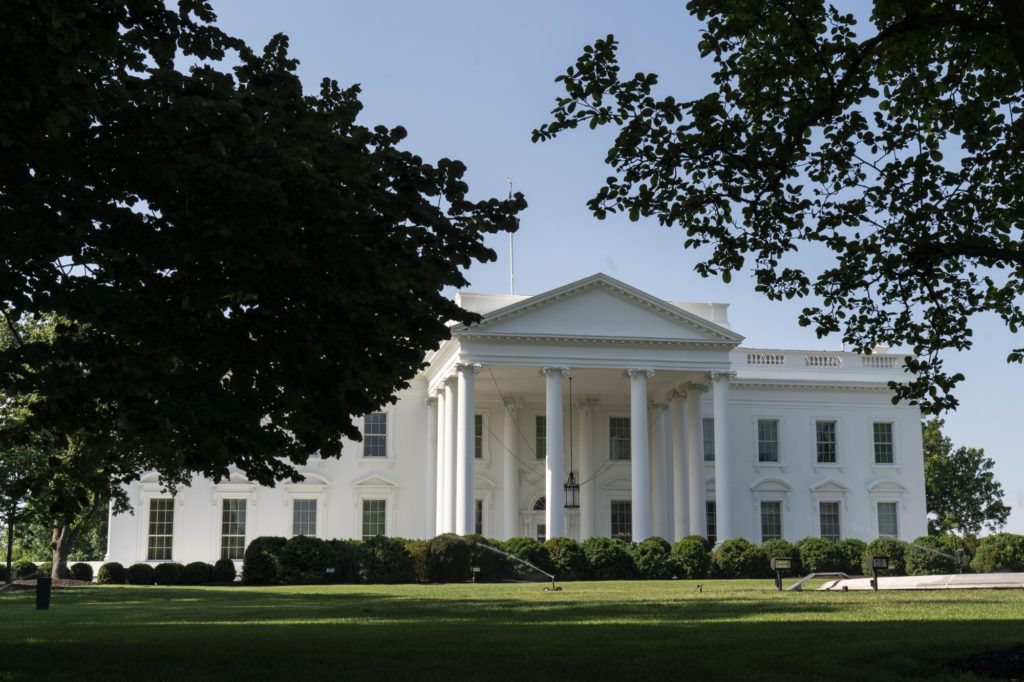
Biden Adviser Tim Wu to Leave After Shaping Antitrust Policy

(Bloomberg) — White House adviser Tim Wu, who worked to shape the Biden administration’s agenda to increase economic competition, is set to leave his position in the coming months, according to people familiar with the move.

Wu is expected to return to antitrust law at Columbia Law School after serving as special assistant to the president for technology and competition policy since March 2021. 

He was the key architect behind President Joe Biden’s executive order to bolster competition last year, which included 72 initiatives by more than a dozen federal agencies. The administration focused on improving competition within industries including technology, health care and agriculture.

Wu, the White House and Columbia Law School didn’t immediately respond to requests for comment.

Wu, who coined the term “net neutrality,” rose to prominence as one of the most aggressive critics of the major technology and telecom companies, arguing that they had a stranglehold over the economy that was hurting smaller companies and consumers. In early 2020, Wu offered his signature warning: “Antitrust winter is over,” after which Biden brought him into the administration. 

In his role at the National Economic Council, Wu helped to lead the Biden administration’s antitrust policies aimed at the largest technology companies, while working with agencies to identify regulations they could use to fight corporate dominance. The executive order created a new competition council led by the head of the NEC, a proposal that Wu had first called for in 2020.

Wu previously worked on competition policy at the NEC under former President Barack Obama, helping to write a similar executive order signed by Obama toward the end of his presidency in 2016. Wu has since penned a number of anti-monopoly books, including “The Curse of Bigness,” which calls for a rejuvenated trust-busting movement in the U.S.

More stories like this are available on bloomberg.com

©2022 Bloomberg L.P.

Electronic Arts Revenue Forecast Falls Short on Gaming Slump

(Bloomberg) — Electronic Arts Inc. gave a forecast for revenue in the current quarter that fell short of analysts’ estimates amid a slowdown in spending on video games and equipment. 

Adjusted revenue, or bookings, which excludes deferred sales from content purchases and other adjustments, will be $1.73 billion to $1.78 billion in the fiscal second quarter, the game publisher said in a statement on Tuesday. Analysts were expecting $1.86 billion on average, according to data compiled by Bloomberg. In the first quarter, adjusted revenue was $1.3 billion, largely in line with estimates.

Known for its Star Wars and sports games, Electronic Arts has yet to release any major new titles this year and is still grappling with fallout from Battlefield 2042, which was released last November to mediocre reviews and poor fan reception. EA acknowledged earlier this year that the game failed to meet expectations and “did not resonate with fans.” 

The video game industry is off to a sluggish start this year, hampered by hardware supply chain issues affecting consoles, inflation and a lack of big hits. Interest in gaming has also cooled as pandemic stay-at-home orders lifted and people resumed outside interests and activities. Spending in the video game industry is expected to drop 8.7% this year, according to analytics firm NPD Group. On Monday, Activision Blizzard Inc. reported adjusted sales declined 15%. 

Although EA’s release schedule has been slow this year, the company plans to launch entries in its Madden NFL and FIFA series later in 2022. In May, EA announced its 30-year licensing agreement with soccer governing organization FIFA would end after this year. The hugely popular series will be renamed EA Sports FC. 

In early 2023, EA plans to release a remake of 2008 survivor horror game Dead Space and the highly-anticipated Star Wars Jedi: Survivor. Its shooter Apex Legends remains enormously popular and is the sixth most-watched game on Amazon.com Inc.’s livestreaming site Twitch. EA says its player network — a service that connects gamers across platforms — grew to 600 million active accounts.  

Electronic Arts reported net income of $311 million in the fiscal first quarter, up from $204 million a year earlier. Adjusted earnings per share were 47 cents, beating analysts’ estimates for 28 cents. 

More stories like this are available on bloomberg.com

©2022 Bloomberg L.P.
Twitter Spy Trial Keeps Jury in Dark on Saudi Torture Claims

(Bloomberg) — When Areej Al-Sadhan testified in the trial of a former Twitter Inc. employee who allegedly spied on her brother for Saudi Arabia, there was much to the story she couldn’t say.

She wasn’t allowed to say that Saudi secret police went on to abduct her brother, Abdulrahman Al-Sadhan, over his social media posts and that the Kingdom sentenced him to 20 years in prison. That he has been tortured with sleep deprivation and electric shocks. That his captors have smashed his fingers and beaten him so severely that he’d been sent to an intensive care unit.

“All of this, based on a satirical Twitter account” her brother had, Areej Al-Sadhan said in an interview about the abuses.

Those details were off limits after a judge said she wasn’t permitted to insinuate that the now former Twitter employee, Ahmad Abouammo, is responsible for violence committed by the Saudi government.

Still, Areej Al-Sadhan’s testimony was a key piece of the US’s weeklong prosecution of Abouammo that demonstrated his ties to Crown Prince Mohammed bin Salman, the defacto Saudi ruler who has cracked down on domestic dissent, arresting scores of well-known clerics, businessmen, intellectuals and activists. 

Through a top aide to the prince, Abouammo was allegedly bribed in exchange for personal information of Twitter users who used the platform to criticize the Saudi royal family. Prosecutors subpoenaed Areej Al-Sadhan to testify, and are relying on her appearance to illustrate the human cost of Abouammo’s actions.

Whether Areej Al-Sadhan’s 12 minutes on the stand can make that connection is being put to the test by the remainder of the government’s case. Her testimony contrasts with the many hours federal agents have spent parsing records of calls, emails, wire transfers and Twitter data, in what the judge at one point complained was unnecessary and “mind numbing” detail.

The prosecution rested its case Tuesday as federal public defenders representing Abouammo started arguing his defense. Jurors are expected to begin deliberating over the verdict this week.

Abouammo, a US citizen who left Twitter in 2015 to take a job with Amazon.com Inc. in Seattle, has pleaded not guilty to numerous charges, including acting as an illegal foreign agent in the US and obstruction of justice. He faces up to 20 years in prison.

At trial, a prosecutor showed Areej Al-Sadhan an April 2015 document the US says was maintained by the crown prince’s aide, Bader Al-Asaker. It was a list of about 10 Twitter handles, and a thinly-veiled reference to what prosecutors had previously referred to as a “shopping list of Twitter users” that Al-Asaker wanted a Twitter insider to “keep track of.”

One of them was the handle of Omar Abdulaziz, a friend of Washington Post columnist and Kingdom critic Jamal Khashoggi who was dismembered by Saudi agents in 2018. A US intelligence assessment found that MBS likely ordered Khashoggi’s murder; the crown prince has denied any involvement.

While jurors didn’t learn any details about Abdulaziz, a prosecutor asked Areej Al-Sadhan,“Is this account what you would characterize as critical of the government of the Kingdom of Saudi Arabia?”

Al-Sadhan acknowledged it was, and was then asked to identify another name on the list. It was her younger brother, Abdulrahman, whose Twitter account, she testified, contained “satirical criticism of the Kingdom of Saudi Arabia.”

Since her brother’s disappearance, Areej Al-Sadhan has maintained an international campaign trying to push Saudi Arabia to explain where he’s being held and his condition, and to free him. On the witness stand she explained some of what she describes in forums and meetings around the world.

Abdulrahman Al-Sadhan was born in Saudi Arabia and lived between the Kingdom and the US, where he graduated from college, according to his sister. He returned to Riyadh in 2014 to work for the International Red Cross and Red Crescent.

Areej Al-Sadhan testified that she works in the technology sector in the Bay Area, and that she communicated with her brother frequently by phone, text and email. In March 2018, he went dark.

“Since I lost communication with my brother, I tried to phone him, and my family did as well,” she told the jury. “All my phone calls were not going through, all my messages were not going through, which was very unusual.”

Al-Sadhan wasn’t permitted to tell jurors that a Saudi appeals court last year upheld her brother’s 20-year sentence, citing a printout of about 200 pages of tweets “as the basis for his alleged crimes,” she said in the interview.

At least 220 individuals remain imprisoned in Saudi Arabia for speaking against MBS or calling for reform within the Kingdom, the London-based human rights’ advocacy group Grant Liberty said in its 2022 report on Saudi Arabia.

For the first year her brother was imprisoned, Areej Al-Sadhan said, her family remained quiet. As she learned about her brother’s torture from families of other prisoners, she decided she had to speak — first on Twitter, “where it all started.” He remains detained and deprived of any family calls or visits, she said.

Fighting persistent threats, she explains Abdulrahman Al-Sadhan’s case to government officials around the world, writes op-eds, and has enlisted the help of human rights organizations. “When we were silent, the worst things were happening” to her brother, she said. “Silence is not an answer.”

(Updates with status of trial in eighth paragraph.)

More stories like this are available on bloomberg.com

©2022 Bloomberg L.P.
Volatility Grips Global Markets Amid Several Unnerving Reversals

(Bloomberg) — Global financial markets whipsawed as risk sentiment remained fragile, with US House Speaker Nancy Pelosi’s Taiwan trip adding to the list of investor worries ranging from a restrictive Federal Reserve policy to the specter of an economic recession.

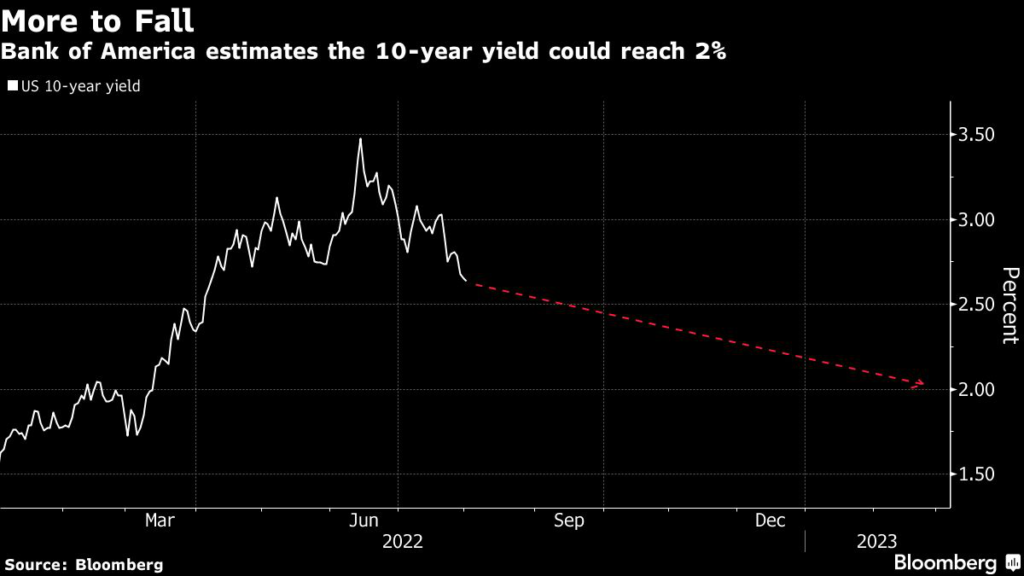
In a session of many reversals, the S&P 500 erased gains, while trading way off session lows. A gauge US-listed Chinese shares climbed 1.9%. Ten-year US yields soared to 2.74%, following a slide that drove them to around 2.5%. The Japanese yen slipped after touching a nearly two-month high. The yuan rose. Gold wiped out gains.

“It’s going to be volatile,” said Ellen Gaske, economist at PGIM Fixed Income. “Geopolitical risks are obviously elevated on a more persistent basis here. So I think that imparts a degree of volatility to markets, and that’s on top of the volatility in rates markets that we are already seeing because of the Fed being on the move, and because it is uncertain how far the Fed will actually have to go from here.”

Read: Pelosi Trip Spurs China Battery Giant to Pause Plant Debut

Pelosi became the highest-ranking American politician to visit Taiwan in 25 years, prompting China to announce missile tests and military drills encircling the island that set the stage for some of its most provocative actions in decades.

Pelosi’s trip is creating a fresh pressure point for investors already dealing with the prospects of a US recession, worldwide rate hikes and surging inflation. The moves so far suggest traders are hedging against tension escalating, with analysts warning of the tailrisk of a conflict between the world’s two largest economies that wreaks havoc on global markets.

“China will show her displeasure by ratcheting up retaliatory actions, but it won’t get out of hand given its economy is weak,” said Rajeev De Mello, a global macro portfolio manager at GAMA Asset Management in Geneva. “However, the risk is if there is any military ‘incident,’ which could lead to an accidental military escalation, which would stress global financial markets.”

While the White House has sought to dial back rising tensions by insisting there is no change in its position toward Taiwan, which China considers as part of its territory, Beijing has called Pelosi’s visit a “dangerous gamble” with grave consequences.

Equity markets in China and Hong Kong were the worst performers in Asia as security analysts outlined potential military responses from Beijing. The Taiwan dollar hit its lowest since May 2020, before paring the drop on signs that local banks were selling the greenback to meet the needs of foreign funds.

Some analysts warn the impact of Pelosi’s visit will hasten the deterioration in US-China ties. The concern is that the trip and China’s reaction to it worsens the longer-term relationship on trade, and plays out in markets over weeks or more, with implications for Treasuries, according to BMO Capital Markets strategists Ian Lyngen and Benjamin Jeffery. Yields on the 10-year benchmark may well drop below 2.5% this week, they wrote in a report.

Pelosi became the highest-ranking American politician to visit Taiwan in 25 years, prompting China to announce military drills encircling the island. In a statement, she said her visit “in no way contradicts longstanding United States policy” and that America “continues to oppose unilateral efforts to change the status quo.”

“The expectation is that China’s reaction will mostly be confined to some signaling actions, instead of something really hurting their economy, and therefore at this stage, we view the market’s reaction has so far been relatively mild,” Becky Liu, head of China macro strategy at Standard Chartered Bank Plc, told Bloomberg Radio. “We just need to be concerned about the medium-to long-term implications.”

American depositary receipts of Baidu Inc. fell 0.6%, while those of Alibaba Group Holding Ltd. posted a 3.4% gain.

Still, investors may need to prepare for a drawn-out reaction in financial markets, something which could underpin haven assets like Treasuries.

“Pelosi’s visit carries with it the presumption of a limited time frame for a tradable response; an assumption that we’ll characterize as misplaced,” BMO’s Lyngen and Jeffery wrote in their note. “Any response could be weeks away or further and for this reason we anticipate that the geopolitical backdrop will once again contribute to the bullish underpinnings for the US rates market.”

(Adds and updates market moves throughout. A previous version of this story corrected the spelling of BMO strategist Ian Lyngen.)

More stories like this are available on bloomberg.com

©2022 Bloomberg L.P.

Stocks Drop on China Tension; Treasury Yields Jump: Markets Wrap

(Bloomberg) — US stocks dropped and Treasuries sank after Federal Reserve officials signaled the central bank is still intent on raising rates until inflation is under control.

The S&P 500 swung between gains and losses as Nancy Pelosi’s arrival in Taiwan prompted China to announce missile tests, even as she said her visit did not alter longstanding US policy in the region. 

US Treasury yields rose across the curve, with 10-year rates climbing as much as 17 basis points to 2.74% and the benchmark three-year rate surging more than 20 basis points, pushing it above 3%. The yen, which was on track for its fifth daily gain, fell as the dollar snapped four days of losses amid a sudden turnaround in risk sentiment. 

Stocks started August on the back foot after posting their best month since 2020 in July. Investors have been keeping an eye out for hawkish comments from Fed officials about the need for higher rates to restrain elevated inflation. While San Francisco Fed President Mary Daly said on Tuesday that the Fed is “nowhere near” done with its efforts to tamp down on inflation, Chicago Fed President Charles Evans said he expects the pace of rate hikes will start to slow later in the year. 

“The Fed is not likely to announce they’re letting up on the brakes at this point,” said Ellen Gaske, economist at PGIM Fixed Income. “They are still seeing inflation numbers that have not started to recede.”

Corporate earnings continued to roll in, impacting stocks. Caterpillar Inc. slumped after a slowdown in China weakened its business. That weighed on the Dow Jones Industrial Average, which was lower for the day. Shares of Uber Technologies Inc. soared as much as 18% after the firm reported second-quarter revenue that beat the average analyst estimate.

Fresh economic data has also kept investors on their toes. Recent data showed that US job openings in June fell to a nine-month low, a sign of moderating demand for labor as economic pressures mount. The job market has been a bright spot in an economy otherwise losing momentum and possibly heading toward a recession.

Goldman Sachs Group Inc. strategists led by Cecilia Mariotti said it was too soon for stock markets to fade the risks of a recession on expectations of a pivot in the Fed’s hawkish policy. JPMorgan Chase & Co. strategists, on the other hand, said the outlook for US stocks is improving for the second half of the year on attractive valuations.


Pelosi’s trip has created a fresh pressure point for investors already dealing with the prospects of a US recession, worldwide rate hikes and inflation that risks becoming entrenched as Russia’s war in Ukraine exacerbates food shortages.

“The Taiwan story fits into the broader risk-off theme,” said Mark McCormick, global head of FX strategy at TD Securities. “It raises concerns about global growth issues, especially if geopolitical tensions and knock-effects exacerbate inflationary concerns. In turn, that forces central banks to keep fighting inflation in spite of the clear deceleration of global growth.”

This week’s MLIV Pulse survey is asking about your outlook for corporate bonds, mergers and acquisitions and health of US corporate balance sheets through the end of the year. It takes one minute to participate in the MLIV Pulse survey, so please click here to get involved anonymously. 

What to watch this week:

  • St. Louis Fed President James Bullard is due to speak, Tuesday
  • OPEC+ meeting on output, Wednesday
  • US factory orders, durable goods, ISM services, Wednesday
  • BOE rate decision, Thursday
  • US initial jobless claims, trade, Thursday
  • Cleveland Fed President Loretta Mester due to speak, Thursday
  • US employment report for July, Friday

Some of the main moves in markets:

Stocks

  • The S&P 500 fell 0.1% as of 2:37 p.m. New York time
  • The Nasdaq 100 rose 0.2%
  • The Dow Jones Industrial Average fell 0.7%
  • The MSCI World index rose 0.1%

Currencies

  • The Bloomberg Dollar Spot Index rose 0.6%
  • The euro fell 0.7% to $1.0189
  • The British pound fell 0.5% to $1.2190
  • The Japanese yen fell 0.9% to 132.81 per dollar

Bonds

  • The yield on 10-year Treasuries advanced 16 basis points to 2.74%
  • Germany’s 10-year yield advanced four basis points to 0.82%
  • Britain’s 10-year yield advanced six basis points to 1.87%

Commodities

  • West Texas Intermediate crude rose 0.4% to $94.31 a barrel
  • Gold futures fell 0.2% to $1,783.40 an ounce

More stories like this are available on bloomberg.com

©2022 Bloomberg L.P.

Close Bitnami banner
Bitnami